DEMOGRAPHIC RESEARCH
VOLUME 31, ARTICLE 27, PAGES 813
−
860
PUBLISHED 8 OCTOBER 2014
http://www.demographic-research.org/Volumes/Vol31/27/ DOI: 10.4054/DemRes.2014.31.27
Research Article
Varying association between education and second
births in Europe:
Comparative analysis based on the EU-SILC data
Martin Klesment
Allan Puur
Leen Rahnu
Luule Sakkeus
© 2014 Klesment, Puur, Rahnu & Sakkeus.
This open-access work is published under the terms of the Creative Commons Attribution NonCommercial License 2.0 Germany, which permits use, reproduction & distribution in any medium for non-commercial purposes, provided the original author(s) and source are given credit.
1 Introduction 814
2 Theoretical perspectives 816
3 Research question and hypotheses 819
4 Data and methods 822
4.1 EU-SILC data 822
4.2 Reconstruction of fertility data 822
4.3 Study sample and variables 824
4.4 Analytical approach 826
5 Results 827
5.1 Separate models for regions 827
5.1.1 The effect of women’s education 828
5.1.2 The effect of partner’s education 833
5.2 Multilevel models 834
5.2.1 The effect of women’s education 834
5.2.2 The effect of partner’s education 838
6 Summary and discussion of the findings 841
7 Acknowledgements 846
References 847
Varying association between education and second births in Europe:
Comparative analysis based on the EU-SILC data
Martin Klesment1
Allan Puur2
Leen Rahnu3
Luule Sakkeus4
Abstract
BACKGROUND
Previous research has shown considerable variation in the relationship between women‘s educational attainment and second births in contemporary Europe. A negative association is found in some countries, while a positive or non-negative relationship is reported in others. Existing studies come mainly from single-country perspectives, which renders the results not strictly comparable.
OBJECTIVE
We investigate the association between women‘s and their partners‘ educational attainment and transition to second births comparatively in regions and sub-regions of Europe.
METHODS
The data come from the 2005 and 2011 waves of the EU Statistics on Income and Living Conditions (EU-SILC). We estimate separate discrete-time event history models for regions and sub-regions and multilevel models for all EU-SILC countries.
RESULTS
Northern Europe exhibits a positive association between women‘s and their partners‘ education and second childbearing. Western Europe features a positive relationship among partners but demonstrates a U-shaped pattern among women. This pattern occurs due to German-speaking countries where women‘s educational attainment
1 Estonian Institute for Population Studies, Tallinn University and Centre for Sociological Research.
University of Leuven, Belgium. E-Mail: [email protected].
2 Estonian Institute for Population Studies, Tallinn University. E-Mail: [email protected].
3
Estonian Institute for Population Studies, Tallinn University. E-Mail: [email protected].
appears inversely related to second births. A negative relationship between women‘s education and second childbearing also prevails in Eastern Europe; in some sub-regions it extends to male partners. Except for in Eastern Europe, the time-squeeze adds to the positive effect of women‘s high education. In Northern Europe it enables highly educated women to wholly catch up with their counterparts with medium and low education as regards the proportion having second births. In Southern Europe, by contrast, the educational gradient turns negative following the consideration of the time-squeeze effect.
CONCLUSIONS
We conclude that the relationship between educational attainment and second births varies not only by individual country but also by larger geographical area in Europe. Although smaller in scale than among women, the variation also extends to male partners.
1. Introduction
Contemporary fertility in Europe is characterised by sizeable contrasts. Although childlessness has gradually increased over the past decades, demographers do not consider varying first-birth probabilities the central factor underlying differences in fertility levels (Frejka and Sardon 2004; Frejka and Sobotka 2008). With few exceptions, cross-national fertility differences today are mainly shaped by variation in second (and third) birth rates (Frejka 2008). There are also indications that second births may become even more important in the future, as the two-child norm seems to have weakened in several countries (Goldstein et al. 2003; Testa 2012).
increase in the number of men and, in particular, women with tertiary education (Samir et al. 2010).
Since the late 1980s an increasing number of empirical studies have addressed the association between women‘s educational attainment and progression to second births. Findings based on these studies show considerable diversity. In several countries (all Nordic countries, Belgium, France, UK, Estonia, and Hungary), women‘s educational attainment is found to be positively related to second-birth intensity. In other countries (Bulgaria, Poland, Romania, Russia, and Ukraine), a non-positive or negative relationship is reported. The observed educational gradients are commonly interpreted as an outcome of contextual features that affect childbearing decisions.
Although previous research on second childbearing has generated much valuable knowledge, it has some important limitations. Most importantly, variations in target populations, time references, methodological approaches, and statistical models limit the comparability of results across various studies. Also, for many countries the evidence is still missing, preventing a comprehensive EU-wide account. We think that the existing knowledge can be expanded if educational differentials are analysed comparatively, covering a large number of countries with similar data and analytical methods. So far only a few researchers have investigated educational gradient in second births in a wider comparative perspective (Van Bavel and Różańska-Putek 2010).
In this study we investigate the association between women‘s and their partners‘ educational attainment and second births based on a dataset that covers 29 countries. Our data come from the 2005 and 2011 waves of the EU Statistics on Income and Living Conditions (EU-SILC). Unlike most previous studies, our research focuses on larger geographical areas rather than individual countries. We estimate discrete-time event history models for major regions and sub-regions of Europe. Multilevel modelling that provides additional insight into overall patterns of the relationship and country-specific features complements this approach. We aim to distinguish several types of association between educational attainment and second childbearing. In the analysis we take into consideration that the results may be biased due to misspecification of the model. In particular, we check for the confounding effects of partner‘s education and first-birth timing (Kreyenfeld 2002; Kravdal 2007).
2. Theoretical perspectives
Most research focusing on the relationship between educational attainment and childbearing considers the micro-economic theory of New Home Economics as a starting point (Cigno 1991; Becker 1993; Hotz, Klerman, and Willis 1997). The micro-economic theory of fertility posits that, as women receive more education and gain access to better positions in the labour market, the costs of childbearing increase. This primarily relates to opportunity costs in the form of foregone earnings, slower human capital accumulation, and depreciation of professional skills, since raising children requires considerable parental and, especially, maternal time. In part, these opportunity costs are revealed by a motherhood wage penalty (Kühhirt and Ludwig 2012; Gough and Noonan 2013).
Assuming that education reflects income potential, the micro-economic theory predicts that women with high education will have fewer children than less educated women, as the former have more to lose in terms of foregone earnings and career opportunities. In addition, it has been suggested that higher educational attainment entails a stronger preference for the quality of children that is associated with increased expenditure on children‘s human capital, thereby also reducing fertility among the highly educated (Willis 1973; Kalwij and Gustafsson 2006). For men, on the other hand, the New Home Economics posits an opposite outcome (Hotz, Klerman, and Willis 1997). With reference to settings with a more or less complete role specialisation, family formation and childbearing will interfere little with men's role as the provider of family income. This makes men with a higher earning capacity more attractive as potential partners and leads to the expectation of positive association between educational attainment and family formation among men.
family model has more far-reaching consequences for women than for men (Bernhardt 2004).
Empirical studies on second births do not provide unequivocal support for predictions derived from the micro-economic and SDT theories. With regard to women, the theories have received support from analyses on several Eastern European countries in which the negative association between women‘s educational attainment and second-birth intensity seems to prevail. This finding has been reported for Armenia and Moldova (Billingsley 2011), Bulgaria (Koycheva 2006), Poland (Gałęzewska 2012), Romania (Muresan and Hoem 2010), Russia (Rieck 2006), and Ukraine (Perelli-Harris 2008). By contrast, elevated second-birth intensity among highly educated women has been found in the Nordic countries (Hoem and Hoem 1989; Oláh 2003; Vikat 2004; Gerster et al. 2007; Kravdal 2007), Belgium (Neels 2006), France (Köppen 2006), and Great Britain (Kreyenfeld and Zabel 2005; Mathews and Sear 2013; Kulu and Washbrook 2014). Likewise, recent analyses on the Czech Republic (Št‘astná 2009), Estonia (Klesment and Puur 2010), and Hungary (Bartus et al. 2013) have indicated a positive gradient in second-birth rates for women with advanced education. Similar findings are reported in some studies for Spain and Italy (Baizán 2005; Kertzer et al. 2009; Adsera 2011; Perelli-Harris 2013). However, there are other studies on the latter countries that have failed to detect a statistically significant positive relationship between women‘s education and second childbearing (Brodmann, Esping-Andersen, and Güell 2007; Aldieri, Barone, and Vinci 2010; Dalla Zuanna and Impicciatore 2010).5 Consistent with theoretical expectations, most studies that have investigated male partner‘s educational gradient in second births report a positive association (Kreyenfeld 2002; Oláh 2003; Prskawetz and Zagaglia 2005; Köppen 2006; Gerster et al. 2007; Klesment and Puur 2010; Bartus et al. 2013).
Variation in the relationship between women‘s educational attainment and second births is commonly interpreted as an outcome of contextual features. Independent of whether the authors draw on the micro-economic or the SDT theory, the aforementioned studies generally relate the positive educational gradient to institutional arrangements supporting the compatibility of work with family life and gender equity. In particular, provision of affordable public childcare, generous parental leave programmes, labour market flexibility, etc. can disburden women with high education of some of the costs that accompany parenthood (Hobson and Oláh 2006; Matysiak 2011; Neyer 2013). As a result, the income effect (more educated people have greater resources for childbearing) may prevail, effectively outweighing the opportunity cost.
5 Mixed empirical evidence also extends to overseas countries with populations of European origin. A
Similarly, the better position of highly educated women in the labour market, relative to their less educated counterparts, facilitates re-entry into employment after childbearing and reduces unemployment risks. Notably, in an update of the SDT theory (Lesthaeghe 2010), greater gender symmetry and more developed services aimed at reducing opportunity costs of childbearing are considered central factors underlying the current diversity of fertility in Europe, ranging from levels close to replacement to levels far below it.
Besides illuminating variation in the relationship between educational attainment and second births, previous studies have drawn attention to several reasons why the observed positive association may be a product of model misspecification. First, due to educational homogamy there is a tendency for better educated women to form partnerships with better educated men, and vice versa (Schwartz and Mare 2005; Blossfeld 2009). Studies pertaining to countries with a relatively strong male breadwinner tradition reveal that without considering a partner‘s characteristics one might overestimate the role of women‘s educational attainment in second births. In particular, this has been found to be the case in Austria and West Germany, where the inclusion of partner‘s education in the model made the positive effect of women‘s high education insignificant (Kreyenfeld 2002; Prskawetz and Zagaglia 2005; Köppen 2006). In other countries, however, the effect remained positive even after considering the partner‘s education (Kravdal 1992; 2007; Oláh 2003; Köppen 2006; Gerster et al. 2007; Klesment and Puur 2010; Bartus et al. 2013).
neglected, since the compression of birth intervals shifts the second-birth rates upwards among highly educated women.
Third, it has been shown that the positive effect of women‘s higher education may result from selection that occurs at earlier stages of family formation. Women who are at risk of second birth form a select group because they must have already opted for parenthood, manifesting a preference for having children. When women with high education forego childbearing more often than their counterparts with less education the selection for family orientation will be more pronounced among the former, biasing the educational gradient for second births towards positive. For Norway and West Germany, Kravdal (2001) and Kreyenfeld (2002) have demonstrated that the positive effect of women‘s high education disappears and turns negative if the selection effect is checked. More recently Dalla Zuanna and Impicciattore reported a similar finding for Italy (2010). Finally, the reported associations between educational attainment and childbearing depend to an important extent on how and when educational characteristics are measured (Kravdal 2004; Hoem and Kreyenfeld 2006a, 2006b).
To sum up, previous studies reveal considerable diversity in the relationship between women‘s educational attainment and second births across the countries of Europe. However, variation in time references, target populations, methodological approaches, and the ways that the potential confounding factors are dealt with renders the results of analyses proceeding from a single-country perspective poorly comparable. To date there has been a rare study investigating the educational differentials in second-birth intensity in a broad comparative perspective, carried out by Van Bavel and Różańska-Putek (2010). In this article we seek to complement their research, which was based on the European Social Survey, using a different dataset.
3. Research question and hypotheses
and Jasilioniene 2009; Wilson 2013). To account for heterogeneity within the major regions, we additionally distinguish German-speaking countries and three sub-regions of Eastern Europe.6
Our hypotheses for the educational gradient in second childbearing are based on the notion that the relationship between women‘s educational attainment and second-birth intensity is an outcome of contextual features. As noted in the theoretical section, existing research attributes the observed positive association to arrangements that facilitate the compatibility of work with parenthood; conversely, restricted opportunities for reconciliation are regarded as a major obstacle to such a relationship (Oláh 2003; Köppen 2006; Kradval 2007; Van Bavel and Różańska-Putek 2010). The evidence pertaining to family policies reveals significant and persistent contrasts in the provision of childcare services, entitlements to parental leave, and labour market flexibility, not only by individual countries but also across regions (Gauthier 2002; Kotowska and Matysiak 2008; Adema 2012).
Northern European countries excel in comprehensive support for working parents with young children and promote gender equality through a combination of generous income-related leave arrangements and widely available public childcare: the Nordic countries invest more in these policy domains than most other countries (Oláh and Bernhardt 2008; Rønsen and Skrede 2008; Lappegård 2010). By contrast, the countries in Southern Europe are characterised by a shorter period of child-related leave and limited provision of childcare services (Delgado, Meil, and Zamora-López 2008; De Rose, Racioppi, and Zanatta 2008; Baizán 2009). Additional features, frequently associated with the Mediterranean countries, include difficulties of entering the labour market, job insecurity, an unfavourable housing market, and traditional division of gender roles (Salvini 2004; Régnier-Loilier and Vignoli 2011).
Against the backdrop of the two latter regions, Western Europe forms a less homogeneous entity when it comes to the balance between work and family life. In that group France is known for its long-established family policies, targeting the reconciliation of women‘s employment and childrearing as a major goal (Breton and Prioux 2005; Toulemon, Pailhé, and Rossier 2008). High coverage of public childcare is also characteristic of Belgium and Luxembourg (Neels and De Wachter 2010). In the Netherlands and English-speaking countries enrolment in public childcare is somewhat lower with part-time work playing a more prominent role in facilitating the work-family balance (Mills et al. 2008; Thévenon 2011). In German-speaking countries the availability of childcare service has been more limited, both in terms of coverage and the work schedules of childcare institutions (Dorbritz 2008; Prskawetz et al. 2008). Finally, in Eastern Europe public support for families is considered rather limited and fragmented; long working hours often add to the lack of formal childcare support for
working parents (Thévenon 2011). Although the Eastern European countries all experienced societal transition in the 1990s, their paths of development are not uniform enough to warrant the distinction of sub-regions (Sobotka 2003).
Based on the theoretical considerations and contextual features discussed above, we formulate the following hypotheses concerning the relationship between women‘s educational attainment and second births, as follows:
For Northern Europe we expect a positive association between women‘s
education and second-birth intensity.
For Western Europe we expect a positive association between women‘s
education and second-birth intensity. However, the positive educational gradient is assumed to be less pronounced or missing in the German-speaking countries.
For Eastern Europe we expect that, among women, the educational gradient in
second-birth intensity is non-positive for the region as a whole. In some sub-regions, the association is likely negative.
For Southern Europe we remain undecided about the prevailing pattern.
Although there are indications of a positive relationship from some studies, low institutional support for combining employment and motherhood implies high opportunity costs associated with childbearing among tertiary educated women, which suggests a negative rather than positive association in this region.
In testing these hypotheses we pay attention to the possibility that the relationship between women‘s education and transition to second births may be confounded by factors discussed in the previous section. In particular, we control for first-birth timing and partner selection. In this article we do not account for self-selection at entry into parenthood as this would have required a different approach to hazard modelling. The inclusion of partner‘s education in the models extends the analysis to the relationship between men‘s educational attainment and childbearing. Based on previous research, we expect a positive association between the partner‘s education and the intensity of second births in all regions.
4. Data and methods
4.1 EU-SILC data
The data used in the article come from the European Union Statistics on Income and Living Conditions (EU-SILC). It is an annual household survey, designed and coordinated by Eurostat. The EU-SILC provides cross-sectional and longitudinal data on a wide range of social issues, with the main focus on income, poverty, living conditions, and social exclusion. The survey uses a rotating panel design. The respondents (aged 16 and older, living in private households) are interviewed at most in four waves, i.e., the sample is fully renewed in four years.7
For this study the main advantages of the EU-SILC are its comparability across a large number of countries, the relatively large sample size, and a capacity to provide an up-to-date account of fertility patterns. At its inception in 2003 the survey covered six member states and Norway. Since then it has been extended to cover the remaining countries of the European Union, plus several non-member states. More specifically, we use cross-sectional data from the 2005 and 2011 waves. These two waves were chosen for the following reasons. First, the inclusion of the 2011 wave (the latest released by Eurostat at the time of conducting the analysis) is essential for providing an up-to-date account of recent fertility developments. Second, the 2005 wave appears to be the earliest that includes data from new members states from the major EU enlargement in 2004. Third, the pooling of data from two waves enables us to obtain statistically more reliable findings based on non-overlapping samples.
Our study considers 26 EU member states, plus Iceland, Norway, and Switzerland. Malta had to be excluded due to problems with event dates. For a few countries the data were available only from a single wave (Ireland 2005, Bulgaria, Romania, and Switzerland 2011). It is assumed that this mismatch does not significantly weaken the results since the educational gradient is unlikely to change markedly in a matter of six years.
4.2 Reconstruction of fertility data
The main disadvantage of the EU-SILC stems from the fact that the survey is not designed for demographic analysis. It collects no direct information on the number of children ever born to women and childbearing histories. However, it is possible to construct the necessary elements of data, applying the own-child method (OCM).
7
The OCM is a reverse-survival technique for estimating fertility from census or large-scale survey (Cho, Retherford, and Choe 1986). It employs numbers and ages (birthdates) of young co-residing children, who are unlikely to have left home, to provide estimates of the numbers and/or timing of births to women in the same household in the years before the enumeration. The method has been used in developed and developing countries as well as in historical studies (Brown 1982; Breschi, Kurosu, and Oris 2003). In recent years the OCM has been applied to labour force surveys in several European countries (Bordone, Billari, and Dalla Zuanna 2009; Coleman and Dubuc 2010). In the latter context, the main advantage of the OCM is its capacity to provide fertility estimates for different sub-groups of the population that are otherwise unavailable.
The first step in the OCM procedure is to match children and mothers within households. This may be complicated by the selection of the one reference person in the household to whom all other household members designate their relationship. In such circumstances the relationship between child and mother is not directly specified in the data, unless the mother is the head of the household. The EU-SILC fortunately allows us to skip these difficulties as it provides all co-resident children with the reference numbers of their mother and father in the same household.
There are a few additional issues related to the OCM that require attention. First, only children surviving at the time of the survey can be matched to their mothers. In developing countries and historical populations the neglect of high infant and child mortality would lead to serious underestimation of fertility levels. In contemporary Europe, however, the losses due to mortality are judged to be small and the corrections are usually deemed unnecessary (Coleman and Dubuc 2010).8 In this study we opted for a similar approach, assuming that infant and child mortality does not introduce a serious bias into the results. Second, the procedure excludes any offspring who have moved away from their mother before the survey. Similar to mortality, the omission of these children tends to bias the OCM-based fertility estimates downwards. A common remedy to this problem is setting an upper age limit to the working sample. Following Rondinelli, Aassve, and Billari (2006), we limited our analysis to women who were aged 16–40 at the time of survey.9
8 For instance, Dubuc and Haskey (2010) report that in the United Kingdom the correction for mortality
increased the 2000–06 total fertility rates, estimated from the labour force survey, by 0.07 children (0.37%).
9 Setting the age limit at age 40 does not completely remove the problem of omitted non-coresident children.
By linking all the children matched to the same mother, we were able to construct the so-called own-children birth histories that constitute the main material for our analysis. With the EU-SILC waves from 2005 and 2011, in cohort perspective our birth histories relate to women born in 1965–1995. From the period perspective, these women have entered reproductive age from the 1980s and their childbearing behaviour has increasingly shaped fertility trends in Europe from the 1990s onwards.
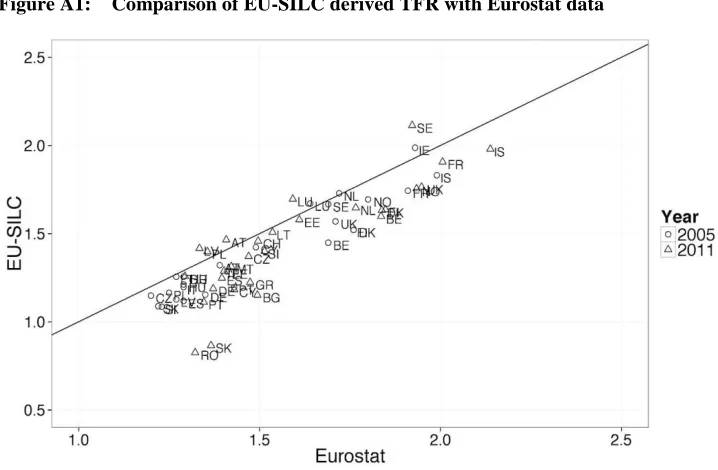
To our knowledge, the EU-SILC has not been used for the analysis of second- or higher-order childbearing. To provide a quality assessment of fertility estimates, the total fertility rates (TFR) calculated on EU-SILC were compared to official TFRs available from Eurostat. The survey-based TFRs were estimated using a Poisson regression model with 5-year age groups (Schoumaker 2004). The results of the comparison for 5-year periods preceding the 2005 and 2011 waves are presented in the Appendix (Figure A1). The estimates based on the EU-SILC tend, to some extent, to underestimate fertility, but the cross-national variation is highly consistent between the two series (correlation coefficient 0.9). For a few countries (e.g., Romania and Slovakia in the 2011 wave) relatively larger discrepancies require caution in the interpretation of country-level results.
To assess the validity of birth histories reconstructed from the EU-SILC we estimated the transition to first and second birth by women‘s educational level, using the Kaplan-Meier method. For major regions of Europe the results are presented in the Appendix (Figures A2 and A3). A further assessment is provided by the comparison of our results with earlier findings for the countries for which previous studies of the educational gradient in second childbearing exist (see the concluding section).
4.3 Study sample and variables
Our study sample consists of women who were aged 16–40 at the time of the survey. The two EU-SILC waves include 72,174 women who had at least one child in this age bracket: 43,657 of them had at least two children. Some observations are lost due to various reasons — we exclude cases that have missing information on event dates, women‘s education, and individual cross-sectional weights, or that are based on full-record imputation (variable RB250 has a value 11–13). This leaves us with 69,224
women with at least one child and 41,685 transitions to second birth in our study sample.
The event under study is the transition to second births. More specifically, our dependent variable is the yearly probability of progression to the second birth.10 Our main independent variable is education, for which the EU-SILC provides the following information: i) highest educational level attained (coded according to ISCED 97 classification), ii) year in which highest educational level was attained, and iii) educational level currently attended. Based on this information we constructed a time-varying education variable, using a specification recommended by Hoem and Kreyenfeld (2006b). We coded all respondents who attended school at the time of survey as being ―in education‖, making an assumption that there were no recent episodes out of education for these persons. Similarly, for those who were out of education at the time of survey, the episodes before attaining the current educational level were coded as being in education. After this point, educational attainment was classified into three levels, low (ISCED levels 0–2), medium (3–4), and high (5–6), based on the highest educational level attained. In the analysis the focus is on the three levels of education; educational enrolment (―in education‖) is included as a control variable.
The partner‘s educational attainment reflects the situation at the time of interview; it is classified into three levels in the same way as women‘s education.11 The
information on the absence of partner is also restricted to the time of the survey: the EU-SILC data do not provide retrospective partnership histories, which prevented us from constructing the time-varying partnership status variable. Authors who have encountered a similar limitation in earlier studies have opted for different solutions. Some authors have not considered the resulting misspecification as particularly harmful to the main results and included women‘s current partnership status and partner‘s educational attainment in the models (Kreyenfeld 2002; Koycheva 2006). Others have restricted the analysis to currently partnered and never-divorced women (Van Bavel and Różańska-Putek 2010), or omitted partner‘s information altogether (Vikat 2004; Gałezewska 2012). We preferred the first approach, as previous studies have clearly demonstrated that omission of partner‘s educational characteristics may seriously bias the estimates for women‘s education, whereas the currently partnered and never-divorced women may constitute a select group. To assess the impact of lacking
10 For confidentiality reasons, month of birth is replaced by the respective quarter of the year in the EU-SILC
data disseminated by Eurostat. For a few countries, only the birth-year of household members is available.
11 A test performed on the Generations and Gender Survey (10 EU-SILC countries) showed that on average
partnership histories we performed a test using data from the Generations and Gender Survey (GGS).12
Other covariates in our analysis include age at first birth, nativity, and birth cohort. By including the age at first birth we aim to control for the fact that women with different educational levels tend to start childbearing at different ages. Following the recommendation of Gerster and Keiding (2008), we use the women‘s actual age at previous birth (grouped as 20, 20–24, 25–29, 30+). To explore the role of first-birth timing in greater detail we employ an interaction of the woman‘s education and age at first birth. Large-scale immigration and increasing heterogeneity of the population in many European countries motivated the inclusion of a control for possible differences between native and foreign-origin populations. Recent evidence suggests that these differences may be manifest in second-birth rates (Andersson and Scott 2007; Milewski 2010; Mussino and Strozza 2012). To account for this we constructed a variable that indicates whether an observation comes from a household that includes persons born abroad or holding foreign citizenship. Finally, based on the recommendation of reviewers, we added the birth cohort of the respondent in the models (until 1975, 1976– 1985, 1986+).
4.4 Analytical approach
Our main interest in this article relates to the variation in the relationship between women‘s educational attainment and transition to second births across larger geographical units. In the first part of the analysis we group individual countries into regions and estimate separate models for each region. The division of the EU-SILC countries into regions, applied in this article, follows the classifications that are commonly applied in the analyses of contemporary fertility in Europe (e.g., Frejka and
Sardon 2004; Frejka and Sobotka 2008; Wilson 2013).13
12 We run alternative models with woman‘s partnership status and partner‘s education measured at the
interview (equivalent to our approach with the EU-SILC data), on the one hand, and woman‘s partnership history and changes in partner and his education, on the other hand. For all GGS countries for which the data on former partner‘s educational attainment were available (Austria, Bulgaria, and Estonia), the results for woman‘s and partner‘s educational attainment turned out to be basically similar in both models. This suggests that lack of partnership histories is relatively harmless to our analysis.
13 Northern Europe refers to Denmark, Finland, Iceland, Norway, and Sweden. Southern Europe encompasses
Since the EU-SILC does not provide precise birthdates for household members, second-birth rates are analysed with discrete-time event history models. Following women after the date of first birth, censoring is applied after 15 years since first birth or the time of interview, depending on which occurs first. The hazard function is defined as the conditional probability of the event occurring at a specified time interval, provided that it has not occurred before: h(t) = P(T = t|T ≥ t). To estimate regional models we apply a generalised linear model (GLM) of binary response with logit link. These models use individual cross-sectional weights provided in the EU-SILC user database, and the estimation is performed using the survey package in R (Lumley 2012).
In the second part of the analysis, multilevel or mixed effects models are estimated. This extends the analysis to general patterns that prevail in the EU-SILC countries and provides insight into country-level differences. In the multilevel analysis the GLM is extended to a generalised linear mixed model, which includes both fixed and random effects and is expressed in a compact form as follows:
where X and Z are, respectively, fixed and random effects predictors, ß stands for fixed effects coefficients, b contains random effects both for countries and country-level variable, and Σ is the relative variance-covariance matrix of random effects. The covariance structure of random effects is set to estimate the correlation between random intercept and random coefficient. Multilevel models are estimated using lme4 package in R (Bates, Maeschler, and Bolker 2012).
Process time (years since first birth) is inserted into models in quadratic form (duration and duration squared). At the preliminary stage of the analysis we also experimented with restricted cubic splines for process time and age at first birth. Alternative specification of these variables made no significant difference to the effects of our main independent variable.
5. Results
5.1 Separate models for regions
women‘s educational attainment, adjusted neither for age at first birth nor for partner‘s education. In the second and third models (M2 and M3) the aforementioned two controls are added, one at a time, respectively. The final model (M4) provides estimates that are adjusted for both controls.
5.1.1 The effect of women’s education
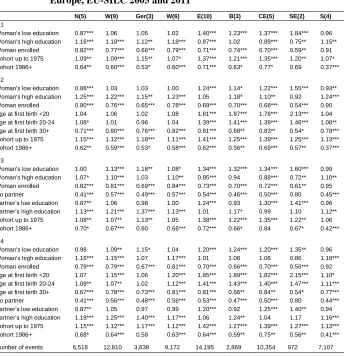
The final model (M4) reveals significant variation in the effect of women‘s educational attainment across regions (Table 1). In Northern and Western Europe, women‘s high
educational attainmentis associated with elevated odds (+16% and +15%, respectively)
of having a second child, compared to their counterparts with medium education (the reference group). A closer look at Western Europe shows that the observed positive association is, in fact, limited to a smaller group of countries that includes Belgium, France, Ireland, Luxembourg, the Netherlands, and the United Kingdom. In the German-speaking sub-region the model fails to reveal a statistically significant effect for highly educated women.
Table 1: Progression to second birth: logistic regression models for regions of Europe, EU-SILC 2005 and 2011
N(5) W(9) Ger(3) W(6) E(10) B(3) CE(5) SE(2) S(4)
M1
Woman's low education 0.87*** 1.06 1.05 1.02 1.40*** 1.23*** 1.37*** 1.84*** 0.96 Woman's high education 1.16*** 1.18*** 1.12** 1.18*** 0.87*** 1.02 0.89*** 0.75** 1.15** Woman enrolled 0.82*** 0.77*** 0.66*** 0.79*** 0.71*** 0.74*** 0.70*** 0.59** 0.91 Cohort up to 1975 1.09** 1.09*** 1.15** 1.07* 1.37*** 1.21*** 1.35*** 1.20** 1.07* Cohort 1986+ 0.64** 0.60*** 0.53* 0.60*** 0.71*** 0.63* 0.77* 0.69 0.37*** M2
Woman's low education 0.86*** 1.03 1.03 1.00 1.24*** 1.14* 1.22*** 1.55*** 0.93** Woman's high education 1.25*** 1.22*** 1.15** 1.23*** 1.05 1.18* 1.10** 0.92 1.24*** Woman enrolled 0.80*** 0.76*** 0.65*** 0.78*** 0.69*** 0.70*** 0.68*** 0.54*** 0.90 Age at first birth <20 1.04 1.06 1.02 1.08 1.81*** 1.87*** 1.78*** 2.13*** 1.04 Age at first birth 20-24 1.08* 1.01 0.96 1.04 1.39*** 1.41*** 1.39*** 1.46*** 1.08** Age at first birth 30+ 0.71*** 0.80*** 0.76*** 0.82*** 0.81*** 0.68** 0.83** 0.54* 0.78*** Cohort up to 1975 1.15*** 1.12*** 1.18*** 1.11*** 1.41*** 1.25*** 1.39*** 1.25*** 1.13*** Cohort 1986+ 0.62** 0.59*** 0.53* 0.58*** 0.62*** 0.56** 0.69*** 0.57** 0.37*** M3
Woman's low education 1.00 1.13*** 1.18** 1.08* 1.34*** 1.32*** 1.34*** 1.60*** 0.99 Woman's high education 1.07* 1.10*** 1.03 1.10** 0.85*** 0.94 0.88*** 0.72** 1.10** Woman enrolled 0.82*** 0.81*** 0.69*** 0.84*** 0.73*** 0.70*** 0.72*** 0.61** 0.95 No partner 0.41*** 0.57*** 0.49*** 0.57*** 0.54*** 0.46*** 0.50*** 0.80 0.45*** Partner’s low education 0.87** 1.06 0.98 1.00 1.24*** 0.93 1.30*** 1.41*** 0.96 Partner’s high education 1.13*** 1.21*** 1.37*** 1.13*** 1.01 1.17* 0.99 1.10 1.12** Cohort up to 1975 1.08** 1.07** 1.13** 1.05 1.38*** 1.22*** 1.35*** 1.22** 1.06 Cohort 1986+ 0.70* 0.67*** 0.60 0.66*** 0.72*** 0.66* 0.84 0.67* 0.42*** M4
Woman's low education 0.98 1.09** 1.15* 1.04 1.20*** 1.24*** 1.20*** 1.35** 0.96 Woman's high education 1.16*** 1.15*** 1.07 1.17*** 1.01 1.08 1.06 0.86 1.18*** Woman enrolled 0.79*** 0.79*** 0.67*** 0.81*** 0.70*** 0.66*** 0.70*** 0.56*** 0.92 Age at first birth <20 1.07 1.15*** 1.06 1.20*** 1.85*** 1.89*** 1.82*** 2.15*** 1.10* Age at first birth 20-24 1.09** 1.07** 1.02 1.12*** 1.41*** 1.43*** 1.40*** 1.47*** 1.11*** Age at first birth 30+ 0.67*** 0.78*** 0.73*** 0.81*** 0.81*** 0.66** 0.84** 0.54* 0.77*** No partner 0.41*** 0.56*** 0.48*** 0.56*** 0.53*** 0.47*** 0.50*** 0.80 0.44*** Partner’s low education 0.87** 1.05 0.97 0.99 1.20*** 0.92 1.25*** 1.40** 0.94 Partner’s high education 1.18*** 1.25*** 1.40*** 1.17*** 1.06 1.24** 1.04 1.17 1.16*** Cohort up to 1975 1.15*** 1.12*** 1.17*** 1.12*** 1.42*** 1.27*** 1.39*** 1.27*** 1.13*** Cohort 1986+ 0.68* 0.64*** 0.58 0.63*** 0.64*** 0.59** 0.75** 0.56** 0.41*** Number of events 6,518 12,810 3,638 9,172 14,195 2,869 10,354 972 7,107
Note: exponentiated coefficients, ***p < 0.01, **p < 0.05, *p < 0.1. Reference categories: medium-educated woman, not enrolled, age at first birth 25–29, non-foreign background, medium-educated partner, cohort 1976-1985. Duration since first birth and foreign background variable not shown.
Regions and subregions: N(5) - Denmark, Finland, Iceland, Norway, Sweden; W(9) - Austria, Belgium, France, Germany, Ireland, Luxembourg, the Netherlands, Switzerland, United Kingdom; Ger(3) – Austria, Germany, Switzerland; W(6) – Belgium, France, Ireland, Luxembourg, the Netherlands, United Kingdom; E(10) – Bulgaria, Czech Republic, Estonia, Hungary, Latvia, Lithuania, Poland, Romania, Slovakia, Slovenia; B(3) – Estonia, Latvia, Lithuania; CE(5) - Czech Republic, Hungary, Poland, Slovakia, Slovenia; SE(2) – Bulgaria, Romania; S(4) – Greece, Italy, Portugal, Spain.
The variation in the effect of women‘s low educational attainment follows a different pattern. In Northern Europe low education involves no significant difference in the odds of having a second child. By contrast, in Western Europe women with low educational attainment feature higher odds of second birth (+9%). Similar to high education, the effect varies across sub-regions. The positive association between women‘s low education and second childbearing seems to be driven by the German-speaking countries. In the rest of Western Europe the effect of low education is found to be not significant statistically.
Unlike for high education, women‘s low educational attainment and second childbearing appear positively related in Eastern Europe. The increase in the odds of second birth related to low education is particularly pronounced in the South Eastern part of the region (+35%). In the Central Eastern sub-region and the Baltic countries the effect is smaller. Finally, in Southern Europe low education makes almost no difference to the odds of second childbearing relative to the reference category.
A combination of findings on high and low education provides an account of the general pattern of the relationship between women‘s education and second births. Judging from the model M4, Northern Europe exhibits a positive association with highly educated women, having significantly higher odds of second birth than their counterparts with medium and low education. The difference between the latter groups is marginal, suggesting that the educational differential in second childbearing is concentrated at the level of tertiary education in the Nordic countries. In the model M4 the Mediterranean region also features a positive link between women‘s educational attainment and second-birth rates, similar to Northern Europe.
Western Europe, considered as a single entity, displays a U-shaped relationship, with both high and low education associated with increased odds of second birth. The examination of sub-regions further reveals that the observed U-shaped configuration stems from an amalgamation of two contrasting patterns. In the German-speaking sub-region significant differences are concentrated at lower levels of education: women with less than (upper) secondary education feature higher likelihood of second birth, while the difference between women with medium and high education is not significant. In the rest of Western Europe the general pattern resembles the Nordic countries, with significantly elevated odds of second childbearing limited to highly educated women.
likelihood of second births among the highly educated, although the sample size for the sub-region prevents the latter finding from reaching the level of statistical significance.
The results reported in Table 1 (comparison of models M3 and M4) also illuminate how the differences in first-birth timing modulate the association between women‘s educational attainment and second childbearing. In three major regions — Northern, Western, and Southern Europe — the consideration of first-birth timing increases the positive effect of women‘s high education. In Eastern Europe the consideration of first-birth timing removes the negative effect of high education that would otherwise prevail in that region. At the level of low education the adjustment for first-birth timing makes less difference, except in Eastern Europe, where it introduces a relatively large decrease in the positive odds of second births, particularly in the South Eastern sub-region.
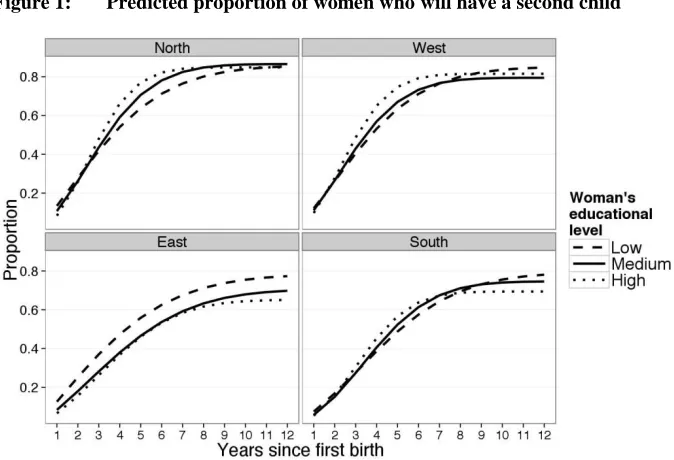
As discussed in earlier sections, women with high education enter parenthood at a later age but tend to accelerate their progression to second and higher order births. Such a time-squeeze can produce a tempo effect and increase the transition rate to the second child among higher qualified women. To gain insight into the role of time-squeeze we extended model M4 and employed a three-way interaction between women‘s age at first birth as a continuous variable, education, and duration since first birth. Based on the interaction model, we predicted, for different durations since first birth and educational levels, the proportion of women who would have a second child. In the prediction, for each educational group the age at first birth was set to a level that corresponds to the mean age of motherhood in the particular group. The results for major regions of Europe are shown in Figure 1.
The predicted proportions indicate that in Northern, Western, and Southern Europe women with high education indeed opt more rapidly for a second birth. As a result, at short and medium durations, the proportion of women having a second child among the highly educated visibly exceeds that in other groups. However, at longer durations (after 10 years since first birth) the situation alters, leading to several different patterns. In Northern Europe the proportion of women who progress to second birth converges at a relatively high level.14 Western Europe demonstrates the lowest proportion among the medium-educated. In Southern Europe the pattern completely reverses when moving to longer durations. In the Mediterranean countries, 10 years after entry into motherhood the highly educated exhibit by far the lowest proportion having a second birth, while the low-educated women rank at the top. Finally, unlike in other regions, in Eastern Europe the low-educated feature the highest progression rate to second birth at all durations.
14 The proportions of women progressing to second births reported in Figure 1 may seem very high (up to
Figure 1: Predicted proportion of women who will have a second child
Note: Predicted from a model with quadratic specification of time since first birth and age (continuous) at first birth. Controlled for partner's educational attainment, woman's educational enrolment, birth cohort, foreign background, and survey year. Reference categories of control variables as in Table 1.
Source: EU-SILC 2005 and 2011 data, own estimation.
The comparison of predicted proportions based on the interaction model and the estimates based on M4 allows us to cast some additional light on the role of time-squeeze in producing the positive effects of women‘s high education in Northern, Western, and Southern Europe, reported in Table 1. The predicted proportions reveal that in Northern and Southern Europe the positive effect of women‘s high education in the model fails to translate into bigger proportions having second births among the highly educated, relative to the reference group with medium education. We suppose that the positive effect, picked up in the model M4 for these two regions, wholly stems
from the more rapid progression to second birth among highly educated women.15 The
contribution of time-squeeze is also evident in Western Europe. Although reduced at longer durations, in that region the larger proportion having a second child among the highly educated persists.
15 This is not to say that the outcomes are similar in Northern and Southern Europe. In the former, the
5.1.2 The effect of partner’s education
The results presented in Table 1 indicate that the male partner‘s high education increases the chance of having a second child in all major regions of Europe. In the final model (M4) the effect is largest in Western Europe with a 25% increase in the odds of second birth relative to the reference group (partner with medium education). In Northern and Southern Europe it amounts to 18% and 16%, respectively. Consistent with the findings reported for women, the partner‘s high education makes less difference in Eastern Europe. The effect runs in the same direction as in other regions but remains below the level of statistical significance.
The examination of sub-regions reveals that partner‘s high educational attainment plays the most salient role in the German-speaking countries where it is associated with a 40% increase in the odds of having a second child. For the rest of Western Europe the effect is similar to that observed in the Nordic countries. In Eastern Europe the effect appears relatively large and significant only in the Baltic countries. In other sub-regions it is smaller and not statistically significant.
Compared to the partner‘s high educational attainment, the effect of partner‘s low education is more heterogeneous. In Northern Europe the partner‘s low education significantly reduces the odds of having a second child, relative to the reference group (−13%). In Southern Europe and Western Europe the partner‘s low education does not make a statistically significant difference in the odds of second birth. In Eastern Europe, on the other hand, the partner‘s low education is positively associated with the odds of second childbearing. Upon a closer look, the positive association is driven by the central and south-eastern sub-regions where the partner‘s low education increases the odds of second birth by 25% and 40%, respectively. In the Baltic countries the partner‘s low education implies a decrease rather than increase in the likelihood of second birth, but the effect fails to reach the level of statistical significance.
Despite some variation for low education, the results indicate a prevailingly positive association between the male partner‘s education and second childbearing. In Northern Europe the positive association stretches from the bottom to the top of the educational ladder. In Western and Southern Europe a statistically significant positive effect of a partner‘s schooling is limited to highly educated partners. Only in Eastern Europe is the association between the partner‘s education and second births inverse, driven by the patterns of the central and south-eastern sub-regions. Having no partner at the time of interview approximately halves the odds of having a second child, with relatively limited variation across regions.
reduction in the effect of women‘s education, following adjustment for the partner‘s characteristics. Among women with high educational attainment the decrease in the odds of second childbearing ranges from 9 percentage points in Northern Europe to 4 percentage points in Eastern Europe. Likewise, the consideration of a partner‘s education modulates the effect of women‘s low educational attainment, but the effect of the adjustment appears less consistent across regions.
5.2 Multilevel models
The results on regions showed considerable variation in the relationship between educational attainment and second births. To investigate the overall pattern prevailing in the EU-SILC countries and variation between individual countries, we estimated a series of multilevel logistic regression models.
As in the previous section, the first model (M1) presents the effect of women‘s educational attainment, adjusted neither for first-birth timing nor for partner‘s education.16 In the second and third models (M2 and M3) the controls for the aforementioned factors are added, one at a time, respectively. The fourth model (M4) provides estimates that are adjusted for both confounding factors. In the final step, two random coefficient models (M5 and M6) are fitted to reveal country differences in the effects of women‘s and the partners‘ educational attainment.
5.2.1 The effect of women’s education
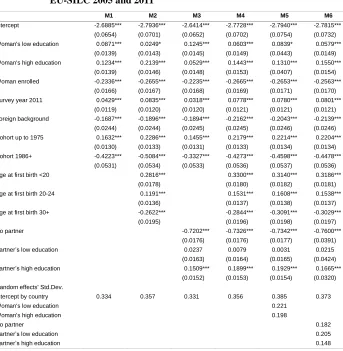
The results from model 4 (Table 2) reveal that, overall, in the EU-SILC countries a positive association between women‘s high educational attainment and second births prevails. On average, highly educated women feature 16% higher odds of having a second child than their counterparts with medium education. Although less pronounced, elevated odds of second childbearing (+6%) are also characteristic of women with a low level of education.17 Against the background of results reported in previous sections, the
16 All multilevel models include the duration (years) since first birth, controls for women‘s educational
enrolment and foreign background, survey year indicator, and a random intercept by country. The models are applied to pooled data without weights.
17
overall U-shaped relationship reflects the amalgamation of contrasting regional patterns.
Table 2: Progression to second birth: mixed effects logistic models for Europe, EU-SILC 2005 and 2011
M1 M2 M3 M4 M5 M6
Intercept -2.6885*** -2.7936*** -2.6414*** -2.7728*** -2.7940*** -2.7815*** (0.0654) (0.0701) (0.0652) (0.0702) (0.0754) (0.0732) Woman's low education 0.0871*** 0.0249* 0.1245*** 0.0603*** 0.0839* 0.0579***
(0.0139) (0.0143) (0.0145) (0.0149) (0.0443) (0.0149) Woman's high education 0.1234*** 0.2139*** 0.0529*** 0.1443*** 0.1310*** 0.1550***
(0.0139) (0.0146) (0.0148) (0.0153) (0.0407) (0.0154) Woman enrolled -0.2336*** -0.2655*** -0.2235*** -0.2665*** -0.2653*** -0.2563***
(0.0166) (0.0167) (0.0168) (0.0169) (0.0171) (0.0170) Survey year 2011 0.0429*** 0.0835*** 0.0318*** 0.0778*** 0.0780*** 0.0801***
(0.0119) (0.0120) (0.0120) (0.0121) (0.0121) (0.0121) Foreign background -0.1687*** -0.1896*** -0.1894*** -0.2162*** -0.2043*** -0.2139***
(0.0244) (0.0244) (0.0245) (0.0245) (0.0246) (0.0246) Cohort up to 1975 0.1632*** 0.2286*** 0.1455*** 0.2179*** 0.2214*** 0.2204***
(0.0130) (0.0133) (0.0131) (0.0133) (0.0134) (0.0134) Cohort 1986+ -0.4223*** -0.5084*** -0.3327*** -0.4273*** -0.4598*** -0.4478***
(0.0531) (0.0534) (0.0533) (0.0536) (0.0537) (0.0536) Age at first birth <20 0.2816*** 0.3300*** 0.3140*** 0.3186***
(0.0178) (0.0180) (0.0182) (0.0181) Age at first birth 20-24 0.1191*** 0.1531*** 0.1608*** 0.1538***
(0.0136) (0.0137) (0.0138) (0.0137) Age at first birth 30+ -0.2622*** -0.2844*** -0.3091*** -0.3029***
(0.0195) (0.0196) (0.0198) (0.0197) No partner -0.7202*** -0.7326*** -0.7342*** -0.7600***
(0.0176) (0.0176) (0.0177) (0.0391) Partner’s low education 0.0237 0.0079 0.0031 0.0215
(0.0163) (0.0164) (0.0165) (0.0424) Partner’s high education 0.1509*** 0.1899*** 0.1929*** 0.1665***
(0.0152) (0.0153) (0.0154) (0.0320) Random effects' Std.Dev.
Intercept by country 0.334 0.357 0.331 0.356 0.385 0.373
Woman's low education 0.221
Woman's high education 0.198
No partner 0.182
Partner’s low education 0.205
Partner’s high education 0.148
Note: logistic regression coefficients, ***p < 0.01, **p < 0.05, *p < 0.1. Standard errors in parentheses. Reference categories: medium educated woman, not enrolled, survey year 2005, non-foreign background, cohort 1976-1985, age at first birth 25-29, medium educated partner. Duration since first birth not shown.
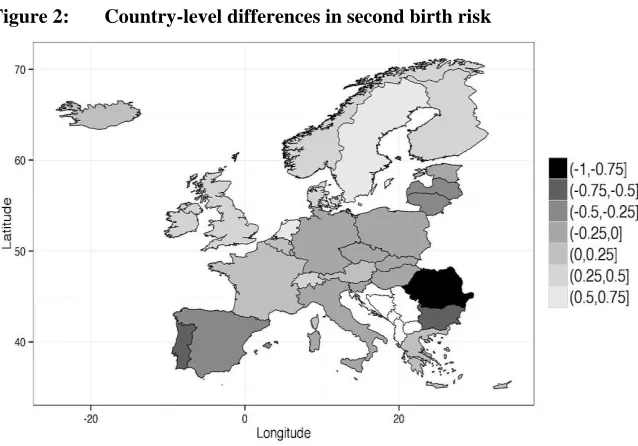
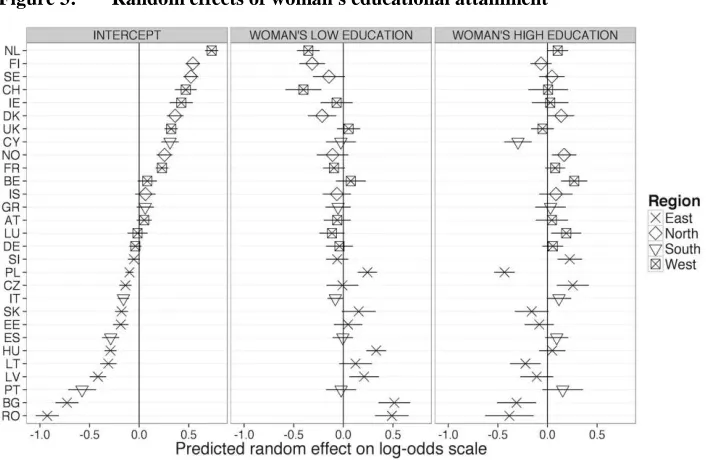
To better visualise the geographical pattern, random intercept prediction from Model 4 is shown on the map (Figure 2). As it shows, second-birth rates tend to be higher in Northern and Western Europe. Lower second-birth rates are found in Southern and Eastern Europe. This pattern fits the delineation between areas with moderate and more pronounced sub-replacement fertility. Also, the evidence is in agreement with fertility differences between sub-regions. For instance, the core countries of the German-speaking sub-region (Austria and Germany) exhibit lower second-birth intensity than most other Western European countries. In order to present cross-country differences in second-birth intensity together with the variation in the effect of women's education, random effects from model M5 are graphed in Figure 3.18 Statistics shown in Figures 2 and 3 are not parameter estimates but conditional modes of random effects; the horizontal lines in Figure 3 associated with random effects show 95% prediction intervals. The countries are ranked by random intercept.
Figure 2: Country-level differences in second birth risk
Note: Random intercept prediction based on model M4 in Table 2. Differences displayed on log-odds scale. Missing countries displayed in white.
Source: EU-SILC 2005 and 2011 data, own estimation.
18 The inclusion of random effects for education relaxes the assumption that observations are completely
The comparison of random intercepts (in the left-hand panel) and random effects for women‘s education shows that, in countries with higher second-birth rates, women with medium and high education tend to have a higher rate of second childbearing than the less-educated. By contrast, in countries with relatively low second-birth rates, the situation tends to be the opposite, with less-educated women exhibiting higher odds of second childbearing. This association is demonstrated by a fairly strong correlation (−0.79) between the random effect for low education (relative to medium education) and the intercept across countries. A weaker correlation (0.30) between the effect for high education (relative to medium) and the intercept suggests that it is primarily the contrast between women with low and medium education rather than between medium and high education that is related to cross-national variation in second-birth rates in contemporary Europe.
Figure 3: Random effects of woman's educational attainment
Note: Random effects' prediction based on model M5 in Table 2.
Source: EU-SILC 2005 and 2011 data, own estimation.
0.131 respectively, M5 in Table 2).19 Country-specific random effects of educational attainment add to fixed effects, shifting the overall effect towards negative or positive. For instance, some Northern and Western European countries (Denmark, Finland, the Netherlands, and Switzerland; also France, Iceland, Luxembourg, Norway, and Sweden, but for the latter countries the prediction intervals overlap with zero) exhibit a negative random effect for low education. As a result the overall positive effect of low education is either reduced to insignificance or turned to negative in these countries. Coupled with the overall positive effect for high education, we would observe a positive gradient for women‘s education in these countries.
By contrast, Eastern Europe showed a positive association between women‘s low education and second births, and no significant effect of women‘s high education in regional models. In general, we can observe a similar pattern in the random effects model: several Eastern European countries exhibit larger than average positive effects for low education (Bulgaria, Hungary, Latvia, Poland, and Romania; in the case of Estonia, Lithuania, and Slovakia the prediction interval includes zero) and reduced effects for high education (Bulgaria, Lithuania, Poland, and Romania). As a result, these random effects imply that the overall U-shaped relationship turns into an inverse association in a number of Eastern European countries.
Figure 3 draws attention to some countries that exhibit random effects that are not typical of the region in which they are included. For instance, in Slovenia and the Czech Republic (also Hungary, but the prediction interval overlaps with zero), the random effect of women‘s high education is on the positive side, unlike in most other countries in their region. As a result, Slovenia and the Czech Republic demonstrate a positive effect for women‘s high education that makes them distinct in the context of Eastern Europe. In the German-speaking sub-region, Switzerland stands apart from Austria and Germany for a significantly negative random effect of women‘s low education that bears resemblance to countries in Northern Europe.
5.2.2 The effect of partner’s education
The results based on model M4 (Table 2) indicate that a partner‘s high education increases the odds of having a second child on average by 21%, relative to the reference group (partner with medium education). By contrast, the overall effect of a partner‘s low education appears negligible with no difference from the reference group. Unlike for women, this finding suggests, on average, a positive association between partner‘s
19 In order to assess the overall effect of education, country-specific random effects for low and high
education and second births. It seems that the positive and negative effects of the low-educated partner, observed in different regional models, are cancelled out in multilevel analysis based on the pooled sample. Another noteworthy result is that overall in the EU-SILC countries the partner‘s high education exerts a somewhat more pronounced positive influence on the intensity of second births than women‘s similar attainment.
Regional models showed that the inclusion of partner‘s education exerts considerable influence on the estimated effect of women‘s education. The comparison of multilevel models M2 and M4 corroborate this finding. On average across the EU-SILC countries the positive coefficient is reduced, following the inclusion of partner‘s characteristics in the model. Among women with low education the adjustment slightly increases the probability of second birth compared to the medium-educated.
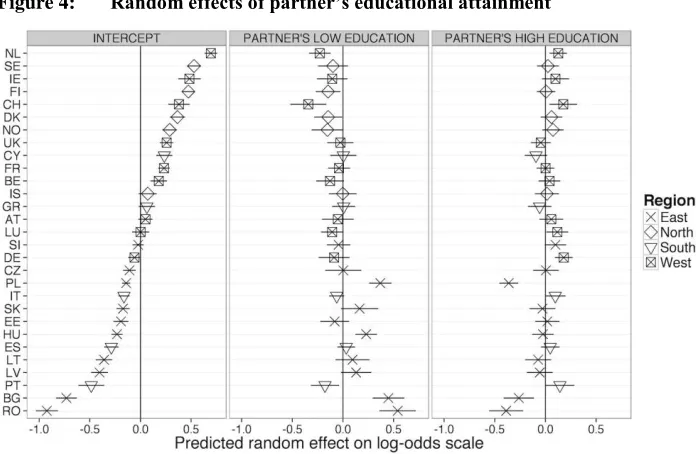
In order to assess the cross-national variation in the effect of partner‘s educational attainment, model 6 includes random effects for the latter variable. The random effects for partner‘s low and high education are plotted on Figure 4 along with the predicted country level random intercept from the same model. As in the previous figure, the countries are ranked according to random intercept that reflects differences in second-birth rates across countries.20
The comparison of intercept and random effects for the partner‘s low education reveals an association that is rather similar to that reported in the previous section for women: we observe a fairly strong negative correlation (-0.71). In fact, this negative correlation suggests that there is a positive association between the effect of a partner‘s education and second-birth rates across countries. In countries with relatively high second-birth rates (close to the top of the figure) the partners with medium education (the reference group) tend to have higher odds of second childbearing than the partners with low education. In the countries with lower second-birth rates (at the bottom of the figure), random effects reveal the opposite situation. The positive association is extended to the contrast between medium and high educational attainment among partners: it appears stronger (correlation coefficient 0.48) than that observed for women.
20 Due to different specifications of the model, the rank order of individual countries is not precisely the same
Figure 4: Random effects of partner’s educational attainment
Note: Random effects' prediction based on model M6 in Table 2.
Source: EU-SILC 2005 and 2011 data, own estimation. No partner category omitted from graph.
The results pertaining to cross-national variation in the effect of partner‘s education obtained from multilevel models are generally in agreement with the evidence based on separate regressions. For instance, the somewhat unexpected positive effect for partner‘s low educational attainment observed in Eastern Europe is also discernible in the random effects model (M6). As shown in Figure 4, a significant number of countries in that region (Bulgaria, Hungary, Poland, and Romania; also Latvia, Lithuania, and the Slovak Republic, but the prediction interval includes zero) demonstrate positive random effects for partner‘s low education. In tandem with negative random effects for partner‘s high education in Bulgaria, Poland, and Romania, these country-specific features shift the association between partners‘ education and second childbearing from positive towards negative in Eastern Europe. On the other hand, systematically negative random effects for partners‘ low education in Denmark and Finland (for Norway and Sweden the prediction interval narrowly includes zero) explain why a significantly negative effect for partner‘s low educational attainment emerges in regional models for Northern Europe.
exemplified by Poland, which, unlike the central-eastern sub-region on the whole, shows a strong positive random effect for male partners‘ low education and an equally strong negative effect for the partners‘ high education. This implies a negative association between partner‘s education and second childbearing that is typical to countries belonging to the South Eastern sub-region. However, albeit intriguing, explaining these country-specific peculiarities goes beyond the focus of the article.
6. Summary and discussion of the findings
In this article we investigated the transition to second births in Europe, based on EU-SILC data. The focus of the study was on the association between women‘s and their partners‘ educational attainment and the odds of having a second child. To date only a few studies have explored the educational gradient in second births in a broad comparative perspective. To our knowledge this is the first study of second-order childbearing that employs the SILC data in order to provide a comprehensive EU-wide account. To analyse the effect of educational attainment we estimated two series of discrete-time event history models of progression to second birth among first-time mothers. The first series of models were fitted to separate datasets, based on regions and sub-regions of Europe. The second series consisted of multilevel models that provided further evidence of the overall pattern and variation of the relationship in the EU-SILC countries.
The modelling results generally support our hypotheses concerning the association between women‘s educational attainment and second childbearing, but they also offer some new insights into its spatial variation. Consistent with expectations, for Northern Europe the regional models revealed a positive association, with highly educated women having significantly elevated odds of second births relative to their counterparts with medium and low education. However, somewhat surprisingly, a similarly strong positive association was observed in the Mediterranean countries (we return to this finding later in this section).