Volume 2, Issue 8, August 2013
Page 153
Abstract
Water quality is the condition of the water body or water resource in relation to its designated uses. It can be defined in qualitative and/or quantitative terms. Water quality is defined by Water Quality Index (WQI). We consider 8 parameters to calculate the Water Quality Index(WQI). We will apply nano sensors to calculate these parameters. That gives accurate result as compare to the conventional sensors.
Keywords: Nanosensor, WQI, simulation, Fuzzy Logic
1.
I
NTRODUCTIONWater quality index (WQI) is a number that combines multiple water quality factors into a single number by normalizing values to subjective rating curves (Miller et al., 1986). It has been used for evaluating the quality of water for water resources such as rivers, streams and lakes, etc. A commonly-used water quality index (WQI) was developed by the National Sanitation Foundation (NSF) in 1970 (Brown and others, 1970). We consider 8 parameters Dissolved oxygen (DO), Fecal coliform, pH , Temperature change, Total phosphate, Nitrate, Turbidity and Total solids to find out WQI. The WQI ranges have been defined as (Brown and others, 1970):
90-100: Excellent 70-90: Good 50-70: Medium 25-50: Bad 0-25: Very Bad
2.
N
ANOSENSOR FOR COMPUTING WQI PARAMETERS2.1 pH sensors based on Zinc Oxide Nanotubes/Nanorods
ZnO nanotubes and nanorods grown on gold thin film were used to create pH sensor devices. The developed ZnO nanotube and nanorod pH sensors display good reproducibility, repeatability and long-term stability and exhibit a pH-dependent electrochemical potential difference versus an Ag/AgCl reference electrode over a large dynamic pH range. We found the ZnO nanotubes provide sensitivity as high as twice that of the ZnO nanorods, which can be ascribed to the fact that small dimensional ZnO nanotubes have a higher level of surface and subsurface oxygen vacancies and provide a larger effective surface area with higher surface-to-volume ratio as compared to ZnO nanorods, thus affording the ZnO nanotube pH sensor have a higher sensitivity. ZnO nanotube pH sensor is developed by a two step method where low-temperature aqueous chemical growth (ACG) of well aligned ZnO nanorods followed by etching nanorods to get ZnO nano tubes. This sensor shows a linear response of the electrochemaical potential to 1-14 pH values.
2.2 Dissolved Oxygen sensor- The gold nanoparticles (GNP) and functionalized carbon nanotube (f-CNT) film (GNP-f-CNT) was prepared on glassy carbon electrode (GCE) by multiple scan cyclic voltammetry. The electrochemical measurements and surface morphology were studied using field emission scanning electron microscopy (FE-SEM), electrochemical impedance spectroscopy (EIS) and X-ray diffraction (XRD).
The dissolved oxygen electrochemical sensor exhibits a well linear response range (from 0 to 50 mg/L, R = 0.9988), lowest detection limit (0.1 mg/L), high sensitivity (196.5 µA L mg-1 cm-2).
2.3 Total Coliform SWNT sensor
Carbon nanotube (CNT) has drawn considerable attentions due to its unique electrical and mechanical properties. Recently, highly porous CNT membrane was prepared by chemical vapor deposition (CVD). This membrane electrode apply for electrochemical detection of E. coli. Preferably, conductive free-standing membrane can make the bacterium of interest directly contact the electrode and keep them within a tiny space, therefore, greatly increase the efficiency of electron transfer and dramatically concentrate the bacteria without actually increase the number, respectively.This sensor is able to detect 1x10⁶ cfu/ml.
2.4 Three-dimensional nano-structured silver on gold array electrode for Nitrate determination
Nitrate is widely spread in natural water environment. As nitrate ingestion above a critical level induces health problems, international organizations limit the level of nitrate in drinking water to 0.8 mol/L. 3D
nano-Water quality monitoring through nanosensors
Dr. Nilesh Dashore1, Dr. Kirti Vishwakarma2
Volume 2, Issue 8, August 2013
Page 154
structured dendritic silver has been prepared via electrodeposion on Au-IDA microelectrode for the determination of nitrate in neutral media. Such the special 3D structure of the electrode posses an extremely high electrocatalytic activity for nitrate reduction, hence ensuring a satisfying performance on nitrate measurement. A layer of 300Å/2000Å Au/Ta was deposited on a glass substrate and patterned by lift-off process. After being covered with SU-8 negative photoresist as insulating layer, sensing area was defined as 1mm. The finger length (L) is 1000 µm in all arrays. The electrode width is 25 µm, the electrode gap is 20 µm and the number of micobands is 40[10] . Silver films were electrodeposited by chronoamperometry onto Au-IDA microelectrode in a 0.1 mol/L KNO3 containing 5 mol/L AgNO3 solution (pH=6.0) by applying a potential step of –0.2 V (vs. SCE). 100s wasthe optimum time for preparation of 3D nano-structured dendritic silver as sensing film.
The peak current values according to nitrate reduction, observed at EAu/3DAgNPs are found to be linearly related with nitrate concentrations ranging from 25 µmol/L to 1000 µmol/L. The dynamic range of nitrate detection is 10-1000 µmol/L.
2.5Nano Thermal Sensors for Sensing Temperature in Water Environment-
Nano thermal sensor is designed by using focused ion beam chemical vapor deposition (FIB-CVD) of tungsten over atomic force microscope (AFM) cantilevers. The nano sensor was calibrated in water using the hot stage of the environmental scanning electron microscope (ESEM). The experimental results show the positive characteristics of the temperature coefficient of resistance (TCR). In comparison with other sensor this sensor is uncomplicated and reliable in fabrication.
2.6 TDS sensor for measuring total dissolved solids
HI 9032 is the most technologically advanced bench top conductivity meter in the market. This sensor is able to detect a wide range of total dissolved solids in aquatic environment. In this meter TDS factor can be adjusted from 0.01 to 0.99. TDS ranges are: 0 .0 to 199 .9 mg/L (ppm), 0 to 1999 mg/L, and 0 .00 to 1999 g/L (ppt) . An RS232 serial port is built into the meter for interfacing with a computer and data transfer. HI 9032 has six memorized programs to meet application needs and uses the new platinum 4-ring probe for a more accurate and stable measurement.[12]
2.7 Nephelometric turbidity sensor for measuring turbidity
This sensor is based on the principle that the intensity of the light scattered by the suspended matter is proportional to its concentration. The measuring system is comprised of the following sub-systems as shown in figure 1: An optical sensor (photodiode) and the signal conditioning circuit. A light source (red laser diode) and the laser driver circuit located in the device housing. The laser diode emits light, that is transmitted through an optical gap to the water sample. A PIC (Peripheral Interface Controller) microcontroller with a built in 10-bit Analog-to-Digital converter, a wireless zigbee transceiver for transferring turbidity measurements to measurement server (or a remote LCD display) and a local LCD module to display the turbidity measurement after digital processing.[13]
Figure1: Nephelometric turbidity sensor
2.8 Nano Molybdenum-blue sensor for measuring Phosphate
Volume 2, Issue 8, August 2013
Page 155
3.
CALCULATION
OF
WATER
QUALITY
INDEX
BY
USING
NANAOSENSORS
AND
FUZZY
LOGIC
APPROACH
3.1 Defining the input variables-
We use 8 pollutants as input variables to calculate water quality index
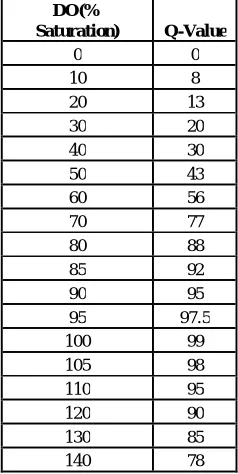
(i) Dissolved oxygen (DO)- Q values for different level of dissolved oxygen are as follows: Table 1:
Q-values for DO
DO(%
Saturation) Q-Value
0 0
10 8
20 13
30 20
40 30
50 43
60 56
70 77
80 88
85 92
90 95
95 97.5
100 99
105 98
110 95
120 90
130 85
140 78
(ii)Fecal Coliform (FC) - Q values for different level of fecal coliform are as follows: Table:2 Q-values for FC
Fecal Coliform(colonies/100 ml) Q-value
0-1 98
2 89
5 80
10 71
20 63
50 53
100 45
200 37
500 27
1000 22
2000 18
5000 13
10000 10
20000 8
50000 5
(iii) pH - Q values for different level of pH are as follows:
Table:3 Q-values for pH
pH (units) Q-Value
<2 0
2 2
3 4
4 8
5 24
Volume 2, Issue 8, August 2013
Page 156
7 90
7.2 92
7.5 93
7.7 90
8 82
8.5 67
9 47
10 19
11 7
12 2
>12 0
(iv) Temperature change( CH TEMP)- Q values for different level of change in temperature are as follows: Table:4 Q-values for Temprature Change
Change in Temperatur
e (0C)
Q-value
-10 56
-7.5 63
-5 73
-2.5 85
-1 90
0 93
1 89
2.5 85
5 72
7.5 57
10 44
12.5 36
15 28
17.5 23
20 21
22.5 18
25 15
27.5 12
30 10
(v) Total Phosphate - Q values for different level of total phosphate are as follows: Table:5 Q-values for Total Phosphate
Total Phosphate(mg/l
P) Q-value
0 99
0.05 98
0.1 97
0.2 95
0.3 90
0.4 78
0.5 60
0.75 50
1 39
1.5 30
2 26
3 21
4 16
5 12
6 10
7 8
Volume 2, Issue 8, August 2013
Page 157
9 6
10 5
>10 2
(vi) Nitrate - Q values for different level of Nitrate are as follows:
Table:6 Q-values for Nitrate
Nitrate-N (mg/l NO3) Q-Value
0 98
0.25 97
0.5 96
0.75 95
1 94
1.5 92
2 90
3 85
4 70
5 65
10 51
15 43
20 37
30 24
40 17
50 7
60 5
70 4
80 3
90 2
(vii) Turbidity - Q values for different level of turbidity are as follows: Table:7 Q-values for Turbidity
Turbidity(NTU) Q-Value
0 97
5 84
10 76
15 68
20 62
25 57
30 53
35 48
40 45
50 39
60 34
70 28
80 25
90 22
100 17
>100 5
(viii) Total dissolved solid (TDS) - Q values for total dissolved solid are as follows: Table:8 Q-values for TDS
TDS (mg/l) Q-value
50 86
100 83
150 78
Volume 2, Issue 8, August 2013
Page 158
250 67
300 59
350 52
400 47
450 40
500 30
3.2 Fuzzyfication
That comprises the process of transforming crisp values into grades of membership for linguistic terms of fuzzy sets. The membership function is used to associate a grade to each linguistic term. Fuzzification is the process that involves a domain transformation where the crisp inputs are transformed into fuzzy inputs(Nilesh and Gopal et. al 2009). To transform crisp inputs into fuzzy inputs, membership function must first be determined for each point. For our model purpose we defined following linguistic variables and membership function for each input and output variables.
(i) Linguistic variable for Dissolved oxygen (DO): 6 types of linguistic variables are defined for the input variable dissolved oxygen.
Fig.2 Membership function for DO
(ii) Linguistic variable for Fecal Coliform (FC) : 4 types of linguistic variables are defined for the input variable fecal coliform.
Fig.3 Membership function for FC
(iii) Linguistic variable for pH : 6 types of linguistic variables are defined for the input variable pH.
Fig.4 Membership function for pH
Volume 2, Issue 8, August 2013
Page 159
Fig.5 Membership function for ch_temp(v) Linguistic variable for Total Phosphate: 5 types of linguistic variables are defined for the input variable total phosphate.
Fig.6 Membership function for PHOSPHATE
(vi) Linguistic variable for Nitrate : 5 types of linguistic variables are defined for the input variable Nitrate.
Fig.7 Membership function for Nitrate
(vii) Linguistic variable for Turbidity : 5 types of linguistic variables are defined for the input variable turbidity.
Fig.8 Membership function for TURBIDITY
(viii) Linguistic variable for Total dissolved solid : 5 types of linguistic variables are defined for the input variable total dissolved solid.
Volume 2, Issue 8, August 2013
Page 160
(ix) Linguistic variable for Q-value : Following types of linguistic variables are defined for the output variable Q-value .Fig.10 Membership function for Q-VALUE
3.3 Fuzzy inference rules
In this step the knowledge pertaining to the given control problem is formulated in terms of a set of fuzzy inference rules(Mohammad Abdul Azim and Abbas Jamlipour et al(2006)). Fuzzy inference rule for the given problem are as follows.
Fig.11 Rules calculating Q-value for DO
3.4 Defuzzification-
In our MATLAB FLC module, the centre of gravity method is used to get a crisp output. This method calculates the weighted average of a fuzzy set(John Yen ,Reza Langari et al. 2007).The result of applying COA defuzzification to a fuzzy conclusion “Y is A” can be expressed by the formula
∑µA(yi) x yi y = --- ∑ µA(yi)
If y is discrete and by the formula
∫µA(yi) x yi dy y = --- ∫ µA(yi) dy
If y is continous.
3.5 Simulation result-
We applied our suggested model to calculate Water Quality Index and found that our model gives satisfactory simulation results.
Volume 2, Issue 8, August 2013
Page 161
Table:9 Calculation of Water Quality Index (WQI)Test Result Unit Q-value Weight
factor Subtotal
DO 80 % sat 75.2 0.17 12.78
Fecal
Coliform 12 #/100 mL 71.93 0.16 11.51
pH 6 std units 71.66 0.11 7.883
Change T 4 degrees C 62.36 0.1 6.236
Total
phosphate 0.5
mg/L
PO4-P 67.49 0.1 6.749
Nitrates 5 mg/L
NO3 62.34 0.1 6.234
Turbidity 4 NTU 81.27 0.08 6.502
TS 140 mg/L 74.02 0.07 5.181
63.075
We consider 8 parameters for determining WQI. So according to the rule addition of weight factor for 8 quality factors
are .87 and subtotal is 63.075 so WQI is calculated by dividing the later by former in the following way .
References
[1] House, M. A. 1989. A Water Quality Index for River Management. Water and Environment Journal. 3(4):336–44. [2] Miller W. W., H. M. Joung, C. N. Mahannah, and J. R. Garrett. 1986. Identification of Water Quality Differences in
Nevada through Index Application. Journal of Environmental Quality 15:265–72.
[3] Brown Robert M., McClelland Nina I., Deininger Rolf A., and Tozer Ronald G. 1970. "A water quality index- do we dare?" Water and Sewage Works. October. p. 339-343.
[4] Mitchell Mark K. and Stapp William B. 2000. Field Manual for Water Quality Monitoring. Twelfth Edition. [5] http://bcn.boulder.co.us/basin/watershed/wqi_nsf.html
[6] http://s3.amazonaws.com/chicagoriver/rich/rich_files/rich_files/280/original/find-20the-20q-value.pdf
[7] Alimujiang Fulati,[2009], ”Miniaturized pH Sensors Based on Zinc Oxide Nanotubes/Nanorods” In: Sensors 9, P-8911-8923;
[8] Tsung-Hsuan Tsai, Cheng-Yu Yang,[2013], “Development of a Dissolved Oxygen Sensor for Commercial Applications” Int. J. Electrochem. Sci., 8 (2013) P-5250 – 5261
[9] 6. Cheng, Y. X.; Liu, Y. Y.; Huang, J. J.; Man, Y. Z.; Zhang, W.; Zhang, Z. H.; Jin, L. T., Rapid amperometric detection of coliforms based on MWNTs/Nafion composite film modified glass carbon electrode. Ta l a n t a 2008, 75, (1), 167-171.
[10]Jingfang Hu , Jizhou Sun , Chao Bian , Jianhua Tong & Shanhong Zia , [june 2012], “Three-dimensional nano-structured silver on gold interdigitated microband array electrode for nitrate determination” Indian Journal of Chemical Technology Vol. 19, November 2012, pp. 414-419
[11]Haitham M. ElShimy,[2007], “Nano Thermal Sensors for Sensing Temperature in Water Environment” , Proceedings of the 7th IEEE International Conference on Nanotechnology pp-1045-1049
[12]TDS monitor HI 9032 by Hanna instruments web: http://www.somatco.com/HI-9032.pdf
[13]Theofanis P. Lambrou and coworkers, “A Nephelometric Turbidity System for Monitoring Residential Drinking Wat er Quality” Nephelometric Sensor pp 1-13.