ISSN: 2231-5373
http://www.ijmttjournal.org
Page 202
Exponentially Varying Temperature and
Concentration Boundary Layer Influence on
Thermal Diffusiveheat Generating Fluid in
Conducting Field
K. Vijaya Kumar1 and E. Keshava Reddy2
1
Reseach Scholar, Department of Mathematics, JNTUA College of Engineering, Ananthapuramu, A.P., India.
2
Department of Mathematics, JNTUA College of Engineering, Ananthapuramu, A.P., India.
Abstract
-Numerical analysis is carried out for the case of thermal diffusion effect on heat generating fluid in the
presence of exponentially varying temperature and concentration in conducting field. The presence of homogeneous chemical reaction is considered. A magnetic field of uniform strength is applied perpendicular to the plate. The set ofdimensionlessequations are solved numerically by using finite difference method. The relevant physical flow parameters on the flow quantities are studied through graphs. Also the variations in skin friction, Nusselt number and Sherwood number are presented in tables.Keywords:Thermal diffusion, Porous medium, Conducting field, Thermal radiation, Chemical reaction, finite difference method.
I. INTRODUCTION
In recent times convection flows by means of simultaneous heat and mass transfer under the impact of a magnetic field and chemical reaction occurs in many engineering applications. Which plays an essential role in many industries namely,in the chemical industry, power and cooling industry for drying,cooling of nuclear reactors and magneto hydrodynamic (MHD) power generators. Many transport processes exist in industrial applications and in nature, in which the simultaneous heat and mass transfer occurs as a result of combined buoyancy effects of the diffusion of chemical species. Some fields of interest in which collective heat and mass transfer play a vital role in the design of chemical processes in gear, development and dispersion of fog, distribution of temperature and vapor over food production fields. Earlier Tripathy et al. [1] studied the effect of Chemical reaction effect on MHD free convective surface over a moving vertical plate through porous medium. Srinivasacharya and Swamy Reddy [2] analyzed the effect of free convection in a non-Newtonian power law Fluid saturated porous medium with Chemical reaction and radiation effects. Kandasamy et al. [3] discussed chemical reaction, heat and mass transfer on MHD flow over a vertical stretching surface with heat source and thermal stratification effect. Mahdy et al. [4] analyzed the effects of chemical reaction and heat generation or absorption on double-diffusive convection from a vertical truncated cone in a porous media with variable viscosity. Anjali Devi and Kandaswami [5] presented effects of a chemical reaction heat and mass transfer on MHD flow past a semi-infinite plate. Khan and Rashad [6] studied combined effects of radiation and chemical reaction on heat and mass transfer by MHD stagnation point flow of a micro polar fluid towards a stretching surface. Barik [7] analyzed the effect of Chemical Reaction and Radiation Effects of MHD Free Convective Flow past an Impulsively Moving Vertical Plate with Ramped Wall Temperature and Concentration. Nehad Ali shah et al. [8] investigated the general solution for MHD-free convection flow over a vertical plate with ramped wall temperature and chemical reaction. Chamkha et al. [9] discussed MHD flow of uniformly stretched vertical permeable surface in the presence of heat generation/absorption and a chemical reaction. Seth et al. [10] presented MHD natural convection flow with radiative heat transfer past an impulsively moving plate with ramped wall temperature. Sattar et al. [11] presented an analytical solution of the free convection and mass transfer flow with thermal diffusion. Makinde et al. [12] studied hydromagnetic heat and mass transfer over a vertical plate with a convective surface boundary condition. Pattnaik et al. [13] discussed effect of heat and mass transfer on MHD free convection flow past an impulsively moving infinite vertical plate with ramped wall temperature.
ISSN: 2231-5373
http://www.ijmttjournal.org
Page 203
and also concentration gradients. On the other hand, mass flux can also be affected by temperature gradients and this represents the thermal-diffusion (Soret) effect. In various studies belonging to Soret effects are neglected on the basis that they are of a smaller order of magnitude than the effects described by Fourier’s and Fick’s laws. But these effects may become essential when they are considered as second order phenomena and in the areas of petrology, geosciences, hydrology etc. The Soret effect has been employed for isotope separation and in mixture between gases with very less molecular weight and of standard molecular weight. Chandra reddyet al. [14] investigated Soret and Dufour effects on MHD free convection flow of Rivlin-Ericksen fluid past a semi-infinite vertical plate. Ayat et al. [15] discussed heat and mass transfer for Soret and Dufour’s effect on mixed convection boundary layer flow over a stretching vertical surface in a porous medium filled with a viscoelastic fluid. Chandra reddy et al. [16] studied thermal and solutal buoyancy effect on MHD boundary layer flow of a visco-elastic fluid past a porous plate with varying suction and heat source in the presence of thermal diffusion. Ahammad et al. [17] analyzed Numerical study of MHD free convection flow and mass transfer over a stretching sheet considering Soret and Dufour effects in the presence of magnetic field. Siva reddy et al. [18] considered Soret effects on Unsteady MHD free convective flow past a semi-infinite vertical plate in the presence of viscous dissipation. Cheng [19] presented a study on Soret and Dufour effects on heat and mass transfer by natural convection from a vertical truncated cone in a fluid saturated porous medium with variable wall temperature and concentration. Srinivasacharya et al. [20] discussed the effects of Soret and Dufour on mixed convection along a vertical wavy surface in a porous medium with variable properties. Chamka et al. [21] considered Double-Diffusion MHD free convective flow along a sphere in the presence of homogeneous-chemical reaction and soret and dufuor effects. Shankar Goud et al. [22] analyzed finite element study of soret and radiation effects on mass transfer flow through a highly porous medium with heat generation and chemical reaction. Maleque et al. [23] studied Dufour and Soret effects on unsteady MHD convective heat and mass transfer flow due to a rotating disk. Recently, unsteady magnetohydrodynamic free convective double-diffusive viscoelastic fluid flow past an inclined permeable plate in the presence of viscous dissipation and heat absorption was presented by Umamaheswar et al. [24]. Dash et al. [25] addressed about free convective MHD flow through porous media of a rotating Visco-elastic fluid past an infinite vertical porous plate with heat and mass transfer in the presence of chemical reaction. Vivek et al. [26] investigated on hydrodynamic and hydromagnetic triply diffusive convection in a viscoelastic fluid through porous medium. Mukesh et al. [27] have considered MHD flow and heat transfer through non-Darcy porous medium bounded between two parallel plates with viscous and Joule dissipation. Choudhury et al. [28] studied effect of viscoelastic MHD boundary layer flow with heat and mass transfer over a continuously moving inclined surface in presence of energy dissipation. Srinivasacharya and Reddy [29] investigated a numerical study on free convection in a non-Newtonian power law fluid in a saturated porous medium in the presence of chemical reaction and radiation. Recently, Reddy et al. [30] carried out unsteady MHD free convection flow of a visco-elastic fluid past a vertical porous plate in the presence of thermal radiation, radiation absorption, heat generation/absorption and chemical reaction. Several authors [37-45] contributed to this kind of studies.
Motivated by the above studies, in this manuscript, we have studied Soret effects on radiation absorption fluid past a linearly accelerated vertical porous plate in the presence of exponentially varying temperature and concentration in conducting field, by extending the work of Muthucumaraswamy and Velumurugan [36]. This is not the simple extension work, we have alsochanged the boundary conditions. The previous studies were confined to isothermal boundary layer and uniform mass transfer or the plate temperature as well as concentration levels near the plate are linear functions of time. This indicates that small changes in temperature and concentration levels were focused much but large variations in temperature and concentration levels were ignored. Hence in this study we have considered exponentially varying temperature and also exponentially varying concentration. This kind of applications can be found in the process of cooling the nuclear reactors where large temperatures will be reduced to small temperatures or vice versa. The novelty of this study is the consideration of radiation absorption effect along with Soret effects in the presence of chemically reacting and radiating fluid in porous medium along with the exponentially varying temperature and concentration boundary layers.
II. MATHEMATICAL FORMULATION
We consider a viscous incompressible, electrically conducting, heatgenerating and radiating fluid flow past an infinite vertical porous plate in the presence of thermo diffusion. A magnetic field of uniform strength B0 is applied perpendicular to the plate. Let x*-axis is taken along the plate in the vertically upward direction and the y* -axis is taken perpendicular to the plate. At time t*≤ 0, the plate is maintained at the temperature higher than ambient
ISSN: 2231-5373
http://www.ijmttjournal.org
Page 204
plane and the temperature and as well as concentration are assumed to vary exponentially with respect to time. It is assumed that the effect of viscous dissipation and the induced magnetic field produced by fluid motion are neglected in comparison to applied magnetic field. This is justified because magnetic Reynolds number is very small for liquid metals and partially ionized fluids which are commonly used in various industrial processes (Cramer and Pai [35], Seth et al. [10]. By usual Boussineq’s and boundary layer approximations followed by Mahdy [4] Sattar and Alam [11] and Umamaheswar [24] and based on the above considerations the unsteady flow is governed by the following equations:
22
* * * 0
* 2
B u
u u
g T T g C C u
k t y
(1)
2
*
* 2 *
* * * * * r p q T T
C Q T T
t y y
(2)
* 2 * 2 *
* 1
* 2 ( ) 2
m T
m
D k
C C T
D k C C
T
t y y
(3)
The corresponding initial and boundary conditions are
* * * 1 2 3 * * * * * * 0 1 2 3 0
0, , C , 0
0 : ,T ( ) , C ( ) 0
0, , C
w
At At
w
u T T C for all y t
t u At T T T e C C C e at y
u
u T T C as y
u where A
(4)
The local radiant absorption for the case of an optically thin gray gas, followed by Ahmed et al. [33] and Raptis and
Perdikis [32] is expressed as
q
r4
* *(
*4 4*)
a
T
T
y
(5)Where σ*
and a* are the Stefan- Boltzmann constant and the mean absorption coefficient, respectively. It is assumed that the temperature difference with in the flow are so small so that
T
*4can be expressed as linear function of T*after using Taylor’s series to expandT
*4about the free stream temperatureT
* and neglecting higher order terms.This approximation results as follows:
T
*4
4
T T
*3 *
3
T
*4.
(6)
* 2 *
* * * * *3 *
* 2 16 ( )
p
T T
C Q T T a T T T
t y
(7)
The non-dimensional quantities are as follows:
1
1
1
*
*
3
*
3
3
0
,
0
,
0
,
, C
, Pr
,
2
2
2
*
*
1
1
2
3
3
(
*
)
0
,
,
,
,
1
2
2
0
(
*
)
0
0
u
u
u
T
T
C
C
C
p
U
u
t
t
Y
y
T
w
T
C
w
C
B
D k
m
T
T
w
T
Kr
k
M
Sc
S
D
u
u
T
m
C
w
C
ISSN: 2231-5373
http://www.ijmttjournal.org
Page 205
1
*
*
*
2
3
0
,
,
,
2
1
1
3
3
0
0
0
g
T
T
g
C
C
B
w
w
M
Gr
Gc
u
u
u
1
1
1
2
3
*
2
3
3
2
3
16
0
,
0
,
0
.
u
u
a T
u
k
Q
K
Q
Ra
(8)By introducing the above non-dimensional quantities, the equations (1), (3) and (6) reduce to following forms. 2
2
1
U U
Gr Gc C M U U
t Y
K
(9)
2 2
Pr Q Ra
t Y
(10)
2 2 0 2 2 1 C C KrC S
t Sc Y Y
(11)
By introducing the non-dimensional quantities, the boundary conditions reduce to the following forms.
0, 0, C 0 for all , t 0
0 : , , C 0
0, 0, C 0
t t
u Y
t U t e e at Y
u as Y
(12)
III.SOLUTION OF THE PROBLEM
Equations (9), (10) and (11) are coupled partial differential equations for which the exact solutions are not possible. Hence these equations along with the set of boundary conditions (12) are solved by semi-implicit finite difference method. The corresponding finite difference schemes of equations (9) - (11) are as follows:
2
,
,
1
,
1
1,
1,
,
,
,
,
2
U
U
i j
U
U
i j
U
i j
i
j
i
j
Gr
i j
GcC
i j
M U
i j
U
i j
t
Y
K
(13)
2
,
,
,
1
1,
1,
Pr
,
,
2
i j
i j
i j
i
j
i
j
Q
i j
Ra
i j
t
Y
(14)
2
2
,
1
,
,
,
1
1,
1,
1,
1,
,
0
2
2
C
i j
C
i j
C
i
j
C
i j
C
i
j
i
j
i j
i
j
KrC
i j
S
t
Sc
Y
Y
(15)Equations (9) – (11) can be written as follows:
2
,
1
1,
1,
,
,
,
,
,
,
1
2
U
U
i j
U
i
j
i
j
U
i j
U
i j
t
Gr
i j
t Gc C
i j
t
M U
i j
t
U
i j
t
K
Y
(16)
2 ,
1,
1,
,
,
,
,
1
Pr
2
Pr
Pr
i j
t
i
j
i
j
Q
Ra
t
t
i j
i j
i j
i j
Y
ISSN: 2231-5373
http://www.ijmttjournal.org
Page 206
2
,
2
,
1,
1,
1,
1,
,
,
,
1
2
0
2
C
C
i j
C
i j
t
i
j
i
j
i
j
i
j
C
C
i j
KrC
i j
S
t
i j
Sc
Y
Y
(18)Here, the suffix i relates to y and j to time. The mesh system is divided by taking ∆y = 0.1. From the initial condition in (8), we have the following equivalent:
( , 0)
0, ( , 0)
0, ( , 0)
0
U i
i
C i
for all i
(19) The boundary conditions from (8) are expressed in finite-difference form as follows(0, )
, (0, )
, (0, )
(
max
, )
0, (
max
, )
0, (
max
, )
0
t
t
U
j
t
j
e C
j
e
j
U i
j
i
j
C i
j
j
(20)(Here imax was taken as 200)
The velocity at the end of time step viz., u (i, j+1)(i=1,200) is computed from (16) in terms of velocity, temperature and concentration at points on the earlier time-step. After that θ (i, j +1) is computed from (17) and then C (i, j +1) is computed from (18). The procedure is repeated until t = 0.5 (i.e. j = 500). During computation ∆t was chosen as 0.001.
Skin-friction:
The skin-friction in non-dimensional form is given by the relation
.
1
, where
2
0
0
U
Y
Y
U
Rate of heat transfer:
The dimensionless rate of heat transfer in terms of Nusselt number is given by
0
Nu
Y Y
Rate of mass transfer:
The dimensionless rate of mass transfer in terms of Sherwood number is given by
0
C
Sh
Y Y
IV. RESULTS AND DISCUSSION
ISSN: 2231-5373
http://www.ijmttjournal.org
Page 207
Fig. 1: Effect of Kr on Concentration profiles.
Fig. 2: Effect of Sc on Concentration profiles.
5 10 15 20 25 30 35 40
0 0.2 0.4 0.6 0.8 1 1.2
y
C
Sc=0.22,0.60,0.78,0.96
Kr=0.1
So=0.1
5 10 15 20 25 30 35 40
0 0.2 0.4 0.6 0.8 1 1.2
y
C
Sc=0.22 So=0.1
ISSN: 2231-5373
http://www.ijmttjournal.org
Page 208
Fig. 3: Effect of S0 on Concentration profiles.
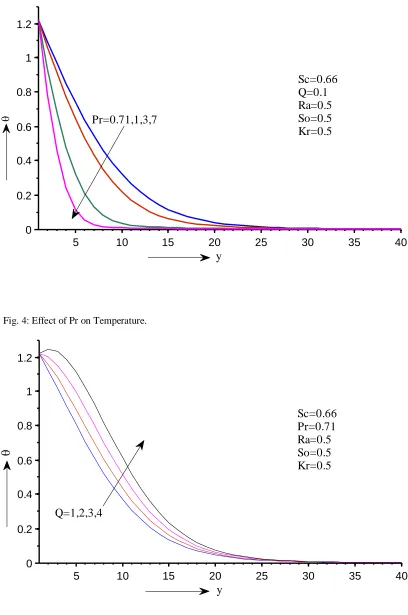
Fig.2 illustrates that the concentration of the fluid decreases for ascending values of Schmidt number. Physically it is true since the increase in Sc means decrease of molecular diffusivity and therefore decrease in concentration boundary layer. Hence the concentration of species is higher for smaller values of Sc and lower for larger values. When heat and mass transfer occur simultaneously in a moving fluid, the mass flux generated by temperature gradients is termed as thermal-diffusion (Soret effect). The velocity of the fluid as well as species concentration increases for ascending values of Soret number. This is noticed from Fig.3 that the concentration of the fluid increases with an increase in Soret number. The variations in temperature field are shown in Figs. 4-6. It is evident from Fig.4 that temperature of the fluid falls down with an increase in the values of Prandtl number. Physically this is true because thermal conductivity of the fluid decreases with increasing values of Prandtl number, resulting decrease in thermal boundary layer thickness.
5
10
15
20
25
30
35
40
0
0.2
0.4
0.6
0.8
1
1.2
y
C
So=0.5,1,1.5,2
ISSN: 2231-5373
http://www.ijmttjournal.org
Page 209
Fig. 4: Effect of Pr on Temperature.
Fig. 5: Effect of Q on Temperature.
5 10 15 20 25 30 35 40
0 0.2 0.4 0.6 0.8 1 1.2
y
M=1
Sc=0.22
Q=0.1
Ra=0.1
So=0.5
Du=0.3
Kr=0.1
=0.2
Pr=0.71,1,3,7
Sc=0.66
Q=0.1
Ra=0.5
So=0.5
Kr=0.5
5 10 15 20 25 30 35 40
0 0.2 0.4 0.6 0.8 1 1.2
y
Q=1,2,3,4
ISSN: 2231-5373
http://www.ijmttjournal.org
Page 210
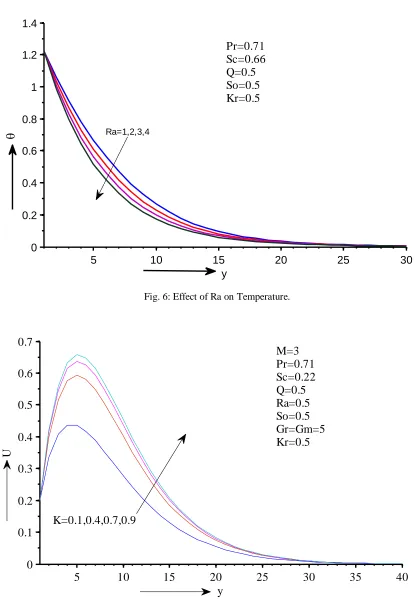
Fig. 6: Effect of Ra on Temperature.
5 10 15 20 25 30
0 0.2 0.4 0.6 0.8 1 1.2 1.4
y
Pr=0.71
Sc=0.66
Q=0.5
So=0.5
Kr=0.5
Ra=1,2,3,4
5
10
15
20
25
30
35
40
0
0.1
0.2
0.3
0.4
0.5
0.6
0.7
y
U
M=3
Pr=0.71
Sc=0.22
Q=0.5
Ra=0.5
So=0.5
Gr=Gm=5
Kr=0.5
ISSN: 2231-5373
http://www.ijmttjournal.org
Page 211
Fig.7: Effect of K on Velocity.
Fig.8: Effect of M on Velocity.
5
10
15
20
25
30
35
40
0
0.1
0.2
0.3
0.4
0.5
0.6
0.7
y
U
M=1,2,3,4
K=1
Pr=0.71
Sc=0.22
Q=0.3
Ra=0.5
So=0.5
Gr=Gm=5
Kr=0.5
5
10
15
20
25
30
35
40
0
0.1
0.2
0.3
0.4
0.5
0.6
0.7
y
U
Pr=0.71,1,3,7
ISSN: 2231-5373
http://www.ijmttjournal.org
Page 212
Fig.9: Effect of Pr on Velocity.
Fig.10: Effect of Soret number on Velocity.
The influence of heat absorption parameter on temperature is conferred in Fig.5. It is examined that the temperature increases for increasing values of heat absorption parameter. This is due to the fact that the heat absorption causes an increase in kinetic energy as well as thermal energy of the fluid. As a result, the temperature of the thermal boundary layer increases in the case of heat generating fluids. Fig.6 depicts the variations in temperature in the presence of radiation parameter. Decrease in temperature is detected under the influence of radiation parameter. This is in conformity with the results of Raptis and Perdikis [32].
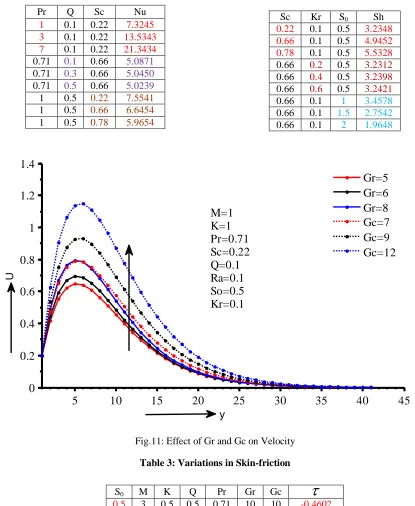
Figs. 7-11 shows the variations in the velocity distribution under the influence of several parameters involved in this study. From Fig.7 velocity profiles are displayed with the variations in permeability of the porous medium parameter K. From this figure, it is noticed that the velocity of the fluid increases from the moving plate to free surface with the increase in the values of the permeability of the porous medium. Physically, an increase in the permeability of porous medium leads the rise in the flow of fluid through it. When the holes of the porous medium become large, the resistance of the medium may be neglected. So that velocity at the plate is observed to be maximum and step by step it reaches the free surface. This result is in good concordance the result of Raju et al. [34]. Fig.8 represents the effect of magnetic parameter on fluid velocity. The velocity decreases with increasing values of magnetic parameter. The central reason behind this effect is that the application of transverse magnetic field perpendicular to the flow causes a flow-resistive force called the Lorentz force which deeds in the opposite direction of the fluid flow. This force results in slowing the motion of the fluid. Fig.9 illustrates the effect of Prandtl number on velocity of the fluid. It is identified that the velocity of the fluid decreases as the values of Prandtl number increases. The fluid of low Prandtl number has high thermal diffusivity and hence it gains higher temperature in steady state, which in turn means more buoyancy force i.e. high fluid velocity with respect to reasonably high Prandtl fluid. The variation of the velocity boundary-layer under the effect of Soret number is shown in Fig.10. An increase in velocity boundary layer is examined with ascending values of Soret number. Fig. 11 depict the variations in velocity with the effect of Grashof number and modified Grashof number. It is shown that
5
10
15
20
25
30
35
40
0
0.1
0.2
0.3
0.4
0.5
0.6
0.7
0.8
y
U
So=1,2,3,4
ISSN: 2231-5373
http://www.ijmttjournal.org
Page 213
the velocity increases under the influence of both the numbers. It can be identified from table 1 that the Nusselt number increases with rising value of Prandtl number. Increasing values of Schmidt number (Sc), heat absorption parameter (Q), heat generation parameter results in declining the Nusselt number. Table 2 displays the variations in Sherwood number. Sherwood number value increases for increasing values of Schmidt number (Sc), chemical reaction parameter (Kr) and it decreases for ascending value of Soret number (S0). Table 3 displays the variations in skin friction. The skin friction increases with an increase in magnetic parameter (M) and Prandtl number (Pr) whereas it declines under the effect of porosity parameter (K), Grashof number (Gr) and modified Grashof number (Gc), heat absorption parameter (Q), Soret number (S0) .
Table.1: Variations in Nusselt Number Pr Q Sc Nu
1 0.1 0.22 7.3245 3 0.1 0.22 13.5343 7 0.1 0.22 21.3434
0.71 0.1 0.66 5.0871
0.71 0.3 0.66 5.0450
0.71 0.5 0.66 5.0239
1 0.5 0.22 7.5541
1 0.5 0.66 6.6454
1 0.5 0.78 5.9654
Table. 2: Variations in Sherwood Number Sc Kr S0 Sh
0.22 0.1 0.5 3.2348 0.66 0.1 0.5 4.9452 0.78 0.1 0.5 5.5328
0.66 0.2 0.5 3.2312
0.66 0.4 0.5 3.2398
0.66 0.6 0.5 3.2421
0.66 0.1 1 3.4578 0.66 0.1 1.5 2.7542 0.66 0.1 2 1.9648
Fig.11: Effect of Gr and Gc on Velocity
Table 3: Variations in Skin-friction
5
10
15
20
25
30
35
40
45
0
0.2
0.4
0.6
0.8
1
1.2
1.4
y
U
Gr=5
Gr=6
Gr=8
Gc=7
Gc=9
Gc=12
M=1
K=1
Pr=0.71
Sc=0.22
Q=0.1
Ra=0.1
So=0.5
Kr=0.1
S0 M K Q Pr Gr Gc
ISSN: 2231-5373
http://www.ijmttjournal.org
Page 214
NOMENCLATURE
A, a Constants
Cp Specific heat at constant pressure [J.kg-1 K-1]
DmThermal diffusivity
Gr Thermal Grashof number
Gcmodified Grashof number
gAcceleration due to gravity [m.s-2] Pr Prandtl number
K porosity parameter Q heat absorption parameter Ra radiation parameter M magnetic parameter
Kr chemical reaction parameter S0 Soret number
Sc Schmidt number Nu Nusselt number Sh Sherwood number
өTemperature [K]
tTime [s]
u Velocity of the plate [m.s-1]
C Concentration [g/ml]
Greek symbols
βVolumetric coefficient of thermal expansion [K-1] β*
Volumetric coefficient of expansion for mass transfer
kThermal conductivity [W.m-1.K-1]
μCoefficient of viscosity [Pa.s] ᴦ Heat generation parameter.
νKinematic viscosity [m2.s-1]
ρDensity of the fluid [kg.m-3] τ skin friction
σ Electrical conductivity [ohm-1 s-1] Subscripts
s surface of the plate
∞ Conditions in the free stream Superscript
* Dimensional
yCoordinate axis normal to the plate [m]
V.
CONCLUSIONS0.5 1 0.5 0.5 0.71 10 10 -0.4786 0.5 2 0.5 0.5 0.71 10 10 -0.4627 0.5 3 0.5 0.5 0.71 10 10 -0.4532 0.5 3 0.1 0.5 0.71 10 10 -0.4567
0.5 3 0.3 0.5 0.71 10 10 -0.4754
0.5 3 0.5 0.5 0.71 10 10 -0.4857
0.5 3 0.5 1 0.71 10 10 -0.3637
0.5 3 0.5 1.5 0.71 10 10 -0.3639
0.5 3 0.5 2 0.71 10 10 -0.3641
0.5 3 0.5 0.5 0.71 10 10 -0.5546
0.5 3 0.5 0.5 1 10 10 -0.4546
0.5 3 0.5 0.5 3 10 10 -0.3765
0.5 3 0.5 0.5 0.71 5 10 -0.2736
0.5 3 0.5 0.5 0.71 10 10 -0.6490
0.5 3 0.5 0.5 0.71 15 10 -0.9544
0.5 3 0.5 0.5 0.71 10 5 -0.4546
0.5 3 0.5 0.5 0.71 10 10 -0.7446
ISSN: 2231-5373
http://www.ijmttjournal.org
Page 215
The dimensionless governing equationsare solved with the help of semi implicit finite difference method. Influence of several parameters on velocity, temperature and concentration are discussed with the help of graphs. Also the effect of some parameters on skin friction, Nusselt number and Sherwood number is also discussed thoroughly. The main conclusions of the present study are stated below:
1. Fluid velocity increases for increasing values of Thermal Grashof number, modified Grashof number, Porosity parameter, Soret number and but it shows reverse trend in the case of magnetic parameter, chemical reaction parameter and Prandtl number.
2. Fluidtemperaturereduces for increasing values of Prandtl number, whereas it enhances in the case of heat absorption parameter and radiation parameter.
3. Cconcentration of the fluid increases when soret number increases but it falls down under the influence of Schmidt number and chemical reaction parameter.
4. Skin friction increases when magnetic parameter and Prandtl number increase whereas it decreases for increasing values of Thermal Grashof number, modified Grashof number, Porosity parameter, heat absorption parameter, Soret number.
5. Nusselt number increases with increasing values of Prandtl number, but an opposite behavior is noticed in the case ofheat absorption parameter and Schmidt number.
6. Sherwood number is enhanced for increasing values of Schmidt number and chemical reaction parameter but it shows reverse trend in the presence of Soret number.
REFERENCES
1. R.S.Tripathy, G.C. Dash, S.R. Mishra, S. Baag, Chemical reaction effect on MHD free convective surface over a moving vertical plate through porous medium, Alexandria Engineering Journal. 54(2015) 673–679.
2. D. Srinivasacharyaand G. Swamy Reddy,Free convection in a non-Newtonian power law fluid saturated porous medium with Chemical reaction and radiation effects, Special Topics & Reviews in Porous Media - An International Journal, 4(3) (2013) 23-236.
3. R. Kandasamy,K. Periasamyand K.K.S. Prabhu, Chemical reaction, heat and mass transfer on MHD flow over a vertical stretching surface with heat source and thermal stratification effects. Int. J. Heat and Mass Transfer,48(21-22) (2005) 4557- 4561.
4. A. Mahdy, Effect of chemical reaction and heat generation or absorption on double-diffusive convection from a vertical truncated cone in a porous media with variable viscosity,International Communications in Heat and Mass Transfer,37 (2010) 548-554.
5. S.P. Anjali Devi, R. Kandasamy,Effects of a chemical reaction heat and mass transfer on MHD flow past a semi -infinite plate,Z. Angew. Math. Mech. 80 (2000) 697-701.
6. W. A. Khan and A.M. Rashad, Combined effects of radiation and chemical reaction on heat and mass transfer by MHD stagnation point flow of a micro polar fluid towards a stretching surface, Journal of the Nigerian mathematical society,36 (2017) 219-238.
7. R.N. Barik,Chemical reaction and radiationeffects of MHD freeconvectiveflow past an impulsivelymovingverticalplate with ramped wall temperature and concentration,European Journal of Advances in Engineering and Technology,1(2) (2014) 56-68.
8. Nehad Ali Shah, Azhar Ali Zafar and Shehraz Akhtar, General solution for MHD -free convection flow over a vertical plate with ramped wall temperature and chemical reaction, Arabian Journal of Mathematics,7 (2017) 49-60.doi.org/10.1007/s40065-017-0187-z.
9. A.J. Chamkha, MHD flow of uniformly stretched vertical permeable surface in the presence of heat generation/absorption and a chemical reaction, Int. Comm. Heat Mass transfer,30 (2003) 413 – 422.
10. G.S. Seth, Md.S. Ansari and R. Nandkeolyar, MHD natural convection flow with radiative heat transfer past an impulsively moving plate with ramped wall temperature, Heat and Mass Transfer,47(5) (2011) 551-561.
11. M.A. Sattar and M.M. Alam, Analytical solution of the free convection and mass transfer flow with thermal diffusion, Dhaka University Journal of Science,49 (2001) 95-104.
12. O.D. Makinde, Similarity solution of hydro magnetic heat and mass transfer over a vertical plate with a convective surface boundar y condition. Int .J.Phy.Sci.vol.5(6) (2010) 700-710.
13. J.R. Pattnaik, G.C. Dash and S. Singh, Effect of heat and mass transfer on MHD free convection flow past an impulsively moving infinite vertical plate with ramped wall temperature, International Journal of Fluid Mechanics,4(1) (2012) 5-81.
14. P. Chandra Reddy, M.C. Raju, G.S.S. Raju, Soret and Dufour effects on MHD free convection flow of Rivlin -Ericksen fluid past a semi infinite vertical plate, Advances and Applications in Fluid Mechanics, 19 (2016) 401-414. doi:10.17654/FM019020401.
15. T. Ayat, M. Mustafa, and I. Pop, Heat and mass transfer for Soret and Dufour’s effect on mixed convection boundary layer flow over a stretching vertical surface in a porous medium filled with a viscoelastic fluid. Communications in Nonlinear Science and Numerical Simulation, 5 (2010) 1183–1196.
16. P. Chandra Reddy, M.C. Raju, G.S.S. Raju, Thermal and solutal buoyancy effect on MHD boundary layer flow of a visco -elastic fluid past a porous plate with varying suction and heat source in the presence of thermal diffusion, Journal of Applied & Computational Mathematics, 4(5) (2015) 1-7. doi:10.4172/2168-9679.1000249.
ISSN: 2231-5373
http://www.ijmttjournal.org
Page 216
18. Siva Reddy Sheri and R.Srinivasa Raju,Soret effects on Unsteady MHD free convective flow past a semi -infinite vertical plate in the presence of viscous dissipation”, International journal for computational methods in engineering science and mechanics, 16 (2015)132-240.
19. C.Y. Cheng, Soret and Dufour effects on heat and mass transfer by natural convection from a vertical truncated cone in a fluid – saturated porous medium with variable wall temperature and concentration, International Communications in Heat and Mass Transfer, 37(8) (2010) 1031- 1035.
20. D. Srinivasacharya, B. Mallikarjuna and R. Bhuvanavijaya, Soret and Dufour effects on mixed convection along a vertical wavy surface in a porous medium with variable properties, Ain Shams Engineering Journal6 (2015),553–564. doi:10.1016/j.asej.2014.11.007.
21. A.J. Chamka, A.M. Ali and Z.A.S. Raizah,Double-Diffusion MHD free convective flow along a sphere in the presence of homogeneous-chemical reaction and soret and dufuor effects, Applied and computational mathematics, 6 (2017) 34-44.
22. B.ShankarGoud and M.N.RajaShekar,Finite element study of soret and radiation effects on mass transfer flow through a highly porous medium with heat generation and chemical reaction, International journal of computational and applied mathematics,12 (2017) 53-64. 23. Kh.A. Maleque, Dufour and Soret effects on unsteady MHD Convective heat and mass transfer flow due to a rotating disk, Latin American
Applied Research, 40 (2010) 105-111.
24. M. Umamaheswar, S.V.K. Varma, M.C. Rajuand A.J. Chamkha,Unsteady magnetohydrodynamic free convective double-diffusive viscoelastic fluid flow past an inclined permeable plate in the presence of viscous dissipation and heat absorption., Special Topics & Reviews in Porous Media, 6 (4) (2015) 333-342.
25. G.C. Dash, P.K. Rath, N. Mohapatra and P.K. Dash, Free convective MHD flow through porous media of a rotating Visco-elastic fluid past an infinite vertical porous plate with heat and mass transfer in the presence of chemical reaction, AMSE Model. 78(4) (2 009) 21-37.
26. K. Vivek, K. Pardeep, K.A. Mukesh, Hydrodynamic and hydromagnetic triply diffusive convection in a viscoelastic fluid through porous medium, Special Topics &Reviews in Porous Media: An International Journal, 6 (4) (2015), 297- 311.
27. K.S. Mukesh, Kuldip Singh and Ashok Kumar, MHD flow and heat transfer through non-Darcy porous medium bounded between two parallel plates with viscous and joule dissipation, Special Topics & Reviews in Porous Media: An International Journal, 5 (1) (2014) 1-11. 28. R. Choudhury, P. Dhar and D. Dey, Viscoelastic MHD boundary layer flow with heat and mass transfer over a continuously moving
inclined surface in presence of energy dissipation, WSEAS Transactions on Heat and Mass Transfer. 8(4) (2013)146 -155.
29. D. Srinivasacharya, G.S.Reddy, Free convection in a non-Newtonian power law fluid in saturated porous medium with chemical reaction and radiation effects, Special Topics & Reviews in Porous Media, 4 (3) (2013) 223-236.
30. L. Rama Mohan Reddy, M. C. Raju, G. S. S. Raju, Unsteady MHD free convection flow of a visco-elastic fluid past a vertical porous plate in the presence of thermal radiation, radiation absorption, heat generation/absorption and chemical reaction, International Journal of Applied Science and Engineering, 14 (2) (2016) 69-85.
31. G.S. Seth, B. Kumbhakar, R. Sharma, Unsteady MHD free convection flow with Hall effect of a radiating and heat absorbing fluid past a moving vertical plate with variable ramped temperature. Journal of the Egyptian Mathematical Society, 1-8(2015).dx.doi.org/10.1016/j.joems.2015.07.007.
32. A. Raptisand C. Perdikis,Unsteady flow through a highly porous medium in the presence of radiation ,Transp. Porous Media. 57 (2004) 171-179.
33. S. Ahmed,A. Batin and A.J. Chamkha, Numerical/Laplace transform analysis for MHD radiating heat/mass transport in a Darcian porous regime bounded by an oscillating vertical surface, Alexandria Eng. J., 54(2014) 45-54. dx.doi.org/10.1016/j.aej.2014.11.006.
34. K.V.S. Raju, T.S. Reddy, M.C. Raju, P.V. Satyanarayana and S. Venkataramana,MHD convective flow through porous medium in a horizontal channel with insulated and impermeable bottom wall in the presence of viscous dissipation and Joule’s heating,Ain Sham’s engineering Journal, 5 (2) (2014) 543-551.doi: 10.1016/j.asej.2013.10.007.
35. K.R. Cramer,S.I. Pai, Magnetofluiddynamics for engineers and applied physics, McGraw Hill Book company ,New York,USA, (1973). 36. R. Muthucumaraswami and G. S. Reddy, Theoretical study of heat transfer effects on flow past a parabolic started vertical plate in the
presence of chemical reation of first order, Int. J. Appl. Mech. Eng. 19(2) (2014) 275-284.
37. S. Harinath Reddy, M. C. Raju, E. Keshava Reddy, Unsteady MHD free convection flow of a Kuvshinski fluid past a vertical porous plate in the presence of chemical reaction and heat source/sink, International Journal of Engineering Research in Africa Vol. 14 (2015) pp. 13-27.
38. S.H. Reddy, M. C. Raju, E. Keshava Reddy, Magneto Convective Flow of a Non-Newtonian Fluid through Non-Homogeneous Porous Medium past a Vertical Porous Plate with Variable Suction, Journal of Applied Mathematics and Physics, 4, 233-248, 2016.
39. S.H. Reddy, M. C. Raju, E. Keshava Reddy, Radiation absorption and chemical reaction effects on MHD flow of heat generating Casson fluid past Oscillating vertical porous plate, Frontiers in Heat and Mass Transfer, 7, 21; 1-9 (2016). DOI: 10.5098/hmt.7.21
40. S. Harinath Reddy, M. C. Raju, E. Keshavareddy, Soret and Dufour effects on radiation absorption fluid in the presence of exponentially varying temperature and concentration in conducting field, Special Topics & Reviews in Porous Media - An International Journal, Vol.7 No.2, 2016, 115-129.
41. B. Mamtha, M. C. Raju, S. V. K.Varma, Thermal diffusion effect on MHD mixed convection unsteady flow of a micro polar fluid past a semi-infinite vertical porous plate with radiation and mass transfer, International Journal of Engineering Research in Africa, Vol. 13 (2015) pp 21-37.
42. M. C. Raju, and S.V. K.Varma, Soret effects due to natural convection in a non-Newtonian fluid flow in porous medium with heat and mass transfer, Journal of Naval architecture and Marine Engineering, Vol. 11 (2), 2014, pp. 147-156.
43. V. Ravikumar , M. C. Raju, G. S. S. Raju., MHD three dimensional Couette flow past a porous plate with heat transfer, IOSR Jour. Maths., Vol. 1, no.3, pp. 3-9, 2012.
44. M. C. Raju, S. V. K. Varma, R. R. K. Rao, “Unsteady MHD free convection and chemically reactive flow past an infinite vertical porous plate”, i-manager Journal of Future Engineering and Technology, Vol.8 (3), 2013, 35-40.