The Growing Adoption of Internet of Things on Supply Chains
Satya Shah 1,*, Keotshepile Mokakangwe2, Keitumetes Bose3, Sarath Menon41-4 Off Campus/Institute of Management, University of Bolton, United Kingdom
Abstract. There has been a vast development within the span of three centuries of industrial revolution with the introduction of modern technology. The gradual but steady adoption of different technologies including Internet of Things (IoT) in Industry 4.0 (I4.0) is now a growing research area including identifying ways for industries to operate their functions. The implementation of IoT in all aspects of human life, which results a fast paced daily life activities is a clear indication that the future is here now. The potentials for cost reduction and profit maximisation have been realised by the involved corporations and a significant number of them is already investing heavily on the new technologies. Scientists now believe that empowering the Internet of Things (IoT) to have artificial intelligence (AI) could help human beings to complete works more smartly and efficiently. The paper aims to focus on the impacts of IoT that affects the supply change management and will explain the reasons that have led to the ever-growing adoption of IoT.
1
Introduction
One of the trends influencing purchasing and supply chain management in current industrial revolution is the need for industries and sectors to increase or improve productivity and efficiency. It has become important for competing firms to deliver satisfaction of benefits to achieve favor and loyalty from consumers through the right product, price, and distribution (Placement) and promotion at the right time. Since the Industrial Revolution 1, subsequent industrial revolutions have driven manufacturing in radical evolutions, from steam energy to electrical and digital automated production [1]. The processes of manufacturing have become increasingly sophisticated, automated and sustainable, at a level that workers can operate machineries simply, efficiently and effectively [2].
The new system of applications and services such as the internet of things (IoT), the cyber-physical systems (CPS), the block chains, the big data and the virtualisation represent a new industrial revolution, the fourth. As defined by many studies, the industry 4.0 or the fourth industrial revolution is the combination of the existing information and communication technologies together towards the production of products and services. The industry 4.0 is the mainstream, up to date digitalised industry which is in the path of development since 2011. In the next two decades, people will not only experience it, but it will be a routine in all sectors of our life. Implementation of different technologies of Industry 4.0 including IoT has resulted mostly positive impacts on many different sectors such as Energy production industry, Manufacturing industry, Warehousing industry, Hospital industry, Chemical and Pharmaceutical industry, Food and Beverage industry [3].
2 Literature Review
The methodology used to prepare this article is bibliographical and comparative. The initial information collected was sorted and analysed from reliable bibliographic sources, from which the concluding remarks were made. Several publications including international scientific journals or key-word conferences and books have been analysed with the keywords such as "Internet of things", "industry 4.0", "industrial revolution", “IoT", “IoT impacts", "supply chain", "logistics", etc.
2.1 Industry 4.0 and Supply Chain Management
but most of them were large global players, with a self-closed loops for their own IoT projects.The term IoT encompasses things connected to the internet, and it is increasingly explained as objects that can communicate with each other.
2.2 Internet of Things (IoT)
The development of IoT is brought into reality by the birth of Machine to Machine (M2M) conception the 1990s. M2M evolution then motivated technologies that is wireless making it possible for connectivity and coordination of vendors everywhere as long as there is internet connection. In 1995, Siemens introduced the first cellular module built for M2M. The concept of IoT was introduced in 2009 as a networked connection of dissemination and receiving data via devices. These devices include electronical hardware which is enabled by software and internet connection. The term originated 15 years ago origins with the proposed definition of IoT emphasizing things being connected and internet related [7]. Even though IoT started being valid in 1992 with to topic growing its significance in industries and service sectors in the past five years as presented in the figure 1.
Figure 1: IoT growth since 1992 [8]
IoT term has grown significantly between 2012 and 2016 with 2013 indicating mobile connection of M2M adding up to 28% amounting to 195 million even though IoT was still in early development stage it showed potential future growth. The internet presents growth of connection though smart phones, laptops, cars among other devices making it possible for anyone and anything to connect anywhere. This trend is expected to grow in years coming due to consumers demand to make purchasing decisions easily. The connected life is likely to force firms to adapt IoT to meet consumer expectations of improved products and quality through service innovation.
IoT is enabling the commercial activities to occur not only in the factory environment but also outside the markets. While automation already existed in manufacturing, IoT is enabling greater computerisation increasing flexibility and efficiency in manufacturing processes. It enhances the ability to satisfy customer requirements and increase competitiveness precisely. Some manufacturing industries have invested in technology that can predict just when the manufacturer
should service the essential equipment. These innovations have led to a reduction in manufacturing down-time and improved customer satisfaction. The operational life of machines may also be increased resulting in a decrease in costs due to continuous, timely maintenance [9].
Most of the recent research studies discusses the security problems including of the activity information that is collected from intelligent devices, software and hardware. The IoT connectivity that emerges from Industry 4.0 makes objects interact with each other automatically. This function apparently increases the risks of information exposures, such as the personal data in human resource department, financial reports, documents at the R&D office and records of business trades [10].
IoT devices have been widely adopted in various environments and situations. IoT is the integration of multiple heterogeneous networks, and it should address security and connectivity issues between different networks [11]. IoT applications bring a stream of innovative technologies and services and focus more on the functions of motion tracking, reminders and environmental detections [12]. Comparing to the smartphones, tablets and computers, IoT devices are limited in compute, storage and network capacity and thus more vulnerable while facing the external attacks [13]. The purpose of IoT is to provide a platform that can accept, store and transmit data through the internet within computers devices.
2.3 Integration of IoT on SC & Logistics
The integration of IoT and SCM platforms facilitates commodities to be located, sensed, identified and controlled through a global platform framework. Within the Industry 4.0 context, there are some challenges regarding the linkages between IoT and the logistic networks, for instance the key success factors of supply chain such as supply chain visibility and delivery of the goods at right quantity, right time, right place, right condition and accurate cost [14]. In this regard, the technology-driven “Smart Logistics” results in smart services and products with increased flexibility, response to market changes, production optimization, reduction of manufacturing and warehousing costs and making closer ties between customer and company [15]. Likewise, and in a broader level, digital logistics is combination of application of innovations within logistics activities provided by “Cyber Physical Systems” (CPS) that has been a result of enhanced use of internet enabling an effective communication and information sharing between humans and machines referring to IoT.
If a device, such as an inventory tracking machine, delivery van, or stock control machine is added to IoT, it can helps in capturing, codifying, monitor or improve real time data which allows improvement in exchange of real time information through a process of information capture [19]. It is observed that SCM integrates the intra and inter organization operations through the whole supply chain system which can be done through internal and external stakeholder collaboration and hence it add superior value product to the end user that is customer satisfaction. This is recognised by the efficiency in the flow of goods and services through the whole supply chain system [20].
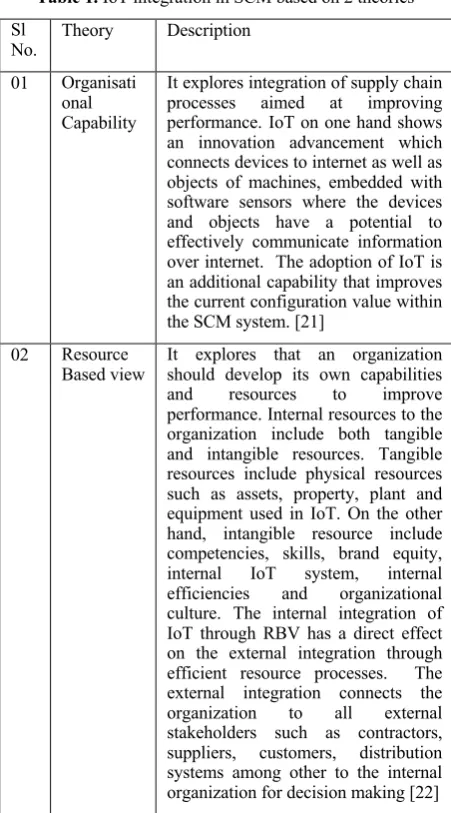
IoT helps to bridge the gap between digital and physical flow of information and physical goods in greater supply chain (SC) integration. The additional capacity is improved through networking, sensing and improved networking capabilities which improves the whole SCM process. Service improvement is developed through digital coordination and connectivity through enhanced technology. Emerging IoT paradigm, effectively manage supply network which enhances customer demands and the speed at which the organization respond to changes in customer demand. Integration of IoT in supply chain has been defined based on two theories as given below.
Table 1. IoT integration in SCM based on 2 theories
Sl
No. Theory Description
01 Organisati onal Capability
It explores integration of supply chain processes aimed at improving performance.IoT on one hand shows an innovation advancement which connects devices to internet as well as objects of machines, embedded with software sensors where the devices and objects have a potential to effectively communicate information over internet. The adoption of IoT is an additional capability that improves the current configuration value within the SCM system. [21]
02 Resource
Based view It explores that an organization should develop its own capabilities and resources to improve performance. Internal resources to the organization include both tangible and intangible resources. Tangible resources include physical resources such as assets, property, plant and equipment used in IoT. On the other hand, intangible resource include competencies, skills, brand equity, internal IoT system, internal efficiencies and organizational culture. The internal integration of IoT through RBV has a direct effect on the external integration through efficient resource processes. The external integration connects the organization to all external stakeholders such as contractors, suppliers, customers, distribution systems among other to the internal organization for decision making [22]
2.4 Impacts of IoT
It looks like the more mature implementation of IoT from which we can take and use valid data for the research purposes, as it is not in an experimental phase but it is already adopted by many industries (AMAZON for example). IoT is enabled in a wide range of applications whose expansion is proportional to the time course. The sectors which present most of the interest are manufacturers, health management, flexible production systems, military operations, warehouses and mines [23].
The following table (table 2) will present some basic advantages on IoT, implementation by different industry [24], [25], [26], [27], [28].
Table 2. Advantages of IoT
Advantages of IoT based on specialist reviews.
Asset Tracking Efficiencies- Tracking of bar codes and numbers are more efficient with IoT which is the expedient technology. The use of GPS and RFID tracks products from the source to the point of end consumption for example, a manufacturer can utilise IoT sensors even to gain information about the room temperature at which items are stored. The information provided enables companies to continuously improve quality control mechanisms, product forecasting and timely deliveries.
Vendor Relations - The data stored at IoT through asset tracking is important as it allows firms to monitor their production schedules and deal with vendors which are core in the whole supply chain. Knowledge of how vendors handle supplies is critical because a high level of quality goods entails good relationship with the vendors and customers. This encourages high vendor and customer retention
Forecasting and Inventory- The use of IoT allows forecasting of more accurate inventories and hence minimise human errors. It therefore helps in monitoring goods and tracking them for placing orders and replacements. This improves efficiency in meeting lead times while adequate stock is timeously delivered to the right place.
Connected Fleets- IoT proves to be more efficient as it helps in connecting supply chain fleet to a common database for tracking. This includes all the companies’ carriers, shipping containers, suppliers’ delivery trucks which are out for sourcing and delivery. Therefore, IoT helps the companies to get customers, suppliers and other related information faster and accurately
Better Maintenance - IoT make use of smart sensors to manage predictive maintenance, manage maintenance and prevent down-time which can cost much to the organization. Supply chain process highly depends on health of machines, However, the IoT smart sensors can help to install sensors and provide better maintenance which can aid in preventing failures. This helps organization to depart from the traditional way of using traditional preventative measures. Instead, IoT sensors collect information which can be used to predict issues which could otherwise go undetected. The preventative maintenance is key in smooth supply chain and hence helps organizations in saving money by preventing equipment failures which are expensive
Accurate Asset Tracking - SCM highly demands on asset tracking solutions. Asset tracking is not a new practice in the SCM, but IoT technology has improved the quality and amount of information. The codes and sensors are used to provide alerts and updates for even items which are damaged in transit. The information is made available to the concerned and authorised teams and they will use that information to discover in-efficiencies which might have been remained hidden. This will improves the overall quality of control systems for the organization in future.
Improved Inventory Practices - IoT helps organization to monitor inventory in a more effective and efficient way. This includes checking inventory levels at different times and getting alerts in the case that stock levels becomes low. Apart from monitoring inventory, there exists some additional information which a business can gain from the up to date information on inventory management. The usage of different materials and products can helps to identify trends and these trends can help to manage more effectively.
Transparent Marketing - End user of the products or services are becoming more conscious of movements of goods and services. They are becoming more aware of the supply chain system from the beginning to the end. The use of IoT plays an important role in bringing transparency about the product movement from the source to the end user which is the customer. The customer will have information about their products and source which makes the company act responsibly and ethically. Therefore, through the use of IoT, organization brings up SCM to new and high levels of transparency.
3. Recommendations and Future
Research
This paper aims to examine the most important aspects of automation and that of industry 4.0 within logistics and transportation areas of supply chain management. It has been highlighted through various research studies that, research have identified ways to investigate both application and engineering perspectives of some of the technological advances. This paper is part of an ongoing research project within the research centre and includes a preliminary study towards the implications and findings of Internet of things and industry 4.0. The methodology is based on the literature review studies to highlight the current state of the main concepts within the context. The paper would be further utilised towards the development of the research framework towards integration of IoT within SME for effective service within their supply chain context.
4. Conclusion
The uncertainties in using traditional SCM has basically a resulted in complex costs, uncertainty in inventory movement’s and hence supply chain requires to become smarter. However the development of IoT has helped organizations in merging data and all supply chain processes in SCM. The IoT helped organization to improve secure system for SCM and track the flow of goods from source to the company and then the end user. The majority of companies that have adopted IoT compete on the basis of efficiency in delivery and low
cost strategy. This ensures that goods are always available which improves the reputation of the organization. The impacts of IoT will depend on how they will interact in its application to the intelligent industry with other systems, such as the cloud technology, big data, predictive maintenance, tracking and monitoring and more. It does not seem to be a transient technology that will bring something else in the future. Only a few of articles present the real picture of the IoT implementation. Nevertheless, its growth interest is increasing rapidly. Technological companies are publishing reports with trends and statistics and are offering new technological solutions and advices. It is obvious from the statistics that the dominant role, from the factors that contribute the impacts to the supply chain, is the economic. There is an effort of crediting the technological evolution to the environmental sustainability and indirectly it is happening, but the main factor is still the cost. There is no doubt that the impact cylinder can change in terms of content as the market manipulators decide to change their targets. From an ethical perspective the conclusion can be made is that the capabilities of IoT is far beyond, than the goals which the global market has set.
Most of the research studies contend that IoT will have positive impacts on the environment and on the economy of the logistics and supply chain industry. But on the other hand, many others believe that the negative impacts will be of greater proportion. The supremacy of a robotics and automation is undeniable to the level of accuracy, economy, efficiency, effectiveness and excellence. But many questions arise towards the human and workforce dimensions.
References
1. Wahlster W.: From Industry 1.0 to Industry 4.0: Towards the 4th Industrial Revolution. Forum Business meets Research (2012).
2. Bertram V.: Autonomous ship technology – smart for sure, unmanned maybe. London: Smart Sh. Technology, 5–12 (2016).
3. Mohamed Ben-Daya, Elkafi Hassini & Zied Bahroun (2017): Internet of things and supply chain management: a literature review, International Journal of Production Research, DOI: 10.1080/00207543.2017.1402140
4. Wahlster W.: From Industry 1.0 to Industry 4.0: Towards the 4th Industrial Revolution. Forum Business meets Research (2012).
5. Tjahjono, B., Esplugues, C., Ares, E. and Pelaez, G.: What does Industry 4.0 mean to Supply Chain. Procedia Manufacturing, 13, 1175-1182 (2017).
6. Pham T M, Wen H L, Chiung W H and Fang Y S, Fuzzy AHP analysis of Internet of Things (IoT) in enterprises,International Journal of Technological forecasting and social change, 136, 1-13, (2018)
7. F. Wortmann and Kristina Flu¨chter, Internet of things: Technology and added value. Published on-line. Institute of Technology Management. Switzerland. (2015)
8. S. Kothari1, S. V. Jain and A. Venkteshwar, International Research Journal of Engineering and Technology (IRJET) e-ISSN: 2395-0056 05, 08 Aug (2018).
10.Choi, S.K., Yang, C.H., Kwak, J., System hardening and security monitoring for IoT devices to mitigate IoT security vulnerabilities and threats. KSII Trans. Internet Inf. Syst.
12 (2), 906–918( 2018)
11.Jin, J., Gubbi, J., Marusic, S., Palaniswami, M., An information framework for creating a smart city through internet of things. IEEE Internet Things J. 1 (2), 112–121, (2014).
12.Wang, Y.H., Hsieh, C.C, Explore technology innovation and intelligence for IoT (Internet of Things) based eyewear technology. Technol. Forecast. Soc. Chang. 127,281–290, (2018)
13.Khan, M.A., Salah, K., IoT security: review, blockchain solutions, and open challenges.Futur. Gener. Comput. Syst.
82, 395–411, (2018)
14.Macaulay, J., Buckalew, L. and Chung, G.: Internet of Things in logistics, DHL Trend Research/Cisco Consulting Services (2015).
15.Barreto, L., Amaral, A. and Pereira, T.: Industry 4.0 implications in logistics: an overview. Procedia Manufacturing, 13, 1245-1252 (2017).
16.Mello, M.H., Gosling, J., Naim, M.M., Strandhagen, J.O. and Brett, P.O.: Improving coordination in an engineer-to-order supply chain using a soft systems approach. Production Planning & Control, 28(2), 89-107 (2017). 17.Pfohl, B.Y. and Kurnaz, T.: The impact of Industry 4.0. On
the supply chain in W. Kersten, T. Blecker, Innovations ad strategies for logistics and supply chains. Technologies, business models and risk management, 31-59 (2015). 18.Szymańska, O., Adamczak, M. and Cyplik, P.: Logistics
4.0-a new paradigm or set of known solutions, Research in Logistics & Production, 7 (2017)
19.Yu, W. The effect of IT-enabled supply chain integration on performance. Production Planning & Control, 26(12), 945-957 (2015)
20.Qrunfleh, S., & Tarafdar, M. Supply chain information systems strategy: Impacts on supply chain performance and firm performance. International Journal of Production Economics, 147(1), 340-350 (2014)
21.Liu, X., & Sun, Y. Information Flow Management of Vendor-Managed Inventory System in Automobile Parts Inbound Logistics Based on Internet of Things. Journal of Software, 6(7), 1374-1380, (2011)
22.Zhao, X., Huo, B., Selen, W., & Yeung, J. H. Y.The impact of internal integration and relationship commitment on external integration. Journal of Operations Management,
29(1), 17-32 (2011)
23. Vis, I.: Survey of research in the design and control of automated guided vehicle systems. European Journal of Operational Research, 170(3), 677-709 (2006).
24.Vanpoucke, E., Vereecke, A., & Muylle, S., Leveraging the impact of supply chain integration through information technology. International Journal of Operations & Production Management, 37(4), 510-530.(2017)
25.Liu, W., & Gao, Z., Study on IOT based architecture of logistics service supply chain. International Journal of Grid and Distributed Computing, 7(1), 169-178 (2014)
26.Perera, C., Member, C. H. L., Jayawardena, S., & Chen, M., Context-aware Computing in the Internet of Things: A Survey on Internet of Things From Industrial Market Perspective. IEEE Access, 2(1ng), 1660-1679, (2015).
27.Borgia, E., The Internet of Things vision: Key features, applications and open issues. Computer Communications,
54, 1-31, (2014).
![Figure 1: IoT growth since 1992 [8]](https://thumb-us.123doks.com/thumbv2/123dok_us/9675880.1950528/2.595.57.291.359.492/figure-iot-growth.webp)