International Journal of Emerging Technology and Advanced Engineering
Website: www.ijetae.com (ISSN 2250-2459, Volume 2, Issue 5, May 2012)279
Performance Comparison of Stability Enhanced AODV
and AOMDV Protocols for MANETs
Chintan Bhavsar
1, Mayur.M Vegad
2, Sunil.A Bakhru
3 1M.E Student, Department of Computer Engineering, BVM Engineering College, 2, 3
Asso.professor, Department of Computer Engineering, BVM Engineering College, V.V Nagar-388120, India.
1
2[email protected] 3[email protected]
Abstract—Ad hoc network is one sort of multi-hop,
self-organizing and dynamically changing network. There are various challenges in designing a wireless ad hoc network like dynamic topology, limited and shared bandwidth and limited battery power. Generally the nodes in the wireless ad hoc network are mobile, due to that the topology changes continuously. Often due to dynamically changing topologies the route from source to destination breaks quite frequently. Consequently, to find a new route from source to destination, network initiates a route discovery. The frequent discovery of route increases the routing overhead and delay. The traditional routing based on hop count metric doesn’t take in its consideration the stability of the wireless link. The need is to find a routing protocol that considers link stability while designing the route, so resulting route is more stable than present routing protocol. The provision of multiple paths may also achieve good performance compared to a single path. In this paper we compare performance of two variants of AODV which finds a stable path using received signal strength and AOMDV which finds multiple paths in a single route discovery.
Keyword---Stability, Ad-Hoc Network, AODV, AOMDV, Received Signal Strength.
I.INTRODUCTION
A mobile ad hoc network (MANET) is a self-configuring infrastructure less network of mobile devices connected by wireless links.Each device in a MANET is free to move independently in any direction, and will therefore change its links to other devices frequently. Each node must forward traffic unrelated to its own use, and therefore be a router.
The primary challenge in building a MANET is
equipping each device to continuously maintain the information required to properly route traffic. Topology of the ad-hoc network depends on the transmission power of the nodes and the location of the mobile nodes, which may change from time to time [1].
One of the main problems in ad-hoc networking is the efficient deliveries of data packets to the mobile nodes where the topology is not pre-determined nor does the network have centralized control. Hence, due to the frequently changing topology, routing in ad-hoc networks can be viewed as a challenge.
In on-demand or reactive routing protocols, the routes are created on requirement basis. To find a path from source to destination, it invokes the route discovery mechanisms. Only the routes that are currently in use are maintained, thereby maintaining low control overhead and reducing the network load since a small subset of all available routes is in use at any time [1].
International Journal of Emerging Technology and Advanced Engineering
Website: www.ijetae.com (ISSN 2250-2459, Volume 2, Issue 5, May 2012)280
The other way of reducing the routing overhead is to find a route which remains active for longer time. A more stable path could be found that would reduce the number of route failures. A stable route would lead to less number of route discoveries and in turn reduce the routing overhead.
In this paper, we compare two approaches (1) Stable path in reactive protocol (2) Multiple paths in reactive protocol
For our purpose we use two variants of AODV which finds a stable path using received signal strength and AOMDV which is an extension of AODV with provision of multiple paths.
II.BACKGROUND.
On-Demand routing protocols work on the principle of creating routes as and when required between a source and destination node pair in a network topology. Our discussion is limited to two on-demand ad-hoc routing protocols, AODV and AOMDV, as follows.
A. Ad-hoc On-Demand Distance Vector Routing (AODV)
AODV is a reactive protocol that discovers routes On demand basis using a route discovery mechanism. It uses traditional routing tables with one entry per destination. Sender sends RREQ (route request) packet whenever there is a need to find a route. The RREQ traverses from intermediate node to its intended recipient. The RREP (route reply) packet is sent by destination in response to RREQ packet. AODV uses sequence numbers maintained at each destination for preventing routing loops and maintain the freshness of route [6]. All routing packets carry these sequence numbers. To remove the unused or older entries in routing table AODV maintains timer-based states in each node. List of precursors is maintained for each routing table entry, indicating the neighboring nodes sets which use that entry to route packets. Whenever the next-hop links breaks the nodes in a precursor list are notified by RREQ (route error) packet .This Packet gets forwarded by each predecessor node to its Predecessors, effectively erasing all routes using the broken link [6].
The advantages of AODV are that less memory space is required as information of only active routes are maintained, in turn increasing the performance, while the disadvantage is that this protocol is not scalable and in large networks it does not perform well and does not support asymmetric links.
B. Ad-hoc On-demand Multipath Distance Vector Routing (AOMDV)
Ad-hoc On-demand Multipath Distance Vector Routing (AOMDV) [7] protocol is an extension to the AODV protocol for computing multiple loop-free and link disjoint paths. There can be multiple next hops for the same destination with same sequence number. This helps in keeping track of a route. An advertized hop count is maintained for each destination by node. Advertized hop count is the maximum hop count for particular destination. Each duplicate route advertisement received by a node defines an alternate path to the destination. Loop freedom is assured for a node by Advertized hop counts. Alternative paths are only considered if they have less hop count than advertized hop count. Because the maximum hop count is used, the advertised hop count therefore does not change for the same sequence number [7]. When a route advertisement is received for a destination with a greater sequence number, the next-hop list and the advertised hop count are reinitialized.
International Journal of Emerging Technology and Advanced Engineering
Website: www.ijetae.com (ISSN 2250-2459, Volume 2, Issue 5, May 2012)281
III.DISCOVERY OF STABLE ROUTE.
A. Approaches to find stable path.
There are various parameters to achieve stable route in routing protocols like node residual energy, link expiration time, Stability of nodes, probabilistic link lifetime estimation and success rate of data transmission for node, link usage, and received signal strength [2].
B. Choosing received signal strength as a parameter for stability
Existing on demand routing protocols for ad hoc network does not take in its consideration the quality of link while deciding the route. If decision for selecting a route is based on received signal strength then the protocols can achieve the route which is more stable. Simulation in [5] shows good resemblance with actual implementation.
C. Cross layer design.
In a cross layer design the received signal strength which is measured at physical layer can be made available to layers above it [3]. The value measured at physical layer is passed to MAC layer and network layer. The received signal strength information sent by the physical layer may be stored either in routing table or neighbor table and can be used to make routing decisions. Such a cross layer design has been utilized to improve the performance of mobile ad hoc network [3].
AODV utilize RREQ (route request) packet in determining the route. RREQ packet is broadcast to all the neighbors. The neighbors check the destination address and accordingly forward RREQ to their neighbors. A RREQ packet traversing from different path arrives at the destination. The path with minimum hop is selected as a route [6]. The route found by AODV may have weak links which may lead to frequent route failures [5]. Frequent route failures will increase the number of route discoveries and in turn increase the routing overhead of the network.
In order to minimize control overhead, the cross layer design uses the received signal strength of RREQ packet [3]. A RREQ packet is only forwarded if it is having sufficient Received signal strength.So, the links with less received signal strength i.e. weak links may not participate in formation of route.
To decide whether the RREQ has the sufficient received signal strength or not, the received signal strength of RREQ is checked against a predetermined threshold.
The threshold to be used can be a fixed value or it could be changing adaptively with changing network condition.
In fixed threshold design the received signal strength of RREQ packet is compared with predetermined threshold without considering the moving direction of sending and receiving node. The fixed threshold would achieve reduced route discovery and reduced link failures, but overall performance may not be satisfactory due to increased no of hops in table route.
To improve the performance the adaptive threshold is used.Which uses different values of threshold with reference to moving speed of the nodes, in addition it also considers moving direction of nodes. Fig 1 shows the received signal strength of RREQ packet is stored in the Neighbor table (NT) against the address of the neighboring node from which it is received. So, whenever node receives RREQ from neighbors the current received signal strength is checked against the previous received signal strength stored in the table. If the current received signal strength is greater than the previous received signal strength, it indicates that the nodes are approaching towards each other. If the current received signal strength is less than previous received signal strength, it indicates that the nodes are moving away from each other.
International Journal of Emerging Technology and Advanced Engineering
Website: www.ijetae.com (ISSN 2250-2459, Volume 2, Issue 5, May 2012) [image:4.612.75.287.104.326.2]282
Fig. 1 shows flowchart for finding moving direction of mobilenodes. Mobile nodes are either approaching or moving away from each other so RREQ is processed accordingly [3].
IV.SIMULATION ENVIRONMENT AND RESULT
ANALYSIS
We make use of ns-2.34 which has support for simulating a multi-hop wireless ad-hoc environment. 49 nodes are deployed in an area of 1000 × 1000 m2. Each point in result is an average of 10 seeds. The other simulation parameters are summarized in table I.
We tested following three cases
(1) AODV with Fixed Threshold (AODV
Fixed).
(2) AODV with adaptive threshold and
consideration of moving direction (AODV Adaptive).
(3) AOMDV.
For “AODV Fixed” in this case fixed threshold value of -60 db is used and it is tested for different speed in the range of 5 m/s-25 m/s.
For “AODV Adaptive” in this case different threshold values (-63.66 db, -61.64 db, -60 db ,-59.37 db, -56.89 db) are used for the speeds (5 m/s, 10 m/s, 15 m/s,20 m/s, 25 m/s) respectively. In addition to that it also considers the moving direction of the mobile nodes.
For AOMDV in this case it is tested for different speed in the range of 5 m/s-25 m/s.
TABLE I SIMULATION PARAMETERS
Parameters Values
Transmission range 250 meter
Simulation time 200 sec
Transmission protocol TCP
Routing protocol AODV Fixed AODV
Adaptive and AOMDV.
Packet size 512 Bytes
A. Packet Delivery Ratio
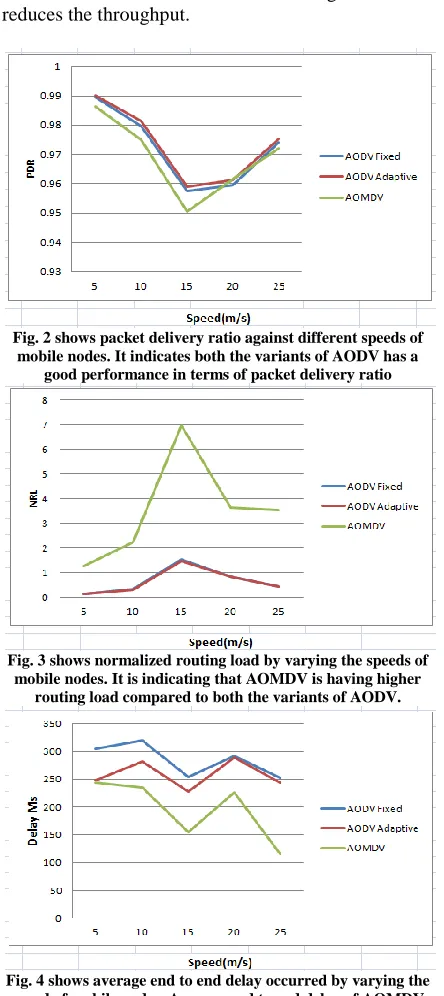
The packet delivery ratio is no of packets received per number of packet sent. Fig.2 shows the packet delivery ratio for AODV Fixed, AODV Adaptive and AOMDV. The adaptive version improves the packet delivery ratio than using the fixed threshold.
Both the fixed threshold and adaptive threshold seems to achieve better performance than AOMDV in terms of packet delivery ratio.
B. Normalized Routing Load
The normalized routing load is number of routing packets sent per number of data packet received. From Fig 3 it can be observed that AOMDV has more routing overhead compared to both the AODV Fixed and AODV Adaptive. Both the variants of AODV do not process the RREQ if it is not having sufficient received signal strength that will reduce the routing load in both the variants. The AOMDV is a multipath routing protocol and it searches for multiple paths by flooding the networks with RREQ packets which incurs more routing overhead.
C. Average end to End Delay
International Journal of Emerging Technology and Advanced Engineering
Website: www.ijetae.com (ISSN 2250-2459, Volume 2, Issue 5, May 2012)283
D. ThroughputThe throughput is total data transmitted per second.It can be observed form Fig 5 that both the AODV variants achieve higher throughput than AOMDV.AOMDV has a better end to end delay but it searches for the multiple paths by doing network wide broadcast that increases the routing load which reduces the throughput.
Fig. 2 shows packet delivery ratio against different speeds of mobile nodes. It indicates both the variants of AODV has a
good performance in terms of packet delivery ratio
Fig. 3 shows normalized routing load by varying the speeds of mobile nodes. It is indicating that AOMDV is having higher
[image:5.612.324.543.116.283.2]routing load compared to both the variants of AODV.
Fig. 4 shows average end to end delay occurred by varying the speed of mobile nodes. Average end to end delay of AOMDV
seems better than both the variants of AODV.
Fig. 5 shows throughput by varying the speed of mobile nodes. Both the variants of AODV seem to achieve better throughput
than AOMDV.
V.CONCLUSION.
This paper evaluates performance of two variants of AODV which finds a stable path and AOMDV Protocol. The results suggest that AOMDV reduces the Average End to End Delay by a considerable amount. AOMDV is having multiple paths so, when the active route breaks the network can switch on to the backup route. This will reduce route discovery latency.
AOMDV requires to find multiple path in a single route discovery so, it does the network wide broadcast of RREQ that will increase the routing load of the network. On the other hand in both variants of AODV the Unnecessary RREQ packets are dropped that will reduce the routing load of the network.
Due to increased routing load both the variants of AODV with stable path achieves better packet delivery ratio and Throughput than AOMDV.
If End to End Delay is of our concern than we can choose AOMDV but, if routing overhead is our concern then we can choose AODV with stable path which reduces the routing load of the network.
REFERENCES
[1] H.D.Trung, W.Benjapolakul, P.M.Duc, May 2007
“Performance evaluation and comparison of different ad hoc routing protocols”, Department of Electrical Engineering, Chulalongkorn University, Bangkok, Thailand.
[2] Hadi Sargolzaey, Ayyoub Akbari Moghanjoughi and Sabira
[image:5.612.71.293.199.697.2]International Journal of Emerging Technology and Advanced Engineering
Website: www.ijetae.com (ISSN 2250-2459, Volume 2, Issue 5, May 2012)284
[3] B.Ramchandran and S. shanmugavel, JUL-AUG
2008,”Received Signal Strength-based Cross-layer design for Mobile Ad Hoc Networks”, IETE Technical Review, Volume 25, Issue 4.
[4] Ruay-Shiung Chang and Shing-Jiuan Leu, January
2006,”Long-lived Path Routing With Received Signal Strength for Ad Hoc Networks”, IEEE International Symposium on Wireless Pervasive Computing.
[5] Kwan-Wu Chin, John Judge, Aidan Williams and Roger
Kermode, November 2002,”Implementation Experience with MANET Routing Protocols”, ACM SIGCOMM Computer Communications Review, Volume 32, Number 5.
[6] Charles E. Perkins, Elizabeth M. Belding-Royer, Samir R.
Das, February 2003, “Ad hoc On-Demand Distance Vector (AODV) Routing draft-ietf-manet-aodv-13.txt,”, Mobile Ad Hoc Networking Working Group, INTERNET DRAFT.
[7] M.K.Marina and S.R.Das, 2001, “On-Demand Multipath
distance vector routing in ad hoc Networks” in: Proceedings of 9th IEEE International Conference on Network Protocols
(ICNP).
![Fig. 1 shows flowchart for finding moving direction of mobile nodes. Mobile nodes are either approaching or moving away from each other so RREQ is processed accordingly [3]](https://thumb-us.123doks.com/thumbv2/123dok_us/8736941.888881/4.612.75.287.104.326/flowchart-finding-moving-direction-mobile-approaching-processed-accordingly.webp)