The Thirty-Third AAAI Conference on Artificial Intelligence (AAAI-19)
Non-Autoregressive Neural Machine Translation with Enhanced Decoder Input
Junliang Guo,
†∗Xu Tan,
‡Di He,
§Tao Qin,
‡Linli Xu,
†Tie-Yan Liu
‡ †Anhui Province Key Laboratory of Big Data Analysis and Application,School of Computer Science and Technology, University of Science and Technology of China ‡Microsoft Research
§Key Laboratory of Machine Perception (MOE), School of EECS, Peking University
†[email protected], [email protected],‡{xuta,taoqin,tyliu}@microsoft.com,§di [email protected]
Abstract
Non-autoregressive translation (NAT) models, which remove the dependence on previous target tokens from the inputs of the decoder, achieve significantly inference speedup but at the cost of inferior accuracy compared to autoregressive transla-tion (AT) models. Previous work shows that the quality of the inputs of the decoder is important and largely impacts the model accuracy. In this paper, we propose two methods to enhance the decoder inputs so as to improve NAT mod-els. The first one directly leverages a phrase table generated by conventional SMT approaches to translate source tokens to target tokens, which are then fed into the decoder as in-puts. The second one transforms source-side word embed-dings to target-side word embedembed-dings through sentence-level alignment and word-level adversary learning, and then feeds the transformed word embeddings into the decoder as inputs. Experimental results show our method largely outperforms the NAT baseline (Gu et al. 2017) by 5.11 BLEU scores on WMT14 English-German task and4.72BLEU scores on WMT16 English-Romanian task.
1
Introduction
The neural network based encoder-decoder framework has achieved very promising performance for machine trans-lation and different network architectures have been pro-posed, including RNNs (Sutskever, Vinyals, and Le 2014; Bahdanau, Cho, and Bengio 2014; Cho et al. 2014a; Wu et al. 2016), CNNs (Gehring et al. 2017), and self-attention based Transformer (Vaswani et al. 2017). All those models translate a source sentence in anautoregressivemanner, i.e., they generate a target sentence word by word from left to right (Wu et al. 2018) and the generation oft-th token yt
depends on previously generated tokensy1:t−1:
yt=D(y1:t−1,E(x)), (1)
whereE(·)andD(·)denote the encoder and decoder of the model respectively,xis the source sentence andE(x)is the output of the encoder, i.e., the set of hidden representations in the top layer of the encoder.
∗
The work was done when the first author was an intern at Mi-crosoft Research Asia.
Copyright c2019, Association for the Advancement of Artificial Intelligence (www.aaai.org). All rights reserved.
Since AT models generate target tokens sequentially, the inference speed becomes a bottleneck for real-world trans-lation systems, in which fast response and low latency are expected. To speed up the inference of machine translation, non-autoregressive models (Gu et al. 2017) have been pro-posed, which generate all target tokens independently and simultaneously. Instead of using previously generated to-kens as in AT models, NAT models take other global sig-nals derived from the source sentence as input. Specifically, Non-AutoRegressive Transformer (NART) (Gu et al. 2017) takes a copy of source sentencexas the decoder input, and the copy process is guided by fertilities (Brown et al. 1993) which represents how many times each source token will be copied; after that all target tokens are simultaneously pre-dicted:
yt=D(ˆx,E(x)), (2)
whereˆx= (ˆx1, ...,xˆTy)is the copied source sentence and Tyis the length of the target sentencey.
While NAT models significantly reduce the inference la-tency, they suffer from accuracy degradation compared with their autoregressive counterparts. We notice that the encoder of AT models and that of NAT models are the same; the differences lie in the decoder. In AT models, the genera-tion of thet-th tokenytis conditioned on previously
gener-ated tokensy1:t−1, which provides strong target side context
information. In contrast, as NART models generate tokens in parallel, there is no such target-side information avail-able. Although the fertilities are learned to cover target-side information in NART (Gu et al. 2017), such information contained in the copied source tokens xˆ guided by fertili-ties is indirect and weak because the copied tokens are still in the domain of source language, while the inputs of the decoder of AT models are target-side tokens y1:t−1.
Con-sequently, the decoder of a NAT model has to handle the translation task conditioned on less and weaker information compared with its AT counterpart, thus leading to inferior accuracy. As verified by our study (see Figure 2 and Ta-ble 3), NART performs poorly for long sentences, which need stronger target-side conditional information for correct translation than short sentences.
pro-pose two concrete methods to generate the decoder input
ˆ
y= (ˆy1, ...,yˆTy)which contains coarse target-side
informa-tion. The first one is based on a phrase table, and explicitly translates source tokens into target-side tokens through such a pre-trained phrase table. The second one linearly maps the embeddings of source tokens into the target-side embedding space and then the mapped embeddings are fed into the de-coder. The mapping is learned in an end-to-end manner by minimizing theL2distance of the mapped source and target embeddings in the sentence level as well as the adversary loss between the mapped source embeddings and target em-beddings in the word level.
With target-side information as inputs, the decoder works as follows:
yt=D(ˆy,E(x)), (3)
where yˆ is the enhanced decoder input provided by our methods. The decoder now can generate allyt’s in parallel
conditioned on the global informationyˆ, which is more close to the target tokensy1:t−1 as in the AT model. In this way,
the difficulty of the task for the decoder is largely reduced. We conduct experiments on three tasks to verify the proposed method. On WMT14 English-German, WMT16 English-Romanian and IWSLT14 German-English trans-lation tasks, our model outperforms all compared non-autoregressive baseline models. Specifically, we obtain BLEU scores of24.28and34.51which outperform the non-autoregressive baseline (19.17and29.79reported in Gu et al. (2017)) on WMT14 En-De and WMT16 En-Ro tasks.
2
Background
2.1
Autoregressive Neural Machine Translation
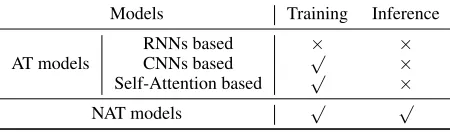
Deep neural network with encoder-decoder framework has achieved great success on machine translation, with differ-ent choices of architectures such as recurrdiffer-ent neural net-works (RNNs) (Bahdanau, Cho, and Bengio 2014; Cho et al. 2014b), convolutional neural networks (CNNs) (Gehring et al. 2017), as well as self-attention based trans-former (Vaswani et al. 2017; He et al. 2018). Early RNNs based models have an inherently sequential architecture that prevents them from being parallelized during train-ing and inference, which is partially solved by CNNs and self-attention based models (Kalchbrenner et al. 2016; Gehring et al. 2017; Shen et al. 2018; Vaswani et al. 2017; Song et al. 2018). Since the entire target translation is ex-posed to the model at training time, each input token of the decoder is the previous ground truth token and the whole training can be parallel given the well-designed CNNs or self-attention models. However, the autoregressive nature still creates a bottleneck at inference stage, since without ground truth, the prediction of each target token has to con-dition on previously predicted tokens. See Table 1 for a clear comparison between models about whether they are paral-lelizable.2.2
Non-Autoregressive Neural Machine
Translation
We generally denote the decoder input asz = (z1, ..., zTy)
to be consistent in the rest of our paper, which representsxˆ
Models Training Inference
AT models
RNNs based × ×
CNNs based √ ×
Self-Attention based √ ×
NAT models √ √
Table 1: Comparison between Autoregressive Transla-tion (AT) and Non-Autoregressive TranslaTransla-tion (NAT) mod-els about whether they are parallelizable in different stages.
andyˆin Equation (2) and (3). The recently proposed non-autoregressive model NART (Gu et al. 2017) breaks the in-ference bottleneck by exposing all decoder inputs to the net-work simultaneously. The generation ofz is guided by the fertility prediction function which represents how many tar-get tokens that each source token can translate to, and then repeatedly copy source tokens w.r.t their corresponding fer-tilities as the decoder inputz. Givenz, the conditional prob-abilityP(y|x)is defined as:
P(y|x, z) =
Ty
Y
t=1
P(yt|z, x) =
Ty
Y
t=1
P(yt|z,E(x;θenc);θdec), (4)
whereTy is the length of target sentence, which equals to
the summation of all fertility numbers.θencandθdecdenote the parameter of the encoder and decoder. The negative log-likelihood loss function for NAT model becomes:
Lneg(x, y;θenc, θdec) =−
Ty
X
t=1
logP(yt|z, x) (5)
Although non-autoregressive models can achieve 15× speedup compared to autoregressive models, they are also suffering from accuracy degradation. Since the conditional dependencies within the target sentence (yt depends on
y1:t−1) are removed from the decoder input, the decoder is
unable to leverage the inherent sentence structure for pre-diction. Hence the decoder has to figure out such target-side information by itself just with the source-side information during training, which is a much more challenging task com-pared to its autoregressive counterpart. From our study, we find the NART model fails to handle the target sentence gen-eration well. It usually generates repetitive and semantically incoherent sentences with missing words, as shown in Ta-ble 3. Therefore, strong conditional signals should be intro-duced as the decoder input to help the model learn better internal dependencies within a sentence.
3
Methodology
Encoder
Source Input Emb
Decoder
Differentiable operations Non-differentiable operations
Decoder Input Emb Target Sequence y
W
Word-Level Adversary Learning
Golden
Generated
Mapped by
Encoder
Source Input Emb
Decoder
Decoder Input Emb Target Sequence y
Source Input x Decoder Input z
Phrase Table Table Lookup
Embedding Mapping Phrase-Table Lookup
Transformer Model
Sentence-Level Alignment
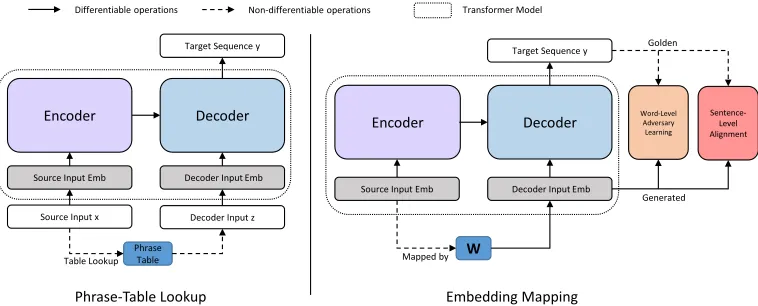
Figure 1: The architecture of our model. A concrete description of fine-grained modules can be found in Section 4.2.
3.1
Phrase-Table Lookup
Previous NAT models take tokens in the source language in as decoder inputs, which make the decoding task difficult. Considering that AT models takes (already generated) target tokens as inputs, a straightforward idea to enhance decoder inputs is to also feed tokens in the target language into the decoder of NAT models. Given a source sentence, a simple method to get target tokens is to translate those source tokens to target tokens using a phrase table, which brings negligible latency in inference.
To implement this idea, we pre-train a phrase table based on the bilingual training corpus utilizing Moses (Koehn et al. 2007), an open-source statistic machine translation (SMT) toolkit. We then greedily segment the source sentence into
Tpphrases and translate the phrases one by one according to
the phrase table. The details are as follows. We first calcu-late the maximum lengthLamong all the phrases contained in the phrase table. Fori-th source wordxi, we first check
whether phrasexi:i+Lhas a translation in the phrase table;
if not then checkxi:i+L−1, and so on. If there exists a phrase
translation forxi:i+L−j, then translate it and check the
trans-lation started atxi+L−j+1following the same strategy. This
procedure only brings 0.14ms latency per sentence on av-erage over thenewstest2014test set on an Intel Xeon E5-2690 CPU, which is negligible compared with the whole inference latency (e.g.,25to200+ ms) of the NAT model, as shown in Table 2.
Note that to reduce inference latency, we only search the phrase table to obtain a course phrase-to-phrase transla-tion, without utilizing the full procedure (including language model scoring and tree-based searching). During inference, we generatezby the phrase table lookup and skip phrases that do not have translations.
3.2
Embedding Mapping
As the phrase table is pre-trained from SMT systems, it can-not be updated/optimized during NAT model training, and may lead to poor translation quality if the table is not very accurate. Therefore, we propose the embedding mapping ap-proach, which first linearly maps the source token embed-dings to target embedembed-dings and feeds them into the decoder
as inputs. This linear mapping can be trained end-end to-gether with NAT models.
To be concrete, given the source sentence x = (x1, ..., xTx)and its corresponding embedding matrixEx∈
RTx×d where d is the dimensionality of embeddings, we
transformExinto the target-side embedding space by a
lin-ear mapping functionfG:
Ez˜=fG(Ex;W) =ExW, (6)
where W ∈ Rd×d is the projection matrix to be learned andE˜z ∈ RTx×d is the decoder input candidate who has
the same number of tokens as the source sentence x. We then reconstruct E˜z ∈ RTx×d to the final decoder input Ez ∈RTy×d whose length is identical to the length of tar-get sentence by a simple method which will be introduced in the next section. Intuitively,Ezshould contain coarse
target-side information, which is the translation of the correspond-ing source tokens in the embeddcorrespond-ing space, although in sim-ilar order as the source tokens. To ensure the projection ma-trixW to be learned end-to-end with the NAT model, we regularize the learning ofW with sentence-level alignment and word-level adversary learning.
Since we already have the sentence-level alignment from the training set, we can minimize the L2distance between the mapped source embeddings and the ground truth target embeddings in the sentence level:
Lalign(x, y) =kfG(e(x))−e(y)k2, (7)
wheree(x) = 1
Tx
PTx
i=1e(xi) is the embedding of source
sentencexwhich is simply calculated by the average of em-beddings of all source tokens.e(y)is the embedding of tar-get sentenceywhich is defined in the same way.
unsupervised word translation (Conneau et al. 2017) and text generation (Yu et al. 2017). The discriminatorfDtakes an
embedding as input and outputs a confidence score between
0and1to differentiate the embeddings mapped from source tokens, i.e.,Ez, and the ground truth embedding of the target
tokens, i.e.,Ey, during training. The linear mapping
func-tionfGacts as the generator whose goal is to makefGable
to provide plausible Ez that is indistinguishable to Ey in
the embedding space, to fool the discriminator. We imple-ment the discriminator by a two-layers multi-layer percep-tron (MLP). Although other architectures such as CNNs can also be chosen, we find that the simple MLP has achieved fairly good performance.
Formally, given the linear mapping function fG(·;W),
i.e., the generator, and the discriminatorfD(·;θD), the
ad-versarial training objectiveLadvcan be written as:
Ladv(x, y) = min
W maxθD
Vword(fG, fD), (8)
whereVwordis the word-level value function which encour-ages every word inzandyto be distinguishable:
Vword(fG, fD) =Ee(yi)∼Ey[logfD(e(yi))]+
Ee(xj)∼Ex[log(1−fD(fG(e(xj))))],
(9) where e(xj) and e(yi) indicates the embedding of j-th
source andi-th target token respectively. In conclusion, for each training pair (x, y), along with the original negative log-likelihood lossLneg(x, y) defined in Equation (5), the total loss function of our model is:
min Θ maxθD
L(x, y) =Lneg(x, y;θenc, θdec)+
µLalign(x, y;W) +λLadv(x, y;θD, W),
(10) whereΘ = (θenc, θdec, W)andθDconsist of all parameters
that need to be learned, whileµandλare hyper-parameters that control the weight of different losses.
3.3
Discussion
The approach of phrase-table lookup is simple and efficient. It achieves considerable performance in experiments by pro-viding direct token-level enhancements, when the phrase ta-ble is good enough. However, when training data is messy and noisy, the generated phrase table might be of low qual-ity and consequently hurts NAT model training. We observe that the phrase table trained by Moses can obtain fairly good performance on small and clean datasets such as IWSLT14 but very poor on big and noisy datasets such as WMT14. See Section 5.3 for more details. In contrast, the approach of embedding mapping learns to adjust the mapping func-tion together with the training of NAT models, resulting in more stable results.
As for the two components proposed in embedding map-ping, the sentence-level alignmentLalignleverages bilingual supervisions which can well guide the learning of the map-ping function, but lacks the fine-grained word-level mapmap-ping signal; word-level adversary lossLadvcan provide compli-mentary information to Lalign. Our ablation study in Sec-tion 5.3 (see Table 5) verify the benefit of combining the two loss functions.
4
Experimental Setup
4.1
Datasets
We evaluate our model on three widely used public ma-chine translation datasets: IWSLT14 De-En1, WMT14 En-De2 and WMT16 En-Ro3, which has 153K/4.5M/2.9M bilingual sentence pairs in corresponding training sets. For WMT14 tasks,newstest2013andnewstest2014are used as the validation and test set respectively. For the WMT16 En-Ro task,newsdev2016is the validation set
andnewstest2016is used as the test set. For IWSLT14
De-En, we use 7K data split from the training set as the validation set and use the concatenation ofdev2010,
tst2010,tst2011andtst2012as the test set, which
is widely used in prior works (Ranzato et al. 2015; Bah-danau et al. 2016). All the data are tokenized and segmented into subword tokens using byte-pair encoding (BPE) (Sen-nrich, Haddow, and Birch 2015) , and we share the source and target vocabulary and embeddings in each language pair. The phrase table is extracted from each training set by Moses (Koehn et al. 2007), and we follow the default hyper-parameters in the toolkit.
4.2
Model Configurations
We follow the same encoder and decoder architecture as Transformer (Vaswani et al. 2017). The encoder is composed by multi-head attention modules and feed forward networks , which are all fully parallelizable. In order to make the de-coding process parallelizable, we cannot use target tokens as decoder input cause such strong signals are unavailable while inference. Instead, we use the input introduced in the Section 3. There exists the problem of length mismatch be-tween the decoder input z and the target sentence, which is solved by a simple and efficient method. Given the de-coder input candidatez˜= (˜z1, ...,z˜Tz˜)which is either pro-vided by phrase-table lookup or Equation (6), thej-th ele-ment of the decoder inputz = (z1, ..., zTy)is computed as zj = Piwij ·e( ˜zi), wherewij = exp(−(j−j
0
(i))2/τ), andj0(i) = i· Ty
Tz˜, and τ is a hyper-parameter controlling the sharpness of the function, which is set to0.3in all tasks. We also use multi-head self attention and encoder-to-decoder attention, as well as feed forward networks for de-coder, as used in Transformer (Vaswani et al. 2017). Consid-ering the enhanced decoder input is of the same word order of the source sentence, we add the multi-head positional at-tention to rearrange the local word orders within a sentence, as used in NART (Gu et al. 2017). Therefore, the three kinds of attentions along with residual connections (He et al. 2016) and layer normalization (Ba, Kiros, and Hinton 2016) con-stitute our model.
To enable a fair comparison, we use same network ar-chitectures as in NART (Gu et al. 2017). Specifically, for WMT14 and WMT16 datasets, we use the default hyper-parameters of the base model described in Vaswani et al. (2017), whose encoder and decoder both have 6layers
1https://wit3.fbk.eu/ 2
https://www.statmt.org/wmt14/translation-task
3
and the size of hidden state and embeddings are set to512, and the number of heads is set to8. As IWSLT14 is a smaller dataset, we choose to a smaller architecture as well, which consists of a5-layer encoder and a5-layer decoder. The size of hidden state and embeddings are set to256, and the num-ber of heads is set to4.
4.3
Training and Inference
We follow the optimizer settings in Vaswani et al. (2017). Models on WMT/IWSLT tasks are trained on8/1NVIDIA M40 GPUs respectively. We setµ = 0.1 andλ = 1.0 in Equation (10) for all tasks to ensure Lneg, Lalign and Ladv are in the same scale. We implement our model on Tensor-flow (Abadi et al. 2016). We provide detailed description of the knowledge distillation and the inference stage below.
Sequence-Level Knowledge Distillation During
train-ing, we apply the same knowledge distillation method used in (Kim and Rush 2016; Gu et al. 2017; Li et al. 2019). We first train an autoregressive teacher model which has the same architecture as the non-autoregressive student model, and collect the translations of each source sentence in the training set by beam search, which are then used as the ground truth for training the student. By doing so, we pro-vide less noisy and more deterministic training data which make the NAT model easy to learn (Kim and Rush 2016; Ott et al. 2018; Gong et al. 2019). Specifically, we pre-train the state-of-the-art Transformer (Vaswani et al. 2017) archi-tecture as the autoregressive teacher model, and the beam size while decoding is set to4.
Inference While inference, we do not know the target
lengthTy. Therefore we first calculate the average ratio
be-tween target and source sentence length in the training set which is denoted asα, then predict the target length rang-ing from
bα·Tz˜i−Bc,bα·Tz˜i +Bc
whereb·cdenotes the rounding operation. This length prediction method de-pends on the intuition that the length of source sentence and target sentence is similar, whereB is half of the searching window.B = 0indicates the greedy output that only gener-ates a single translation result for a source sentence. While
B≥1, there will be multiple translations for one source sen-tence, therefore we utilize the autoregressive teacher model to rescore and select the final translation. While inference,α
is set to1.1for English-to-Others tasks and0.9for Others-to-English tasks, and we try bothB = 0andB = 4which result in1and9candidates. We use BLEU scores (Papineni et al. 2002) as the evaluation metric4.
As for the efficiency, the decoder input z is obtained through table-lookup or the multiplication between dense matrices, which brings negligible additional latency. The teacher model rescoring procedure introduced above is fully parallelizable as it is identical to the teacher forcing traing process in autoregressive models, and thus will not in-crease the latency much. We analyze the inference latency
4
We report tokenized and case-sensitive BLEU scores for WMT14 En-De and WMT16 En-Ro to keep consistent with NART (Gu et al. 2017), as well as tokenized and case-insensitive scores for IWSLT14 De-En, which is common practices in litera-ture (Wu et al. 2016; Vaswani et al. 2017).
per sentence and demonstrate the efficiency of our model in experiment.
5
Results
5.1
Translation Quality and Inference Latency
We compare our model with non-autoregressive baselines including NART (Gu et al. 2017), a semi-non-autoregressive model Latent Transformer (LT) (Kaiser et al. 2018) which incorporates an autoregressive module into NART, as well as Iterative Refinement NAT (IR-NAT) (Lee, Mansimov, and Cho 2018) which trains extra decoders to iteratively refine the translation output, and we list the “Adaptive” results re-ported in their paper. We also compare with strong autore-gressive baselines that based on LSTM (Wu et al. 2016; Bahdanau et al. 2016) and self-attention (Vaswani et al. 2017). We also list the translation quality purely by lookup from the phrase table, denoted as Phrase-Table Lookup, which serves as the decoder input in the hard model. For inference latency, the average per-sentence decoding latency on WMT14 En-De task over thenewstest2014test set is also reported, which is conducted on a single NVIDIA P100 GPU to keep consistent with NART (Gu et al. 2017). Results are shown in Table 2.
Among different datasets, our model achieves state-of-the-art performance all non-autoregressive baselines. Specifically, our model outperforms NART with rescoring
10 candidates from 4.26 to 5.62 BLEU score on differ-ent tasks. Comparing to autoregressive models, our model is only 1.1 BLEU score behind its Transformer teacher at En-Ro tasks, and we also outperforms the state-of-the-art LSTM-based baseline (Wu et al. 2016) on IWSLT14 De-En task. The promising results demonstrate that the proposed method can make the decoder easy to learn by providing a strong input close to target tokens and result in a bet-ter model. For inference latency, NART needs to first pre-dict the fertilities of source sentence before the translation process, which is slower than the phrase-table lookup pro-cedure and matrix multiplication in our method. Moreover, our method outperforms NART with rescoring 100 candi-dates on all tasks, but with nearly5times faster, which also demonstrate the advantages of the enhanced decoder input.
Translation Quality w.r.t Different Lengths We compare
WMT14 WMT16 IWSLT14
Models En−De De−En En−Ro De−En Latency / Speedup
LSTM-based S2S (Wu et al. 2016) 24.60 / / 28.53† / /
Transformer (Vaswani et al. 2017) 27.41† 31.29† 35.61† 32.55† 607ms 1.00×
LT (Kaiser et al. 2018) 19.80 / / / 105ms 5.78×
LT (rescoring10candidates) 21.00 / / / / /
LT (rescoring100candidates) 22.50 / / / / /
NART (Gu et al. 2017) 17.69 21.47 27.29 22.95† 39ms 15.6×
NART (rescoring10candidates) 18.66 22.41 29.02 25.05† 79ms 7.68×
NART (rescoring100candidates) 19.17 23.20 29.79 / 257ms 2.36×
IR-NAT (Lee, Mansimov, and Cho 2018) 21.54 25.42 29.66 / 254†ms 2.39×
Phrase-Table Lookup 6.03 11.24 9.16 15.69 / /
ENAT Phrase-Table Lookup 20.26 23.23 29.85 25.09 25ms 24.3×
ENAT Phrase-Table Lookup(rescoring9candidates) 23.22 26.67 34.04 28.60 50ms 12.1×
ENAT Embedding Mapping 20.65 23.02 30.08 24.13 24ms 25.3×
ENAT Embedding Mapping(rescoring9candidates) 24.28 26.10 34.51 27.30 49ms 12.4×
Table 2: BLEU scores on WMT14 En-De, WMT14 De-En, WMT16 En-Ro and IWSLT14 De-En tasks. “/” indicates the cor-responding result is not reported and “†” means results are produced by ourselves. We also list the inference latency compared with previous works. ENAT with rescoring9candidates indicates results whenB= 4, otherwiseB= 0.
[0,10) [10, 20) [20, 30) [30,40) >40
Length Buckets 10.0
12.5 15.0 17.5 20.0 22.5 25.0 27.5 30.0
BLEU
BLEU scores over different sentence length buckets
NART Ours AT
Figure 2: The BLEU scores comparison between AT, NART, and our method over sentences in different length buckets on
newstest2014. Best view in color.
5.2
Case Study
We conduct several case studies on IWSLT14 De-En task to intuitively demonstrate the superiority of our model, listed in Table 3.
As we claimed in Section 1, the NART model tends to repetitively translate same words or phrases and sometimes misses meaningful words, as well as performs poorly while translating long sentences. In the first case, NART fails to translate a long sentence due to the weak signal provided by the decoder input, while both of our models success-fully translate the last half sentence thanks to the strong information carried in our decoder input. As for the sec-ond case, NART translates “to you” twice, and misses “all of”, which therefore result in a wrong translation, while our model achieves better translation results again.
5.3
Method Analysis
Phrase-Table Lookup v.s. Embedding Mapping We have
proposed two different approaches to provide decoder input with enhanced quality, and we make a comparison between the two approaches in this subsection.
According to Table 2, the phrase-table lookup achieves better BLEU scores in IWSLT14 En and WMT14 De-En task, and the embedding mapping performs better on the other two tasks. We find the performance of the first ap-proach is related to the quality of phrase table, which can be judged by the BLEU score of the Phrase-to-Phrase trans-lation. As IWSLT14 De-En is a cleaner and smaller dataset, the pre-trained phrase table tends to have good quality (with BLEU score 15.69 as shown in Table 2), therefore it is able to provide an accurate enough signal to the decoder. Although WMT14 En-De and WMT16 En-Ro dataset are much larger, the phrase tables are of low quality (with BLEU score 6.03 in WMT14 En-De and 9.16 in WMT16 En-Ro), which may provides noise signals such as missing too much tokens and misguide the learning procedure. Therefore, our embedding mapping outperforms the phrase-table lookup by providing implicit guidance and allow the model adjust the decoder input in a way of end-to-end learning.
Varying the Quality of Decoder Input We study how the
out-Source: hier ist ein foto, das ich am n¨ordlichen ende der baffin-inseln aufnahm, als ich mit inuits auf die narwhal-jagd ging. und dieser mann, olaya, erz¨ahlte mir eine wunderbare geschichte seines großvaters.
Target: this is a photograph i took at the northern tip of baffin island when i went narwhal hunting with some inuit people, and this man, olayuk, told me a marvelous story of his grandfather.
Teacher: here’s a photograph i took up at the northern end of the fin islands when i went to the narwhal hunt, and this man, olaya, told me a wonderful story of his grandfather.
NART: here’s a photograph that i took up the north end of of the baffin fin when i with iuits went to the narwhal hunt, and this guy guy, ollaya. & lt; em & gt; & lt; / em & gt;
PT: so here’s a photo which i the northern end the detected when i was sitting on on the went. and this man , told me a wonderful story his’s.
ENAT Phrase: here’s a photograph i took up at the end of the baffin islands i went to the nnarwhal hunting hunt, and this man, olaaya told me a wonderful story of his grandfather.
ENAT Embedding: here’s a photograph that i took on the north of the end of the baffin islands, when i went to nuits on the narhal hunt, and this man, olaya, told me a wonderful story of his grandfather.
Source: ich freue mich auf die gespr¨ache mit ihnen allen!
Target: i look forward to talking with all of you.
Teacher: i’m happy to talk to you all!
NART: i’m looking to the talking to to you you.
PT: i look forward to the conversations with you all!
ENAT Phrase: i’m looking forward to the conversations with all of you.
ENAT Embedding: i’m looking forward to the conversations to all of you.
Table 3: Case studies on IWSLT14 De-En task. ENAT Phrase and ENAT Embedding denotes the proposed phrase-table lookup and embedding mapping methods respectively. PT indicates the phrase-table lookup results, which serves as the decoder input to ENAT Phrase method. We collect the results of NART with rescoring10candidates and setB = 4while inference for our methods to confirm a fair comparison.
Approach Decoder Input NAT Result
Word-Table Lookup 3.54 19.16
Phrase-Table Lookup 6.03 20.33
Table 4: The BLEU scores when varying the quality of de-coder input on WMT14 En-De task. We set B = 0in the inference for the NAT result.
Lalign Ladv BLEU score
√ √
24.13 √
23.53 √
23.74
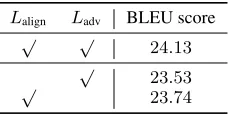
Table 5: Ablation study of the embedding mapping approach on IWSLT14 De-En task. We setB= 0while inference.
puts and the reference in WMT14 En-De test set, listed in Table 4. The quality of the word-table lookup is relatively poor compared with the phrase-table lookup. Under this cir-cumstance, the signal provided by the decoder input will be weaker, and thus influence the accuracy of NAT model.
Ablation Study on Embedding Mapping We conduct
an ablation study in this subsection to study the different components in the embedding mapping approach, i.e., the sentence-level alignment and word-level adversary learn-ing. Results are shown in Table 5. Sentence-level alignment
Lalign slightly outperforms the word-level adversary learn-ingLadv. However, addingLadvtoLalignimproves the BLEU score to24.13, which illustrates that the complimentary in-formation provided by two loss functions is indispensable.
6
Conclusion
We targeted at improving accuracy of non-autoregressive translation models and proposed two methods to enhance the decoder inputs of NAT models: one based on a phrase table and the other one based on word embeddings. Our methods outperform the baseline on all tasks by BLEU scores ranging from3.47to5.02.
In the future, we will extend this study from several as-pects. First, we will test our methods on more language pairs and larger scale datasets. Second, we will explore bet-ter methods to utilize the phrase table. For example, we may sample multiple candidate target tokens (instead of using the one with largest probability in this work) for each source to-ken and feed all the candidates into the decoder. Third, it is interesting to investigate better methods (beyond the phrase table and word embedding based methods in this work) to enhance the decoder inputs and further improve translation accuracy for NAT models.
Acknowledgements
and the Fundamental Research Funds for the Central Uni-versities (WK2150110008).
References
Abadi, M.; Barham, P.; Chen, J.; Chen, Z.; Davis, A.; Dean, J.; Devin, M.; Ghemawat, S.; Irving, G.; Isard, M.; et al. 2016. Tensorflow: a system for large-scale machine learn-ing. InOSDI, volume 16, 265–283.
Ba, J. L.; Kiros, J. R.; and Hinton, G. E. 2016. Layer nor-malization.arXiv preprint arXiv:1607.06450.
Bahdanau, D.; Brakel, P.; Xu, K.; Goyal, A.; Lowe, R.; Pineau, J.; Courville, A.; and Bengio, Y. 2016. An actor-critic algorithm for sequence prediction. arXiv preprint arXiv:1607.07086.
Bahdanau, D.; Cho, K.; and Bengio, Y. 2014. Neural ma-chine translation by jointly learning to align and translate.
arXiv preprint arXiv:1409.0473.
Brown, P. F.; Pietra, V. J. D.; Pietra, S. A. D.; and Mer-cer, R. L. 1993. The mathematics of statistical machine translation: Parameter estimation.Computational linguistics
19(2):263–311.
Cho, K.; Van Merri¨enboer, B.; Bahdanau, D.; and Ben-gio, Y. 2014a. On the properties of neural machine translation: Encoder-decoder approaches. arXiv preprint arXiv:1409.1259.
Cho, K.; Van Merri¨enboer, B.; Gulcehre, C.; Bahdanau, D.; Bougares, F.; Schwenk, H.; and Bengio, Y. 2014b. Learning phrase representations using rnn encoder-decoder for statis-tical machine translation.arXiv preprint arXiv:1406.1078. Conneau, A.; Lample, G.; Ranzato, M.; Denoyer, L.; and J´egou, H. 2017. Word translation without parallel data.
arXiv preprint arXiv:1710.04087.
Gehring, J.; Auli, M.; Grangier, D.; Yarats, D.; and Dauphin, Y. N. 2017. Convolutional sequence to sequence learning.
arXiv preprint arXiv:1705.03122.
Gong, C.; Tan, X.; He, D.; and Qin, T. 2019. Sentence-wise smooth regularization for sequence to sequence learning. In
AAAI.
Goodfellow, I.; Pouget-Abadie, J.; Mirza, M.; Xu, B.; Warde-Farley, D.; Ozair, S.; Courville, A.; and Bengio, Y. 2014. Generative adversarial nets. InNIPS.
Gu, J.; Bradbury, J.; Xiong, C.; Li, V. O.; and Socher, R. 2017. Non-autoregressive neural machine translation.arXiv preprint arXiv:1711.02281.
He, K.; Zhang, X.; Ren, S.; and Sun, J. 2016. Deep resid-ual learning for image recognition. InProceedings of the IEEE conference on computer vision and pattern recogni-tion, 770–778.
He, T.; Tan, X.; Xia, Y.; He, D.; Qin, T.; Chen, Z.; and Liu, T.-Y. 2018. Layer-wise coordination between encoder and decoder for neural machine translation. InNIPS.
Kaiser, Ł.; Roy, A.; Vaswani, A.; Pamar, N.; Bengio, S.; Uszkoreit, J.; and Shazeer, N. 2018. Fast decoding in se-quence models using discrete latent variables.arXiv preprint arXiv:1803.03382.
Kalchbrenner, N.; Espeholt, L.; Simonyan, K.; Oord, A. v. d.; Graves, A.; and Kavukcuoglu, K. 2016. Neu-ral machine translation in linear time. arXiv preprint arXiv:1610.10099.
Kim, Y., and Rush, A. M. 2016. Sequence-level knowledge distillation.arXiv preprint arXiv:1606.07947.
Koehn, P.; Hoang, H.; Birch, A.; Callison-Burch, C.; Fed-erico, M.; Bertoldi, N.; Cowan, B.; Shen, W.; Moran, C.; Zens, R.; et al. 2007. Moses: Open source toolkit for statis-tical machine translation. InProceedings of the 45th annual meeting of the ACL on interactive poster and demonstration sessions, 177–180.
Lee, J.; Mansimov, E.; and Cho, K. 2018. Deterministic non-autoregressive neural sequence modeling by iterative refine-ment.arXiv preprint arXiv:1802.06901.
Li, Z.; He, D.; Tian, F.; Qin, T.; Wang, L.; and Liu, T.-Y. 2019. Hint-based training for non-autoregressive translation. Ott, M.; Auli, M.; Granger, D.; and Ranzato, M. 2018. Analyzing uncertainty in neural machine translation. arXiv preprint arXiv:1803.00047.
Papineni, K.; Roukos, S.; Ward, T.; and Zhu, W.-J. 2002. Bleu: a method for automatic evaluation of machine transla-tion. InProceedings of the 40th annual meeting on associa-tion for computaassocia-tional linguistics, 311–318.
Ranzato, M.; Chopra, S.; Auli, M.; and Zaremba, W. 2015. Sequence level training with recurrent neural networks.
arXiv preprint arXiv:1511.06732.
Sennrich, R.; Haddow, B.; and Birch, A. 2015. Neural ma-chine translation of rare words with subword units. arXiv preprint arXiv:1508.07909.
Shen, Y.; Tan, X.; He, D.; Qin, T.; and Liu, T.-Y. 2018. Dense information flow for neural machine translation. In
NAACL.
Song, K.; Tan, X.; He, D.; Lu, J.; Qin, T.; and Liu, T.-Y. 2018. Double path networks for sequence to sequence learn-ing. InCOLING.
Sutskever, I.; Vinyals, O.; and Le, Q. V. 2014. Sequence to sequence learning with neural networks. InNIPS.
Vaswani, A.; Shazeer, N.; Parmar, N.; Uszkoreit, J.; Jones, L.; Gomez, A. N.; Kaiser, Ł.; and Polosukhin, I. 2017. At-tention is all you need. InNIPS.
Wu, Y.; Schuster, M.; Chen, Z.; Le, Q. V.; Norouzi, M.; Macherey, W.; Krikun, M.; Cao, Y.; Gao, Q.; Macherey, K.; et al. 2016. Google’s neural machine translation system: Bridging the gap between human and machine translation.
arXiv preprint arXiv:1609.08144.