Volume 3, Issue 5, May 2014
Page 99
Abstract
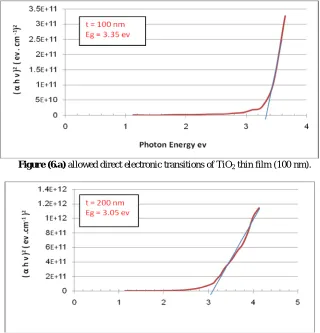
TiO2 thin films were deposited by reactive R.F. magnetron sputtering method on glass substrates with different thicknesses 100 and 200 nm. The structure of TiO2 thin films was tested with the X-Ray diffraction and it was formed to be a polycrystalline with recognized peaks oriented in ( 101) , ( 004) and ( 105) for thickness of 100 nm and (101), ( 004) ( 200) for thickness of 200 nm . The surface morphology of the deposits materials have been studied by using atomic force microscope (AFM). The grain size of the nanoparticles observed in the range of (27) (32) nm for the thickness of 100 and 200 nm respectively. The optical properties concerning the absorption and transmission spectra were studied for the prepared thin films. Optical band gaps were calculated and were found to be (3.35) eV and (3.05) eV for sample thickness of 100 and 200 nm respectively.
Keywords: TiO2: Thin Film; Nanostructure; Optical; Sputtering RF.
1.
I
NTRODUCTIONSputtering is initiated due to the bombardment of energetic particles at the target. These energetic particles are generally ions. Two approaches can be followed to produce ions and sputter the target materials. The first is quite straightforward by using an ion source which is aimed toward the target Collecting the sputtered particles on a substrate enables the deposition of a thin film. However, ion beam sputtering is not widely used for industrial large scale applications. Ions guns are more often utilized in surface analytical techniques such as SIMS (secondary ion mass spectrometry) or to bombard the substrate during thin film deposition[1]. The sputtering process with the assistant of magnetron cathodes is called magnetron sputtering which is widely used in both scientific and industrial fields[2]. A magnetron uses a magnetic field to confine electrons close to the cathode, making it easier to sustain an electrical discharge at low pressure. There are various geometries but all magnets are arranged in such a way that the magnetic field lines are parallel to the cathode surface and perpendicular to the electric field lines. This causes the secondary electrons to drift in a closed path in the – E ×B direction, also known as the Hall Effect, trapping the electrons near the cathode surface. This arrangement results in enhanced ion bombardment and sputtering rates for both DC and RF discharges. Magnetron sputtering is particularly useful when high deposition rates and low substrate temperatures are required [3]. In RF magnetron sputtering, cathode and anode are changeable and for very short cycles, target functions as anode which cause the removal of insulating layer. By doing so, the process can continue [4,5]. Transition metal oxides are often nonstoichiometric, at near-atmospheric oxygen pressure the oxygen vacancies is the predominant defect in TiO2 [6]. The oxygen deficiency introduces an excess of electrons in the material resulting in an increase of the electrical conductivity [7]. The oxygen vacancies act as electron donors, thus TiO2-x is an n-type semiconductor, in contrast with p-type semiconductors which contain electron acceptors and where the charge carriers are holes rather than electrons [8].
Nano-crystalline titanium dioxide (TiO2) is one of the most investigated oxide materials due to its high refractive index, high dielectric constant, and optical transmittance in the visible and near-IR region [9, 10]. It has been attracted a lot of interest for a wide range of applications, such as dye-sensitized solar cells[11,12] photo catalysts[13] optical coatings[14,15] and capacitors for large-scale integrated (LSI) devices[16]. Thin films and nanostructures based on titanium dioxide are extensively studied for various applications because of their multifunctional nature. Among MOS (metal oxide semiconductors), the stability of titanium dioxide in harsh environment makes it a good candidate for gas sensing applications [17].
2.
EXPERIMENTALDETAILSTitanium dioxide (TiO2) thin films were prepared on glass substrates via reactive radio frequency (RF) magnetron sputtering system using pure Titanium dioxide (TiO2) target with purity of 99.99%. The glass substrates were cleaned chemically and ultrasonically, the glass substrate was cleaned by Ethanol followed by distilled water rinse, subsequently samples are placed in beaker contain distilled water inside ultrasonic device for 2 hour at 353K The substrates and target
Study of The Structural and Optical Properties
of Titanium dioxide Thin Films Prepared by RF
Magnetron sputtering
Aqeel K. Hadi1, Muneer H.Jaduaa1, Abdul- Hussain K. Elttayef2
1
Wasit University - College of science ,2 Ministry of Science and Technology
Volume 3, Issue 5, May 2014
Page 100
were fixed in the chamber of magnetron sputtering system . The base pressure of the deposition chamber was kept at 6 × 10⁻⁵ Torr,3.
Results and discussion:
3.1 Structural Properties
The X-Ray diffraction (XRD) analysis is conducted to determine the
Phases and the grain size. The XRD patterns for the investigated TiO2 samples prepared at Room temperatures and constant deposition time as well as those deposited at different thickness are shown in Fig. (1 a, b).
Fig (1. a.) XRD of TiO2 thin film (100 nm).
Fig (1. b.) XRD of TiO2 thin film ( 200 nm ).
The XRD patterns for samples prepared at Room temperatures show only three peaks at 25.3o Tio2 (101), 37.9o ( 004) and 53.9o ( 105 ) anatase for 100 nm, while at 200 nm thickness phase appearance at 25.3o TiO2 ( 101) , 37.9
o
( 004) and 48o ( 200) anatase . These results in agreement with the standard TiO2 for 100 nm thickness XRD [X-ray diffraction data file [N 1997 JCPDS prevalent].
The mean crystallite size has been obtained with Scherer relation [18],
D = kλ / (βCosθ) ……….. (1)
where D is the crystallite size, k is a fixed number of 0.9, λ is the X-ray
wavelength, θ is the Bragg’s angle in degrees, and β is the full-width-at-half maximum (FWHM) of the chosen peak.
(004)A
Volume 3, Issue 5, May 2014
Page 101
The mean size of crystallization calculated using eg 1for 100 nm and 200 nm thin films of TiO2 is found to be 30 nm and 37 nm.3.2 Morphology
Morphological information of these thin film surfaces was analyzed by the AFM as shown in fig. ( 2) and fig.( 3 ).
From the topographic images, it can be seem that the films deposited with thickness of 100 nm appear to be more uniform that the topography of the sample deposited with thickness of 200 nm.
The film 100 nm has particle size (27nm) while the film of 200 nm has a particle size (32 nm).
Fig.2. AFM images of TiO2 thin film (100 nm)
Fig.3. AFM images of TiO2 thin film (200 nm)
3.2 Optical Properties
Figure (4) illustrates transmittance spectrum of TiO2 films for different thickness (100,200 nm.). It is observed that maximum transmittance at (100 nm) thickness for wavelength range (650 -800 nm).
Volume 3, Issue 5, May 2014
Page 102
Figure (5) illustrates absorptance spectrum for (TiO2) films of 100, 200 nm. When the thickness of the film is increased, absorptance is also increased. At the visible spectrum absorption is minimum, that it is suitable to be antireflection coating.Fig. ( 5 ) the relation between Absorption and wavelength of TiO2 thin films
3.3 The Energy gap
The energy gap can be calculated from equation:
(αhν)1/2
= B
(hν-Eg) 1/2………..(2)
Where :( α )Absorption coefficient , (h) Planck's constant, ( ν) The frequency of the photon , (hν) photon energy, ( B ) Constant depends on the probability of the transfer of electronic the relations are drawn between (α hν)2 and photon energy ( hν),as in figure (6.a,b) illustrate allowed direct transition electronic .
Figure (6.a) allowed direct electronic transitions of TiO2 thin film (100 nm).
Volume 3, Issue 5, May 2014
Page 103
4.
Conclusion
We have successfully prepared TiO2 films by reactive R.F. magnetron sputtering method on glass substrates with different thicknesses. The resulting TiO2 films were characterized by XRD measurement and AFM. The optical properties concerning the absorption and transmission spectra were studied for the prepared thin films.
References
[1] A. Anders Surface & Coatings Technology 200 (2005) 1893 – 1906.
[2] P. J. Kelly and R. D. Arnell, Vacuum 56 (3), 159 (2000).
[3] F.L.Akkad, APunnose, J.Prabu, J.Appl.Phys A 71(2000)157A magnetron uses a magnetic
[4] J. L. Vossen, and W. Kern, “Thin film processes II”, Academic press (1st edition, 1991), pp. 24-32.
[5] P. M. Martin, “Handbook of deposition technologies for films and coatings”, Elsevier (3rd edition, 2010), pp. 277-278.
[6] P. Kofstad: “Nonstoichiometry, diffusion, and electrical conductivity in binary metal oxides”, Wiley Interscience, New York (1972).
[7] S. M. Sze: “Physics of semiconductor devices”, Wiley Interscience, New York (1981).
[8] H. Kim, D. C. Gilmer, S. A. Campbell and D. L. Polla: Appl. Phys. Lett. 69 (1996) 3860–3862.
[9] A. Fujishima and K. Honda: Nature 238 (1972) 37–38.
[10]L. Forro, O. Chauvef, D. Emin, L. Zuppiroli, H. Berger and D. Levy: J. Appl. Phys. 75 (1994) 633–635
[11]B. O’Regan and M. Gra¨tzel: Nature 353 (1991) 737–740.
[12]A. Hagfelt and M. Gratzel: Chem. Rev. 95 (1995) 49–68.
[13]A. Fujishima and K. Honda: Bull. Chem. Soc. Japan 44 (1971) 1148–1150.
[14]K. Narashimha Rao and S. Mohan: J. Vac. Sci. Technol. A 8 (1990) 3260–3264.
[15]K. Balasubramanian, X. F. Han and K. H. Guenther: Appl. Opt. 32 (1993) 5594–5600.
[16]Y. H. Lee: Vacuum 51 (1998) 503–509
[17]L. E. Depero, and G. Sberveglieri, Cr-inserted TiO2 thin films for chemical gas sensors, Sensors and Actuators B Vol. 128 (2007);, 312–319
[18]B.D. Cullity, “Elements of x-ray diffraction”, Addison-Wesley Publishing Company Inc., London (1978).
Author
Aqeel K. Hadi . M.SC student in physics department, college of science, Wasit University. His research interest includes the preparation of nano films and applications
Muneer H.Jaduaa, He is Assistant Proff., at physics dept., college of science, Wasit university. He is leading research group in the field of solid state and material Science. Graduate in Voronezh State University (Russian Federation).