I. Introduction
T
HE quadratic assignment problem (QAP) is one of the known classical combinatorial optimization problems, in 1976 Sahni and Gonzalez [1] proved that the QAP belongs to the class of NP-hard problems [1]. It was introduced for the first time by Koopmans and Beckmann in 1957 [2]; its purpose is to assign n facilities to n fixed locations with a given flow matrix of facilities and distance matrix of locations in order to minimize the total assignment cost. This problem is applied in various fields such as hospital layout [3], scheduling parallel production lines [4] and analyzing chemical reactions for organic compounds [5].Many recent hybrid approaches have improved performance in solving QAP such as genetic algorithm hybridized with tabu search method [6], ant colony optimization mixed with local search method [7] and ant colony optimization combined with genetic algorithm and local search method [8]. Recently the hybrid algorithms are much proposed and used by many researchers to find optimal or near optimal solutions for the QAP.
In this paper we propose a new competitive approach when compared with other existing methods in the literature. The golden ball algorithm mixed with simulated annealing (GBSA) is considered here as a hybrid metaheuristic to apply in the quadratic assignment problem. This work presents an efficient adaptation of GBSA algorithm to the quadratic assignment problem (QAP). This algorithm is based on the concept of soccer; it guides the search by simulated annealing [9] to
escape from the local optima. The suggested technique has never been proposed or tested with QAP. In this research we use some small, medium and large test problems for comparing our approach to other recent methods from literature. Our approach is able to explore effectively the search space; it reaches the known optimal solutions in less time.
The rest of this paper is structured as follows: In section I, Introduction. In section II, Quadratic assignment problem formulation. In section III, Methods. In section IV, Results and discussion. In section V, Conclusion.
II. Quadratic Assignment Problem
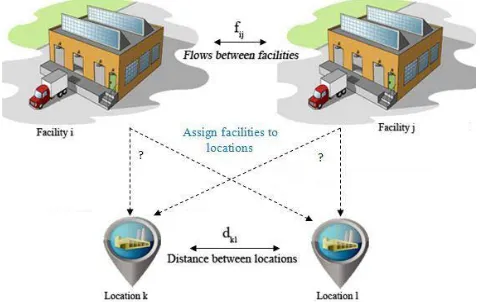
The QAP [1] can be defined as a problem of assigning n facilities to n locations, with given flows between the facilities and given distances between the locations (Fig.1).
Fig. 1. Quadratic Assignment Problem.
Keywords
Combinatorial Optimization, Golden Ball Algorithm, Simulated Annealing, Quadratic Assignment Problem.Abstract
The Quadratic Assignment Problem (QAP) is a combinatorial optimization problem; it belongs to the class of NP-hard problems. This problem is applied in various fields such as hospital layout, scheduling parallel production lines and analyzing chemical reactions for organic compounds. In this paper we propose an application of Golden Ball algorithm mixed with Simulated Annealing (GBSA) to solve QAP. This algorithm is based on different concepts of football. The simulated annealing search can be blocked in a local optimum due to the unacceptable movements; our proposed strategy guides the simulated annealing search to escape from the local optima and to explore in an efficient way the search space. To validate the proposed approach, numerous simulations were conducted on 64 instances of QAPLIB to compare GBSA with existing algorithms in the literature of QAP. The obtained numerical results show that the GBSA produces optimal solutions in reasonable time; it has the better computational time. This work demonstrates that our proposed adaptation is effective in solving the quadratic assignment problem.
Hybrid Algorithm for Solving the Quadratic
Assignment Problem
Mohammed Essaid Riffi, Fatima Sayoti*
LAROSERI Laboratory, Dept. of Computer Science, Faculty of Sciences, University of Chouaib
Doukkali, El Jadida (Morocco)
Received 1 June 2017 | Accepted 27 September 2017 | Published 20 October 2017
* Corresponding author.
E-mail address: [email protected]
The purpose is to assign the facilities to the locations in such a way that the total cost is minimized. Each facility must be placed just at one location.
We consider two n × n matrices, the flow matrix F=fij and the distance matrix D=dkl. The QAP formulation is given as follows (1):
minCost = ∑
∑
f
ijd
π(i) π(j)(1)
Sn is the set of all permutation of n elements {1, 2, …, n}.
π(i) and π(j) are respectively locations of facilities i and j, we suppose that π(i)=k and π(j)=l.
fij dπ(i) π(j) is the cost of assigning facility i in location k and facility j in location l.
The objective function (Cost) must be minimized.
Several algorithms are usually used to solve the quadratic assignment problem:
• Exact algorithms such as branch and bound algorithm [10] and branch and cut algorithm [11].
• Metaheuristics such as genetic algorithm [12],[13],[14], tabu search method [15],[16],[17], simulated annealing algorithm [9], ant colony optimization [18] and particle swarm optimization [19].
In recent year, metaheuristic algorithms are used in solving the QAP more than the exact algorithms which are unable to solve the hard instances of QAP in a reasonable time. Many researchers compared between different metaheuristic algorithms for solving the QAP [20], [21].
III. Methods
A. Golden Ball Metaheuristic
The GB technique is a metaheuristic proposed by E.Osaba et al. [22],[23]. It uses different principles of soccer to solve combinatorial optimization problems. The quality of this technique is demonstrated applying it to four combinatorial problems [23]: Asymmetric traveling salesman problem (ATSP) [24], Vehicle Routing Problem with Backhauls (VRPB) [25],[26], n-Queen Problem (NQP) [27], One-Dimensional Bin Packing Problem (BPP) [28].This algorithm is a promising metaheuristic to solve combinatorial optimization problems [23].
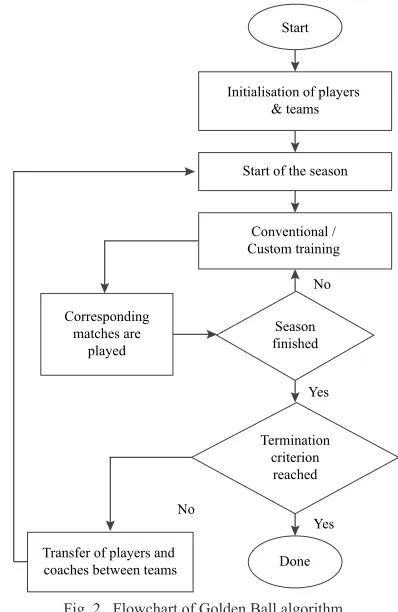
In Golden Ball algorithm, groups of solutions are considered as soccer teams which are composed of a fixed number of players, the captain of team plays the rule of the best solution of the group. Each team has a coach who determines the type of training to improve the efficiency of its team. There are two types of training: conventional training and custom training. As shown in Fig. 2, the concept of this method is based on four main phases: initialization phase, training phase, competition phase and transfer phase.
In the initialization phase, we set the value of the number of teams (NT) and the number of players per team (PT). We assign randomly to each team a coach.
In the training phase, all teams must train by following a specific type of training. The conventional training is the daily training of a team. When a team becomes unable to improve its capacities, in this case, it must follow a custom training.
In the competition phase, each team must compete with other team chosen randomly. The winning team receives three points, in the case of equality; both teams receive one point. The accumulated points will be used to order the teams in descending order.
In the transfer phase, we detect three cases of transfer:
Season transfer: during the season, all teams must be sorted in the descending order according to the strength value.
Start
Initialisation of players & teams
Start of the season
Conventional / Custom training
Season finished
No
Yes Corresponding
matches are played
Termination criterion
reached
Transfer of players and
coaches between teams Done
No
Yes
Fig. 2. Flowchart of Golden Ball algorithm.
The strength value is calculated using the following formula (2):
∑
(2)
qij is the quality of player i of team j
All teams exchange their players in this way: the best player of the first team must be replaced by the worst player of the last team. This worst player will be replaced by this best player.
The best player of the second team must be replaced by the worst player of the penultimate team. This worst player will be replaced by this best player and so forth.
Special transfer: When a player of a given team is unable to improve after a custom training, the team must exchange it with a player of another team chosen randomly.
Cessation of coaches: after having ordered all the teams in descending order according to their accumulated point, the weaker teams must change their conventional training by another randomly selected.
The GB algorithm was tested by E.Osaba et al. with four different combinatorial optimization problems [23]. The same technique was applied on the flow shop scheduling problem [29] and the job shop scheduling problem [30].
B. Simulated Annealing Method
= ∆ /( × )
(3)
is Boltzmann constant∆
is the energy difference produced by this change of state is the temperature of the solidViscous liquid state
Crystal structure Amorphous structure
High energy
High temperature
Slow
cooling coolingFast
Local energy minimun Global energy minimun
Fig. 3. Evolution of thermodynamic system.
The simulated annealing method [31] is one of the oldest algorithms; it is an iterative metaheuristic very used to solve combinatorial optimization problems in the continuous and discrete case. The strong point of this technique is to escape from the local minima and avoid the cyclic behavior. The performance of simulated annealing algorithm depends on a set of parameters which must be controlled. It means that the correct setting of the parameters produces satisfactory results.
IV. Adaptation of GBSA Algorithm
In the initialization phase we generate randomly the initial population of NT×PT solutions.
Each solution is represented in the following manner (Fig. 4):
Locations 2 7 4 5 6 3 9 8 1
Facilities i=1 i=2 i=3 i=4 i=5 i=6 i=7 i=8 i=9 Fig. 4. Assign 9 facilities to 9 locations.
In the training phase, we used the following methods as conventional training functions:
2-opt [32], [33]: this iterative method is a local search algorithm, it repeatedly tries to improve the current assignment by exchanging two facilities.
Insertion method [34]: this method inserts a facility chosen randomly between two facilities.
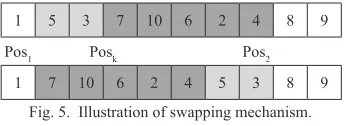
Swapping mechanism [35]: this method swaps two parts selected randomly; the following figure (Fig. 5) explains the concept of this technique.
1 5 3 7 10 6 2 4 8 9
Pos1 Posk Pos2
1 7 10 6 2 4 5 3 8 9 Fig. 5. Illustration of swapping mechanism.
As a custom training function the proposed adaptation used simulated annealing method [14],[31], it is used when the current solution is blocked in the local minima; it helps to accept some movement and escape from the local optimum.
Simulated annealing steps
S1:=Current solution
Generate a new solution based on the current solution. We used the swap of two random locations
S2:=New solution f(S1):= cost of S1 f(S2):= cost of S2 if ( f(S2)<f(S1))
S1:=S2 Else
Generate random number r in [0,1) Calculate the value of p
= ( ( ) ( ))/( )
If(r<p) S1:=S2
Decrease the temperature value Repeat all steps until T= 0.
V. Results and Discussion
The program was run 10 times on different instances of QAPLIB [36]. The GBSA algorithm was implemented in C language and compiled using Microsoft Visual Studio 2008, the program code was executed in computer with Genuine Intel( R ) 575 @ 2.00 GHz 2.00 GHz RAM 2,00 Go.
The program uses three parameters: NT (number of groups), PT (number of schedules per group) and T (temperature).
The parameters values in the table below (Table I) produce better results during the algorithm run.
4×5 random solutions are sufficient to obtain good results.
TABLE I. Parameters values
NT 4
PT 5
T 40
At the high temperature, the simulated annealing method becomes unnecessary because proximally 50% of iterations accept decision at the high temperature [37]. In this paper we fixed the high temperature at 40 which is considered a symptom of fever in humans.
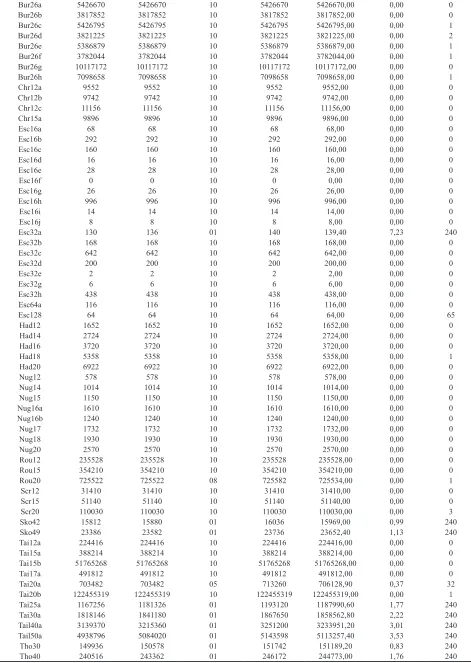
Table II represents the following information: Optimal: Best known Solution
Best: Best permutation
NBest: The number of runs in which the algorithm reaches the best permutation
Worst: The worst permutation
Average: The average cost (= the sum of solutions cost obtained divided by 10)
The relative percentage deviation from the best known solution is calculated as follows (4):
RPD = Average − Optimal
Optimal × 100 %
(4)
TABLE II. Numerical Results of the GBSA Algorithm
Instance Optimal Best Nbest Worst Average %RPD Time
Bur26a 5426670 5426670 10 5426670 5426670,00 0,00 0
Bur26b 3817852 3817852 10 3817852 3817852,00 0,00 0
Bur26c 5426795 5426795 10 5426795 5426795,00 0,00 1
Bur26d 3821225 3821225 10 3821225 3821225,00 0,00 2
Bur26e 5386879 5386879 10 5386879 5386879,00 0,00 1
Bur26f 3782044 3782044 10 3782044 3782044,00 0,00 1
Bur26g 10117172 10117172 10 10117172 10117172,00 0,00 0
Bur26h 7098658 7098658 10 7098658 7098658,00 0,00 1
Chr12a 9552 9552 10 9552 9552,00 0,00 0
Chr12b 9742 9742 10 9742 9742,00 0,00 0
Chr12c 11156 11156 10 11156 11156,00 0,00 0
Chr15a 9896 9896 10 9896 9896,00 0,00 0
Esc16a 68 68 10 68 68,00 0,00 0
Esc16b 292 292 10 292 292,00 0,00 0
Esc16c 160 160 10 160 160,00 0,00 0
Esc16d 16 16 10 16 16,00 0,00 0
Esc16e 28 28 10 28 28,00 0,00 0
Esc16f 0 0 10 0 0,00 0,00 0
Esc16g 26 26 10 26 26,00 0,00 0
Esc16h 996 996 10 996 996,00 0,00 0
Esc16i 14 14 10 14 14,00 0,00 0
Esc16j 8 8 10 8 8,00 0,00 0
Esc32a 130 136 01 140 139,40 7,23 240
Esc32b 168 168 10 168 168,00 0,00 0
Esc32c 642 642 10 642 642,00 0,00 0
Esc32d 200 200 10 200 200,00 0,00 0
Esc32e 2 2 10 2 2,00 0,00 0
Esc32g 6 6 10 6 6,00 0,00 0
Esc32h 438 438 10 438 438,00 0,00 0
Esc64a 116 116 10 116 116,00 0,00 0
Esc128 64 64 10 64 64,00 0,00 65
Had12 1652 1652 10 1652 1652,00 0,00 0
Had14 2724 2724 10 2724 2724,00 0,00 0
Had16 3720 3720 10 3720 3720,00 0,00 0
Had18 5358 5358 10 5358 5358,00 0,00 1
Had20 6922 6922 10 6922 6922,00 0,00 0
Nug12 578 578 10 578 578,00 0,00 0
Nug14 1014 1014 10 1014 1014,00 0,00 0
Nug15 1150 1150 10 1150 1150,00 0,00 0
Nug16a 1610 1610 10 1610 1610,00 0,00 0
Nug16b 1240 1240 10 1240 1240,00 0,00 0
Nug17 1732 1732 10 1732 1732,00 0,00 0
Nug18 1930 1930 10 1930 1930,00 0,00 0
Nug20 2570 2570 10 2570 2570,00 0,00 0
Rou12 235528 235528 10 235528 235528,00 0,00 0
Rou15 354210 354210 10 354210 354210,00 0,00 0
Rou20 725522 725522 08 725582 725534,00 0,00 1
Scr12 31410 31410 10 31410 31410,00 0,00 0
Scr15 51140 51140 10 51140 51140,00 0,00 0
Scr20 110030 110030 10 110030 110030,00 0,00 3
Sko42 15812 15880 01 16036 15969,00 0,99 240
Sko49 23386 23582 01 23736 23652,40 1,13 240
Tai12a 224416 224416 10 224416 224416,00 0,00 0
Tai15a 388214 388214 10 388214 388214,00 0,00 0
Tai15b 51765268 51765268 10 51765268 51765268,00 0,00 0
Tai17a 491812 491812 10 491812 491812,00 0,00 0
Tai20a 703482 703482 05 713260 706128,90 0,37 32
Tai20b 122455319 122455319 10 122455319 122455319,00 0,00 1
Tai25a 1167256 1181326 01 1193120 1187990,60 1,77 240
Tai30a 1818146 1841180 01 1867650 1858562,80 2,22 240
Tail40a 3139370 3215360 01 3251200 3233951,20 3,01 240
Tail50a 4938796 5084020 01 5143598 5113257,40 3,53 240
Tho30 149936 150578 01 151742 151189,20 0,83 240
The program stops when the optimal solution is reached or when the execution time exceeds 240 seconds. We take two digits after the comma, for the results shown in the two columns: Average and the Relative Percentage Deviation %RPD.
As Table II shows, the proposed algorithm allows to obtain always the optimal solution of 81,25% of the instances tested in a time not exceeding three seconds. The %RPD of 93,75% of the instances does not exceed 2% and this clearly shows that the GBSA algorithm converges well to the optimal solution. According to the values shown in the Table II, when the value of %RPD is equal to 0.00%, this means that the program reaches exactly the optimal solution at least 8 times per 10 tests and in this case the best and the worst solution are often the same.
Abd El-Nasser et al. [38] presented a comparative study between Meta-heuristic algorithms: Genetic Algorithm (GA), Tabu Search (TS), and Simulated annealing (SA) for solving a real-life (QAP) and analyze their performance in terms of both runtime efficiency and solution quality [38].
The Fig. 6 compares the relative percentage deviation of some instances of QALIB for our proposed algorithm GBSA, GA, TS and SA. The result shows that GBSA has more quality than the other algorithms for solving the QAP. We can deduce that our proposed method has really improved SA’s effectiveness in solving these instances which we have chosen as an example for our comparative study.
There exist two sets of problems in QAPLIB that represent a challenge for any proposed algorithm. These problems were introduced by Skorin-Kapov [39] and Taillard [40].
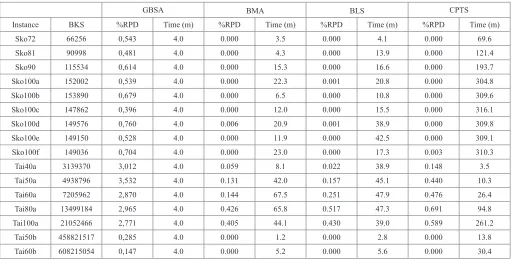
We selected 9 instances from Skorin-Kapov and 7 instances from Taillard. For this list of QAPLIB instances, we compared our proposed method with others recent methods such as: Memetic algorithm (BMA) [41], Breakout local search (BLS) [42] and Cooperative parallel tabu search algorithm (CPTS) [43]. The list of instances shown in Table III is a challenge for our algorithm.
We have fixed the maximum execution time of GBSA algorithm at 4 minutes. As the results depict (Table III), the GBSA algorithm needs some improvement to better solve some hard instances of QAP. But in
general, the proposed algorithm seems promising to solve the quadratic assignment problem. According to the values of the relative percentage deviation from the best known solution, GBSA algorithm produces results near the global optimum in a reasonable time.
VI. Conclusion
The GBSA algorithm is the result of the hybridization of two methods: golden ball metaheuristic and simulated annealing method. This new hybrid algorithm is based on soccer concepts; it incorporates and guides simulated Annealing technique to escape from the local minima and to find the global optimal solution. This method has never been proposed or tested on QAPLIB instances. In this work we proposed an adaptation of our strategy to solve the QAP. The numerical results indicate the efficiency of the proposed GBSA adaptation and its performance compared to algorithms in literature of QAP. As a result, we deduce that our proposed approach has a high convergence speed.
TABLE III. Comparison of GBSA Algorithm with Algorithms in the Literature of the QAP
GBSA BMA BLS CPTS
Instance BKS %RPD Time (m) %RPD Time (m) %RPD Time (m) %RPD Time (m)
Sko72 66256 0,543 4.0 0.000 3.5 0.000 4.1 0.000 69.6
Sko81 90998 0,481 4.0 0.000 4.3 0.000 13.9 0.000 121.4
Sko90 115534 0,614 4.0 0.000 15.3 0.000 16.6 0.000 193.7
Sko100a 152002 0,539 4.0 0.000 22.3 0.001 20.8 0.000 304.8
Sko100b 153890 0,679 4.0 0.000 6.5 0.000 10.8 0.000 309.6
Sko100c 147862 0,396 4.0 0.000 12.0 0.000 15.5 0.000 316.1
Sko100d 149576 0,760 4.0 0.006 20.9 0.001 38.9 0.000 309.8
Sko100e 149150 0,528 4.0 0.000 11.9 0.000 42.5 0.000 309.1
Sko100f 149036 0,704 4.0 0.000 23.0 0.000 17.3 0.003 310.3
Tai40a 3139370 3,012 4.0 0.059 8.1 0.022 38.9 0.148 3.5
Tai50a 4938796 3,532 4.0 0.131 42.0 0.157 45.1 0.440 10.3
Tai60a 7205962 2,870 4.0 0.144 67.5 0.251 47.9 0.476 26.4
Tai80a 13499184 2,965 4.0 0.426 65.8 0.517 47.3 0.691 94.8
Tai100a 21052466 2,771 4.0 0.405 44.1 0.430 39.0 0.589 261.2
Tai50b 458821517 0,285 4.0 0.000 1.2 0.000 2.8 0.000 13.8
Tai60b 608215054 0,147 4.0 0.000 5.2 0.000 5.6 0.000 30.4
Moreover, we need to ameliorate this technique even more for some hard QAPLIB instances. Finally, we plan to apply the GBSA algorithm to TSP and compare it with Random-keys Golden Ball algorithm [44]. We plan also to propose a new hybridization such as mixing Golden Ball algorithm with Tabu Search method.
References
[1] S.Sahni, & Gonzalez, T. P-complete approximation problems. Journal of the ACM (JACM), 23(3), 555-565, (1976).
[2] T.C.Koopmans, & M. Beckmann, Assignment problems and the location of economic activities. Econometrica: journal of the Econometric Society, 53-76, (1957).
[3] AN.Elshafei, Hospital layout as a quadratic assignment problem. Operational Research Quarterly, 167-179, (1977).
[4] A. M.Geoffrion, & G. W. Graves, Scheduling parallel production lines with changeover costs: Practical application of a quadratic assignment/LP approach. Operations Research, 24(4), 595-610, (1976).
[5] I. Ugi, J. Bauer, J. Brandt, J. Friedrich, J. Gasteiger, C. Jochum, & W. Schubert, Neue anwendungsgebiete für computer in der chemie. Angewandte Chemie, 91(2), 99-111, (1979).
[6] Z. Drezner, Extensive experiments with hybrid genetic algorithms for the solution of the quadratic assignment problem. Computers & Operations Research, 35(3), 717-736, (2008).
[7] Y. Hani, L. Amodeo, F. Yalaoui, & H. Chen, Ant colony optimization for solving an industrial layout problem. European Journal of Operational Research, 183(2), 633-642, (2007).
[8] L. Y. Tseng, & S. C. Liang, A hybrid metaheuristic for the quadratic assignment problem. Computational Optimization and Applications, 34(1), 85-113, (2006).
[9] V.Černý, Thermodynamical approach to the traveling salesman problem: An efficient simulation algorithm. Journal of Optimization Theory and Applications, 45(1), 41-51, (1985).
[10] R.E.Burkard, E. Cela, P.M.Pardalos, & L.S.Pitsoulis. The quadratic assignment problem. In Handbook of Combinatorial Optimization (pp. 1713-1809). Springer US, (1998).
[11] V. Kaibel, Polyhedral combinatorics of QAPs with less objects than locations. Univ., (1997).
[12] Z. Drezner, Compounded genetic algorithms for the quadratic assignment problem. Operations Research Letters, 33(5), 475-480, (2005).
[13] M. A. El-Baz, A genetic algorithm for facility layout problems of different manufacturing environments. Computers & Industrial Engineering, 47(2), 233-246, (2004).
[14] W. A. N. G. Rong-Long, & K. Okazaki, Solving facility layout problem using an improved genetic algorithm. IEICE Transactions on Fundamentals of Electronics, Communications and Computer Sciences, 88(2), 606-610, (2005).
[15] Z. Drezner, The extended concentric tabu for the quadratic assignment problem. European Journal of Operational Research, 160(2), 416-422, (2005).
[16] T. James, C. Rego, & F. Glover, A cooperative parallel tabu search algorithm for the quadratic assignment problem. European Journal of Operational Research, 195(3), 810-826, (2009).
[17] A. Misevicius, A tabu search algorithm for the quadratic assignment problem. Computational Optimization and Applications, 30(1), 95-111, (2005).
[18] H. Q. Saremi, B. Abedin, & A. M. Kermani, Website structure improvement: Quadratic assignment problem approach and ant colony meta-heuristic technique. Applied Mathematics and Computation, 195(1), 285-298, (2008).
[19] H. Liu, A. Abraham, & J. Zhang, A particle swarm approach to quadratic assignment problems. In Soft Computing in Industrial Applications (pp. 213-222). Springer Berlin Heidelberg, (2007).
[20] M. Bashiri, & H. Karimi. Effective heuristics and meta-heuristics for the quadratic assignment problem with tuned parameters and analytical comparisons. Journal of Industrial Engineering International, 8(1), 1-9, (2012).
[21] G. Paul.Comparative performance of tabu search and simulated annealing heuristics for the quadratic assignment problem. Operations Research
Letters, 38(6), 577-581, (2010).
[22] E. Osaba, F. Diaz, & E. Onieva, A novel meta-heuristic based on soccer concepts to solve routing problems. In Proceedings of the 15th Annual Conference Companion on Genetic and Evolutionary Computation (pp. 1743-1744). ACM, (2013, July).
[23] E. Osaba, F. Diaz, R. Carballedo, E. Onieva, & A. Perallos, Focusing on the Golden Ball Metaheuristic: An Extended Study on a Wider Set of Problems. The Scientific World Journal, 2014, (2014).
[24] A. M. Frieze , G. Galbiati , and F. Maffioli , On the worst-case performance of some algorithms for the asymmetric traveling salesman problem, Networks, 12 (1), 23–39, (1982).
[25] B. Golden, E. Baker, J. Alfaro, and J. Schaffer, The vehicle routing problem with backhauling: two approaches, in Proceedings of the 21st Annual Meeting of SE TIMS, pp. 90–92, South Carolina, SC, USA, (1985).
[26] E.Osaba, & F. Díaz. Design and Implementation of a Combinatorial Optimization Multi-population Meta-heuristic for Solving Vehicle Routing Problems. International Journal of Interactive Multimedia and Artificial Intelligence, 4(2), 89-90, (2016).
[27] I. Rivin, I. Vardi, and P. Zimmermann, The n-queens problem, The American Mathematical Monthly, 101(7), pp. 629– 639, (1994).
[28] S. Martello, and P. Toth, Knapsack Problems: Algorithms and Computer Implementations, Wiley, New York, NY, USA, (1990).
[29] F. Sayoti, & M. E. Riffi, Golden Ball Algorithm for solving Flow Shop Scheduling Problem. International Journal of Artificial Intelligence and Interactive Multimedia, 4(1), 15-18, (2016).
[30] F. Sayoti, M. E. Riffi, & H. LabaniOptimization of Makespan in Job Shop Scheduling Problem by Golden Ball Algorithm. Indonesian Journal of Electrical Engineering and Computer Science, 4(3), (2016).
[31] A. Misevičius, A modified simulated annealing algorithm for the quadratic assignment problem. Informatica, 14(4), 497-514, (2003).
[32] G. A. Croes, A method for solving traveling-salesman problems. Operations Research, 6(6), 791-812, (1958).
[33] S. Lin, Computer solutions of the traveling salesman problem. Bell System Technical Journal, 44(10), 2245-2269, (1965).
[34] M. Fischetti, Salazar Gonzalez, J. J., & Toth, P.. A branch-and-cut algorithm for the symmetric generalized traveling salesman problem. Operations Research, 45(3), 378-394, (1997).
[35] C. D. Tarantilis, Solving the vehicle routing problem with adaptive memory programming methodology. Computers & Operations Research, 32(9), 2309-2327, (2005).
[36] R.E.Burkard,S. Karisch, & F.Rendl. QAPLIB-A quadratic assignment problem library. European Journal of Operational Research, 55(1), 115-119, (1991).
[37] W. Ellen E., C.Roger D., & F.Mark A. Parallel simulated annealing using speculative computation. IEEE Transactions on Parallel and Distributed Systems, 1991, 2(4), 483-494.
[38] G.A, El-Nasser A., A.M. Mahmoud, & E.-S. M. El-Horbaty. A comparative study of meta-heuristic algorithms for solving quadratic assignment problem. International Journal of Advanced Computer Science and Applications, 5(1), arXiv:1407.4863, (2014).
[39] J.Skorin-Kapov. Tabu search applied to the quadratic assignment problem. ORSA Journal on computing, 2(1), 33-45,(1990).
[40] E.Taillard. Robust taboo search for the quadratic assignment problem. Parallel computing, 17(4-5), 443-455, (1991).
[41] U.Benlic, & J.K.Hao. Memetic search for the quadratic assignment problem. Expert Systems with Applications, 42(1), 584-595, (2015).
[42] U. Benlic, & J.K. Hao. Breakout local search for the quadratic assignment problem. Applied Mathematics and Computation, 219(9), 4800-4815, (2013).
[43] T.James, C. Rego., & F.Glover. A cooperative parallel tabu search algorithm for the quadratic assignment problem. European Journal of Operational Research, 195(3), 810–826, (2009).
Mohammed Essaid Riffi
Ms. Mohammed Essaid Riffi is a professor at the University of Chouaib Doukkali, El Jadida, Morocco, currently he is chief of Computer Science department and former coordinator of Mathematical and Computer Science. Its research axis is the metaheuristics.
Fatima Sayoti