Volume-5, Issue-1, February-2015
International Journal of Engineering and Management Research
Page Number: 220-224
Design A Home Appliance Product for the Generation of Plastic Oil and
Steam from Waste Plastics
D. Vinoth raj1, C. Kannan2
1
Final Year PG Student, TRP Engineering College (SRM Group), Tiruchirappalli, INDIA
2
Assistant Professor (Selection Grade), Department of Mechanical Engineering, TRP Engineering College (SRM Group), Tiruchirappalli, INDIA
ABSTRACT
In this research work, plastic oil and steam are going to be generated from waste plastics. Waste lubricating oil used to improve the heat conduction in the plastic total volume [1]. A specific quantity of lubricating oil was mixed with plastics to produce plastic oil. An indigenous home appliance product was developed and special operating procedure was being followed for the simultaneous production of plastic oil and steam. The energy available in the waste plastics was recovered in two different forms of energy as plastic oil and steam, which in turn increases overall efficiency to the conversion process. Due to this process, enormous amount of waste plastics was getting converted into fuel (plastic oil). This method was found to have the potential of reducing the ill-effects of the waste plastics and lubricating oil on the environment.
Keywords---- Plastic Oil, Waste Plastics, Plastic
Disposal etc.
I.
INTRODUCTION
Plastics play an important role in day to day life of all human beings. Due to their relatively low cost, low weight, durability, ease of manufacture, versatility and imperviousness to water, plastics are being used in an enormous and expanding range of products. A plastic material can be made from a wide range of synthetic or semi-synthetic organic solids that are mouldable. Plastics are typically organic polymers of high molecular mass, but often they contain other substances. They are usually synthetic, most commonly derived from petrochemicals, but many are partially natural.
Plastics are made from crude oil and natural gas. Basic compounds of carbon, hydrogen, oxygen and
nitrogen are extracted and combined to produce plastics. Plastics prevent food waste by keeping perishable foods fresh longer
and by also helping products from damage, breakage and spoilage.
1.1 Effect of Waste Plastics
Land: Chlorinated plastic can release harmful
chemicals into the surrounding soil, which can then seep into groundwater or other surrounding water sources and also the ecosystem. This can cause serious harm to the species that drink this water. In 2012, it was estimated that there was approximately 165 million tons of plastic pollution in the world's oceans.
Animals: Plastic pollution has the potential to poison animals, which can then adversely affect human food supplies.
Fig 1. Effect of solar radiation on plastic degradation
In 2004, English scientists reported on tiny, even microscopic plastic fragments that have worked their way down and are polluting deep ocean sediments and are now in the plankton, the very bottom of the food chain. (Richard Thompson, Science magazine)
Fig 2. A photographic view of Plankton
1.2 Disposal Of Plastic Waste
Disposal of plastic waste has emerged as an important environmental challenge and its recycling is facing roadblocks due to its non-degradable nature. Because plastic does not decompose biologically, the amount of plastic waste in our surroundings is steadily increasing. More than 90% of the articles found on the sea beaches contain plastic. Plastic waste is often the most objectionable kind of litter and will be visible for months in landfill sites without degrading.
Recycling and reuse of plastics is gaining importance as a sustainable method for plastic waste disposal. Unfortunately, plastic is much more difficult to recycle than materials like glass, aluminum or paper. A common problem with recycling plastics is that plastics are often made up of more than one kind of polymer or there may be some sort of fibre added to the plastic and making it as a composite.
Plastic polymers require greater processing to be recycled as each type melts at different temperatures and has different properties, so careful separation is
necessary. Moreover, most plastics are not highly compatible with one another. Apart from familiar applications like recycling bottles and industrial packaging film, there are also new developments e.g. the Recovinyl initiative of the PVC industry (covering pipes, window frames, roofing membranes and flooring).
Polyethylene terephthalate (PET) and high density polyethylene (HDPE) bottles have proven to have high recyclability and are taken by most curbside and drop-off recycling programs. The growth of bottle recycling has been facilitated by the development of processing technologies that increase product purities and reduce operational costs. Recycled PET and HDPE have many uses and well-established markets.
In contrast, recycling of Poly Vinyl Chloride (PVC) bottles and other materials is limited. A major problem in the recycling of PVC is the high chlorine content in raw PVC (around 56 percent of the polymer's weight) and the high levels of hazardous additives added to the polymer to achieve the desired material quality. As a result, PVC requires separation from other plastics before mechanical recycling.
Fig 3. A typical plastic waste
1.3 Plastics Materials In India
India has witnessed a substantial growth in the consumption of plastics and an increased production of plastic waste. Polyolefins account for the major share of 60% in the total plastics consumption in India. Packaging is the major plastics consuming sector, with 42% of the total consumption, followed by consumer products and the construction industry. The total plastics consumption is projected to grow by a factor of six between 2000 and 2030. Out of the total plastics waste generated, 47% is currently being recycled in India; this is much higher than the share of recycling in most of the other countries.
countries. This consumption led to more than 5400 tonnes of plastics waste being generated per day in 2000/2001 (totaling 2 million tonnes per annum).
The consumption of plastics will increase about six fold between 2000 and 2030. The share of polyolefin in India will remain at about 60%, a percentage comparable to that of Western Europe. In 2030, plastics waste for disposal (excluding recycled plastics) will increase 10 times compared to the situation in the year 2000/2001.Waste for disposal is increasing relatively faster than the plastics consumption because of the higher share of long-life products in waste and the lower recycling rates of these products. India generates 5.6 million metric tons of plastic waste annually, with Delhi
generating the most at 689.5 metric tons every day,
according to a report from the Central Pollution Control Board (CPCB).
II.
DESIGN DETAILS
2.1 Product Outline Layout
Fig 4. Schematic Layout of the Product
2.2 Important Components In This Product
Reactor
It is the place, where waste plastic was being stored and the temperature of the reactor was raised to the melting temperature of the waste plastics. Due to this action, larger molecule hydrocarbon would have been easily splited into smaller molecule hydrocarbon. Steam Cylinder
This cylinder section was used to produce the steam.
Electrical Generator
The Generator employed in this unit was being used to convert mechanical energy into electrical energy. Condenser Unit
To reduce the temperature of hydrocarbons, a condenser was being used in this layout. Hence the
plastic gas would have been cooled, condensed and collected as plastic oil.
Water Reservoir
This is used to supply the water for two sections like steam production unit and condenser unit.
2.3 Parameters Monitoring For Safety
Temperature & Pressure
These two will be monitored and controlled to avoid any mistakes and accidents.
Insulation and Coating
Insulation used to prevent heat losses from the equipment. And it was provided to withstand the pressure rise and give additional strength to the equipment. Coating used to prevent corrosion and high heat treatment from the reactor chamber.
III.
MATERIAL AND
FABRICATION DETAILS
3.1 Raw Material Selection
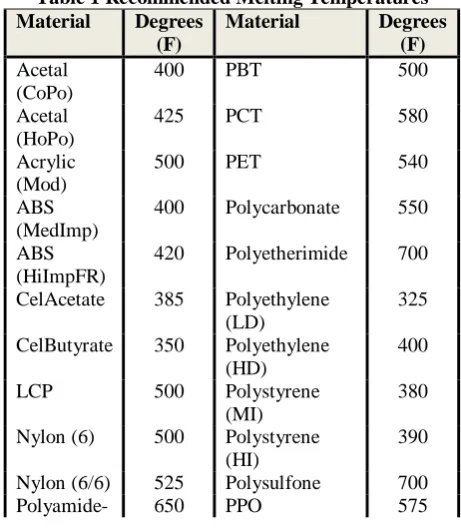
The initial product design was initiated from this source selection. In view of the fact that amount of energy required for the overall conversion process depends upon the raw material type and its melting temperature, a clear idea of different types of plastics and their melting temperature should have been analysed in prior to the product design. The following table shows the different types of plastics and their melting temperature.
Table 1 Recommended Melting Temperatures
Material Degrees
(F)
Material Degrees
(F) Acetal
(CoPo)
400 PBT 500
Acetal (HoPo)
425 PCT 580
Acrylic (Mod)
500 PET 540
ABS (MedImp)
400 Polycarbonate 550
ABS (HiImpFR)
420 Polyetherimide 700
CelAcetate 385 Polyethylene
(LD)
325
CelButyrate 350 Polyethylene
(HD)
400
LCP 500 Polystyrene
(MI)
380
Nylon (6) 500 Polystyrene
(HI)
390
Nylon (6/6) 525 Polysulfone 700
imide
Polyarylate 700 PVC (Rig/Flex) 350/325
TFE 600
The required melting temperature will be found out from the table and the maximum melting temperature will also be finalized from source availability.
Maximum Melting Temperature: 382.22°C Optimum Temperature: 480°C
Optimum Temperature was chosen due to additional energy required to complete pyrolysis process.
3.2 Energy Source Selection
Different types of heat sources are available in the market like wood, gas, electric heater, etc. The other types of heat sources are not more efficient when compared to electrical source. Hence, electrical energy source in the form of electric heater is being selected for this application.
Heating Source: Electric heater.
The advantages of an electrical heater were listed below.
• There is no ash formation
• Easily available in all environment and climate
• There is no energy losses
• Easily control at any time
Rate of temperature can be raised at short time interval. No of heaters are available in the market. After the analysis and comparison, the following heater is being selected for equipment fabrication.
Heater& its Configuration: Mica Insulated Band Heater
Mode : MBH-80151100T
Internal Diameter : 203 mm
Width : 38 mm
Watt : 1100
W/in2 : 29
Terminal Style : T
Weight : 0.57 kg
Fig 4. A Photograph of Mica insulated band heater
These two band heaters could be on either 120 or 240 Vac. Each half was rated for 120 V and was wired in
parallel for 120 V and in series for 240 V operation. It would be effective, when tightly closed with the cylinder.
3D solid models of the following components required for this product fabrication was performed and were shown in the Fig. 5 to 8
Outer diameter: 203 mm Internal diameter: 197 mm Height: 300 mm
Material: Stainless Steel
Fig 5. A 3D model of Reactor
Diameter :243 mm Material: Stainless Steel
Fig 6. A 3D model of Reactor Lid
Diameter: 289 mm Height : 170 mm Injector radius: 126 mm Injector height: 153 mm
Fig 7. A 3D model of steam cylinder
Hemisphere diameter : 289 mm
Height: 50 mm
Fig 8. A 3D model of upper cover of plastic incinerator equipment
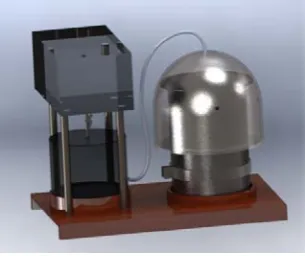
The assembled view of the product was shown in Fig.9
IV.
RESULTS AND CONCLUSION
The waste plastic incinerator equipment was designed and suitable layout was also finalized. Even though there were several methods being reported in the literature for the incineration of waste plastics, an initiative has been taken in this research work to design an equipment to incinerate the household waste plastics in order to produce gaseous hydrocarbons and plastic oil. Thus produced gaseous hydrocarbons could be used as a replacement for LPG being utilized in our houses for cooking purpose. The plastic oil could be sold to the municipality for laying road works. If the steam pressure will be more to run the turbine, then we go for electricity production by the use of turbine. If it doesn’t means we can still use the steam for controlling the microbial activity from kitchen equipments and cooking utensils.
This type of incineration will increase the faster rate of plastic recycling, since every recycling process is being done in home appliance product. Short time period will reach environmental changes due to recycling. With this single equipment, everyone can fulfil the daily needs of home like fuel, electrical energy and hot water.
ACKNOWLEDGEMENT
The authors are very much thankful to Shri Murugan Kitchen Equipments, Ariyamangalam, which is on the way of producing the prototype of this design. Further testing and other research activities will be carried out on that prototype.
REFERENCES
[1] Shikui Wu, Kaixiong Xu, Lusen Jiang, Li Wang, The Co-cracking experiment and application route of waste plastics and Heavy oil. Elsevier, AASRI Procedia 7(2014), 3–7.
[2] Mochamad Syamsiro, Harwin Saptoadi, Tinton Norsujianto, Putri Noviasri, Shuo Cheng, Zainal Alimuddin, Kunio Yoshikawa, Fuel oil production from Municipal plastic wastes in sequential pyrolysis and catalytic reforming reactors. Elsevier, Energy Procedia 4 7(2014), 180–188.
[3] Achin Kumar, R.K. Singh, Recovery of hydrocarbon liquid from waste high density polyethylene by thermal pyrolysis, Brazilian journal of chemical engineering, vol.28, 2011, pp.659-667.
[4] Sarker M, Rashid M.M, Rahman M.S, Randomly mixture of waste plastics conversion into fuel by using leftover residue, World research journal of environment and waste management, Volume 1(Issue 1), 2012, p. 01– 10.
[5] M.Sarker, M.M Rashid, M.Molla, Waste plastic conversion into hydrocarbon fuel like low sulfur diesel. Journal of environmental science and engineering, 5(2011), 446–452.
[6] Antony Raja, Advaith Murali, Conversion of plastic wastes into fuels, Journal of Materials science and engineering B1, (2011), 86–89.
[7] Toshiro Tsuji, Koji Hasegawa, Takao Masuda, Thermal cracking of oils from waste plastics, Springer, J Mater Cycles waste manag 5(2003), 102–106.
[8] M.Mani, C.Subash, G.Nagarajan, Performance, emission and combustion charecteristics of a DI diesel engine using waste plastic oil, Elsevier, Applied thermal engineering 29(2009), 2738–2744.
[9] Jane Pratoomyod, Dr.Ing. Krongkaew
Laohaliadanond, Performance and emission evaluation of blends of diesel fuel with waste plastic oil in a diesel engine, International journal of engineering science and innovative technology (IJESIT), Volume 2, Issue 2, 2013