Scikit-Multiflow: A Multi-output Streaming Framework
Jacob Montiel [email protected]
LTCI, T´el´ecom ParisTech, Universit´e Paris-Saclay Paris, FRANCE
Jesse Read [email protected]
LIX, ´Ecole Polytechnique Palaiseau, FRANCE
Albert Bifet [email protected]
LTCI, T´el´ecom ParisTech, Universit´e Paris-Saclay Paris, FRANCE
Talel Abdessalem [email protected]
LTCI, T´el´ecom ParisTech, Universit´e Paris-Saclay Paris, FRANCE
UMI CNRS IPAL, National University of Singapore
Editor:Balazs Kegl
Abstract
scikit-multiflowis a framework for learning from data streams and multi-output learning in Python. Conceived to serve as a platform to encourage the democratization of stream learn-ing research, it provides multiple state-of-the-art learnlearn-ing methods, data generators and evaluators for different stream learning problems, including single-output, multi-output and multi-label. scikit-multiflowbuilds upon popular open source frameworks including scikit-learn,MOAand MEKA. Development follows the FOSS principles. Quality is enforced by complying with PEP8 guidelines, using continuous integration and functional testing. The source code is available athttps://github.com/scikit-multiflow/scikit-multiflow.
Keywords: Machine Learning, Stream Data, Multi-output, Drift Detection, Python
1. Introduction
Recent years have witnessed the proliferation of Free and Open Source Software (FOSS) in the research community. Specifically, in the field of Machine Learning, researchers have benefited from the availability of different frameworks that provide tools for faster develop-ment, allow replicability and reproducibility of results and foster collaboration. Following the FOSS principles, we introduce scikit-multiflow, a Python framework to implement algo-rithms and perform experiments in the field of Machine Learning on Evolving Data Streams. scikit-multiflowis inspired in the popular frameworksscikit-learn,MOAand MEKA.
scikit-learn (Pedregosa et al., 2011) is the most popular open source software machine learning library for the Python programming language. It features various classification, regression and clustering algorithms including support vector machines, random forest, gradient boosting, k-means and DBSCAN, and is designed to inter-operate with the Python numerical and scientific packages NumPy and SciPy.
c
MOA (Bifet et al., 2010) is the most popular open source framework for data stream mining, with a very active growing community. It includes a collection of machine learning algorithms (classification, regression, clustering, outlier detection, concept drift detection and recommender systems) and tools for evaluation. Related to the WEKA project (Hall et al., 2009),MOA is also written in Java, while scaling to more demanding problems.
TheMEKAproject (Read et al., 2016) provides an open source implementation of meth-ods for multi-label learning and evaluation. In multi-label classification, the aim is to predict multiple output variables for each input instance. This different from the ‘standard’ case (binary, or multi-class classification) which involves only a single target variable.
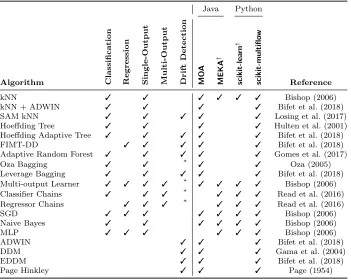
As a multi-output streaming framework, scikit-multiflowserves as a bridge between re-search communities that have flourished around the aforementioned popular frameworks, providing a common ground where they can thrive. scikit-multiflowassists on the democra-tization of Stream Learning by bringing this research field closer to the Machine Learning community, given the increasing popularity of the Python programing language. The ob-jective is two-folded: First, fills the void in Python for a stream learning framework which can also interact with available tools such as scikit-learn and extends the set of available
Table 1: Available methods in scikit-multiflow. Methodologies on the left, and frameworks on the right of the vertical bar.
Java Python
Algorithm Classification Regression Single-Output Multi-Output Drift
Detection
MO
A
MEKA
†
scikit-lea
rn
†
scikit-multiflo
w
Reference
kNN 3 3 3 3 3 3 Bishop (2006)
kNN + ADWIN 3 3 3 3 Bifet et al. (2018)
SAM kNN 3 3 3 3 3 Losing et al. (2017)
Hoeffding Tree 3 3 3 3 Hulten et al. (2001)
Hoeffding Adaptive Tree 3 3 3 3 3 Bifet et al. (2018)
FIMT-DD 3 3 3 3 3 Bifet et al. (2018)
Adaptive Random Forest 3 3 3 3 3 Gomes et al. (2017)
Oza Bagging 3 3 * 3 3 Oza (2005)
Leverage Bagging 3 3 3 3 3 Bifet et al. (2018) Multi-output Learner 3 3 3 3 * 3 3 3 3 Bishop (2006) Classifier Chains 3 3 3 * 3 3 3 Read et al. (2016) Regressor Chains 3 3 3 * 3 3 3 Read et al. (2016)
SGD 3 3 3 3 3 3 3 Bishop (2006)
Naive Bayes 3 3 3 3 3 3 Bishop (2006)
MLP 3 3 3 3 3 3 Bishop (2006)
ADWIN 3 3 3 Bifet et al. (2018)
DDM 3 3 3 Gama et al. (2004)
EDDM 3 3 3 Bifet et al. (2018)
Page Hinkley 3 3 3 Page (1954)
*Depending on the base learner.
state-of-the-art methods on this platform. Second, provides a set of tools to facilitate the development of stream learning research, an example is (Montiel et al., 2018).
It is important to notice that scikit-multiflow complements scikit-learn, whose primary focus is batch learning, expanding the set of free and open source tools for Stream Learning. In addition, scikit-multiflow can be used within Jupyter Notebooks, a popular interface in the Data Science community. Special focus in the design of scikit-multiflow is to make it friendly to new users and familiar to experienced ones.
scikit-multiflowcontains stream generators, learning methods, change detectors and eval-uation methods. Stream generators include: Agrawal, Hyperplane, Led, Mixed, Random-RBF, Random-RBF with drift, Random Tree, SEA, SINE, SEA, STAGGER, Waveform, Multi-label, Regression and Concept-Drift. Available evaluators correspond to Prequential and Hold-Out evaluations, both supporting multiple performance metrics forClassification (Accuracy, Kappa Coefficient, Kappa T, Kappa M),Multi-Output Classification (Hamming Score, Hamming Loss, Exact Match, Jaccard Index)Regression (Mean Squared Error, Mean Absolute Error) andMulti-Output Regression(Average Mean Squared Error, Average Mean Absolute Error, Average Root Mean Squared Error). Learning methods and change detec-tors are listed in Table 1. This table also serves to outline the position of scikit-multiflow with respect to other open source frameworks.
2. Stream Data Mining Notation and Background
Consider a continuous stream of data A = {(~xt, yt)}|t = 1, . . . , T where T → ∞. Input
~
xt is a feature vector and yt the corresponding target where y is continuous in the case of regression and discrete for classification. The objective is to predict the target y for an unknown ~x. In traditional single-output models, we deal with a single target variable for which one corresponding output is produced per test instance. Multi-output models can produce multiple outputs to assign to multiple target variables~y for each test instance.
Different to batch learning, where all data (X, y) is available for training; in stream learning, training is performed incrementally as new data (~xi, yi) is available. Performance
P of a given model is measured according to some loss function that evaluates the difference between the set of expected labels Y and the predicted ones ˆY. Hold-out evaluation is a popular performance evaluation method for batch and stream settings, where tests are performed in a separate test set. Prequential-evaluation (Dawid, 1984) or interleaved-test-then-train evaluation, is a popular performance evaluation method for the stream setting only, where tests are performed on new data before using it to train the model.
3. Architecture
The base class inscikit-multiflowisStreamModelwhich contains the following abstract meth-ods to be implemented by its subclasses:
• fit— Trains a model in a batch fashion. Works as an interface to batch methods that implement afit() function such asscikit-learn methods.
• partial fit— Incrementally trains a stream model.
• predict — Predicts the target’s value in supervised learning methods.
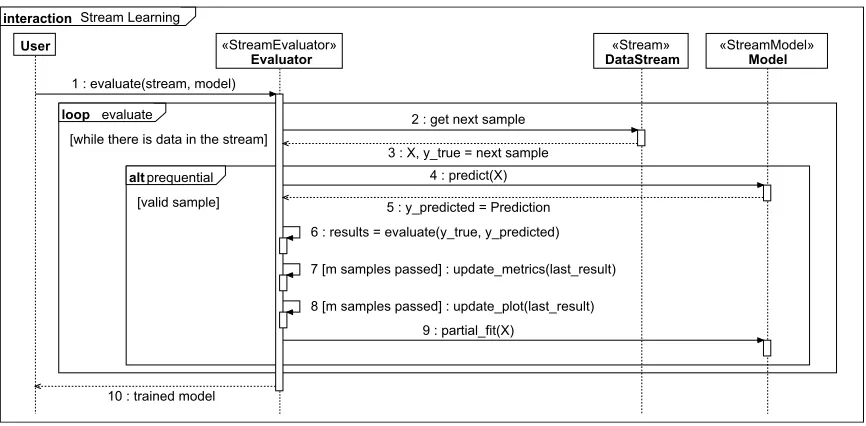
AStreamModelobject interacts with two other objects: aStreamobject and (optionally) aStreamEvaluator object. TheStreamobject provides a continuous flow of data on request. The StreamEvaluator performs multiple tasks: queries the stream for data, trains and tests the model on the incoming data and continuously tracks the model’s performance. The sequence to train a Stream Model and track its performance using prequential evaluation inscikit-multiflowis outlined in Figure 1.
UNREGISTERED
Stream Learning interaction
evaluate loop
[while there is data in the stream]
«StreamEvaluator» Evaluator
«Stream» DataStream
«StreamModel» Model User
prequential alt
[valid sample] 1 : evaluate(stream, model)
2 : get next sample
3 : X, y_true = next sample
4 : predict(X)
5 : y_predicted = Prediction
6 : results = evaluate(y_true, y_predicted)
7 [m samples passed] : update_metrics(last_result)
8 [m samples passed] : update_plot(last_result)
9 : partial_fit(X)
10 : trained model
Figure 1: Training and testing a stream model using scikit-multiflow. This sequence corre-sponds to prequential evaluation.
4. Development
Thescikit-multiflowpackage is distributed under the BSD License. Development follows the FOSS principles and encompasses:
• A webpage,https://scikit-multiflow.github.io/, including documentation and user guide. Both, documentation and user guide, are living documents that are con-tinuously updated to reflect the current stage of scikit-multiflow.
• Version control via git. The source code of the package is publicly available on Github
athttps://github.com/scikit-multiflow/scikit-multiflow
• Package deployment and software quality are enforced via continuous integration and functional testing,https://travis-ci.org/scikit-multiflow/scikit-multiflow
References
Albert Bifet, Ricard Gavalda, Geoff Holmes, and Bernhard Pfahringer. Machine Learning for Data Streams with Practical Examples in MOA. MIT Press, 2018. https://moa. cms.waikato.ac.nz/book/.
Christopher M Bishop. Pattern recognition and machine learning. 2006.
A Philip Dawid. Present position and potential developments: Some personal views: Sta-tistical theory: The prequential approach. Journal of the Royal Statistical Society. Series A (General), pages 278–292, 1984.
Jo˜ao Gama, Pedro Medas, Gladys Castillo, and Pedro Rodrigues. Learning with Drift Detection. pages 286–295, 2004. ISSN 0302-9743. doi: 10.1007/978-3-540-28645-5 29.
Heitor M. Gomes, Albert Bifet, Jesse Read, Jean Paul Barddal, Fabr´ıcio Enembreck, Bern-hard Pfharinger, Geoff Holmes, and Talel Abdessalem. Adaptive random forests for evolving data stream classification. Machine Learning, 106(9-10):1469–1495, 2017. ISSN 15730565. doi: 10.1007/s10994-017-5642-8.
Mark Hall, Eibe Frank, Geoffrey Holmes, Bernhard Pfahringer, Peter Reutemann, and Ian H. Witten. The weka data mining software: An update. SIGKDD Explor. Newsl., 11 (1):10–18, November 2009. ISSN 1931-0145. doi: 10.1145/1656274.1656278.
Geoff Hulten, Laurie Spencer, and Pedro Domingos. Mining time-changing data streams. Proceedings of the seventh ACM SIGKDD international conference on Knowledge discov-ery and data mining - KDD ’01, 18:97–106, 2001. ISSN 10844627. doi: 10.1145/502512. 502529.
Viktor Losing, Barbara Hammer, and Heiko Wersing. KNN classifier with self adjusting memory for heterogeneous concept drift. Proceedings - IEEE International Conference on Data Mining, ICDM, 1:291–300, 2017. ISSN 15504786. doi: 10.1109/ICDM.2016.141.
Jacob Montiel, Albert Bifet, Viktor Losing, Jesse Read, and Talel Abdessalem. Learning fast and slow: A unified batch/stream framework. In Big Data (Big Data), 2018 IEEE International Conference on. IEEE, 2018.
N.C. Oza. Online Bagging and Boosting. In 2005 IEEE International Conference on Systems, Man and Cybernetics, volume 3, pages 2340–2345. IEEE, 2005. ISBN 0-7803-9298-1. doi: 10.1109/ICSMC.2005.1571498.
Ewan S Page. Continuous inspection schemes. Biometrika, 41(1/2):100–115, 1954.
Fabian Pedregosa, Ga¨el Varoquaux, Alexandre Gramfort, Vincent Michel, Bertrand Thirion, Olivier Grisel, Mathieu Blondel, Peter Prettenhofer, Ron Weiss, Vincent Dubourg, et al. Scikit-learn: Machine learning in python. Journal of machine learn-ing research, 12(Oct):2825–2830, 2011.