The Thirty-Third AAAI Conference on Artificial Intelligence (AAAI-19)
Exploring Human-Like Reading Strategy for Abstractive Text Summarization
Min Yang,
1Qiang Qu,
1∗Wenting Tu,
2Ying Shen,
3Zhou Zhao,
4Xiaojun Chen
5 1Shenzhen Institutes of Advanced Technology, Chinese Academy of Sciences2Shanghai University of Finance and Economics
3Peking University Shenzhen Graduate School,4Zhejiang University,5Shenzhen University {min.yang, qiang}@siat.ac.cn, [email protected]
[email protected], [email protected], [email protected]
Abstract
The recent artificial intelligence studies have witnessed great interest in abstractive text summarization. Although remark-able progress has been made by deep neural network based methods, generating plausible and high-quality abstractive summaries remains a challenging task. The human-like read-ing strategy is rarely explored in abstractive text summariza-tion, which however is able to improve the effectiveness of the summarization by considering the process of reading com-prehension and logical thinking. Motivated by the human-like reading strategy that follows a hierarchical routine, we propose a novel Hybrid learning model for Abstractive Text Summarization (HATS). The model consists of three major components, a knowledge-based attention network, a multi-task encoder-decoder network, and a generative adversarial network, which are consistent with the different stages of the human-like reading strategy. To verify the effectiveness of HATS, we conduct extensive experiments on two real-life datasets, CNN/Daily Mail and Gigaword datasets. The exper-imental results demonstrate that HATS achieves impressive results on both datasets.
Introduction
Abstractive text summarization aims to generate condensed and concise summaries that retain the salient information and overall meaning of the source articles. As opposed to the extractive text summarization, which extracts the best sum-marizing components from the input documents, abstractive summaries potentially contain new phrases that do not ap-pear in the source articles. Abstractive text summarization has attracted increasing attention recently due to its broad applications in natural language processing (NLP).
Recent advances in the deep learning based approaches (i.e., the sequence to sequence framework) (Rush, Chopra, and Weston 2015; Nallapati et al. 2016) have taken the state-of-the-art of abstractive text summarization to a new level. The general idea behind these methods is to encode the in-put documents as vector representations with a long short-term memory (LSTM), and then use another LSTM as the decoder to generate the corresponding summaries. The se-quence to sese-quence (seq2seq) framework has become the
∗
Qiang Qu is corresponding author.
Copyright c2019, Association for the Advancement of Artificial Intelligence (www.aaai.org). All rights reserved.
mainstream due to their capability of capturing the seman-tic and syntacseman-tic relations between raw documents and their summaries in a scalable and end-to-end way.
Although great efforts have been devoted to the ab-stractive text summarization, generating plausible and high-quality abstractive summaries remains a challenging task in practice, because computers lack human knowledge as well as language capability to understand the entire text and then write a summary highlighting its main points. Despite the significance of human reading ability, to date, no attempt has been devoted to exploring the human-like reading strategy in abstractive text summarization (i.e., how humans summarize an article).
When humans read, comprehend and summarize a piece of text, their exploration of the reading process organizes it-self most naturally into an examination of three phases: gen-eral understanding of the document, task-specific reading comprehension, and polishing process (Avery and Graves 1997; Toprak and Almacıo˘glu 2009). Humans first set the purpose of reading and pre-view the text quickly with prior (background) knowledge to get a general understanding of the document. As revealed by previous work (Tarchi and others 2017), prior knowledge1facilitates and enhances hu-man reading, which is expected to have a large influence on the reading process as it helps the reader to construct a co-herent mental representation of the document and gain an overview of the content in the document.
Reading comprehension is a central component of skilled reading, which is essential to ensure the good understanding of a document. To construct the meaning of a text, readers have to go beyond literal information through the genera-tion of inferences. Indeed, inferences are what make readers move from a mere interpretation of individual sentences to a global meaning that integrates multiple sentences (Tarchi and others 2017). After reading the text thoroughly, readers are required to find the task-specific information and make many different types of inferences, such as pointing out the category and retaining the salient information of the input documents.
Similar to human cognitive process for writing a high-quality summary, the readers will evaluate the generated
1
summary and then polish the summary when necessary based on the evaluation signal. This polishing process cre-ates opportunities for deeper understanding as well as er-ror correction and ensures that the summarization goal has been met. For example, in practice, the generated sum-mary usually needs to be edited for accuracy and fluency by adding further information and rephrasing the generated words when necessary. Overall, if one desires to create a ma-chine intelligence possessing such a reading comprehension skill of humans for abstractive text summarization, explor-ing these hierarchical stages of the human-like readexplor-ing strat-egy is quite necessary.
In this paper, we propose a novel Hybrid learning model for Abstractive Text Summarization (HATS), which mim-ics the process of how humans write a summary for a piece of text. Similar to previous state-of-the-art methods (Paulus, Xiong, and Socher 2017), the sequence to sequence frame-work is used as the backbone of our summarization sys-tem. HATS additionally consists of three components corre-sponding to the hierarchical stages of the human-like read-ing strategy.First, we design a knowledge-attention network to get the general understanding of the document, which leverages the commonsense knowledge from the knowledge base (KB) as prior knowledge to distinguish the important information from the input text and determine the focus of the summary. It is intuitive that the importance of each context word in the document is significantly influenced by the entity mentions in KB.Second, to enhance the process of reading comprehension and deeply understand a text, a multi-task learning is proposed to jointly train the task of ab-stractive summarization and two other related tasks: text cat-egorization and syntax annotation. Specifically, text catego-rization improves the quality of locating salient information of the text and syntax annotation exploits word-level syntax to generate high-quality summaries from the language mod-eling perspective.Third, we employ a generative adversar-ial network (GAN) to further refine the performance of ab-stractive text summarization by using a discriminative model to guide the training of the generative model in an adver-sarial process. This adveradver-sarial process can eventually ad-just the generative model to generate human-like and high-quality abstractive summaries.
We summarize our main contributions as follows:
• To the best of our knowledge, this is the first work explor-ing human-like readexplor-ing strategy for abstractive text sum-marization.
• We leverage the commonsense knowledge from the knowledge base as prior knowledge to capture the impor-tant information of the input document, obtaining the gen-eral understanding of the document.
• A multi-task learning system is employed to jointly train the abstractive summarization task and two other related tasks: text categorization and syntax annotation. Specifi-cally, text categorization helps to learn a category-specific text encoder and improve the quality of locating salient in-formation of the text. The syntax annotation helps to gen-erate high-quality summaries from the language modeling perspective, and thus alleviates the issues of incomplete
sentences and duplicated words.
• A generative adversarial network is employed to further refine the summarization performance and generate more plausible, high-quality and human-like abstractive sum-maries.
• Extensive experiments are conducted to show that HATS achieves substantial improvements over the compared methods on the widely used CNN/Daily Mail and Giga-word datasets.
Related Work
Abstractive Text Summarization There has been in-creasing interest in generalizing the neural language model to the field of abstractive summarization based on the sequence-to-sequence model (Rush, Chopra, and Weston 2015; Nallapati et al. 2016; See, Liu, and Manning 2017). For example, Rush, Chopra, and Weston (2015) were the first to apply the attention-based encoder-decoder model to abstractive text summarization, achieving state-of-the-art performance on two sentence-level summarization datasets. Nallapati et al. (2016) proposed the attention encoder-decoder RNN that captured the hierarchical document struc-ture and identified the key sentences and keywords in the document. See, Liu, and Manning (2017) proposed a hybrid pointer-generator network that allowed both copying words from the source text via pointing and generating words from a fixed vocabulary. Cao et al. (2018a) used existing sum-maries as soft templates to guide the seq2seq model. Cao et al. (2018b) exploited open information extraction and de-pendency parse methods to extract actual fact descriptions from the source text, and then forced the generation of sum-maries conditioned on both the source text and the extracted fact descriptions.
Several recent studies attempted to integrate the encoder-decoder RNN and reinforcement learning paradigms for ab-stractive summarization, taking advantages of both (Paulus, Xiong, and Socher 2017; Liu et al. 2018). For example, Paulus, Xiong, and Socher (2017) combined the maximum-likelihood cross-entropy loss with rewards from policy gra-dient reinforcement learning to reduce exposure bias. Liu et al. (2018) proposed an adversarial process for abstrac-tive text summarization, in which the generator is built as an agent of reinforcement learning.
Our Methodology
Problem Definition
Assume that each input articleX = {x1, x2, ..., xn}has a
corresponding reference summaryY ={y1, y2, ..., yk}and
a category labelC, wherenandkdenote the length of the input document and reference summary, respectively. Given an input articleX, the abstractive summarization task tries to generate a summaryYˆ ={yˆ1,yˆ2, ...,yˆm}, wheremdenotes
the length of the generated summary. For the text categoriza-tion task, given an input articleX, our objective is to predict the category labelCˆ for the input article. For syntax anno-tation, we haveZ = {z1, z2, ..., zm} denoting the
Combi-natory Category Grammar (CCG) (Steedman and Baldridge 2011) supertag sequence for the corresponding summaryY
of source text X. CCG uses a set of lexical categories to represent constituents, which provides a connection between syntax and semantics of natural language. CCG supertag an-notation (Clark 2002) is a task to assign lexical categories to each word in a piece of text.
Architecture of Our Approach
As discussed in Section 1, there are three phases (general understanding of the document, task-specific reading prehension, and polishing process) when humans read, com-prehend and summarize a piece of text. Accordingly, we pro-pose a hybrid learning model HATS to simulate the process of how humans summarize an article. As depicted in Figure 1, HATS also consists of three components: a knowledge-based attention module, a multi-task learning module, and a generative adversarial network module. Next, we will elabo-rate each component of the proposed HATS model in details.
Knowledge-based Attention Module
The knowledge-based attention module leverages the com-monsense knowledge in KB as prior knowledge to learn a knowledge-aware documentencoderof our sequence to se-quence framework, getting the general understanding of the document.
Initial Context Representations
Each word x in the input text is mapped to a low-dimensional embedding v ∈ Rde by embedding layers,
wherededenotes the dimension of word embedding. Then,
the hidden states of words in the document are learned by LSTM layers. Formally, given the input word embeddingvk
at indexkin the input text, the hidden statehk ∈ Rdc (d c
is the number of hidden states for each LSTM unit) can be updated from the previous hidden statehk−1, which is
com-puted by
hk=LSTM(hk−1, vk) (1)
Thus, given the input document X, we can obtain the initial contextual document representation Hinit =
[h1, ..., hn], wherenis the length of the input articleX.
Context Vector
Partial Summary
Decod
er
H
idden
States
V
o
ca
bula
ry
Distribution
Final Distribution
𝑷𝒈𝒆𝒏
× 𝟏 − 𝑷𝒈𝒆𝒏 × 𝑷𝒈𝒆𝒏
𝐌𝐋𝐏
Text Categorization Task Super Tag
Sha
red t
he
Decod
er
Syntax Labeling Task
Discriminator
Positive samples
Negative samples
Ground truth references
Generated references by Generator
Discriminator Adversarial Training
𝑥1 𝑥2
𝑥𝑛
𝐋𝐒𝐓𝐌 𝐋𝐚𝐲𝐞𝐫
Multi-view Co-attention Network 𝐂𝐨𝐧𝐭𝐞𝐱𝐭
𝐑𝐞𝐩𝐫𝐞𝐬𝐞𝐧𝐭ation
𝐊𝐧𝐨𝐰𝐥𝐞𝐝𝐠𝐞 𝐑𝐞𝐩𝐫𝐞𝐬𝐞𝐧𝐭ation
𝐂𝐨𝐧𝐜𝐚𝐭𝐞𝐧𝐚𝐭𝐢𝐨𝐧
𝐖𝐨𝐫𝐝 𝐄𝐦𝐛𝐞𝐝𝐝𝐢𝐧𝐠 𝐋𝐚𝐲𝐞𝐫 𝐆𝐫𝐚𝐩𝐡 𝐄𝐦𝐛𝐞𝐝𝐝𝐢𝐧𝐠 𝐋𝐚𝐲𝐞𝐫 𝐂𝐨𝐧𝐯𝐨𝐥𝐮𝐭𝐢𝐨𝐧𝐚𝐥 𝐋𝐚𝐲𝐞𝐫
𝑥1 𝑥2
𝑥𝑛
𝐊𝐁
Generator
Att
ention
Distribution
Figure 1: The overall architecture of our model.
Initial Knowledge Representations
We perform entity mention detection by n-gram matching and provide a set of top-N entity candidates from KB for each entity mention in the document. The embeddings of en-tities in KB are learned by DeepWalk (Perozzi, Al-Rfou, and Skiena 2014). Formally, we present candidate entities for the entity mention at time stepkasEk ={ek1, ek2, ..., ekN} ∈
RN×dkb, whered
kbis the dimension of the entity embedding
in KB. Then, the candidate entities are averaged to form the knowledge representation for thek-th word in the document:
¯
Ek =N1 P N
i=1eki∈Rdkb.
After obtaining the knowledge representation for each en-tity mention in the document, a CNN layer is then employed to capture the local n-gram information and learn a high level knowledge representation Einit ∈
Rn×dk (d
k is the
number of hidden states of CNN):
Einit=CNN( ¯E) (2)
We refer the interested readers to (Kim 2014) for the im-plementation details of CNN in text modeling.
Knowledge-aware Document Representations
capture the important information from different representa-tion subspaces at different posirepresenta-tions.
Formally, MCN takes as input theinitial knowledge
rep-resentationas attention source to learn the knowledge-aware
context representation:
Hfinal=f lat(Σ·Hinit) (3)
Σ = [Σ1,Σ2, . . . ,Σn] (4)
Σi=softmax(%(hi, µ(Einit))) (5)
%(hi, µ(Einit)) = tanh(U1hi+V1µ(Einit) +b1) (6)
wheref latis an operation that flattens matrix into vector form;U1 andV1are attention parameters to be learned;b1
is the bias term;Σ∈Rb×nis the attention matrix,Σ i∈Rb
indicates the importance of thei-th word of the input doc-ument in multiple hops of attention, andbis the number of hops of attention; each row of attention matrix denotes one hop of attention on the whole document, namely a single-head attention.
Similarly, we can useinitial context representationas at-tention source to learn the context-aware knowledge repre-sentation for the input document, denoted asEf inal.
Finally, the knowledge-aware context representation and context-aware knowledge representation are concatenated to form the final knowledge-aware representation for input ar-ticle X: emb = {[H1final, E1final], . . . ,[Hfinal
n , Enfinal]} ∈
R(n×(dc+dk)).
Multi-task Learning Module
Motivated by the fact that humans have no difficulty per-forming text summarization because they have the capabil-ities of multiple domains (Zhao et al. 2018), we propose a multi-task encoder-decoder module to mimic the process of active reading.
Text Categorization Task
The abstractive text summarization task shares itsencoder
with the text categorization task. For the text categorization task, we feed the knowledge-aware document representation
embinto a task-specific fully-connected layer followed by a
softmaxlayer to predict the category probability distribution:
ˆ
C=softmax(Vtext·tanh(Utext·emb+btext)) (7)
whereCˆis prediction probabilities of text categories;Vtext,
Utextare weight matrices, andbtextis bias term.
The parameters of text categorization task are learned in a supervised manner. In particular, given a labeled training data set{(X1:M, C1:M)}, we minimize directly the
cross-entropy between the predicted label distributionCˆ and the ground truth distributionCas the objective function:
JMLtext(θ1) =− M
X
i=1 L
X
j=1
Cijlog( ˆCij), (8)
whereCˆi is the prediction probabilities of thei-th sample,
Ciis the ground truth label of thei-th sample,Lis the
num-ber of category classes,Mis the number of training samples,
θ1denotes the parameters related to text categorization.
Syntax Annotation and Abstractive Text
Summarization Tasks
Shared LSTM Decoder LSTM decoder is shared by the abstractive summarization task and the syntax annotation task, which is essentially a language model for estimating the contextual probability of the next word except that it is conditioned on the output of the encoder. We use the knowledge-aware document representation (i.e.,emb) as the initial state of the LSTM decoder. On each decoding stept, the decoder receives the inputut(while training, ut is the
embedding of the previous word of the reference summary; at test time it is the embedding of the previous word emitted by the decoder) and update its hidden statestas
st=LSTM(st−1, ct, ut) (9)
wherectis the context vector at time stept. It can be
com-puted as a weighted sum of the hidden states of the en-coded input representationemb. Formally, we use the atten-tion mechanism to calculate the attenatten-tion weightsβtand the
context vectorctas
ct= n
X
i=1
βt,i·embi, βt,i =softmax(ft,i) (10)
ft,i=vTtanh(Wh·embi+Ws·st+battn) (11)
whereWh,Wsandbattnare learnable parameters.
The context vectorctcan be viewed as the representation
of the source text at time step t. We then concatenate the context vectorctand the decoder hidden statestat time step
tand feed it to a linear function to produce the hidden vector of the decoder:
Ot=V[st, ct] +b (12)
The generation probabilities of thet-th word and thet-th CCG supertag can be computed by:
Ptsum.=P(yt|Yˆ1:t−1;X) =softmax(Usum.Ot+bsum)
(13)
Ptsyn.=P(zt|Yˆ1:t−1;X) =softmax(Usyn.Ot+bsyn.)
(14)
where theUsum.,Usyn.,bsum.,bsyn.are parameters to be
learned. The superscriptssyn.andsum denote the param-eters related to supertag annotation and abstractive summa-rization, respectively.Yˆ1:t−1 denotes the previously
gener-ated tokens. Note that Psum
t denotes the word distribution
over the whole vocabulary at time stept.
However, the pure generation model sometimes suffers from the out-of-vocabulary generation issue and produces many “UNK” tokens in the summary. To alleviate this limitation, copy mechanism is widely adopted in recent abstractive summarization systems (Gulcehre et al. 2016; Gu et al. 2016; See, Liu, and Manning 2017). Similar to the work (See, Liu, and Manning 2017), in this study the gen-eration probabilitypgen ∈[0,1]for time steptis calculated
from the context vectorct, the decoder statest, and the
de-coder inputut:
where vectorsVc,Vs,Vu and scalarbgen are learnable
pa-rameters.
For each timestept, given a candidate tokenwj(jdenotes
the index of the vocabulary), ifwj is out-of-vocabulary
to-ken, thenpw
t(wj) = 0, if it does not appear in the source
text, thenat,j = 0.
¯
Ptsum.(wj) =Pgen∗Ptsum.(wj)+(1−Pgen)∗
X
at,j (16)
For the syntax annotation and summarization generation subtasks, we employ the minimum negative log-likelihood estimation. Specifically, the objective is the sum of the neg-ative log likelihood of the target word/supertag at each de-coding step.
JMLsum.(θ2) =− m
X
t
log( ¯Ptsum.) (17)
JMLsyn.(θ3) =− m
X
t
log(Ptsyn.) (18)
where m is the length of the sequence during decoding phase.
Joint Training
For the purpose of improving the shared LSTM encoder and LSTM decoder, we train these three related tasks simultane-ously. The joint multi-task objective function is minimized by:
JML(Θ) =λ1JMLtext+λ2JMLsum.+λ3JMLsyn. (19)
whereΘdenotes the collective parameters of the model.λ1,
λ2andλ3are hyper-parameters that determine the weights
of the three objectives. Here, we setλ1 =λ2 = 0.45, and
λ3 = 0.1, which are determined by performing the grid
search on a validation set.
Policy Gradient for Summary Generation However, the maximum likelihood estimation (MLE) method suffers from two main issues. First, the evaluation metric is different from the training loss. Second, the input of the decoder at each time step is often the previous ground-truth word during training. This exposure bias (Ranzato et al. 2016) leads to er-ror accumulation at the testing phase. To alleviate the afore-mentioned issues when generating summaries, we also op-timize directly for ROUGE-1 since it achieves best results among the alternatives such as METEOR (Lavie and Agar-wal 2007) and BLEU (Papineni et al. 2002), by using policy gradient algorithm, and minimize the negative expected re-wards:
JRLsum= (r(ˆy)−r(ys))
m
X
t
log p(yts|Y1:ts−1;X) (20)
wherer(ˆy)is the reward of a greedy decoding generated se-quenceyˆ, andr(ys)is the reward of sequenceysgenerated
by sampling among the vocabulary at each step.
After pre-training the proposed model by minimizing the joint ML objective (see Eq.(19)), we switch the model to fur-ther minimize a mixed training objective, integrating the re-inforcement learning objectiveJsum
RL with the original
multi-task lossJML:
Jmixed(Θ) =βJML+ (1−β)JRLsum (21)
whereβis a hyper-parameter, and we setβ=0.1;Θdenotes the set of parameters of the encoder-decoder framework.
Generative Adversarial Network Module
Generative adversarial network (GAN) (Goodfellow et al. 2014) is proposed to refine the performance of text summa-rization. GAN consists of a generative modelGand a dis-criminative modelDthat compete in a minimax game with two players: The discriminative model tries to distinguish the real high-quality summaries from the training dataset or generated byG, and the generative modelGtries to fool the discriminative model to generate plausible summaries. Con-cretely,DandGplay the following game onL(D, G):
min
G maxD L(D, G) =EY∼Pdata[logD(Y)]+
EY¯∼G[log(1−D( ¯Y))]
(22)
Here,Y is the input data from the training set,Y¯ is the data generated by the generative model.
Discriminative Model
D
The discriminative model is a binary classifier and aims at distinguishing the input sequence as originally generated by humans or synthesized by machines. We encode the input sequence with a CNN as it shows great effectiveness in text classification (Kim 2014). We use multiple filters with vary-ing window sizes to obtain different features and then apply a max-over-time pooling operation over the features. These pooled features are passed to a fully connected softmax layer whose output is the probability of being “original”.
In the adversarial process, using the discriminator as a re-ward function can further improve the generative model it-eratively by dynamically updating the discriminative model. Once we obtain more realistic and high-quality summaries generated by G, we re-train the discriminative model as:
minΦ−EY∼Pdata[logDΦ(Y)]−EY¯∼GΘ[log(1−DΦ( ¯Y))]
(23) whereΦandΘrepresent the parameter sets of discrimina-tive modelDand generative modelG.
Generative Model
G
When the discriminative modelDis obtained and fixed, we are ready to update the generative modelG. The loss func-tion of our generativeGis defined by Eq.(21). According to the policy gradient theorem (Sutton et al. 2000), we compute the gradient ofJmixedw.r.t. the parametersΘ:
OΘJmixed=
1
T
T
X
t=1
X
yt
R(( ˆY1:t−1, X), yt)·OΘ(GΘ(yt|Yˆ1:t−1, X))
= 1
T
T
X
t=1
Eyt∈GΘ[R(( ˆY1:t−1, X), yt)OΘlogp(yt|Yˆ1:t−1, X)]
(24)
whereR(( ˆY1:t−1, X), yt)is the action-value function, and
we have R(( ˆY1:t−1, X), yt) = Dφ( ˆY1:T), T is the length
of the generated sequence. We update the parameters using stochastic gradient descent,Yˆ1:t is the generated summary
Experimental Setup
Datasets Description
We conduct experiments on two widely used real-life datasets. The detailed properties of the datasets are described as follows.
CNN/Daily Mail Corpus We first evaluate our model on the CNN/Daily Mail Corpus (Hermann et al. 2015), which is widely used in abstractive text summarization. The dataset comprises news stories in CNN/Daily Mail websites paired with multi-sentences human-generated summaries. Totally, it consists of 287,226 training instances, 13,368 validation instances and 11,490 test instances. There are 781 tokens on average of articles and 56 tokens on average of summaries.
Gigaword CorpusThe Gigaword corpus is originally in-troduced by (Graff et al. 2003). Following (Nallapati et al. 2016), we utilize publicly available scripts to preprocess the data2. Totally, there are about 3.8M training instances, 400K validation and test instances.
In all experiments, data preprocessing is performed. Each text is tokenized with a widely used natural language pro-cessing toolkit NLTK3. We build independent vocabularies for articles and summaries by keeping the top 20,000 words with the highest frequency. The rest words that are not in-cluded in the vocabulary are replaced by the “UNK” token.
For the text categorization task, we explore the source webpage of each news story, which provides a specific egory for each article. We divide these data into 11 cat-egories: Sports, Showbiz, Politics, Opinion, Tech, Travel, Health, Crime, Living, Business, and Other.
For the syntax annotation task, the training data is anno-tated with CCG supertags4, where each word has a
corre-sponding dependency label of supertags.
Implementation Details
Following the setting of (See, Liu, and Manning 2017), we use the non-anonymized version and truncate the input ar-ticles/target summaries to a maximum length of 400/100 words. We adopt Freebase as our KB in the experiments. 100-dimensional word2vec (Mikolov et al. 2013) embed-dings are used to initialize the word embedembed-dings for both datasets. For both datasets, the recurrent parameter matrices are initialized as orthogonal matrices, and we initialize the other parameters with the normal distribution N(0,0.01). We set bothdcanddkto 200. For the convolutional layer of
discriminative modelD, we set the number of feature maps of CNN to 200. The width of the convolution filters is set to be 2.
We first pre-train ML model for summarization with a learning rate of 0.15 (See, Liu, and Manning 2017). Then switch toHATStraining using the Adam optimizer (Kingma and Ba 2014), with a mini-batch size of 16 and a learning rate of 0.001. We use the beam search with a beam size of 5 during decoding. Dropout (with the dropout rate of 0.2) and
2Code is available at
https://github.com/kyunghyuncho/dl4mt-material
3
http://www.nltk.org
4
https://github.com/uwnlp/EasySRL
L2regularization (with the weight decay value of 0.001) are
used to avoid overfitting.
Baseline Methods
In the experiments, we compare the proposed model with several strong competitors, including ABS and ABS+ (Nal-lapati et al. 2016), RAS-LSTM and RAS-Elman (Chopra, Auli, and Rush 2016), CopyNet (Gu et al. 2016), LenEmb (Kikuchi et al. 2016), PGC (See, Liu, and Manning 2017), DeepRL (Paulus, Xiong, and Socher 2017), and GANsum (Liu et al. 2018).
Experimental Results
In this section, we evaluate the proposed HATS model from both quantitative and qualitative perspectives.
Quantitative Evaluation
Following the same evaluation as in (Nallapati et al. 2016), we evaluate HATS items of Rouge-1, Rouge-2, Rouge-L, and human evaluation. Rouge-1 and Rouge-2 (Lin 2004) are widely used evaluation metrics for summarization tasks, which estimate the consistency betweenn-gram occurrences in the generated and reference summaries. Rouge-L com-pares the longest common sequence between the generated summary and the reference summary. For human evaluation, we evaluate the informativeness and fluency of the generated summaries by randomly select 1000 examples from the test set. Similar to (Yang et al. 2018), three human evaluators were invited to score each summary generated by all mod-els based on their informativeness (if the summary captures important information in the article) and fluency (if the sum-mary is written in well-formed English). They are required to score the summaries by taking the above 2 factors into consideration, where 1 indicates the lowest score and 10 in-dicates the highest score.
We report the ROUGE scores and human evaluation re-sults in Tables 1-2. Our HATS model substantially and con-sistently outperforms the compared methods by a notice-able margin on both datasets. PGC consistently perform bet-ter than ABS. This may be because that the copy mecha-nism used in PGC can handle the out-of-vocabulary words. DeepRL and GANsum are better than PGC, because they utilize reinforcement learning to alleviate the exposure bias problem and optimize directly the evaluation metrics.Our modelperforms even better than the strong competitors by exploring the human-like reading strategy in abstractive text summarization.
Methods Rouge-1 Rouge-2 Rouge-L Human ABS 35.46 13.30 32.65 3.76 ABS+ 35.63 13.75 33.01 3.99 RAS-LSTM 37.46 15.11 34.45 4.51 RAS-Elman 38.25 16.28 35.43 4.73 PGC 39.53 17.28 36.38 5.43 DeepRL 39.87 15.82 36.90 5.35 GANsum 39.92 17.65 36.71 5.72
HATS 42.16 19.17 38.35 6.35
w/o KB 41.54 18.64 37.53 5.86 w/o text 41.77 18.76 37.85 5.93 w/o syntax 42.05 18.98 38.12 5.82 w/o GAN 41.35 18.43 37.44 5.98
Table 1: Quantitative evaluation results for CNN/Daily Mail dataset. All the scores have a 95% confidence interval of at most±0.25.
Methods Rouge-1 Rouge-2 Rouge-L Human ABS 29.55 11.32 26.42 4.05 ABS+ 29.78 11.89 26.97 4.32 RAS-LSTM 32.55 14.70 30.03 4.78 RAS-Elman 33.78 15.97 31.15 4.92 PGC 33.44 16.09 31.43 5.94 DeepRL 35.16 16.75 31.68 5.33 GANsum 35.04 16.55 31.96 6.32
HATS 36.78 18.65 33.96 6.53
w/o KB 35.35 17.54 31.98 6.23 w/o text 36.08 18.17 32.35 6.35 w/o syntax 36.42 18.36 32.37 6.14 w/o GAN 35.27 17.23 31.71 6.09
Table 2: Quantitative evaluation results for Gigaword dataset. All the scores have a 95% confidence interval of at most±0.25.
5 10 15 20 25 30
Training Epochs
20.0 22.5 25.0 27.5 30.0 32.5 35.0 37.5
ROUGE-L
ROUGE-L SCORE on CNN/Daily Mail
Pre-Train Model GAN Model
5 10 15 20 25 30
Training Epochs
15.0 17.5 20.0 22.5 25.0 27.5 30.0 32.5
ROUGE-L
ROUGE-L SCORE on English Gigaword
Pre-Train Model GAN Model
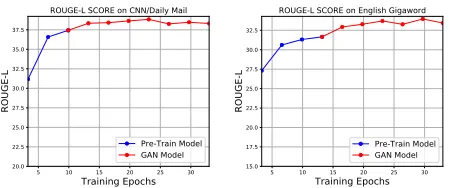
Figure 2: Learning curves of HATS in terms of Rouge-L.
Ablation Study
To investigate the effect of each component of the HATS model, we also perform the ablation test of HATS in terms of discarding external knowledge from KB (denoted w/o KB), text categorization (denoted as w/o text), syntax generation (denoted as w/o syntax), and generative adversarial network framework (denoted as w/o GAN), respectively.
The ablation results are summarized in Table 1-2 (bottom four lines). Generally, all three factors contribute a great
im-provement to HATS. From the results, we can observe that the Rouge and human evaluation scores decrease sharply when discarding the generative adversarial network frame-work. This is within our expectation since the RL reward signal coming from the discriminative modelDguides the model to enjoy considerable success in generating high-quality and human-like summaries. In addition, common-sense knowledge from KB also contributes to the effective-ness of HATS. This verifies that the prior knowledge from KB helps to learn more comprehensive document represen-tations. However, the improvement of Rouge scores by inte-grating syntax annotation is relatively limited. This may be explained by the fact that the issue of the incomplete sen-tence has little effect on the automatic evaluation metrics of summarization. In contrast, syntax annotation contributes a great improvement on human evaluation scores.
Case Study
To evaluate the proposed model qualitatively, we report some generated summaries by different models. Due to lim-ited space, we randomly choose one generated summary by DeepRL and our model from test data for comparison. The results are reported in Table 3. We observe that our model tends to generate more specific and meaningful summary given the source article. For example, our model success-fully catches the key point of “dark matter” and “the size of the map”, while DeepRL attends over some trivial facts instead of the key facts.
Input:“University of Waterloo astrophysicists have cre-ated a 3D master map of the universe spanning nearly two billion light years. The innovative spherical map of galaxy superclusters is the most complete picture of our cosmic neighbourhood to date. It will help astrophysi-cists understand how matter is distributed in the universe and provide key insights into dark matter one of physics’ greatest mysteries. Scroll down for video a slice through the Map of the nearby Universe. Our Milky Way Galaxy galaxy is in the centre, marked by a cross.(...)”
Ground-truth: “Map spans nearly two billion light years. Will help astrophysicists predict the universe’s ex-pansion. Could help identify where, and how much dark matter exists.”
DeepRL: “University of Waterloo created a 3D master map of galaxy universe spanning nearly two billion light years. The innovative spherical map galaxy superclusters is the most complete picture of our cosmic neighbour-hood to date. It will help astrophysicists understand how matter is distributed in the universe and provide key in-sights into dark matter. The lighter blue and white areas on the map represent greater concentrations of galaxies.”
Ours:“3D master map of the universe spans nearly two billion light years. Innovative spherical map of galaxy su-perclusters is the most complete picture. Will help astro-physicists understand the universe distribution and pro-vide key insights of dark matter.”
Conclusion and Future Work
In this paper, we propose a hierarchical human-like strat-egy to mimic how humans approach the task of abstractive text summarization. The experimental results showed that the proposed HATS model achieved higher ROUGE scores and human evaluation results than several strong baseline methods. Moreover, the experimental results of human eval-uation also verified that HATS could generate summaries with better informativeness and fluency. In the future, we would explore automatic evaluation metrics that may better match the human judgments.
Acknowledgment
This work was also partially supported by the National Natu-ral Science Foundation of China (Grant No. 61803249), the Shanghai Sailing Program (Grant No. 18YF1407700), the SIAT Innovation Program for Excellent Young Researchers (Grant No. Y8G027), and the CAS Pioneer Hundred Talents Program. Min Yang was sponsored by CCF-Tencent Open Research Fund.
References
Avery, P. G., and Graves, M. F. 1997. Scaffolding young learn-ers’ reading of social studies texts. Social Studies and the Young Learner9(4):10–14.
Cao, Z.; Li, W.; Li, S.; and Wei, F. 2018a. Retrieve, rerank and rewrite: Soft template based neural summarization. InACL, vol-ume 1, 152–161.
Cao, Z.; Wei, F.; Li, W.; and Li, S. 2018b. Faithful to the original: Fact aware neural abstractive summarization.AAAI.
Chopra, S.; Auli, M.; and Rush, A. M. 2016. Abstractive sen-tence summarization with attentive recurrent neural networks. In
NAACL, 93–98.
Clark, S. 2002. Supertagging for combinatory categorial grammar. InTAG, 19–24.
Furbach, U.; Schon, C.; and Stolzenburg, F. 2014. Cognitive sys-tems and question answering.arXiv preprint arXiv:1411.4825. Goodfellow, I.; Pouget-Abadie, J.; Mirza, M.; Xu, B.; Warde-Farley, D.; Ozair, S.; Courville, A.; and Bengio, Y. 2014. Gen-erative adversarial nets. InNIPS.
Graff, D.; Kong, J.; Chen, K.; and Maeda, K. 2003. English giga-word.Linguistic Data Consortium4(1):34.
Gu, J.; Lu, Z.; Li, H.; and Li, V. O. 2016. Incorporating copying mechanism in sequence-to-sequence learning. InACL, volume 1, 1631–1640.
Gulcehre, C.; Ahn, S.; Nallapati, R.; Zhou, B.; and Bengio, Y. 2016. Pointing the unknown words. InACL, volume 1, 140–149. Hermann, K. M.; Koˇcisk`y, T.; Grefenstette, E.; Espeholt, L.; Kay, W.; Suleyman, M.; and Blunsom, P. 2015. Teaching machines to read and comprehend. InICNIPS, 1693–1701. MIT Press. Kikuchi, Y.; Neubig, G.; Sasano, R.; Takamura, H.; and Okumura, M. 2016. Controlling output length in neural encoder-decoders.
EMNLP1328–1338.
Kim, Y. 2014. Convolutional neural networks for sentence classi-fication. InEMNLP.
Kingma, D. P., and Ba, J. 2014. Adam: A method for stochastic optimization.arXiv preprint arXiv:1412.6980.
Lavie, A., and Agarwal, A. 2007. Meteor: An automatic metric for mt evaluation with high levels of correlation with human judg-ments. InACL, 228–231.
Li, W.; Li, W.; and Wu, Y. 2018. A unified model for document-based question answering document-based on human-like reading strategy. In
AAAI, 604–611.
Lin, C.-Y. 2004. Rouge: A package for automatic evaluation of summaries.Text Summarization Branches Out.
Liu, L.; Lu, Y.; Yang, M.; Qu, Q.; Zhu, J.; and Li, H. 2018. Gen-erative adversarial network for abstractive text summarization. In
AAAI.
Masson, M. E. 1983. Conceptual processing of text during skimming and rapid sequential reading. Memory & Cognition
11(3):262–274.
Mikolov, T.; Sutskever, I.; Chen, K.; Corrado, G. S.; and Dean, J. 2013. Distributed representations of words and phrases and their compositionality. InNIPS, 3111–3119.
Nallapati, R.; Zhou, B.; Gulcehre, C.; Xiang, B.; et al. 2016. Ab-stractive text summarization using sequence-to-sequence rnns and beyond. InSIGNLL, 280–290.
Papineni, K.; Roukos, S.; Ward, T.; and Zhu, W.-J. 2002. Bleu: a method for automatic evaluation of machine translation. InACL, 311–318.
Paulus, R.; Xiong, C.; and Socher, R. 2017. A deep reinforced model for abstractive summarization. ICLR.
Perozzi, B.; Al-Rfou, R.; and Skiena, S. 2014. Deepwalk: online learning of social representations. InSIGKDD, 701–710.
Ranzato, M.; Chopra, S.; Auli, M.; and Zaremba, W. 2016. Se-quence level training with recurrent neural networks. InICLR. Rush, A. M.; Chopra, S.; and Weston, J. 2015. A neural attention model for abstractive sentence summarization. InEMNLP, 379– 389.
See, A.; Liu, P. J.; and Manning, C. D. 2017. Get to the point: Summarization with pointer-generator networks. InACL, 1073– 1083.
Steedman, M., and Baldridge, J. 2011. Combinatory catego-rial grammar. Non-Transformational Syntax: Formal and Explicit Models of Grammar181–224.
Sutton, R. S.; McAllester, D. A.; Singh, S. P.; and Mansour, Y. 2000. Policy gradient methods for reinforcement learning with function approximation. InNIPS, 1057–1063.
Tarchi, C., et al. 2017. Comprehending and recalling from text: The role of motivational and cognitive factors. Issues in Educational Research27(3):600.
Toprak, E. L., and Almacıo˘glu, G. 2009. Three reading phases and their applications in the teaching of english as a foreign language in reading classes with young learners. Journal of language and Linguistic Studies5(1):pp–20.
Yang, M.; Qu, Q.; Shen, Y.; Lei, K.; and Zhu, J. 2018. Cross-domain aspect/sentiment-aware abstractive review summarization by combining topic modeling and deep reinforcement learning.
Neural Computing and Applications1–13.