The Thirty-Third AAAI Conference on Artificial Intelligence (AAAI-19)
Unsupervised Controllable Text Formalization
Parag Jain, Abhijit Mishra, Amar Prakash Azad,
Karthik Sankaranarayanan
IBM Research
{pajain34,abhijimi,amarazad,kartsank}@in.ibm.com
Abstract
We propose a novel framework for controllable natural lan-guage transformation. Realizing that the requirement of par-allel corpus is practically unsustainable for controllable gen-eration tasks, an unsupervised training scheme is introduced. The crux of the framework is a deep neural encoder-decoder that is reinforced with text-transformation knowledge through auxiliary modules (calledscorers). These scorers, based on off-the-shelf language processing tools, decide the learning scheme of the encoder-decoder based on its actions. We ap-ply this framework for the text-transformation task of formal-izing an input text by improving its readability grade; the de-gree of required formalization can be controlled by the user at run-time. Experiments on public datasets demonstrate the efficacy of our model towards: (a) transforming a given text to a more formal style, and (b) varying the amount of formal-ness in the output text based on the specified input control. Our code and datasets are released for academic use.
1
Introduction
Automatic text style-transformation is one of the key goals of text-to-textnatural language generation (NLG) research and most existing systems for such tasks are either super-vised (e.g., variants ofSeq2Seq neural models (Sutskever, Vinyals, and Le 2014; Bahdanau, Cho, and Bengio 2014), or Statistical Machine Translation models (Koehn 2009)) or template/rule based (Gatt and Reiter 2009). Supervised NLG requires large-scale parallel corpora for training, which is a major impediment in scaling to diverse use-cases. For ex-ample, in the context of commercial dialog systems alone, there are several scenarios where a system’s answer (which may be coming from a database (Jain et al. 2018)) needs to be transformed either for its tone(politeness, excitedness, etc.), or its level offormality(casual, formal,etc.based on the user’s personality), or for itscomplexity(simplifying lin-guistic or domain-specific terminology such as in legal or medical domains). As such requirements and use-cases keep growing, it is practically unsustainable to obtain large scale parallel corpora for each such text transformation task.
From a scientific perspective, a supervised treatment of all such tasks using several parallel corpora seeks to learn
Copyright c2019, Association for the Advancement of Artificial Intelligence (www.aaai.org). All rights reserved.
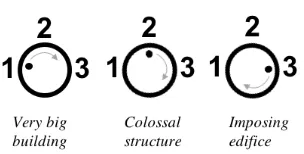
Figure 1: Controllable formalization showing an anecdotal snippet and its expected variations w.r.t. input controls
both the language transformation (while preserving seman-tics), as well as the style transformation, simultaneously for each task. We make 3 key observations with respect to this: (i) since the preservation of language semantics is necessary for transformation, whereas only the attribute or style of the text needs to be changed, it should be possible to decouple these two aspects, (ii) it should be cheaper to independently verifythese aspects at the output (with well-understood NLP techniques) than tospecify the required transformation for each input text with its output example, and (iii) it should be possible tocontrolthe degree or magnitude of the intended attribute (readability level, politeness level,etc.) required at the output. These observations motivate us to seek an un-supervised approach to such a gamut of text transformation tasks and underlie the proposed NLG framework.
Our framework is based on an encoder-decoder module (Bahdanau, Cho, and Bengio 2014), which is pre-trained with unlabeled texts.The decoder additionally takes user-specified control as input. Further, knowledge of the re-quired text-transformation is acre-quired through auxiliary modules (calledscorers) which decide the learning scheme of the encoder-decoder based on its actions. These scorers are based on readily available natural language processing (NLP) tools which can produce scores indicating: (a) how formal the generated text is, (b) whether the generated text is fluent, and most importantly, (c) whether the generated text carries similar semantics as the input. This framework is trained in multiple iterations, where each iteration is com-prised of two phases of(i) explorationand(ii) exploitation. In the exploration phase, the decoder randomly samples can-didate texts for given inputs, and with the help of scorers, automatically produces training data for controllable gener-ation. In the exploitation phase, the encoder-decoder is re-trained with the examples thus generated.
For experiments, we prepare a mixture of unlabeled in-formal texts with low readability grade. Our NLP tools mea-sure readability, adequacy and fluency. With this setup, we observe that (a) the system generated transformed texts are more formal than the input, and (b) their degree of formal-ness conforms to the input controls provided. The efficacy of our system is demonstrated through both qualitative and quantitative evaluations, in terms of human judgments and various NLG evaluation metrics. We also show the system’s effectiveness for another relevant task of text complexifica-tion (reversed simplificacomplexifica-tion). The source code and dataset are publicly available.
2
Related Work
Unsupervised NLG has always been more challenging due to the fact that: (i) the output space is more complex and structured, making unsupervised learning more difficult, and (ii) metrics for evaluating NLG systems without reference output text are elusive. Recently, Artetxe et al. (2017) and Lample, Denoyer, and Ranzato (2017) have proposed ar-chitectures for unsupervised language translation with un-supervised autoencoder based lexicon induction techniques. This approach primarily focuses on cross-lingual transfor-mation and requires multiple unlabeled corpora from differ-ent languages. It can not trivially be extended to our setup to achieve a controllable text-transformation goal within a single language, and further there is no notion of control in language translation. A notable work by Hu et al. (2017) discusses controllable generation; the system takes control parameters like sentiment, tenseetc., and generates random sentences conforming to the controls. However, this system, unlike ours, does not transform a given input text.
The work that is most relevant to ours is by (Mueller, Gif-ford, and Jaakkola 2017) which jointly trains a VAE and an outcome prediction module to correct an input such that the output has a higher expected outcome. We use this work for comparison by configuring their system to perform formal style transformation. This model, however, does not take as input an external control parameter which ours does.
Some other relevant works are on sentiment and at-tribute based unsupervised style transfer (Ficler and Gold-berg 2017; Shen et al. 2017; 2017), semi-supervised trans-fer through back translation using a translation corpora (Prabhumoye et al. 2018), formal-informal text classifi-cation using linguistic feature (Sheika and Inkpen 2012), politeness analysis (Danescu-Niculescu-Mizil et al. 2013), polite-conversation generation (Niu and Bansal 2018) us-ing encoder-decoder models, but these do not perform con-trollabletext-transformation. Similarly other relevant gen-eration frameworks for formal-text gengen-eration by Sheikha and Inkpen (2011) and paraphrase generation (Wubben, Van Den Bosch, and Krahmer 2010; Prakash et al. 2016) are ei-ther template based or supervised, and are not controllable. Language generation systems such as Li et al.; Yu et al. (2017; 2017) which incorporate NLP based scorers are unsu-pervised but suffer from convergence problems while train-ing, as also pointed out by Hu et al. (2017). To the best of our knowledge, our work is the first to approach the task of unsupervised controllable text transformation.
3
System Overview
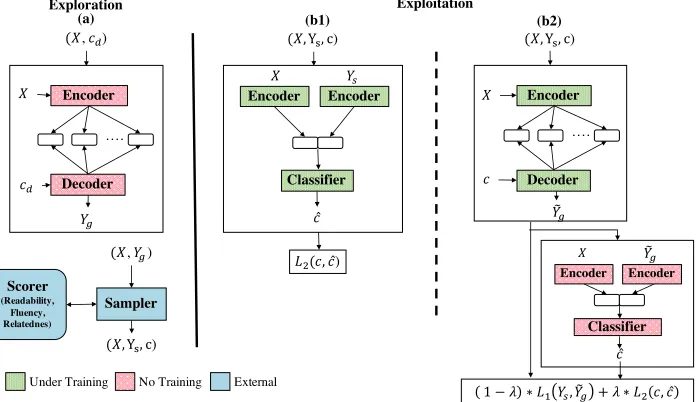
Our framework is designed to take text (or sentence, at this moment) and a set of control parameters. At this moment we consider only one input controli.e., degree of formaliza-tion. For such a task, a neural encoder-decoder is a natural choice. In our setting, the encoder-decoder takes a control value apart from the input text. To train this module without supervision, additional components are employed. Figure 2 depicts an overview of the system and the learning scheme.
3.1
Encoder and Controllable-Decoder
Our framework builds on the encoder-attend-decoder archi-tecture of (Bahdanau, Cho, and Bengio 2014). The work-ing principle of this is well-known, and is thus skipped for brevity. A vital change that we apply to the traditional archi-tecture is the inclusion of an additional input to the decoder - the control input. The control input is passed through an embedding layer ofddimensions.
Given an input sentence X comprising N words, and a d dimensional control vector c, the encoder first pro-duces a hidden representation H, using stacked layers of GRUs (Cho et al. 2014). The decoder generates one word at each time step, by: (a) attendingto the hidden representa-tion building a context vector, (b) concatenating the context vector with the control vector and the current hidden state of the decoder, and (c) producing a conditional probability distribution from the resultant output through a non-linear function. To summarize, for the M word output sentence
Y = (y1,y2,· · ·,yM), the conditional probability term for each wordyican be computed as,
p(yi|{y1,y2,· · · ,yi−1},zi,c)
=g(Eyi−1,c,si,zi)
(1)
wheregis thesoftmaxfunction that outputs the probabil-ity distribution ofyi;Eyi−1is the embedding of the
Encoder
Decoder
Encoder
…. 𝑋
𝑐#
(𝑋, 𝑐#)
𝑌&
Scorer (Readability,
Fluency, Relatednes)
Sampler
(𝑋, 𝑌&)
(𝑋, Y), c)
Encoder
Classifier
𝑋 𝑌+
𝑐̂
𝐿.(𝑐, 𝑐̂)
Encoder
Decoder …. 𝑋
𝑐
(𝑋, Y), c)
𝑌/&
𝑋
𝑐̂
1 − 𝜆 ∗ 𝐿5𝑌+, 𝑌/& + 𝜆 ∗ 𝐿.𝑐, 𝑐̂ (𝑋, Y), c)
Under Training
Exploration Exploitation
(a) (b1) (b2)
Encoder Encoder
Classifier
No Training External
𝑌/&
Figure 2: System architecture and phases of training
3.2
Sampler and Scorer
To train the encoder-decoder framework in an unsupervised manner (i.e.without true labelsY being available), instead of taking the most likely output of the decoder, the out-put probability distribution is passed through asamplerthat samplesKdifferent samples from the decoder. Sampling is necessary for the exploration step in the training process (discussed later in Section 4.2). Given an input textX, the decoder can produce outputYg. The role of the sampler is to takeYg and produceKvariants ofYg by applying slight variations. Once K samples are obtained, the best sample (Ys) that maximizes the weighted score (produced by the scorer module), is retained for further processing.
Ys= argmax
Y
{G(X,Y)|Y ∈ {Yg, SampleK(Yg)}} (2) whereG(.) is the scorer function andSampleK(.) is the sampler function that producesKoutputs.
The scorer (G(.)) comprises of multiple individual scor-ing modules that decide various aspects of the generated text. In our setting, the scorer intends to measure: (a) to what extent the generated text is semantically related to the input, (b) how fluent the generated text is, and, (c) how formal the text is, in terms of readability grade. These aspects are mea-sured as follows:
Semantic Relatedness: Semantic relatedness between the source (X) and generated/sampled text (Y) (denoted asrs) indicate how well the meaning is preserved during transfor-mation.
rs(X,Y) =docsim(X,Y)
wheredocsim(.)can be any document similarity measure. We use a simplistic embedding based similarity measure where a cosine similarity between averaged embedding vec-tors ofXandY is considered as similarity1.
1
We use Spacy’s (spacy.io) document similarity function. Sim-ilarity between texts are computed after removing stopwords.
Fluency: Fluency (denoted asrf) or how structurally well constructed is the target text (Y), is measured by using a language model.
rf(Y) =p(y1,y2,· · · ,yM)
which can be broken down into a product of conditional probability terms. For estimating the conditional probabil-ities, N-gram (Brown et al. 1992) or neural language mod-els (Bengio et al. 2003) can be used. For our experiments, we trained a 4-gram back-off model with KenLM (Heafield 2011) and Europarl monolingual English corpus (Koehn 2005), which contains mixed domain texts.
Readability Grade: Readability grade score (denoted as
rd) indicates the grade level that must be acquired to under-stand a given text. Typically a higher grade is indicative of higher linguistic complexity. Out of several metrics for read-ability grade scoring available, we chose theFlesch-Kincaid readability index (Kincaid et al. 1975), a simple yet popular readability metric. The metric relies on number of words in a sentence, and average number of syllables per word; it thus assesses thelexicalcomplexity of the text.
The cumulative scoring functionG(.)is a linear combi-nation of the individual scores2discussed above.
G(X,Y) =βsrs(X,Y) +βfrf(Y) +βdrd(Y) (3) where weightsβs,βf,βdare empirically decided.
3.3
Sampling Strategy:
At each time step i during generation, instead of choos-ing the most likely word from yi, one of its syn-onyms is randomly picked. The synonym of the word is decided by looking up a synonym list3, and pick-ing one synonym randomly with a uniform probability of
2
scores normalized between [0,1].
3
1/total number of synonyms. A sentence is formed by concatenating the words thus chosen. Since large number of combinations of synonyms are possible, one iteration of sampling is stopped whenKsample sentences are extracted. Note that our sampler is highly lexicalized, i.e.,it gen-erates only lexical variations. The reason behind such as choice is two-fold: (a) majority of the existing scorers for readability and document similarity assessment emphasize on the lexical aspects, and (b) generic/data-independent paraphrasers that transform text at syntax, semantic levels are elusive. However, the sampler plays an external role and our system can be bolstered with better samplers as the state-of-the-art progresses. For instance, for obtaining more di-verse samples, conditional VAEs (Sohn, Lee, and Yan 2015), trained on unlabeled texts can be considered.
3.4
Control Determination
The sampler and scorer result in generation of new exam-ple output for (X,Ys). However, for training the encoder-decoder (seeExploitation, in Section 4.3), the system needs data in the form of (X,Ys, c). The control value (c) for the newly generated example is determined as follows.
c=
1, ifcr< ζ1 2, ifζ1< cr< ζ2 3, ifcr> ζ2,
(4)
wherecr=rd(Ys)/rd(X).
In our setup we allow only one control that is based on readability. For other tasks and multiple controls, appropri-ate criteria can be defined within the same framework.
3.5
Control Predictor
The encoder-decoder during training is coupled with a clas-sification module orControl Predictor. The role of the con-trol predictor is to predict the expected concon-trol value of any input output pair (X,Y). The control predictor con-stitutes a pair of encoders on top of embedding layers that get hidden representationshx,hyfrom bothX andY re-spectively. The hidden representations are then concatenated
h = [hx;hy]and passed to a fully connected neural net-work with ReLU activation to get an intermediate hidden representationhf. To obtain a probability vector we perform a linear transform overhf and normalize it using softmax, which is given as:
hf=relu(Whh) (5)
hc=softmax(Wchf) (6)
During training, the control predictor takes<X,Ys,c> instances generated by the sampler and scorer module. It predicts control cˆ, suffers a cross-entropy based loss L2(c,cˆ). The losses are back-propagated to the embedding
layers. Section 4.4 motivates the need of this module.
4
Training Objective and Process
Training is carried out in three phases: (1)pre-training(2) explorationand (3)exploitation. While phase (1) is carried out once, the system undergoes phases (2) and (3) for several iterations. Figure 2 gives an overview of the training process.4.1
Pre-training
The encoder-decoder is first pretrained as an autoencoder with unlabeled data, it learns to predict X0 from X such that X0 ∼ X. Since, no control input is available during this phase, the control input is neglected. Pretraining ensures better initialization of the encoder and decoder parameters.
4.2
Exploration
Since labeled data is not directly available for training, the exploration phase helps synthesize instances of input text, output text and appropriate control (<X,Y,c>). The sys-tem is not trained during the process and is only allowed to predict outputYg and “explore” for other samples that are variations ofYg. With the help of the sampler, the sys-tem generatesK sample outputs and the scorer selects the sample Ys that maximizes the score. If none of the sam-ples obtain a better score than the default outputYg, no new instance is augmented for that particularX in that particu-lar iteration of exploration. If the generated output is same as the input, that instance is discarded. The possible control value for the generated sample Ys is computed following Equation 4.
As the encoder-decoder is pretrained, in the first itera-tion of exploraitera-tion, the model predictsYgsame as inputX. Since the sampled sentences selected by the scorer will al-ways have better score thanYg (else it will not be selected), the first iteration of exploration ensures that the output side of the synthesized data is different and with a better cumu-lative score than the input.
4.3
Exploitation
In this phase, the encoder-decoder are trained using the data generated during the exploration phase. This process is car-ried out in two stages as mentioned below:
Training of Control Predictor: The Control Predictor Module is trained withX,Y taken as input and cas out-put. It undergoes training in a standard classification setup where batches of labeled data are fed in multiple iterations and the loss is minimized. Once training gets over, the pre-dictor is plugged into the encoder-decoder network (where it becomes non-trainable) to predict the control for the gener-ated sentences. BothX,Y are provided as input since con-trol values signify therelativevariation ofY w.r.t.X.
Training of Encoder-Decoder: The encoder-decoder framework trains with sourceX, controlcas input and tar-get outputYs. For each instance, the model predicts output
Yg. The control predictor then has to predict the control cat-egory of the output (Yg). However, obtainingYg involves finding out the most likely words in the conditional prob-ability distribution (Equation 1) usingargmax operation. This makes the overall loss (Equation 7) non-differentiable.
To avoid this, we approximateYgas follows:
Yg≈Y˜g={y˜1,y˜2, ...,y˜M} where,
˜
where,siis the unnormalized decoder hidden representation (logits) andτ >0is thetemperature. Setting the tempera-ture to close to zero approximates the output to one-hot rep-resentation, typically obtained throughargmax. This, how-ever, ensures differentiability unlikeargmax.
The modified outputY˜g is input to the Control Predictor which predicts the appropriate controlcˆpertaining toXand
Yg. Based on the predicted output and control, a composite loss is calculated, as follows.
L(Ys,Yg,c,cˆ) =λ× L2(c,cˆ) +(1−λ)× L1(Ys,Y˜g)
(7)
whereλ∈[0,1]is a hyper parameter and the functionsL1(.)
andL2(.)arecross-entropybased loss functions, popularly
used in sequence-to-sequence and classification tasks.
4.4
Why Control Predictor?
In our setting for transformation, token level entropy faces the following issues: (i) Token-level loss averaged over the generated words equally penalizes all words; but in con-trollable transformation some words (for instance content words) play a more important role than others (e.g. stop-words), (ii) Cross entropy alone does not adequately cap-ture how the generated sentences are related to the controls passed. To alleviate these, we employ a predictor that com-putes an additional loss between predicted controls of the generated sentence and the reference controls.
5
Experiment Setup
We now describe the dataset, architectural choices, and hy-perparameters selected. Our dataset containsunlabeledtext which are simple and informal in nature. It comprises of
14432 informally written sentences collected from Enron Email Corpus4, Corpus of Late Modern English Prose5, non-spam emails from Spam Dataset6, andessays for kids7. The data is split into a train:valid:test split of80% : 12% : 8%. The vocabulary size of the dataset is95775words. The source code and dataset are available at https://github.com/ parajain/uctf.
We used a bidirectional GRU based encoder with 2 lay-ers; the forward and backward hidden representations from the encoder are concatenated. The embedding matrix with a word embedding size of 300 was shared between the en-coder and deen-coder. For enen-coder, 2 layers of GRUs were used and the hidden dimension size was set to 250. The decoder had 2 layers with hidden dimension size set to 500 . The weights related to language model, sentence similarity and readability scorers, given in Equation 3 are empirically set to 0.6, 0.2 and 0.2 respectively. Note that, Equation 3, by de-sign, allows choosing different combinations of transforma-tion parameters. These parameters may be tuned differently for different practical settings. For example, a low weight on semantic relatedness will be less restrictive on “relatedness”
4
http://bailando.sims.berkeley.edu/enron email.html
5http://ota.ox.ac.uk/desc/2077 6
http://csmining.org/index.php/spam-assassin-datasets.html
7
http://www.mykidsway.com/essays/
and can generate text with higher readability grade which is suitable for a domain such as creative writing. On the other hand for a domain such as legal where relatedness is more important, the corresponding weight can be set to a higher value.
During loss computation (Equation 7) we tried different values of parameterλ∈[0.1,0.3,0.5]and settled with0.1. The ζ1 and ζ2 in equation 4 were set to1.05and 1.1
re-spectively; these threshold values were incremented by5%
for each category to suit practical purposes. The temperature parameterτwas set to0.001; we did not use annealing. For both encoder-decoder and control predictor, we employed the Adam optimizer with the learning rate set to0.001. The system underwent pretraining once, followed by amaximum of20cycles of exploration-exploitation. For each input, we chose max K = 100 samples. Exploitation occurs for20
epochs with early stopping enabled. After each cycle, the model was saved and we chose the model which provided the best average score over a held-out set prepared only for model selection. During testing, for each input sentence in the test-data, control level values of2and3were chosen. Test scenario:The present system is configured to take an input sentence andthreepossible control levels pertaining to the degree of formalization desired by the user. The con-trol levels can be 1, 2 and 3. As depicted in Figure 1 in the introductory section, an input control of 1 would retain the input sentence as is, control 2 would transform it to a rela-tivelymedium level formal text (termed asFormalness-Mid) and control of 3 will transform the input to a text that is even more formal that2, (termed asFormalness-High).
5.1
Research Questions Addressed
Our experiments are designed to address the following re-search questions
• RQ1:Is our method able to produce output that is formal, fluent and adequate? Is the transformation controllable? How well does the output’s formalness conform to the in-put control provided?
• RQ2:Does the control predictor have a positive impact on the overall performance of our model?
• RQ3:Is iterative exploration-exploitation helpful? Why wouldn’t a much simpler strategy of just one round of sampling and training suffice?
• RQ4:Does our approach outperform the existing super-vised and unsupersuper-vised methods for such tasks?
RQ1is answered by measuring fluency, semantic related-ness and readability of the output text following Section 3.2. To answerRQ2andRQ3, we prepare two trivial variants of system: (a) CTRLNOPREDICTOR, in which the control pre-dictor module is removed, and (b) CTRLONESHOTwhere exploration and exploitation cycles are not iteratively carried out. Rather, the system undergoes one round of exploration cycles followed by one exploitation cycle.
Mode CTRL CTRL CTRL Mueller WITHPREDICTOR NOPREDICTOR ONESHOT et al., 2017
Formalness
Control Mid High Mid High Mid High NONE
Readability 0.568 0.583 0.538 0.538 0.554 0.554 0.33 Relatedness 0.72 0.74 0.77 0.77 0.78 0.78 0.05
LM Score 0.34 0.34 0.32 0.32 0.30 0.30 0.16
Table 1: Average test-set scores (normalized between[0−1])
System BLEU Relatedness Readability (with input)
Mueller et al. 5.09 0.41 0.38 Seq2Seq (skyline) 38.37 0.17 0.71 Formalness-Mid (Ours) 21.81 0.58 0.52 Formalness-High (Ours) 21.14 0.57 0.74
Table 2: Comparison of BLEU (%), avg. Semantic Related-ness with input, and avg. normalized readability scores.The avg. readability for input and reference sentences in test data are (0.41) and (0.50) respectively
• Comparison with Existing Unsupervised Method:The most relevant unsupervised transformation system is by Mueller, Gifford, and Jaakkola (2017). This system takes a sequence as input, auto-encodes it and applies minor variation based on expected outcome that is decided by a scorer. We fix readability metric as the scoring function and treat the system as a baseline.
• Indirect Comparison with Supervised SystemsA sim-ilar task to ours is the reverse of text simplification, for which labeled datasets exist. We chose the dataset con-figuration given in the neural-text simplification work by Nisioi et al. (2017), originally derived from Hwang et al. (2015). We flip the input-output side of the parallel corpus, thereby reversing the training objective. Our sys-tem uses only the simplified side of the data for training, with the previously discussed configuration. Additionally, the completesimple-to-complexparallel corpus was used to train a neural Seq2Seq generation system (Bahdanau, Cho, and Bengio 2014) using the Marian toolkit (Junczys-Dowmunt et al. 2018) with default configurations8.
6
Evaluation Results
For our dataset, we first evaluate the output text based on: (a) basic parameters such as fluency, adequacy (semantic re-latedness with input) and readability grade, and (b) whether the quality of output comply with the input control param-eters or not. A direct comparison between different variants of our own system could be done using these measures.
Observe in Table 1, the readability scores for CTRLWITH-PREDICTOR are always better than the average readability
8
convergence attained after70000iterations.
0 10 20 30 40 50 60 70 80
Mid High Mid High Mid High CtrlWithPredictor CtrlNoPredictor CtrlOneShot
A
gr
ee
m
ent
a
cc
ur
ac
y
%
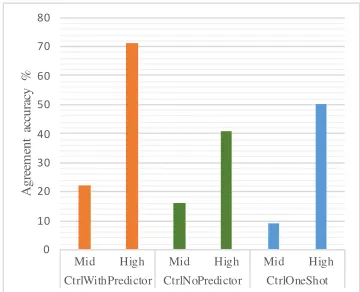
Figure 3: Accuracy (in %) showing the agreement between desired input control and control measured on the output text using Equation 4
.
grade of the input (0.54). This indicates that the transfor-mation obtained by the system has an improved readabil-ity grade. The improvement is even more for CTRLWITH-PREDICTORthan the other two, which demnostrates the im-portance of the Control Predictor and the iterative training scheme. The Language Model scores CTRLWITHPREDIC-TORis the highest and differs significantly from CTRLNO-PREDICTOR. This shows that adding the auxiliary loss from Control Predictor output results in better fluency. Regarding semantic relatedness, we observe that most sentences gen-erated by CTRLONESHOTundergo little or no modification vis-´a-visthe input. This results in a slightly higher semantic relatedness score. Moreover, in most cases the output ob-tained from these two systems are indifferent to control val-ues of M idandHigh, hence the average scores are same for both control levels. For CTRLONESHOT, for the same input text, multiple variants for the same input are gener-ated in one-shot. In the hindsight, using such data may have confused the system during training and it may have learned to ignore the control. Lastly, CTRLNOPREDICTOR hardly incurs any direct loss pertaining to the control values, and thus, becomes somewhat agnostic of the control levels.
Mode Input Sentence Formalness Control-Mid Formalness Control-High
W
ithPred
(1) 18 year old who abandoned her child in a hospital later got cus-tody
(1) 18 year old who unpopulated her kid in a infirmary resultant got custody
(1) 18 year old who deserted her tyke in a infirmary resultant got detention
(2) the first sync after upgrading will be slow
(2) the first synchronise afterward upgrading will be idle
(2) the first synchronise afterward upgrading will be laggard
NoPred
(1) 18 year old who abandoned her child in a hospital later got cus-tody
(1) 18 class old who deserted her child in a infirmary accompanying got detention
(1) 18 class old who deserted her child in a infirmary accompanying got detention
(2) the first sync after upgrading will be slow
(2) the introductory synchronise afterward upgrading will be goosy
(2) the introductory synchronise afterward upgrading will be goosy
OneShot
(1) 18 year old who abandoned her child in a hospital later got cus-tody
(1) 18 yr old who untenanted her tyke in a hospital subsequently got detention
(1) 18 class old who deserted her tyke in a hospital subsequently got detention
(2) the first sync after upgrading will be slow
(2) the eightieth sync later upgrad-ing bequeath be tedious
(2) the eightieth sync later upgrad-ing bequeath be tedious
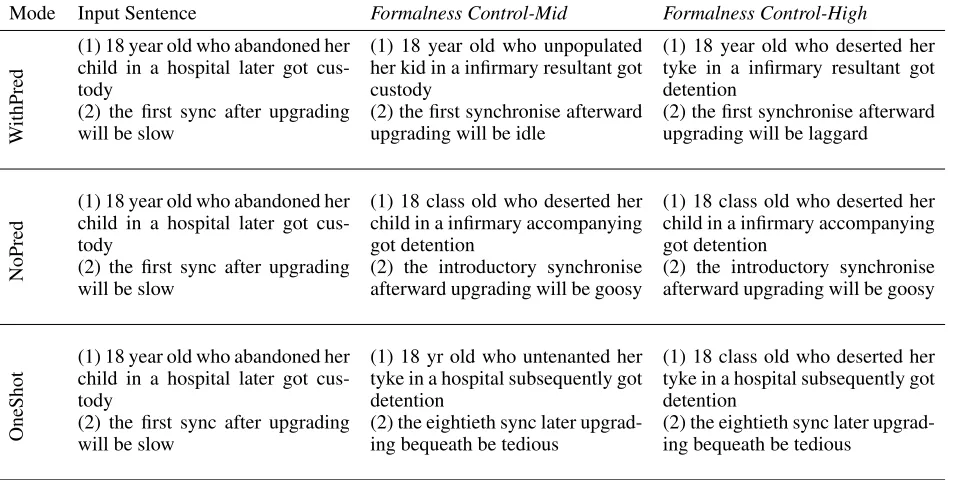
Table 3: Example input and transformed sentences with varying control values and system variants
control value Def ault (i.e.,very similar to input) or con-trol valueHigh. This suggests the need for fine-tuning the user-defined parameters in Equation 4. However, note that the highest percentage values are obtained for CTRLWITH-PREDICTOR.
6.1
Human Evaluation
We performed an additional experiment where three lan-guage experts unaware of the task were given 30 random instances from our test dataset. Each instance consists of the input sentence, the predicted outputs with controlsM id
andHigh(shuffled for ruling out bias). For each instance the experts were asked to rank the output sentences based on their perceived readability. Ideally, the output for M id
should rank lower than the one forHigh. The average agree-ment between the human-rated rank labels and the default ranking based on input control categories turned out to be 80.2%, This indicates that the readability of outputHighis indeed higher than that ofM id.
Table 3 presents a few randomly selected examples for different input sentences and varied control values for all 3 system variants. We can clearly observe that the input sentences are modified according to control values. CTRL-WITHPREDICTORshows increasing readability grade going fromM idtoHigh. This is also corroborated by readability scores in Table 1. Further, as expected, the CTRLNOPRE-DICTOR system is unable to capture the change in control levels due to lack of explicit feedback. The CTRLONESHOT system also does not show much improvement with con-trols due to lack of transformation knowledge it would have gained if the iterative exploration/exploitation based train-ing had been applied. We believe, our observations above provide positive answers to research questionsRQ1,RQ2, andRQ3.
6.2
Comparison with Supervised Systems for
Reversed-simplification Task
Table 2 shows how comparable are the generated complex sentences with the reference complex texts for reverse sim-plification task. For this, BLEU (Papineni et al. 2002) is considered as the metric. Supervised Seq2Seq, as expected serves as askylineand achieves a much better BLEU than ours. Yet the BLEU score of our system is significant, con-sidering that our system is unsupervised and not designed to produce outputs that overlap more with the reference text. It is important to note that the average readability scores for our system variants are better than that of the reference cor-pora (avg. readability 0.50) and Seq2Seq, which shows the capability of our system in transforming the input to a more formal version. Moreover, the higher semantic relatedness scores indicate that our models are indeed capable of pre-serving the semantics better.
Regarding comparison with Mueller et al., the crux of their system is a variational autoencoder and an outcome prediction module which revises the input such that the out-put has a higher expected outcome. The problem with such an approach is that it is restricted to generating from a known distribution of sentences provided in the form of training data. The reduced performance by the system as seen in Ta-bles 1 and 2 is perhaps due to the facts that the training data size is less and the system does not have schemes for iter-ative training like ours. The above comparison studies pro-vide insights forRQ4.
7
Conclusion and Future Work
knowledge. Our system is tested for the task of formaliz-ing the input text by improvformaliz-ing its readability grade, where the degree of readability grade is controllable. Experiments on general domain datasets demonstrate the goodness of the output transformed texts both quantitatively and quali-tatively. The system also learns to give importance to the user-defined control and responds accordingly. A shortcom-ing of the current approach is that it only performs lexical formalization because of the sampling strategy and choice of Flesch Kincaid readability metric that is highly lexical. Our future agenda involves exploring better sampling techniques for generating complex structural and semantic variants, and also testing the framework for tasks like text simplification and style-transformation.
References
Artetxe, M.; Labaka, G.; Agirre, E.; and Cho, K. 2017. Un-supervised neural machine translation.arXiv:1710.11041. Bahdanau, D.; Cho, K.; and Bengio, Y. 2014. Neural ma-chine translation by jointly learning to align and translate. arXiv:1409.0473.
Bengio, Y.; Ducharme, R.; Vincent, P.; and Jauvin, C. 2003. A neural probabilistic language model. JMLR, 2003 3(Feb):1137–1155.
Brown, P. F.; Desouza, P. V.; Mercer, R. L.; Pietra, V. J. D.; and Lai, J. C. 1992. Class-based n-gram models of natural language.Computational linguistics.
Cho, K.; Van Merri¨enboer, B.; Bahdanau, D.; and Bengio, Y. 2014. On the properties of neural machine translation: Encoder-decoder approaches. arXiv:1409.1259.
Danescu-Niculescu-Mizil, C.; Sudhof, M.; Jurafsky, D.; Leskovec, J.; and Potts, C. 2013. A computational ap-proach to politeness with application to social factors. In ACL, 2013.
Ficler, J., and Goldberg, Y. 2017. Controlling linguistic style aspects in neural language generation.arXiv:1707.02633. Gatt, A., and Reiter, E. 2009. Simplenlg: A realisation en-gine for practical applications. In12th European Workshop on NLG.
Heafield, K. 2011. Kenlm: Faster and smaller language model queries. InSixth Workshop on SMT.
Hu, Z.; Yang, Z.; Liang, X.; Salakhutdinov, R.; and Xing, E. P. 2017. Toward controlled generation of text. In Inter-national Conference on Machine Learning.
Hwang, W.; Hajishirzi, H.; Ostendorf, M.; and Wu, W. 2015. Aligning sentences from standard wikipedia to simple wikipedia. InNAACL-HLT.
Jain, P.; Laha, A.; Sankaranarayanan, K.; Nema, P.; Khapra, M. M.; and Shetty, S. 2018. A mixed hierarchical attention based encoder-decoder approach for standard table summa-rization. InNAACL-HLT.
Junczys-Dowmunt, M.; Grundkiewicz, R.; Dwojak, T.; Hoang, H.; Heafield, K.; Neckermann, T.; Seide, F.; Ger-mann, U.; Aji, A. F.; Bogoychev, N.; Martins, A. F. T.; and Birch, A. 2018. Marian: Fast neural machine translation in c++. arXiv:1804.00344.
Kincaid, J. P.; Fishburne Jr, R. P.; Rogers, R. L.; and Chissom, B. S. 1975. Derivation of new readability formulas (automated readability index, fog count and flesch reading ease formula) for navy enlisted personnel. Technical report, DTIC Document.
Koehn, P. 2005. Europarl: A parallel corpus for statistical machine translation. InMT summit.
Koehn, P. 2009.Statistical machine translation. Cambridge University Press.
Lample, G.; Denoyer, L.; and Ranzato, M. 2017. Unsuper-vised machine translation using monolingual corpora only. arXiv:1711.00043.
Li, Z.; Jiang, X.; Shang, L.; and Li, H. 2017. Paraphrase generation with deep reinforcement learning. arXiv:1711.00279.
Mueller, J.; Gifford, D.; and Jaakkola, T. 2017. Sequence to better sequence: continuous revision of combinatorial struc-tures. InICML, 2017, 2536–2544.
Nisioi, S.; ˇStajner, S.; Ponzetto, S. P.; and Dinu, L. P. 2017. Exploring neural text simplification models. InACL, 2017. Niu, T., and Bansal, M. 2018. Polite dialogue generation without parallel data.arXiv:1805.03162.
Papineni, K.; Roukos, S.; Ward, T.; and Zhu, W.-J. 2002. Bleu: a method for automatic evaluation of machine transla-tion. InACL, 2002.
Prabhumoye, S.; Tsvetkov, Y.; Salakhutdinov, R.; and Black, A. W. 2018. Style transfer through back-translation. arXiv:1804.09000.
Prakash, A.; Hasan, S. A.; Lee, K.; Datla, V.; Qadir, A.; Liu, J.; and Farri, O. 2016. Neural paraphrase generation with stacked residual lstm networks. arXiv:1610.03098.
Sheika, F. A., and Inkpen, D. 2012. Learning to classify documents according to formal and informal style. Linguis-tic Issues in Language Technology.
Sheikha, F. A., and Inkpen, D. 2011. Generation of for-mal and inforfor-mal sentences. In13th European Workshop on NLG.
Shen, T.; Lei, T.; Barzilay, R.; and Jaakkola, T. 2017. Style transfer from non-parallel text by cross-alignment. InNIPS, 2017, 6830–6841.
Sohn, K.; Lee, H.; and Yan, X. 2015. Learning struc-tured output representation using deep conditional genera-tive models. InNIPS.
Sutskever, I.; Vinyals, O.; and Le, Q. V. 2014. Sequence to sequence learning with neural networks. InNIPS.
Wubben, S.; Van Den Bosch, A.; and Krahmer, E. 2010. Paraphrase generation as monolingual translation: Data and evaluation. InINLG, 2010.