International Journal of
Current Multidisciplinary Studies
Available Online at http://www.journalijcms.com Vol. 4, Issue,6(A), pp.892-899, June, 2018
RESEARCH ARTICLE
AN EVALUATION OF THE RELATIONSHIP BETWEEN SOCIAL MEDIA USAGE PATTERNS
AND PERCEIVED LEARNING OUTCOME AMONG TEACHER TRAINEES IN SELECTED
PRIVATE COLLEGES IN NAKURU COUNTY. IN KENYA
Mutugi Lilian
1and Magutah Abysolom Kuria
21
Masters Graduate in Educational Psychology, Tutor- Nakuru Teachers’ Training college
2Curriculum Studies student – Kenyatta University, Kenya.
A R T I C L E I N F O A B S T R A C T
Received 11th March, 2018 Received in revised form 27th April, 2018 Accepted 5th May, 2018 Published online 28th June, 2018
Social media sites have gained popularity among college students and are becoming an indispensable constituent of majority of their daily routines. This study sought to evaluate the relationship between social media usage patterns and perceived learning outcome among teacher trainees in selected private colleges in Nakuru County in Kenya. The objectives of the study were; to assess the influence of social media usage on academic grades of teacher trainees; to examine the influence of social media usage on performance of teacher trainees during their attachment and to establish the effect of social media usage on teacher trainees’ timely completion and submission of assignments. This study was guided by the production function theory. The study adopted mixed methodology approach. Concurrent triangulation research design was applied to enable the researcher use the quantitative and qualitative methods. The target population was 1440 which comprised of 240 tutors and 1200 teacher trainees. Stratified sampling was used in order to achieve adequate representation of sub samples to create five strata based on the number of colleges. From the five colleges 291 teacher trainees were selected using proportionate sampling and 74 tutors selected using simple random sampling. The sampling procedures enabled the researcher to realize a sample size of 365 respondents. Questionnaires were used to collect data from teacher trainees whereas a structured interview schedule was used to collect data from tutors. Piloting of research instruments was conducted amongst 30 teacher trainees and 10 tutors to establish validity, reliability, credibility and dependability. Validity was established by involving the supervisor and other experts from the University who determined content validity. Reliability coefficient was obtained using Cronbach’s Alpha Method. Credibility and dependability of the qualitative data was established through triangulation and multiple analyses. Qualitative data was analyzed thematically along the objectives and presented in a narrative form. The quantitative data was analyzed using descriptive and inferential statistics in Statistical Packages for Social Science (SPSS Version 21). The descriptive results were presented using mean, standard deviation and frequency distribution tables. Inferential statistics was presented using spearman rank order correlation co efficient. The study established that there was a relationship between the social media usage and the perceived learning outcomes on teacher trainees.
Keywords:
Social media, teacher trainees, learning outcome,
INTRODUCTION
The rapid development of information and communication technologies has sparked the creative incorporation of social media into current pedagogical applications and processes. Social media includes a variety of web-based tools and services that are designed to promote community development through collaboration and information sharing (Arnold & Paulus, 2010;
Junco, Helbergert & Loken, 2011). These tools provide opportunities for individual expression as well as interactions with other users (Arnold & Paulus, 2010). Social media is a multi-purpose platform with web-based technology which incorporates text, sound, video, and images with the purpose of making communication more interactive, appreciative and enjoyable (Kaplan & Haenlein, 2010). Social media is a means of interaction among people in which they create, share,
IJCMS
exchange and comment on contents among themselves in virtual communities and networks. The social media introduces substantial and pervasive changes to communication between organizations, communities and individuals (Kietzmann et al., 2011). In recent years, Social media networks have penetrated people’s daily life with amazing rapidity to become an important social platform for computer-mediated communication (Correa et al., 2010; Powell, 2009; Tapscott, 2008).
Social media networks have created a phenomenon on the internet that has gained popularity over the last decade (Boyd & Ellison, 2007). In recent years these network sites have achieved notable popularity among college students. Many of these young adults use social media networks to communicate with family, friends, and even strangers. Created in 2004, Facebook was originally established for students at Harvard University but expanded to other university audiences and eventually opened to anyone over the age of 13. WhatsApp Messenger is a proprietary, cross-platform instant messaging subscription service for smartphones and selected feature phones that uses the internet for communication. In addition to text messaging, users can send each other images, videos, and audio media messages as well as their location using integrated mapping features. WhatsApp was founded by former Yahoo employees Brian Acton and Jan Koum in 2009 took its name from a play on the phrase “What’s Up,” according to its website. The app can be downloaded on Android, iOS, BlackBerry, Windows and Symbian platforms. (www.whatsApp.com, 2014).
Studies from the USA by Boyd & Ellison (2008) found out that the various functions offered by the social network sites make them attractive and irrevocable for their users. The social media networks are not only popular for photo sharing and other known applications useful tools for students, but also there are some academic purposes which encourage university students use these sites. Ijeoma and Burke (2013) disclosed in their study in the United Kingdom that social media have many negative effects on the students’ social learning outcome. Social media usage can negatively affect academic pursuits because of the time spent by the users which does not often relate to academics.
Frequent technological innovations have increased the desire of students to adopt new technologies in their learning processes. These innovations have brought changes in various pedagogical and technological applications and processes. College students are adopting social media networks with a lot of creativity. Studies have indicated that social media network tools can be used to support educational activities by making interaction, collaboration, active participation, information and resource or material sharing possible (Ajjan and Hartshorne, 2008). The most prevalent use of social media networks in the college community is creating profiles and groups to communicate events with users building a sense of community and possible academic applications.
Positive and negative effects of technology on achievement have been documented. Researchers have found that recreational internet use is strongly correlated with impaired academic performance (Kubey, Lavin, & Barrows, 2001).
Students who reported internet caused schoolwork problems were found to have spent five times more hours online than those who did not, and they were also significantly more likely to report that their Internet use caused them to stay up late, get less sleep, and miss classes. Students who reported academic problems were more likely to use the internet for real-time social activities such as instant messaging and chat rooms.
While there have been noted benefits associated with social network sites use, including new opportunities for sociability and self-expression, there are also some concerns about its use, particularly frequent use (Lenhart & Madden, 2007). Earlier studies examined the general usability of social media among young students in higher level of education in America. Similarly, Hemmi & Land, (2009) examined the use of social media and maintain that, the appropriation of social technologies is not an easy and straightforward process. At higher level of education more complex academic tasks are handled and the new generation of students is perceived to understand that social media and social technologies are influential to learning.
According to (Khan, 2009) Facebook users often time experience poor performance academically. Karpinski, (2009) pointed out that Facebook users devoted lesser time to their studies in comparison to nonusers did and subsequently had lower GPAs.
Given the high-volume usage of social media, an obvious and popular concern among faculty, administrators, and parents is the widespread notion that students spend far too much time on non-academic activities related to the Internet and social media. The most salient concern among scholars, educators, and the public however is related to the effects of social networking sites such as Facebook on the time dedicated to studying. McCoy (2016) in his study “Digital Distractions in the Classroom Phase II: Student Classroom Use of Digital Devices for Non- Class Related Purposes” notes that students are becoming more distracted than ever. They tend to check their digital devices, particularly, their smartphones, on an average of 11.43 times during class for non-classroom activities.
According to the study findings, the most prevalent form of distraction was texting, reported by 87 percent of students in the 2015 study. At 76 percent email came in second, closely followed by "checking the time" at 75 percent. Social networking was reported by 70 percent of respondents, Web surfing by 42 percent and game-playing by 10 percent. As most media is regarded as a source of entertainment, popular opinion believes it serves only as a distraction and yet another impediment to academic achievement. In Kenya, a study by Consumer Insight (2014) reveals that Kenyan urban youth spend at least USD250 million annually to purchase data for accessing Facebook and Twitter on their mobile phones. This study will focus on Facebook and WhatsApp since they are the most popular social media sites and application respectively used by a majority of college students.
Statement of the Problem
Social media sites which include Facebook, Twitter, WhatsApp, Skype, Yahoo Messenger, MySpace and YouTube have gained popularity among college students and are becoming an indispensable constituent of majority of college students’ daily routines. However, there is growing concerns about frequency use of social media networks among college students. Majority of college students in Kenya spend several hours a day browsing different social sites even during formal classes and library session thereby creating distractions and reducing the time for focusing on their studies. The prolonged social media networks usage may affect the students’ learning outcome. The proliferation of social media therefore presents a major challenge to parents, educators and policy-makers in as far as learning is concerned. The present study sought an evaluation of the relationship between social media usage patterns and perceived learning outcome among teacher trainees in selected private colleges in Nakuru County in Kenya therefore sought to bridge the gap by evaluating the relationship between social media usage patterns and perceived learning outcome among teacher trainees in selected private colleges in Nakuru County in Kenya.
Objectives of the Study
This study was guided by the following specific objectives:
1. To assess the influence of social media usage on academic grades of teacher trainees;
2. To examine the influence of social media usage on performance of teacher trainees during their attachment 3. To establish the effect of social media usage on teacher
trainees’ timely completion and submission of assignments.
Significance of the study
The findings of this study could help teachers to identify the various elements that learners find to be so attractive to them while browsing the social media. Policy makers in government and private sector are set to benefit from this report through using empirical findings in policy formulation. For instance, in the educational sector curriculum developers would be informed when developing curriculum so as to incorporate the positive features of social media. The results of the study also have implications for further scholarly research by other researchers who may be interested in this field of knowledge.
Theoretical literature review
This study was guided by the production function theory. An education production function is an application of the economic concept of a production function to the field of education. Production function is the process that transforms inputs into outputs. Mace (1979) asserts that different combination of inputs yield a given level of output. Hence the production function describes a technical relationship showing the amount of output capable of being produced by each and every set of specified inputs. Education in the context of this theory is viewed as a productive activity that combines various inputs such as technology (use of internet and social media) and other resources such as teaching-learning materials to transform the enrolled students into competent and qualified graduates. In the context of this study, inputs that go into education include use of IT in education and specifically social media and the outcome of such investment in technology on learners’ outcome measured in terms of students’ performance, timely completion of assignment and improved academic grades.
LITERATURE REVIEW
Numerous researches had been conducted regarding usage pattern of social media networks among university students’. In research conducted by Ellison et al., (2008) in 2006, 2007 and 2008 to find the changes in use and perception of Facebook in the three years, the questionnaire surveys were answered by 1175 undergraduate student in Michigan State University in the USA. The analysis result from the survey show most respondent use Facebook to keep in touch with their old friends compared by to find or meet new people.
measures related to maintaining existing relationship (Joinson, 2008).
Recently, a study was conducted Ophus and Abbit, (2009) in Midwestern University with the intention to explore student usage patterns and perceptions of the value of social networking technology in an academic setting. The participants of this study were 110 undergraduates where majority of the students were female (107) and most of them between the ages 18 and 19 years old. Result from the surveys reported about 95.5 percent of respondents logged on to Facebook either daily or multiple times per day and most of them used social media networks to communicate with friends (87.3 percent) and followed by communication with family. Result also showed that there were 85.5 percent of respondent never use Facebook to communicate with their instructor.
Tuckman (1975) defined performance as the apparent demonstration of understanding, concepts, skills, ideas and knowledge of a person and proposed that grades clearly depict the performance of a student. Hence, students’ academic performance must be managed efficiently keeping in view all the factors that can positively or negatively affect their educational performance. Use of technology such as internet is one of the most important factors that can influence educational performance of students positively or adversely. Shah et al. (2001) proposed that student users are affected by the internet and this impact is determined by the type of internet usage. They are positively affected by the informative use of internet while having drastic impact of recreational use of internet on them. Also, Oskouei (2010) proposed that internet is advantageous to both students and teachers if used as a tool of knowledge creation and dissemination. The effect of SNS usage will depend on the type of SNS the student is using, if student uses the internet for the purpose of leisure activity that interferes with academic, it will affect the student academic performance negatively.
The University of New Hampshire observed that a majority of students use social networking for social connections and entertainment, but are also using it for education and professional reasons. The study revealed that students who multi-task between social networking sites and homework are likely to have 20% lower grades than a student who does not have a social networking site in visual range. Enriquez (2010) found that even running a social networking site on the background on a student's PC while studying or doing homework could lower a student's grade. American Educational Research Association conducted a research and it was declared on its annual conference in San Diego, California (2009) that SNSs users study less and generated lower grades eventually (21stcenturyscholar.org). Similarly, Banquil et al. (2009) found a continuing drop of grades among student users of social networking sites. However, many researchers also found a positive association between use of social media networks and academic performance of the student users. Students, using internet frequently, scored higher on reading skills test and had higher grades as well.
The growth of online SNSs is phenomenal; Facebook alone has 250 Million active subscribers/users worldwide with over 120 million logging on at least once a day (Nana, 2012). Facebook,
Skype, Yahoo Messenger and other such web based programs are becoming very popular amongst youths.
Many colleges are embracing social network sites and other internet and computer tools to enhance instruction, collaboration, and professional development (Davis, 2010). Tremendous growth in information and communication technologies has brought changes in various pedagogical and technological applications and processes. College students are adopting social networks with a lot of creativity. Studies have indicated that social network tools can be used to support educational activities by making interaction, collaboration, active participation, information and resource or material sharing possible (Ajjan and Hartshorne, 2008). Since students spend a lot of time on social network sites, it is therefore very advisable to incorporate teaching and learning activities in social media. The growth of social media networks including Facebook, LinkedIn, and MySpace is on the rise among today’s college students. An increasing number of higher education instructors are beginning to combine distance education delivery with social media networks. However, there is currently little research detailing the educational benefits associated with the use of social media networks. Online social networks widen a students’ access to resources and social support and may have beneficial effects on their development. Educational institutions are using social network sites (along with Skype) to create chat-room forums and groups to discuss and clarify, provide a range of extra supports for learning, and 26 facilitate communication with families (especially those for whom face-to-face meetings are difficult). Some schools are using smartphones to enable students to instant-message peers and teachers with questions related to homework and to clarify difficult material. Social interactions through technology also can be an aid for students and families who are shy or overly anxious in social situations (Pierce, 2009). More generally, social site networks may be of use in enhancing relationships between teachers and students (Mazer, Murphy, Simonds, 2007). With respect to psychosocial development, researchers have suggested that participation on social network sites influences such matters as identity formation and social skill development. A recent study suggests such participation may have positive effects with respect to how youth cope with emotional distress such as grieving following someone’s death (Williams & Merten, 2009).
MATERIALS AND METHODS USED
The study employed a Concurrent Triangulation Design. The design was appropriate for this study because it enabled the researcher to compare, validate, confirm and collaborate quantitative results and qualitative findings so as to end up with valid and well-substantiated conclusions. Concurrent triangulation design combined quantitative and qualitative methods that involved the use of different methods and sources to ensure the integrity of data or extend inferences drawn from the data through convergence of both the data and the conclusions derived from the data. The design enabled collection of both quantitative and qualitative data, analysis and interpretation.
Sampling Procedures and Sample Size
This study employed stratified sampling. Stratified sampling was used in order to achieve adequate representation from sub samples. The study population was divided into five strata, representing the private colleges in the county. To obtain the sample size of respondents from each college, the table for finite population developed by Krejcie, and Morgan, (1970) was used obtain a sample of 291 teacher trainees from a population of 1200 and 74 tutors representing 30% of the tutors’ population from the five teacher training colleges. The choice of respondents from each college was determined using proportionate sampling using the following formula advanced by Kothari (2004) was used:
Hence using simple random sampling, 90 respondents from TTC1, 60 from TTC2, 55 from TTC3 60 from TTC4 and 26 from TTC5 were selected for the study to give a sample matrix 291 teacher trainees and 17 tutors from TTC1, 16 from TTC2, 14 from TTC3, 15 TTC4 and 12 TTC5 to give a sample of 74 tutors. This gave a sample matrix of 365 respondents. 4.4 Social Media usage patterns and perceived learning outcomes
RESULTS AND FINDINGS
Distribution of Respondents by Daily Social Media Exposure
The study sought to establish the social media usage patterns. This would explain how the respondents utilize their time in the social media each day. The findings are presented in table 2.
Table 2 Distribution of respondents by their daily social media exposure
Daily Social Media Access (hours)
Frequency Percent Valid Percent Cumulative Percent
<0.5 73 25.1 25.1 25.1
0.5-1 90 30.9 30.9 56.0
1-2 79 27.1 27.1 83.2
>2 49 16.8 16.8 100.0
Total 291 100.0 100.0
According to data presented in table 2, 25.1% of respondents spent half an hour to 1 hour on Social Media, 30.9% spent 1 to 2 hours, 27.1% less than half an hour and 16.8% more than 2 hours. This implies that almost two thirds (56%) of college trainee teachers spent up to two hours daily on social media. The time spent online could be part of study time and therefore, this could present implication for academic achievement efforts which influence learning outcome.
Social media usage and perceived Learning Outcomes
The study conceptualized perceived learning outcomes in terms of the respondents self-reported scores on their last academic grade, performance for the last teaching practice and their timeliness in completing and submitting assignments. The findings of the study are presented in the following section. Respondents were required to indicate their previous academic grades which were operationalized by grading as Distinction, Credit and Pass from highest to lowest respectively. The self-response report is recorded in Table 3.
Table 3 Distribution of respondents by their previous academic grades
Last Academic Grade
Frequency Percent Valid Percent Cumulative
Percent
Valid
Distinction 10 3.4 3.4 3.4
Credit 275 94.5 94.5 97.9
Pass 6 2.1 2.1 100.0
Total 291 100.0 100.0
The performance for the sampled teacher trainees in their last academic exams by the time of the study was found to be normally distributed. This was evidence by majority 94.5% scoring credit grade, 3. 4% distinction and 2.1% had a pass.
Spearman’s correlation matrix was generated for respondents’ usage patterns of Social Media and their relationship with learning outcomes as a confirmatory test for the correlations between variables. The results are presented in Table 4
Table 4 Spearman's rho Correlation Coefficient SNS Usage Patterns and Learning Outcome
1 2 3
1.Academic Grade
Correlation 1
Sig. (2-tailed) .
2.TP Grade
Correlation .207** 1
Sig. (2-tailed) 0.00 .
3.Assignment Lateness
Correlation 0.057 .120* 1
Sig. (2-tailed) 0.321 0.038 .
4.Computer Use (years)
Correlation 0.077 -0.075 -0.091
Sig. (2-tailed) 0.164 0.177 0.114
5.Daily Access (hours)
Correlation -0.01 -0.095 0.02
Sig. (2-tailed) 0.852 0.091 0.734
6.Purpose
Correlation -.123* 0.00 -0.011
Sig. (2-tailed) 0.027 0.995 0.851
7.Sites
Correlation -0.025 0.046 0.045
Sig. (2-tailed) 0.656 0.416 0.437
8.Using
Correlation 0.014 0.06 .138*
Sig. (2-tailed) 0.825 0.357 0.039
** Correlation is significant at the 0.01 level (2-tailed). * Correlation is significant at the 0.05 level (2-tailed).
Table 4 indicates that respondents experience with computers as measured in years correlated positively with academic grade (0.077(p=0.16˃0.05) and negatively with teaching practice grade (-0.075(p=0.18˃0.05) and timeliness in assignment submission (-0.091(p=0.11˃0.05). However, all correlation
Stratum sample Size = No. of elements in the stratum X Sample Size Total Number of elements
Table 1 Sample size of respondents
Colleges Teacher Trainees Tutors (30% of N)
TTC 1 90 17
TTC 2 60 16
TTC 3 55 14
TTC 4 60 15
TTC 5 26 12
coefficients were not statistically significant and therefore it was inferred that the number of years a student uses computers does not influence their learning outcomes. Daily computer use as measured by number of hours correlated negatively with academic grade (-0.01(p=0.85˃0.05) and teaching practice grade (-0.095(p=0.09˃0.05) but positively with timeliness in assignment submission (0.02(p=0.73˃0.05). all coefficients were not statistically significant, implying there was no significant relationship between daily use of social media and students’ learning outcomes. The purpose for using computers correlated negatively with academic grade 0.123(p=0.03˂0.05) and timeliness in assignment submission (-0.011(p=0.85˃0.05) but positively correlated with teaching practice grade (0.00(p=0.99). It was observed that the relationship between purpose for visiting SNS was statistically significant and therefore inferred that higher scores on purpose for visiting predict lower scores for academic grade. The sites visited presented negative correlation with academic grade (-0.025(p=0.66˃0.05) but was positively related to teaching practice grade (0.046(p=0.42˃0.05) and timeliness in assignment submission (0.045(p=0.44˃0.05). Sites visited did not significantly influence learning outcomes among students because all coefficients were not statistically significant. Using was positively related to Academic grade (0.014(p=0.83˃0.05), teaching practice grade (0.06(p=0.36˃0.05) and timeliness in assignment submission (0.138(p=0.04˂0.05). using social media therefore was observed to have significant positive influence on timely submission of assignments.
Social Media Usage Patterns and perceived Learning Outcomes
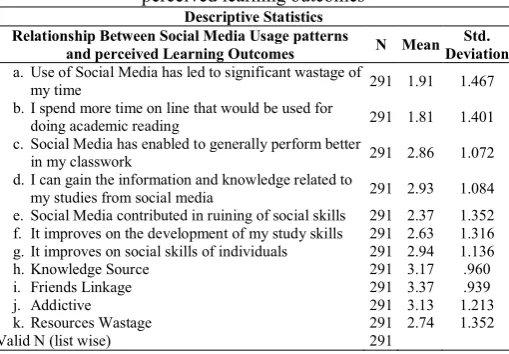
The purpose of this study was to evaluate the relationship between social media usage and perceived learning outcome among teacher trainees in private colleges in Nakuru County. Social Media usage was operationalized by means of the frequency of visiting the social network sites and the duration of time spent in these sites. Learning outcomes was conceptualized in terms of students’ performance in academics. The findings are presented in table 5.
Table 5 Relationship between social media usage patterns and perceived learning outcomes
Descriptive Statistics Relationship Between Social Media Usage patterns
and perceived Learning Outcomes N Mean
Std. Deviation
a.Use of Social Media has led to significant wastage of
my time 291 1.91 1.467
b.I spend more time on line that would be used for
doing academic reading 291 1.81 1.401
c.Social Media has enabled to generally perform better
in my classwork 291 2.86 1.072
d.I can gain the information and knowledge related to
my studies from social media 291 2.93 1.084
e.Social Media contributed in ruining of social skills 291 2.37 1.352
f. It improves on the development of my study skills 291 2.63 1.316
g.It improves on social skills of individuals 291 2.94 1.136
h.Knowledge Source 291 3.17 .960
i. Friends Linkage 291 3.37 .939
j. Addictive 291 3.13 1.213
k.Resources Wastage 291 2.74 1.352
Valid N (list wise) 291
From the low means and standard deviation in table 5 reveal that majority of the respondents disagreed that the use of social media had led to significant wastage of their time and
that they spent more of their time online that would have otherwise been used in doing academic work (M=1.91, SD= 1.467; M= 1.81, SD= 1.401) respectively. The findings of this study are similar to those of Langat (2015) in whose study students stated that social media does not affect their studies negatively during the day. In fact respondents acknowledged that social media in deed contributes positively to their study habits. Further the present study established from the means and standard deviations that the respondents were undecided as to whether social media usage enabled them to perform better (M= 2.86, SD=1.072). The respondents also disagreed that they gained more information and knowledge related to their studies, contributed to ruining their social skills and study skills as well as their individual skills (M=2.94, SD=1.084; M=2.37,SD=1.352; M=2.63, SD= 1.316; M= 2.94, SD= 1.136). The study findings echo the findings of Jackson, (2011); Liu et al., (2011) and Tomai et al., (2010). These studies conclude that using social media for educational purposes can be beneficial for student learning in multiple ways. First, social media enhances peer interactions, which can bridge diversity in the classroom and establish open lines of communication between students and secondly it also facilitates discussion and knowledge transfer between students, creating a deeper sense of understanding of the course material.
Qualitative analysis of data from the tutors’ interview schedule revealed that tutors were in agreement that social media had significantly interfered with the learning process of the students. They backed their assertions by stating that students were using more of their time on social media than on their studies. This according to them it had taken away time from which the students would have utilized in productive learning activities. They affirmed that learners have occasionally been caught during class time engaging in social media.
Findings
The findings revealed that majority of the respondents disagreed that the use of social media had led to significant wastage of their time and that they spent more of their time online that would have otherwise been used in doing academic work. It was further established that the respondents were undecided as to whether social media usage enabled them to perform as well as gain more information and knowledge related to their studies.
CONCLUSIONS
The study concludes that in terms of the relationship between social media usage and students learning outcome, students did not view the use of social media as a waste of their time
Recommendations
Based on the findings of the study, the following recommendations were advanced:
2. There is need to balance time used on social media to avoid addiction and concentrate on social media use for academic purposes since it can be a rich source of educational content if well utilized
3. College students need to be made aware that overindulgence in social media is addictive and hence there is need exercising self-control as early as possible.
References
Ajjan, H., & Hartshorne, R. (2008).Investigating faculty decisions to adopt Web 2.0 technologies: theory and empirical tests. The Internet and Higher Education, 11(2): 71-80
Arnold, N., & Paulus, T. (2010). “Using a social networking site for experiential learning: Appropriating, lurking, modeling and community building”. Internet and Higher Education, 13, 188-196.
Banquil, K. et al. (2009). Social networking sites affect one’s academic performances adversely. Retrieved June 2, 2014, from http://www.scribd.com/doc/28919575/social- networking-sites-affect-one%E2%80%99S-academic-performance-adversely
Bosch, T.. (2009). “Using online social networking for teaching and learning: Facebook use at the University of Cape Town”. South African Journal for Communication Theory and Research, 35(2):185-200.
Boyd, D.. & Ellison, N. B. (2007). “Social network sites: Definition, history, and scholarship”. Journal of Computer Mediated Communication, 13, 210-230. Correa, T., Hinsley, A. W. & de Zuniga, H. G. (2010), "Who
interacts on the web? The intersection of users’ personality and social media use", Computers in Human Behavior, 26, 247–253
Creswell, J. (2003). Research design:Qualitative, Quantitative and Mixed Approaches (Second ed.). Thousand Oaks: sage Publications.
Davis, F. (1989). Perceived usefulness, perceived ease of use, and user acceptance of information technology. MIS Quarterly, 13, 319–340.
Ellison, N. ., Steinfield, C., & Lampe, C. (2007). The benefits of Facebook "friends:" Social capital and college students' use of online social network sites.
Journal of Computer-Mediated Communication, 12(4). Englander, T & Wang (2010). Educational Review, Journal
of education. 62(1): 85 -96.
Enriquez, J. (2010). Facebook and Other Online Social Networking Sites Can Lower Grades, Study Says. Retrieved from http://seerpress.com/facebook-and- other-online-social-networking-sites-can-lower-grades-study-says/6935/.
Facebook Target Group, Facebook (2012), Retrieved From:
http://www.facebook.com, Access date (01/04/2014) Facebook. (2012). Factsheet: Newsroom. Retrieved April 1,
2012 from http://newsroom.fb.com/content/ default.aspx?NewsAreaId=22. Access date (01/04/2014) Hemmi, A., Bayne, S., & Land, R. (2009). The
Appropriation and Repurposing of Social Technologies in Higher Education. Journal of Assisted Learning, 25 (Special Issue), 19-30.
Hew, K. & Cheung, W. S. (2012). Student participation in online discussions: Challenges, solutions, and future research. New York: Springer.
Ijeoma A., and Burke M. (2013) “Influence of social media on social learning outcome of post graduate students. A case study of Salford University,United Kingdom”
Journal of Research & Method in Education Volume 3, Issue 6,PP 39-43
Joinson, A. (2008). 'Looking t', 'Looking up', or 'Keeping up with' People? Motives and Uses of Facebook. Proceedings of the 26th annual SIGCHI conference on human factors in computing systems, New York, ACM. Junco, R., Heiberger, G., & Loken, E. (2011). The effect of
Twitter on college student engagement and grades.
Journal of Computer Assisted Learning, 27(2):119-132 Khan, U (2009). Face book students underachieve in exams.
Daily Telegraph. Retrieved on July, 2014, from http://www.telegraph.co.uk/education/educationnews/514 5243/Faceb ook-students-underachieve-in-exams.html. Kaplan, A. & Haenlein, M. (2010). Users of the world, unite!
The challenges and opportunities of Social Media.
Business Horizons, 53(1), 59-68.
Karpinski A (2009). A description of Facebook use and academic performance among undergraduate and graduate students. Annual Meeting of the American Educational Research Association, San Diego, Calif. Katz, E. & Blumler, G. (1974). The uses of mass
communication: Current perspectives on gratifications research. Beverly Hills, CA: Sage.
Kietzmann, J., Hermkens, K., McCarthy, I. and Silvestre, B. (2011). “Social media? Get serious! Understanding the functional building blocks of social media”. Business Horizons. 54 (3): 241–251.
Kothari, C. (2007) Research methods: methods and techniques (2nded.). New Delhi: New Age Publishers. Kubey, R., Lavin, M. & Barrows, J.. (2001). Internet use and
collegiate academic performance decrements: Early findings. Journal of Communication, 51, 366–382. Lenhart, A., & Madden, M. (2007). Social networking
websites and teens: An overview. Retrieved April 20, 2014, from http://www.pewinternet.org/pdfs/PIP_SN Lei, J., & Zhao, Y. (2005). Technology uses and student
achievement: A longitudinal study. Computers & Education, 49, 284–296.
Liu, X. & Larose, R. (2008). Does Using the Internet Make People More Satisfied with Their Lives? The Effects of the Internet on College Students’ School Life Satisfaction. Cyber Psychology & Learning outcome,
11(3).
Mazer, J. Murphy, R., Simonds, C. (2007). "I'll See You On "Facebook": The Effects of Computer-Mediated Teacher Self-Disclosure on Student Motivation, Affective Learning, and Classroom Climate". Communication Education 56, 1-17.
Murphy, G. (1967). Introductory aspects of modern parapsychological research. Transactions of the New York Academy of Sciences, 30, 256-260
International Journal of Science and Technology. 2(7): 462-472.
Ophus, J. & J. Abbit (2009). "Exploring the Potential Perceptions of Social Networking Systems in University Courses." Journal of Online Learning and Teaching 5(4): 639-648.
Oskouei, R.., & Chaudhary, B. D. (2010). Internet Usage Pattern by Female Students: A Case Study. Information Technology: New Generations, 7th International Conference held in Las Vegas from 12-14, April 2010, Las Vegas. Pp. 1247-1250.
Pierce, T. (2009). Social anxiety and technology: Face-to-face communication versus technological communication among teens. Computers in Human Behavior, 25, 1367-1372.
Roy, S. (2009). ‘Internet uses and gratifications: A survey in the Indian context’, Computers in Human Behavior, 29: 878-886.
Selwyn, N. (2009). The digital native – myth and reality.
Aslib Proceedings: New Information Perspectives, 61(4), 364-369,
Shah, D. Kwak, N., Holbert, R. L. (2001). Connecting‟ and „disconnecting‟ with civic life: Patterns of Internet use and the production of social capital. Journal of Political Communication. 18: 141-162.
Slavin, R. (2003). Educational Psychology: Theory and Practice, 7th Edition New York: Prentice-Hall
Tapscott, D. (2008), "Grown up digital: How the next generation is changing your world", New York: McGraw-Hill
Tuckman H (1975). Teacher Effectiveness and Student Performance. Journal of Economics of Education. 7(1): 34-39.
Williams, A., & Merten, M. (2009). Adolescents’ Online Social Networking Following the Death of a Peer.
Journal of Adolescence Research, 24(10), 67-90.
How to cite this article:
Mutugi Lilian and Magutah Abysolom Kuria (2018) ' An evaluation of the relationship between social media usage patterns and perceived learning outcome among teacher trainees in selected private colleges in nakuru county. In kenya', International Journal of Current Multidisciplinary Studies, 04(6), pp. 892-899.