The Journal of Science Policy & Governance
TECHNOLOGY ASSESSMENT:
TO ACT OR NOT TO ACT: A PROPOSAL
FOR DOMESTIC GEOENGINEERING
GOVERNANCE
BY
ALISSA M. ROLAND, FORDAM SCHOOL OF LAW
I. Abstract
Geoengineering is “the deliberate large-scale manipulation of the planetary environment to counteract anthropogenic climate change” (The Royal Society 1). Scientists have agreed in recent years (Kintisch) that international greenhouse gas emission reduction agreements like the Kyoto Protocol have not been implemented fast or efficiently enough to slow or reverse climate change projecting there may not be time to prevent, or even slow, climate change through emission reduction
II. Geoengineering: The Science and Technology As It Stands Today A.The Greenhouse Effect.
The Earth’s atmosphere naturally contains gases referred to as greenhouse gases. Water vapor is the most abundant of these gases, followed by carbon dioxide, ozone, then trace amounts of methane and nitrous oxide. These gases are responsible for the Earth’s warm climate and thus keep surface temperatures habitable for human life.
Solar radiation passes through the Earth’s atmosphere with about 30% immediately reflected back into space by clouds and the Earth’s surface (Karl 1719). The remaining radiation is first absorbed by land masses and oceans, and then re-emitted from the planet as infrared radiation (Karl 1720). Excess infrared radiation passes back out through the Earth’s atmosphere and into space. At ideal concentrations, greenhouse gases maintain the Earth at a temperature warm enough to sustain human life (Karl 1719). However, concentrations of the greenhouse gases in the atmosphere have been increasing throughout the last 250 years, leading to a proportionate increase in trapped radiation and heat. As a result, the planet’s temperature is rising, leading to the phenomenon known as global warming (United Nations 107). As warming continues, the planet’s climate changes, resulting in altered local weather conditions and ecosystems (“Causes”).
years, atmospheric carbon dioxide (carbon dioxide) levels increased by nearly 40%, from preindustrial levels of approximately 280 ppmv (parts per million volume) to nearly 384 ppmv in 2007,” (Doney 184). In fact, NOAA reported that 2013 saw the first recorded global average atmospheric concentration of carbon dioxide above 400 ppm (“Carbon Dioxide at NOAA’s Mauna Loa”) (“Carbon Dioxide”). Although oceans absorb up to one third of excess carbon dioxide (Doney 184), increased carbon dioxide concentrations will slow the oceans’ ability to do so as they grow saturated (Davis 911). Carbon dioxide is the gas of greatest interest to geoengineering because it is currently emitted faster than it can be removed from the atmosphere by the planet’s natural carbon cycle (“FAQ 10.3”). As a result of this carbon dioxide accumulation global temperatures are increasing rapidly (National Research Council 11). Scientists and policymakers alike recognize that attempts to mitigate global warming through carbon dioxide emission regulation alone have been a slow process. Even if stringent mitigation policies were adopted and implemented today, it may be too late to revert atmospheric concentrations of greenhouse gases to pre-industrial levels and consequently too late to reverse the effects of global warming completely. Therefore, interest in geoengineering, “the deliberate large-scale manipulation of the planetary environment to counteract anthropogenic climate change,” (The Royal Society 1) has grown domestically and internationally in recent years as a possibility to at least avoid a global temperature increase of 2° C or more, which has been identified as a possible target temperature to avoid more dangerous impacts (New 14).
B. Carbon Dioxide Removal
Carbon dioxide removal seeks to directly reduce the levels of heat-trapping carbon dioxide in the atmosphere. Theoretically, levels would be reduced by removing carbon dioxide from the atmosphere (also called “air capture”) and then storing the gas in another form on the planet (United States. Cong., “Engineering the Climate” 1). Proposed methods include biological, physical and chemical reactions with sequestration both on land and in the sea (The Royal Society 10). These methods are further divided into two categories: 1) the active removal of carbon dioxide from the atmosphere by a machine, or 2) enhancing the natural cycle of the oceans to increase their capacity to absorb carbon dioxide ("What Is Geoengineering?").
The mechanical method would involve industrial plants inducing known chemical reactions of carbon dioxide with other solids or solutions (The Royal Society 15) to separate the greenhouse gas from the air. This now concentrated carbon dioxide could then be repurposed for other industrial needs (Kintisch 104). Calera is one such company that practices carbon sequestion which converts carbon dioxide into a cement system (“Welcome to Celara”). Unfortunately, carbon dioxide is difficult to capture, meaning high temperatures, pressures and additional chemicals are required during capture of the gas (Kintisch 108).
136). Releasing additional iron into the ocean is hypothesized to stimulate phytoplankton to bloom and take up more carbon dioxide (Goodell 139). While this technique has been tested with some success on a small scale (Peterson 70), early data suggests that initial estimates of the amount of carbon dioxide trapped by this process were overly optimistic (Pollard 577).
C. Solar Radiation Management.
Solar radiation management interrupts the greenhouse effect by reducing the amount of solar radiation the Earth absorbs, thereby reducing the amount of planet-warming radiation trapped by greenhouse gases. Two major methods have been proposed: 1) increasing the reflectivity of the Earth, and 2) deflecting solar radiation before it penetrates the atmosphere.
The most basic method for increasing reflectivity of sunlight is painting structures like house roofs and buildings light, preferably white, colors. If solar radiation is reflected instead of absorbed, it can pass back through the atmosphere, and into space in its original state as shortwave radiation, which does not contribute to warming and is unimpeded by greenhouse gases (Margonelli). Former United States Secretary of Energy Steven Chu vocalized support for this method within the United States. Estimates about potential reductions are optimistic, but hindered by the prevalence of sloped roofs (K. Johnson) and the projected expenses of nationwide implementation (The Royal Society 25).
researchers suggest that simple seawater could be sprayed into sky by boats or aircraft in a fine mist (Salter 3989). Some number of mist particles would become part of already-existing clouds, acting as cloud condensation nuclei and allowing water droplets to condense (Goodell 169). This method, also termed cloud brightening, would scatter and reflect the incoming solar radiation away from the planet more efficiently than natural, larger cloud nuclei (The Royal Society 27).
Perhaps the most infamously discussed solar reflection option is nicknamed “The Pinatubo Option.” The idea was first proposed by a Nobel-prize winning chemist, Paul Crutzen, in 2005, based on the premise that the average global temperature decreased following the 1991 eruption of Mount Pinatubo in the Philippines (Goodell 55). When that volcano erupted, large amounts of sulfur dioxide were released and became sulfuric acid microdroplets, or aerosols (Goodell 55). These aerosols, similar to the ones used in cloud brightening, reflected solar radiation back into space in similar to much the same way as natural clouds, albeit at a much higher rate due to the induced excess concentration (The Royal Society 29). The average global temperature decreased one half of a degree Celsius the year following the eruption. Crutzen suggested that humankind could intentionally inject sulfur aerosols into the stratosphere to induce a calculated cooling of the planet to obtain results similar to those of the volcanic eruption (211). Potential negative side effects of this proposal include alteration of the natural carbon cycle, ozone depletion (The Royal Society 31) and changes in annual precipitation (Caldiera 4043). Additionally, both size and distribution of the aerosols would need to be exact to create the necessary reflection (The Royal Society 31).
the Earth to deflect sunlight away from the planet and out into space. There could be tens of thousands of large, or trillions of tiny, mirrors in space, shielding the Earth from the sun’s rays. While larger mirrors could be fabricated on Earth and rocketed into low Earth orbit, the smaller centimeter-size discs could be created in space from asteroids and could be located much further from the planet, 1.5 million kilometers towards the sun. A common concern regarding this technique however is that while temperatures may respond to such intervention quickly, the initial implementation could be costly and take years to develop (The Royal Society 31-33).
Many other methods of carbon dioxide removal and solar radiation management have been proposed alongside the few select examples explored here. All proposed methods raise similar questions of whether both domestic government research and/or active larger scale field research into this area should be considered and if so, how to safely conduct such research, evaluate the results and possibly implement the technique in a way the domestic and the international community can govern.
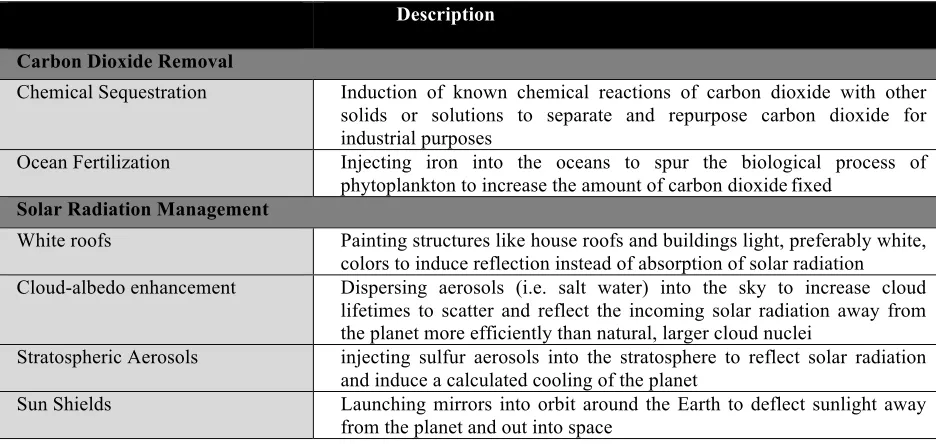
Description
Carbon Dioxide Removal
Chemical Sequestration Induction of known chemical reactions of carbon dioxide with other solids or solutions to separate and repurpose carbon dioxide for industrial purposes
Ocean Fertilization Injecting iron into the oceans to spur the biological process of phytoplankton to increase the amount of carbon dioxidefixed
Solar Radiation Management
White roofs Painting structures like house roofs and buildings light, preferably white, colors to induce reflection instead of absorption of solar radiation Cloud-albedo enhancement Dispersing aerosols (i.e. salt water) into the sky to increase cloud
lifetimes to scatter and reflect the incoming solar radiation away from the planet more efficiently than natural, larger cloud nuclei
Stratospheric Aerosols injecting sulfur aerosols into the stratosphere to reflect solar radiation and induce a calculated cooling of the planet
Sun Shields Launching mirrors into orbit around the Earth to deflect sunlight away from the planet and out into space
III.The Concerns
While some scientists have agreed that geoengineering is worth further investigation, other scientists and environmental groups (for example, the ETC Group) (“The ABCs”) would prefer the issue be dropped completely for scientific, economic, political, and ethical reasons. These concerns must be weighed against the potential benefits of geoengineering during the decision-making process.
Scientific. Methods that require oceanic involvement may have undesirable effects on marine biodiversity and fishing communities (The Royal Society 45). There are also great uncertainties about how weather patterns might be altered (The Royal Society 50). While the goal of geoengineering would be to stop, or slow, the current climate change path, intentional atmospheric modification could cause even more undesirable changes. Further, some of these methods, if implemented, would have to be continued essentially forever, if no additional emission reduction steps were taken (Keith “Geoengineering” 498). If, for example, sulfur aerosols were used but then stopped suddenly, the planet would not only resume warming, but it would immediately jump to the level of warming as if no geoengineering had taken place. Instead of the gradual increase we are currently experiencing, the temperature jump would be large and fast, leaving some species no time to evolve and adapt (The Royal Society 35). Additionally, no presently proposed method addresses ocean acidification, another consequence of current carbon dioxide levels and a condition that does not currently appear reversible even with a hypothetical reversing of global warming (Lovett).
geoengineering has the potential to be relatively inexpensive to carry out, in contrast to the cost of altering humankinds’ emissions-loving way of life (Keith “Geoengineering” 495). Dirty energy industries, like the oil industry could use geoengineering as an excuse to draw attention, and research money, away from carbon emission reduction and clean technology development (Hamilton). Environmental groups also fear that governments would shirk their responsibilities to developing countries which are already suffering the effects of climate change caused by industrial nations “ETC Group Briefing”). There is also fear that geoengineering would impact agricultural crop years over the long term and affect global food security (Pongratz 101 ).
Political. Richer, more financially-able, countries, or even a private company, with scientific resources could seek to develop and employ geoengineering without regard to the desires of other, less resourceful nations. A single nation could take unilateral action and subject the whole world to the results. National security is also a concern. Should any of these techniques prove feasible, or we learn to catalyze specific, directed weather events, what is there to stop one country from going to “weather war” with another? (Keith “GEOENGINEERING THE CLIMATE “ 275).
unrepresented future: what kind of planet we are leaving for those generations that come after ourselves (Johnson 561). Finally, paralleling the political concern of imposing change on developing nations, there is an equivalent ethical argument about imposing change, and perhaps danger, on these populations without their consent (United States Cong. CRS-8),.
IV.Governance A. International
One of the earliest international agreements concerning geoengineering was a 2008 Resolution by the Convention on the Prevention of Marine Pollution by Dumping of Wastes and Other Matter to prevent ocean fertilization for any reasons other than “legitimate scientific research,” (United States. Cong. “Geoengineering” 34). Another agreement was reached in 2010 when countries party to the 1992 UN Framework Convention on Biological Diversity agreed to a moratorium on geoengineering (Hogue 12). It is worth noting that while 193 countries are party to this treaty, the United States is not, and therefore is exempted from the ban (“List of Parties”). The countries involved agreed to “small scale” research only, as well as an approval process before beginning research (Hogue 12). Prior to this, the Convention on Biological Diversity adopted a ban on ocean fertilization, but refrained from using the specific term “geoengineering” (“Decision IX/16”) .
anthropogenic interference with the climate system,” (United Nations) the United Nations Convention on the Law of the Sea which might govern the practice of ocean fertilization (United States. Cong. House “International Governance” 12), or The Outer Space Treaty of 1967 which might govern space mirrors (Kintisch 220). Additionally, the 1977 UN Convention on the Prohibition of Military or Any other Hostile Uses of Environmental Modification 1977 (Bodansky 310) and the Convention on the Prevention of Marine Pollution by Dumping of Wastes and Other Matter 1972 may be implicated (Rayfuse 297). The upcoming Intergovernmental Panel on Climate Change report will also contain research and recommendations regarding geoengineering to an extent that previous reports did not (IPCC). The IPCC’s “Climate Change 2013” Summary for Policymakers includes a brief paragraph on geoengineering acknowledging the unknown effects and consequences of geoengineering (Working Group I 27). If any governing treaty to which the United States is a party is adapted to govern the full suite of geoengineering proposals, the United States should be prepared to participate in negotiations.
B. Domestic
of Defense all arguably have interest in the topic as well. In fact, many of these groups have jointly funded a study due in 2014 from the National Academies of Science to explore the current state of the technology of geoengineering (Roach). Additionally, Congress held hearings on the issue over three days from 2009-2010 (United States. Cong. “Geoengineering” 2) and the National Research Council intends to hold another committee meeting this fall (Geman). However, actual governance to either prevent or support geoengineering in the United States is still lacking.
Therefore, a joint research effort should be developed between the mentioned agencies and other interested groups (i.e., NGOs, policy think tanks, etc.) to govern geoengineering.
V. A Proposal
A public, Manhattan Project-like network of existing federal agencies, private and public research institutions, and even non-profit organizations should be assembled to evaluate the state of the technology as it progresses and oversee any large-scale research or domestic implementation.
In the 1940’s the United States funded creation of the atomic bomb through what would later be called the Manhattan Project. Project sites were established across the country to carry out simultaneous research and development across various avenues of technology. Researchers were members of both public institutions (e.g., University of California) and private (e.g., Columbia University). The government provided not only financial support, but the U.S. Army Corps of Engineers constructed a number of research facilities (“Manhattan Project”).
the Manhattan Project, this assembly should not immediately begin active physical research. It should also be clear from the Project’s mission statement that geoengineering is not a foregone conclusion. Research funding should not be predicated on the need to produce positive, or pro-geoengineerng, results. All questions, legal and scientific, should be evaluated giving equal consideration to the advantages (and disadvantages) of both pursuing geoengineering and not pursuing geoengineering.
First, this group should evaluate the state of the existing technology to address the following questions:
● Should the United States take any action regarding geoengineering?
● If the United States does explore geoengineering, how should the research proceed?
o Should the United States pursue theoretical research only? (Dilling 2)
o Should the United States pursue small scale research only?
● How should geoengineering affect mitigation and adaptation efforts?
If the assembly finds that research should be undertaken, the following questions will also need to be debated based on the results of small scale or theoretical research:
● Should the United States pursue full scale implementation?
● Should the United States abstain completely from geoengineering?
● Should the United States pursue enough research to act if another country or body implements geoengineering and countermeasures are required?
geoengineering within the ban or moratorium. Applicable existing laws which are currently administered to by a number of individual government agencies should be evaluated and perhaps consolidated into a single governing treatise, along with any new laws deemed necessary. Finally, governance is necessary to ensure compliance with the consolidated geoengineering laws.
If it is determined that the United States should pursue geoengineering further, all of these questions and many more will require answers including which techniques to pursue, where and how to implement the technology. Input from existing federal agencies, private and public research institutions, and non-profit organizations will be valuable to answer any of these questions. The report expected from the National Academies asks many similar questions about what is currently known about different geoengineering techniques and what future research is need “to provide a credible scientific underpinning for future discussions.” However, a spokesperson for the report stated that no research or experiments would be conducted and no new technology produced during the assessment (“Project: Geoengineering”).
federal agencies, private and public research institutions, and non-profit organizations to ensure balance. An Executive Board, also similar to the Intergovernmental Panel on Climate Change Bureau may be elected from this network to guide the project, join the findings of individual working groups, and present a unified voice of the Project’s findings to Congress or international assemblies (“Structure"). Regular reporting of the working groups to an Executive Board could be required, who could in turn report to Congress, the President, and the public on the state of the environment and technology.
Figure 2. Hypothetical organization of a Project.
Overall, the most important requirement of a research and review network is unity of the many existing interested agencies and scientific institutions toward a common goal, whatever that goal is ultimately determined to be.
VI. Conclusion
VII. References
"The ABCs of Ensuring Precaution on Geoengineering." ETC Group. N.p., 5 Oct. 2012. Web. 16 Nov. 2013. <http://www.etcgroup.org/content/abcs-ensuring-precaution-geoengineering>.
Bodansky, Daniel. "May We Engineer the Climate?" Climatic Change 33.3 (1996): 309-21. Print.
Caldeira, Ken, and Lowell Wood. "Global and Arctic Climate Engineering: Numerical Model Studies."
Philosophical Transactions of the Royal Society A: Mathematical, Physical and Engineering Sciences
362.1886 (2008): 4039-056. Print.
"Carbon Dioxide at NOAA's Mauna Loa Observatory Reaches New Milestone: Tops 400 Ppm." Earth System
Research Laboratory. NOAA, 10 May 2013. Web. 16 Nov. 2013.
"Causes." Global Climate Change. NASA, n.d. Web. 16 Nov. 2013. <http://climate.nasa.gov/causes>.
Crutzen, Paul J. "Albedo Enhancement by Stratospheric Sulfur Injections: A Contribution to Resolve a Policy Dilemma?" Climatic Change 77.3-4 (2006): 211-20. Print.
Davis, William D. "What Does “Green” Mean?: Anthropogenic Climate Change, Geoengineering, and International Environmental Law." Georgia Law Review 43 (2009): 901. Print.
"Decision IX/16." Decisions Adopted by the Conference of the Parties to the Convention on Biological Diversity at
Its Ninth Meeting. Proc. of Conference of the Parties to the Convention on Biological Diversity, Bonn,
Germany, May 19-30, 2008. N.p.: n.p., 2009. N. pag. Print.
Dilling, Lisa, and Rachel Hauser. "Governing Geoengineering Research: Why, When and How?" Climatic Change
(2013): n. pag. Print.
Doney, Scott C. "Ocean Acidification: The Other Carbon Dioxide Problem." Annual Review Marine Science 1 (2009): 169-92. Print.
"ETC Group Briefing for CBD COP 10 in Nagoya: Geoengineering." ETC Group. N.p., n.d. Web. <http://www.etcgroup.org/en/node/5202>.
"FAQ 10.3 If Emissions of Greenhouse Gases Are Reduced, How Quickly Do Their Concentrations in the Atmosphere Decrease? ." IPCC.ch. N.p., n.d. Web. 16 Nov. 2013.
<http://www.ipcc.ch/publications_and_data/ar4/wg1/en/faq-10-3.html>.
Geman, Ben. "OVERNIGHT ENERGY: Neil Young vs. Keystone XL, Rep. Issa vs. Ex-EPA Chief, and More." Web log post. The Hill. N.p., 9 Sept. 2013. Web. 17 Nov. 2013. <http://thehill.com/blogs/e2-wire/e2-wire/321181-overnight-energy-neil-young-vs-keystone-xl-issa-vs-ex-epa-chief-and-more>.
"Geoengineering." Max-Planck-Institut Für Meteorologie. N.p., n.d. Web. 23 Feb. 2011.
<http://www.mpimet.mpg.de/en/science/the-atmosphere-in-the-earth-system/working-groups/middle-and-upper-atmosphere/topics-projects/geoengineering.html>.
Goodell, Jeff. How to Cool the Planet: Geoengineering and the Audacious Quest to Fix Earth's Climate. Boston: Houghton Mifflin Harcourt, 2010. Print.
Hanley, Charles J. "Scientists Weigh Who Decides How to save the Earth Climate Experts Offer Unproven Ideas to Combat Global Warming." Star-Ledger 4 Apr. 2011: 4. Print.
Hogue, Cheryl. "Countries Agree To Ban Geoengineering." Chemical and Engineering News 88.45 (2010): 12. Web. <http://cen.acs.org/articles/88/i45/Countries-Agree-Ban-Geoengineering.html>.
IPCC. Agreed Reference Material For The Ipcc Fifth Assessment Report. Rep. IPCC, n.d. Web. 14 Sept. 2013. <http://www.ipcc.ch/pdf/ar5/ar5-outline-compilation.pdf>.
Johnson, Keith. "Steven Chu: White Roofs to Fight Global Warming." Web log post. Wall Street Journal, 29 May 2009. Web. 16 Nov. 2013. <http://blogs.wsj.com/environmentalcapital/2009/05/27/steven-chu-white-roofs-to-fight-global-warming>.
Johnson, Nicholas J. "Regulatory Takings and Environmental Regulatory Evolution: Toward A Macro Perspective."
Fordham Environmental Law Review 6.3 (2011): 557-63. Print.
Karl, T. R., and K. Trenberth. "Modern Global Climate Change." Science 302.5651 (2003): 1719-723. Print.
Keith, David W. "Geoengineering." Encyclopedia of Global Change: Environmental Change and Human Society. By Andrew Goudie and David J. Cuff. Oxford: Oxford UP, 2002. 498. Print.
Keith, David W. "GEOENGINEERING THE CLIMATE: History and Prospect1." Annual Review of Energy and the
Environment 25.1 (2000): 245-84. Print.
Kintisch, Eli. Hack the Planet: Science's Best Hope-- or Worst Nightmare-- for Averting Climate Catastrophe. Hoboken, NJ: Wiley, 2010. Print.
"List of Parties." List of Parties. Convention on Biological Diversity, n.d. Web. 19 Mar. 2011. <http://www.cbd.int/convention/parties/list/>.
Lovett, Richard A. "Geoengineering Model: Solar-radiation Management Could Have Unwanted Regional Impacts: Scientific American." Geoengineering Model: Solar-radiation Management Could Have Unwanted
Regional Impacts: Scientific American. Scientific American, 18 July 2010. Web. 17 Nov. 2013.
<http://www.scientificamerican.com/article.cfm?id=geoengineering-tradeoffs>.
"Manhattan Project." Encyclopedia Britannica. N.p., n.d. Web. 14 Sept. 2013. <http://www.britannica.com/EBchecked/topic/362098/Manhattan-Project>.
Margonelli, Lisa. "Really? The White Roof Solution." The Atlantic. N.p., 27 May 2009. Web. 16 Nov. 2013. <http://www.theatlantic.com/technology/archive/2009/05/really-the-white-roof-solution/18343/>.
National Research Council. Climate Change Science: An Analysis of Some Key Questions. Washington, D.C.: National Academy, 2001. Print.
New, Mark. "Four Degrees and Beyond: The Potential for a Global Temperature Increase of Four Degrees and Its Implications." Philisophical Transactions of the Royal Society A 369.1934 (2011): 6-19. Print.
Peterson, James Edward. "Can Algae Save Civilization? A Look at Technology, Law, and Policy Regarding Iron Fertilization of the Ocean to Counteract the Greenhouse Effect." Colorado Journal of International
Environmental Law and Policy 6 (1995): 61. Print.
Sandy Thomalla, Hugh J. Venables, Robert Williamson, and Mike V. Zubkov. "Southern Ocean Deep-water Carbon Export Enhanced by Natural Iron Fertilization." Nature 457.7229 (2009): 577-80. Print.
Pongratz, J., D. B. Lobell, L. Cao, and K. Caldeira. "Crop Yields in a Geoengineered Climate." Nature Climate
Change 2 (2012): 101-05. Print.
"Project: Geoengineering Climate: Technical Evaluation and Discussion of Impacts." Project: Geoengineering
Climate: Technical Evaluation and Discussion of Impacts. National Academies, n.d. Web. 15 Sept. 2013.
<http://www8.nationalacademies.org/cp/projectview.aspx?key=49540>.
Rayfuse, Rosemary, Mark G. Lawrence, and Kristina M. Gjerde. "Ocean Fertilisation and Climate Change: The Need to Regulate Emerging High Seas Uses." The International Journal of Marine and Coastal Law 23.2 (2008): 297-326. Print.
Roach, John. "Nbc News Science." NBC News. N.p., 18 July 2013. Web. 16 Nov. 2013.
<http://www.nbcnews.com/science/cia-said-back-study-ways-hack-global-climate-6C10680035>.
The Royal Society. Geoengineering The Climate: Science, Governance And Uncertainty. Rep. no. RS Policy Document 10/09. N.p.: n.p., 2009. Print.
Salter, Stephen, Graham Sortino, and John Latham. "Sea-going Hardware for the Cloud Albedo Method of Reversing Global Warming." Philosophical Transactions of the Royal Society A: Mathematical, Physical
and Engineering Sciences 266 (2008): 3989-4006. Royal Society Publishing, 29 Aug. 2008. Web. 16 Nov.
2013. <http://rsta.royalsocietypublishing.org/content/366/1882/3989.full.pdf+html>.
Strong, Aaron L., John J. Cullen, and Sallie W. Chisholm. "Ocean Fertilization: Science, Policy, and Commerce."
Oceanography 22.3 (2009): 236–261. Web.
"Structure." IPCC - Intergovernmental Panel on Climate Change. IPCC, n.d. Web. 17 Nov. 2013. <http://www.ipcc.ch/organization/organization_structure.shtml>.
United Nations. United Nations Framework Convention on Climate Change. S. Treaty Doc No. 102-38. vol. 1771 U.N.T.S. 107. May 9, 1992
United States. Cong. Geoengineering: Governance and Technology Policy. By Kelsi Bracmort, Richard K.
Lattanzio, and Emily C. Barbour. Cong. Rept. R41371. Congressional Research Service, 2 Jan. 2013. Web. 16 Nov. 2013. <http://www.fas.org/sgp/crs/misc/R41371.pdf>.
United States. Cong. House. Committee On Science And Technology. Engineering The Climate: Research Needs
And Strategies For International Coordination. By Bart Gordon. 111th Cong., 2nd sess. H. Rept. N.p.: n.p.,
2010. Print.
United States. Cong. House. House Committee on Science and Technology, Subcommmitte on Energy and Policy.
International Governance of Geoengineering. By Richard Lattanzio and Emily Barbour. 111th Cong., 2nd
sess. H. Doc. 7-5700. Congressional Research Service, n.d. Web.
<http://www.nonaiswa.org/wordpress/wp-content/uploads/2010/10/M-0311101.pdf>.
Working Group I. Climate Change 2013 The Physical Science Basis: Summary for Policymakers. Switzerland: IPCC, 2013. Print.
Voiland, Adam. "Aerosols: Tiny Particles, Big Impact : Feature Articles." Aerosols: Tiny Particles, Big Impact :
Feature Articles. Nasa Earth Observatory, 2 Nov. 2010. Web. 16 Nov. 2013.
<http://earthobservatory.nasa.gov/Features/Aerosols>.
"What Is Geoengineering?" The Guardian. N.p., 18 Feb. 2011. Web. 16 Nov. 2013. <http://www.theguardian.com/environment/2011/feb/18/geo-engineering>.
Bio