R E S E A R C H
Open Access
Effect of electric and magnetic fields on
impurity binding energy in zinc-blend
symmetric InGaN/GaN multiple quantum dots
Ebrahim Sadeghi
*and Elham Naghdi
Abstract
The binding energy of ground state for hydrogenic impurity in multiple quantum dots is calculated in the
framework of effective-mass approximation and using a variational method. It is shown that the binding energy is a function of the size of dots, impurity position and external fields strength. The binding energy has a maximum value when the impurity is located on the center of dots and decreases for other impurity positions. The external electric and magnetic fields change the magnitude and the position of peaks.
PACS Codes: 73.20.D; 71.21.La; 71.55.Eq
Keywords: Bessel function; Binding energy; External field; Multiple quantum dot; Whittaker function
1 Background
The study of confined quantum systems has been the interesting subject of investigation since the beginning of quantum theory. The interest in the study of the physical properties of confined quantum systems such as quantum wells, wires, and dots, has increased, with the recent progress in semiconductor nanotechnology [1-5].
In recent years, theoretical and experimental investiga-tions have been performed into the issue of the hydrogenic binding of an electron to a donor impurity which is con-fined within low-dimensional heterostructures [6,7]. The understanding of the electronic and optical properties of impurities in such systems is important because the optical and transport properties of devices made from these materials are strongly affected by the presence of shallow impurities.
The wide-band gap GaN material systems have attracted much attention for their applications in optoelectronic devices [8]. Built-in electric field is absent in zinc-blend (ZB) GaN structures because the spontaneous polariza-tion does not exist in the ZB GaN due to the higher crystal symmetry. There has been a lot of work devoted to understanding of hydrogenic impurity states in ZB
*Correspondence: [email protected]
Department of Physics, Yasouj University, Yasouj 75914-353, Iran
GaN quantum dots and quantum wire [9-14]. In all of those calculations, they are all base on single low-dimensional quantum structures. The impurity effects in ZB GaN-based multiple QDs have also been investi-gated theoretically [15,16]. In theses systems, wave func-tion would penetrate more to the adjacent quantum dots if the barrier height or the barrier thickness is reduced.
On the other hand, the application of an exter-nal electric field can provide much valuable informa-tion about the confined impurities. Recent theoretical investigations predicated both the field induced level shifts and the field dependence of the carrier lifetime. Therefore, the impurity and the applied electric field effects on the optical properties of QDs are of great interest for fundamental physics and device applications [17,18].
To our knowledge, there have not been theoretical investigations on impurity states in ZB symmetric multi-ple GaN QDs under external electric and magnetic fields. In this paper the variational method is used for calculating the impurity binding energy in symmetricInGaN/GaN
multiple quantum dots. In this regard, a trial wave func-tion based on the carrier wave funcfunc-tion in cylindrical quantum dot is introduced and the energy is calculated. In Section 2, the Hamiltonian and the calculation method
are given. The numerical calculations and discussion on typical InGaN/GaN material are presented in Section 3.
2 Methods
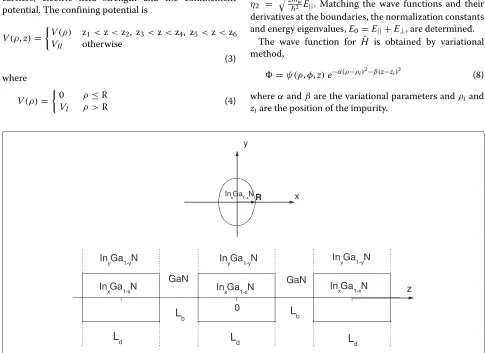
We consider a cylindrical ZB symmetric InxGa1−xN
multiple QD of radius R and length Ld surrounded
by two large energy gap materials InyGa1−yN in the
radial direction and GaN in the z-direction, Figure 1. Within the framework of effective mass approxima-tion, the Hamiltonian description of an electron in the presence of an external field and hydrogenic impurity is given as
ˆ
H= ˆH0−
e2 ε|r−ri|
(1) with
a) Electric field
ˆ H0=
ˆ P2
2m∗+V(ρ,z)+ |e|Fz (2)
wherem∗, FandV(ρ,z)are the effective mass of charge carriers, electric field strength and the confinement potential. The confining potential is
V(ρ,z)=
V(ρ) z1<z<z2, z3<z<z4, z5<z<z6
VII otherwise
(3) where
V(ρ)=
0 ρ≤R
VI ρ >R (4)
Using the separation of variable, the eigenfunction ofHˆ0
is written as
ψ(ρ,φ,z)=f(ρ)h(z)eimφ m=0,±1, .. (5) The radial wave function of the ground state can be expressed as
f(ρ)=
CwJ0(ω1ρ) ρ≤R
CbK0(ω2ρ) ρ >R (6)
whereω1 =
2m∗w
2 E⊥,ω2 =
2m∗b
2 (VI−E⊥),J0andK0
are the zero-order Bessel and modified Bessel functions. The wave function h(z) can be obtained by the linear combination of Airy functionsAiandBi,
h(z)=
⎧ ⎪ ⎨ ⎪ ⎩
Ai
η
1z−η22 (−η1)2/3 +Bi
η
1z−η22
(−η1)2/3 well region Ai
κ
1z+κ22 (−κ1)2/3 +Bi
κ
1z+κ22
(−κ1)2/3 barrier region
(7) whereκ1=
2m∗beF
2 ,κ2=
2m∗b
2 (VII−E||),η1=
2m∗weF
2 , η2 =
2m∗w
2 E||. Matching the wave functions and their
derivatives at the boundaries, the normalization constants and energy eigenvalues,E0=E||+E⊥, are determined.
The wave function for Hˆ is obtained by variational method,
=ψ(ρ,φ,z)e−α(ρ−ρi)2−β(z−zi)2 (8)
whereαandβ are the variational parameters andρiand ziare the position of the impurity.
z
R
y
x
InxGa1-xN
In xGa1-xN In
xGa1-xN In
xGa1-xN
L
b
L
bL
dL
dL
dIn yGa1-yN In
yGa1-yN In
yGa1-yN
GaN GaN
0
b) Magnetic field
The Hamiltonian for the system in the presence of magnetic field is
ˆ H0=
ˆ
P−ecA 2
2m∗ +V(ρ,z) (9)
where A is the vector potential of magnetic field. For a homogeneous magnetic field B(0, 0,B) directed along z-axis, the vector potential is chosen asA = B× r/2. The wave function forH0can be written as Eq. (5), where
the ground state radial wave functionsf(ρ)are Whittaker functions andh(z)is the linear combination of sin(γz)and cos(γz)functions,
f(ρ)=
⎧ ⎪ ⎨ ⎪ ⎩
Cw
ρ WM
γ2 1 2μ, 0,μρ
2
2 ρ≤R
Cb ρWW
−γ2 2 2μ, 0,
μρ2
2 ρ >R
(10)
where γ1 = √E⊥/R∗, γ2 = √(VI−E⊥)/R∗, R∗ = m∗e4/(2c22) and μ = eB0/(2m∗cR∗). The impurity
binding energy,Eb, is obtained as Eb=E0−min
α,β
< | ˆH| >
< | > . (11)
3 Results and discussion
In this study, the numerical calculations are carried out on a typical GaN/InxGa1−xN/InyGa1−yN QDs. The following parameters are used in the calculations:
m∗=[0.1x+0.19(1−x)]m0,Eg=3.22(1−x)+1.9x−
1.4x(1−x),x=0.15, andy=0.02.
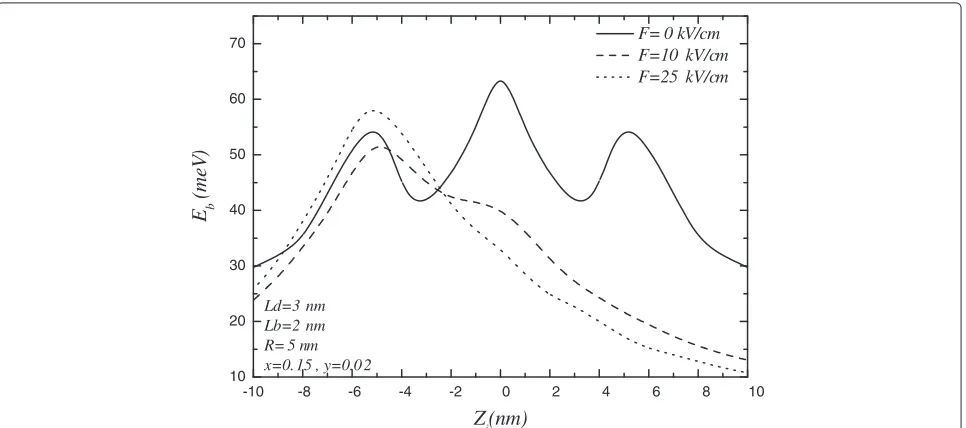
Figure 2 is shown the impurity binding energy as a function of impurity position for different electric fields strength. ForF = 0 the binding energy has a maximum value when the impurity is located at the center of the inner dot. Also, the binding energy has two weaker sym-metric local maxima for the impurity in the outer dots. The reason is that the electron wave function is mainly distributed inside the well region of the dots, and the Coulomb interaction is considerably large when the impu-rity is at the center of dots. The results are similar to works done by Wei, Chang and Zheng [16,19]. ForF = 0, the electron is under electric force and its wave function is pushed to left side of the system. In this case the vari-ation of binding energy is not symmetric, it has only a maximum value when the impurity is located at the center of QD1.
The variation of binding energy in terms of impurity position under magnetic field along z-direction is pre-sented in Figure 3. As it is seen, the binding energy increases as the magnetic field is applied. Because of, the magnetic field causes the wave function of electron local-izes inside the dot regions and, therefore, the interaction of electron and impurity located in the center of QDs increases.
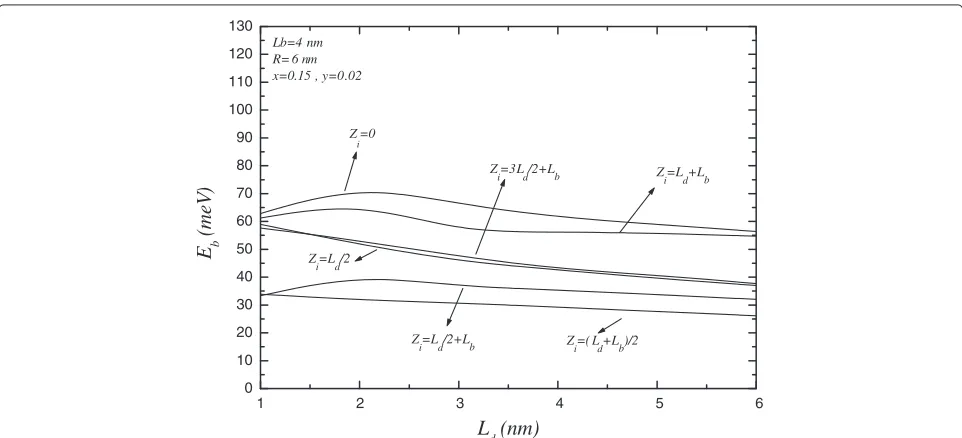
Figure 4 displays the binding energy as a function of the height of dot,Ld, for different impurity positions. When
the impurity is at the center of dots (zi=0,zi=Ld+Lb),
the binding energy increases , it reaches a maximum for a givenl0and then decreases as the dot height increases. It
is due to the electron wave function is localized inside the dot forLd ≤ l0 2.3 nm, and then the Coulomb
inter-action is increased but forLd > l0the distance between
-10 -8 -6 -4 -2 0 2 4 6 8 10
10 20 30 40 50 60 70
Ld=3 nm Lb=2 nm R= 5 nm x=0.15 , y=0.0 2
F= 0 kV/cm F=10 kV/cm F=25 kV/cm
-10 -8 -6 -4 -2 0 2 4 6 8 10 20
30 40 50 60 70 80 90 100
Ld=3 nm Lb=2 nm R= 5 nm x=0.15 , y=0.0 2
µ=1 µ=0
Figure 3The variations of binding energy in terms of impurity position in the presence of magnetic field.
electron and impurity is increased and the binding energy decreases. For impurity position at the center of barrier (zi = (Ld+Lb)/2), the binding energy decreases as Ld
increases, this is because the interaction between electron and impurity decreases. The binding energy for impurity position at the end of QDs (zi = Ld/2, 3Ld/2 + Lb)
decreases as Ld increases. This is also because the wave
function is distributed at the dot and the distance between electron and impurity increases asLdincreases.
The effect of external electric field on the binding energy on symmetric multiple QDs is considered in Figure 5. As
it is seen, the maximum value of binding energy for impu-rity at the center of dot decreases and is shift to left (Ld <
2 nm). The presence of electric field causes the wave func-tion is pushed to the left direcfunc-tion and the binding energy for impurity positions at the left side of system, such as
zi = −(Ld+Lb)increases, while it decreases for impurity
positions at the right side.
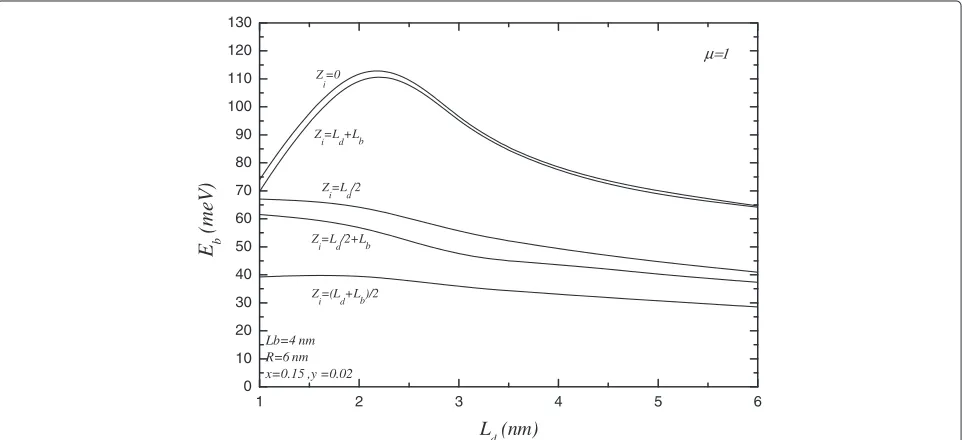
In Figure 6, the variation of the binding energy as a func-tion ofLdand in the presence of magnetic field is shown.
The binding energy increases for all impurity positions. Forzi=0 andzi=Ld+Lb, the binding energies have the
1 2 3 4 5 6
0 10 20 30 40 50 60 70 80 90 100 110 120 130
Lb=4 nm R= 6 nm x=0.15 , y=0.02
Z
i=Ld/2+Lb
Z
i=3Ld/2+Lb
Z
i=( Ld+Lb)/2
Z
i=Ld/2
Z
i=Ld+Lb
Z
i=0
1 2 3 4 0
10 20 30 40 50 60 70 80 90 100 110 120 130
Lb=4 nm R= 6
x=0.15 ,y =0.02
Z
i=0
Z
i=Ld/2
Z
i=-(Ld+Lb)
Z
i=Ld+Lb
Z
i=(Ld+Lb)/2
Z
i=Ld/2+Lb
F=25kV/cm nm
Figure 5The variations of binding energy versus the length of cylindrical quantum dot for various impurity positions in the presence of electric field.
similar variations and almost the same value. The reason is the same as Figure 3.
4 Conclusion
The binding energy in a multiple cylindrical quantum dots using the variational method and appropriate wave
function is calculated for ZBGaNstructures in the pres-ence of electric and magnetic fields. The results clearly showed that the binding energy has three peaks, that are around the center of dots, and decreases as the dot size increases. The electric field varies the value and the position of binding energy peaks according to impurity
1 2 3 4 5 6
0 10 20 30 40 50 60 70 80 90 100 110 120 130
Lb=4 nm R=6 nm x=0.15 ,y =0.02
Z i=Ld/2+Lb Z
i=0
Z i=Ld/2 Z
i=Ld+Lb
Z i=(Ld+Lb)/2 E b
(meV
)
Ld(nm)
µ=1
positions. The binding energy increases as magnetic field is applied for all impurity positions. The behavior of the binding energy is dependent on distribution of electron wave function and impurity position.
Competing interests
The authors declare that they have no competing interest.
Authors’ contributions
ES carried out study and methods. EN carried out the calculations and plotted the figures. Both authors read and approved the final manuscript.
Received: 3 November 2013 Accepted: 29 May 2014
References
1. AY Cho, JR Arhur, Molecular beam epitaxy. Prog.Solid State Chem.10, 157 (1975)
2. PD Dapkus, Metalorganic chemical vapor deposition. Annu. Rev. Mater. Sci.12, 243 (1982)
3. S Hersee, JP Duchemim, Low-pressure chemical vapor deposition. Annu. Rev. Mater. Sci.12, 65 (1982)
4. L Jacak,Quantum Dots. (P Hawrylak, A Wojs, eds.) (Springer-Verlag, Berlin, 1998)
5. G Cantele, D Nino, G Iadonisi, Confined states in ellipsoidal quantum dots. J. Phys.Condens. Matter12, 9019 (2000)
6. E Sadeghi, A Avazpour, Binding energy of an off-center donor impurity in ellipsoidal quantum dot with parabolic confinement potential. Physica B
406, 241 (2011)
7. H Leon, JL Marin, R Riera, Excitonic and electronic states in ellipsoidal and semiellipsoidal quantum dots. Physica E27, 385 (2005)
8. SF Chichibu, M Sugiyama, T Onuma, T Kitamura, H Nakanishi, T Kuroda, A Tackeuchi, T Sota, Y Ishida, H Okumura, Localized exciton dynamics in strained cubicIn0.1Ga0.9N/GaNmultiple quantum wells. Appl.Phys. Lett.
79, 4319 (2001)
9. LM Jiang, HL Wang, HT Wu, Q Gong, SL Feng, External electric field effect on the hydrogenic donor impurity in Zinc-belendGaN/AlGaNcylindrical quantum dot. J. Appl. Phys.105(053710) (2009)
10. FC Jiang, CX Xia, Hydrogenic impurity states in Zinc-belendInGaN
quantum dot. Physica B403, 165 (2008)
11. JJ Shi, ZZ Gan, Effect of piezoelectricity an spontaneous polarization on localized excitons in self-formedInGaNquantum dots. J. Appl.Phys.94, 407 (2003)
12. CX Xia, SY Wei, X Zhao, Built-in electric field effect on hydrogenic impurity in wurtziteGaN/AlGaNquantum dot. Appl.Surf. Sci.253, 5345 (2007) 13. CX Xia, ZP Zeng, SY Wei, Barrier width dependence of the donor binding
energy of hydrogenic impurity in wurtziteInGaN/GaN. J. Appl.Phys.
106(094301) (2009)
14. H Wang, L Jiang, Q Gong, S Feng, External electric field effect on the hydrogenic donor impurity in zinc-belendInGaN/GaNcylindrical quantum well. Physica B405, 3818 (2010)
15. CX Xia, YM Liu, SY Wei, Hydrogenic impurity states in zinc-belend
GaN/AlNcoupled quantum dots. Phys.Lett. A372, 6420 (2008) 16. S Wei, Q Chang, Hydrogenic impurity states in zinc-belend symmetric
InGaN/GaNmultiple quantum dots. Physica E43, 354 (2010) 17. E Sadeghi, Linear and nonlinear optical absorption coefficients in an
asymmetric graded ridge quantum wire. Superlattices Microstructures
49, 91 (2011)
18. W Xie, Linear and nonlinear optical absorptions of a two-electron quantum dot. Physica B405, 2102 (2010)
19. Jin-liang Zheng, Binding energy of hydrogenic impurity in
GaAs/Ga1-xAlxAsmultiple quantum dot strain. Physica E.40, 2879 (2008)
doi:10.1186/s40580-014-0025-3
Cite this article as:Sadeghi and Naghdi:Effect of electric and magnetic
fields on impurity binding energy in zinc-blend symmetric InGaN/GaN multiple quantum dots.Nano Convergence20141:25.
Submit your manuscript to a
journal and benefi t from:
7Convenient online submission
7Rigorous peer review
7Immediate publication on acceptance
7Open access: articles freely available online
7High visibility within the fi eld
7Retaining the copyright to your article