Available Online at www.ijpret.com 143
INTERNATIONAL JOURNAL OF PURE AND
APPLIED RESEARCH IN ENGINEERING AND
TECHNOLOGY
A PATH FOR HORIZING YOUR INNOVATIVE WORKREDUCTION TECHNIQUES IN DYNAMIC ANALYSIS OF STRUCTURES
ROSHAN RAMDAS GADPAL
Dept. of Applied Mechanics, Govt. Polytechnic Arvi, Dist Wardha.
Accepted Date: 15/03/2016; Published Date: 01/05/2016
\
Abstract: For stress and deformation analysis of tall structures, bridges, ships, aircraft, automobiles, nuclear reactors and many other structures, large finite element models with thousands of degrees of freedom (dof) are used. Use of same detailed representation that is required for static analysis is not practically possible while performing the dynamic analyses. Moreover it becomes unnecessary also and the entire project becomes tremendously cumbersome. Furthermore, design and control methods work best for the systems with a smaller number of degrees of freedom. To overcome this difficulty dynamic reduction techniques have been developed to reduce the number of degrees of freedom, prior to performing dynamic analysis. If dynamic reduction is not used the solution cost will dominate for the practical industrial problems.
Keywords: Stress and Deformation Analysis, Dynamic Analyses, Degrees Of Freedom,
Dynamic Reduction Techniques.
Corresponding Author: MS. ROSHAN RAMDAS GADPAL
Access Online On:
www.ijpret.com
How to Cite This Article:
Roshan Ramdas Gadpal, IJPRET, 2016; Volume 4 (9): 143-152
Available Online at www.ijpret.com 144
INTRODUCTION
In general while performing dynamic analysis of structures using FEM, sometimes it becomes necessary to discretize a structure into a large number of elements because of changes in geometry, loading or material properties. However it is not always possible to obtain rigorous mathematical solutions for the entire structure. While assembling the elements for entire structure, the number of unknown displacements, that is, the number of degrees of freedom may be quite large. As a result of which the stiffness, mass and damping matrices will be of large size. The solution of corresponding Eigen problem to compute natural frequencies and modal shapes will be difficult and moreover expensive. In such cases it is advisable to reduce the size of these matrices in order to make the solution of eigen problem more manageable and economical.
Four major steps in dynamic analysis are
1. Assembly of equations
2. Dynamic reduction (optional)
3. Solution of equations
4. Recovery of forces, stresses.
If dynamic reduction is not used the solution cost will dominate for the practical industrial problems.
II. REVIEW OF LITERATURE
FEM based dynamic analysis seldom gives correct results matching with the experimental behavior of the structure. The research on the model updating is yet to have a reliable method which suits for present industrial requirement. All the methods lack in generality and useful on case specific basis. List of the publications is exhaustive and lot of literature is available. An attempt is made to highlight few techniques and latest development in the model updating. Many methods of reducing dynamic matrices used in FEM analysis are currently in use. Out of them following three are more popular.
1. Guyan reduction method,
2. Improved reduction system and
Available Online at www.ijpret.com 145
The simplest procedure of Guyan [1] assumes that the interpolation shapes can be calculated using the FEM stiffness and/or mass matrices to solve a static solution.
The Improved Reduction System (IRS) method developed by O’Callahan [2] improves upon Guyan reduction by including a first order estimate for mass effects in the development of Transformation Matrix.
Another approach to improve on Guyan reduction is called Dynamic Reduction system proposed by Paz [3]
Friswell et. al. [4] and Freed et.al.[5] have presented additional discussion of TAM (Test Analysis Models) reduction and expansion.
IRS reduction method can be easily performed in NASTRAN using a rigid format alter [6, 7]. The weaknesses of IRS reduction method were shown by Gordis [8].
However, these more advanced methods can encounter numerical problems if the accelerometer set is inadequate.
In general, Guyan reduction should be used due to its simplicity and greater experience base. In this paper this method is re-mastered and a computer program has been developed which gives a sufficiently closer dynamic behavior of the structure
III. FORMULATION
Available Online at www.ijpret.com 146
(a) 16 dof model
(b) 4 dof model
Fig. 1. FEM models
The reduced stiffness and mass matrices are obtained as follows
The equations of motion are :
M ü + K u = F … (1)
If inertial forces and applied forces are grouped together, the we can write the equations as :
K u = F … (2)
The displacement set u can be partitioned as ur = retained set and uo = omitted set.
u = {𝐮𝐮𝐫
𝐨 } … (3)
To start with the retained set may be taken as 20 % of the total dof . The equations of motion can now be written in partitioned form as :
[𝐊𝐫𝐫 𝐊𝐫𝐨 𝐊𝐫𝐨𝐓 𝐊𝐨𝐨
] {𝐮𝐮𝐫 𝐨 } = {
𝐅𝐫
𝐅𝐨} … (4)
The idea is to choose the omitted set such that the components of FO are small . Thus we
should retain those dof in the r – set with large and concentrated masses which are loaded and which are needed to adequately describe the mode shape. Setting FO = 0 , the lower part of
equation (4) yields :
[ 𝐊𝐫𝐫 𝐊𝐫𝐨 𝐊𝐫𝐨𝐓 𝐊𝐨𝐨] {
𝐮𝐫 𝐮𝐨 } = {
𝐅𝐫
𝟎 } … (5)
Available Online at www.ijpret.com 147
[𝐊𝐫𝐫 ]{ 𝐮𝐫 } + [𝐊𝐨𝐨 ] { 𝐮𝐨 } = 0
{ 𝐮𝐨 } = - [𝐊𝐨𝐨 ]-1 [𝐊𝐨𝐫 ]{ 𝐮𝐫 } … (6)
The strain energy in the structure is
U = 12 uT K u and can be written as
U =12 [𝐮𝐫T 𝐮
𝐨T ] [
𝐊𝐫𝐫 𝐊𝐫𝐨 𝐊𝐫𝐨𝐓 𝐊𝐨𝐨] {
𝐮𝐫 𝐮𝐨 }
Substituting eqn.(6) into the above, we can write U = 1
2 𝐮𝐫
T K
r 𝐮𝐫 , where Kr is the reduced
stiffness matrix given by :
Kr = 𝐊𝐫𝐫 – 𝐊𝐫𝐨𝐊𝐨𝐨−𝟏 𝐊𝐫𝐨𝐓 … (7)
To obtain an expression for reduced mass matrix, we consider the kinetic energy
V = 1
2 𝒖̇
T M 𝒖̇ . Upon partitioning the mass matrix and using eqn. (6), we can write the kinetic
energy as V = 12 𝐮̇𝐫T M
r𝐮̇𝐫 , where Mr is the reduced matrix given by
Mr = Mrr – Mro Koo-1 𝐊𝐫𝐨𝐓– 𝐊𝐫𝐨𝐊𝐨𝐨−𝟏 𝐌𝐫𝐨𝐓
+ 𝐊𝐫𝐨𝐊𝐨𝐨−𝟏 𝐌𝐨𝐨 𝐊𝐨𝐨−𝟏 𝐊𝐫𝐨 𝐓
…(8)
Now, with these reduced stiffness and mass matrices, only a smaller eigenvalue problem is required to be solved.
Kr Ur = λ Mr Ur … (9)
Then we recover,
Uo = - Koo-1 𝐊𝐫𝐨𝐓 Ur … (10)
IV NUMERICAL EXAMPLES
Available Online at www.ijpret.com 148
(a)
(b)
E = 200 GPa, ρ = 7840 kg/m3,
I = 2000 mm4, A = 240 mm2
Fig. 2. Cantilever beam model
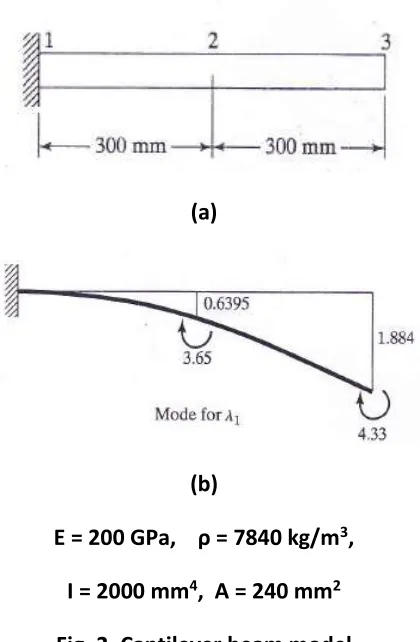
Example 1: A cantilever having geometrical and material properties as shown in fig. 2 is analysed for modal analysis. The degree of freedom at each node is deflection (amplitude) w and slope 𝜕𝑤/𝜕𝑥. Using standard finite element procedure [9], we obtain the stiffness and mass matrices by hand calculations:
K = 1000 [
355.6 0 −177.8 26.67
0 10.67 −26.67 2.667
−177.8 −26.67 177.8 −26.67 26.67 2.667 −26.67 5.33
]
M = 0.001 [
419.3 0 72.6 −5.20
0 0.967 5.20 −0.36 72.6 5.20 209.7 −8.90 −5.20 −0.36 −8.90 0.48
Available Online at www.ijpret.com 149
Now evaluate the lowest two eigenvalues and corresponding eigenmodes for the beam based on a 4 dof model using Guyan’s reduction method.
Solution : For applying Guyan’s reduction method to this problem based on omitting the rotational dof and comparing the results with the full model, refer fig.2 u3, u5 refer to
translational dof while u4, u6 refer to the rotational dof. Thus the retained set is u3, u5 and the
omitted set is u4, u6. Extracting the appropriate components from the full 4 x 4 K and M
matrices we obtain
krr = 1000 [ 355.6 −177.8 −177.8 177.8]
kro = 1000 [ 0 26.67 −26.67 −26.67]
koo= 1000 [ 10.67 2.667 2.667 5.33 ]
mrr = [ 0.4193 0.0726 0.0726 0.2097 ]
mro = [ 0 −0.0052 0.0052 −0.0089 ]
moo = [ 0.000967 −0.00036 −0.00036 0.00048 ]
From equations (7) and (8), we obtain the reduced matrices
Available Online at www.ijpret.com 150
Mr = [ 0.502 0.1 0.1 0.155 ]
An input data file is prepared and the program JACOBI2 is used to solve the eigenvalue problem in eq(9). The solution is
λ1 = 20250 , λ2 = 818300
Ur1 = {0.6395
1.884}, Ur2 = {
1.370 −1.959 }
Using eqn. (10), we obtain the eigenvector components corresponding to the omitted dof as
Uo1 = {3.65
4.33} , Uo2 = {
−0.838 −16.238 }
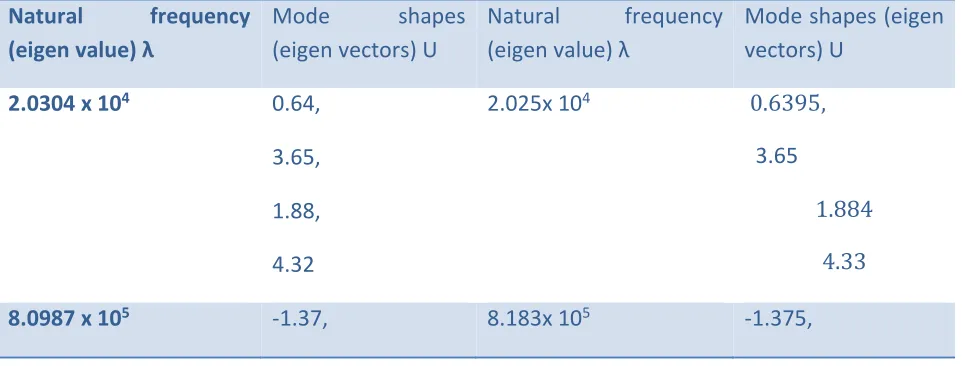
The results of analysis are summarized in table 1. All the results show good agreement with the results reported in literature [10,11].
Table 1
Results reported in literature in full form Results obtained with present analysis
Natural frequency
(eigen value) λ
Mode shapes
(eigen vectors) U
Natural frequency
(eigen value) λ
Mode shapes (eigen vectors) U
2.0304 x 10⁴ 0.64,
3.65,
1.88,
4.32
2.025x 10⁴ 0.6395,
3.65
1.884
4.33
Available Online at www.ijpret.com 151 1.39,
1.901,
15.27
1.386,
1.906,
15.27
V. CONCLUDING REMARKS
In this paper, the application of various reduction techniques was studied with their prominent features and computer programs were developed to get dynamic behaviour of structures. Following hints shall be followed while using dynamic reduction techniques.
Identify dof to be retained in the analysis set and distribute it uniformly over the structure.
Put the points with large masses in a set.
It is better for the retained set to have both translations and rotations in case of structural elements.
Natural frequencies and mode shapes give us the needed data concerning what excitation frequencies should be avoided.
REFERENCES:
1. Guyan R. J.,“ Reduction of Stiffness and Mass Matrices”, AIAA Journal, Vol. 3, February, 1965.
2. O’Callahan J., “A Procedure for an Improved Reduced System (IRS) Model”, 7th International
Modal Analysis Conference, January, 1989.
3. Paz Mario, “Structural Dynamics Theory and Computation”, CBS Publishers & Distributors Pvt. Ltd. ISBN: 81-239-0978-0, 2nd Edition, 2004, pp 247-277.
4. Friswell M.I. and Mottershead J. E., “Finite Element Model Updating in Structural Dynamics”, Kluwer academic Publishers, ISBN 0-7923-3431-0, 1995.
5. Freed A.M. and Flanigan C.C., “A comparison of Test –Analysis Model Reduction Methods”, 8th International Modal Analysis Conference, January, 1990.
Available Online at www.ijpret.com 152
7. Flanigan C., “Development of the IRS Component Dynamic Reduction Method for substructure Analysis”, AIAA-91-1056, AIAA 32nd Structures, Structural Dynamics and Materials
Conference, April 1991.
8. Gordis J.H., “An Analysis of Improved Reduced System (IRS) Model Reduction Procedure”, 10th International Modal Analysis Conference, February, 1992.
9. A.S. Meghre & K.N. Kadam – Finite Element Method in Structural Analysis – First Edition – 2014
10. T.R.Chandrupatla and A.D. Belegundu – Introduction to Finite Elements in Engineering – Second Edition Prentice Hall of India Pvt. Ltd. 1998