Open Access
Research
An e-learning application on electrochemotherapy
Selma Corovic
†, Janez Bester
†and Damijan Miklavcic*
†Address: University of Ljubljana, Faculty of Electrical Engineering, Trzaska 25, 1000 Ljubljana, Slovenia
Email: Selma Corovic - [email protected]; Janez Bester - [email protected]; Damijan Miklavcic* - [email protected] * Corresponding author †Equal contributors
Abstract
Background: Electrochemotherapy is an effective approach in local tumour treatment employing locally applied high-voltage electric pulses in combination with chemotherapeutic drugs. In planning and performing electrochemotherapy a multidisciplinary expertise is required and collaboration, knowledge and experience exchange among the experts from different scientific fields such as medicine, biology and biomedical engineering is needed. The objective of this study was to develop an e-learning application in order to provide the educational content on electrochemotherapy and its underlying principles and to support collaboration, knowledge and experience exchange among the experts involved in the research and clinics.
Methods: The educational content on electrochemotherapy and cell and tissue electroporation was based on previously published studies from molecular dynamics, lipid bilayers, single cell level and simplified tissue models to complex biological tissues and research and clinical results of electrochemotherapy treatment. We used computer graphics such as model-based visualization (i.e. 3D numerical modelling using finite element method) and 3D computer animations and graphical illustrations to facilitate the representation of complex biological and physical aspects in electrochemotherapy. The e-learning application is integrated into an interactive e-learning environment developed at our institution, enabling collaboration and knowledge exchange among the users. We evaluated the designed e-learning application at the International Scientific workshop and postgraduate course (Electroporation Based Technologies and Treatments). The evaluation was carried out by testing the pedagogical efficiency of the presented educational content and by performing the usability study of the application.
Results: The e-learning content presents three different levels of knowledge on cell and tissue electroporation. In the first part of the e-learning application we explain basic principles of electroporation process. The second part provides educational content about importance of modelling and visualization of local electric field in electroporation-based treatments. In the third part we developed an interactive module for visualization of local electric field distribution in 3D tissue models of cutaneous tumors for different parameters such as voltage applied, distance between electrodes, electrode dimension and shape, tissue geometry and electric conductivity. The pedagogical efficiency assessment showed that the participants improved their level of knowledge. The results of usability evaluation revealed that participants found the application simple to learn, use and navigate. The participants also found the information provided by the application easy to understand.
Published: 20 October 2009
BioMedical Engineering OnLine 2009, 8:26 doi:10.1186/1475-925X-8-26
Received: 29 July 2009 Accepted: 20 October 2009
This article is available from: http://www.biomedical-engineering-online.com/content/8/1/26
© 2009 Corovic et al; licensee BioMed Central Ltd.
Conclusion: The e-learning application we present in this article provides educational material on electrochemotherapy and its underlying principles such as cell and tissue electroporation. The e-learning application is developed to provide an interactive educational content in order to simulate the "hands-on" learning approach about the parameters being important for successful therapy. The e-learning application together with the interactive e-learning environment is available to the users to provide collaborative and flexible learning in order to facilitate knowledge exchange among the experts from different scientific fields that are involved in electrochemotherapy. The modular structure of the application allows for upgrade with new educational content collected from the clinics and research, and can be easily adapted to serve as a collaborative e-learning tool also in other electroporation-based treatments such as gene electrotransfer, gene vaccination, irreversible tissue ablation and transdermal gene and drug delivery. The presented e-learning application provides an easy and rapid approach for information, knowledge and experience exchange among the experts from different scientific fields, which can facilitate development and optimisation of electroporation-based treatments.
Background
Electrochemotherapy is an effective approach in tumor treatment employing locally applied high-voltage electric pulses in combination with chemotherapeutic drugs which enter tumor cells after their membrane has been electroporated [1,2]. Electroporation is a phenomenon of cell membrane permeability increase due to local delivery of short and sufficiently intense voltage pulses via appro-priate electrodes to the target cells and tissues [3,4]. In addition to electrochemotherapy, other medical applica-tions of electroporation are emerging at an increasing rate, such as gene electrotransfection [5,6], cell fusion [7] and irreversible tissue ablation [8] and transdermal gene and drug delivery [9]. The effectiveness of cell and tissue elec-troporation, and thus the effectiveness of electroporation-based therapies, depends on one hand on the parameters of the applied pulses such as amplitude, duration, number and repetition frequency and type of electrodes used and on the other hand on the characteristics of the cell and tissues to be electroporated. Depending on the
electric pulse parameters used, electroporation can be reversible or irreversible. Namely, when the electric pulses are applied, local electric field (E) is established within the treated tissue. In order to cause structural changes in cell membrane magnitude of local electric field need to achieve the critical reversible threshold value (Erev). The phenomenon is reversible until the magnitude of local electric field reaches the irreversible threshold value Eirrev, which causes permanent damages of the cell membrane. The reversible electroporation regime has to be assured in all applications in which the viability of cells has to be preserved, such as electrochemotherapy and particularly gene therapy [4]. On the other hand, in some medical and biotechnological applications such as irreversible tumour tissue ablation, liquid food sterilization or water treat-ment, the irreversible electroporation is used as a nonther-mal method for efficient cell killing [10]. The key role in electroporation effectiveness plays the local electric field, which can be directly modified by the amplitude of deliv-ered electric pulses and electrodes used for electric pulse
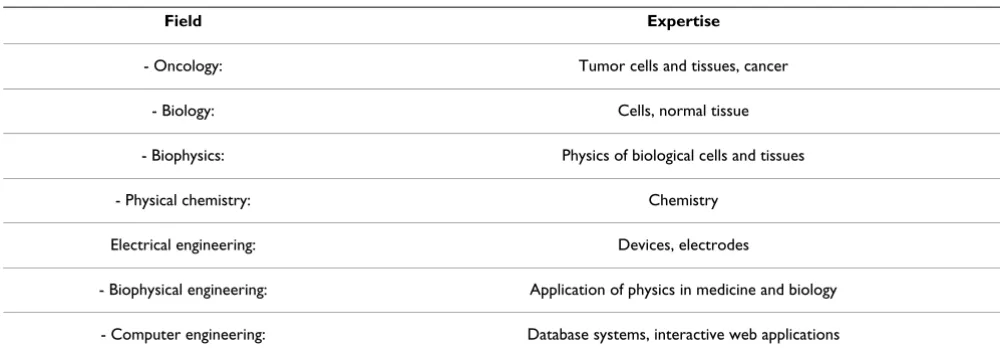
Table 1: Scientific fields and the corresponding expertise needed in electrochemotherapy
Field Expertise
- Oncology: Tumor cells and tissues, cancer
- Biology: Cells, normal tissue
- Biophysics: Physics of biological cells and tissues
- Physical chemistry: Chemistry
Electrical engineering: Devices, electrodes
- Biophysical engineering: Application of physics in medicine and biology
delivery [11]. Thus, for controlled use of the method in each particular electroporation-based application electric pulse parameters and electrodes' shape and placement with respect to the target tissue need to be specifically optimized [12].
Knowledge exchange and collaboration among the experts involved in electroporation-based therapies
In development of electroporation-based therapies (e.g. electrochemotherapy), a multidisciplinary expertise is required. In electrochemotherapy a close collaboration, knowledge and experience exchange among experts in the fields of oncology, biology, biophysics, physical chemis-try and electrical, biomedical engineering and informatics is needed (Table 1). The efficacy of electrochemotherapy can be assured with the knowledge of parameters of the local electric field (i.e. pulse parameters and electrode geometry and their positioning), being crucial for success-ful tissue electroporation and subsequently for the best electrochemotherapy treatment outcome. Realistic math-ematical models validated by corresponding experimental observations are valuable tool in designing and optimiza-tion of local electric field distribuoptimiza-tion. To develop a good mathematical model allowing for therapy outcome pre-diction the engineers need to posses knowledge about biological mechanisms involved in electrochemotherapy. To make the therapy as efficient as possible it is of great importance to transfer the knowledge from basic science to the field of biomedical engineering and to the practic-ing clinicians who performs the treatment.
Information and communication technology is necessary for efficient interdisciplinary collaboration and knowl-edge exchange. Internet technology has already been suc-cessfully used to support clinical trials of electrochemotherapy by establishing a central database and the Web application system for electronic collection of data (such as treatment parameters used and treatment efficiency follow up) submitted by users from distant medical centres across Europe [13-15]. Based on a com-prehensive analysis of collected data, performed by the developed system the standard operating procedures for clinical electrochemotherapy of cutaneous and subcuta-neous tumor in patients have been defined [2,16-18]. The clinical trials showed and numerous other studies demon-strated, that electrochemotherapy is an efficient antitumor treatment regardless of tumor histology and its location. In order to further improve the treatment planning meth-ods also for other electroporation-based therapies, to develop the needed equipment (i.e. generators, elec-trodes, software) and to broaden the clinical electrochem-otherapy to other types of tumours, numerous international and multidisciplinary scientific projects are being conducted.
A collaborative e-learning in electrochemotherapy
The objective of our study was to develop an e-learning application to support collaboration, knowledge and experience exchange among experts involved in electro-chemotherapy and to also apply the acquired knowledge to other electroporation-based technologies such as gene electrotransfection, irreversible tissue ablation and transdermal gene and drug delivery. The target users of our application are biomedical engineers, biologists involved in research and other application development, the clinicians, oncologists and medical personnel involved in choosing and performing the treatment, but also patients and all those who want to learn about elec-trochemotherapy. The target audience is therefore mixed [19] (i.e. coming from scientific areas, different fields of expertise, and with different level of experiences) and dis-persed [20] (i.e. geographically located in different research centres spread around Europe/World). In order to consider the users involved in electrochemotherapy our e-learning application was designed to provide educa-tional material for collaborative and flexible learning.
The web based technologies facilitate flexible learning by providing a choice of learning modalities (i.e. in local, near or remote conditions), which is particularly impor-tant when the dispersed audience is concerned [20]. Accordingly, we used web-based technologies to collect, organize and transfer the acquired knowledge among the target audience in electrochemotherapy. We used compu-ter graphics such as model-based visualization and simple 2D and 3D computer animations and graphical illustra-tions to facilitate the representation of complex biological and physical mechanisms involved in electrochemother-apy. The educational content is based on previously pub-lished results from molecular dynamics, lipid bilayers, single cell level and simplified tissue models to complex biological tissues [3,4,11,31-43].
The e-learning application is integrated into an interactive e-learning environment E-CHO [44] developed at our institution. The e-learning application on electrochemo-therapy was introduced to the participants at the Interna-tional Scientific workshop and postgraduate course (Electroporation Based Technologies and Treatments) that took place at the University of Ljubljana in November 2007 [45]. The pedagogical efficiency of the application was analyzed by participant evaluation on the presented educational content at the beginning and at the end of the e-learning training session. We also present the results of a simple usability evaluation of the application we per-formed by asking the participants to answer to a usability questionnaire and to provide users opinion/comments on the application and suggestions on its possible improve-ment.
Methods
The e-learning web application is based on HTML, JavaS-cript, ASP and Macromedia Flash web technologies. Graphical illustrations and 3-dimensional visualizations of the electroporation process on the levels of cell mem-brane, cell and tissues were done by using a software pack-age 3D Studio Max. Based on the numerical calculations of electric filed distribution carried out with software packages FEMLAB and Matlab, more simple 2-dimen-sional and 3-dimen2-dimen-sional illustrations were designed using software packages 3D StudioMax, Macromedia Flash, PhotoShop and CorelDraw. The educational con-tent (textual and graphical information) is published using Hypertext Markup Language (HTML). The designed e-learning application is integrated into E-CHO e-learning system developed by the Laboratory of telecommunica-tions [44] (University of Ljubljana) at the Faculty of Elec-trical Engineering. The E-CHO e-learning environment enables the use of various types of communications among users, such as forums, e-mail correspondence and videoconferencing as well as authentication of users, sta-tistical analysis, network traffic measurement, and sup-port for video streaming [46].
Evaluation
We introduced the designed e-learning application at the International Scientific workshop and postgraduate course (Electroporation Based Technologies and Treat-ments) [45] in order to evaluate its pedagogical and usa-bility efficiency. The participants were a mixed audience of 17 participants with heterogeneous knowledge and experience in the field of electrochemotherapy and other electroporation-based technologies. The mixed audience was composed of participants coming from different research institutions across Europe and World:
- Denmark (University of Copenhagen: 1 biologist (PhD student) and 1 medical physician (PhD researcher) from Herlev Hospital and 1 from Gentofte Hospital);
- France (1 physicist (PhD student) from doctoral school École normale supérieure de Cachan; 1 biologist (Post-Doc researcher) from Institut Gustave Roussy, Villejuif; 2 biologists (1 PhD student and 1 PostDoc researcher) from IPBS (Institut de Pharmacologie et de Biologie Structu-rale) - Research Unit of CNRS/UMR 5089 and University Paul Sabatier, Toulouse);
- Egypt (University of Cairo: 1 physicist (PhD student) from Biophysics Department, Faculty of Science); and
- Slovenia (University of Ljubljana: 8 electrical engineers (PhD students) from Faculty of Electrical Engineering and 1 biologist (PhD student) from Faculty of Pharmacy).
In order to statistically analyze the obtained results we divided the mixed audience/participants into two groups:
first group of 11 engineers (by gathering electrical engi-neers and physicists) and second group of 7 biologists (by gathering biologists and the medical physician).
The participants were gathered in a computer-based class-room providing each participant with a computer. Each of the participants was provided with a username and pass-word to log on to the E-CHO system. Before the start of the e-learning session a Power Point presentation was pre-sented to the participants by the instructor giving instruc-tions on the course of studying the educational content and on the evaluation testing. In order to create a collab-orative e-learning environment the participants were encouraged to collaborate (i.e. discuss between each other and with the instructor) while studying the educational content.
evalua-tion tests. The evaluaevalua-tion tests were taken by each of the participants only once.
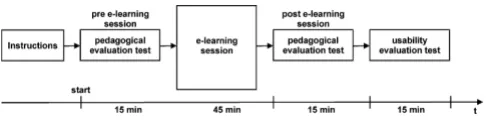
We evaluated the e-learning application by testing the pedagogical efficiency of the presented educational con-tent and by performing the usability study of the applica-tion. All the participants were asked to provide their agreement on the use of the results of pedagogical effi-ciency and usability study for the research purposes. Each of the participants individually completed the evaluation tests and submitted them to the E-CHO system for further statistical analysis. The time sequence of the steps per-formed during our study is given by a flow chart in Fig. 1.
1) Pedagogical efficiency study
In order to evaluate the pedagogical efficiency of the edu-cational content on electrochemotherapy the participants were asked to answer to the same test before and at the end of the e-learning session. The questions were targeted so as to give 50% to 100% success. The exact questions asked in the pre and post e-learning session test are given in Additional file 1.
2) Usability study
The usability evaluation was conducted at the end of the e-learning session after the pedagogical efficiency evalua-tion was completed. The participants were asked to com-plete a usability questionnaire related to the user satisfaction with the developed e-learning application, in order to allow the authors (i.e. developers and instructors) to detect possible errors or to obtain the users feedback on further upgrades/improvements. The questionnaire con-sisted of thirteen usability related questions (see Addi-tional file 2). The participants were asked to express their opinion on a seven point Likert scale (LS) ranging from 1 (disagree - LS (1)) to 7 (strongly agree (LS - (7)) statement or to remain neutral by checking neither agree nor disa-gree (NA) statement, which we considered as negative evaluation result (Additional file 2). After completing the usability questionnaire the participants were encouraged to provide their opinion/comments on the application and suggestions for its improvement.
Results
The structure of the e-learning content
The e-learning content presents three different levels of knowledge on electroporation-based treatment (i.e.
elec-trochemotherapy) and cell and tissue electroporation. The e-learning content particularly emphasizes the impor-tance of local electric field for successful cell and tissue electroporation. The main structure of the e-learning con-tent is given in Fig. 2.
The first part of our e-learning application (Basics of elec-troporation process) brings the educational material on basic mechanisms underlying electroporation process on the levels of: cell membrane, cell and tissue as a composite of cells. Electroporated cell in a local electric field exceed-ing reversible threshold value E >Erev is represented by a simple graphical illustration in Fig. 3a. The electropora-tion of cell membrane first occurs within the cell area fac-ing the electrodes (dashed line in Fig. 3a), since the induced transmembrane potential is maximal at the poles of the cell in accordance Schwan's equation: UTI = -1.5 r E
cos (φ), where r is the radius of the cell, E is the strength of applied electric field, and φ is the angle between the direc-tion of the electric field and the selected point on the cell surface. Possible applications of electroporation process, depending on parameters of the electric pulses applied, are illustrated in Fig. 3b: the introduction of small mole-cules, macromolecules and cells' electrofusion require reversible electroporation regime (Erev <E <Eirrev), while the permanent cell damaging requires irreversible electro-poration thus local electric field exceeding irreversible threshold E >Eirrev.
The value of induced transmembrane voltage and thus the cell electroporation depends on the cell size, shape, and the position of the cell with respect to the direction of applied electric field, which we represented in Figs. 4a, b, c and 4d. For a spheroidal cell, maximum induced trans-membrane potential strongly depends on its orientation with the respect to the electric field. It is the highest when the spheroidal cell is parallel to the applied electric field. In Fig. 4e we illustrated that increasing the pulse ampli-tude results in larger area of membrane with smaller extent of electroporation, while increase in pulse number or duration does not affect the membrane area but increases the extent of electroporation.
In order to visualize the electroporation process as anima-tions in three dimensions we used 3D Studio Max soft-ware. We visualized the introduction of small molecules through an electroporated cell membrane, into an electro-porated cell and into all successfully electroelectro-porated cells within an exposed tissue (i.e. a composite of cells), as shown in Fig. 5.
The second part of the e-learning content (Modelling and visualization of local electric field) provides educational content about the importance of modelling and visualiza-tion of local electric field in electroporavisualiza-tion-based treat-ments. The user is warned about possible errors that can
A flow chart representing the time sequence of the steps performed during the study
Figure 1
be made while performing cell or tissue electroporation, such as insufficient amplitude of electric pulses or inade-quate electrode geometry or electrode positioning. This part of e-learning content is particularly intended as guid-ance to the practitioners who perform electrochemother-apy treatment of solid tumours. Namely, for successful tumour treatment all the tumor cells have to be destroyed, otherwise the tumour cell can re-grow due to the insuffi-cient magnitude of local electric field E <Erev. This was demonstrated in our e-learning application with an
exam-ple of an unsuccessful subcutaneous tumour treatment performed on a nude mouse shown in Fig. 6. The Fig. 6a shows the electrode position and the tumour geometry just before the treatment, while Fig. 6b shows the regrowth of two tumours after initial disappearance: two new tumours regrew in the regions (marked with numbers 1 and 2) where the tumour tissue was not exposed to the sufficient electric field E >Erev. Simple graphical illustra-tion of the tumor and its surrounding tissue posiillustra-tion between two plate electrodes is shown in Fig. 6c. In Fig. 6d
The structure of the e-learning application on electrochemotherapy
Figure 2
The structure of the e-learning application on electrochemotherapy.
Single cell electroporation and different electroporation regimes
Figure 3
calculated local electric field distribution: the reversibly electroporated tissue is marked with colours (from blue to red), the tissue exposed to E >Erev is marked white and the patterned region represents the irreversibly electroporated tissue E >Eirrev.
By using simple graphical illustration we pointed out that the effectiveness of electrochemotherapy can be improved by: optimizing the applied voltage, changing electrode dimension or changing electrode orientation and their position, which we previously predicted by means of numerical modelling. We further provide a list of impor-tant parameters of the local electric field in
electropora-tion-based treatments, such as: electrode geometry (needle or plate electrodes), dimension of the particular electrode (width, length, diameter), distance between electrodes, electrode position with respect to the target tis-sue, electrode orientation with respect to the target tistis-sue, geometry of the target tissue, geometry of the tissue sur-rounding the target tissue, the contact surface between the electrode and the tissue, electric properties of the target tis-sue i.e. tistis-sue conductivity, electric properties of the sur-rounding tissue, the voltage applied to the electrodes and threshold values of the tissue Erev and Eirrev. Using math-ematical modelling and graphical illustrations we showed that the local electric field within the treated tissue is not
Influence of different parameters on cell electroporation
Figure 4
Influence of different parameters on cell electroporation. (a) Electric field parallel to elongated cell, (b) electric pulse amplitude is increased, (c) orientation of electric field is changed, (d) electric pulse amplitude is increased and (e) increasing the pulse amplitude results in larger area of membrane with smaller extent of electroporation, while increase in pulse number or duration does not affect the membrane area but increases the extent of electroporation. (Redrawn from [10]).
Administration of small molecules by electroporation
Figure 5
homogeneous due to the specific structure and electric properties of the tissues (particularly of the target tumour tissue that usually has higher electric conductivity than its surrounding tissues).
In the third part of the e-learning application (Local elec-tric field in 3D tissue models) we developed an interactive module for visualization of local electric field distribution in tissues for different parameters such as voltage applied, distance between electrodes, electrode' dimension and shape, tissue geometry and electric conductivity. The module provides 3D animations we developed by using 3D Studio Max, which were based on previously calcu-lated local electric field distribution in 3D realistic tissue models. For the numerical calculations we used COMSOL Multiphysics software.
The module allows for local electric field visualization in cutaneous (protruding tumours) and subcutaneous tumours (tumours more deeply seeded in the tissue). Users can appreciate the local electric field distribution
within the treated tissue when electroporated directly or through the skin by using plate or needle electrodes. The module also provides a guideline on how to overcome a highly resistive skin tissue in order to permeabilize more conductive underlying tissues.
The objective of this part of the e-learning application is to provide an interaction with the educational content in order to simulate the "hands-on" learning approach about the parameters of the local electric field. By varying different parameters (such as amplitude of electric pulses, electrodes' dimensions and shape and distance between electrodes) in the navigation bar users have the possibility to shape the electric field distribution within the models (see the navigation bar in Fig. 7). The local electric field distribution can be viewed in 2D model cross-sections or played as a 3D animation. The E is displayed in the range between Erev to Eirrev. In Figure 7 the local electric field distribution inside the cutaneous protruding tumour obtained with two different amplitudes of applied voltage (Fig. 7a: U = 300 V and Fig. 7b: U = 600 V) using two par-allel plate electrodes is shown as example. By increasing the applied voltage (for the same tissue geometry, elec-trode size and position) the stronger local electric field is obtained. Similar effect can be achieved by increasing the electrode dimensions (electrode width), while by increas-ing the distance between electrodes the tumor is exposed to a lower local electric field intensity, as shown in Figs. 7c and 7d.
The model of subcutaneous tumour gives the user an insight into the local electric field within the target tissue when electroporated through the skin. This model is com-posed of two layers; the upper layer representing skin tis-sue with lower specific conductivity compared to the underlying layer which is more conductive. The electric field distribution is presented in two models with two dif-ferent thicknesses of the skin layer: 1 mm (Fig. 8a) and 3 mm (Fig. 8b). Thus, the user can appreciate the presence of the skin and its poor electric conductivity on the local electric field distribution within the target tumour and its surroundings.
The key messages that the interactive module provides are:
1) in order to successfully electroporate the target tumour through the skin layer a higher voltage needs to be applied compared to the tumour electroporation, which further depends also on skin thickness. The user is offered a guideline on how to overcome the highly resistive skin tis-sue in order to permeabilize more conductive underlying tissues using plate electrodes (Fig. 8);
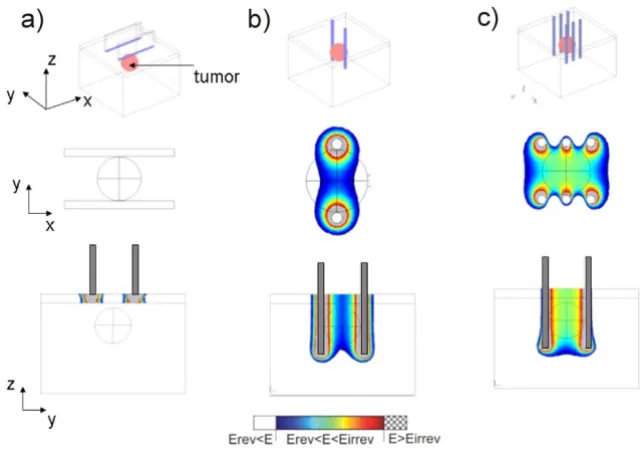
2) plate electrodes are more suitable for treatment of pro-truding cutaneous tumours, while for situations when the
In vivo electrochemotherapy performed on a nude mouse -- tumour regrowth after initial disappearance
Figure 6
In vivo electrochemotherapy performed on a nude mouse -- tumour regrowth after initial disappear-ance. In vivo electrochemotherapy of tumour performed on a nude mouse: a) The electrode position and the tumour geometry just before the treatment, b) after the treatment two new tumours regrew in the regions (marked with num-bers 1 and 2) where the tumour tissue was not exposed to E > Erev, c) graphical illustration of the tumour and its sur-rounding tissue position between electrodes and d) calcu-lated local electric field distribution: the reversibly
tumour is seeded more deeply in the tissue needle elec-trodes are to be used (Fig. 9a and 9b), and;
3) by increasing the number of needle electrodes stronger local electric field in the tissue can be achieved (Fig. 9c).
The educational web pages are concluded by a test (see Additional file 1) that gives the user an opportunity to test the acquired knowledge, while allowing the teacher and the web-developer to follow the efficacy of the con-structed pages and their educational success.
Results of the pedagogical efficiency evaluation
The results of the pedagogical efficiency evaluation are shown in Fig. 10. The evolution of the scores obtained from the test before and after the e-learning session was analyzed on the basis of each question (listed in Addi-tional file 1), which allowed for testing the participants' knowledge improvement for each question and the
perti-nence of the questions. The results of percentage rate anal-ysis of correct answers to each question of the pre and post e-learning session test given by all participants, (both par-ticipant groups i.e. engineers and biologists), is shown in Fig. 10a. The results of the percentage rate analysis done for biologists and engineers separately are shown in Figs. 10b and 10c, respectively.
The percentage rate of correct answers for all participants (mixed population) obtained after the e-learning session was above 50% for all questions in the test (Fig. 10a). The results in Fig. 10a show that the level of knowledge of all participants was improved after the e-learning session compared to the knowledge shown before the session. The results in Fig. 10b show that before the e-learning ses-sion the knowledge of biologists was more heterogeneous compared to the knowledge possessed by engineers as shown in Fig. 10c.:
Local electric field distribution within a model of cutaneous (protruding) tumour
Figure 7
1) for biologists the average percentage rates of correct answers changed from 73% before e-learning session to 87% after e-learning session, with a large dispersion depending on the question (for example - question 4: from 0% before to 43% after e-learning session; question 9 from 86% before to 100% after e-learning session), Fig. 10b.
2) for engineers the average percentage rates of correct answers changed from 89% before e-learning session to 95% after e-learning session, Fig. 10c.
Nevertheless, increase in percentage rate of correct answers, after the e-learning session, to each of the ques-tions was obtained for both groups i.e. biologists and engineers (Figs. 10b and 10c).
Results of the usability evaluation
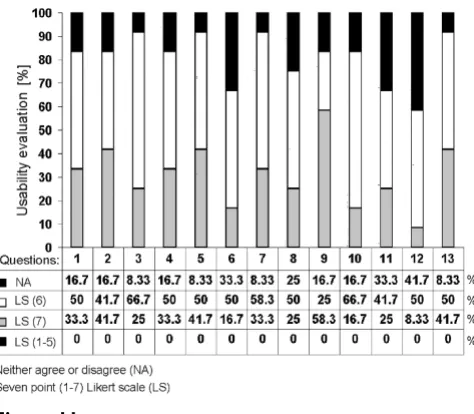
The results of the usability evaluation of the e-learning application are shown in Fig. 11. The participants expressed their opinion for all 13 usability related ques-tions with 6 or 7 agree statements in the seven point Likert scale (LS (6) and LS (7)) and with neutral neither agree nor disagree statement (NA). None of the questions was evaluated with statements from 1 to 5 in the Likert scale (LS (1-5)), as shown in Fig. 11.
The participants evaluated the statement that the informa-tion provided by the system is easy to understand
(ques-tion 9) with the highest percentage of agree statements in the Likert scale (58.3% of LS (7) and 25% of LS (6)). Par-ticipant were most neutral (41.7% of NA) regarding ques-tion 12 (The system covers all the areas I expected to cover). However, the same question was evaluated with 50% of LS (6) and 8.3% of LS (7) statements. The partici-pants were neutral with 33% for questions 6 (I believe I became more confident with the system) (with 50% of LS (6)) and for question 11 (The interface of system is pleas-ant) (with 41.67% of LS (6)). Overall, the participants were satisfied with the developed e-learning application (question 13) with 41.6% of the highest percentage of agree statements in the Likert scale (LS (7)) and with only 8.3% of neutral statements (NA). The results of the usabil-ity evaluation (Fig. 11) also revealed that the participants were satisfied with how easy it was to use the system (question 1: 33.3% of LS (7) and 50% of LS (6)). The par-ticipants were comfortable using the system (question 4: 33.33% of LS (7) and 50% of LS (6)) and found the sys-tem simple to use (question 2: 41. 67% of both LS (7) and LS (6)), to learn to use (question 5: 41.67% of LS (7) and 50% of LS(6)) and to be effectively navigated (question 3: 25% of LS (7) and 66.67% of LS (6)). The users also found the information provided with system (such as online help, on-screen messages, and other documentation) clear (question 7: 33.3% of LS (7) and 50% of LS (6)), easy to find (question 8: 25% of LS (7) and 50% of LS (6)) and effective and complete (question 10: 16.67% of LS (7) and 66.67% of LS (6)) (Fig. 11).
Local electric field distribution within a model of subcutaneous tumor
Figure 8
After completing the usability questionnaire the partici-pants provided their opinion/comments on the applica-tion and suggesapplica-tions on its improvement. Most of participants provided the comment that they liked the idea to present the knowledge on electrochemotherapy in the form of e-learning application. The participants partic-ularly found interesting the interactive visualization of local electric field in tissues for different parameters such as voltage applied, distance between electrodes, electrode' dimension, which for the time being can not be visualized while performing the electrochemotherapy treatment. The engineers, who are not familiar with chemical and biological processes during electroporation of cells and tissues, suggested that more of biological and chemical background should be also added to the existing educa-tional material. On the other hand the biologists sug-gested that it would be interesting to have a possibility to visualize the distribution of local electric field and changes in electric properties for different cell types such as muscle fibers, hepatocytes, blood vessels, while being electroporated and which are potential target cells for gene transfer.
Discussion
We developed, implemented and evaluated an e-learning application on electroporation-based therapies such as electrochemotherapy. This is the first e-learning applica-tion developed to support collaboraapplica-tion, knowledge and experience exchange among the experts from different sci-entific fields involved in electrochemotherapy and other
electroporation-based therapies and in order to organize and to transfer the acquired knowledge and experience to the users (such as clinicians, medical personnel, students, patients and all those who want to learn about electropo-ration-based therapies).
The educational content on electrochemotherapy and cell and tissue electroporation is based on previously pub-lished studies from molecular dynamics, lipid bilayers, single cell level and simplified tissue models to complex biological tissues and research and clinical results of elec-trochemotherapy treatment [3,4,11,31-43].
The e-learning content presents three different levels of knowledge on cell and tissue electroporation. In the first part of the e-learning application we explain basic mech-anisms underlying electroporation process. Based on sim-ple graphical illustrations we demonstrated the influence of each of the pulse parameters, such as pulse amplitude, pulse number and duration, on electroporation of cells with different sizes, shapes and orientations with respect to the applied electric field. By using 3D animation we vis-ualized the aqueous pore formation in cell membrane, which is most widely accepted model, among different theoretical models that describe cell membrane electropo-ration.
Electrochemotherapy treatment outcome is directly related to the local electric field distribution within the target tumour tissue and its surrounding tissues
Local electric field in subcutaneous tumour model obtained by using different electrode configurations
Figure 9
Results of the pedagogical efficiency evaluation
Figure 10
[11,12,40,47-49]. The second part of the e-learning con-tent was thus developed in order to provide the educa-tional material about the parameters of local electric field being crucial to make the tumor treatment as efficient as possible. For this purpose we used combination of numerical calculations by means of mathematical model-ling and simple graphical illustrations. We demonstrated how the pulse amplitude, electrode shape and electrode positioning influence on the local electric field distribu-tion within the treated cells and tissues. We also demon-strated how the electric properties of a treated sample (i.e. its geometry and electric conductivity) can modify the local electric field distribution. Namely, when the voltage is applied, the electric field distributes within the complex tissue with different electric properties as in voltage divider. The latter means that the electric field is the high-est in the layer with the highhigh-est electric resistivity (lowhigh-est conductivity) [43], which is particularly important when electroporating the skin and/or its underlying tissues.
In the third part of the e-learning application, we devel-oped an interactive module for visualization of local elec-tric field distribution in tissues for different parameters such as voltage applied, distance between electrodes, elec-trode' dimension, tissue geometry and electric conductiv-ity. The interactive module is aimed at hands-on learning on how the above-mentioned parameters can modify the local electric field distribution within the treated tissue. The module allows for local electric field visualization in cutaneous and subcutaneous tumours. Users can appreci-ate the local electric field distribution within the treappreci-ated tissue when electroporated directly or through the skin by using plate or needle electrodes. The module also pro-vides guidelines on how to overcome a highly resistive
skin tissue in order to permeabilize more conductive underlying tissues. Since, for the time being the local elec-tric field in the treated tissue can not be visualized while performing the electrochemotherapy treatment, the inter-active visualization approach we provide in our e-learning application can serve as an important tool in selection of the appropriate electric pulses amplitude, electrode shape and their placement with respect to the tissue geometry and its electric conductivity, which is needed for best elec-trochemothertapy treatment outcome.
Good collaboration among the participants and with the instructor was established during the e-learning session. Namely, the participants assisted each other while study-ing the educational content and several discussions were initiated between physicists and biologists and between the participants and the instructor. The e-learning applica-tion was concluded by a test on the presented educaapplica-tional material and by a questionnaire on usability of the devel-oped application.
We evaluated the designed e-learning application at the International Scientific workshop and postgraduate course (Electroporation Based Technologies and Treat-ments) [45]. The evaluation was carried out by testing the pedagogical efficiency of the presented educational con-tent and by performing the usability study of the applica-tion. The pedagogical efficiency assessment showed that the participants improved their level of knowledge (Fig. 10).
The percentage rate of correct answers for all participants (mixed population) obtained after the e-learning session was above 50% for all test questions (Fig. 10a). The results in Fig. 10b show that before the e-learning session the knowledge of biologists was more heterogeneous com-pared to the knowledge possessed by engineers as shown in Fig. 10c. This is in part because the level of knowledge possessed by biologists (compared to the engineers) was lower before the e-learning session, since the test and the e-learning content was about electrical parameters. How-ever, the increase in percentage rate of correct answers, after the e-learning session compared to the results obtained before the e-learning session, to each of the questions was obtained for both biologists and engineers (Figs. 10b and 10c). Only for question 4 the percentage of correct answers given by biologist after the e-learning ses-sion was slightly below 50% (i.e. 43% of success rate after e-learning session compared to 0% before e-learning ses-sion). In order to further improve the success rate of ques-tion 4 we concluded that: 1. quesques-tion 4 should be more clearly formulated by developers and 2. more of e-learn-ing content on the voltage applied between electrodes (U) and on electroporation threshold of local electric field (E) should be provided in the e-learning application. The
Results of the usability evaluation
Figure 11
same question answered by engineers was 70% of success rate before and after e-learning session.
The results of usability evaluation revealed that partici-pants found the application simple to learn to use and navigate (Fig. 11). Overall, the participants were satisfied with the e-learning application. The participants found the information provided by system easy to understand (question 9 with the highest percentage of agree state-ments in the Likert scale (58.3% of LS (7)) and 25% of LS (6)). The participants were most neutral regarding the statement that the e-learning application covered all the areas they expected to cover (question 12 evaluated with 41.7% of NA). However, the same question was evaluated with 50% of LS (6) and 8.3% of LS (7) statements. The modular structure of the application allows for upgrade with new educational content collected from the clinics and research, and for the integration of new application modules including computer-supported collaborative vis-ualization being an important component in remote col-laboration among the experts [29]. The e-learning application can be used as an education form at both lev-els: either as a completely independent e-learning form or as an integral part of a blended learning form. The e-learn-ing session can be executed by the users in a linear sequence of studying steps according to the program flow model (i.e. by starting at the beginning of the e-learning content and by concluding with the final evaluation tests) or in a studying sequence which is not previously defined, which can serve as an additional e-learning module of blended learning [30].
Conclusion
The e-learning application together with E-CHO system is available to the users to provide collaborative and flexible learning in order to facilitate knowledge exchange among the experts from different scientific fields that are involved in electrochemotherapy. The e-learning application is developed to provide an interactive educational content in order to simulate the "hands-on" learning approach about the parameters being important for successful ther-apy. The e-learning application on electrochemotherapy can be easily adapted to serve as a collaborative e-learning tool also in other electroporation-based treatments such as gene electrotransfer, irreversible tissue ablation or transdermal gene and drug delivery [6,8,9,50]. The pre-sented e-learning application provides an easy and rapid approach for information, knowledge and experience exchange among the experts from different scientific fields, which can facilitate development and optimisation of electroporation-based treatments.
Competing interests
The authors declare that they have no competing interests.
Authors' contributions
All authors read and approved the final manuscript.
Additional material
Acknowledgements
This study was supported by the Slovenian Research Agency and by the European Commission within the 5th framework program under the grants Cliniporator QLK3-1999-00484 and ESOPE QLK3-2002-02003 and within the 6th framework program under the grant ANGIOSKIN LSHB-CT-2005-512127.
References
1. Mir LM: Therapeutic perspectives of in vivo cell electroper-meabilization. Bioelectrochemistry 2001, 53:1-10.
2. Marty M, Sersa G, Garbay JR, Gehl J, Collins CG, Snoj M, Billard V, Geertsen PF, Larkin JO, Miklavcic D, Pavlovic I, Paulin-Kosir SM, Cemazar M, Morsli N, Soden DM, Rudolf Z, Robert C, O'Sullivan GC, Mir LM: Electrochemotherapy-An easy, highly effective and safe treatement of cutaneous and subcutaneous metastases: Results of ESOPE (European Standard Operating Proce-dures of Electrochemotherapy) study. Eur J Cancer Suppl 2006,
4:3-13.
3. Mir LM, Bureau M, Gehl J, Rangara R, Rouy D, Caillaud J, Delaere P, Branellec D, Schwartz B, Scherman D: High-efficiency gene trans-fer into skeletal muscle mediated by electric pulses. Proc Natl Acad Sci USA 1999, 96:4262-4267.
4. Miklavcic D, Semrov D, Mekid H, Mir LM: A validated model of in vivo electric field distribution in tissues for electrochemo-therapy and for DNA electrotransfer for gene electrochemo-therapy. Bio-chim Biophys Acta 2000, 1523:73-83.
5. Prud'homme G, Glinka Y, Khan A, Draghia-Akli R: Electroporation-enhanced nonviral gene transfer for the prevention or treat-ment of immunological, endocrine and neoplastic diseases.
Curr Gene Ther 2006, 6:243-273.
6. Andre F, Gehl J, Serša G, Préat V, Hojman P, Eriksen J, Golzio M, Cemazar M, Pavselj N, Rols MP, Miklavcic D, Neumann E, Teissie J, Mir LM: Efficiency of high- and low-voltage pulse combina-tions for gene electrotransfer in muscle, liver, tumor, and skin. Human Gene Ther 2008, 19:1261-1271.
7. Trontelj K, Reberšek M, Kanduser M, Curin-Serbec V, Sprohar M, Miklavcic D: Optimization of bulk cell electrofusion in vitro for production of human-mouse heterohybridoma cells. Bioelec-trochemistry 2008, 74:124-129.
8. Rubinsky J, Onik G, Mikus P, Rubinsky B: Optimal parameters for the destruction of prostate cancer using irreversible electro-poration. Journal of Urology 2008, 180:2668-2674.
9. Pavselj N, Miklavcic D: A numerical model of permeabilized skin with local transport regions. IEEE Trans Biomed Eng 2008,
55:1927-1930.
Additional file 1
Pedagogical efficiency questionnaire. The file provides the test on the educational content completed by the participants before and at the end of the e-learning session.
Click here for file
[http://www.biomedcentral.com/content/supplementary/1475-925X-8-26-S1.PDF]
Additional file 2
Usability efficiency questionnaire. The file provides usability questions related to the user satisfaction with the developed e-learning application.
Click here for file
Publish with BioMed Central and every scientist can read your work free of charge "BioMed Central will be the most significant development for disseminating the results of biomedical researc h in our lifetime."
Sir Paul Nurse, Cancer Research UK
Your research papers will be:
available free of charge to the entire biomedical community
peer reviewed and published immediately upon acceptance
cited in PubMed and archived on PubMed Central
yours — you keep the copyright
Submit your manuscript here:
http://www.biomedcentral.com/info/publishing_adv.asp
BioMedcentral 10. Kanduser M, Miklavcic D: Electroporation in biological cell and
tissue: an overview. In Electrotechnologies for Extraction from Food Plants and Biomaterials Edited by: Vorobiev E, Lebovka N. New York, Springer Science; 2008:1-37.
11. Miklavcic D, Beravs K, Semrov D, Cemazar M, Demsar F, Sersa G:
The importance of electric field distribution for effective in vivo electroporation of tissues. Biophys J 1998, 74:2152-2158. 12. Zupanic A, Corovic S, Miklavcic D: Optimization of electrode
position and electric pulse amplitude in electrochemother-apy. Radiol Oncol 2008, 42:93-101.
13. Pavlovic I, Kramar P, Corovic S, Cukjati D, Miklavcic D: A web-appli-cation that extends functionality of medical device for tumor treatment by means of electrochemotherapy. Radiol Oncol 2004, 38:49-54.
14. Pavlovic I, Miklavcic D: Web-based electronic data collection system to support electrochemotherapy clinical trial. IEEE Trans Inf Technol Biomed 2007, 11:222-230.
15. Pavlovic I, Kern T, Miklavcic D: Comparison of paper-based and electronic data collec-tion process in clinical trials: Costs simulation study. Contemp Clin Trials 2009, 30:300-316.
16. Mir LM, Gehl J, Sersa G, Collins CG, Garbay JR, Billard V, Geertsen P, Rudolf Z, O'Sullivan GC, Marty M: Standard operating proce-dures of the electrochemotherapy: instructions for the use of bleomycin or cisplatin administered either systemically or locally and electric pulses delivered by the CliniporatorTM by means of invasive or non-invasive electrodes. Eur J Cancer Suppl 2006, 4:14-25.
17. Sersa G, Miklavcic D: Electrochemotherapy of tumours (Video Article). J Visual Exp 2008, 22:1038.
18. Colombo GL, Di Matteo S, Mir LM: Cost-effectiveness analysis of electrochemotherapy with the Cliniporator™ vs other methods for the control and treatment of cutaneous and subcutaneous tumors. Therapeutics and Clinical Risk Management 2008, 2:541-548.
19. Godfrey M: Teaching software engineering to a mixed audi-ence. Information and Software Technology 1998, 40:229-232. 20. Gillet D, Nguyen Ngoc AV, Rekik Y: Collaborative web-based
experimentation in flexible engineering education. IEEE Trans Educ 2005, 48:696-703.
21. Holbert KE, Karady GG: Strategies, challenges and prospects for active learning in computer-based classroom. IEEE Trans Educ 2009, 52:31-38.
22. Dale E: Audio-Visual methods in teaching 3rd edition. New York, Holt, Rinehart, and Winston; 1969.
23. Day AJ, Foley DJ: Evaluating a web lecture intervention in a human-computer interaction course. IEEE Trans Educ 2006,
49:420-431.
24. Buret F, Muller D, Nicolas L: Computer-aided education for magnetostatics. IEEE Trans Educ 1999, 42:45-49.
25. Guerrero JF, Bataller M, Soria E, Magdalena R: BioLab: An educa-tional tool for signal processing training in biomedical engi-neering. IEEE Trans Educ 2007, 50:34-40.
26. Biomedical sciences teaching modules [http://www.virtualcam pus.ch/display.php?lang=1&pname=discipline_4]
27. Telea AC: Data visualization - principles and practice Wellesley, Massa-chusetts, AK Peters Ltd; 2008.
28. Assaad RS, Silva-Martinez J: A graphical approach to teaching amplifier design at the undergraduate level. IEEE Trans Educ 2009, 52:39-45.
29. Teyseyre AR, Campo MR: An overview of 3D software visualiza-tion. IEEE Trans Vis Comput Graphics 2009, 15:87-105.
30. Hoic-Bozic N, Mornar V, Boticki I: A blended learning approach to course design and implementation. IEEE Trans Educ 2009,
52:19-30.
31. Neumann E, Rosenheck K: Permeability changes induced by electric impulses in vesicular membranes. J Membr Biol 1972,
10:279-290.
32. Tsong TY: Electroporation of cell membranes. Biophys J 1991,
60:297-306.
33. Weaver JC, Chizmadzhev YA: Theory of electroporation: a review. Bioelectrochem Bioenerg 1996, 41:135-160.
34. Teissie J, Eynard N, Gabriel B, Rols MP: Electropermeabilization of cell membranes. Adv Drug Deliver Rev 1999, 35:3-19.
35. Kotnik T, Miklavcic D: Analytical description of transmem-brane voltage induced by electric fields on spheroidal cells.
Biophys J 2000, 79:670-679.
36. Valic B, Pavlin M, Miklavcic D: The effect of resting transmem-brane voltage on cell electropermeabilization: a numerical analysis. Bioelectrochemistry 2004, 63:311-315.
37. Pavlin M, Kanduser M, Rebersek M, Pucihar G, Hart FX, Magjarevic R, Miklavcic D: Effect of cell electroporation on the conductivity of a cell suspension. Biophys J 2005, 88:4378-4390.
38. Tarek M: Membrane electroporation: a molecular dynamics simulation. Biophys J 2005, 88:4045-4053.
39. Sel D, Cukjati D, Batiuskaite D, Slivnik T, Mir LM, Miklavcic D:
Sequential finite element model of tissue electropermeabili-zation. IEEE Trans Biomed Eng 2005, 52:816-827.
40. Pavselj N, Bregar Z, Cukjati D, Batiuskaite D, Mir LM, Miklavcic D:
The course of tissue permeabilization studied on a mathe-matical model of a subcutaneous tumor in small animals.
IEEE Trans Biomed Eng 2005, 52:1373-1381.
41. Kotnik T, Miklavcic D: Theoretical evaluation of voltage induce-ment on internal membranes of biological cells exposed to electric fields. Biophys J 2006, 90:480-491.
42. Teissié J, Escoffre JM, Rols MP, Golzio M: Time dependence of electric field effects on cell membranes. A review for a criti-cal selection of pulse duration for therapeuticriti-cal applications.
Radiol Oncol 2008, 42:196-206.
43. Pavselj N, Miklavcic D: Numerical modeling in electroporation-based biomedical applications. Radiol Oncol 2008, 42:159-168. 44. Interactive e-learning system (E-CHO), Laboratory of
tele-communications, Faculty of Electrical Engineering, Univer-sity of Ljubljana [http://www.ltfe.org]
45. International Scientific workshop and postgraduate course (Electroporation Based Technologies and Treatments), Fac-ulty of Electrical Engineering, University of Ljubljana [http:/ /www.cliniporator.com/ect]
46. Humar I, Sinigoj A, Bester J, Hegler OM: Integrated component web-based interactive learning systems for engineering. IEEE Trans Educ 2005, 8:664-675.
47. Corovic S, Zupanic A, Miklavcic D: Numerical modeling and opti-mization of electric field distribution in subcutaneous tumor treated with electrochemotherapy using needle electrodes.
IEEE Trans Plasma Sci 2008, 36:1665-1672.
48. Corovic S, Al Sakere B, Haddad V, Miklavcic D, Mir LM: Importance of contact surface between electrodes and treated tissue in electrochemotherapy. Technol Cancer Res Treat 2008, 7:393-399. 49. Corovic S, Mojca P, Miklavcic D: Analytical and numerical quan-tification and comparison of the local electric field in the tis-sue for different electrode configurations. Biomed Eng Online 2007, 37:1-14.