VOLUME NO.6(2016),ISSUE NO.09(
S
EPTEMBER) ISSN2231-5756A Monthly Double-Blind Peer Reviewed (Refereed/Juried) Open Access International e-Journal - Included in the International Serial Directories
Indexed & Listed at:
Ulrich's Periodicals Directory ©, ProQuest, U.S.A., EBSCO Publishing, U.S.A., Cabell’s Directories of Publishing Opportunities, U.S.A., Google Scholar, Open J-Gage, India [link of the same is duly available at Inflibnet of University Grants Commission (U.G.C.)],
Index Copernicus Publishers Panel, Poland with IC Value of 5.09 & number of libraries all around the world.
V
OLUMEN
O.
6
(2016),
I
SSUEN
O.
09
(S
EPTEMBER)
ISSN
2231-5756
CONTENTS
Sr.
No.
TITLE & NAME OF THE AUTHOR (S)
Page
No.
1
.
OPTIMIZING CAPITAL STRUCTURE THROUGH DEBT TO EQUITY BALANCING: A STUDY OF SELECTED
ZIMBABWE STOCK EXCHANGE LISTED COMPANIES
DR. B. NGWENYA
1
2
.
MAIZE CULTIVATION IN KARNATAKA & GROWERS’ AWARENESS ON PRICE RISK MANAGEMENT TOOLS.
V. CHANDRA SEKHAR RAO & DR. G V KESAVA RAO
5
3
.
A STUDY OF LEAD LAGS RELATIONSHIP BETWEEN NSE EQUITY MARKET AND SINGLE STOCK FUTURES
DR. SANDHYA SRIDEVI MARIPINI & SATYANARAYANA KOILADA
11
4
.
MOBILE PHONE MESSAGING INTERVENTIONS MAY PROVIDE BENEFIT IN SUPPORTING THE
SELF-MANAGEMENT OF LONG-TERM ILLNESSES: AN ANALYSIS
SURENDRA NATH SHUKLA & DR. J K SHARMA
18
5
.
LECTURERS’ PERCEPTION ON STUDENTS’ APPRAISAL OF COURSES AND TEACHING: A CASE OF UNIVERSITY
OF CAPE COAST, GHANA
EMMANUEL KOFI GYIMAH, ALBERT JUSTICE KWARTENG, ERIC ANANE & IVY KESEWAA NKRUMAH
21
6
.
EDUCATION AS A MEANS OF WOMEN’S EMPOWERMENT: A STUDY ON THE PARENTS’ ATTITUDES
DEEPRAJ CHAKRABARTY, DEBOSMITA NATH & DR. D. GHOSE
27
7
.
A STUDY ON OVERALL IMPACT OF TRAINING AND DEVELOPMENT ON JOB PERFORMANCE, MORALE OF
EMPLOYEES AND TO REDUCE THE EMPLOYEE RESISTANCE TO NEW TECHNOLOGY
DR. MAHESHA KEMPEGOWDA & PURUSHOTHAM.C.J
30
8
.
MILLING STUDIES OF PULSES USING DIFFERENT PRE-MILLING TREATMENT OF PIGEON PEA (
CAJANUS
CAJAN
)
MEDHA VYAS & PRIYANKA BHADOURIYA
35
9
.
A STUDY ON FINANCIAL DERIVATIVE OPTIONS WITH REFERENCE TO SELECTED SECTORS
BHAGYA LAKSHMI.K & DR. N. BABITHA THIMMAIAH
41
10
.
AN ARTICLE ON PERFORMANCE APPRAISAL: A STUDY WITH REFERENCE TO KIRLOSKAR ELECTRIC CO. LTD.,
MYSORE
SOWMYA.H.L
48
11
.
TECHNOLOGICAL INNOVATIONS IN INDIAN BANKING SECTOR: AN INSTRUMENT FOR ECONOMIC GROWTH
DR. PRAGYA PRASHANT GUPTA
50
12
.
LITERACY AND LITERARY PROGRAMMES AND THEIR IMPLEMENTATION IN INDIA
HARISH R.
56
13
.
THE DEVELOPMENT OF MANAGERIAL WOMEN OF BELOW POVERTY LINE SELF HELP GROUP IN DISTRICT
GONIDA IN MAHARASHTRA
KU.MRUNALI S. LILHARE
60
14
.
PROBLEMS AND PROSPECTS OF KUDUMBASREE LINKED MICRO ENTERPRISES
VARGHESE JOY
62
15
.
PROBLEMS AND PROSPECTS OF LEATHER INDUSTRY IN VELLORE DISTRICT
DR. AJAY KUMAR SHARMA
66
16
.
CHANGING E-TAIL TRENDS IN INDIA
AMIT KISHORE SINHA & DR. GYANENDRA B. S. JOHRI
73
17
.
A STUDY ON TWO WHEELER PURCHASING PATTERN OF COLLEGE STUDENTS IN KOTTARAKARA TALUK
ANCY SAM
79
18
.
HUMAN INTERACTION WITH SMART MOBILE PHONE
DR. C. NIRMALA
84
19
.
POLITICIZATION OF STUDENTS' UNIONS: A STUDY IN BHUBANESWAR, ODISHA
PRASANTA MOHAPATRA
87
20
.
RELEVANCE OF UNORGANISED RETAILERS AND THEIR PROBLEMS WITH SPECIAL EMPHASIS TO CALICUT
CITY
SHAHIBA.EC
93
V
OLUMEN
O.
6
(2016),
I
SSUEN
O.
09
(S
EPTEMBER)
ISSN
2231-5756
INTERNATIONAL JOURNAL OF RESEARCH IN COMMERCE, IT & MANAGEMENT
CHIEF PATRON
PROF. K. K. AGGARWAL
Chairman, Malaviya National Institute of Technology, Jaipur
(An institute of National Importance & fully funded by Ministry of Human Resource Development, Government of India)
Chancellor, K. R. Mangalam University, Gurgaon
Chancellor, Lingaya’s University, Faridabad
Founder Vice-Chancellor (1998-2008), Guru Gobind Singh Indraprastha University, Delhi
Ex. Pro Vice-Chancellor, Guru Jambheshwar University, Hisar
FOUNDER PATRON
LATE SH. RAM BHAJAN AGGARWAL
Former State Minister for Home & Tourism, Government of Haryana
Former Vice-President, Dadri Education Society, Charkhi Dadri
Former President, Chinar Syntex Ltd. (Textile Mills), Bhiwani
FORMER CO-ORDINATOR
DR. S. GARG
Faculty, Shree Ram Institute of Business & Management, Urjani
ADVISORS
PROF. M. S. SENAM RAJU
Director A. C. D., School of Management Studies, I.G.N.O.U., New Delhi
PROF. M. N. SHARMA
Chairman, M.B.A., Haryana College of Technology & Management, Kaithal
PROF. S. L. MAHANDRU
Principal (Retd.), Maharaja Agrasen College, Jagadhri
EDITOR
PROF. R. K. SHARMA
Professor, Bharti Vidyapeeth University Institute of Management & Research, New Delhi
CO-EDITOR
DR. BHAVET
Faculty, Shree Ram Institute of Engineering & Technology, Urjani
EDITORIAL ADVISORY BOARD
DR. RAJESH MODI
Faculty, Yanbu Industrial College, Kingdom of Saudi Arabia
PROF. SANJIV MITTAL
University School of Management Studies, Guru Gobind Singh I. P. University, Delhi
PROF. ANIL K. SAINI
Chairperson (CRC), Guru Gobind Singh I. P. University, Delhi
DR. SAMBHAVNA
V
OLUMEN
O.
6
(2016),
I
SSUEN
O.
09
(S
EPTEMBER)
ISSN
2231-5756
DR. MOHENDER KUMAR GUPTA
Associate Professor, P. J. L. N. Government College, Faridabad
DR. SHIVAKUMAR DEENE
Asst. Professor, Dept. of Commerce, School of Business Studies, Central University of Karnataka, Gulbarga
ASSOCIATE EDITORS
PROF. NAWAB ALI KHAN
Department of Commerce, Aligarh Muslim University, Aligarh, U.P.
PROF. ABHAY BANSAL
Head, Department of I.T., Amity School of Engineering & Technology, Amity University, Noida
PROF. A. SURYANARAYANA
Department of Business Management, Osmania University, Hyderabad
PROF. V. SELVAM
SSL, VIT University, Vellore
DR. PARDEEP AHLAWAT
Associate Professor, Institute of Management Studies & Research, Maharshi Dayanand University, Rohtak
DR. S. TABASSUM SULTANA
Associate Professor, Department of Business Management, Matrusri Institute of P.G. Studies, Hyderabad
SURJEET SINGH
Asst. Professor, Department of Computer Science, G. M. N. (P.G.) College, Ambala Cantt.
FORMER TECHNICAL ADVISOR
AMITA
Faculty, Government M. S., Mohali
FINANCIAL ADVISORS
DICKIN GOYAL
Advocate & Tax Adviser, Panchkula
NEENA
Investment Consultant, Chambaghat, Solan, Himachal Pradesh
LEGAL ADVISORS
JITENDER S. CHAHAL
Advocate, Punjab & Haryana High Court, Chandigarh U.T.
CHANDER BHUSHAN SHARMA
Advocate & Consultant, District Courts, Yamunanagar at Jagadhri
SUPERINTENDENT
V
OLUMEN
O.
6
(2016),
I
SSUEN
O.
09
(S
EPTEMBER)
ISSN
2231-5756
INTERNATIONAL JOURNAL OF RESEARCH IN COMMERCE, IT & MANAGEMENT
CALL FOR MANUSCRIPTS
We invite unpublished novel, original, empirical and high quality research work pertaining to the recent developments & practices in the areas of Com-puter Science & Applications; Commerce; Business; Finance; Marketing; Human Resource Management; General Management; Banking; Economics; Tourism Administration & Management; Education; Law; Library & Information Science; Defence & Strategic Studies; Electronic Science; Corporate Gov-ernance; Industrial Relations; and emerging paradigms in allied subjects like Accounting; Accounting Information Systems; Accounting Theory & Practice; Auditing; Behavioral Accounting; Behavioral Economics; Corporate Finance; Cost Accounting; Econometrics; Economic Development; Economic History; Financial Institutions & Markets; Financial Services; Fiscal Policy; Government & Non Profit Accounting; Industrial Organization; International Economics & Trade; International Finance; Macro Economics; Micro Economics; Rural Economics; Co-operation; Demography: Development Planning; Development Studies; Applied Economics; Development Economics; Business Economics; Monetary Policy; Public Policy Economics; Real Estate; Regional Economics; Political Science; Continuing Education; Labour Welfare; Philosophy; Psychology; Sociology; Tax Accounting; Advertising & Promotion Management; Management Information Systems (MIS); Business Law; Public Responsibility & Ethics; Communication; Direct Marketing; E-Commerce; Global Business; Health Care Administration; Labour Relations & Human Resource Management; Marketing Research; Marketing Theory & Applications; Non-Profit Or-ganizations; Office Administration/Management; Operations Research/Statistics; Organizational Behavior & Theory; Organizational Development; Pro-duction/Operations; International Relations; Human Rights & Duties; Public Administration; Population Studies; Purchasing/Materials Management; Re-tailing; Sales/Selling; Services; Small Business Entrepreneurship; Strategic Management Policy; Technology/Innovation; Tourism & Hospitality; Transpor-tation Distribution; Algorithms; Artificial Intelligence; Compilers & Translation; Computer Aided Design (CAD); Computer Aided Manufacturing; Computer Graphics; Computer Organization & Architecture; Database Structures & Systems; Discrete Structures; Internet; Management Information Systems; Mod-eling & Simulation; Neural Systems/Neural Networks; Numerical Analysis/Scientific Computing; Object Oriented Programming; Operating Systems; Pro-gramming Languages; Robotics; Symbolic & Formal Logic; Web Design and emerging paradigms in allied subjects.
Anybody can submit the soft copy of unpublished novel; original; empirical and high quality research work/manuscript anytime in M.S. Word format
after preparing the same as per our GUIDELINES FOR SUBMISSION; at our email address i.e. [email protected] or online by clicking the link online
submission as given on our website (FOR ONLINE SUBMISSION, CLICK HERE).
GUIDELINES FOR SUBMISSION OF MANUSCRIPT
1. COVERING LETTER FOR SUBMISSION:
DATED: _____________
THE EDITOR
IJRCM
Subject: SUBMISSION OF MANUSCRIPT IN THE AREA OF .
(e.g. Finance/Mkt./HRM/General Mgt./Engineering/Economics/Computer/IT/ Education/Psychology/Law/Math/other, please specify)
DEAR SIR/MADAM
Please find my submission of manuscript titled ‘___________________________________________’ for likely publication in one of your journals.
I hereby affirm that the contents of this manuscript are original. Furthermore, it has neither been published anywhere in any language fully or partly, nor it is under review for publication elsewhere.
I affirm that all the co-authors of this manuscript have seen the submitted version of the manuscript and have agreed to inclusion of their names as co-authors.
Also, if my/our manuscript is accepted, I agree to comply with the formalities as given on the website of the journal. The Journal has discretion to publish our contribution in any of its journals.
NAME OF CORRESPONDING AUTHOR :
Designation/Post* :
Institution/College/University with full address & Pin Code :
Residential address with Pin Code :
Mobile Number (s) with country ISD code :
Is WhatsApp or Viber active on your above noted Mobile Number (Yes/No) :
Landline Number (s) with country ISD code :
E-mail Address :
Alternate E-mail Address :
Nationality :
* i.e. Alumnus (Male Alumni), Alumna (Female Alumni), Student, Research Scholar (M. Phil), Research Scholar (Ph. D.), JRF, Research Assistant, Assistant Lecturer, Lecturer, Senior Lecturer, Junior Assistant Professor, Assistant Professor, Senior Assistant Professor, Co-ordinator, Reader, Associate Profes-sor, ProfesProfes-sor, Head, Vice-Principal, Dy. Director, Principal, Director, Dean, President, Vice Chancellor, Industry Designation etc. The qualification of
V
OLUMEN
O.
6
(2016),
I
SSUEN
O.
09
(S
EPTEMBER)
ISSN
2231-5756
NOTES:
a) The whole manuscript has to be in ONE MS WORD FILE only, which will start from the covering letter, inside the manuscript. pdf.
version is liable to be rejected without any consideration.
b) The sender is required to mention the following in the SUBJECT COLUMN of the mail:
New Manuscript for Review in the area of (e.g. Finance/Marketing/HRM/General Mgt./Engineering/Economics/Computer/IT/ Education/Psychology/Law/Math/other, please specify)
c) There is no need to give any text in the body of the mail, except the cases where the author wishes to give any specific message
w.r.t. to the manuscript.
d) The total size of the file containing the manuscript is expected to be below 1000 KB.
e) Only the Abstract will not be considered for review and the author is required to submit the complete manuscript in the first
instance.
f) The journal gives acknowledgement w.r.t. the receipt of every email within twenty-four hours and in case of non-receipt of acknowledgment from the journal, w.r.t. the submission of the manuscript, within two days of its submission, the corresponding author is required to demand for the same by sending a separate mail to the journal.
g) The author (s) name or details should not appear anywhere on the body of the manuscript, except on the covering letter and the
cover page of the manuscript, in the manner as mentioned in the guidelines.
2. MANUSCRIPT TITLE: The title of the paper should be typed in bold letters, centeredand fully capitalised.
3. AUTHOR NAME (S) & AFFILIATIONS: Author (s) name, designation, affiliation (s), address, mobile/landline number (s), and
email/al-ternate email address should be given underneath the title.
4. ACKNOWLEDGMENTS: Acknowledgements can be given to reviewers, guides, funding institutions, etc., if any.
5. ABSTRACT: Abstract should be in fully Italic printing, ranging between 150 to 300 words. The abstract must be informative and
eluci-dating the background, aims, methods, results & conclusion in a SINGLE PARA. Abbreviations must be mentioned in full.
6. KEYWORDS: Abstract must be followed by a list of keywords, subject to the maximum of five. These should be arranged in alphabetic
order separated by commas and full stop at the end. All words of the keywords, including the first one should be in small letters, except special words e.g. name of the Countries, abbreviations etc.
7. JEL CODE: Provide the appropriate Journal of Economic Literature Classification System code (s). JEL codes are available at
www.aea-web.org/econlit/jelCodes.php. However, mentioning of JEL Code is not mandatory.
8. MANUSCRIPT: Manuscript must be in BRITISH ENGLISH prepared on a standard A4 size PORTRAIT SETTING PAPER. It should be free
from any errors i.e. grammatical, spelling or punctuation. It must be thoroughly edited at your end.
9. HEADINGS: All the headings must be bold-faced, aligned left and fully capitalised. Leave a blank line before each heading.
10. SUB-HEADINGS: All the sub-headings must be bold-faced, aligned left and fully capitalised.
11. MAIN TEXT:
THE MAIN TEXT SHOULD FOLLOW THE FOLLOWING SEQUENCE:
INTRODUCTION
REVIEW OF LITERATURE
NEED/IMPORTANCE OF THE STUDY
STATEMENT OF THE PROBLEM
OBJECTIVES
HYPOTHESIS (ES)
RESEARCH METHODOLOGY
RESULTS & DISCUSSION
FINDINGS
RECOMMENDATIONS/SUGGESTIONS
CONCLUSIONS
LIMITATIONS
SCOPE FOR FURTHER RESEARCH
REFERENCES
APPENDIX/ANNEXURE
V
OLUMEN
O.
6
(2016),
I
SSUEN
O.
09
(S
EPTEMBER)
ISSN
2231-5756
INTERNATIONAL JOURNAL OF RESEARCH IN COMMERCE, IT & MANAGEMENT
12. FIGURES & TABLES: These should be simple, crystal CLEAR, centered, separately numbered & self-explained, and the titles must be
above the table/figure. Sources of data should be mentioned below the table/figure. It should be ensured that the tables/figures are referred to from the main text.
13. EQUATIONS/FORMULAE: These should be consecutively numbered in parenthesis, left aligned with equation/formulae number placed
at the right. The equation editor provided with standard versions of Microsoft Word may be utilised. If any other equation editor is utilised, author must confirm that these equations may be viewed and edited in versions of Microsoft Office that does not have the editor.
14. ACRONYMS: These should not be used in the abstract. The use of acronyms is elsewhere is acceptable. Acronyms should be defined
on its first use in each section e.g. Reserve Bank of India (RBI). Acronyms should be redefined on first use in subsequent sections.
15. REFERENCES: The list of all references should be alphabetically arranged. The author (s) should mention only the actually utilised
references in the preparation of manuscript and they may follow Harvard Style of Referencing. Also check to ensure that everything that you are including in the reference section is duly cited in the paper. The author (s) are supposed to follow the references as per the following:
•
All works cited in the text (including sources for tables and figures) should be listed alphabetically.•
Use (ed.) for one editor, and (ed.s) for multiple editors.•
When listing two or more works by one author, use --- (20xx), such as after Kohl (1997), use --- (2001), etc., in chronologically ascendingorder.
•
Indicate (opening and closing) page numbers for articles in journals and for chapters in books.•
The title of books and journals should be in italic printing. Double quotation marks are used for titles of journal articles, book chapters,dissertations, reports, working papers, unpublished material, etc.
•
For titles in a language other than English, provide an English translation in parenthesis.•
Headers, footers, endnotes and footnotes should not be used in the document. However, you can mention short notes to elucidate some specific point, which may be placed in number orders before the references.PLEASE USE THE FOLLOWING FOR STYLE AND PUNCTUATION IN REFERENCES:
BOOKS
•
Bowersox, Donald J., Closs, David J., (1996), "Logistical Management." Tata McGraw, Hill, New Delhi.•
Hunker, H.L. and A.J. Wright (1963), "Factors of Industrial Location in Ohio" Ohio State University, Nigeria. CONTRIBUTIONS TO BOOKS•
Sharma T., Kwatra, G. (2008) Effectiveness of Social Advertising: A Study of Selected Campaigns, Corporate Social Responsibility, Editedby David Crowther & Nicholas Capaldi, Ashgate Research Companion to Corporate Social Responsibility, Chapter 15, pp 287-303.
JOURNAL AND OTHER ARTICLES
•
Schemenner, R.W., Huber, J.C. and Cook, R.L. (1987), "Geographic Differences and the Location of New Manufacturing Facilities,"Jour-nal of Urban Economics, Vol. 21, No. 1, pp. 83-104.
CONFERENCE PAPERS
•
Garg, Sambhav (2011): "Business Ethics" Paper presented at the Annual International Conference for the All India ManagementAsso-ciation, New Delhi, India, 19–23
UNPUBLISHED DISSERTATIONS
•
Kumar S. (2011): "Customer Value: A Comparative Study of Rural and Urban Customers," Thesis, Kurukshetra University, Kurukshetra.ONLINE RESOURCES
•
Always indicate the date that the source was accessed, as online resources are frequently updated or removed.WEBSITES
V
OLUMEN
O.
6
(2016),
I
SSUEN
O.
09
(S
EPTEMBER)
ISSN
2231-5756
A STUDY ON FINANCIAL DERIVATIVE OPTIONS WITH REFERENCE TO SELECTED SECTORS
BHAGYA LAKSHMI.K
ASST. PROFESSOR & RESEARCH SCHOLAR
DEPARTMENT OF MBA
VTU PG CENTRE
MYSORE
DR. N. BABITHA THIMMAIAH
ASST. PROFESSOR
DEPARTMENT OF BUSINESS ADMINISTRATION
VTU PG CENTRE
MYSORE
ABSTRACT
Financial markets always give importance to maximize returns and minimize risk. Derivatives are among the head of the innovations in the financial markets and aims to increase returns and reduce risk. They offer an opportunity for investors to protect themselves from the vagaries of the financial market. This paper gives a clear representation of development of derivatives such as Option Contracts and an attempt has been made to analyze the profit and loss position of Option contracts of buyers and sellers of different securities. This paper has also given more prominence to understand the concept of derivatives with special reference to Option Contracts and finally it provides a practical knowledge about the operations in the Option market.
KEYWORDS
derivative, options, securities.
INTRODUCTION
he birth of the market for derivatives instruments such as forwards, futures and options, can be found to the readiness of risk bearing economic agents to protect themselves against uncertainties and unexpected things arising out of variations in the prices of assets. Derivative tools or instruments initially came into exist as hedging devices against variations in product prices, and commodity-linked derivatives stayed the single form of such products for considerably three hundred years. Derivatives arose into focus in the 1970s period due to rising volatility in the financial markets. However meanwhile, since their presence, these products have turned into very prevalent and by 1990s, they accounted for about 2/3 of overall transactions in derivative instruments. There are two types of Derivatives commonly traded in the market – Futures and Options, and in Options it is additionally a Call option and a Put option. The price of these derivatives is based on an underlying asset, and the price of the derivative generally moves in tandem with the price of the underlying. The underlying is generally a stock or an index in the context of investing in a stock market.
The most common derivatives products such as futures and options are becoming increasingly important in world markets as a tool for risk management. Deriva-tives tools have been used to reduce risk. DerivaDeriva-tives are used to isolate the risks and transfer them to parties willing to bear these risks. In recent years, the market for these derivatives instruments has grown enormously in form of different instruments available and their difficulty and also the turnover. Futures and options both the instruments on stock indices have added much popularity than on single stocks, particularly among institutional investors, who are main users of index-related derivatives.
OBJECTIVES OF THE STUDY
1. To understand the concept of Derivatives with a special reference to Options contracts. 2. To find out the profit or loss position of the Options buyers and sellers
RESEARCH METHODOLOGY
The present study is based on the secondary source of information. The secondary source of information is used in reviewing the literature and collection of company scripts. The Study is based on Descriptive research design. Randomly we have chosen different sector the data has been collected from INFOSYS, TCS, ICICI BANK and SBI scripts for the analysis. To analyze the profit or loss positions of selected sector the time period considered 24 months data. Scrip Tables are used to describe the profit and loss position of the different companies effectively. The table explains the market price and call options price. The 1st column clarifies date of trading. 2nd column elucidates the SPOT market price in cash segment on the date which is mentioned in the table. The 3rd column tells about call premiums amounting at following strike prices. based on the company’s perspective the lot size varies form one company to another company hence the effect of loss or profit amount ultimately sands with lots sixe or volume traded.
LITERATURE REVIEW
Dr. Premalata (2003) analyses the effect of presenting the derivatives like index futures and options contracts on the instability of the underlining stock index in
our country India. The outcome or results of his analysis suggest that the futures and options trading have not led to an alteration in the instability of the underlying stock index.
Snehal Bandwadekar and Saurabh Ghosh (2003) founded out that the derivative instruments like the futures and the options on the Stock Market of India have
become significant instruments of price finding, portfolio variation and risk hedging in recent times.
O. P. Gupta (2004) studied and suggests that the overall instability of the stock market has dropped after the existence of the index futures for both the Nifty and
the Sensex indices, anyhow there is no definite evidence.
Sandeep Srivastava (2005) used the open interest and volume based predictors of call and put option which has given by Bhuyan and Yan (2002). The outcome of
the study shows that these predictors have noteworthy explanatory power with open interest as more important as compared to the trading volume.
Golaka C Nath and Rajendra P. Chitale (2005) study the behavior of volatility in cash market after the introduction of derivatives and examine issues and
impedi-ments in the use of different types of derivatives available for use by these institutional investors in India.
Ashutosh Vashishtha (2010) analyses that the turnover of derivative has grown from 2365 crores to Rs 11010482 crores in 2000-01, within a very small and short
span of period of eight years derivative trading in India has exceeded successfully cash segment in terms of volume and turnovers.
V
OLUMEN
O.
6
(2016),
I
SSUEN
O.
09
(S
EPTEMBER)
ISSN
2231-5756
INTERNATIONAL JOURNAL OF RESEARCH IN COMMERCE, IT & MANAGEMENT
OPTIONS
An option is a contract between a purchaser and a vendor, where one person (1st Person) provides to the other party (2nd Person) the right, but not the respon-sibility, to purchase from (or sell to) the First Person the underlying asset on or beforehand a precise day at a certain predetermined price. In return for allowing the option, the party granting the option gathers a payment from the other person. This payment collected is known the “premium” or the price of the option. The right to purchase or vend is alleged by the “option purchaser” the party permitting the right is the “option vendor”. Dissimilar futures and forwards contracts, options need a cash payment (called the premium) upfront from the option purchaser to the option vendor. This imbursement is called as the option price or option premium. Options can be bought and sold either on the over the counter (OTC) markets or in the stock exchange. Options bought and sold on the exchanges are sponsored by the Clearing Corp thus reducing the risk ascending due to evasion by the counter parties tangled. Options which are traded in the OTC market are not backed by the Clearing Corporation.
PARTIES or PERSONS IN AN OPTION CONTRACT
• Buyer of the option: The purchaser of an option is a person who by paying option premium purchases the right but not the obligation to work out his option on seller.
• Writer or seller of the option: The writer of the call or put options is the person one who gets the option premium and is there by obligated to vend or purchase the asset if the purchaser aerobics the option on him.
OPTIONS TERMINOLOGY
OPTION PRICE
Option price is the price that the option purchaser has to pay to the option vendor. It is also known to as the option premium.
EXPIRY DATE
The date mentioned in the option contract is understood as the expiry date, the exercise date, the straight date or the maturity date.
STRIKE PRICE
The price stated in the option contract is referred as the strike price or the exercise price.
IN-THE-MONEY OPTION
An ITM is an option that would hint to an optimistic cash movement to the owner if it was exercised instantly. A call option in the index can be said in the money when the existing index stays at higher level that the strike price (i.e. spot price > strike price). If the index is much upper than the strike price the call is known as deep in the money. In the event of a put option, the put is in the money if the index is lesser than the strike price.
AT-THE-MONEY OPTION
An ATM is an option that leads to zero cash movement if it implemented instantly. When the present index equivalents the strike price (spot price = strike price) den an option on the index will be an at the money.
OUT-OF-THE-MONEY OPTION
An OTM option is an option that leads to an adverse cash movement if it were exercised instantly. A call option on the index is become out of the money when the present index positions at less than the strike price (spot price < strike price). If the index is terribly lesser than the strike price the call is called as deep OTM. In the case of a put, the put is OTM if the index is greater the strike price.
INTRINSIC VALUE OF AN OPTION
It is one of the components of option premium. The intrinsic value of a call option is in the money, if it will be an in the money. If the call option is out of the money, its intrinsic value will be Zero. An option should be in the money to get an intrinsic value.
TYPES OF OPTIONS
There are two major types in options. They are:
• CALL OPTION
A call option is an option yielding the right to the purchaser of the option to purchase the underlying asset on a precise day at a predetermined and agreed upon price, but not the obligation or responsibility to do so. It is the vendor who gifts this right to the purchaser of the option. It might be noted that the party one who is having the right to purchase the underlying asset is referred as “buyer of the call option”
The price at which the purchaser has the right to purchase the asset is decided upon at the time of arriving to the contract. This is called as the strike price of the contract. Hence the purchaser of the call option has the right (but not the obligation) to purchase the underlying asset; he will use his right to purchase the underlying asset if and only if the price of the underlying asset in the market is extra than the strike price on or earlier the expiry date of the contract. The purchaser of the call does not have an obligation to purchase if he does not want.
STRATEGIES
The below are the strategies that are adopted by the parties of a call option. Imagining that commission, brokerage, premium, margins, transaction costs and taxes are ignored.
A call option buyer’s profit or loss could be demarcated as under:
• At all points where spot price < exercise price, there will be a loss.
• At all points where spot prices> exercise price, there will be a profit.
• Call Option purchaser losses are limited and earnings are unlimited.
Conversely, the call option writer’s profits/loss will be as follows:
• At all points where spot prices < exercise price, there would be a profit
• At all points where spot prices > exercise price, there would be a loss
• Call Option writer’s earnings are limited and losses are unlimited
PUT OPTION
A put option is a contract surrendering the right to the purchaser of the option to vend the underlying asset on or earlier an exact day at a predetermined price, but not the obligation to do so. It is the vendor who delegates this right to the purchaser of the option.
The party one who has the right to vend the underlying asset is referred as the “buyer of the put option”. The price at which the purchaser has the right to vend the asset is decided upon at the time of arriving the contract. This price is called as the strike price of the contract.
Since the purchaser of the put option has the right (but not the duty) to vend the underlying asset, he will execute his right to vend the underlying asset if and only if the price of the underlying asset in the bazaar is fewer than the strike price on or earlier the expiry date of the contract. The purchaser of the put option is not having the obligation to vend if he does not want to.
STRATEGIES
The below are the strategies which are adopted by the parties of a put option.
A put option purchaser’s profit or loss could be calculated as follows:
• At all points where spot price<exercise price, there will be a gain.
• At all points where spot price>exercise price, there will be a loss.
Conversely, the put option writer’s profit/loss will be as follows:
• At all points where spot price<exercise price, there will be a loss.
V
OLUMEN
O.
6
(2016),
I
SSUEN
O.
09
(S
EPTEMBER)
ISSN
2231-5756
Analysis of profit or loss position of the option writer and option holder:
This analysis is to know the profit or loss position/situation of the Option seller and Option purchaser of different companies.
INFOSYS
The below analysis is mainly based on data taken from Infosys scripts. This analysis considered from February 2013 to January 2015 contracts of Infosys. The lot volume or lot size of Infosys is 250, the time period in which this analysis done is from 28-02-13 to 29-01-15.
CALL OPTIONS
TABLE 1: SHOWING DETAILS OF CALL OPTION CONTRACTS OF INFOSYS
Date Market price Strike prices
2500 2550 2650 2750
28 Feb 2013 2907 425.35 381.05 292.3 185
28 Mar 2013 2889.35 400 359.05 263.55 195
25 Apr 2013 2227.7 10.7 297.4 215.7 190.35
30 May 2013 2341.45 17.1 99.8 72.85 52.15
27 June 2013 2482.8 138.05 116.3 71.9 78
25 July 2013 2915.3 432.1 422.8 321.25 210
29 Aug 2013 3104.6 630.05 577.05 479.85 393 26 Sept 2013 3012.3 554.15 488.95 394.3 305.1 31 Oct 2013 3309.9 844.75 777.45 678.15 578.95
28 Nov 2013 3327.8 835 795.45 696.15 596.85
26 Dec 2013 3520.65 1017 992.8 893.65 813.55
30 Jan 2014 3704.25 1174.4 1170.75 1071.4 968.5 27 Feb 2014 3807.5 1301.6 1275.45 1176.15 1076.9
26 Mar 2014 3248.9 761 699.6 548.6 507.55
29 May 2014 2924.5 459.45 416.55 346.8 452.9
26 June 2014 3182.5 704.8 656.1 560.15 264.35
31 July 2014 3367.65 884.3 834.6 735.35 467.6
28 Aug 2014 3598.8 1115.4 1065.7 966.4 636.2
25 Sept 2014 3691 1212.35 1162.8 1063.65 867.05 30 Oct 2014 3881.45 1382.05 1332.05 1313.9 964.5
29 Jan 2015 2145.5 3.15 14.2 1651.1 1214.55
Source: NSE website (www.nseindia.com)
BUYERS PAYOFF
If a person who has purchased call Option at a strike price at Rs. 2500/-and the premium payable is Rs.425.35, at the end of the contract the spot market price is bounded at Rs. 2,145.5, since it will be out the money for purchaser and in the money for seller the purchase will be at loss hence the purchaser gets loss on premium i.e. ₹. 425.35 Per share. So the total loss for the purchaser will be ₹. 1, 06,337.5 (425.35 * 250).
SELLERS PAYOFF
As it is in the money for the seller, hence he will get a profit only premium i.e. Rs.425.35 per share. So the total profit to the seller will be Rs. 1, 06,337.5 (425.35 * 250).
Put options
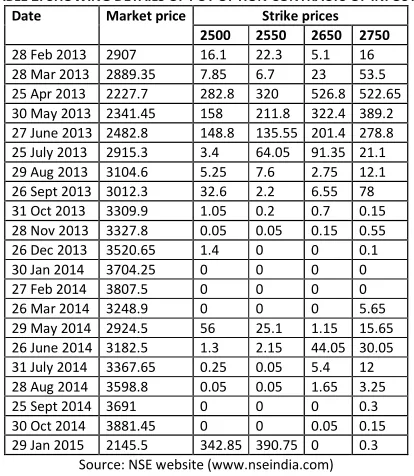
TABLE 2: SHOWING DETAILS OF PUT OPTION CONTRACTS OF INFOSYS
Date Market price Strike prices
2500 2550 2650 2750
28 Feb 2013 2907 16.1 22.3 5.1 16
28 Mar 2013 2889.35 7.85 6.7 23 53.5
25 Apr 2013 2227.7 282.8 320 526.8 522.65
30 May 2013 2341.45 158 211.8 322.4 389.2 27 June 2013 2482.8 148.8 135.55 201.4 278.8
25 July 2013 2915.3 3.4 64.05 91.35 21.1
29 Aug 2013 3104.6 5.25 7.6 2.75 12.1
26 Sept 2013 3012.3 32.6 2.2 6.55 78
31 Oct 2013 3309.9 1.05 0.2 0.7 0.15
28 Nov 2013 3327.8 0.05 0.05 0.15 0.55
26 Dec 2013 3520.65 1.4 0 0 0.1
30 Jan 2014 3704.25 0 0 0 0
27 Feb 2014 3807.5 0 0 0 0
26 Mar 2014 3248.9 0 0 0 5.65
29 May 2014 2924.5 56 25.1 1.15 15.65
26 June 2014 3182.5 1.3 2.15 44.05 30.05
31 July 2014 3367.65 0.25 0.05 5.4 12
28 Aug 2014 3598.8 0.05 0.05 1.65 3.25
25 Sept 2014 3691 0 0 0 0.3
30 Oct 2014 3881.45 0 0 0.05 0.15
29 Jan 2015 2145.5 342.85 390.75 0 0.3
Source: NSE website (www.nseindia.com)
BUYERS PAYOFF
If an investor purchases 1 lot of Put Options for Rs 2,550 he has to pay premium of Rs. 22.3 Premium per share. The settlement price is Rs/- 2,145.5. The difference between strike price and spot price is Rs. 405 and investor has to consider premium price also hence the total profit of investor will be Rs 95,675. If it is positive value then it’s a money contract for the buyer, hence purchaser will get profit only, in case spot price is high than the strike price, buyer will get loss.
SELLER’S PAYOFF
It is in the money for the purchaser and out the money for the seller, hence buyer will enjoy the profit and seller has to face the loss.
V
OLUMEN
O.
6
(2016),
I
SSUEN
O.
09
(S
EPTEMBER)
ISSN
2231-5756
INTERNATIONAL JOURNAL OF RESEARCH IN COMMERCE, IT & MANAGEMENT
CALL OPTION
TABLE 3: SHOWING DETAILS OF CALL OPTION CONTRACTS OF TCS
date market price strike prices
1900 1950 2000 2050
28 Feb 2013 1517 0.05 0.1 9 -
28 Mar 2013 1575.75 0.95 2.8 33 0.05
25 Apr 2013 1402.3 0.25 1.9 57.2 0
30 May 2013 1499.4 0.05 22 94.23 0
27 June 2013 1491.9 0 17.5 46 -
25 July 2013 1795.75 78.75 66.8 116.2 -
29 Aug 2013 1947.1 134 96.2 135.2 -
26 Sept 2013 1942.9 148.6 112 171 44.75
31 Oct 2013 2112.05 273.15 126.75 124.6 172.3 28 Nov 2013 1984.6 157.1 111.11 191.1 30.25
26 Dec 2013 2100.3 243.8 167 225.5 133
30 Jan 2014 2217.6 364.2 193.23 276.6 248.3 27 Feb 2014 2182.15 319.35 257.57 311 196.55 26 Mar 2014 2094.25 258.6 273.75 350.25 158.35 24 Apr 2014 2213.75 324.9 315.2 319.98 235.25
29 May 2014 2159.95 306.6 369 475 192.8
26 June 2014 2307.65 424.3 454 398.75 305.15 31 July 2014 2580.05 705.95 498.9 507.11 543.8 28 Aug 2014 2522.35 634.95 415.6 567.23 486
25 Sept 2014 2708.6 824.85 511 706 676.15
30 Oct 2014 2558.2 671 455.21 845.2 524.1
27 Nov 2014 2653.3 765.15 602.02 659.25 616.1
24 Dec 2014 2479.9 596.15 653 402 448.95
29 Jan 2015 2544.65 656.75 685.2 678.8 507.75 Source: NSE website (www.nseindia.com)
BUYERS PAYOFF
If an investor has purchased call Option at a strike price at Rs. 1900/-and the premium payable is Rs.134, at the end of the contract the spot market price is bounded at Rs. 2,544.65, since it will be out the money for seller and in the money for the purchaser, the investor /purchaser will enjoy the profit of premium I.e. Rs 134 per share hence the total profit for the investor will be Rs. 16,750 (134*125).
SELLERS PAYOFF
Since it is out of the money for the seller, he will encompass a loss on premium i.e. ₹.134 per share.
PUT OPTIONS
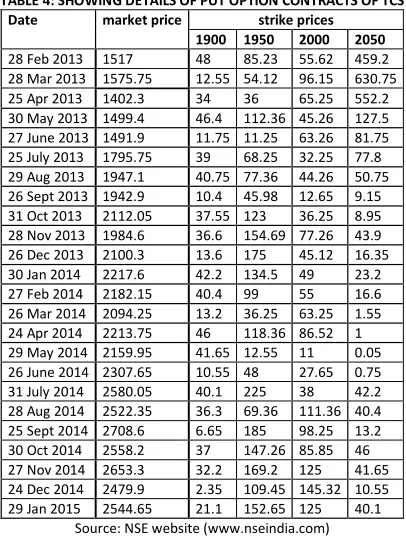
TABLE 4: SHOWING DETAILS OF PUT OPTION CONTRACTS OF TCS
Date market price strike prices
1900 1950 2000 2050
28 Feb 2013 1517 48 85.23 55.62 459.2
28 Mar 2013 1575.75 12.55 54.12 96.15 630.75
25 Apr 2013 1402.3 34 36 65.25 552.2
30 May 2013 1499.4 46.4 112.36 45.26 127.5 27 June 2013 1491.9 11.75 11.25 63.26 81.75 25 July 2013 1795.75 39 68.25 32.25 77.8 29 Aug 2013 1947.1 40.75 77.36 44.26 50.75 26 Sept 2013 1942.9 10.4 45.98 12.65 9.15 31 Oct 2013 2112.05 37.55 123 36.25 8.95 28 Nov 2013 1984.6 36.6 154.69 77.26 43.9
26 Dec 2013 2100.3 13.6 175 45.12 16.35
30 Jan 2014 2217.6 42.2 134.5 49 23.2
27 Feb 2014 2182.15 40.4 99 55 16.6
26 Mar 2014 2094.25 13.2 36.25 63.25 1.55
24 Apr 2014 2213.75 46 118.36 86.52 1
29 May 2014 2159.95 41.65 12.55 11 0.05
26 June 2014 2307.65 10.55 48 27.65 0.75
31 July 2014 2580.05 40.1 225 38 42.2
28 Aug 2014 2522.35 36.3 69.36 111.36 40.4
25 Sept 2014 2708.6 6.65 185 98.25 13.2
30 Oct 2014 2558.2 37 147.26 85.85 46
27 Nov 2014 2653.3 32.2 169.2 125 41.65
24 Dec 2014 2479.9 2.35 109.45 145.32 10.55 29 Jan 2015 2544.65 21.1 152.65 125 40.1
Source: NSE website (www.nseindia.com)
BUYER’S PAYOFF
If an investor purchases 1 lot of Put Options for Rs 1,900he has to pay premium of Rs. 48 per share. The settlement price is Rs/- 2,544.65. The difference between strike price and spot price is Rs. -644.65 and investor has to consider premium price also hence the total loss of investor will be Rs 86,581.25. It is negative value then it’s an out the money contract for the buyer, hence purchaser will face only, in case spot price is higher than the strike price, buyer will get loss.
SELLER’S PAYOFF
Since it is out the money for the seller, he will enjoy profit on premium.
ICICI: This below analysis is based on data taken from ICICI bank scrip. This analysis considered from February 2013 to January 2015 contracts of ICICI bank. The
V
OLUMEN
O.
6
(2016),
I
SSUEN
O.
09
(S
EPTEMBER)
ISSN
2231-5756
CALL OPTION
TABLE 5: SHOWING DETAILS OF CALL OPTION CONTRACTS OF ICICI
Date Market Price Strike Prices
750 800 850 900
28 Feb 2013 1040.4 75.05 63.35 55.65 46.35
28 Mar 2013 1045.2 88.4 76.65 68.9 59.45
25 Apr 2013 1177.35 98.55 86.75 78.95 69.35 30 May 2013 1182.8 101.55 89.7 81.85 72.15 27 June 2013 1030.55 95.3 83.5 75.65 66
25 July 2013 934.85 95.35 83.5 75.6 65.9
29 Aug 2013 807.2 93.05 81.2 73.3 63.55
26 Sept 2013 946.1 91.05 79.2 71.3 61.5
31 Oct 2013 1120.95 92.1 80.2 72.3 62.45
28 Nov 2013 1038.1 94.9 83 75.05 65.15
26 Dec 2013 1099.65 94 82.1 74.15 64.25
30 Jan 2014 974.55 103.95 92 84.05 74.15
26 Feb 2014 1036.45 104.5 92.6 84.65 74.7
27 Mar 2014 1259 89.05 77.15 69.2 59.4
23 Apr 2014 1299.55 79.6 67.7 59.85 50.2
29 May 2014 1436.95 88.75 76.8 68.9 59.1
26 June 2014 1402.65 83.1 71.15 63.25 53.5 31 July 2014 1471.25 87.6 75.65 67.7 57.8
28 Aug 2014 1556.8 81.9 69.95 62 52.15
25 Sept 2014 1465.3 77.85 65.9 57.95 48.1 30 Oct 2014 1614.05 93.7 81.75 73.8 63.85 27 Nov 2014 1723.2 110.23 94.45 39.2 103.3 24 Dec 2014 353.1 124.36 100.23 62.36 123.23
29 Jan 2015 380.3 132.7 118.65 104 144.36
Source: NSE website (www.nseindia.com)
BUYERS PAYOFF
If an investor has purchased call Option at a strike price at Rs. 750/-and the premium payable is Rs.75.05 per share, at the end of the contract the spot market price is bounded at Rs. 380.3, since it will be out the money for purchaser and in the money for the seller, the investor purchaser will face loss on premium I.e. Rs, 75.05 per share hence the total loss for the investor will be Rs. 93,812.5 (75.05 * 1250).
SELLERS PAYOFF
Since it is in the money for the seller, he will get a profit on premium i.e. ₹.75.05 per share.
PUT OPTION
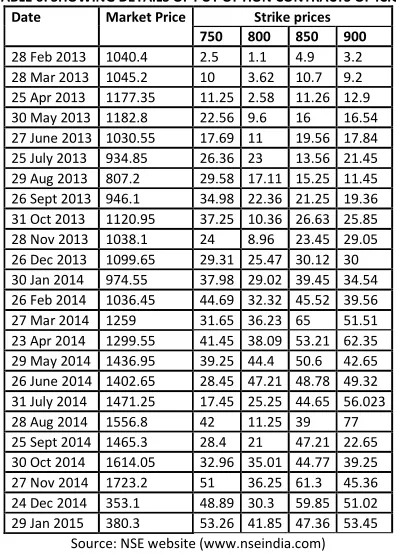
TABLE 6: SHOWING DETAILS OF PUT OPTION CONTRACTS OF ICICI
Date Market Price Strike prices
750 800 850 900
28 Feb 2013 1040.4 2.5 1.1 4.9 3.2
28 Mar 2013 1045.2 10 3.62 10.7 9.2
25 Apr 2013 1177.35 11.25 2.58 11.26 12.9
30 May 2013 1182.8 22.56 9.6 16 16.54
27 June 2013 1030.55 17.69 11 19.56 17.84 25 July 2013 934.85 26.36 23 13.56 21.45 29 Aug 2013 807.2 29.58 17.11 15.25 11.45 26 Sept 2013 946.1 34.98 22.36 21.25 19.36 31 Oct 2013 1120.95 37.25 10.36 26.63 25.85
28 Nov 2013 1038.1 24 8.96 23.45 29.05
26 Dec 2013 1099.65 29.31 25.47 30.12 30 30 Jan 2014 974.55 37.98 29.02 39.45 34.54 26 Feb 2014 1036.45 44.69 32.32 45.52 39.56
27 Mar 2014 1259 31.65 36.23 65 51.51
23 Apr 2014 1299.55 41.45 38.09 53.21 62.35 29 May 2014 1436.95 39.25 44.4 50.6 42.65 26 June 2014 1402.65 28.45 47.21 48.78 49.32 31 July 2014 1471.25 17.45 25.25 44.65 56.023
28 Aug 2014 1556.8 42 11.25 39 77
25 Sept 2014 1465.3 28.4 21 47.21 22.65 30 Oct 2014 1614.05 32.96 35.01 44.77 39.25
27 Nov 2014 1723.2 51 36.25 61.3 45.36
24 Dec 2014 353.1 48.89 30.3 59.85 51.02 29 Jan 2015 380.3 53.26 41.85 47.36 53.45
Source: NSE website (www.nseindia.com)
BUYER’S PAYOFF
V
OLUMEN
O.
6
(2016),
I
SSUEN
O.
09
(S
EPTEMBER)
ISSN
2231-5756
INTERNATIONAL JOURNAL OF RESEARCH IN COMMERCE, IT & MANAGEMENT
SELLER’S PAYOFF
It is in the money for the purchaser and out of the money for the vendor. Hence the seller is in loss.
SBI: This below analysis is based on data taken from SBI bank scrip. This analysis considered the February 2013 to January 2015 contracts of SBI bank. The lot size
or lot volume of SBI is 1250, the time period in which this analysis achieved is from 28-02-13 to 29-01-15.
CALL OPTION
TABLE 7: SHOWING DETAILS OF CALL OPTION CONTRACTS OF SBI
Date Market Price Strike prices
1600 1700 1800 1900
28 Feb 2013 2080.9 761 292.3 44.75 319.98
28 Mar 2013 2072.75 459.45 263.55 172.3 475 25 Apr 2013 2334.55 704.8 215.7 30.25 66.8
30 May 2013 2088.55 884.3 185 133 96.2
27 June 2013 1912.5 381.05 195 248.3 112
25 July 2013 1798.15 359.05 190.35 196.55 126.75 29 Aug 2013 1487.8 297.4 52.15 158.35 111.11
26 Sept 2013 1676.1 99.8 78 235.25 167
31 Oct 2013 1796.75 116.3 210 192.8 193.23
28 Nov 2013 1763.6 422.8 393 305.15 257.57
26 Dec 2013 1753.45 577.05 305.1 543.8 273.75
30 Jan 2014 1516.6 488.95 369 486 315.2
26 Feb 2014 1520.4 215.7 454 676.15 369
27 Mar 2014 1837 72.85 498.9 524.1 454
23 Apr 2014 2065.2 71.9 415.6 616.1 498.9
29 May 2014 2601.45 321.25 511 448.95 415.6 26 June 2014 2652.55 479.85 455.21 507.75 511 31 July 2014 2439.25 394.3 602.02 171 455.21
28 Aug 2014 2460.7 507.55 653 124.6 602.02
25 Sept 2014 2377.7 452.9 685.2 191.1 475
30 Oct 2014 2638 264.35 124.6 225.5 398.75
27 Nov 2014 305.85 467.6 191.1 276.6 507.11
24 Dec 2014 305.75 636.2 225.5 311 567.23
29 Jan 2015 327 311 276.6 350.25 706
Source: NSE website (www.nseindia.com)
If an investor has purchased call Option at a strike price at Rs. 1900/-and the premium payable is Rs. 319.98 per share, at the end of the contract the spot market price is bounded at Rs. 327, since it will be out the money for purchaser and in the money for the seller, the investor purchaser will face loss on premium I.e. Rs. 319.98 per share hence the total loss for the investor will be Rs. 3,99,975 (319.98* 1250).
SELLERS PAYOFF
As it is in the money for the seller, he will earn a profit on premium.
PUT OPTION
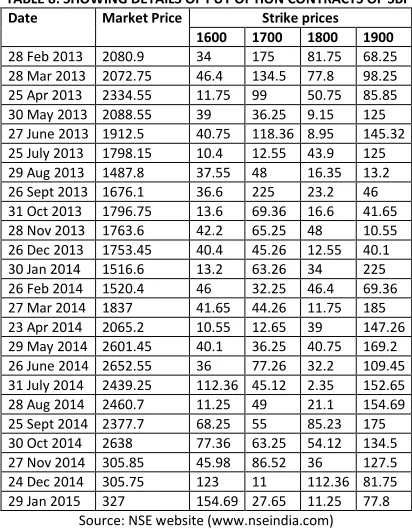
TABLE 8: SHOWING DETAILS OF PUT OPTION CONTRACTS OF SBI
Date Market Price Strike prices
1600 1700 1800 1900
28 Feb 2013 2080.9 34 175 81.75 68.25
28 Mar 2013 2072.75 46.4 134.5 77.8 98.25
25 Apr 2013 2334.55 11.75 99 50.75 85.85
30 May 2013 2088.55 39 36.25 9.15 125
27 June 2013 1912.5 40.75 118.36 8.95 145.32
25 July 2013 1798.15 10.4 12.55 43.9 125
29 Aug 2013 1487.8 37.55 48 16.35 13.2
26 Sept 2013 1676.1 36.6 225 23.2 46
31 Oct 2013 1796.75 13.6 69.36 16.6 41.65
28 Nov 2013 1763.6 42.2 65.25 48 10.55
26 Dec 2013 1753.45 40.4 45.26 12.55 40.1
30 Jan 2014 1516.6 13.2 63.26 34 225
26 Feb 2014 1520.4 46 32.25 46.4 69.36
27 Mar 2014 1837 41.65 44.26 11.75 185
23 Apr 2014 2065.2 10.55 12.65 39 147.26
29 May 2014 2601.45 40.1 36.25 40.75 169.2
26 June 2014 2652.55 36 77.26 32.2 109.45
31 July 2014 2439.25 112.36 45.12 2.35 152.65
28 Aug 2014 2460.7 11.25 49 21.1 154.69
25 Sept 2014 2377.7 68.25 55 85.23 175
30 Oct 2014 2638 77.36 63.25 54.12 134.5
27 Nov 2014 305.85 45.98 86.52 36 127.5
24 Dec 2014 305.75 123 11 112.36 81.75
29 Jan 2015 327 154.69 27.65 11.25 77.8
Source: NSE website (www.nseindia.com)
BUYERS PAYOFF
V
OLUMEN
O.
6
(2016),
I
SSUEN
O.
09
(S
EPTEMBER)
ISSN
2231-5756
SELLERS PAYOFF
It is in the money for the purchaser and out of the money for the vendor. Hence the seller is in loss.
CONCLUSION
In India, Derivatives market is growing swiftly unlike equity markets. Trading in derivatives need high knowledge and understanding about finance. Being fresh to markets extreme number of investors has not yet understood the full allegations of the derivatives trading. These markets can give greater depth, stability and liquidity to Indian capital markets. Effective risk management with derivatives entails a detailed understanding of ideologies that administer the pricing of deriva-tives. Option market will act as an efficient price discovery vehicle which will certainly help the traders to take hedging and arbitrage positions to secure maximum returns at minimum risk exposure. In bullish market the call option seller incurs extra losses so the investor is recommended to go for a call option to buy, whereas the put option buyer hurts in a bullish market, so he is advised to sell a put option. In bearish market the call option purchaser gets more losses so the investor is advised to move for a call option to sell, whereas the put option seller gets more losses, so he is advised to buy a put option. Finally, it can be concluded that the derivatives are the instruments that are mostly used for hedging purpose. As we all know one cannot eliminate the risk completely but can minimize the risk to some extent.
REFERENCES
1. Day Effects Day in India” – (2007) – by Sumon Bhaumik and Suchismita Bose.
2. “Derivatives and Volatility on Indian stock markets”- (2003)-by Snehal Bandivadekar and Saurabh Ghosh. 3. “Do Futures and Options trading increase stock market volatility?” (2003)- by Dr. Premalata Shenbagaraman.
4. Development of Financial Derivatives Market in india – A Case Study” (2010) –by Ashutosh Vashishtha and Satish Kumar. 5. “Effect of Introduction of Index Futures On Stock Market Volatility: The Indian Evidence” (2004) –by O.P. Gupta 6. “Impact of Derivatives Trading on Emerging Capital Markets: A Note on Expiration
7. Indian financial system - M.Y. Khan
8. “Informational Content of Trading Volume and Open Interest – An Empirical Study of Stock Option Market In India” – (2005)- by Sandeep Srivastava. 9. Investment management 5th edition 2003 - V.K. Bhalla
10. Options, Futures and Other Derivatives 7th edition - John C. Hull
WEBSITES
V
OLUMEN
O.
6
(2016),
I
SSUEN
O.
09
(S
EPTEMBER)
ISSN
2231-5756
INTERNATIONAL JOURNAL OF RESEARCH IN COMMERCE, IT & MANAGEMENT
REQUEST FOR FEEDBACK
Dear Readers
At the very outset, International Journal of Research in Commerce, IT & Management (IJRCM) acknowledges
& appreciates your efforts in showing interest in our present issue under your kind perusal.
I would like to request you to supply your critical comments and suggestions about the material published
in this issue, as well as on the journal as a whole, on our e-mail
for further
improve-ments in the interest of research.
If you have any queries, please feel free to contact us on our e-mail
.
I am sure that your feedback and deliberations would make future issues better – a result of our joint effort.
Looking forward to an appropriate consideration.
With sincere regards
Thanking you profoundly
Academically yours
Sd/-
Co-ordinator
DISCLAIMER