Please cite this article as: A. Omidvari and M. R. Hematiyan, Approximate Closed-form Formulae for Buckling Analysis of Rectangular Tubes under Torsion, International Journal of Engineering (IJE), TRANSACTIONS B: Applications Vol. 28, No. 8, (August 2015) 1226-1232
International Journal of Engineering
J o u r n a l H o m e p a g e : w w w . i j e . i rApproximate Closed-form Formulae for Buckling Analysis of Rectangular Tubes under
Torsion
A. Omidvari, M. R. Hematiyan*
Department of Mechanical Engineering, Shiraz University, Shiraz 71936, Iran
P A P E R I N F O
Paper history: Received 25 April 2015
Received in revised form 15 July 2015 Accepted 30 July2015
Keywords: Torsion Buckling
Rectangular Hollow Tube Warping
Optimization
A B S T R A C T
The buckling torque may be much less than the yield torque in very thin rectangular tubes under torsion. In this paper, simple closed-form formulae are presented for buckling analysis of long hollow rectangular tubes under torsion. By the presented formulae, one can obtain the critical torque or the critical angle of twist of the tube in terms of its geometrical parameters and material constants. First, an approximate function for critical angle of twist, including a part in terms of the Poisson’s ratio and another part in terms of geometrical parameters with unknown coefficients are considered. Then, the unknown coefficients are found by a mini-max optimization method and also by using the accurate results obtained by the finite element method. The formulae can be used for a wide range of dimensions of hollow rectangular tubes. The numerical studies show that the maximum error of the presented formulae is less than 10%.
doi: 10.5829/idosi.ije.2015.28.08b.16
1. INTRODUCTION1
Thin-walled hollow members are widely used in mechanical, aerospace, and structural engineering applications. Torsional analysis of structures is an important topic in mechanical and structural engineering and it is of great interest for engineers and is one of the active researches [1-4].
Hollow tubes have high strength and rigidity in torsion, but the thinness of these structures can cause instability problems, which play an important role in design of the hollow members under torsion. Two different cases of torsional instability may occur in beams.
In the first case, a torsional load is applied to the beam and when the load reaches to its critical value a torsional instability occurs [5]. In the second case, a load other than a torque, (e.g. bending moment or axial load) is applied to the beam; however, a torsional instability occurs in the beam [6]. In this paper, the first
1*Corresponding Author’s Email: [email protected] (M. R.
Hematiyan)
case, i.e. instability of hollow rectangular tubes under torsion is studied.
According to thin-walled theory [7], the torsional rigidity of a hollow tube and the shearing stress in different parts of the cross-section of the tube under torsion can be simply estimated. However, the critical torque or the critical angle of twist of a hollow tube, which causes instability, cannot be computed simply by a closed-form formula.
Donnell presented a formula for evaluation of buckling shear stress of circular hollow tubes under torsion in terms of Young modulus, thickness, radius, and Poisson’s ratio [8].
Wittrick and Curzon derived criteria for the local buckling of polygonal tubes due to combined longitudinal compression and torsion [9]. Mao and Lu developed a method for buckling analysis of laminated cylindrical shells under torsion subjected to mixed boundary conditions [10]. They found the solution in terms of a double trigonometric series, which satisfied the mixed boundary conditions.
behavior of imperfect cylindrical shells under torsion [11]. In their research, a boundary layer theory of shell buckling was used to obtain an analytical solution.
Shen developed the boundary layer theory for buckling analysis of anisotropic laminated circular thin shells under torsional loading [12]. Shen developed a method for post-buckling analysis of functionally graded shells under torsion in a thermal environment [13]. Shen considered temperature with uniform distribution on shell surface and non-uniform distribution in the thickness direction. Results showed that the volume fraction of the constituents of the functionally graded material had an effect on buckling load and post-buckling behavior of the shell.
Takano investigated the effects of anisotropy, transverse shear stiffness, length, and their interactions on buckling of thin and moderately thick cylinders under pure torsion and under combined axial compression and torsion [14]. Takano showed that the buckling load of a cylindrical shell is affected not only by anisotropy and transverse shear stiffness but also by shell length.
Gonçalves and Camotim using the generalized beam theory and the finite element method investigated the instability of hollow beams with polygonal cross-sections under uniform torsion [15]. They have stated that local plate-type buckling is critical in very thin hollow polygonal members, but as the thickness increases, distortional buckling may become critical.
Although buckling of rectangular hollow beams under torsion is investigated by several researchers; however, to the authors’ best knowledge, there is no report presenting closed-form formulae for buckling analysis of rectangular tubes under torsion. In this study, simple closed-form formulae for buckling analysis of rectangular hollow tubes under torsion are presented. The formulae are systematically generated using the numerical results obtained from a large number of accurate finite element analyses. The accuracy of the presented formulae is investigated too. The most effort has been made to obtain simple and relatively accurate formulae.
2. FORMULATION OF THE PROBLEM
In this part, the formulation for buckling analysis of hollow circular tubes is reviewed first and then the formulation for rectangular hollow tubes is presented.
2. 1. A Review of Formulae for Buckling of Thin-Walled Hollow Tubes under Torsion Simple equations for torsion of thin-walled hollow tubes can be found in standard textbooks of mechanics of materials. These equations can be expressed as follows [16]:
c
tA T
2
(1)
(2)
where, τ is the shear stress, T is the applied torque, t is the thickness, Ac is the area bounded by the center line
of the wall cross-section, α is the angle of twist per unit length, and G is the shear modulus. It should be mentioned that Equation (1) cannot accurately estimate the shearing stresses at internal corners of hollow members [17].
Donnell presented an approximate formula
describing the critical shear stress for buckling of long circular hollow tubes [8]. Timoshenko and Gere modified the Donnell formula for the critical buckling load of long circular tubes and presented their formula as follows [18]:
2 / 3 4 / 3 2 ( )
) 1 (
236 . 0
r t E
cr
(3)
where E is Young modulus, ν is Poisson’s ratio, t is the thickness and r is the radius of the circular hollow tube. The critical torque can be obtained from Equation (1) as follows:
(4)
By using Equations (1), (3), and (4) the critical angle of twist (per unit length) is found as follows:
3/2
4 / 3
2 )( )
1 ( ) 1 (
) 1 ( 472 . 0
r t r
cr
(5)
As it can be seen, this equation is written as a multiplication of two parts. The first part is expressed in terms of the Poisson’s ratio, and the second part is expressed in terms of the geometrical parameters.
2. 2. Problem Statement and Dimensionless Parameters A rectangular tube of length L and thickness t is considered. The dimensions of the cross-section of the tube are represented by a and b (a>b) as shown in Figure 1. The longitudinal axis of the tube coincides with the z-direction, and the cross-section is in the xy plane. The angle of twist at the first end at z=0 is assumed to be zero, while the other end at z=L is free to twist and is subjected to the torque T. Two different cases are considered for warping constraint at the two ends of the tube. In a case, the free warping condition (uniform torsion) and in another case the fixed warping condition is considered. The objective is to find closed-form closed-formulae for computation of the critical value of the angle of twist or the applied torque that causes the tube to buckle.
t ds G A
T
c 2 4
Figure 1. The geometry of the rectangular tube and its cross-section
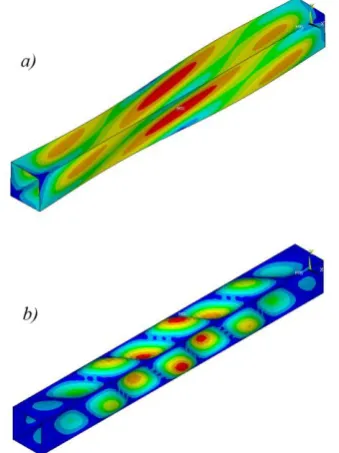
Figure 2. First mode of buckling for a rectangular tube: a) , (distorsional buckling), b) ,
004 . 0
*
t (plate-type buckling)
Dimensionless geometrical parameters for the problem are expressed as follows:
, , (6)
The dimensionless angle of twist and dimensionless shearing stress are respectively defined as follows:
(7)
E
*(8)
There are two types of buckling shape for rectangular tubes under torsion: 1) distortional buckling, and 2) local plate-type buckling [15]. These types of buckling shape are shown in Figure 2. When the beam
wall is very thin, the local plate-type buckling occurs as the first buckling mode. However, for beams with larger wall thicknesses, the distortional buckling is the critical (first) mode. The relative displacement of longitudinal edges is very small in the local plate-type buckling; however, it is considerable in distortional buckling. The local plate-type buckling of rectangular tubes under torsion is approximately similar to that of a simply supported rectangular plate under pure shear. Unlike the local plate-type buckling, the distortional buckling can be considered in the category of global buckling modes.
The numerical studies, which will be described in next sections show that buckling torque corresponding to a very thin beam may be much less than its yield torque. On the other hand, it is observed that the buckling shearing stress is usually greater than the yield shearing stress in rectangular tubes in which the distortional buckling mode is the first mode. Therefore, in this work, the buckling of very thin-walled rectangular tubes, which have practical importance, are investigated.
Similar to Equation (5), we assume that the critical angle of twist per unit length of the rectangular tube can be approximately expressed by multiplication of a function in terms of the Poisson’s ratio ν and a function in terms of the geometrical parameters. Therefore, the critical angle of twist per unit length in a dimensionless form is expressed as follows:
) , ( )
( * *
2 1
* g g t b
cr
(9)
The expressions for the functions g1 and g2 are found using accurate numerical data obtained from the finite element method (FEM). Similar approaches have been successfully used by Shahpari and Hematiyan [19], and Shirazi and Hematiyan [20], for stress and deformation analysis of members under torsion.
3. COLLECTING NUMERICAL DATA USING THE FEM
As previously mentioned, the formulae will be constructed using the FEM results. At first the validity and correctness of the finite element modeling is checked by comparing the FEM result for buckling analysis of a square tube with the result reported by Wittrick and Curzon [9]. A square tube with parameters
L=2 m, a=b=0.1 m, 0.3 and t=0.001 m is considered. For the FEM analysis of the problem the software ANSYS 13.0 is used. 3200 8-node shell elements (SHELL281) is considered for modeling of the square tube. The value for the critical angle of twist of the square tube obtained using the FEM is 2.45×10⁻², while the value reported in the literature [9] is 2.50×10⁻², which shows a difference of only 2%. It should be 1
*
b t*0.04 b* 1
a t t*
a b b*
a L L*
a
mentioned that the solution by Wittrick and Curzon is based on some assumptions with a small approximation.
To obtain appropriate expressions for the functions
1
g and g2 in Equation (9), we use the FEM to calculate the critical value of the angle of twist in terms of ν, t*, and b*. A large number of cases in which the local plate-type buckling is critical are considered and analyzed using the FEM. The Poisson's ratio is assumed to be between 0.15 and 0.45. For better approximation, two formulae are generated for expressing the buckling load of rectangular tubes. The first formula is generated for the following range of variables:
(10a)
(10b)
The second formula is expressed for the following range:
(11a)
(11b)
In most of rectangular tubes made of conventional materials with geometrical parameters out of the above mentioned ranges, yielding occurs before buckling.
For buckling analysis of the rectangular tube using the FEM, the first end at z=0 is held fixed in x and y
directions, while the other end at z=L is subjected to the following displacement boundary conditions.
yz
ux
(12)xz
uy (13)
where, ux and uy represent displacements in x and y
directions, respectively. Two different warping conditions are considered for the tube ends. In the first case the free warping condition (uniform torsion), i.e. , and in the second case the fixed warping condition, i.e. is considered. The critical value of
α for the first buckling mode is found through the FEM analysis. 408 different cases were analyzed using the FEM software ANSYS 13.0 to collect required data. In each case, more than 2000 8-node shell elements were used to discretize the rectangular tube. A mesh study was performed in each case in order to ensure that the used mesh was adequately refined. In all cases the values of a and L* have been set to 0.2 and 10, respectively. Using a numerical study, it was observed that for the considered rectangular tubes with plate-type buckling and the critical angle of twist is approximately independent of the length. We observed that the critical angle of twist for rectangular tubes with very large length is at most 3% smaller than that for
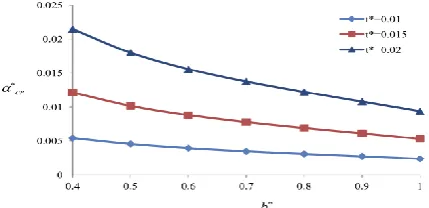
corresponding tubes with L*10. As examples, the variations of the dimensionless critical angle of twist in terms of the dimensionless length for two different rectangular tubes are shown in Figure 3. It can be seen that the critical angle of twist is with a good approximation, independent of the tube length for . The critical value of the angle of twist for each case of the 408 cases was computed using the FEM. As example, the obtained results for are depicted in Figures 4 and 5. As it can be seen from Figures 4 and 5, the critical angle of twist increases with increase in thickness.
Figure 3. Variation of the dimensionless critical angle of twist in terms of the dimensionless length of two rectangular tubes with and
Figure 4. Results for critical angle of twist for rectangular tubes with and obtained using the FEM
Figure 5. Results for critical angle of twist for rectangular tubes with 0.25 and 0.01t*0.02 obtained using the FEM
01 . 0 002 .
0 t*
1 2 . 0 b*
02 . 0 01 . 0 t*
1 4 . 0 b*
0
z u
0
z u
10
*
L
10
*
L
25 . 0
3 . 0
b* 1
25 . 0
4. THE APROXIMATE CLOSED-FORM FORMULAE FOR THE BUCKLING ANALYSIS OF RECTANGULAR TUBES UNDER UNIFORM TORSION (FREE WARPING CONDITION)
The variation of the dimensionless critical angle of twist, i.e.
cr* , with respect to Poisson ratio can be represented by a quadratic function with an acceptable accuracy. However, variation of
cr* , with respect to t*and *
b cannot be approximated by a simple polynomial. Many different equations for expressing
cr* in terms of ν, t*, and b* were examined. Finally, the following function was selected.5 4( )
) )( ( ) , ,
( * * 1 2 2 3 * *
* c c
cr vt b cv cvc t b
(14)
The formula given in Equation (14) is relatively simple and can represent with an appropriate accuracy. The
unknown parameters to in Equation (14) can be found by solving an optimization problem. In other words, these unknown parameters should be found in a
way that the computed value of from Equation (14) has a small difference with the corresponding FEM solution (with a fine mesh). The optimization problem can be expressed as a mini-max problem [21, 22] as follows:
Max (Fi)
i 1,2,...,nMinimize (15)
where ) , , ( ) , , ( ) , , ( * * * * * * * * * i i i cr i i i cr i i i cr i b t v b t v b t v F (16) ) , , ( * * * i i i cr v t b
and *( ,*, *)
i i i cr v t b
represent the dimensionless
critical angle of twist, computed using the proposed formula given in Equation (14) and the FEM,
respectively. , , and are known
values for Poisson’s ratio, dimensionless thickness, and dimensionless edge length, respectively. The design variables of the optimization problem, which should be found are to . The mini-max problem is solved using MATLAB software by a method based on the sequential quadratic programming [23].
As previously mentioned, the unknown coefficients are found for two different ranges of the independent variables. A formula is found for the first range of variables given in Equation (10) and the other formula is found for the second one given in Equation (11). Two formulae can represent the variations of
cr* better than only one formula. The obtained formulae are:1 2 . 0 , 01 . 0 002 . 0 ) ( ) )( 5 . 15 4 . 23 2 . 17 ( * * 873 . 0 * 978 . 1 * 2 * b t b t
cr
(17a) 1 4 . 0 , 02 . 0 01 . 0 ) ( ) )( 5 . 18 4 . 5 2 . 52 ( * * 870 . 0 * 987 . 1 * 2 * b t b t
cr
(17b)
The constants in Equations (17a) and (17b) are found using the numerical results obtained from 120 and 84 FEM analyses, respectively.
Equations (15a) and (15b) can be expressed as follows:
1.978 0.873
2 1
(17.2 23.4 15.5)
0.002 0.01, 0.2 1
cr
t b
a a a
t b a a (18a) 1.987 0.870 2 1
(52.2 5.4 18.5)
0.01 0.02, 0.4 1
cr
t b
a a a
t b a a (18b)
Both of the above equations can be used for L*10
and 0.15v0.45. The maximum error of the formulae in Equations (18a) and (18b) in comparison with accurate FEM solutions are 6 and 5%, respectively. The critical shearing stress and critical torque can be found using Equations (1) and (2), respectively, which yield to: cr cr b a abG ) ( (19) cr cr b a tG b a T ) ( 2 2 2
(20)
The dimensionless critical shearing stress can be expressed as follows:
* * * * ) 1 )( 1 ( 2 cr cr b b (21)
Now, we consider a rectangular tube with 0.3,
1
*
b , and t*0.02. We obtain
cr* 0.0127 fromEquation (17b) and
*cr0.00244 from Equation (21).Assuming the rectangular tube is made of steel with
GPa 70
G , we get cr445MPa, which is a relatively
large value. Larger values of t* correspond to larger values of cr. This result shows that buckling analysis
of rectangular tubes with t*0.02 is more important than tubes with t*0.02.
*
cr
1
c
c
5* cr
i v * i t * ib (i1,2,...,n)
1
5. THE APROXIMATE CLOSED-FORM FORMULAE FOR THE BUCKLING ANALYSIS OF RECTANGULAR TUBES WITH FIXED WARPING CONDITIONS AT TWO ENDS
The formulae presented in the previous section were developed for rectangular tubes with no warping constraints at their ends. In other words, we assumed the warping is uniform along the longitudinal axis of the tube.
For rectangular tubes with warping constraint at ends, the warping will not be uniform along the longitudinal axis of the tube. These are usually named non-uniform torsion. Warping of closed section members in uniform or non-uniform torsion is usually much more less than that for open-section members. The critical values of the angle of twist of a rectangular tube for cases with and without warping constraints are very close to each other. However, we have found separate formulae for rectangular tubes with warping constraints.
The closed form formulae for evaluation of the critical angle of twist of rectangular tubes with warping constraint at two ends can be expressed as follows.
1.974 0.892
2 1
(49.2 4.6 17.3)
0.002 0.01, 0.2 1 cr
t b
a a a
t b
a a
(22a)
1.987 0.901
2 1
(16.1 26.8 15.7)
0.01 0.02, 0.4 1
cr
t b
a a a
t b
a a
(22b)
These formulae are found by an approach similar to the one for rectangular tubes without warping constraint. Both of the above equations can be used for
10
*
L and 0.15v0.45. The maximum error of the formulae in Equations (22a) and (22b) in comparison with accurate FEM solutions are 5 and 6%, respectively.
6. CONCLUSIONS
Simple closed-form formulae were presented for buckling analysis of hollow rectangular tubes under torsion with or without warping constraints. By the presented formulae, one can simply calculate the critical angle of twist of the tube in terms of its geometrical parameters and material constants.
The formulae can be used with a good approximation for a wide range of dimensions of hollow rectangular tubes. The presented formulae are independent of the tube length; however they are
suitable for rectangular tubes with a dimensionless length greater than 10.
There are two sources of errors in the formulae, the error due to using the approximate functions for expressing the critical angle of twist and the error due to assuming that the critical angle of twist is independent of the tube length. However, the numerical studies showed that the maximum overall error of the presented formulae is less than 10%.
7. REFERENCES
1. Bazehhour, B.G. and Rezaeepazhand, J., "Simplified approach for torsional analysis of homogenous tubes with non-circular cross-sections", International Journal of Engineering, Vol. 25, No. 3, (2012), 277-287.
2. Akbari, J., Rakhshanb, N. and Ahmadvandb, M., "Evaluation of ultimate torsional strength of reinforcement concrete beams using finite element analysis and artificial neural network",
International Journal of Engineering-Transactions B: Applications, Vol. 26, No. 5, (2012), 501.
3. Talebanpour, A. and Hematiyan, M., "Torsional analysis of piezoelectric hollow bars", International Journal of Applied Mechanics, Vol. 6, No. 02, (2014), 1450019.
4. Wan, H.-X. and Mahendran, M., "Bending and torsion of hollow flange channel beams", Engineering Structures, Vol. 84, (2015), 300-312.
5. Sofiyev, A., "The torsional buckling analysis for cylindrical shell with material non-homogeneity in thickness direction under impulsive loading", Structural Engineering and Mechanics, Vol. 19, No. 2, (2005), 231-236.
6. Chen, C.H., Yao, Y. and Huang, Y., "Elastic flexural and torsional buckling behavior of pre-twisted bar under axial load",
Structural Engineering and Mechanics, Vol. 49, No. 2, (2014), 273-283.
7. Sadd, M.H., "Elasticity: Theory, applications, and numerics, Academic Press, (2009).
8. Donnell, L.H., Stability of thin-walled tubes under torsion., California Inst. of Tech., Pasadena (USA), (1933).
9. Wittrick, W. and Curzon, P., "Local buckling of long polygonal tubes in combined compression and torsion", International Journal of Mechanical Sciences, Vol. 10, No. 10, (1968), 849-857.
10. Mao, R. and Lu, C.-H., "Buckling analysis of a laminated cylindrical shellunder torsion subjected to mixed boundary conditions", International Journal of Solids and Structures, Vol. 36, No. 25, (1999), 3821-3835.
11. Zhang, X. and Han, Q., "Buckling and postbuckling behaviors of imperfect cylindrical shells subjected to torsion", Thin-Walled Structures, Vol. 45, No. 12, (2007), 1035-1043.
12. Shen, H.-S., "Boundary layer theory for the buckling and postbuckling of an anisotropic laminated cylindrical shell, part iii: Prediction under torsion", Composite Structures, Vol. 82, No. 3, (2008), 371-381.
13. Shen, H.-S., "Torsional buckling and postbuckling of fgm cylindrical shells in thermal environments", International Journal of Non-Linear Mechanics, Vol. 44, No. 6, (2009), 644-657.
15. Gonçalves, R. and Camotim, D., "Buckling behaviour of thin-walled regular polygonal tubes subjected to bending or torsion",
Thin-Walled Structures, Vol. 73, No., (2013), 185-197. 16. Megson, T.H.G., "Aircraft structures for engineering students,
Elsevier, (2012).
17. Doostfatemeh, A., Hematiyan, M. and Arghavan, S., "Closed-form approximate "Closed-formulas for torsional analysis of hollow tubes with straight and circular edges", Journal of Mechanics, Vol. 25, No. 04, (2009), 401-409.
18. Timoshenko, S.P. and Gere, J.M., "Theory of elastic stability. ",
McGrawHill-Kogakusha Ltd, Tokyo, (1961).
19. Shahpari, S.-Z. and Hematiyan, M.R., "Closed-form solutions for torsion analysis of structural beams considering web-flange junctions fillets", Journal of Theoretical and Applied Mechanics, Vol. 51, No. 2, (2013) 393-407.
20. Shirazi, A.A.R.H. and Hematiyan, M.R., "Closed-form formulation for torsional analysis of beams with open or closed cross sections having a crack", Proceedings of the Institution of Mechanical Engineers, Part G: Journal of Aerospace Engineering, Vol. 227, No. 12, (2013), 1953-1967.
21. Yi, X., "The sequential quadratic programming method for solving minimax problem", Journal of Systems Science and Mathematical Sciences, Vol. 3, (2002), 355-364.
22. Zhu, Z., Cai, X. and Jian, J., "An improved sqp algorithm for solving minimax problems", Applied Mathematics Letters, Vol. 22, No. 4, (2009), 464-469.
23. Arora, J., "Introduction to optimum design, Academic Press, (2004).
Approximate Closed-form Formulae for Buckling Analysis of Rectangular Tubes under
Torsion
A. Omidvari, M. R. Hematiyan
Department of Mechanical Engineering, Shiraz University, Shiraz 71936, Iran
P A P E R I N F O
Paper history: Received 25 April 2015
Received in revised form 15 July 2015 Accepted 30 July2015
Keywords: Torsion Buckling
Rectangular Hollow Tube Warping
Optimization
ديكچ ه
هلیم رد شچیپ تحت هک یلیطتسم عطقم اب کزان یلیخ هرادج یاراد یلاخوت یاه زا رتمک یلیخ تسا نکمم شنامک یشچیپ رواتشگ دنراد رارق
لومرف هلاقم نیا رد .دشاب اهنآ میلست یشچیپ رواتشگ هلیم شنامک لیلحت یارب هتسب مرف اب هداس ییاه
هئارا لکش لیطتسم عطقم اب یلاخوت یاه
یم لومرف زا هدافتسا اب .دوش یم هدش هئارا یاه
یپ هیواز ای ینارحب رواتشگ ناوت نآ یدام تباوث و یسدنه یاهرتماراپ بسحرب ار هلیم ینارحب شچ
بیارض اب یسدنه یاهرتماراپ بسح رب یرگید تمسق و نوساوپ تبسن بسحرب تمسق کی لماش یبیرقت عبات کی ادتبا .دروآ تسدب
یم هتفرگ رظنرد صخشمان هنیهب شور کی زا هدافتسا اب صخشمان بیارض سپس .دوش
سا اب نینچمه و یزاس مک جیاتن زا هدافت
هدمآ تسدب یاطخ
یم تسدب دودحم ناملا شور زا لومرف .دنیآ
هلیم یارب هدافتسا لباق اه یسررب .دنتسه یسدنه داعبا زا یعیسو هنماد اب یلاخوت یلیطتسم یاه
یاه
یم ناشن یددع لومرف هنیشیب یاطخ هک دهد
زا رتمک هدش هئارا یاه
01
.تسا دصرد