Please cite this article as: S. Najafi, S. Dowlati, G. Rezazadeh, S. Azizi, Quality Factor of Free In-plane Vibration of a Fully Clamped Rectangular Micro-plate, International Journal of Engineering (IJE), IJE TRANSACTIONS A: Basics Vol. 31, No. 1, (January 2018) 96-103
International Journal of Engineering
J o u r n a l H o m e p a g e : w w w . i j e . i rQuality Factor of Free In-plane Vibration of a Fully Clamped Rectangular
Micro-plate
S. Najafia, S. Dowlati*b, G. Rezazadeha, S. Azizia
a Mechanical Engineering Department, Urmia University, Urmia, Iran b Electrical Engineering Department, Urmia University, Urmia, Iran
P A P E R I N F O
Paper history: Received 24 October 2017
Received in revised form 11 December 2017 Accepted 21 December 2017
Keywords:
In-plane Vibration Thermo-elastic Damping Quality Factor Rectangular Micro-plate
A B S T R A C T
Thermo-elastic damping is a significant dissipation mechanism in high quality factor microstructures. In this paper, thermo-elastic damping of the in-plane vibration of fully clamped rectangular micro-plates has been studied. The governing equation of the micro-plate motion and heat conduction equation were derived. Then, The Galerkin method has been used to solve the coupled heat-displacement equations. Eventually, considering the micro-plate of various materials, the effects of geometrical parameters including the length and width of micro-plate and also ambient temperature on the thermo-elastic damping quality factor have been investigated.
doi: 10.5829/ije.2018.31.01a.14
1. INTRODUCTION1
Recently, Micro Electro Mechanical Systems (MEMS) have drawn many attentions due to the advantages of favorable scaling property, low energy consumption, high sensitivity, high mechanical resonance frequencies and high design flexibility. Micro-waveguides, micro-resonators, mirrors, switches and micro-pumps are essential parts in many MEMS devices such as charge detectors, radio frequency (RF) filters, mass flow sensors and many others. Micro-plates are one of the essential structures widely used in resonantly actuated micro-structures in which the sensitivity and resolution are underlying issues [1]. Thus, designing micro-resonators with high quality factor is of a great necessity.
The dissipation mechanisms contributing in the decline of the quality factor can be classified into extrinsic and intrinsic losses in which intrinsic losses such as Thermo-Elastic Damping (TED) cannot be controlled as easily as extrinsic losses such as air damping [1]. TED is a significant loss mechanism in
*Corresponding Author’s Email: [email protected] (S. Dowlati)
flexural resonators [1] which was discovered by Zener [2, 3]. TED, as a source of mechanical thermal noise, is a contributing factor in the decreasing of quality factor and consequently increasing of energy consumption. Duwel et al. [4] and Evoy et al. [5] have experimentally shown that TED is a major damping source in MEMS and NEMS. Lifshitz and Roukes derived an analytical expression for quality factor (QF) of TED in micro-beams and studied the effect of different geometrical parameters on it [6]. Sun et al. [7] and Sharma et al. [8] established the equation of the coupled thermo-elastic case for axi-symmetric out-of-plane vibrations of a circular plate in order to study TED in micro-plates. TED of transversal vibrations of micro-beams and micro-plates have been discussed in the literature by Rezazadeh et al. [9], Najafi et al. [10], Maroofi et al. [11] and many others. Furthermore, Rezazadeh et al. [12] studied TED in a micro-beam resonator based on modified couple stress theory and Zhong et al. [13] investigated TED in a micro-plate resonator using modified couple stress. The mentioned theory is utilized to capture the size effect where there is a considerable internal length scale parameter [14, 15].
however, in-plane vibrations occur where structure is made of piezoelectric or magnetostrictive materials subjected to electric or magnetic field [16, 17]. In-plane vibrations appeared in the design of ship hulls [18] and also in the outer sheets of the sandwich panels while the assembly itself undergoes lateral vibration [19]. Bardell et al. [20] studied in-plane vibration frequencies in simply supported plates, clamped and free plates using Rayleigh-Ritz method. Seok et al. [21] used the equations of plane stress including in-plane inertia to treat the problem of the free vibrations of a thin relatively short cantilever plate and presented the dispersion curves for in-plane flexure of rectangular plates. Gorman [22] obtained accurate analytical-type solutions by means of the superposition method for the free in-plane vibration of fully clamped rectangular plates. In other work, Gorman employed the superposition method to analyze the effects of elastic edge support on the in-plane free vibration frequencies and mode shapes of rectangular plates [23]. He also obtained accurate analytical-type solutions for the free in-plane vibration eigenvalues and mode shapes of fully clamped orthotropic rectangular plates [23]. Gorman presented exact solutions for the free in-plane vibration of the rectangular plates with two opposite edges simply supported [24]. Andrianov et al. [25] analyzed natural in-plane vibration of rectangular plates using homology perturbation approach. Hyde et al. [26] investigated free in-plane vibration of rectangular plates undergoing plane stress deformation through Ritz discrimination of the Rayleigh quotient.
In this paper, thermo-elastic damping of in-plane vibrations of a fully clamped rectangular micro-plate under electrostatic actuation is investigated. The Galerkin method and complex-frequency approach are applied to solve the coupled equations of the plate motion and heat conduction. Furthermore, it aims to determine how the length, width and ambient temperature influence the QTED.
2. MODEL DESCRIPTION AND PROBLEM FORMULATION
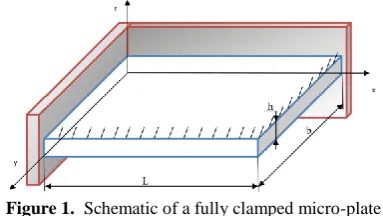
Figure 1 depicts a fully clamped rectangular micro-plate in which L, b and hare the length, width, and thickness of the plate, respectively.
2. 1. Stress and Strain Fields Mechanical and thermal effects result in a general strain field as [27]:
( ) (T)
eij eijM eij (1)
Stress in terms of strain can be written as:
Figure 1. Schematic of a fully clamped micro-plate
0
ij Cijkl kle ij T T
(2)
where, Cijklis a fourth-order elasticity tensor [28] and ij
is a second-order tensor containing thermo-elastic moduli [29]. Thus, Equation (2) can be expressed as:
0 2
(3 2 ) ( )
ij kk ij ij
ij
e e
T T
(3)
in which , ,
and areLame’s constant, shear modulus, thermal expansion coefficient and Kronecker delta, respectively. Equation (3) in terms ofE
and
can be rewritten as follows:0
1
(1 )(1 2 )
( )
1 2
ij ij
kk ij
ij
E e E
e E
T T
(4)
2. 2. Motion Equation The governing equation of motion is expressed as [30]:
,
ij j bi ai
(5)
where
, bianda
are the mass density, body force, and acceleration vector, respectively. The equation of motion by ignoring the body force can be written as:, , ,
0 ,
( )
(3 2 ) ( )
k ki i jj j ij
i i
u u u
T T u
(6)
2. 3. Heat Equation Heat conduction equation with no sources is defined as [29]:
,ii (3 2 ) 0 ii
kT cT T e (7)
,ii (3 2 ) 0 i i,
kT cT T u (1)
Equations (6) and (8) are a system of coupled equations. Considering plane stress condition due to the thickness of the plate we have:
( )
( )
1
( )
1
z x y
x y w e z E e e u v x y (9)
It is assumed that the plate can only vibrate in x and y directions, hence the terms 2u z2and 2v z2 are eliminated; it means that plate remains at a right angle in x and y directions or u u x y t( , , ) and v v x y t( , , ). Heat doesn’t have enough time to transfer in z direction because the vibrations are not steady, which means:
( , , )
T T x y t . Simplifying and transforming Equations (6) and (1) into non-dimensional form result in:
2 2 2
1 2
2 2
2
3 2
2 2 2
4 5
2 2
2
6 2
2 2 2
7 8
2 2
2
8 9
ˆ ˆ ˆ
ˆ ˆ
ˆ ˆ
ˆ ˆ
ˆ ˆ
ˆ ˆ ˆ
ˆ ˆ ˆ ˆ ˆ ˆ ˆ ˆ ˆ
ˆ ˆ ˆ
ˆ ˆ
ˆ ˆ
ˆ ˆ
0
ˆ ˆ ˆ
u u v
B B x y x y u B x t
v v u
B B x y x y v B y t u B B t x x y v B B
t y t
(10) where: 2
1 2 2
2 0
3 4 2
2 2
0
5 2 6 2
2 3
7 2 8 3
9
(1 ) 1
, 2
(2 )
2(1 )(1 ) (2 )
,
(2 )(1 2 ) (1 )
2(1 )
,
(1 ) (1 2 )
(2 )
,
2 (1 ) (1 )
(2 ) ˆ 2
,
2(1 )(1 ) 1
l B B b T l B B b T l l B B b b
l l E
B B k b cl E B k (11)
The non-dimensional parameters of Equation (10) are introduced as:
2 2 0 0
ˆ ,ˆ ,ˆ ,ˆ ,
2 (1 )(1 )
ˆ ,
(2 )
u v y x
u v y x
l b b l
l t T E
, (12)
where T T0 .
2. 4. Solving the Governing Equations The Galerkin method is applied to solve Equation (10). Thereby, it can be approximated in terms of linear combinations of a finite number of shape functions and time-dependent coefficients [31, 32].
1 1 1 1 1 1
ˆ ˆ ˆ ˆ( , , )
ˆ
ˆ ˆ
( ) ( ) ( )
ˆ ˆ ˆ ˆ( , , )
ˆ
ˆ ˆ
( ) ( ) ( )
ˆ( , , )ˆ ˆ ˆ
ˆ
ˆ ˆ
( ) ( ) ( ) N M
n m nm
n m
K F
k f kf
k f
E R
e r er
e r
u x y t
x y a t
v x y t
x y b t
x y t
x y c t
(13)By substituting Equation (13) into Equation (10), error functions are obtained as follows:
1 1 1 1 1 2 1 1 3 1 1 1 1 1 ˆ ˆ ˆ ( ) ( ) ( ) ˆ ˆ ˆ ( ) ( ) ( ) ˆ ˆ ˆ ( ) ( ) ( ) ˆ ˆ ˆ ( ) ( ) ( ) ˆ ˆ ˆ ( ) ( ) ( ) N M
n m nm
n m N M
n m nm
n m K F
k f kf
k f E R
e r er
e r N M
n m nm
n m
x y a t
B x y a t
B x y b t
B x y c t
x y a t
1 1 4 1 1 5 1 1 6 1 1 2 1 1 ˆ ˆ ˆ ( ) ( ) ( ) ˆ ˆ ˆ ( ) ( ) ( ) ˆ ˆ ˆ ( ) ( ) ( ) ˆ ˆ ˆ ( ) ( ) ( ) ˆ ˆ ( )ˆ ( )ˆ ( ) K Fk f kf
k f K F
k f kf
k f N M
n m nm
n m E R
e r er
e r K F
k f kf
k f
x y b t
B x y b t
B x y a t
B x y c t
x y b t
1 1 7 1 1 8 1 1 8 1 1 9 3 1 1 ˆ ˆ ˆ ( ) ( ) ( ) ˆ ˆ ˆ ( ) ( ) ( ) ˆ ˆ ˆ ( ) ( ) ( ) ˆ ˆ ˆ ( ) ( ) ( ) ˆ ˆ ˆ ( ) ( ) ( ) E R
e r er
e r E R
e r er
e r N M
n m nm
n m K F
k f kf
k f E R
e r er
e r
x y c t
B x y c t
B x y a t
B x y b t
B x y c t
Shape functions which satisfy the boundary conditions are considered as follows:
ˆ ˆ
( ) sin( )
ˆ ˆ
( ) sin( )
ˆ ˆ
( ) sin( )
ˆ ˆ
( ) sin( )
ˆ ˆ
( ) sin( )
ˆ ˆ
( ) sin( )
n k e m f r
x n x
x k x
x e x
y m y
y f y
y r y
(15)
Weighted residual method of Galerkin is applied to Equation (14) as follow:
1 1 1 0 0 1 1 2 0 0 1 1 3 0 0
ˆ ˆ ˆ ˆ
( ) ( ) 0
1,..., , 1,...,
ˆ ˆ ˆ ˆ
( ) ( ) 0
1,..., , 1,...,
ˆ ˆ ˆ ˆ
( ) ( ) 0
1,..., , 1,...,
i j
q g
p c
x y dxdy
i N j M
x y dxdy
q K g F
x y dxdy
p E c R
(16)By substituting Equation (15) into Equation (16) and simplifying it for the first mode of displacements in x and y directions, the first mode of heat in y direction and the second mode of heat in x direction, results can be described as:
2 11 1 11
3 21
2 11 4 11
2 9 21 7 21
8 11
ˆ ˆ
( ) (1 ) ( )
8 ˆ
( ) 0 3
ˆ ˆ
ˆ ( ) (1 ) ( ) 0
ˆ ˆ
( ) (4 ) ( )
8 ˆ
( ) 0 3
a t B a t
B c t
b t B b t
B c t B c t
B a t
(17)
in which a11( )tˆ , b11( )tˆ and c21( )tˆ are introduced as:
ˆ 11 11 ˆ 11 11 ˆ 21 21 ˆ ( ) ˆ ( ) ˆ ( ) st st st
a t e
b t e
c t e
(18)
Substituting Equation (18) into Equation (17) gives:
2 2 1 2 2 4 8 3 2 9 7 0 0 0 0 (1 ) ˆ
0 (1 )
8 0 3 8 3 0 (4 ) s B s B B s B
B s B
(19)
Therefore, the complex frequencies of the system can be obtained by solving the following characteristic equation. 2 2 1 2 2 4 8 3 2 9 7 0 (1 ) ˆ
det 0 (1 )
8 0 3 8 3 0 0 (4 ) s B s B B s B B s B
(20)
3. NUMERICAL RESULTS
The micro-plates with the specifications as given in Table 1 [33, 34] are considered for investigating the effects of length, width, ambient temperature and material properties on the quality factor.
According to complex frequency approach, The quality factors of thermo-elastic damping (QTED) for the
cases in which
is small, can be achieved as follows [6]:1 1 Re( ) 2 2 Im( ) TED
Q
(21)
In this study, the coefficient of linear thermal expansion is assumed to be constant.
Table 2 shows the evaluated frequency result for the first mode of displacements when there is no heat effect in vibrations which is in a good agreement with those of other researchers.
TABLE 1. Material properties of micro-plates.
Parameters Unit Si SiC PolySilicon Gold Nickel
Young’s modulus (E) GPa 169 400 160 79 210
Poisson’s ratio (ν) --- 0.28 0.185 0.22 0.44 0.31
Thermal conductivity (k) w mk 150 70 148 318 92
Density (ρ) kg m3 2300 3200 2330 19320 8900
Specific heat at constant volume (C) j kgk 695 938 107 129 438
Coefficient of linear thermal expansion (α)× 106 1
k 2.6 3 4.7 14.21 13
TABLE 2. Non-dimensional Natural frequency (ω) of micro-plate
Ref. ω
Present 3.741
Bardell et al. [20] 3.555
Gorman [23] 3.555
Hyde et al. [26] 3.549
Dozio [35] 3.555
Du et al. [36] 3.554
Figure 2. Thermo-elastic damping quality factor versus the length of the micro-plates of SiC, Si, nickel, polysilicon, and gold
The quality factors of thermo-elastic damping with respect to the variations of ambient temperature are depicted in Figure 1. As shown, increasing ambient temperature results in decreasing of QTED.
The variations of QTED for various values of plate
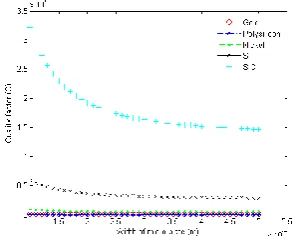
widths are plotted in Figure 2 at the constant ambient temperature (T0300k ). It can be seen that as the
width of the plate increases, the QTED decreases.
Figure 3, 6 and 7 depicted an attempt to magnify the lower region of Figures 2, 3, and 4 where QTED of gold
and polysilicon are much lower than those of nickel, Si, and SiC and consequently not clear enough.
Figure 1. Effect of ambient temperatures on QTED of the
micro-plates (L=b=200µm) of SiC, Si, nickel, polysilicon, and gold
Figure 2. Thermo-elastic damping quality factor versus the width of the micro-plates of SiC, Si, nickel, polysilicon, and gold
Figure 3. QTED versus the length of the micro-plates of
Figure 4. Effect of various ambient temperatures on QTED of
the micro-plates (L=b=200µm) of polysilicon, and gold
Figure 5. Thermo-elastic damping quality factor versus the width of the micro-plates of polysilicon and gold
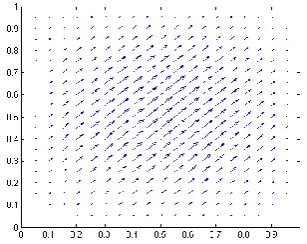
Figure 8 depicts the first mode of displacement for fully clamped square micro-plate.
Table 3 presents the differences between QTED of
in-plane and transversal vibrations for silicon fully clamped micro-plate under various temperatures. It can be seen that QTEDs of in-plane vibrations are extremely
higher than those of transversal vibration.
Figure 6. First mode of displacements of the micro-plate
TABLE 3. Differences between QTED in in-plane and
transversal vibrations for silicon fully clamped micro-plate
T0 ( K ) QTED (in this paper) QTED (Nayfeh, Younis [1])
100 213.5 5
10
≈ 4.5 5
10
150 142.3 5
10
≈ 3 5
10
300 71.1 5
10
≈ 1.5 5
10
4. CONCLUSION
This paper studied in-plane vibration of a fully clamped rectangular micro-plate considering thermo-coupling effect. The governing equation of the micro-plate motion and heat conduction equation were extracted. Then, the non-dimensional forms of these equations were obtained. Afterwards, Galerkin method was applied to solve the equations. The complex fundamental Eigen frequency of the first mode of the micro-plate vibration was determined by solving the coupled ordinary equations and eventually quality factor of the system was achieved. The results indicate that QTED is decreased by increasing the width and ambient
temperature of the micro-plate while it is increased by an increment of the length of the plate. Additionally, it is demonstrated that QTED of gold and poly-silicon
plates change slightly over the width of the micro-plates in comparison with nickel, silicon, and Si-Carbide. Moreover, the obtained QTED of in-plane vibrations is
presented in comparison to transversal vibrations and it is observed that QTED of in-plane vibrations is about 50
times higher than that of transversal vibrations.
It can be suggested that the structures with in-plane vibrations could be used instead of those with the transversal vibrations where the high value of the magnitude of vibration is not of require. The results offered to be employed in the design of MEMS waveguides and MEMS resonators with the high quality factor. Future work could be devoted to extending this study based on couple stress theory.
5. REFERENCES
1. Nayfeh, A.H. and Younis, M.I., "Modeling and simulations of thermoelastic damping in microplates", Journal of Micromechanics and Microengineering, Vol. 14, No. 12, (2004), 1711.
2. Zener, C., "Internal friction in solids. I. Theory of internal friction in reeds", Physical Review, Vol. 52, No. 3, (1937), 230-235.
3. Zener, C., "Internal friction in solids ii. General theory of thermoelastic internal friction", Physical Review, Vol. 53, No. 1, (1938), 90-99.
gyros", Sensors and Actuators A: Physical, Vol. 103, No. 1, (2003), 70-75.
5. Evoy, S., Olkhovets, A., Carr, D.W., Parpia, J.M. and Craighead, H.G., "Temperature-dependent internal friction in silicon nanoelectromechanical systems", MRS Online Proceedings Library Archive, Vol. 657, (2000), 2397-2399. 6. Lifshitz, R. and Roukes, M.L., "Thermoelastic damping in
micro-and nanomechanical systems", Physical Review B, Vol. 61, No. 8, (2000), 5600-5609.
7. Sun, Y. and Tohmyoh, H., "Thermoelastic damping of the axisymmetric vibration of circular plate resonators", Journal of Sound and Vibration, Vol. 319, No. 1, (2009), 392-405. 8. Sharma, J. and Sharma, R., "Damping in micro-scale generalized
thermoelastic circular plate resonators", Ultrasonics, Vol. 51, No. 3, (2011), 352-358.
9. Rezazadeh, G., Vahdat, A.S., Pesteii, S.-M. and Farzi, B., "Study of thermoelastic damping in capacitive micro-beam resonators using hyperbolic heat conduction model", Sensors & Transducers, Vol. 108, No. 9, (2009), 54-72.
10. Najafi, M., Rezazadeh, G. and Shabani, R., "Thermo-elastic damping in a capacitive micro-beam resonator considering hyperbolic heat conduction model and modified couple stress theory", Journal of Solid Mechanics Vol, Vol. 4, No. 4, (2012), 386-401.
11. Maroofi, M., Najafi, S., Shabani, R. and Rezazadeh, G., "Investigation of thermoelastic damping in the longitudinal vibration of a micro beam", International Journal of Engineering-Transactions B: Applications, Vol. 28, No. 2, (2014), 314-320.
12. Rezazadeh, G., Vahdat, A.S., Tayefeh-rezaei, S. and Cetinkaya, C., "Thermoelastic damping in a micro-beam resonator using modified couple stress theory", Acta Mechanica, Vol. 223, No. 6, (2012), 1137-1152.
13. Zhong, Z.-Y., Zhang, W.-M., Meng, G. and Wang, M.-Y., "Thermoelastic damping in the size-dependent microplate resonators based on modified couple stress theory", Journal of Microelectromechanical Systems, Vol. 24, No. 2, (2015), 431-445.
14. Beni, Y.T., Jafaria, A. and Razavi, H., "Size effect on free transverse vibration of cracked nano-beams using couple stress theory", International Journal of Engineering-Transactions B: Applications, Vol. 28, No. 2, (2014), 296-304.
15. Dowlati, S., Rezazadeh, G., Afrang, S., Sheykhlou, M. and Pasandi, A.M., "An accurate study on capacitive microphone with circular diaphragm using a higher order elasticity theory",
Latin American Journal of Solids and Structures, Vol. 13, No. 4, (2016), 590-609.
16. Hagood, N.W. and von Flotow, A., "Damping of structural vibrations with piezoelectric materials and passive electrical networks", Journal of Sound and Vibration, Vol. 146, No. 2, (1991), 243-268.
17. Khanchehgardan, A., Shah-Mohammadi-Azar, A., Rezazadeh, G. and Shabani, R., "Thermo-elastic damping in nano-beam resonators based on nonlocal theory", International Journal of Engineering-Transactions C: Aspects, Vol. 26, No. 12, (2013), 1505-1513.
18. Gorman, D., "Free in-plane vibration analysis of rectangular plates with elastic support normal to the boundaries", Journal of Sound and Vibration, Vol. 285, No. 4, (2005), 941-966.
19. Wang, G. and Wereley, N.M., "Free in-plane vibration of rectangular plates", AIAA Journal, Vol. 40, No. 5, (2002), 953-959.
20. Bardell, N., Langley, R. and Dunsdon, J., On the free in-plane
vibration of isotropic rectangular plates. 1996, Elsevier.
21. Seok, J., Tiersten, H. and Scarton, H., "Free vibrations of rectangular cantilever plates. Part 1: Out-of-plane motion",
Journal of Sound and Vibration, Vol. 271, No. 1, (2004), 131-146.
22. Gorman, D., "Accurate analytical type solutions for the free in-plane vibration of clamped and simply supported rectangular plates", Journal of Sound and Vibration, Vol. 276, No. 1, (2004), 311-333.
23. Gorman, D., "Accurate in-plane free vibration analysis of rectangular orthotropic plates", Journal of Sound and Vibration, Vol. 323, No. 1, (2009), 426-443.
24. Gorman, D., "Exact solutions for the free in-plane vibration of rectangular plates with two opposite edges simply supported",
Journal of Sound and Vibration, Vol. 294, No. 1, (2006), 131-161.
25. Andrianov, I.V., Awrejcewicz, J. and Chernetskyy, V., "Analysis of natural in-plane vibration of rectangular plates using homotopy perturbation approach", Mathematical Problems in Engineering, Vol. 2006, (2006).
26. Hyde, K., Chang, J., Bacca, C. and Wickert, J., "Parameter studies for plane stress in-plane vibration of rectangular plates",
Journal of Sound and Vibration, Vol. 247, No. 3, (2001), 471-487.
27. Timoshenko, S.P. and Woinowsky-Krieger, S., "Theory of plates and shells, McGraw-hill, (1959).
28. Chandrasekharaiah, D. and Debnath, L., "Continuum mechanics, Elsevier, (2014).
29. Sadd, M.H., "Elasticity: Theory, applications, and numerics, Academic Press, (2009).
30. Mase, G.T., Smelser, R.E. and Mase, G.E., "Continuum mechanics for engineers, CRC press, (2009).
31. Shah-Mohammadi-Azar, A., Khanchehgardan, A., Rezazadeh, G. and Shabani, R., "Mechanical response of a piezoelectrically sandwiched nano-beam based on the nonlocal theory",
International Journal of Engineering, Vol. 26, No. 12, (2013), 1515-1524.
32. Mobki, H., Sadeghia, M. and Rezazadehb, G., "Design of direct exponential observers for fault detection of nonlinear mems tunable capacitor", International Journal of Engineering Transactions A: Basics, Vol. 28, No. 4, (2015), 634-641. 33. Saeedivahdat, A., Abdolkarimzadeh, F., Feyzi, A., Rezazadeh,
G. and Tarverdilo, S., "Effect of thermal stresses on stability and frequency response of a capacitive microphone",
Microelectronics Journal, Vol. 41, No. 12, (2010), 865-873. 34. Zamanian, M. and Khadem, S., "Analysis of thermoelastic
damping in microresonators by considering the stretching effect", International Journal of Mechanical Sciences, Vol. 52, No. 10, (2010), 1366-1375.
35. Dozio, L., "Free in-plane vibration analysis of rectangular plates with arbitrary elastic boundaries", Mechanics Research Communications, Vol. 37, No. 7, (2010), 627-635.
Quality Factor of Free In-plane Vibration of a Fully Clamped Rectangular
Micro-plate
S. Najafia, S. Dowlatib, G. Rezazadeha, S. Azizia
a Mechanical Engineering Department, Urmia University, Urmia, Iran b Electrical Engineering Department, Urmia University, Urmia, Iran
P A P E R I N F O
Paper history: Received 24 October 2017
Received in revised form 11 December 2017 Accepted 21 December 2017
Keywords:
In-plane Vibration Thermo-elastic Damping Quality Factor Rectangular Micro-plate
ديكچ ه
ییاریم یفلاتا مزیناکم ، کیتسلااومرت اب ییاهراتخاسورکیم رد یهجوت لباق
تیفیک روتکاف ییاریم هلاقم نیا .تسا لااب
کیتسلااومرت هحفص نورد تاشاعترا
رد ار یا یم رارق هعلاطم دروم رادریگ لاماک یلیطتسم هحفصورکیم .دهد
لداعم ه مکاح رب
تاشاعترا هحفصورکیم و یلیطتسم
یترارح تیاده هلداعم هتفرگ راکب هدش لپوک تلاداعم لح یارب نیکرلگ شور و جارختسا
هدش سنج زا یلیتطسم تاحفصورکیم یارب ،سپس .تسا لوط لماش داعبا رثا ،فلتخم یاه
طیحم یامد رثا نینچمه و ضرع و
هتفرگ رارق یسررب دروم تیفیک روتکاف رب .تسا
![Table 1 [33, 34] are considered for investigating the effects of length, width, ambient temperature and material properties on the quality factor](https://thumb-us.123doks.com/thumbv2/123dok_us/202986.2014569/4.595.57.164.99.252/considered-investigating-effects-ambient-temperature-material-properties-quality.webp)