*Corresponding author: Yusuf Perwej ISSN: 0976-3031
Research Article
A TECHNOLOGICAL PERSPECTIVE OF BLOCKCHAIN SECURITY
Yusuf Perwej
1*., Nikhat Akhtar
2and Firoj Parwej
31
Department of Information Technology, Al Baha University, Al Baha, Kingdom of Saudi Arabia (KSA)
2Department of Computer Science & Engineering, Babu Banarasi Das University, Lucknow, India
3
Department of Computer Science & Engineering Singhania University, Pacheri Bari, Jhunjhunu, Rajasthan, India
DOI: http://dx.doi.org/10.24327/ijrsr.2018.0911.2869
ARTICLE INFO ABSTRACT
Blockchain has swiftly become one of the most dominant and promising technologies of the past couple of years. The information security is the key to the development of contemporaneous Internet technology. The distributed mechanism, scripted mechanism, password mechanism and decentralized mechanism of the Blockchain present a perfectly new perspective for the development of Internet information security technology. Blockchain is a distributed database that maintains a successively increasingly list of records called blocks that are secured from any kind of interfere with and revision endeavor. A word that often emerges when talking about Blockchain is Bitcoin. The numerous people still confuse Blockchain with Bitcoinal though, they are not the same. Bitcoin is just one of several applications that use Blockchain technology. In Blockchain every block contains a time stamp and a link to the previous block. Blockchain extant level of security of a system and data perspective for both private and public ledgers. Alternatively, uploading data to a cloud server or storing it in a single location, as well as breaking everything into small chunks and distributes them across the whole network of computers. In this paper, we try to conduct a comprehensive survey on the Blockchain security as well as the challenges and opportunities for the prospective of security and privacy of data in Blockchain. In its present state, several leading companies and governments detect demonstrations of the Blockchain integrated intoidentity management, credential validation, finance, supply chain, property exchange recording, and other territory.
INTRODUCTION
The amount of data in our world is swiftly increasing. According to a recent report, it is estimated that 89% of the data in the world today has been created in the last two years as well as current output of data is roughly 2.5 quintillion bytes a day [1]. This data comes from everywhere, such as posts to social media sites, sensors used to gather shopper information, cell phone, GPS signals and videos, purchase transaction, and digital pictures to name a few [2]. This data is called big data [3]. In the big data era, data are incessantly being collected and analyzed, leading to innovation and economic growth [4]. The organizations and companies use the data they collect to personalize services, predict future trends, optimize the corporate decision-making process and more. At present, data is a valuable asset in our economy [5]. There have been different attempts to address these privacy matters, both from a legislative perspective as well as from a technological viewpoint [6]. In recent years, a new class of responsible
systems emerged. The first such system was Bitcoin [7], which permits users to transfer currency [8] securely without a centralized regulator, using a publicly verifiable open ledger such as Blockchain [9].
A Blockchain consists of blocks that hold batches of valid and avowed transactions. Every block includes the hash of the previous block in the Blockchain linking the two. The linked blocks form a chain [8], which is called a Blockchain. A Blockchain is factually an append-only data structure maintained by a set of nodes which do not fully believe each other. All nodes in a Blockchain network consent on an ordered set of blocks, each [9] containing multiple transactions, thus the Blockchain can be lookedat a log of ordering transactions. In a database reference, Blockchain can be looked as a solution to the distributed transaction management arduous nodes keep facsimile of the data and agree on [10] an execution order of transactions [11]. In spite of that, conventional database systems work in a trusted environment and employ well known
Available Online at http://www.recentscientific.com
International Journal of
Recent Scientific
Research
International Journal of Recent Scientific Research
Vol. 9, Issue, 11(A), pp. 29472-29493, November, 2018
Copyright © Yusuf Perwej., Nikhat Akhtar and FirojParwej, 2018, this is an open-access article distributed under the terms of the Creative Commons Attribution License, which permits unrestricted use, distribution and reproduction in any medium, provided the original work is properly cited.
DOI: 10.24327/IJRSR CODEN: IJRSFP (USA)
Article History:
Received 12th August, 2018
Received in revised form 23rd
September, 2018
Accepted 7th October, 2018
Published online 28th November, 2018
Key Words:
concurrency control techniques to [12] order transactions. The Blockchain superior position is that it does not presume nodes trust each other and consequently is designed to achieve Byzantine fault tolerance [13]. This potentially permits you to use the Blockchain ledger to make sure that the data you backed up and stored in the cloud with third-party vendors [9] has gone entirely unchanged even years, months, and weeks later. No one can deny that Blockchain offers authentic, independent data verification [14].
Related Work
The Blockchain technology enables distributed public ledgers that hold immutable data in aencrypted and secure way and make sure that transactions can never be changed. The condos et al. [15] define a Blockchain as an electronic ledger for digital records, transactions, phenomena managed by the participants of a distributed computer network. Earlier, most trade repositories, for lending or sale of securities, were not publicly accessible. In spite of, this does not necessarily indicate who carried out the transactions, e.g. in the case of Bitcoin, the users remain unidentified or pseudo-unidentified, since only the identification tag of the digital wallets is required for a transaction. The Glaser and Bezzenberger [16] and Tapscott and Tapscott [17] et al furthermore, a Blockchain is a distributed system without a pivotal control point or authority. The pivotal control points or authorities are not essential in a Blockchain because the distributed network verifies the transactions being performed. This is contemplatea key innovation of the Blockchain technology [18].
Nakamoto 2008 et al [19] said if a transaction between two sideis to be made in the network, the nodes in the distributed network compete to find a solution to mathematical puzzle and also store that transaction in the trade repository. A transaction can then no longer be destroyed from the trade repository or ever returned. Tapscott and Tapscott et al [17] said the expunction of a central instance in the distributed network implies a radical shift to direct transactions between non-intermediaries or intermediary services. The blocks hold a copy of the last transactions since the last block was added Bogart and Rice et al [20]. The Walport et al [21] said the data structure of a Blockchain correlate with a database that groups entries into blocks that are linked in chronological order via a cryptographic signature. The Glaser and Bezzenberger et al [16] for the verification of the Blockchain different consensus procedure can be used, which are based on peer-to-peer procedure and encryption. Blockchain was fundamentally created as an approach to cryptographic-based payment transactions to confer ansubstitute procedure of trust between two transaction parties. Nakamoto et al [22] in classical transactions, the parties have to rely on a faith third party, like as a bank. In the instance of Bitcoin, the essential faith is now completely substituted by the Blockchain, as it permitsfor a mass trade repository operated by many decentralized registers. Next related to the vulnerability discovered in Ethereum that permits an attacker to eclipse a victim Gervais et al. [23] show that a resource constrained attacker can perform eclipse attacks on Bitcoin with only one TCP/IP connection. As long as MDP model does not capture such partial eclipse attacks, we do consider stronger full eclipse attacks. Nasdaq et al [24] said you need to have aabsolute ecosystem on the Blockchain for it
to offer maximum value to all its stockholder. Yonatan Sompolinsky et al. [25] GHOST is an substitute to the longest chain rule for establishing consensus in PoW based Blockchains in which stale blocks also contribute to the security of the chain and in which stale blocks therefore do not influence the security. The Puschmann et al [26] define a literature does not provide a structured inter-organizational overview of the emerging Blockchain ecosystem. Mougayar et al [27] to imagine the Blockchain ecosystem, some Blockchain landscapes were developed for practitioners clustered companies that are besmeared in decentralized services, crypto-tech computing, or crypto currencies into four major categories with over 20 sub-categories.
There also exist many options to Proof of Work. In Proof of Stake [29], nodes “stake” some value and based on the staked amount get a share of the vote of whether a block is valid. Proof of Burn (POB) is a proposal to subsititute POW by burning coins, i.e. sending them to an address that is verifiably unspendable, such that they can no longer be spent. However, current POB based Blockchain rely on burning coins from POW Blockchain in order to create blocks and therefore can not stand on their own. From a security standpoint, researchers developed different techniques targeting privacy concerns focused on private data. The Yves-Alexandre et al. [30] contemporaneous research has demonstrated how anonymized datasets employing these methods can be de-anonymized given even a small amount of data points or high dimensionality data. Latanya Sweeney et al [31] said data anonymizationtechnique attempt to defend personally identifiable information. k-anonymity, a common property of anonymized datasets be in need of that sensitive information of each record is indistinguishable from at least k-1 other records. AshwinMachanavajjhala et al [32] is respective extensions to k-anonymity include l-diversity, which make sure that sensitive data is represented by a diverse enough set of presumable values. Ninghui Li et al [33] t-closeness, which looks at the distribution of sentient data.
Blockchain Architecture
Blockchain endue a shared ledger technology that participants in a business network can use to record the history of business transactions that cannot be modified. In view of the fact that, Blockchain uses consensus [8] to commit transactions to the ledger, the outcomeis final. Every member has a copy of the same ledger, so asset provenance and traceability are transparent and faith [14]. Blockchain systems can seem complex but, they can be comfortably understood by examining and it can be applied to any industry.
Hashes
International Journal of Recent Scientific Research
inappreciable difference in the original [34] data outcome in a completely different hash value. It is extremely arduous to presuppose the original data based on a hash value. The taking mileage of such characteristics, this contrivance is used for the detection of falsification of data, and in the Bitcoin
used for the verification and assurance of the continuity o Blockchain data and the creation of Blockchain through proof of work make use of the calculation of hash values.
algorithms play an important role in security systems where they are used to assure that transmitted messages have not been interfered with [35]. A hashing algorithm makes use of many Blockchain technologies is the secure hash algorithm (SHA) with an output size of 256 bits (SHA-256). So many computers support this algorithm in hardware, making it rapidly to compute.
Figure 1 The Hash Functionality
Transactions
A transactionis a recording of a shifting of assets between parties. An analog to this would be a record in a examine account for each time money[36] was deposited or withdrawn. Every block in a Blockchain contains multiple transactions. A single transaction typically need sat least the following information fields.
Transaction ID
A unique identifier for every transaction.
Blockchain use an ID, and others take a hash of the distinguished transaction as a unique identifier.
Inputs
A list of the digital assets to be relocated.
asset is uniquely identified and may have different values from other assets [8]. However, assets cannot be added or delete from existing digital assets. Alternatively, digital assets can be divided into multiple new digital assets are combined to form fewer new digital assets.
Outputs
The accounts that will be the receiver of the digital assets. Every output specifies the value to be relocated
owner, the identity of the new owner, and a set of conditions the new owners must meet to obtain that value. If the digital assets provided are more than need, the superfluous funds are returned to the sender.
Amount
The total amount of the digital asset to transposition.
International Journal of Recent Scientific Research Vol. 9, Issue, 11(A), pp. 29472-29493, November, 2018
inappreciable difference in the original [34] data outcome in a It is extremely arduous to resuppose the original data based on a hash value. The taking characteristics, this contrivance is used for the detection of falsification of data, and in the Bitcoin system, it is used for the verification and assurance of the continuity of creation of Blockchain through proof of work make use of the calculation of hash values. The Hash important role in security systems where that transmitted messages have not been with [35]. A hashing algorithm makes use of many Blockchain technologies is the secure hash algorithm (SHA) 256). So many computers support this algorithm in hardware, making it rapidly to
Hash Functionality
A transactionis a recording of a shifting of assets between parties. An analog to this would be a record in a examine account for each time money[36] was deposited or withdrawn. multiple transactions. A sat least the following
A unique identifier for every transaction. The certain Blockchain use an ID, and others take a hash of the
a unique identifier.
A list of the digital assets to be relocated. The each digital asset is uniquely identified and may have different values from other assets [8]. However, assets cannot be added or delete tively, digital assets can be divided into multiple new digital assets are combined to form
The accounts that will be the receiver of the digital assets. relocated to the new the identity of the new owner, and a set of conditions the new owners must meet to obtain that value. If the digital assets provided are more than need, the superfluous funds are
transposition.
Ledgers
Throughout history, pen and paper ledgers have been used to keep track of the interchange of goods and services. A ledger is a collection of transactions. Not long ago, ledgers have been stored digitally, often in huge databases ow
solely by centralizing faith third parties on behalf of a community of users [37]. A ledger implemented using a Blockchain can mitigate these matters
distributed consensus contrivance. The Block
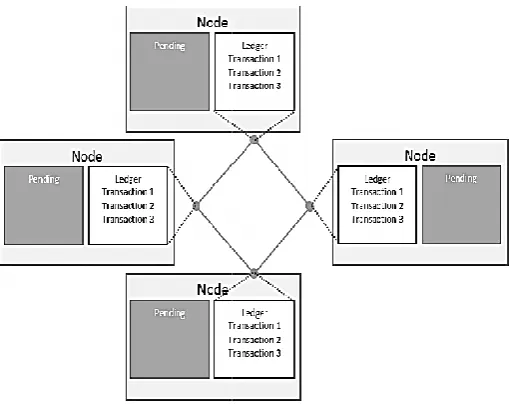
be imitated and distributed amongst every node within the system. In figure 2 shown illustratea simple network with four nodes, where each has a copy of a ledger of transactions. New transactions are submitted to a node, which will then caveat the rest of the network that a new transaction has arrived.
Figure 2 A network maintaining a ledger across nodes
Asymmetric-Key Cryptography
A basic technology utilized by Blockchain technologies is asymmetric-key cryptography
key cryptography) [38]. Asymmetric
pair of keys a public key and a private key that are mathematically belonging to each other [39]. The public key may be made public without deficiency the security of the process, but the private key must abide secret if the data is to retain its cryptographic protection. Even though there is a connection between the two keys, the private key cannot proficient be determined based on knowledge of the public key. The asymmetric key cryptography uses the
key pair for specific functions, dependent on which service is to be endured. Asymmetric-key cryptography endue
to verify that the user transferring value to another user is in possession of the private key competent of sign
Addressin Blockchain
An address is just like an account number in the bank and it signifies your unique identity on the Blockchainfrom which you can transfer out cryptocurrency and to which you can receive cryptocurrency [8]. Addresses are
receive digital assets shown in figure 3.Each address on the bitcoinBlockchain comes attached with a public key and a private key [15]. These together form the backbone of security in the Blockchain network. The public and private keys al
29493, November, 2018
Throughout history, pen and paper ledgers have been used to keep track of the interchange of goods and services. A ledger is a collection of transactions. Not long ago, ledgers have been stored digitally, often in huge databases owned and operated solely by centralizing faith third parties on behalf of a community of users [37]. A ledger implemented using a Blockchain can mitigate these matters through the use of a distributed consensus contrivance. The Block chain ledger will and distributed amongst every node within the system. In figure 2 shown illustratea simple network with four nodes, where each has a copy of a ledger of transactions. New transactions are submitted to a node, which will then caveat the
etwork that a new transaction has arrived.
A network maintaining a ledger across nodes
Key Cryptography
A basic technology utilized by Blockchain technologies is key cryptography (also referred to as public/private cryptography) [38]. Asymmetric-key cryptography uses a pair of keys a public key and a private key that are mathematically belonging to each other [39]. The public key may be made public without deficiency the security of the must abide secret if the data is to retain its cryptographic protection. Even though there is a connection between the two keys, the private key cannot proficient be determined based on knowledge of the public key. The asymmetric key cryptography uses the various keys of the key pair for specific functions, dependent on which service is key cryptography endue the ability to verify that the user transferring value to another user is in possession of the private key competent of signing the value.
work in a couple. The public key is a long alphanumeric string that is originated by the private key to an account and this can be publicly shared so that miners can confirm digitally signed transactions. The private key is a string that looks the way address does and is unique to the owner of a specific Bitcoin address. The proprietor of this Bitcoin address utilization his private key to digitally sign any transaction that he makes. As the name proposes, a user private key is private to the user the public key is known to every person.
Figure 3 The Address in Blockchain
Firstly, any wallet collects entropy and uses it to generate an Elliptic Curve Digital Signature Algorithm (ECDSA) private key and ECDSA is the cryptographic algorithm in
Bitcoin addresses [40]. It is an asymmetric signature algorithm, which means that you can sign piece of information with the private key and calibrate the signature with the public key. This means that anyone can generate the corresponding publ
they are being aware the private key. But, it is not possible to generate the private key from the public key. The
Curve Digital Signature Algorithm on the private key to get the public key. However, it is a one-way function, there is no to derive the private key from the public key. It is a derivative of the public key. The various cryptographic algorithms run on the public key to generate the address. The software hashes the public key with SHA 256 and the outcome with RIPEMD Then it adds the bytes 00 as a prefix in the beginning of the consequence of string.
Blocks
The transaction data for all time recorded in files called blocks. Every block records transaction for that time period, and once the block are computed with hashes, it is intaglio, and that will never be changed after that. The participant may submit candidate transactions to [41] the ledger by sending these transactions to some of the nodes engage in the Blockchain. The presented transactions are propagated t
nodes in the network. The distributed transactions, then wait in a queue, or transactionpool, so long as they are added to the Blockchain by a mining node. The mining nodes are the subset of nodes that preserve the Blockchain by publishing blocks.
work in a couple. The public key is a long alphanumeric string that is originated by the private key to an account and this can be publicly shared so that miners can confirm digitally signed transactions. The private key is a string that looks the way the address does and is unique to the owner of a specific Bitcoin address. The proprietor of this Bitcoin address utilization his private key to digitally sign any transaction that he makes. As the name proposes, a user private key is private to the user and
The Address in Blockchain
wallet collects entropy and uses it to generate an Elliptic Curve Digital Signature Algorithm (ECDSA) private key and ECDSA is the cryptographic algorithm in the core of Bitcoin addresses [40]. It is an asymmetric signature algorithm, which means that you can sign piece of information with the private key and calibrate the signature with the public key. This means that anyone can generate the corresponding public key if being aware the private key. But, it is not possible to generate the private key from the public key. The Elliptic Curve Digital Signature Algorithm on the private key to get the way function, there is no route to derive the private key from the public key. It is a derivative of the public key. The various cryptographic algorithms run on the public key to generate the address. The software hashes the public key with SHA 256 and the outcome with RIPEMD-160. Then it adds the bytes 00 as a prefix in the beginning of the
The transaction data for all time recorded in files called blocks. Every block records transaction for that time period, and once hashes, it is intaglio, and that will The participant may submit candidate transactions to [41] the ledger by sending these transactions to some of the nodes engage in the Blockchain. The presented transactions are propagated to the additional The distributed transactions, then wait in so long as they are added to the Blockchain by a mining node. The mining nodes are the subset of nodes that preserve the Blockchain by publishing new
The transaction is added to the Blockchain when a mining node publishes a block and block containsa set of validated transactions. The calibrate that the providers of funds in a transaction had access to the private key which could sign over the attainable funds. The other mining nodes will investigate the validity [15] of all transactions in a published block and will not accept a block if it contains any invalid transactions. Subsequently, creation each block is hashed thereby creating a digest that represents the block. The
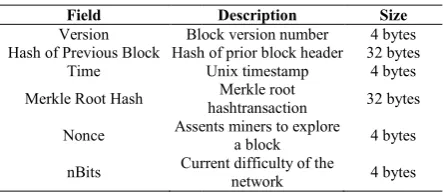
single bit in the block would completely change the hash value. The block’s hash digest is used to help protect the block from transformation since all nodes will have a copy of the block’s hash and can then check to make sure that the block has not been transformed. The block header hash is calculated by running the block header through the SHA256 algorithm two times. A block header hash is not sent through the network, but as an alternative is calculated by each node as part of the verification process of every block.
The version number is used to keep track of upgrades and modification in the protocol. The previous block header hash is the linkage into the foregoing block and secures the chain. timestamp is the number of seconds since the first of January 1972 and the trouble target of the block is the number of zeroes that must be found when hashing the block header in order to meet the required level of proof of work to retain the block time at 10 minutes. The nonce is the value that is changed by the miners to try disparate permutations to achieve the hassle level required the nonce has been appended by the superfluous nonce function which sits in the coinbase transaction
transaction of the Merkle root, indicate
reward to a superfluous counter to add permutations to as the nonce number can be used well within a second by the modern mining apparatus.
Table 1 The Block Header Format
Field
Version Block version number
Hash of Previous Block Hash of prior block header Time
Merkle Root Hash
Nonce Assents miners to explore
nBits Current
The storing the hash of every transaction within the header of a block, a data structure known as a Merkle treeis utilized. A Merkle tree likens the hash values of the data together until there is a singular root. The root is an efficient contrivance used to summarize the transactions in a block and make sure the presence of a transaction within a block. This structure bears out that the data sent in a distributed network are valid, since any transformation to the under
and can be thrown away. Chaining Blocks
The Blocks are chained together through each block containing the hash of the prior block’s header, [8] thus forming the Blockchain shown in figure 4. If a prior published block were altered, it would have a dissimilar hash.
The transaction is added to the Blockchain when a mining node publishes a block and block containsa set of validated that the providers of funds in a transaction had access to the private key which could sign over the attainable funds. The other mining nodes will investigate the validity [15] of all transactions in a published block and will not accept a block if it contains any invalid transactions. Subsequently, creation each block is hashed thereby creating a est that represents the block. The transformation of even a single bit in the block would completely change the hash value. hash digest is used to help protect the block from transformation since all nodes will have a copy of the block’s nd can then check to make sure that the block has not The block header hash is calculated by running the block header through the SHA256 algorithm two A block header hash is not sent through the network, but lculated by each node as part of the verification process of every block.
The version number is used to keep track of upgrades and modification in the protocol. The previous block header hash is the linkage into the foregoing block and secures the chain. The timestamp is the number of seconds since the first of January 1972 and the trouble target of the block is the number of zeroes that must be found when hashing the block header in order to meet the required level of proof of work to retain the block e at 10 minutes. The nonce is the value that is changed by the miners to try disparate permutations to achieve the hassle level required the nonce has been appended by the superfluous nonce function which sits in the coinbase transaction or the first action of the Merkle root, indicate who to pay the block superfluous counter to add permutations to as the nonce number can be used well within a second by the modern
The Block Header Format Data
Description Size
Block version number 4 bytes
Hash of prior block header 32 bytes
Unix timestamp 4 bytes
Merkle root
hashtransaction 32 bytes
Assents miners to explore
a block 4 bytes
Current difficulty of the
network 4 bytes
The storing the hash of every transaction within the header of a block, a data structure known as a Merkle treeis utilized. A the hash values of the data together until root is an efficient contrivance used to summarize the transactions in a block and make sure the presence of a transaction within a block. This structure bears out that the data sent in a distributed network are valid, since any transformation to the underlying data would be detected
International Journal of Recent Scientific Research
Figure 4 The Chain of Blocks
This in turn would reason all ensuing blocks to also have dissimilar hashes since they include the hash of the prior block. This makes it possible to comfortably detect and denial modification to prior published blocks. Example
electronic coin as a [42] chain of digital signatures. Every owner transfers the coin to the next by digitally signing a hash of the prior transaction and the public key of the next owner and concatenate these to the end of the coin [43]shown in figure 5. A payee can calibrate the signatures to calibrate the chain of ownership.
Figure 5 The Chaining of Transactions
Forking in Blockchain
In straightforward terms, fork is an application of a new rules to the Blockchainprotocol. Forks belong to the fact that various parties need to use common rules to maintain the history of the Blockchain. Forking signalize
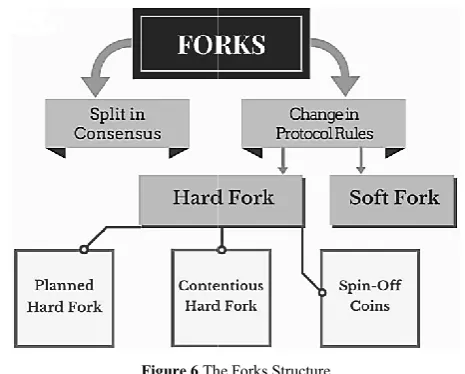
Blockchainnon permanent or permanent [43]. The forking is said to happen when a Blockchain partitioned into two branches. It can happen as an outcome of a transformation in consensus algorithm or other software transformation. Then, depending on the nature [44] of transform, the fork can be categorized into hard fork and soft fork shown in figure 6.
International Journal of Recent Scientific Research Vol. 9, Issue, 11(A), pp. 29472-29493, November, 2018
This in turn would reason all ensuing blocks to also have dissimilar hashes since they include the hash of the prior block. This makes it possible to comfortably detect and denial any modification to prior published blocks. Example for, an electronic coin as a [42] chain of digital signatures. Every owner transfers the coin to the next by digitally signing a hash of the prior transaction and the public key of the next owner atenate these to the end of the coin [43]shown in figure 5. A payee can calibrate the signatures to calibrate the
The Chaining of Transactions
In straightforward terms, fork is an application of a new set of rules to the Blockchainprotocol. Forks belong to the fact that various parties need to use common rules to maintain the history of the Blockchain. Forking signalize any divergence in permanent or permanent [43]. The forking is happen when a Blockchain partitioned into two outcome of a transformation in consensus algorithm or other software transformation. Then, depending on the nature [44] of transform, the fork can be
soft fork shown in figure 6.
Figure 6 The Forks Structure
Hard Fork
A hard forkis a transform to the technology that will entirely prevent users who do not adopt it from using the transform Blockchain system. A hard fork is a permanent divergence from the prior [45] version of the Blockchain, and nodes running previous versions will no longer be accepted by the current version. A hard fork is a thoroughgoing transform to the protocol that makes prior valid blocks or transactions unacceptable. Any transaction in the forked chain will not be valid on the no longer young chain. All nodes and miners will have to be improved in the latest version of the protocol software if they choose to be on the new forked chain. This essentially creates a fork in the
follows the new, improved Blockchain, and one path which continues along the no longer young path.
normally done only when there is enough support from the mining community. When the
signal towards the improved or fork, the developers of the chain start work on the improved code.
Soft Fork
A soft fork is a transform to the technology that will not completely prevent users who do not adopt the
using the transform Blockchain system.
happen when a transform to the software protocol keeps it backward consistent. What this means is that the latest forked chain will follow the latest rules and will also honor the old rules. The actual chain will con
This kind of fork needs only a majority of the miners make better to enforce the new rules, as opposed to a hard fork, which needs all nodes to make better and agree with the new version. A new transaction types can often be
forks, needs only that the participants for sender and receiver and miners comprehend the new transaction type. This is done by having the new transaction become visible to older clients as a "pay-to-anybody" transaction and getting the miner
to sacrifice blocks including this transaction unless the transaction confirmed under the new rules. This is how to pay to script hash was concatenate to Bitcoin.
occur at times due to a nonpermanent divergence in the Blockchain when miners using non
a new consensus rule their nodes don’t be aware about.
29493, November, 2018
The Forks Structure
A hard forkis a transform to the technology that will entirely prevent users who do not adopt it from using the transform A hard fork is a permanent divergence from the prior [45] version of the Blockchain, and nodes running previous versions will no longer be accepted by the current version. A hard fork is a thoroughgoing transform to the protocol that makes prior valid blocks or transactions ransaction in the forked chain will not be valid on the no longer young chain. All nodes and miners will have to be improved in the latest version of the protocol software if they choose to be on the new forked chain. This essentially creates a fork in the Blockchain, one path which follows the new, improved Blockchain, and one path which continues along the no longer young path. Hard Fork is normally done only when there is enough support from the mining community. When the oodles of miners give a positive signal towards the improved or fork, the developers of the chain start work on the improved code.
Forks and Cryptographic Modification
If flaws are established in the cryptographic technologies for a Blockchain application, the only solution may be to create a hard fork, depending on the importance of the flaw. So long as, more than 60 percent of the network is on the new software version, the vulnerability could still happen. They chop and change to a new hashing algorithm could pose aimportance, practical difficulty because [46] it could invalidate all alive specialized mining hardware. Hypothetically, if SHA-256 were explored to have a flaw, there would need to be a hard fork to migrate to a new hash algorithm. The block that change over to the new hash algorithm would lock all previous blocks into SHA-256, and all new blocks would need to utilize the new hashing algorithm. Additionally, cryptocurrencie ssuch as Ethereum use Keccak-256 [47] while Litecoin uses the script hashing algorithm. One possibility for the requirement to converter cryptographic features present in a Blockchain system would be the development of a practical quantum computer system, which would be capable of greatly weakening alive cryptographic algorithms. The cryptographic algorithms utilized within most Blockchain technologies for private & public key pairs will need to be replaced if a sledgehammer quantum computer becomes a reality. This is because algorithms that rely on the computational complexity of integer factorization or work on extricate discrete logarithms namely DSA is very an easy target for quantum computing. The hashing algorithms and Merkle trees that are the other basis for Blockchains are much less an easy target for quantum computing attacks, but are still incapacitate when quantum computers become a tangibility.
Security in Blockchains
The security in Blockchain can be denied as the protection of transaction information and data in a block opposed to internal and malevolent, unintentional, and peripheral threats [48]. Normally, this protection involves prevention of threat, detection of threat, suitable response to threat using security policies, IT services and tools. The Blockchain technology uses many techniques to instate the security of transaction data or block data, regardless of the usage or data in the block. Numerous applications, namely as bitcoin use the encryption technique for data safety [49] describe in detail about using a combination of private and public key to securely encrypt and decrypt data. The other most safe concept of Blockchain is that the longest chain is the authentic one [50]. This alienates the security risks due to 52% the greater number attack and fork issues. As the longest chain is the eventually authentic, the other attacks become null and void as they end up being unparented forks [51].
1. Defense in Entrance. This is a plan which uses a lot of corrective measures to protect the data. It follows the principle that protecting data in multiple layers is more proficiently as against to single security layer. 2. Manage Smear. In this plan, we patch the awed part
like application, operating system, code, firmware etc. By obtaining, testing and installing patches.
3. Minimum Prerogative. In this plan the access to data is diminished to the lowest level possible to reinforce the elevated level of security.
4. Manage Hazard. In this plan, we process the risks in an environment by recognize, assessing and controlling hazards.
5. Manage Penetrability. In this plan, we investigation for vulnerabilities and manage them by recognizing, authenticating, metamorphose and patching.
Privacy in Blockchains
The privacy is the competency of a single person or a group to seclude themselves or data therefore expressing themselves discerningly. Privacy in Blockchain means being able to perform transactions without [52] disclose identification information. Concurrently, privacy permits a user to remain compliant by discerningly divulging themselves without showcasing their activity to the entire network [53].The aim of ameliorate privacy in Blockchains is to make it extremely arduous for other users to copy or use other users crypto profile. An enormous volume of variations can be perceived when applying Blockchains technology. Below common characteristics are particularly valuable and are summarized as follows [54].
1. Stored Data Classify. Blockchain endue the exibility to store all forms of data. The privacy standpoint in Blockchain varies for personal and organizational data. Despite the fact that, privacy rules are applicable for personal data, more stringent privacy rules apply to sensitive and organizational data.
2. Storage Distribution. The nodes in the network that stores thorough copies of the Blockchain are called full nodes. The full nodes in amalgamation with the append-only characteristic of Blockchain leads to data no longer needed. This no longer needed of data supports two key features of Blockchain technology including transparency and verifiability. The similarity of application with data minimization adjudicates the level of transparency and verifiability of that network for an application.
3. Connect -only. It is not possible to change the data of previous blocks in the Blockchain undetected. The append only characteristic of Blockchain in certain cases does not curtail to the right to correction of users, principally if data is recorded wrongly. Distinctive observation needs to be provided while assigning rights to data subjects in Blockchain technology.
4. Public vsPrivate Blockchain. The accessibility of Blockchain is noticeable from the perspective of privacy. In an advanced level the banned data on a block can be encrypted for conditional access by authorized users as every node in the Blockchain has preserveda copy of the complete Blockchain.
5. Permissioned vsNon-permissioned category of Blockchain. With public or non-permissioned Blockchain applications, all users in principle are allowed to add data. Permitting the restoration of faith mediatorsinuences the distribution of rein over the network.
Blockchain Categorization
International Journal of Recent Scientific Research Vol. 9, Issue, 11(A), pp. 29472-29493, November, 2018
determines who can admittance them. If any person can read and write to a Blockchains, it is permissionless. If only specific users can read and write to it, it is permissioned. Both protocols are part of the consensus procedure that helps to validate transactions, but differ widely on who is permitted to calibrate payments and maintain the shared ledger [55]. While permissionless systems are open to any person with the essential computing power and software to validate transactions in a Blockchain, permissioned systems rely on faith validators. It’s foremost to note that while participant reach is the main discriminator [56] between permissioned and permissionless systems, both models share a number of core attributes. Both are decentralized peer-to-peer (P2P) networks through which every user has a copy of a shared add-only ledger of cryptographically secured transactions and utilize specific consensus protocols to ensure transactions. Both are frauds and meddleresistant systems that provide an unswerving signature for all records in the Blockchain.
Permissionless
A permissionless system is much like what Ethereumand Bitcoinare based upon and any personcan be a node and join a network to validate blocks that are contributing to the public ledger. In nature, anyperson can read the chain and add new blocks to it. This standpoint is in line with the actual vision for Blockchain to be open, neutral and public. The inadequacy of, the massive amount of computational power that is required to achieve consensus [57]. Every node in the network must solve a complex cryptographic puzzle called a proof of work to make sure transaction validity. What’s more, the public character of the ledger makes it visible to every person, which is amatter for enterprise use cases that constrain increased privacy measures. When deciding whether to make use of a permissionless Blockchain, one must consider whether the application required the following standard.
Publicly available data-Since permissionless ledgers tend to permit any personto inspect and contribute to the Blockchain, the data is commonly public. Does the data for the applicationrequiredto be accessible to everyone. Is there any damage to having public data.
Full Transactional Memoir-In view of the open nature of data from these systems, any person can track the transfer of assets between accounts, from the creation of assets, to each transaction in progress.
Fabled data Endeavor-Since any personcould contribute to the Blockchain, some could submit fabled data to the Blockchain, imitate data from valid sources. Is there a way for the application to assure it only gathers data from venerable sources.
Data Fixity - Many applications follow the update, delete, create, and read functions for data. With a Blockchain, there is only read, create. There are methods that can be employed to beseech older data if a newer version is found, but there is no elimination process for the actual data. Can the application manage, possibly outdated unfaltering data. Does the data lend itself to being unfaltering.
Transactional throughput competency - At the present, transactions on Blockchain are not conducted at the same pace as other solutions, so some slowdown while intermission for
data to be posted may be incurred. Can the application manage that.
Permissioned
A permissioned system like backwash dependon third-party validates that it has assumptive, like as Microsoft, MIT. Permission can be acquired through available validators, regulatory bodies or a business consortium in charge of making such conclusion. With this contrivance, authorization is required to read information on the chain, verify transactions and afterward add new blocks to it. Privacy is one of the [58] basic advantage of select a permissioned system. In this context, a bank may wish to harness the power of Blockchain and its decentralized nature while keeping the volume of its transactions private for the emulative edge. This type of sensitive information would only be visible to third-party validators, it has invited to its network as antagonistic to being publicly attainable. Permissioned systems are also immeasurably scalable as consensus models can be built on a simplified proof of stake (PoS) protocol as differentiate to proof of work (PoW) utilized in permissionless systems. While permissioned Blockchain are often thinking about an improvement over current systems,certain design characteristics must be thought about carefully to ensure security.
Faith - The faith is another critical opinion when deciding to build an application on a Blockchain. Within a permissioned Blockchain system the method of consensus is normally less computationally intensive, therefore, it could be possible for users to act spitefully. However, the faith does not need to surmount to all users. It is possible for the maintainer of theBlockchain to designate a finite set of mining nodes. Interfere with explicit design -Another essential opinion is having aInterfere in explicit design. If a malicious mining node tried to alter a block, they might for example, forge a transaction to give themselves money.
Invariableness-Invariableness is essential and is one of the founding principles of the Blockchain. In normally, malicious transactions that enter the Blockchain cannot be unfinished, even if they are identified. To do so needs rewriting published blocks which indefeasibly forks the Blockchain and need the approval of the majority of mining nodes. In a permissioned system this can be convenient since the mining nodes are generally a faith set that have a particular relationship.
Invasion Incidents on Blockchain System
In most cases, the prospective user of Blockchain technology is the simple targets. This category includes those in the business of huge, well-adopted Blockchain implementations such as Ethereumand Bitcoin. The assaults have adopted several techniques to target prospective user and businesses using well established techniques. In this section, we survey primary attacks on Blockchain systems and vectors include.
DAO Incidents on Blockchain system
organization, remove the need for documents and prospective user in governing, creating a structure with decentralized control. Firstly, the attackerpublishes a malicious, smart contract, [59] which includes a withdraw () function call to DAO inits callback function. The withdraw () will send Ether to the callee, which is also in the form of call. Therefore, it will invocation the callback function of the evil-intentioned smart contract again. In this way, the attacker is capable of to steal all the Ether from DAO. Unfortunately, while programmers were working on fixing this and other difficult situation, an unknown attacker began using this approach to start draining the DAO of ether collected from the sale of its tokens.
Selfish Mining Incidents on Blockchain system
The selfish mining attack is operated by attackers for the objective of obtaining undue rewards or misspend the computing power of truthful miners [60]. The attacker holds explore blocks privately and then efforts to fork a private chain. Subsequently, selfish miners would mine on this private chain, and try to preserve a longer private branch than the public branch because they privately hold more newly explore blocks. For the moment, truthful miners continue mining on the public chain. The current blocks mined by the attacker would be manifest when the public branch approaches the length of private branch,[61] forasmuch the truthful miners end up misspend computing power and gaining no underprice, in view of the fact that, selfish miners publish their current blocks just before honest miners. As anoutcome, the selfish miners gain a competitive benefit, and truthful miners would be incentivized to join the branch maintained by selfish miners. By means of a further consolidation of mining, power into the attacker's side, this attack weakens the decentralized nature of Blockchain. This offer an attack scheme named Selfish-Mine, which can force the truthful miners to perform misspend computations on the musty public branch. In the opening situation of Selfish-Mine, the length of the private chain and public chain are the most similar.
Phishing Incidents on Blockchain system
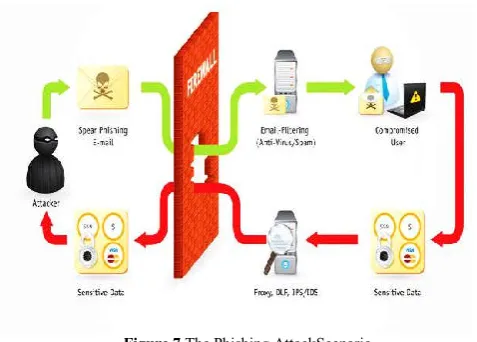
The Phishing scams are the most familiar Blockchain attacks due to their spreading and favorable outcome rate. Phishing attacks endeavor to gain sensitive, confidential information such as credit card information, usernames, passwords, network credentials, shown in figure 7. Think about the Iota cryptocurrency. The sufferer lost $4 million in a phishing scam that lasted a number of months. The service worked as advertised and enabled sufferer [62] to triumphantly create and use their wallets as expected, providing a false sense of security and faith. The attacker then waited, perseveringly taking benefit of the building faith. After six months, the attacker collected logs, which included secret seeds, and then commence the attack. Using the information earlier stolen, the attacker transferred all funds from the sufferer wallets. The phishing attempts most often begin with an email attempting to instate sensitive information through any user interaction, such as downloading an infected attachment or clicking on a malicious link.
Figure 7 The Phishing AttackScenario
MalwareIncidents on Blockchain system
The malware that compromises an institution’s data or harm the institution’s information systems can be introduced in a heterogeneity of ways. A malware attack is a type of cyber attack in which malware or malicious software performs activities on the sufferer computer system, usually without his/her knowledge. They were the primary tool used by nasty performers to obtain cryptocurrency. The ransom ware was not new but became a pleasing due to the advantage of transferring and conceal funds through cryptocurrencies. The cybercriminals also had effortless access tools, in particular Hidden Tear, which [63] was meant to be an educational tool on ransom ware but was rapidly used by nasty performers to build hundreds of variants. Malicious performers began experimenting with different type of choice cybercurrencies, also known as altcoins. The ransom ware G and Crabdiscarded Bitcoin in the grace of Dash. GandCrab was added in to the famous RIG exploit kit, along with a different type of malware. GandCrab and other malware launched continual attacks against Adobe Flash Player and Microsoft Internet Explorer via malvertising.
Tor Man-in-the Middle Incidents on Blockchain system
International Journal of Recent Scientific Research
BGP Hijacking Incidents on Blockchain system
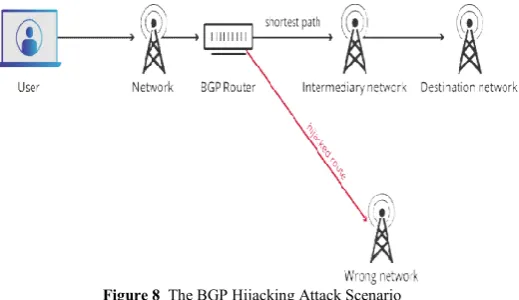
BGP (Border Gateway Protocol) is a practically routing protocol and regulates how IPpackets are forwarded to their destination. To inhibit the network traffic of Blockchain, attackers either leverage or manipulate BGP routing shown in figure 8. The BGP hijacking generally needs the
network operators, which could potent opportunity to latency network messages.
pervasively analyze the influence of routing attacks, including both network-level and node-level attacks, on Bitcoin, and show that the number of the triumphingly to
internet prexes depends on the distribution of mining power. Because of the high centralization of some Bitcoin mining pools [66], if they are attacked by BGP hijacking,
worthy of attention effect. The attackers can effectively divide the Bitcoin network, or latency the speed of block propagation.
Figure 8 The BGP Hijacking Attack Scenario
Stealing of the Keys Incidents on Blockchain system
For all systems, the stealing of passwords or other access devices through different forms of attack is a common and recurring issue. Blockchains are no different. The majority of attacks belonging to Blockchains[67] have been designed to steal cryptographic keys, not inevitably attack the Blockchainsit self. This experience underscores the significance of enterprise key management to decrease the risk of stolen or compromised keys.
CryptojackingIncidents on Blockchain system
The Cryptojacking is the technique of hijacking a browser mine cryptocurrency and has astonishingly shown a resurgence. Similar toransomware, cryptojacking campaigns experimented with altcoins. Since 2017, the Archive Poster plug
Chrome browser was found to be mining Monero coins without permission [68]. The sufferer first learned of the problem when some started complaining of high CPU usage. By that period more than 110,000 people had downloaded the miner. At least four versions of the application included the cryptojackingJavaScript code from Coinhive, which comfortably embeds mining into websites or tools, fundamentally with aneasy to-use
open-Cryptojackinginhabit in a gray area. Despite that, many sites do not expose mining, and visitors are left precarious about retard performance.
Web Application Incidents on Blockchain system
Attacks are aimed a web applications are often an outset step in mining private data and credentials that are used by hackers to
International Journal of Recent Scientific Research Vol. 9, Issue, 11(A), pp. 29472-29493, November, 2018
BGP Hijacking Incidents on Blockchain system
BGP (Border Gateway Protocol) is a practically routing es how IPpackets are forwarded to their To inhibit the network traffic of Blockchain, attackers either leverage or manipulate BGP routing shown in figure 8. The BGP hijacking generally needs the control of network operators, which could potentially seize the Maria et al. [65] pervasively analyze the influence of routing attacks, including level attacks, on Bitcoin, and show that the number of the triumphingly to-be-hijacked ternet prexes depends on the distribution of mining power. the high centralization of some Bitcoin mining pools [66], if they are attacked by BGP hijacking, it will have a worthy of attention effect. The attackers can effectively divide latency the speed of block propagation.
The BGP Hijacking Attack Scenario
Stealing of the Keys Incidents on Blockchain system
For all systems, the stealing of passwords or other access attack is a common and recurring issue. Blockchains are no different. The majority of attacks belonging to Blockchains[67] have been designed to steal cryptographic keys, not inevitably attack the self. This experience underscores the cance of enterprise key management to decrease the risk
CryptojackingIncidents on Blockchain system
The Cryptojacking is the technique of hijacking a browser to mine cryptocurrency and has astonishingly shown a resurgence. campaigns experimented with altcoins. Since 2017, the Archive Poster plug-in for the Chrome browser was found to be mining Monero coins without permission [68]. The sufferer first learned of the problem when ed complaining of high CPU usage. By that period more than 110,000 people had downloaded the miner. At least four versions of the application included the cryptojackingJavaScript code from Coinhive, which comfortably embeds mining into websites or tools, -source API. The Despite that, many sites do not expose mining, and visitors are left precarious about retard
Web Application Incidents on Blockchain system
Attacks are aimed a web applications are often an outset step in mining private data and credentials that are used by hackers to
compromise data on other systems [69]. Depending on the volume of data that is being used to benefit further access, data gleaned from a web application attack can form part of an advanced brute force attack that leverages purloin usernames and passwords to benefit access to customer accounts. In this type of attack known as credential stuffing purloin login credentials are serially and frequently input into the login fields on a website using automated scripts or alter software in order to gain access. Once the hacker triumphingly
account using a purloin username and password, the hacker has access to the financial data and account funds.
Dictionary Incidents on Blockchain system
Dictionary attacks have been around for a period of ten years. Generally, they attempt to break a sufferer password or other authentication mechanism [70]. The dictionary attack extraordinarily a rainbow table attack.
password for an online account, the service provider should not accumulate the password in plain text. As an alternative, it should take a cryptographic hash of the password and store its value. For example, if we use the highly insecure password, the server may protect it as 6baa61e4c9b93f3f0682250b6c, which is the SHA-1 hash of the password
hashing algorithms and other method, like
this more secure. In spite of, consider what happens if attackers see the preceding string. They might identify that string as the hash for the password. Despite the fact that,
arduous to detect a string based on a hash, the reverse is not real. Detect the hash for a string is extremely convenient using a command-line interpreter such as Bash.
Eclipse Incidents on Blockchain system
The Eclipse attacks are a type of network attack that purpose at eclipsing certain nodes from the entire peer
This clearly means, monopolizing a node connectionso that it doesn’t receive information from any nodes other than the attacking nodes. In contrast to Eclipse attacks are primarily focused on attacking single nodes rather the entire network at once [71].The primus afraid of Eclipse attacks are the attacks that can come after. The eclipse attack assent an attacker to monopolize all of the sufferer incoming and outgoing connections, which disassemble the sufferer from the other peers in the network [72]. Then, the att
sufferer’s view of the Blockchain, or let the sufferer’s redundant computing power on outdated views of the Blockchain. Additionally, the attacker is able to leverage the sufferer’s computing power to conduct its own malicious act Ethan et al. [73] think of two types of eclipse attack on Bitcoin's peer-to-peer network, such asbotnet attack and infrastructure attack. The botnet attack is launched from bots with miscellaneous IP address ranges and secondly infrastructure attack models the threat from an ISP, company or nation-state that has confluent IP addresses. The Bitcoin network might tolerate from disintegration and a sufferer’s view of the Blockchain will be filtered due to the eclipse attack.
Distributed Denial of Service ( Blockchain system
Distributed Denial of Service (DDoS) attacks
foremost target huge organizations. Using botnets9 or other conciliate systems, a DDoS attack sends a stream of traffic and
29493, November, 2018
compromise data on other systems [69]. Depending on the volume of data that is being used to benefit further access, data ed from a web application attack can form part of an advanced brute force attack that leverages purloin usernames and passwords to benefit access to customer accounts. In this type of attack known as credential stuffing purloin login ly and frequently input into the login fields on a website using automated scripts or alter software in order to gain access. Once the hacker triumphingly accesses an account using a purloin username and password, the hacker has
a and account funds.
Dictionary Incidents on Blockchain system
Dictionary attacks have been around for a period of ten years. Generally, they attempt to break a sufferer password or other authentication mechanism [70]. The dictionary attack ily a rainbow table attack. When we create a password for an online account, the service provider should not accumulate the password in plain text. As an alternative, it should take a cryptographic hash of the password and store its we use the highly insecure password, the server may protect it as 6baa61e4c9b93f3f0682250b6c, which 1 hash of the password string. We can use different hashing algorithms and other method, like as salting, to make consider what happens if attackers see the preceding string. They might identify that string as the Despite the fact that, in most cases it is arduous to detect a string based on a hash, the reverse is not string is extremely convenient using line interpreter such as Bash.
Eclipse Incidents on Blockchain system
The Eclipse attacks are a type of network attack that purpose at certain nodes from the entire peer-to-peer network. rly means, monopolizing a node connectionso that it doesn’t receive information from any nodes other than the attacking nodes. In contrast to Eclipse attacks are primarily focused on attacking single nodes rather the entire network at afraid of Eclipse attacks are the attacks that can come after. The eclipse attack assent an attacker to monopolize all of the sufferer incoming and outgoing connections, which disassemble the sufferer from the other peers in the network [72]. Then, the attacker can filter the view of the Blockchain, or let the sufferer’s cost redundant computing power on outdated views of the Blockchain. Additionally, the attacker is able to leverage the sufferer’s computing power to conduct its own malicious acts. . [73] think of two types of eclipse attack on peer network, such asbotnet attack and infrastructure attack. The botnet attack is launched from bots with miscellaneous IP address ranges and secondly els the threat from an ISP, company or state that has confluent IP addresses. The Bitcoin network might tolerate from disintegration and a sufferer’s view of the Blockchain will be filtered due to the eclipse attack.
Distributed Denial of Service (DDoS) Incidents on
data to a targeted website to overload the system and for the moment or [74] for all time disrupt system operations shown in figure 9. In a Blockchains network, the cyber security controls underlie at each node provide an additional layer of security that contributes circumference defense and defense in depth for the network.
Figure 9 The Distributed Denial of Service (DDoS) Attack
Balance Incidents on Blockchain system
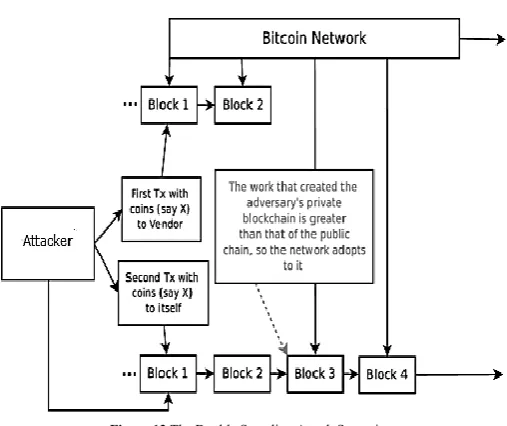
The Christopher et al. [75] proposed the balanced attack against POW-based Blockchain, which permits a low-mining-power attacker to momently interrupt communications between subgroups with identical mining power. The Blockchain into a DAG (Directed Acyclic Graph) tree, in which DAG = < B; E>. B is the nodes pointing blocks' information, and they are connected through direct edges E. After introducing a latency between correct sub groups of counterpart mining power, the attacker matter transactions in one subgroup and mines blocks in another suborder called block subgroup, to promise that the tree of block subgroup overburden the tree of transaction subgroup. Even though the transactions are committed, the attacker is able to overburden the tree containing this transaction and rewrite blocks with high probability. The balance attack inherently infringes the stubbornness of the main branch prefix and permits double spending. The attacker necessity to identify the merchant-associated with subgroup and create transactions to purchase goods from those merchants. Later on, the attacker matter transactions to this subgroup and propagates the mined blocks to the rest nodes of the group. While the merchant ship goods, the attacker stops delaying messages [76]. The attacker could triumphinglyreissue another transaction using precisely the same coins. The balance attack signalizes that POW-based blockchain is block unaware of.
Man-in-the-Middle (MITM) Incidents on Blockchain system
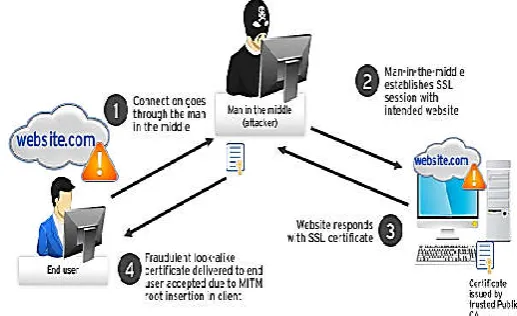
A Man-in-the-Middle (MITM)attack include an unauthorized actor positioning its system or access tool in transmissions between a user and a faith party in order to capture or impede datashown in figure 10. This can happen in any form of online communication,like asemail, web surfing, social media, etc. Not only are they trying to eavesdrop on your private conversations, they can also target all the information internally your devices. There are two types of MITM attacks [77]. A normal attack involves an unauthorized actor within the physical closeness of the target who can gain access to an unsecured network, like as a Wi-Fi router. The second type is commonly referred to as a “Man-in-the-Browser” attack and
involves the use of malware, which is injected into an uncircumcised user’s [78] system and, without the knowledge of the user, records the data that is being sent to a faith third party website, such as a bank.
Figure 10 The Man-in-the-Middle (MITM) Attack
LivenessIncidents on Blockchain system
Aggelos et al. [79] introduced the liveness attack, which is able to delay as much as possible the verification time of a target transaction. They also present two instantiations of such attack on Ethereumand Bitcoin. Liveness attack be made up of three phases, namely attack preparation phase, transaction denial phase, and Blockchain retarder phase. In attack preparation phase such as selfish mining attack, an attacker builds advantage over truthful miners in some way before the target transaction TX is broadcasted to the public chain. The attacker builds the private chain, which is longer than the public chain shown in figure 11.
Figure 11 The Liveness Attack Scenario
In secondly transaction denial phase the attacker personally holds the block that contains TX, in order to prevent TX from being written into the public chain. In thirdly Blockchain retarder phase growth process of the public chain, TX will no longer be able to be personally held at a certain time. In this phenomena, the attacker will publish the block that contains TX. In some Blockchain systems, when the depth of the block that contains TX is greater than a stable, TX will be consideredvalid. For that reason, the attacker will continue building private chain in order to build a gain over the public chain. Later on, the attacker will publish her personally held blocks into public chain in suitable time to decelerate the rise rate of public chain.
Routing Incidents in Blockchain system