The Thirty-Third AAAI Conference on Artificial Intelligence (AAAI-19)
A PSPACE Subclass of Dependency
Quantified Boolean Formulas and Its Effective Solving
∗Christoph Scholl,
1Jie-Hong Roland Jiang,
2Ralf Wimmer,
1,3Aile Ge-Ernst
1 1Albert-Ludwigs-Universit¨at Freiburg, Freiburg im Breisgau, Germany2National Taiwan University, Taipei, Taiwan
3Concept Engineering GmbH, Freiburg im Breisgau, Germany {scholl, wimmer, geernsta}@informatik.uni-freiburg.de, [email protected]
Abstract
Dependency quantified Boolean formulas (DQBFs) are a pow-erful formalism, which subsumes quantified Boolean formulas (QBFs) and allows an explicit specification of dependencies of existential variables on universal variables. This enables a succinct encoding of decision problems in the NEXPTIME complexity class. As solving general DQBFs is NEXPTIME complete, in contrast to the PSPACE completeness of QBF solving, characterizing DQBF subclasses of lower compu-tational complexity allows their effective solving and is of practical importance.
Recently a DQBF proof calculus based on a notion of fork extension, in addition to resolution and universal reduction, was proposed by Rabe in 2017. We show that this calculus is in fact incomplete for general DQBFs, but complete for a subclass of DQBFs, where any two existential variables have either identical or disjoint dependency sets over the universal variables. We further characterize this DQBF subclass to be ΣP3 complete in the polynomial time hierarchy. Essentially
us-ing fork extension, a DQBF in this subclass can be converted to an equisatisfiable 3QBF with only a linear increase in for-mula size. We exploit this conversion for effective solving of this DQBF subclass and point out its potential as a general strategy for DQBF quantifier localization. Experimental re-sults show that the method outperforms state-of-the-art DQBF solvers on a number of benchmarks, including the 2018 DQBF evaluation benchmarks.
1
Introduction
During the last two decades an enormous progress in the solution of quantifier-free Boolean formulas (SAT) has been observed. Nowadays, SAT solving is successfully used in many application areas, e. g., in planning (Rintanen, Heljanko, and Niemel¨a 2006), automatic test pattern generation (Eg-gersgl¨uß and Drechsler 2012; Czutro et al. 2010), and formal verification of hard- and software systems (Biere et al. 2003; Clarke et al. 2001; Ivancic et al. 2008). Motivated by the suc-cess of SAT solvers, efforts, e. g., (Lonsing and Biere 2010;
∗This work was partly supported by the German Research
Foun-dation (DFG) within the project ‘Solving Dependency Quantified Boolean Formulas’ and the Ministry of Science and Technology of Taiwan. JHJ was supported in part by the Alexander von Humboldt Foundation during this work.
Copyright c⃝2019, Association for the Advancement of Artificial Intelligence (www.aaai.org). All rights reserved.
Janota et al. 2012; Janota and Marques-Silva 2015; Tentrup and Rabe 2015), have been made to consider the more general formalism of quantified Boolean formulas (QBFs).
Although QBFs are capable of encoding decision prob-lems in the PSPACE complexity class, they are not pow-erful enough to succinctly encode many natural and prac-tical problems that involve decisions under partial infor-mation. For example, the analysis of games with incom-plete information (Peterson, Reif, and Azhar 2001), topo-logically constrained synthesis of logic circuits (Balabanov, Chiang, and Jiang 2014), synthesis of safe controllers (Bloem, K¨onighofer, and Seidl 2014), synthesis of fragments of linear-time temporal logic (Chatterjee et al. 2013), and verification of partial designs (Scholl and Becker 2001; Gitina et al. 2013) fall into this category and require an even more general formalism known asdependency quanti-fied Boolean formulas (DQBFs)(Peterson, Reif, and Azhar 2001).
Unlike QBFs, where an existential variable implicitly de-pends on all the universal variables preceding its quantifica-tion level, DQBFs admit the dependency sets being explicitly specified. Essentially the dependency specifiable quantifica-tions correspond to Henkin quantifiers (Henkin 1961). The se-mantics of a DQBF can be interpreted from a game-theoretic viewpoint as a game played by one universal player and multiple non-cooperative existential players with incomplete information, each partially observing the moves of the uni-versal player as specified by his/her own dependency set. A DQBF is true if and only if the existential players have winning strategies. This specificity of dependencies allows DQBF encodings to be exponentially more compact than their equivalent QBF counterparts. In contrast to the PSPACE-completeness of QBF, the decision problem of DQBF is NEXPTIME-complete (Peterson, Reif, and Azhar 2001).
Driven by the needs of the applications mentioned above, research on DQBF solving has emerged in the past few years, leading to solvers such asIDQ (Fr¨ohlich et al. 2014) and
HQS (Gitina et al. 2015; Wimmer et al. 2015; Wimmer et al. 2017). Due to the high worst-case complexity of DQBF solving, identifying special DQBF structures, as we do in this paper, may provide insights for solver improvement.
As an example for a DQBF, consider the formula
∀x1∀x2∃y1(x1)∃y2(x2) : (x1∧x2)≡(y1≡y2)
throughout this paper. The DQBF asks whether there are choices fory1only depending on the value ofx1, denoted y1(x1), and fory2 only depending onx2, denotedy2(x2),
such that the Boolean formula after the quantifier prefix eval-uates to true for all assignments tox1andx2.1The Boolean
formula in turn states that the existential variablesy1andy2
have to be equal iffx1andx2are true. Sincey1can only
‘see’x1 andy2 onlyx2,y1andy2 ‘cannot coordinate’ to
satisfy the constraint. Thus, the formula is false. However, a straightforward translation of this DQBF into a QBF with only implicit dependency sets will not work. Changing the quantifier prefix into a QBF quantifier prefix∀x1∃y1∀x2∃y2
means thaty1may depend onx1, buty2may depend onx1
andx2. In that case the formula would be true. Changing the
prefix into∀x2∃y2∀x1∃y1has a similar effect.
In this paper, we look into a technique for DQBF solving called fork extension, which has been presented in (Rabe 2017). Rabe uses fork extension in an attempt to turn resolu-tion and universal reducresolu-tion (Kleine B¨uning, Karpinski, and Fl¨ogel 1995) into a complete proof system for DQBF, which he calls fork resolution. Here we show that (in contrast to the statement in (Rabe 2017)) fork resolution is incomplete.
However, we use the technique of fork extension to show that a certain non-trivial subclass of DQBF (DQBF with pair-wise disjoint or identical dependency sets) is in PSPACE (or more precisely: it isΣP3 complete). In fact, we show that
for-mulas from this subclass can be converted into equisatisfiable QBFs with three quantifier levels, needing only a linear in-crease in formula size. Note that the above example falls into this DQBF subclass. In addition, for practical application we point out the potential usage of fork extension as a general strategy for DQBF quantifier localization.
To obtain a better characterization of subclasses of DQBF which are in PSPACE and others which are already NEXPTIME-complete, we consider a ‘slightly extended’ sub-class (allowing dependency sets with all universal variables in addition) and show that this subclass is already NEXPTIME-complete. In addition, we prove that for both considered subclasses of DQBF the proof system with fork extension is complete.
Finally, we exploit the formula conversion technique to improve DQBF solvers by solving formulas efficiently in case that an initial test reveals that they belong to the spe-cial subclasses. Experimental results show that our method outperforms state-of-the-art DQBF solvers on a number of benchmarks, including the 2018 DQBF evaluation bench-marks (Pulina and Seidl 2018). The contributions of this work are thus twofold: providing a better understanding of DQBF complexity on the theoretical side and advancing DQBF solver technology on the practical side.
The paper is structured as follows: Sect. 2 presents the foundations of DQBF and Rabe’s fork resolution calculus. In Sect. 3 we prove that the fork resolution calculus is in-complete. We present and analyze two sub-classes of DQBF regarding their complexity in Sect. 4. Sect. 5 shows that fork
1We can interpret this as agameplayed byy
1andy2against
x1andx2, wherey1andy2only have incomplete information on
actions ofx1,x2, respectively.
resolutioniscomplete for these classes. Experimental results are presented in Sect. 6. Sect. 7 concludes this paper and outlines future work.
2
Foundations
2.1
DQBF and QBF
Dependency quantified Boolean formulas are obtained by prefixing Boolean formulas with the so-called Henkin quan-tifiers (Henkin 1961).
Definition 1 (Syntax of DQBF). Let V = {x1, . . . , xn, y1, . . . , ym} be a finite set of Boolean variables. A dependency quantified Boolean formula (DQBF) ψ
over V has the form ψ := Q : φ, where
Q = ∀x1. . .∀xn∃y1(Dy1). . .∃ym(Dym), with Dyi ⊆
{x1, . . . , xn} being the dependency set of yi for i =
1, . . . , m, is called the(quantifier) prefix, andφ, a quantifier-free Boolean formula overV, is called thematrixofψ.
We denote the set of universal variables by Vψ∀ = {x1, . . . , xn}and the set of existential variables byVψ∃ =
{y1, . . . , ym}. We define the dependency function dep : V →2V to bedep(v) =Dvifv∈Vψ∃, anddep(v) ={v} if v ∈ Vψ∀. Moreover, as the order of the variables in the
prefixQdoes not matter due to the explicit specification of
dependency sets, we regardQas a set. Thereby, the notation Q\ {v}with a variablev ∈V denotes the prefix resulting
fromQby removing the variablevtogether with its
quan-tifier (as well as its dependency set in casevis existential,
and all its occurrences in dependency sets if it is universal). Similarly, the notationQ∪{
∃y(Dy)}denotes adding an existential variabley(and universal quantifiers for variables
that are inDybut not inVψ∀) to the prefix.
The semantics of a DQBF is typically defined in terms of so-called Skolem functions. Let[[V]]denote the set of truth
assignments to variablesV.
Definition 2(Semantics of DQBF). A DQBFψdefined as above issatisfiableif and only if there exist functionssy :
[[Dy]]→Bfory∈Vψ∃, calledSkolem functionsofψ, such
that replacing inφeach existential variableywith (a Boolean expression overDyfor)syturnsφinto a tautology.
Deciding whether a given DQBF is satisfiable is NEXPTIME-complete (Peterson, Reif, and Azhar 2001).
Definition 3(Equisatisfiability of DQBFs). Two DQBFsψ
andψ′are calledequisatisfiableif they are either both satis-fiable or both unsatissatis-fiable.
An important special case of DQBFs is known as quanti-fied Boolean formulas. They exhibit a linearly ordered quan-tifier prefix, where each existential variableydepends on all
universal variables in whose scope it is:
Definition 4 (Syntax of QBF, Equivalent DQBF). Let
V = {x1, . . . , xn, y1, . . . , ym} be a finite, non-empty set
of Boolean variables,X1, . . . , Xk ⊆ {x1, . . . , xn} a
par-tition of {x1, . . . , xn}such thatXi ̸= ∅fori = 2, . . . , k,
andY1, . . . , Yk⊆ {y1, . . . , ym}a partition of{y1, . . . , ym}
φbe a quantifier-free Boolean formula overV. A quanti-fied Boolean formula (QBF) Ψ(in prenex form) is given by Ψ := ∀X1∃Y1∀X2∃Y2. . .∀Xk∃Yk : φ. The QBF Ψ
is equivalent to the DQBFψ := ∀x1. . .∀xn∃y1(Dy1). . .
∃ym(Dym) : φ, withDyi = ⋃Lℓ=1Xℓ such thatL is the
unique index withyi ∈ YL. In this case we say that the
DQBFψ‘can be written as a QBFΨ’ or the DQBFψ‘has an equivalent QBF prefix’.
Lemma 1((Gitina et al. 2015)). A DQBFψhas an equiv-alent QBF prefix ifDy ⊆Dy′ orDy′ ⊆Dy holds for all y, y′ ∈Vψ∃.
QBFs, with PSPACE-complete complexity (Meyer and Stockmeyer 1973), can be solved more efficiently than gen-eral DQBFs. There are well-known QBF solvers, such as DepQBF (Lonsing and Biere 2010; Lonsing and Egly 2014), AIGSolve (Pigorsch and Scholl 2009; Pigorsch and Scholl 2010), RAReQS (Janota et al. 2012), Qesto (Janota and Marques-Silva 2015), and CAQE (Tentrup and Rabe 2015). In the following we assume that the matrixφis given in
conjunctive normal form(CNF). A formula is in CNF if it is a conjunction ofclauses; a clause is a disjunction ofliterals, and a literal is either a variablevor its negation¬v. We view
a formula in CNF as a set of clauses and a clause as a set of literals, e. g., we write{
{x1,¬x2},{x2,¬x3}}
for the for-mula(x1∨ ¬x2)∧(x2∨ ¬x3). We assume that none of the
clauses of the CNFφunder consideration is tautological, i. e.,
there is no variablevsuch that{v,¬v} ⊆Cfor allC∈φ.
For a literalℓ,var(ℓ)denotes the corresponding variable, i. e., var(v) = var(¬v) = v anddep(ℓ) = dep(
var(ℓ)).
More-over, for a clauseC = {ℓ1, . . . , ℓk}we definedep(C) =
∪k
i=1dep(ℓi)and for a CNFφ={C1, . . . , Cn}we define
dep(φ) =∪n
i=1dep(Ci).
Note that a DQBF can be transformed such that its ma-trix is in CNF. While transforming the mama-trix directly into CNF without introducing new variables can cause an ex-ponential blow-up in formula size, Tseitin transformation (Tseitin 1970) provides an alternative with only a linear in-crease in size at the cost of having additional existential variables. The idea is to introduce auxiliary existential vari-ables that store the truth values of sub-expressions. Because the values of these variables are uniquely determined by the sub-expressions, they may depend on all universal variables.
2.2
Universal Expansion, Resolution, Universal
Reduction, and Fork Extension
We give an overview on relevant techniques that are used in the literature in the context of DQBF solving.
Universal expansion, which has been defined for QBF, can be easily generalized to DQBF as observed, e. g., in (Bubeck and Kleine B¨uning 2006; Bubeck 2010; Balabanov, Chiang, and Jiang 2014; Gitina et al. 2013).
Definition 5 (Universal Expansion for DQBF). For a DQBFψ = ∀x1. . .∀xn∃y1(Dy1). . .∃ym(Dym) : φwith
Zxi = {yj ∈ Vψ∃
⏐
⏐xi ∈ Dyj}, performinguniversal ex-pansion on variable xi ∈ Vψ∀ in ψ yields a new prefix
(
Q\({xi} ∪⋃yj∈Zxi{yj}
)) ∪{
∃yjb(Dyj \ {xi})
⏐ ⏐yj ∈
Zxi, b ∈ {xi, xi}} and a new matrix φ[0/xi][yxji/yj]∧ φ[1/xi][yjxi/yj]for allyj ∈Zxi, whereφ[κ/v]denotes the
Boolean formula resulting fromφby replacing all occur-rences of variablevby Boolean expressionκ.
Definition 6(Resolution). Letφbe a formula in CNF,ℓa literal, andC, C′∈φclauses such thatℓ∈Cand¬ℓ∈C′. TheresolventofCandC′w. r. t. to thepivot literalℓis given byC⊗ℓC′:=(C\ {ℓ})∪(C′\ {¬ℓ}).
Resolvents are implied by the formula, i. e., ifRis a
resol-vent of two clauses inφ, thenφandφ∪ {R}are logically
equivalent (Biere et al. 2008, Sect. 3.2.1).
In (Wimmer et al. 2015) it has been proven that resolution can be used to eliminate existential variables from a DQBF under certain conditions (we mention only a subset here):
Theorem 1(Variable elimination by resolution). Lety∈Vψ∃
be an existential variable ofψ. We partition the matrixφinto the clause sets φy = {C ∈ φ|y ∈ C}, φ¬y = {C ∈ φ| ¬y∈C}, andφ∅=φ\(φy∪φ¬y).
If one of the following conditions is satisfied
1. for allC∈φyand allk∈Cwe havedep(k)⊆dep(y), 2. for all C′ ∈ φ¬y and all k ∈ C′ we have dep(k) ⊆
dep(y),
then ψ is equisatisfiable with ψ′ := Q\ {y} : φ∅ ∧ ⋀
C∈φy
⋀
C′∈φ¬y
C⊗yC′.
Universal reduction removes a universal variable from a clause if the clause does not contain any existential variable which depends upon it. This technique has been generalized to DQBF in (Balabanov, Chiang, and Jiang 2014; Fr¨ohlich et al. 2014).
Lemma 2(Universal reduction). LetQ:φ∧Cbe a DQBF andℓ ∈Ca universal literal such that for allk∈ Cwith
k ̸= ℓ we have var(ℓ) ̸∈ dep(k). Then Q : φ∧C and
Q:φ∧(
C\ {ℓ})
are equisatisfiable.
It has been shown that resolution together with universal reduction (which is called Q-Resolution or QRes for short) provides a complete proof system for QBF (Kleine B¨uning, Karpinski, and Fl¨ogel 1995). This result means that a QBF
Ψis unsatisfiable if and only if QRes can derive the empty
clause fromΨ. This statement isnottrue for DQBF as has been shown in (Balabanov, Chiang, and Jiang 2014). Rabe made the attempt to extend resolution with universal reduc-tion to a complete proof system by adding a new operareduc-tion calledfork extension. Fork extension is based on the follow-ing lemma (Rabe 2017):
Lemma 3(Splitting). Letψ=Q:φ∧(C1∪C2)be a DQBF containing a clauseC1∪C2and letybe a new variable not
occurring inψ. ThenψandQ∪{
∃y(dep(C1)∩dep(C2))}: φ∧(C1∪ {y})∧(C2∪ {¬y})are equisatisfiable.
Rabe applies the above splitting rule on clauses consisting of two partsC1andC2with incomparable dependency sets,
i. e., dep(C1) ̸⊆ dep(C2) anddep(C2) ̸⊆ dep(C1). We
3
Incompleteness of QResSplit
Theorem 1 in (Rabe 2017) claims that QResSplit is a sound and complete proof calculus for DQBF. Unfortunately, the completeness part is incorrect.
Theorem 2. QResSplit is incomplete for DQBF.
Proof. We show that QResSplit cannot deduce the unsatisfia-bility of the following DQBF:
∀x1∀x2∀x3∃y1(x1, x2)∃y2(x2, x3)∃y3(x1, x3) :
(x1∧x2∧x3)≡(y1⊕y2⊕y3).
where the symbol ‘⊕’ denotes the exclusive OR (XOR) opera-tion. The unsatisfiability of the DQBF can be seen as follows. We first rewrite the matrix as the conjunction of
(x1∧x2∧x3)→(y1⊕y2⊕y3) (1a)
(x1∧x2∧x3)←(y1⊕y2⊕y3) (1b)
Eq. (1b) can be written as the conjunction of
(¬x1)→ ¬(y1⊕y2⊕y3) (2a)
(¬x2)→ ¬(y1⊕y2⊕y3) (2b)
(¬x3)→ ¬(y1⊕y2⊕y3) (2c)
By universally expanding on all universal variables the DQBF with its matrix re-expressed by Eq. (1a), (2a), (2b), (2c) can be rewritten as the conjunction of the following linear equations over GF(2) (Han and Jiang 2012).
yx1x2
1 ⊕y x2x3
2 ⊕y x1x3
3 = 1 (3a)
yx1x2
1 ⊕y x2x3
2 ⊕y x1x3
3 = 0 (3b)
yx1x2
1 ⊕y x2x3
2 ⊕y x1x3
3 = 0 (3c)
yx1x2
1 ⊕y x2x3
2 ⊕y x1x3
3 = 0 (3d)
yx1x2
1 ⊕y x2x3
2 ⊕y x1x3
3 = 0 (3e)
yx1x2
1 ⊕y x2x3
2 ⊕y x1x3
3 = 0 (3f)
yx1x2
1 ⊕y x2x3
2 ⊕y x1x3
3 = 0 (3g)
yx1x2
1 ⊕y x2x3
2 ⊕y x1x3
3 = 0 (3h)
It can be verified through Gaussian elimination that the sys-tem of linear equations has no solution, and thus the original DQBF is unsatisfiable.
On the other hand, to see the limitation of QResSplit, the matrix of the DQBF should be expressed in CNF with the following clauses
(y1∨y2∨y3∨x1∨x2∨x3)
(y1∨y2∨y3∨x1∨x2∨x3)
(y1∨y2∨y3∨x1∨x2∨x3)
(y1∨y2∨y3∨x1∨x2∨x3)
(y1∨y2∨y3∨x1) (y1∨y2∨y3∨x2) (y1∨y2∨y3∨x3)
(y1∨y2∨y3∨x1) (y1∨y2∨y3∨x2) (y1∨y2∨y3∨x3)
(y1∨y2∨y3∨x1) (y1∨y2∨y3∨x2) (y1∨y2∨y3∨x3)
(y1∨y2∨y3∨x1) (y1∨y2∨y3∨x2) (y1∨y2∨y3∨x3)
The following observations can be made.
1. Universal reductions are not applicable to any clause, since in each clause all universal variables occur in the dependency sets of the existential variables.
2. All resolvents for pairs of clauses are tautologies. 3. Fork extension is inapplicable, because any partition of a
clauseCinto two partsC1andC2does not yield
incompa-rable dependency sets, that is, eitherdep(C1)⊆dep(C2)
ordep(C2)⊆dep(C1).
Consequently, it is not possible to derive the empty clause by QResSplit from this DQBF.
4
Classes DQBF
de, DQBF
de+, and DQBF
decIn this section, we define two main non-trivial sub-classes of DQBFs which we call DQBFdeand DQBFdec.2DQBFde
contains all DQBFs where the dependency sets of the existen-tial variables are either pairwise equal or disjoint. DQBFdec
extends DQBFdeby additionally allowing dependency sets
containingalluniversal variables. Formally,
Definition 7 (DQBFde and DQBFdec). A DQBF ψ := ∀x1. . .∀xn∃y1(Dy1). . .∃ym(Dym) :φwithφin CNF be-longs to DQBFdeiff for all pairs of existential variablesy
i
andyj (1 ≤ i, j ≤m)Dyi =Dyj orDyi ∩Dyj = ∅.ψ
belongs to DQBFdeciff for all pairs of existential variables
yiandyj(1≤i, j ≤m)Dyi =Dyj orDyi∩Dyj =∅or Dyi={x1, . . . , xn}orDyj ={x1, . . . , xn}.
In the following, we prove that DQBFdecan be reduced
to QBF and is thus in PSPACE. In contrast, the ‘slightly extended’ class DQBFdecturns out to be an NEXPTIME
complete subclass of DQBF (i. e., it is equivalent to DQBF in terms of complexity).
Theorem 3. DQBFdeis in PSPACE.
The proof is constructive and transforms a DQBF in DQBFde into an equisatisfiable QBF. The conversion
pro-ceeds according to the following Alg. 1.
input :DQBFψ:=Q:φ,ψ∈DQBFde,
Q:=∀x1. . .∀xn∃y1(Dy1). . .∃ym(Dym),
φin CNF, clauses inφuniversally reduced output :Equisatisfiable 3QBF
1 while∃C∈φ, ℓ1∈C∩Vψ∃withdep(ℓ1)̸=∅and
dep(C)\dep(ℓ1)̸=∅do
2 C1:={ℓ∈C| dep(ℓ)⊆dep(ℓ1)};C2:=C\C1; 3 t:=new variable withdep(t) =∅;
4 φ:= (φ\C)∪ {C1∪ {t}} ∪ {C2∪ {¬t}}; 5 Q:=Q∪ {∃t(∅)};
6 {t1, . . . tk}:={v∈Q|v∈Vψ∃,dep(v) =∅}; 7 {w1, . . . wm′}:={v∈Q|v∈Vψ∃,dep(v)̸=∅}; 8 return∃t1, . . .∃tk∀x1. . .∀xn∃w1. . .∃wm′ :φ;
Algorithm 1:Convert DQBFdeinto 3QBF.
Proof. We consider a DQBF in DQBFdeas given in Alg. 1. W. l. o. g. we assume that the clauses inφare already
univer-sally reduced according to Lemma 2. The dependency sets ofy1, . . . , ymformknon-empty disjoint setsD1, . . . , Dkor knon-empty disjoint setsD1, . . . , Dktogether with∅.
In lines 1–5 we apply fork extension to ψ as long as φ contains a clauseC with an existential literal ℓ1 ∈ C,
dep(ℓ1)̸=∅, anddep(C)\dep(ℓ1)̸=∅. In that case (due
to universal reduction)Chas to contain at least a second
ex-istential literalℓ2withdep(ℓ2)̸=∅anddep(ℓ2)̸= dep(ℓ1)
(and thusdep(ℓ2)∩dep(ℓ1) =∅, sinceψis in DQBFde). By
fork extension we splitCintoC1∪ {t}andC2∪ {¬t}(tis
a new existential variable).C1contains all existential literals
2‘de’ stands for ‘disjoint or equal dependency sets’ and ‘dec’ for
fromCwith the same dependency set asℓ1, all existential
literals fromCwith empty dependency sets, and all
univer-sal literals fromCwhich are indep(ℓ1). By construction,
dep(C1)∩dep(C2) = ∅ and thereforedep(t) = ∅. Fork
extension is performed until the condition mentioned above does not hold for any clause. We call the result after all fork extensionsψ′and the corresponding matrixφ′.
The clauses of φ′ can now be partitioned into k + 1
setsP0, P1, . . . , Pk.P0is possibly empty and contains only
clausesC withdep(C) = ∅. EachPi with 1 ≤ i ≤ k is non-empty and contains only clausesCiwithdep(Ci) =Di, i. e., for all existential literalsℓ∈Ciwe havedep(ℓ) =Di ordep(ℓ) = ∅, for all universal literalsµ ∈ Ci we have
var(µ)∈Di. Now it is easy to see that all existential
vari-ablesyoccurring inPiwith1≤i≤kanddep(y) =Dican be eliminated by resolution according to Thrm. 1. ClausesCi withyor¬yonly occur inPi. As shown above, for all literals k∈Ciwe havedep(k)⊆Di= dep(y)and thus,ysatisfies conditions 1)and2) of Thrm. 1; 1) or 2) would already be sufficient according to Thrm. 1. LetPiy ={C∈Pi|y∈C}, Pi¬y={C∈Pi| ¬y∈C}, andPi∅=Pi\(Piy∪P
¬y i ). It is important to note that elimination ofyby resolution replaces PibyPi′=Pi∅∧
⋀
C∈Py i
⋀
C′∈P¬y i
C⊗yC′and therefore after elimination ofy we still have the property that all literals kinP′
i have dependency setsdep(k)⊆Di. Thus, variable elimination of existential variables can be performed in any arbitrary order for all existential variables with non-empty dependency setsDi.
The consideration above implies that replacing all depen-dency setsDi̸=∅inψ′by the set{x1, . . . , xn}of all univer-sal variables leads to an equisatisfiable DQBF. This simply follows from the fact that variable elimination by resolution forydepending onDiand forydepending on{x1, . . . , xn} would lead toexactly the same results. After this transforma-tionψ′ has three groups of variables: Existential variables
depending on∅, including the new variables introduced by fork extension and calledt1, . . . tkin line 6 of Alg. 1, univer-sal variablesx1, . . . , xn, and existential variables depending on{x1, . . . , xn}, calledw1, . . . wm′ in line 7. Now it is easy to see that this DQBF can be written as a QBFψ′′with only
three quantifier levels, see line 8.
The size ofψ′′is linear in the size of the original DQBFψ,
since the number of needed fork extensions is limited by the number of occurrences of existential literals with non-empty dependency sets inψ. Since the decision problem for QBF is
in PSPACE, DQBFdeis in PSPACE as well.
Example 1. We consider the DQBF
∀x1∀x2∃y1(x1)∃y2(x2) : (x1∧x2)≡(y1≡y2).
which is in DQBFde. Translating the matrix φinto CNF results in
(y1∨y2∨x1∨x2)∧(y1∨y2∨x1∨x2)∧(y1∨y2∨x1)
∧(y1∨y2∨x2)∧(y1∨y2∨x1)∧(y1∨y2∨x2).
Because the first clauseC =y1∨y2∨x1∨x2contains
variables with incomparable dependency sets, we have to split it intoC1=y1∨x1andC2=y2∨x2and replace it by
t1∨y1∨x1andt1∨y2∨x2with a new variablet1depending ondep(C1)∩dep(C2) =∅. Applying fork extension to all 6 clauses results in 12 clauses with 6 new variablest1, . . . , t6,
all with empty dependency sets:
(t1∨y1∨x1)
(t2∨y1∨x1)
(t3∨y1∨x1)
(t4∨y1)
(t5∨y1∨x1)
(t6∨y1)
(t1∨y2∨x2)
(t2∨y2∨x2)
(t3∨y2)
(t4∨y2∨x2)
(t5∨y2)
(t6∨y2∨x2)
The new matrixφ′can be partitioned into two setsP1and P2.P1corresponds to the left block of clauses above;P2 cor-responds to the right one. All clauses inP1have dependency
set{x1}; all clauses inP2have dependency set{x2}.
According to Thrm. 1 we can removey1by resolution from P1(and thus fromφ′) and we can removey2fromP2 (φ′).
This means that we can replace the dependency sets ofy1
andy2by{x1, x2}and we can write the DQBF as a QBF ∃t1. . .∃t6∀x1∀x2∃y1∃y2:φ′.
By having a closer look at the proof of Thrm. 3 we imme-diately observe that the theorem holds for an extended class DQBFde+:
Definition 8 (DQBFde+). A DQBF ψ := ∀x1. . .∀xn
∃y1(Dy1). . .∃ym(Dym) : φ with φ in CNF belongs to
DQBFde+iff for all pairs of existential variablesy
iandyj
(1 ≤i, j ≤m)occurring together in some clause ofφwe haveDyi=Dyj orDyi∩Dyj =∅.
Corollary 1. DQBFde+is in PSPACE and each DQBFψin DQBFde+can be transformed into an equisatisfiable 3QBF (a QBF with 3 quantifier levels).
The proof of Thrm. 3 actually gives us a precise character-ization of DQBFde+(or DQBFde) within the polynomial time
hierarchy (Stockmeyer 1976): On the one hand, each DQBF
ψin DQBFde+can be transformed in polynomial time into an
equisatisfiable 3QBF (a QBF with 3 quantifier levels). There-fore DQBFde+is inΣP
3. On the other hand, each 3QBF can
be viewed as a DQBF in DQBFde+, showing theΣP
3-hardness
of DQBFde+. Together we have: Corollary 2. DQBFde+isΣP3 complete.
In contrast, Thrm. 3 does not hold anymore, if we replace DQBFdeby the ‘slightly extended’ class DQBFdec. In fact,
we have:
Theorem 4. DQBFdecis NEXPTIME complete.
Proof. DQBFdecis in NEXPTIME, since DQBFdecis a sub-class of DQBF and DQBF is in NEXPTIME. Now we show that DQBFdec is NEXPTIME hard by showing that each
DQBF formula can be transformed into an equisatisfiable formula in DQBFdecby a polynomial transformation. The
proof can be led by considering that – according to (Gitina et al. 2013) – each DQBF formula can be regarded as a Par-tial Equivalence Checking Problem (PEC) and each PEC can be backtranslated into a DQBF. The backtranslation from (Gitina et al. 2013) in fact produces a formula from DQBFdec.
More specifically, we give a direct transformation. Let
xji a new copyxjji, leading to a new dependency setD′yj =
{xjj1, . . . , xjj
kj}. Since the dependency sets contain only new variable copies, it is clear that they are disjoint. It is easy to see that the non-CNF DQBF
ψ′:=∀x1. . .∀xn∀x111. . .∀x
1 1k1. . .∀x
m m1. . .∀x
m mkm
∃y1(Dy′1). . .∃ym(D
′ ym) :
(⋀m
j=1 kj
⋀
l=1
(xjjl≡xjl)
)
→φ (4)
andψare equisatisfiable. (The idea is that we requireφonly
to hold for assignments to the universal variables, where the copied variables have the same values as the original vari-ables.) The matrix ofψ′can be transformed into CNF either
using the laws of distributivity (with a potential exponential blow-up in size) or using Tseitin transformation with new Tseitin variables depending on all universal variables. The second option leads to an equisatisfiable formula in DQBFdec
which is polynomial in the size of the original formulaψ.
The proof shows that in Def. 7 it was essential to restrict DQBFdeto formulas with the matrix in CNF. The described
transformation in Eq. (4) allows us to make the dependency sets of all existential variables disjoint with a polynomial blowup of the formula – but it does not preserve the CNF structure of the matrix. If it did, Thrm. 3 would imply that NEXPTIME = PSPACE.
Quantifier Localization The 3QBFs resulting from fork
extension in the proof of Thrm. 3 have a special structure which allows to ‘localize quantifiers’, i. e., to restrict the scope of quantifiers tosubformulasof the matrix, leading to a non-prenex formula. QBF and DQBF solvers relying on formula rewriting like Q-Resolution and universal expansion profit from quantifier localization to a great extent, since the rewriting has to be done only for smaller subformulas.
For each setPi from the partition of clauses mentioned in the proof of Thrm. 3, the existential variables depending on Di as well as the universal variables from Di can be quantifiedlocallytoPi. E. g. for the DQBF from Ex. 1, after fork extension the clauses are partitioned into two setsP1
andP2 withdep(P1) = {x1}anddep(P2) = {x2}. With
quantifiers localized toP1andP2, the DQBF can be rewritten
into∃t1. . .∃t6:([∀x1∃y1:P1]∧[∀x2∃y2:P2]).
Skolem Functions For many applications not only DQBF
solving, but also the computation of Skolem functions is needed. Despite the equisatisfiability between the converted 3QBFs and their original DQBFs in DQBFde+, Skolem
func-tions derived by QBF solving may not necessarily meet the dependency set requirements due to the relaxed QBF depen-dency conditions. Fortunately, using the special structure of the converted 3QBFs allowing partitioning the matrix into setsPi, it is easy to prove that Skolem functions with the originally intended dependency sets can be recovered by sim-ply substituting the extra dependency variables in the 3QBF Skolem functions with arbitrary Boolean constants.
5
QResSplit for DQBF
deand DQBF
decIn Sect. 3 we have shown that the proof system QResSplit is not complete for DQBF. Having a closer look at the proof of Thrm. 3, we immediately see that QResSplit is complete both for DQBFde/ DQBFde+and for DQBFdec. The proof is
straightforward and much less involved than the (incorrect) proof attempt for Theorem 1 in (Rabe 2017).
Theorem 5. QResSplit is complete for DQBFde+ and for DQBFdec.
Proof. Let us consider a DQBF
ψ :=∀x1. . .∀xn∃y1(Dy1). . .∃ym(Dym) :φin DQBFdec. First, the existential variables depending on all universal vari-ables can be eliminated by resolution according to Thrm. 1.3
The result is a DQBFψ′in DQBFde⊆DQBFde+(which
may be exponentially larger thanψ). For each DQBFψ′in
DQBFde+fork extension exactly as in the proof of Thrm. 3
leads to a DQBFψ′′. It has been shown that all existential
variables with non-empty dependency sets can be eliminated by resolution fromψ′′. The resulting DQBFψ′′′ contains
only universal variables and existential variables with empty dependency sets. Then the universal variables can be removed by universal reduction, see Lemma 2. Finally, the remaining clauses to be considered form a SAT problem. There is a resolution proof deriving an empty clause from those clauses iff the remaining SAT problem is unsatisfiable.
6
Experiments
For our experiments we have used one core of an Intel Xeon CPU E5-2650v2 with 2.6 GHz. The runtime of all experi-ments was limited to 1800 s and the memory to 4 GB.
We start our experimental analysis by considering two sets of parameterized benchmarks with disjoint dependency sets. Both sets are generalizations of the DQBF in Ex. 1.
For the first set of parameterized benchmarks we defined a family of DQBFde formulasF0, F1, . . ., with the matrix
translated into CNF in a straigthforward manner.Fn is de-fined as Fn := QFn :
( ⋀n
i=0(xi1 ∧xi2) )
≡ ( yn
1 ≡ y2n )
. The prefixQFn contains universal variables from the sets X1n ={x01, . . . , xn1},X2n = {x02, . . . , xn2}. The existential variablesy1nandyn2 depend onX1nandX2n, respectively.Fn has2n+2universal and2existential variables. The second
setG0, G1, . . .is defined similarly, butGn has n2+3n+2 universal and2n+ 2existential variables.Gnis defined as Gn := QGn : ⋀
n
i=0ϕi withϕi = (⋀ij=0 (
xij,1∧xij,2)) ≡ (
y1i ≡ y2i). For
0≤i≤n the prefix QGn contains
univer-sal variables from the sets X1i = {xi1,1, . . . , xii,1},X2i = {xi1,2, . . . , xii,2}and existential variablesy1i andy2i
depend-ing onXi
1andX2i, resp. Note that bothF0andG0coincide
with our running example, which is a shortened version (Rabe 2017) of the formula used in (Balabanov, Chiang, and Jiang 2014) to prove that QRes is not complete for DQBF.
3For this completeness consideration, we actually do not have
500 1,000 1,500 2,000 10−2
10−1 100 101
102
n
Runtime
in
seconds HQS
iDQ RAReQS DepQBF CAQE
Qesto
Figure 1: DQBF Solvers vs. QBF Solvers for FamilyFn.
50 100 150 200 250 300
10−2 10−1
100 101
102
103
n
Runtime
in
seconds HQS
iDQ RAReQS DepQBF CAQE
Qesto
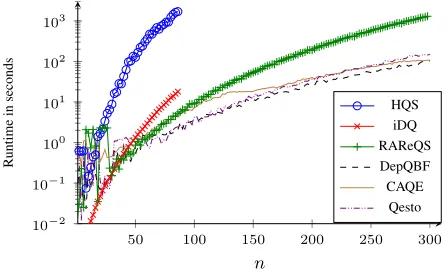
Figure 2: DQBF Solvers vs. QBF Solvers for FamilyGn.
We implemented the translation of DQBF formulas from DQBFde+into QBF as shown in Sect. 4 and applied it to
the familiesFn andGn. ForFn we generated benchmarks with n increasing in steps of 10 from0 to 2000, for Gn withnincreasing from0to300in steps of2. We evaluated
the runtimes of the DQBF solvers HQS (Gitina et al. 2015) (which was the winner of the DQBF track of the QBFE-VAL’18 competition) andIDQ (Fr¨ohlich et al. 2014) applied to the original formulas and compared them to the runtimes of the state-of-the-art QBF solvers DepQBF (Lonsing and Biere 2010), RAReQS (Janota et al. 2012), Qesto (Janota and Marques-Silva 2015), and CAQE (Tentrup and Rabe 2015) applied to the QBFs resulting from translation. The CPU times for the QBF solvers include the times for translating the DQBFs into QBFs using fork extension.
In Fig. 1 we present the results for formulasFn, in Fig. 2 for formulasGn. Thex-axis represents the valuen, they -axis the CPU time in seconds. HQS can only solveF0and F10, but fails already forF20.IDQ solves all instances until F510and exceeds the memory limit starting withF520. In
contrast, all QBF solvers work pretty well on all generated instances. All of them can solve the instances up toF2000.
The maximum runtimes for solving the instances lie between 20.9 s for DepQBF and 7.2 s for RAReQS. This impressively shows the success of our conversion method for DQBFde
formulas. The results are confirmed by experiments forGn
50 100 150 200
10−1
101
103
n
Runtime
in
seconds
HQS-DE HQS
iDQ
Figure 3: DQBF Solvers on Competition Benchmarks.
10−2 10−1 100 101 102 103
10−1 101
103
HQS (runtime in seconds)
HQS-DE
(runtime
in
seconds)
Figure 4: Competition Benchmarks, DQBFde+.
as well. Here both HQS andIDQ can solve the instances
until G86 (forG88 HQS exceeds the time limit, iDQ the
memory limit), but with higher runtimes for HQS (HQS needs 1694.1 s forG86,IDQ 18.0 s). CAQE, DepQBF, and Qesto
solve all benchmarks up toG300with a maximum CPU time
between 103.3 s for CAQE and 150.4 s for Qesto. RAReQS performs a little bit worse on this benchmark set; it exceeds the memory limit forG300and solvesG298within 1300.8 s,
but still performs much better than the DQBF solvers. Encouraged by those results we enhanced the DQBF solver HQS (Wimmer et al. 2017) by a special treatment of formu-las from DQBFde+. Whenever we detect that a DQBF
be-longs to DQBFde+we translate it into a QBF and process it
further by QBF solving. We call the resulting solver HQS-DE.4 As a benchmark set we used the complete set of 334
instances from the DQBF track of the QBFEVAL’18 com-petition (Pulina and Seidl 2018). Fig. 3 shows a cactus plot comparing the performance of HQS-DE to HQS andIDQ on
the complete set of DQBF benchmarks. It shows that HQS clearly outperformsIDQ on this set of benchmarks. HQS is able to solve 171 benchmarks, whereasIDQ only solves
77. Interestingly, HQS-DE in turn outperforms HQS, solving even 12 benchmarks more than HQS within 1800 s.
For the QBFEVAL’18 benchmarks, there are 34 out of 334 instances falling into the DQBFde+class. Fig. 4 shows a
scat-ter plot with runtimes of HQS-DE and HQS for this subset of benchmarks. We see that HQS-DE clearly outperforms HQS on the DQBFde+benchmarks. It is faster than HQS for all
4Available at https://abs.informatik.uni-freiburg.de/src/projects
but one benchmark, and solves 28 benchmarks in contrast to only 14 solved by HQS.IDQ solves 18 out of 34 benchmarks. AlthoughIDQ is slightly better than HQS on the DQBFde+
benchmarks, it is still strongly inferior to HQS-DE.
7
Conclusions and Future Work
Through our theoretical investigation on special classes of DQBFs, we have shown that the insights lead to improve-ments of state-of-the-art DQBF solvers by providing a spe-cialized solution using fork extension. Experiments on two parameterized benchmark sets and the DQBF competition instances have shown the benefits of the proposed method.
For the future, we plan to look into fork extension for en-abling quantifier localization in a more general setting, not only restricted to formulas from DQBFde+. Moreover, we
plan to complement the successful approach of the solver HQS which uses partial universal expansion and so-called de-pendency elimination (Wimmer et al. 2017) for transforming a DQBF into a QBF by a technique that alternatively trans-forms the DQBF into an equisatisfiable DQBF in DQBFde+,
enabling a translation into 3QBF by fork extension.
References
Balabanov, V.; Chiang, H. K.; and Jiang, J. R. 2014. Henkin quantifiers and Boolean formulae: A certification perspective of DQBF.Theoretical Computer Science523:86–100.
Biere, A.; Cimatti, A.; Clarke, E. M.; Strichman, O.; and Zhu, Y. 2003. Bounded model checking.Advances in Computers58:117–
148.
Biere, A.; Heule, M.; van Maaren, H.; and Walsh, T., eds. 2008.
Handbook of Satisfiability, volume 185 ofFrontiers in Artificial Intelligence and Applications. IOS Press.
Bloem, R.; K¨onighofer, R.; and Seidl, M. 2014. SAT-based synthe-sis methods for safety specs. InVMCAI, 1–20.
Bubeck, U., and Kleine B¨uning, H. 2006. Dependency quantified Horn formulas: Models and complexity. InSAT, 198–211.
Bubeck, U. 2010. Model-based transformations for quantified Boolean formulas. Ph.D. Dissertation, University of Paderborn,
Germany.
Chatterjee, K.; Henzinger, T. A.; Otop, J.; and Pavlogiannis, A. 2013. Distributed synthesis for LTL fragments. InFMCAD, 18–25.
Clarke, E. M.; Biere, A.; Raimi, R.; and Zhu, Y. 2001. Bounded model checking using satisfiability solving. Formal Methods in System Design19(1):7–34.
Czutro, A.; Polian, I.; Lewis, M. D. T.; Engelke, P.; Reddy, S. M.; and Becker, B. 2010. Thread-parallel integrated test pattern gener-ator utilizing satisfiability analysis. Int’l Journal of Parallel Pro-gramming38(3-4):185–202.
Eggersgl¨uß, S., and Drechsler, R. 2012. A highly fault-efficient SAT-based ATPG flow.IEEE Design & Test of Computers29(4):63–
70.
Fr¨ohlich, A.; Kov´asznai, G.; Biere, A.; and Veith, H. 2014. iDQ: Instantiation-based DQBF solving. InInt’l Workshop on Pragmatics of SAT (POS), 103–116.
Gitina, K.; Reimer, S.; Sauer, M.; Wimmer, R.; Scholl, C.; and Becker, B. 2013. Equivalence checking of partial designs using dependency quantified Boolean formulae. InICCD, 396–403.
Gitina, K.; Wimmer, R.; Reimer, S.; Sauer, M.; Scholl, C.; and Becker, B. 2015. Solving DQBF through quantifier elimination. In
DATE, 1617–1622.
Han, C., and Jiang, J. R. 2012. When boolean satisfiability meets gaussian elimination in a simplex way. InCAV, 410–426.
Henkin, L. 1961. Some remarks on infinitely long formulas. In
Infinitistic Methods: Proc. of the 1959 Symp. on Foundations of Mathematics, 167–183.
Ivancic, F.; Yang, Z.; Ganai, M. K.; Gupta, A.; and Ashar, P. 2008. Efficient SAT-based bounded model checking for software verifica-tion.Theor. Comput. Sci.404(3):256–274.
Janota, M., and Marques-Silva, J. 2015. Solving QBF by clause selection. InIJCAI, 325–331.
Janota, M.; Klieber, W.; Marques-Silva, J.; and Clarke, E. M. 2012. Solving QBF with counterexample guided refinement. In SAT,
114–128.
Kleine B¨uning, H.; Karpinski, M.; and Fl¨ogel, A. 1995. Resolution for quantified boolean formulas. Information and Computation
117(1):12–18.
Lonsing, F., and Biere, A. 2010. DepQBF: A dependency-aware QBF solver.Journal on Satisfiability, Boolean Modelling and Com-putation7(2-3):71–76.
Lonsing, F., and Egly, U. 2014. Incremental QBF solving by DepQBF. InInt’l Congress on Mathematical Software (ICMS),
307–314.
Meyer, A. R., and Stockmeyer, L. J. 1973. Word problems requiring exponential time: Preliminary report. InSTOC, 1–9.
Peterson, G.; Reif, J.; and Azhar, S. 2001. Lower bounds for multi-player non-cooperative games of incomplete information. Comput-ers & Mathematics with Applications41(7–8):957–992.
Pigorsch, F., and Scholl, C. 2009. Exploiting structure in an AIG based QBF solver. InDATE, 1596–1601.
Pigorsch, F., and Scholl, C. 2010. An AIG-based QBF-solver using SAT for preprocessing. InDAC, 170–175.
Pulina, L., and Seidl, M. 2018. QBFEval’18 – Competitive evalua-tion of QBF solvers. http://www.qbflib.org/qbfeval18.php. Rabe, M. N. 2017. A resolution-style proof system for DQBF. In
SAT, 314–325.
Rintanen, J.; Heljanko, K.; and Niemel¨a, I. 2006. Planning as satisfiability: parallel plans and algorithms for plan search.Artificial Intelligence170(12-13):1031–1080.
Scholl, C., and Becker, B. 2001. Checking equivalence for partial implementations. InDAC, 238–243.
Stockmeyer, L. J. 1976. The polynomial-time hierarchy.Theoretical Computer Science3(1):1–22.
Tentrup, L., and Rabe, M. N. 2015. CAQE: A certifying QBF solver. InFMCAD, 136–143.
Tseitin, G. S. 1970. On the complexity of derivation in propositional calculus.Studies in Constructive Mathematics and Mathematical LogicPart 2:115–125.
Wimmer, R.; Gitina, K.; Nist, J.; Scholl, C.; and Becker, B. 2015. Preprocessing for DQBF. InSAT, 173–190.
Wimmer, R.; Karrenbauer, A.; Becker, R.; Scholl, C.; and Becker, B. 2017. From DQBF to QBF by dependency elimination. InSAT,