The Thirty-Third AAAI Conference on Artificial Intelligence (AAAI-19)
Abduction-Based Explanations for Machine Learning Models
∗Alexey Ignatiev,
1,3Nina Narodytska,
2Joao Marques-Silva
11Faculty of Science, University of Lisbon, Portugal 2VMware Research, CA, USA
3ISDCT SB RAS, Irkutsk, Russia
{aignatiev,jpms}@ciencias.ulisboa.pt, [email protected]
Abstract
The growing range of applications of Machine Learning (ML) in a multitude of settings motivates the ability of com-puting small explanations for predictions made. Small expla-nations are generally accepted as easier for human decision makers to understand. Most earlier work on computing expla-nations is based on heuristic approaches, providing no guar-antees of quality, in terms of how close such solutions are from cardinality- or subset-minimal explanations. This paper develops a constraint-agnostic solution for computing expla-nations for any ML model. The proposed solution exploits abductive reasoning, and imposes the requirement that the ML model can be represented as sets of constraints using some target constraint reasoning system for which the deci-sion problem can be answered with some oracle. The experi-mental results, obtained on well-known datasets, validate the scalability of the proposed approach as well as the quality of the computed solutions.
Introduction
The fast growth of machine learning (ML) applications has motivated efforts to validate the results of ML models (Le-ofante et al. 2018; Ruan, Huang, and Kwiatkowska 2018; Narodytska 2018; Narodytska et al. 2018; Wicker, Huang, and Kwiatkowska 2018; Huang et al. 2017; Katz et al. 2017), but also efforts to explain predictions made by such mod-els (Evans and Grefenstette 2018; Li et al. 2018; Ribeiro, Singh, and Guestrin 2018; Ignatiev et al. 2018; Montavon, Samek, and M¨uller 2018; Ribeiro, Singh, and Guestrin 2016; Lakkaraju, Bach, and Leskovec 2016; Baehrens et al. 2010). One concern is the application of ML models, includ-ing Deep Neural Networks (DNNs) in safety-critical ap-plications, and the need to provide some sort of certifi-cation about correctness of operation. The importance of computing explanations is further underscored by a num-ber of recent works (Goodman and Flaxman 2017; Doshi-Velez and Kim 2017; Monroe 2018; Darwiche 2018; Lip-ton 2018), by recent regulations (EU Data Protection Reg-ulation 2016), ongoing research programs (DARPA 2016),
∗
This work was supported by FCT grants ABSOLV (LISBOA-01-0145-FEDER-028986), FaultLocker (PTDC/CCI-COM/29300/2017), SAFETY (SFRH/BPD/120315/2016), and SAMPLE (CEECIND/04549/2017).
Copyright c2019, Association for the Advancement of Artificial Intelligence (www.aaai.org). All rights reserved.
but also by recent meetings (IJCAI XAI Workshop 2017; ICML WHI Workshop 2017; NIPS IML Symposium 2017; Kwiatkowska, Fijalkow, and Roberts 2018).
For logic-based models, e.g. decision trees and sets, ex-planations can be obtained directly from the model, and related research work has mostly focused on minimizing the size of representations (Lakkaraju, Bach, and Leskovec 2016; Ignatiev et al. 2018). Nevertheless, important ML models, that include neural networks (NNs), support vec-tor machines (SVMs), bayesian network classifiers (BNCs), among others, do not naturally provide explanations to pre-dictions made. Most work on computing explanations for such models is based on heuristic approaches, with no guarantees of quality (Ribeiro, Singh, and Guestrin 2016; Lakkaraju, Bach, and Leskovec 2016; Angelino et al. 2017; Al-Shedivat, Dubey, and Xing 2018; Li et al. 2018). Re-cent work (Al-Shedivat, Dubey, and Xing 2018) suggests that these heuristic approaches can perform poorly in practi-cal settings. For BNCs, a recent compilation-based approach (Shih, Choi, and Darwiche 2018) represents a first step to-wards computing explanations with guarantees of quality. Nevertheless, a drawback of compilation approaches is the exponential worst-case size of the compiled representation, and also the fact that it is specific to BNCs.
theory (e.g. a decidable theory of first-order logic). The ML model prediction explanation approach proposed in this pa-per imposes mild requirements on the target ML model and the constraint reasoning system used. One must be able to encode the ML model as a set of constraints, and the con-straint reasoning system must be able to answer entailment queries.
To illustrate the application of abductive reasoning for computing explanations, the paper focuses on Neural Net-works. As a result, a recently proposed encoding of NNs into Mixed Integer Linear Programming is used (Fischetti and Jo 2018). This encoding is also evaluated with Satisfiabil-ity Modulo Theories (SMT) solvers. Although other recently proposed MILP encodings could be considered (Tjeng and Tedrake 2017), the most significant differences are in the al-gorithm used.
The experimental results, obtained on representative problem instances, demonstrate the scalability of the pro-posed approach, and confirm that small explanations can be computed in practice.
Background
Propositional Formulas, Implicants and Abduction.
We assume definitions standard in propositional logic and satifiability (Biere et al. 2009), with the usual definitions for (CNF) formulas, clauses and literals. Where required, for-mulas are viewed as sets of clauses, and clauses as sets of literals. For propositional formulas, a(n) (partial) assignment is a (partial) map from variables toB={0,1}. A satisfying assignment is such that the valuation of the formula (under the usual semantics of propositional logic) is 1. Throughout the paper, assignments will be represented as conjunctions of literals. Moreover, letF be a propositional formula de-fined on a set of variablesX = {x1, . . . , xn}. A literal is either a variablexior its complement¬xi. A term is a set of literals, interpreted as a conjunction of literals. A termπis animplicantifπF. An implicantπis aprime implicant ifπF, and for any proper subsetπ0 ( π,π02F (Mar-quis 2000). A prime implicantπgiven a satisfying assign-mentµis any prime implicantπ⊆µ. Given a CNF formula and a satisfying assignment, a prime implicant can be com-puted in polynomial time. For an arbitrary propositional for-mula, given a satisfying assignment, a prime implicant can be computed with a linear number of calls to an NP solver (e.g. (Liberatore 2005)). In contrast, computing the shortest prime implicant is hard forΣP2(Liberatore 2005), the second level of the polynomial hierarchy.
LetF denote a propositional theory which, for the goals of this paper can be understood as a set of clauses. LetH andEbe respectively a set of hypotheses and a set of man-ifestations (or the evidence), which often correspond to unit clauses, but can also be arbitrary clauses.
A propositional abduction problem (PAP) is a 5-tuple
P = (V,H,E,F, c).Vis a finite set of variables.H,Eand Fare CNF formulas representing, respectively, the set of hy-potheses, the set of manifestations, and the background the-ory.cis a cost function associating a cost with each clause ofH,c:H →R+.
Given a background theory F, a set S ⊆ H of hy-potheses is an explanation (for the manifestations) if: (i) S entails the manifestations E (given F); and (ii) S is consistent (givenF). The propositional abduction problem consists in computing a minimum size explanation for the manifestations subject to the background theory, e.g. (Eiter and Gottlob 1995; Saikko, Wallner, and J¨arvisalo 2016; Ignatiev, Morgado, and Marques-Silva 2016).
Definition 1 (Minimum-size explanations forP) Let
P = (V,H,E,F, c) be a PAP. The set of expla-nations of P is given by the set Expl(P) = {S ⊆ H | F ∧ S2⊥,F ∧ SE}. The minimum-cost solutions of
P are given byExplc(P) =argminE∈Expl(P)(c(E)).
Subset-minimal explanations can be defined similarly. Moreover, throughout the paper the cost function assigns unit cost to each hypothesis, and so we use the following alternative notation for a PAPP,P= (V,H,E,F).
First Order Logic and Prime Implicants. We assume definitions standard in first-order logic (FOL) (e.g. (Gallier 2003)). Given a signatureS of predicate and function sym-bols, each of which characterized by its arity, a theoryT is a set of first-order sentences overS.S is extended with the predicate symbol=, denoting logical equivalence. A model Mis a pairM= (U,I), whereUdenotes a universe, andI is an interpretation that assigns a semantics to the predicate and function symbols ofS. A setV of variables is assumed, which is distinct fromS. A (partial) assignmentν is a (par-tial) function fromVtoU. Assignments will be represented as conjunctions of literals (or cubes), where each literal is of the formv = u, withv ∈ V andu ∈ U. Throughout the paper, cubes and assignments will be used interchange-ably. The set of free variables in some formulaFis denoted byfree(F). Assuming the standard semantics of FOL, and given an assignmentνand corresponding cubeC, the nota-tionM, CFis used to denote thatFis true under model Mand cubeC(or assignmentν). In this caseν (resp.C) is referred to as satisfying assignment (resp. cube), with the assignment being partial if|C|<|V|(and so ifνis partial). A solver for some FOL theoryT is referred to as aT-oracle. A well-known generalization of prime implicants to FOL (Marquis 1991) will be used throughout.
Definition 2 Given a FOL formulaF with a modelM = (U,I), a cubeCis a prime implicant ofFif
1. M, CF.
2. IfC0is a cube such thatM, C0FandM, C0C, then M, CC0.
A smallest prime implicant is a prime implicant of minimum size. Smallest prime implicants can be related with mini-mum satisfying assignments (Dillig et al. 2012). Finally, a prime implicantCofFandMgiven a cubeC0is a prime implicant ofFsuch thatC⊆C0.
Mixed Integer Linear Programming (MILP). In this pa-per, a MILP is defined over a set of variablesV, which are partitioned into real (e.g.Y), integer (e.g.W) and Boolean (e.g.Z) variables.
min P
vj∈V cjvj
s.t. P
vj∈V aijvj≤bi 1≤i≤K
(1)
where{b1, . . . , bK} can either be real, integer or Boolean values. To help with the encoding of ML models, we will exploit indicator constraints (e.g. (Belotti et al. 2016; Fischetti and Jo 2018)) of the form:
li →
X
vj∈V
aijvj ≤bi
(2)
whereliis some propositional literal.
Clearly, under a suitable definition of signature S and model M, withU , R∪Z∪B, (smallest) prime impli-cants can be computed for MILP.
Minimal Hitting Sets. Given a collectionSof sets from
a universeU, a hitting sethfor Sis a set such that∀S ∈ S, h∩S6=∅.A hitting sethis said to beminimalif none of
its subsets is a hitting set.
ML Explanations as Abductive Reasoning
We consider the representation of an ML model using a set of constraints, represented in the language of some con-straint reasoning system. Associated with this concon-straint reasoning system, we assume access to an oracle that can answer entailment queries. For example, one can consider Satisfiability Modulo Theories, Constraint Programming, or Mixed Integer Linear Programming.Moreover, we associate the quality of an explanation with the number of specified features associated with a predic-tion. As a result, one of the main goals is to compute cardinality-minimal explanations. Another, in practice more relevant due to performance challenges of the first goal, is to compute subset-minimal explanations.
Propositional Case. LetM denote some ML model. We
assume a set of (binarized) featuresV ={f1, . . . , fk}, and a classification problem with two classes{c0, c1}. Let some
p ∈ {c0, c1} denote some prediction. Moreover, let us as-sume that we can associate a logic theoryT with the ML modelM, and encodeMas a formulaF.
Given the above, one can compute cardinality minimal ex-planations forpas follows. LetH={(fi),(¬fi)|fi ∈ V}, let E = {(p)}, and associate a unit cost function ν with each unit clause ofH. Then, any explanation for the PAP
P = (V,H,E,F)is an explanation for the predictionp. To compute cardinality minimal explanations, we can use for example a recently proposed approach (Ignatiev, Morgado, and Marques-Silva 2016). Moreover, observe that if features are real-valued, then the approach outlined above for com-puting cardinality minimal explanations does not apply.
Algorithm 1:Computing a subset-minimal explanation
Input: FunderM, initial cubeC, predictionE
Output:Subset-minimal explanationCm 1 begin
2 foreachl∈Cdo
3 ifEntails(C\ {l},F → E,M)then
4 C←C\ {l}
5 returnC
6 end
In a more concrete setting of some pointφin feature space and prediction p, we consider a concrete set H, where the value of each feature ofφis represented with a unit clause. As above, we can consider propositional abduction, which in this case corresponds to computing the (minimum-size) prime implicants that explain the prediction as a subset of the point in feature space. This relationship is detailed next.
General Case. In a more general setting, features can take arbitrary real, integer or Boolean values. In this case we consider an input cubeCand a predictionE. The relation-ship between abductive explanations and prime implicants is well-known (e.g. (Marquis 1991; 2000). LetCbe the cube associated with some satisfying assignment. Regarding the computation of abductive explanations,C∧ F2⊥and the
same holds for any subset of C. This means that we just need to consider the constraintC∧ FE, which is equiv-alent toC(F → E). Thus, asubset-minimal explanation
Cm (givenC) is a prime implicant ofF → E (givenC), and a cardinality-minimal explanationCM (givenC) is a cardinality-minimal prime implicant ofF → E (givenC). Thus, we can compute subset-minimal (resp. cardinality-minimal) explanations by computing instead prime impli-cants (resp. shortest PIs) ofF → E. As a final remark, the cardinality minimal prime implicants ofF → Eare selected among those that are contained inC.
Computing Explanations. This section outlines the al-gorithms for computing a subset-minimal explanation and a cardinality-minimal explanation. The computation of a subset-minimal explanation requires a linear number of calls to aT-oracle. In contrast, the computation of a cardinality-minimal explanation in the general case requires a worst-case exponential number of calls to aT-oracle (Liberatore 2005).
Algorithm 1 shows the algorithm to compute a subset-minimal explanation for a prediction E made by an ML modelMencoded into formulaFunder modelM. Given a
Algorithm 2:Computing a smallest size explanation
Input: FunderM, initial cubeC, predictionE
Output:Cardinality-minimal explanationCM 1 begin
2 Γ← ∅
3 whiletruedo
4 h←MinimumHS(Γ)
5 ifEntails(h,F → E,M)then
6 returnh
7 else
8 µ←GetAssignment()
9 C0←PickFalseLits(C\h, µ)
10 Γ←Γ∪C0
11 end
to check the entailment, it suffices to test whether formula
(C\ {l})∧ F ∧ ¬E isfalse. As a result, the algorithm tra-verses all literals of the cube and, thus, makes|C|calls to theT-oracle.
Computing a cardinality-minimal explanation is hard for
ΣP
2 (Eiter and Gottlob 1995) and so it is practically less efficient to perform. For the propositional case, a smallest size explanation can be extracted using directly a proposi-tional abduction solver (Ignatiev, Morgado, and Marques-Silva 2016) applied to the setup described above. Note that in the general case dealing with FOL formulas, the number of all possible hypotheses is infinite and so a similar setup is not applicable. However, and analogously to Algorithm 1, one can start with a given cubeCrepresenting an input data sample and consistent with formulaF representing an ML model.
Algorithm 2 shows a pseudo-code of the procedure com-puting a smallest size explanation for predictionE. The al-gorithm can be seen as an adaptation of the propositional abduction approach (Ignatiev, Morgado, and Marques-Silva 2016) to the general ML explanation problem and is based on the implicit hitting set paradigm. As such, Algorithm 2 is an iterative process, which deals with a setΓof the sets to hit. Initially, setΓis empty (line 2). At each iteration, a new smallest size hitting set hfor Γ is computed (see line 4). Hitting set his then treated as a cube, which is tested on whether it is a prime implicant of formulaF → E under model M. As was discussed above, this can be tested by calling aT-oracle on formulah∧ F ∧ ¬E (line 5). If the T-oracle returnsfalse, the algorithm reports hitting sethas a smallest size explanation for the prediction and stops. Oth-erwise, i.e. if theT-oracle returnstrue, an assignmentµfor the free variables of formulah∧ F ∧ ¬E is extracted (see line 8). Assignmentµis then used to determine a subsetC0
of literals of cubeC\hthat were falsified by the previous call to theT-oracle. Finally, setΓis updated on line 10 to includeC0and the process continues.
Note that the correctness of Algorithm 2, although not proved here, immediately follows from the correctness of the original hitting set based approach to propositional
ab-duction (Ignatiev, Morgado, and Marques-Silva 2016). The intuition behind the algorithm is the following. Every itera-tion checks whether a given (smallest size) subsethof the input cubeC is an implicant of F → E. If this is not the case, some other literals, i.e. from setC\h, should be in-cluded tohat the next iteration of the algorithm. Moreover, a new setC0to hit comprises only literals ofC\hthat were falsified during the previousT-oracle call because they are guaranteed to have been disabled previously, not only by our choice ofhbut also by theT-oracle call.
Example 1 Consider an example model mapping pairs of all possible integers i1 and i2 into set {1,2}. Assume the model is encoded to the following set of (indicator) con-straintsFgiven variableszk∈ {0,1},k∈[3]:
z1= 1↔i1≤0, z3= 1↔z1+z2≤1, z3= 1→o= 1
z2= 1↔i2≤0, z3= 0→o= 2 Given a data sample encoded as a cubeC = (i1 = 3)∧
(i2 = 2), the prediction is1. It is clear that there are two minimal explanations for this classification:Cm1 = (i1= 3) andC2
m= (i2= 2). Observe that both can be trivially com-puted by the linear search procedure of Algorithm 1 because
Cj
m(F →(o= 1))istrueforj∈[2].
Encoding Neural Networks with MILP
This section considers a MILP encoding of a neural network with a commonly-used ‘rectified linear unit’ nonlinear op-erator (RELU). For simplicity, we explain an encoding of a building block of the network as all blocks have the same structure and are assembled sequentially to form the net-work. A block consists of a linear transformation and a non-linear transformation. Let x = {x1, . . . , xn}, x ∈ Rn bean input andy = {y1, . . . , ym} ∈ Rm≥0 be an output of a block. First, we apply a linear transformationx0 =Ax+b, whereA∈Rm×Rnandb∈Rmare real-valued parameters
of the network. Then we apply a non-linear transformation
y=RELU(x0), where RELU=max(x0,0).
To encode a block, we use a recently proposed MILP en-coding (Fischetti and Jo 2018). One useful modeling prop-erty of this encoding is that it employs indicator constraints that are natively supported by modern MILP solvers. Hence, we can avoid using the Big-M notation in the encoding that requires good bounds tightening to compute the value of Big-M. To perform the encoding, we introduce two sets of variables: Boolean variablesz={z1, . . . , zm}, z∈ {0,1}m and auxiliary real variabless={s1, . . . , sm}, s∈Rm≥0. In-tuitively, thezivariable encodes the sign ofP
n
j=1ai,jxj+
bi. Ifzi = 1thenP n
j=1ai,jxj+bi≤0andyi = 0. Ifzi= 0 thenPn
j=1ai,jxj+bi ≥0andyi =P n
j=1ai,jxj+bi. A block is encoded as follows:
n X
j=1
ai,jxj+bi=yi−si, (3)
zi= 1→yi≤0, (4)
zi= 0→si≤0, (5)
wherei ∈ [1, m]. To see why the encoding is correct we consider two cases. First, we consider the casezi = 1. As we mentioned above,yimust be zero in this case. Indeed, if
z= 1thenyi ≤0holds. Together withyi ≥0, we get that
yi = 0. Similarly,zi= 0should ensure thatP n
j=1ai,jxj+
bi =yi. Ifz= 0thensi ≤0forcingsi= 0. In this case,yi equals toPn
j=1ai,jxj+bi.
A common neural network architecture for classification problems performs a normalization of the network output as the last layer, e.g. the softmax layer. However, we do not need to encode this normalization transformation as it does not change the maximum value of the output that defines prediction of the network.
Example 2 Consider an example of a block with two inputs,
x1andx2and two outputsy1andy2. LetA = [2,−1; 1,1] andb = [−1,1]be parameters of a linear transformation. To encode this block, we introduce auxiliary variabless1,
s2,z1andz2. We obtain the following constraints:
2x1−x2−1 =y1−s1,
x1+x2+ 1 =y2−s2,
z1= 1→y1≤0, z2= 1→y2≤0,
z1= 0→s1≤0, z2= 0→s2≤0,
y1≥0, y2≥0, s1≥0, s2≥0, z1∈ {0,1}, z2∈ {0,1}.
Experimental Results
This section evaluates the scalability of the proposed ap-proach to computing cardinality- and subset-minimal ex-planations and the quality of the computed exex-planations (in terms of the minimality guarantees). The benchmarks considered include the well-known text-based datasets from the UCI Machine Learning Repository1 and Penn Machine Learning Benchmarks2, as well as the widely used MNIST
digits database3.
Setup and prototype implementation. To assess scala-bility, all benchmarks were ran on a Macbook Pro having an Intel Core i7 2.8GHz processor with 8GByte of memory on board. Time limit was set to 1800 seconds while memory limit was set to 4GByte. The prototype implementation of the proposed approach follows Algorithm 1 and Algorithm 2 for computing subset- and cardinality-minimal explanations, respectively. It is written in Python and targets both SMT and MILP solvers4. SMT solvers are accessed through the
PySMT framework (Gario and Micheli 2015), which pro-vides a unified interface to SMT solvers like CVC4, Math-SAT5, Yices2, and Z3 among a few others. Note that in the following only the results of Yices2 (Dutertre 2014) are shown as of the best performing SMT solver, selected based on a prior experimentation with CVC4, MathSAT5, Yices2, and Z3. CPLEX 12.8.0 (IBM ILOG 2018) is used as a MILP
1
https://archive.ics.uci.edu/ml/
2https://github.com/EpistasisLab/penn-ml-benchmarks/ 3
http://yann.lecun.com/exdb/mnist/
4
Here we mean that training and encoding of neural networks as well as the explanation procedures are implemented in Python.
oracle accessed via its official Python API.5The implemen-tation of minimum hitting set enumeration in Algorithm 2 is based on an award-winning maximum satisfiability solver RC26 written on top of the PySAT toolkit (Ignatiev,
Mor-gado, and Marques-Silva 2018).
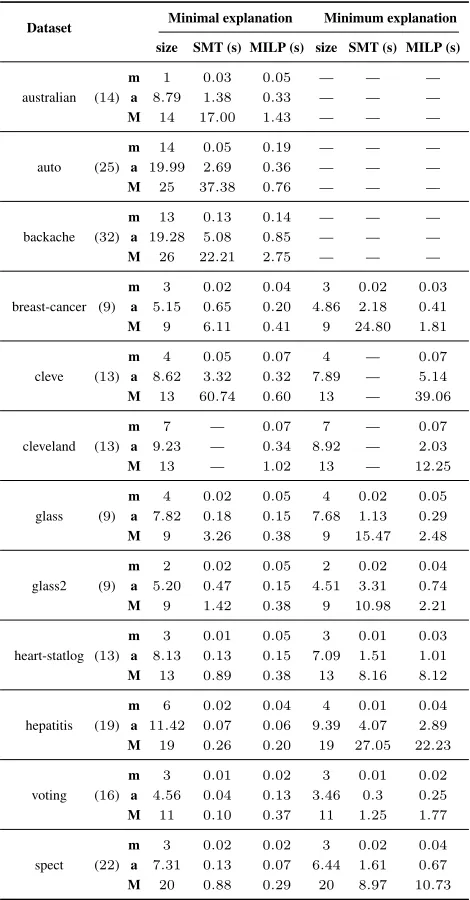
Quality of explanations. This section focuses on a selec-tion of datasets from UCI Machine Learning Repository and Penn Machine Learning Benchmarks (see Table 1 for de-tails). The selected datasets have 9–32 features and contain 164–691 data samples. The experiment is organized as fol-lows. First, given a dataset, a neural network is trained7and
encoded as described above. Second, the explanation pro-cedure (computing either a subset- or a cardinality-minimal explanation) is ran for each sample of the dataset. If all sam-ples get explained within 1800 seconds in total, the proce-dure is deemed to succeed. Otherwise, the process is inter-rupted meaning that the explanations for some of the sam-ples are not extracted successfully.
Column 1 of Table 1 lists the selected datasets followed by the number of features. Column 4 details the minimal, average, and maximal size of explanations per sample for a given a dataset (depending on prefixm,a, andMin col-umn 3). Analogously, colcol-umns 5–9 depict the minimal, av-erage, and maximal time spent for computing an explanation for a given dataset, either with an SMT or a MILP oracle in use.
As one can observe, using a MILP oracle is preferred as it consistently outperforms its SMT rival. In general, the MILP-based solution is able to compute a subset-minimal explanation of a sample in a fraction of a second. Also note that subset- and cardinality-minimal explanation size varies a lot depending on the dataset. On the one hand, it may be (seeaustralian) enough to keep just 1 feature to explain the outcome, which is≈ 7%of the data sample. On the other hand, some data samples cannot be reduced at all (see theM
values in column 4). On average, the relative size of subset-minimal explanations varies from28.5%to86.7%with the mean value being60.5%. This is deemed to provide a rea-sonable reduction of sample size, which may help a human interpret the outcomes of a machine learning classifier.
Subset- vs. cardinality-minimal explanations. Com-pared to subset-minimal explanations, computing smallest size explanations is significantly more expensive due to the problem being hard for the second level of the polyno-mial hierarchy. As one can observe, the proposed explana-tion procedure fails to explainalldata samples within the given total 1800 seconds (seeaustralian,auto,backache).
5
Note that more efficient reasoning engines exist (Katz et al. 2017; Ruan, Huang, and Kwiatkowska 2018; Gehr et al. 2018; Dutta et al. 2018). Those were not tested because the explanation procedure relies on efficient incremental access to the oracle and its ability to add and remove constraints“on the fly”.
6
https://maxsat-evaluations.github.io/2018
7
Table 1: Subset-minimal and cardinality-minimal explana-tions for the selected UCI and PennML datasets. Explana-tions are computed with the use of an SMT or a MILP ora-cle. The data shows minimal (m), average (a), and maximal (M) size of the computed explanations per dataset, as well as minimal (m), average (a), and maximal (M) time per dataset required to extract one explanation either by an SMT oracle or its MILP counterpart.
Dataset Minimal explanation Minimum explanation size SMT (s) MILP (s) size SMT (s) MILP (s)
australian (14)
m 1 0.03 0.05 — — —
a 8.79 1.38 0.33 — — —
M 14 17.00 1.43 — — —
auto (25)
m 14 0.05 0.19 — — —
a 19.99 2.69 0.36 — — —
M 25 37.38 0.76 — — —
backache (32)
m 13 0.13 0.14 — — —
a 19.28 5.08 0.85 — — —
M 26 22.21 2.75 — — —
breast-cancer (9)
m 3 0.02 0.04 3 0.02 0.03 a 5.15 0.65 0.20 4.86 2.18 0.41 M 9 6.11 0.41 9 24.80 1.81
cleve (13)
m 4 0.05 0.07 4 — 0.07 a 8.62 3.32 0.32 7.89 — 5.14 M 13 60.74 0.60 13 — 39.06
cleveland (13)
m 7 — 0.07 7 — 0.07
a 9.23 — 0.34 8.92 — 2.03
M 13 — 1.02 13 — 12.25
glass (9)
m 4 0.02 0.05 4 0.02 0.05 a 7.82 0.18 0.15 7.68 1.13 0.29 M 9 3.26 0.38 9 15.47 2.48
glass2 (9)
m 2 0.02 0.05 2 0.02 0.04 a 5.20 0.47 0.15 4.51 3.31 0.74 M 9 1.42 0.38 9 10.98 2.21
heart-statlog (13)
m 3 0.01 0.05 3 0.01 0.03 a 8.13 0.13 0.15 7.09 1.51 1.01 M 13 0.89 0.38 13 8.16 8.12
hepatitis (19)
m 6 0.02 0.04 4 0.01 0.04 a 11.42 0.07 0.06 9.39 4.07 2.89 M 19 0.26 0.20 19 27.05 22.23
voting (16)
m 3 0.01 0.02 3 0.01 0.02 a 4.56 0.04 0.13 3.46 0.3 0.25 M 11 0.10 0.37 11 1.25 1.77
spect (22)
m 3 0.02 0.02 3 0.02 0.04 a 7.31 0.13 0.07 6.44 1.61 0.67 M 20 0.88 0.29 20 8.97 10.73
As in the case of minimal explanations, the MILP oracle outperforms the SMT-based solver being able to explain 2 more datasets. The size of smallest size explanations varies from21.6%to85.3%with the average value being52.6%. Although cardinality-minimal explanations are in general smaller than subset-minimal ones, their computation takes a lot more time and so the overall advantage of minimum
size explanations seems questionable.
State-of-the-art in logic-based explanations. As a side problem, here we compare the quality of explanations pro-duced by the current approach with the state of the art in logic-based explanation of Bayesian network classi-fiers (Shih, Choi, and Darwiche 2018), given a concrete dataset. Following (Shih, Choi, and Darwiche 2018), let us focus on the Congressional Voting Records dataset (referred to asvotingin Table 1). The dataset contains 16 key votes by Congressmen of the U.S. House of Representatives, ex-pressed as Booleanyesandno(1and0). Consider the fol-lowing list of votes classified as Republican:
(0 1 0 1 1 1 0 0 0 0 0 0 1 1 0 1)
The BDD-based approach of (Shih, Choi, and Darwiche 2018) for explaining Bayesian network classifiers computes the followingsmallest sizeexplanations of size 9:
( 0 1 1 0 0 0 1 1 0 )
( 0 1 1 1 0 0 1 1 0 )
To be able to compare to this data, we trained 4 neural net-works separately of each other8 and tried to “explain” their
predictions given this concrete data sample. As a result, we got the followingsubset-minimalexplanations of size vary-ing from 3 to 5:
( 1 0 0 0 )
( 1 0 0 )
( 0 1 0 0 0 )
( 0 1 0 0 1)
A possible intuition behind this impressive result is that models based on neural networks may generalize better than solutions relying on Bayesian networks and/or they allow for more “aggressive” and, thus, more efficient interpretation.
It should also be noted that the proposed approach is constraint-agnostic and computes explanations “of the fly” in the online manner while the work of (Shih, Choi, and Darwiche 2018) relies on prior compilation of the classi-fier function into a BDD, which is in general known to be computationally expensive.
Scalability and MNIST digits. A widely used benchmark dataset for testing machine learning models is MNIST digits, which comprises a set of greyscale images depicting hand-written digits. This section aims at illustrating visually and discussing a few minimal explanations provided for exam-ple predictions of a neural network trained on the MNIST digits datasets. Concretely, let us consider a neural network with one hidden layer containing 15 or 20 neurons trained to distinguish two digits, e.g. 1 and 3, or 1 and 7, among other pairs. Each MNIST data sample describes a picture of size 28×28, and so the total number of features is 784.
Observe that the number of features makes these datasets significantly more challenging for extracting explanations. Our experiments confirm this fact as the average time spent for computing one subset-minimal explanation using
8
(a) (b) (c) (d)
Figure 1: Possible minimal explanations for digit one.
(a) (b) (c) (d)
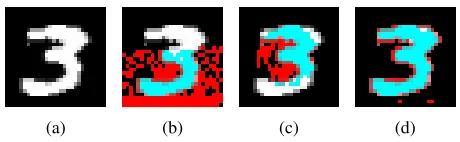
Figure 2: Possible minimal explanations for digit three.
a MILP oracle is about52.86seconds. As for SMT, given 1 hour time limit, we were unable to get an explanation for any MNIST data sample using the SMT solvers avail-able in PySMT. The average size of subset-minimal expla-nations varies from46.4%to80.3%of the total number of pixels (i.e.784), with the mean value being63.92%. Also note that no cardinality-minimal explanation was computed within 1 hour time limit. This holds for all SMT and MILP alternatives tried.
Let us focus on two particular data samples shown in Fig-ure 1a and FigFig-ure 2a. These samples describe concrete ways of writing digits 1 and 3. Subset-minimal explanations for these samples computed by Algorithm 1 are depicted in Fig-ure 1b and FigFig-ure 2b, respectively. (Observe that pixels in-cluded in the explanations are either red or magenta while greyscale parts of the images are excluded from the expla-nations.) Note that Algorithm 1 tries to remove pixels from an image one by one starting from the top left corner and ending at the bottom right corner. As shown in Figure 1b and Figure 2b, this procedure ends up keeping the bottom part of the image as it is needed to forbid misclassifications while the top part of the image being removed. While this is perfectly correct from the logical perspective, it may not satisfy some users as it does not give any reasonable hint on why the image is classified that specific way.
In this situation, better results could be obtained if the pix-els were traversed in a different order. For instance, one may find reasonable first to remove pixels that are far from the image center because the most important information in an image is typically located close to its center. Applying this strategy to the considered samples results in the explanations highlighted in Figure 1c and Figure 2c.
Another possible policy would be to prefer removing dark parts of an image keeping the light parts. The result of ap-plying this policy is shown in Figure 1d and Figure 2d.9
9
Note that none of the presented explanations for digit 1 follows exactly the shape of the digit. The reason is that in many cases the area occupied by the shape of digit 1 is“contained”in the area of some shapes of digit 3 and so some of the pixels“irrelevant”to 1 are needed in order to forbid classifying the digit as 3.
Moreover, a user may consider other heuristics to sort the pixels including various combinations of the ones described above. As there can be myriads of possible explanations for the same data sample, trying various heuristics to sort/order the pixels can help obtaining explanations that are more in-terpretable than the other from a human’s point of view.
Summary. As shown above, the proposed approach for computing subset- and cardinality-minimal explanations for ML models using an underlying constraints formalism can obtain high quality results for a variety of popular datasets, e.g. from UCI Machine Learning Repository, Penn Machine Learning Benchmarks, and also MNIST digits. In particular, the experimental results indicate that the approach, if applied to neural network classifiers, is capable of obtaining expla-nations that are reasonably smaller than those of the state of the art and, thus, may be preferred as more interpretable from the point of view of human decision makers.
Scalability of the proposed ideas was tested with the use of SMT and MILP oracles. As it was shown, MILP in gen-eral outperforms its SMT counterparts. It was also shown that computing smallest-size explanations is computation-ally quite expensive, which makes subset-minimal explana-tions a better alternative. Another important factor here is that subset-minimal explanations are usually just a bit larger than cardinality-minimal explanations.
Related Work
Discussion and Future Work
This paper proposes a principled approach to the problem of computing explanations of ML models. Nevertheless, the use of abductive reasoning, and the associated complexity, can raise concerns regardingrobustnessandscalability. Sev-eral ways can be envisioned to tackle the robustness issue. First, the approach enables a user not only to compute one explanation, either minimal or minimum, but also to enu-meratea given number of such explanations. Second, since the proposed approach is based on calls to some oracle, pref-erences over explanations, e.g. in terms of (in)dependent feature weights, can in principle be accommodated.
Regarding the issue of scalability, it should be noted that developed prototype serves as aproof of conceptthat the proposed generic approach can provide small and rea-sonable explanations, which are arguably easier to stand by a human decision maker, this despite the under-lying ML model being a blackbox, whose decisions may look uninterpretable per se. As the experimental results show, this holds for all the benchmark sets studied. More-over and as the experimental results suggest, the approach still applies (with no conceptual modification) if one opts to use oracles other than an ILP solver (Katz et al. 2017; Ruan, Huang, and Kwiatkowska 2018; Gehr et al. 2018; Dutta et al. 2018). Given the performance results obtained by these recent works, one should expect to be able to handle larger-scale NNs. Furthermore, since the proposed approach is constraint-agnostic, the same ideas can provide the basis for the the development of efficient decision procedures and effective encodings, not only for NN-based classifiers, but also for other state-of-the-art machine learning models. An alternative way to improve scalability would be to apply ab-straction refinementtechniques, a prominent approach that proved invaluable in many other settings.
Although the scalability of approaches for computing ex-planations is an important issue, the existence of a principled approach can serve to benchmark other heuristic approaches proposed in recent work (Ribeiro, Singh, and Guestrin 2016; Frosst and Hinton 2017). More importantly, the proposed principled approach can elicit new heuristic approaches, that scale better than the exact methods outlined in the paper, but which in practice perform comparably to those exact methods. Observe also that explanations provided by any heuristic approach can, not only be validated, but can also be minimized further, in case additional minimization can be achieved.
As a final remark, note that by providing a high-level de-scription, independent of a concrete ML model, the paper shows how the same general approach can be applied to any ML model that can be represented with (first-order logic) constraints. This demonstrates the flexibility of the proposed solution in that most existing ML models can (at least con-ceptually) be encoded with FOL. We emphasize that the ap-proach is perfectly general. If for some reason FOL is in-adequate to encode some ML model, one could consider second-order or even higher order logics. Of course, the price to pay would be the (potential) issues with decidability and scalability.
Conclusions
Explanations of ML predictions are essential in a number of applications. Past work on computing explanations for ML models has mostly addressed heuristic approaches, which can yield poor quality solutions. This paper proposes the use of abductive reasoning, namely the computation of (shortest) prime implicants, for finding subset- or cardinality-minimal explanations. Although the paper considers MILP encod-ings of NNs, the proposed approach is constraint-agnostic and independent of the ML model used. A similar approach can be applied to any other ML model, provided the model can be represented with some constraint reasoning system and entailment queries can be decided with a dedicated ora-cle. The experimental results demonstrate the quality of the computed explanation, and highlight an important tradeoff between subset-minimal explanations, which are computa-tionally easier to find, and cardinality-minimal explanations, which can be far harder to find, but which offer the best pos-sible quality (measure as the number of specified features).
A number of lines of work can be envisioned. These in-clude considering other ML models, other encodings of ML models, other approaches for answering entailment queries, and also the evaluation of additional benchmark suites.
References
Al-Shedivat, M.; Dubey, A.; and Xing, E. P. 2018. The intriguing properties of model explanations. CoRR abs/1801.09808.
Angelino, E.; Larus-Stone, N.; Alabi, D.; Seltzer, M.; and Rudin, C. 2017. Learning certifiably optimal rule lists. In KDD, 35–44.
Baehrens, D.; Schroeter, T.; Harmeling, S.; Kawanabe, M.; Hansen, K.; and M¨uller, K. 2010. How to explain individ-ual classification decisions. Journal of Machine Learning Research11:1803–1831.
Barrett, C. W.; Sebastiani, R.; Seshia, S. A.; and Tinelli, C. 2009. Handbook of Satisfiability. IOS Press. chapter Satis-fiability Modulo Theories.
Belotti, P.; Bonami, P.; Fischetti, M.; Lodi, A.; Monaci, M.; Nogales-G´omez, A.; and Salvagnin, D. 2016. On handling indicator constraints in mixed integer programming. Comp. Opt. and Appl.65(3):545–566.
Biere, A.; Heule, M.; van Maaren, H.; and Walsh, T., eds. 2009. Handbook of Satisfiability, volume 185 ofFrontiers in Artificial Intelligence and Applications. IOS Press.
DARPA. 2016. DARPA explainable Artificial Intelligence (XAI) program.
Darwiche, A. 2018. Human-level intelligence or animal-like abilities? Commun. ACM61(10):56–67.
Dillig, I.; Dillig, T.; McMillan, K. L.; and Aiken, A. 2012. Minimum satisfying assignments for SMT. InCAV, 394– 409.
Doshi-Velez, F., and Kim, B. 2017. A roadmap for a rigor-ous science of interpretability. CoRRabs/1702.08608.
Dutta, S.; Jha, S.; Sankaranarayanan, S.; and Tiwari, A. 2018. Output range analysis for deep feedforward neural networks. InNFM, 121–138.
Eiter, T., and Gottlob, G. 1995. The complexity of logic-based abduction. J. ACM42(1):3–42.
EU Data Protection Regulation. 2016. Regulation (EU) 2016/679 of the European Parliament and of the Council. Evans, R., and Grefenstette, E. 2018. Learning explanatory rules from noisy data. J. Artif. Intell. Res.61:1–64.
Fischetti, M., and Jo, J. 2018. Deep neural networks and mixed integer linear optimization. Constraints23(3):296– 309.
Frosst, N., and Hinton, G. E. 2017. Distilling a neural net-work into a soft decision tree. InCExAIIA.
Gallier, J. 2003.Logic For Computer Science. Dover. Gario, M., and Micheli, A. 2015. PySMT: a solver-agnostic library for fast prototyping of SMT-based algorithms. In SMT Workshop.
Gehr, T.; Mirman, M.; Drachsler-Cohen, D.; Tsankov, P.; Chaudhuri, S.; and Vechev, M. T. 2018. AI2: safety and robustness certification of neural networks with abstract in-terpretation. InS&P, 3–18.
Goodman, B., and Flaxman, S. R. 2017. European Union regulations on algorithmic decision-making and a ”right to explanation”.AI Magazine38(3):50–57.
Huang, X.; Kwiatkowska, M.; Wang, S.; and Wu, M. 2017. Safety verification of deep neural networks. InCAV, 3–29. 2018. IBM ILOG: CPLEX optimizer 12.8.0. http://www-01.ibm.com/software/commerce/optimization/ cplex-optimizer.
ICML WHI Workshop. 2017. ICML workshop on human interpretability in machine learning.
Ignatiev, A.; Pereira, F.; Narodytska, N.; and Marques-Silva, J. 2018. A SAT-based approach to learn explainable deci-sion sets. InIJCAR, 627–645.
Ignatiev, A.; Morgado, A.; and Marques-Silva, J. 2016. Propositional abduction with implicit hitting sets. InECAI, 1327–1335.
Ignatiev, A.; Morgado, A.; and Marques-Silva, J. 2018. PySAT: A Python toolkit for prototyping with SAT oracles. InSAT, 428–437.
IJCAI XAI Workshop. 2017. IJCAI workshop on explain-able artificial intelligence (XAI).
Katz, G.; Barrett, C. W.; Dill, D. L.; Julian, K.; and Kochen-derfer, M. J. 2017. Reluplex: An efficient SMT solver for verifying deep neural networks. InCAV, 97–117.
Kwiatkowska, M.; Fijalkow, N.; and Roberts, S. 2018. FLoC summit on machine learning meets formal methods. Lakkaraju, H.; Bach, S. H.; and Leskovec, J. 2016. Inter-pretable decision sets: A joint framework for description and prediction. InKDD, 1675–1684.
Leofante, F.; Narodytska, N.; Pulina, L.; and Tacchella, A. 2018. Automated verification of neural networks: Advances, challenges and perspectives. CoRRabs/1805.09938.
Li, O.; Liu, H.; Chen, C.; and Rudin, C. 2018. Deep learn-ing for case-based reasonlearn-ing through prototypes: A neural network that explains its predictions. InAAAI, 3530–3537. Liberatore, P. 2005. Redundancy in logic I: CNF proposi-tional formulae. Artif. Intell.163(2):203–232.
Lipton, Z. C. 2018. The mythos of model interpretability. Commun. ACM61(10):36–43.
Marquis, P. 1991. Extending abduction from propositional to first-order logic. InFAIR, 141–155.
Marquis, P. 2000. Consequence finding algorithms. In Handbook of Defeasible Reasoning and Uncertainty Man-agement Systems. 41–145.
Monroe, D. 2018. AI, explain yourself. Commun. ACM 61(11):11–13.
Montavon, G.; Samek, W.; and M¨uller, K. 2018. Methods for interpreting and understanding deep neural networks. Digital Signal Processing73:1–15.
Narodytska, N.; Kasiviswanathan, S. P.; Ryzhyk, L.; Sagiv, M.; and Walsh, T. 2018. Verifying properties of binarized deep neural networks. InAAAI.
Narodytska, N. 2018. Formal analysis of deep binarized neural networks. InIJCAI, 5692–5696.
NIPS IML Symposium. 2017. NIPS interpretable ML sym-posium.
Ribeiro, M. T.; Singh, S.; and Guestrin, C. 2016. ”Why should I trust you?”: Explaining the predictions of any clas-sifier. InKDD, 1135–1144.
Ribeiro, M. T.; Singh, S.; and Guestrin, C. 2018. Anchors: High-precision model-agnostic explanations. InAAAI. Ruan, W.; Huang, X.; and Kwiatkowska, M. 2018. Reach-ability analysis of deep neural networks with provable guar-antees. InIJCAI, 2651–2659.
Saikko, P.; Wallner, J. P.; and J¨arvisalo, M. 2016. Implicit hitting set algorithms for reasoning beyond NP. InKR, 104– 113.
Shanahan, M. 1989. Prediction is deduction but explanation is abduction. InIJCAI, 1055–1060.
Shih, A.; Choi, A.; and Darwiche, A. 2018. A symbolic ap-proach to explaining bayesian network classifiers. InIJCAI, 5103–5111.
Simonyan, K.; Vedaldi, A.; and Zisserman, A. 2013. Deep inside convolutional networks: Visualising image classifica-tion models and saliency maps. CoRRabs/1312.6034. Tjeng, V., and Tedrake, R. 2017. Verifying neural networks with mixed integer programming. CoRRabs/1711.07356. Wicker, M.; Huang, X.; and Kwiatkowska, M. 2018. Feature-guided black-box safety testing of deep neural net-works. InTACAS, 408–426.