RESEARCH ARTICLE
A methodological approach
on the procedural effectiveness of EIA: the case
of Sardinia
Cristian Cannaos and Giuseppe Onni
*Abstract
The evaluation of environmental effects of the projects is nowadays an essential element to consent to their realiza-tion. For this reason, since 1985, the authorization procedure for Environmental Impact Assessment has been acti-vated in Europe. The main aim of the article is to explore the case study of Sardinia, illustrating a methodology that allows the collection and analysis of information related to regional EIA procedures in Italy. The need to collect useful data to build a state of art of EIA arises from the absence of general statistics and official data collections. Through this research, the article provides an overview of Sardinia practice on EIA to date. Moreover, starting from an overview on the effectiveness of the EIA, the article, debating the case study, introduces some evaluations about local and general problems of the process linked to this topic.
Keywords: Environmental Impact Assessment, Effectiveness, EIA normative evolution
© The Author(s) 2019. This article is distributed under the terms of the Creative Commons Attribution 4.0 International License (http://creat iveco mmons .org/licen ses/by/4.0/), which permits unrestricted use, distribution, and reproduction in any medium, provided you give appropriate credit to the original author(s) and the source, provide a link to the Creative Commons license, and indicate if changes were made.
Introduction
Since 1985, the Environmental Impact Assessment (EIA) has been introduced in Europe like a tool with the aim to identify and evaluate the environmental impact of an action or activity in advance, to facilitating both the decision-making process and a safer environmental man-agement (Glasson et al. 2005; Morgan 1998; Sadler 1996). This tool is now widely used in most parts of the world (Canter 1977; Petts 1999; Wood 2003), however, the pro-cess of environmental assessment of projects still seems far from achieving its objectives, as the evaluations rarely conform to idealized models (Sadler 1996; Glasson et al.
1997; Bond and Wathern 1999; Barker and Wood 1999; Cashmore et al. 2004).
Nevertheless, there is a continuous regulatory change in the EIA apparatus, precisely in the search for a proce-dural application that can be at the same time more effec-tive in pursuing the general objeceffec-tives of environmental assessment.
It does not mean that the VIA process is ineffective, indeed it can be said that the principle of caution and prevention to be applied to interventions that can alter the environment, today, is both affirmed and globally accepted, substantially and procedurally (Sadler 1996).
In the application of the directive, the EIA retains many intrinsically local aspects, both for the specificity of pro-jects and territories and for the importance of the inter-pretation of the rules by the competent authority (CA) which has many margins of discretion.
“An EA process can only be fully understood and comprehensively evaluated in relation to the national or jurisdictional framework of decision-making within which it operates” (Sadler 1996). In the Italian context, where the EIA is divided by com-petences (national, regional and provincial), it is difficult to identify researches or statistics that represent both which projects are subject to EIA and how the authori-zation procedures affect the processes. A concrete inves-tigation on planning and administrative procedures is not traceable in national bibliographies, while there are examples at European level (Barker and Wood 1999; CE
Open Access
*Correspondence: [email protected]
2003; Wood 2003; Cashmore et al. 2004; Christensen et al. 2005; GHK 2010; Banias et al. 2017).
For this reason, the aim of the article is to describe and analyze the state of the art of EIA procedures in Sardinia (both screening and EIA) evaluating aspects that can help to make specific and general inferences about their effectiveness.
The study introduced in this article also aims to repre-sent a methodology that can be followed for the analysis of EIA in similar contexts (certainly valid for other Ital-ian regional contexts, probably exportable with some arrangements in other countries).
A literature review about effectiveness of EIA To illustrate the theoretical background of the reflections presented in the article and to explore how other studies approach the investigation of the effectiveness of the EIA, a revision of the existing literature is necessary.
The focus on VIA practices has led to the development of a wide field of research on the issue of effectiveness. The difficulties that both legislation and EIA practices have in conforming themselves to the models of the pro-cess itself are widely recognized by the literature and they are often idealized and excessively rational (Rosenberg et al. 1981; Glasson et al. 1997; Barker and Wood 1999).
Referring to the effectiveness of the EIA, this article has as its main reference the theoretical approach of Sadler (1996), which is still valid and contemporary, and which has influenced many subsequent reflections on this topic (Cashmore et al. 2004; Glasson et al. 2005; Christensen et al. 2005; Pischke and Cashmore 2006; Jay et al. 2007).
Effectiveness can be investigated both in its substan-tial characteristics (that is, in its ability to reach the pre-established purpose) and in its procedural characteristics (that is, whether it is undertaken according to established expectations) (Cashmore et al. 2004).
The substantial objectives of EIA can be divided in two groups: proximate aims (Sadler 1996) and long-term objectives (Cashmore et al. 2004).
The proximate aims are those that see the EIA as a system aimed to preventing possible impacts before the projects are implemented (Wood 2003), and as a deci-sion-making tool, principally in relation to the release of an environmental authorization, but also for its influence on development designs.
The long-term objectives are those linked to the over-all action of the EIAs, which should lead to sustainable development, more careful to the environment, ensuring a correct balance between social, economic and environ-mental interests.
The effectiveness of the EIA in these terms appears to be rather scarce, and it does not reach the aims neither in
terms of proximity nor in the long term (Cashmore et al.
2004).
In several studies of the early nineties based on ques-tionnaires, it is argued that the environmental informa-tion of the EIAs are useful, but they do not substantially change the final decision about the authorization (Wood and Jones 1997), and do not even produce substantial changes on projects (Sadler 1996).
On the other hand, recent studies (Barker and Wood
1999; Christensen et al. 2005; Banias et al. 2017) show positive opinions on EIA effects both for decision-mak-ing influence and for project changes.
This improvement seems normal, because EIA has made much progress over the years, and the procedures and the practices (in Europe, but all over the world) have been refined.
The goal of sustainable development in the literature is not seen as well-defined and therefore effectively pros-ecutable (Cashmore et al. 2004; Jay et al. 2007; Zhang et al. 2012). It is not simple to measure the real contrib-ute of EIA for the objective related to the environmental protection.
Although the long-term objectives of EIA have a par-ticular value in terms of effectiveness (Doyle and Sad-ler 1996), in the analysis of the case of study, this article focuses on some elements related to effectiveness of EIA in terms of proximate aims and the procedural charac-teristics (Ensminger and McLean 1993; Frost 1997; Petts
1999; Bond et al. 2004), perhaps simpler and more con-crete to evaluate.
Everything originates from the US law (NEPA 1969). This legislation was substantially a political response to the concern about the impacts of the modern develop-ment on environdevelop-ment (O’Riordan and Sewell 1981; Cald-well 1993; Petts 1999).
“EIA thus originated from a political imperative, not from scientific theory (Lee et al. 1995), and practice predated the development of a detailed conceptual foundation” (Cashmore et al. 2004).
This procedural approach then is more devoted to fix a procedure which would define a method of investigation, requiring following a well-defined, procedurally specified course of action, rather than imposing a specific level of environmental protection (Lemons 1995). Even today, the directives continue to replicate this regulatory approach. Many studies have investigated the correspondence between procedural prescriptions and real processes of EIA. Thus, they investigated on the scoping, screening and EIA stages, the EIS quality, referred to general rules fixed by the directives, and the public involvement.
duration of the process, the public involvement, and make some inferences about the final results of EIA, rea-soning about the entire process of the evaluation.
Approaches to the study of the effectiveness of the EIA
For the proximate aim, the article investigates on the decision-making process, reasoning on the quality of EIS and project changes, while for the procedural character-istics it investigates on the duration and on the results of the procedures.
“Sadler (1996) suggests that effectiveness of the EIA can be tested at different stages in a cycle of EIA sys-tems:
1. Whether a given EIA policy is effectively trans-lated into practice through the application of rel-evant processes and procedures,
2. whether the practice results in effective EIA per-formance through contributions to decision-mak-ing, and
3. whether this performance then effectively feeds back into changes in the EIA policy by examining whether EIA realizes its purpose” (Glasson et al.
2005).
To study the EIA process in dependence of the differ-ent stages of its implemdiffer-entation is a consolidate way of research on the factors that can influence its effective-ness (Zhang et al. 2012). We can call these stages pre-EIA stage, EIA stage and post-EIA stage.
To analyze the first stage, some authors (Barker and Wood 1999; Christensen et al. 2005; Glasson et al. 2005; Banias et al. 2017) made an illustration of EIA experi-ences in different countries, building a state of the art and analyzing how EIA is carried out, especially referring to compliance with current European Directives.
To build the state of art of EIA in a country or region it is not a simple task. It is worth saying that there is no general statistical system that illustrates how many EIAs are made at each CA, both among the various member states but also within the individual member states.
Even the reports of the European Commission (i.e. EC 2009) are drawn up on the basis of the responses of the member states or on some specific studies (i.e. GHK
2010), but there is neither a constant monitoring of the quantity of EIA procedures nor of the project typologies to which they refer. In Italy, some data is available on the website of the Ministry of the Environment,1 but only in
relation to the EIAs of ministerial competence, while it is
not possible to have, at least in a simple and direct way, a complete frame of the EIA processes that each region performs and on what typologies of projects. It is neces-sary to do a region-by-region search, which clashes with the ways in which each region publishes the environmen-tal assessments and the different methods through which each has regulated EIA procedures, often delegating some tasks to the provincial administrations.
For this reason, the article illustrates the methodology used to gather the information useful to reconstruct the number and typology of the procedures of EIAs carried out in Sardinia.
The compliance between European Directives on EIA and their transposition in national laws is a crucial factor for the first stage.
There is a long history of delays due to a bad (absent or partial) transparency of the European Directives into Member States laws. Italy is one of the Member States where the transposition of the first EIA directive of 1985 has delayed too long.
It lead to continuous changes in its legislation and application procedures, which significantly obstructs an effective application of the EIA procedures to projects. If it is possible, Sardinia, due to its special statute, has had an even more troubled history in the implementation of the EIA procedures.
On the other hand also the European Directive, thanks to a feedback mechanism (post EIA stage), has been revised several times, requiring new transparency by the member states.
These continuous changes does not allow a consolida-tion of good practices. Proponents and evaluators have continually to review the methods for elaboration and evaluation of the EISs, and the ways to manage the pro-cess, negatively affecting the effectiveness of the EIA.
For many authors one relevant component of effective-ness in the EIA stage is the preparation of high-quality EISs.
“Two schools of thought exist about the quality of an initial EIS. Some argue that developers should be encouraged to submit EISs of the highest stand-ard from the outset. This reduces the need for costly interaction between developer and competent authority (Ferrary 1994), provides a better basis for public participation (Sheate 1994), places the onus appropriately on the developer and increases the chance of effective EIA overall. Others argue that it is the entirety of the environmental information that is important, and that the advice of statutory con-sultees, the comments of the public and the expertise of the competent authority can substantially over-come the limitations of a poor EIS (Braun 1993).
This view is also supported by planning inspectors at appeal and judicial review cases.” (Glasson et al.
2005)
According with the first approach, some effectiveness assessments are based on the Analysis of Environmental Impact Studies (EIS) evaluating their content trough cod-ified systems (i.e. The Oxford Brooked University Review Package uses a set of EIGHT categories and 92 criteria;2
Glasson et al. 2005).
The majority of these analyses are carried out studying a limited number of EIS.
It depends on the length of EISs, that are still increas-ing, and by their differences. In fact, EISs are very differ-ent from each other and difficulties to read and compare, because they are elaborated according to different struc-tures, refer to different projects and are located in dif-ferent contexts. All these differences require a very long time for the analysis of EISs. However, quality measured in this way is an academic vision of quality, which often does not coincide neither with the evaluator one nor with the proposer one.
“EA is a plural process that is shaped by the inter-action of many players. Their perspectives on how well EA works vary, reflecting different roles, back-grounds and past experiences” (Sadler 1996).
“For instance, the DOE (1996) study, Radcliff and Edward-Jones (1995), and Jones (1995) found little agreement about EIS quality between planners, con-sultees and the researchers” (Glasson et al. 2005). Nevertheless, questionnaires, interviews or experts’ experience of their past work are diffused tools to investi-gate the effectiveness of the EIA in decision-making.3
In fact, the results of different survey made using ques-tionnaires or interviews often show ambiguous results about effectiveness of the EIA, and even inside the same category of stakeholders there are different positions
(Radcliff and Edward-Jones 1995; Barker and Wood 1999; Christensen et al. 2005; Banias et al. 2017).
This article approaches to the study of EIA giving more value to the entire process. It is not important the quality of EIS in itself (that, nevertheless, is a fundamental ele-ment for the EIA process), but it especially remains a tool for dialogue on the impacts of a project. During the stage of discussion of the proposal between proponent and CA often the quality of EISs is improved, by additional infor-mation changes devoted to reach the goal of the better identification of the impacts.
The evaluation of project changes is often used to measure the effectiveness during the EIA stage.
“The process of making an EIA is very much based on the idea that the dialogue between the parties concerned is likely to lead to modifications of the proposed project. Such dialogue will take place dur-ing the process itself, but it is likely to begin even before the authorities receive a formal application, for example, in the discussions between the devel-oper and his consultants” (Barker and Wood 1999). If the pre-EIA changes of a project are quite difficult to investigate and identify (Christensen et al. 2005), even using questionnaire or interviews to stakeholders, it is easier to analyze the changes made during the EIA stage (which can be very important) or to evaluate minor changes and mitigation measures imposed in the consent decision document.
Many studies explore the effectiveness as the contrib-ute of the EIA process in the design changes, sometimes giving an evaluation of these changes dividing them in minor, moderate or major modification (Barker and Wood 1999) and other times just making an accountabil-ity of project changes and mitigation measures (Chris-tensen et al. 2005). “There is no real test to decide the actual impacts and effects of the EIA other than research-ing into great detail with individual modifications and mitigation measures, deciding their impacts and finally their environmental effects” (Christensen et al. 2005). The costs involved for the study of each EIA are very high, becoming an obstacle to investigate many cases.
Referring to the EIA stage, the length of time needed to take a consent decision about the project it is rel-evant, maybe crucial. To take long time to decide can have effects more similar to a refusal, even if it is positive. Excessively long durations of the procedure can result very ineffective, and, in some cases, they can lead to the abandonment of some proposals, whose nature is strictly contingent on their approval time (for example, pro-posals linked to the presence of incentives or funding). During longer term, even the environment can register important changes, which can invalidate parts of the EISs 2 The Oxford Brooked University Review Package (Glasson et al. 2005) is
divided into eight district categories that assess the quality of an EIS regard-ing the followregard-ing aspects: (i) description of the development, (ii) description of the environment, (iii) scoping, consultation and impact identification, (iv) prediction and evaluation of impacts, (v) alternatives, (vi) mitigations and monitoring, (vii) non-technical summary, (viii) organisation and presentation of information.
Each of these aspects is classified separately with grades ranging from 0 to 5, where for 0 it is assumed that the study was carried out in an unsatisfac-tory way or with omissions and with 5 instead a study well achieved and free from omissions.
and the effectiveness of some mitigation or compensation measures.
The report of GHK consulting (2008) suggest the use of time limits on periods for screening and scoping and on consultation, and the EIA directive from 2003 (Direc-tive 2003/35/CE) ask to member states to fix specifically time limits to permit the public participation to EIA. The implementation of these points is translated into a specific maximum duration of EIA process, but often it seems disregarded.
Even the outcomes of the procedure can be referred to the end of the EIA stage.
The evaluation process, both Screening and EIA, leads to a more informed decision (negative or positive) on the environmental impact of proposals (which often are modified, integrated with additional information or developed in itinere in relation to the interaction with the CA).
With these conceptual premises, the article explored the case study of Sardinia, whose analysis also allowed doing some inferences about effectiveness of the EIA.
Sardinia is one of the southern Italian regions that, since the sixties of last century, has undergone important processes of territorial transformation, immersed in a perpetual transition between an agro pastoral past and a new industrial and tourist dimension (Cannaos and Onni
2017). EIA can be a useful tool to govern these transfor-mations in a sustainable way, but its success on this path is related to its effectiveness.
According to the Sadler suggestion, the article try to analyze EIA in three stages: pre-EIA stage, EIA stage, post EIA stage.
Methodology
The aim of this article is therefore to evaluate the EIA procedure when it has ended. To do this, the research uses as a study basis the set of regional deliberations that conclude each single procedure, collecting and classify-ing them.
In application of the emphasis given by the directives on EIA to the transparency of the EIA process, it is quite easy to find all the materials (regarding projects and EIS) of each EIA on the website of Regional Council of Sar-dinia.4 However, for each EIA we have a great amount
of materials to download, to read, to evaluate and to compare.
Indeed, to analyze the EIS, we decide to collect and classify the deliberations of the Regional Council regard-ing the end of EIA processes.
This choice has two advantages: every deliberation is written more or less with the same scheme, and we have to find, collect, read and analyze for every process just a document of few pages and not great amounts of differ-ent materials.
Exploring a large number of EIS takes a long time and the materials to analyze can be very different in quan-tity, quality and frame. Moreover, from the direct study of EISs cannot be deduced the main impacts and flaws of the proposal detected by the CA. In the EIS, there is not information on the evaluation process and the deci-sion on EIA, which are important elements to discuss on procedural effectiveness. The use of the deliberation, however, thanks to their structure, helps and greatly sim-plifies the analysis for the purposes of the research.
Every deliberation is identified by a number and a date, it reports the date of the first submission of the proposal, the date of the effective start of the process, a brief description of the project and of its impacts, a quite detailed story of the EIA process, the results of the tech-nical evaluation of EIS and it finishes with a political deliberation on the authorization.
In the analyzed deliberations, the political choice has been always coherent with the technical evaluation.
Screening procedures finish with the decision to sub-mit or not the project to the EIA procedure (do not submit the project to EIA means to obtain the Environ-mental authorization), while EIA procedures close with a decision on positive or negative environmental compat-ibility of the project; in the first case the project obtain the Environmental authorization, in the second one it is rejected. Usually a positive conclusion of the process is accompanied by a list of prescriptions that the proponent has to implement inside his project.
The first step has been to identify all the deliberations regarding EIA or Screening procedures and collect them. After a research since 2000, we found 1276 deliberations.
The research began in 2017, and for this reason the resolutions between 2012 and 2017 are the foundations of the research. Furthermore, as described above, 2012 is the year of the R.D. n. 34/33 of 7 August, so it was con-sidered extremely useful to have this year as the begin-ning of the work.
decided to withdraw the request, or all the other reason that can lead to stop the procedure without arriving at a deliberation).
We found 537 deliberations on EIA, and, after a first control, we selected 434 deliberations regarding EIAs. We set up a database to compile with some data extrapo-lated by every deliberation. It has been a circular process, because while we were loading the data of every delib-eration we were deciding the type, number and name of fields and the allowed values of database. In the final ver-sion of database, we identified 17 fields for every delib-eration.5 We identified what categories of projects are
currently submitted to EIA in Sardinia, where these pro-jects are located, how long an EIA process lasts and what are the results of these processes. Overall, we validated and loaded 395 deliberations.
Sardinia practice to date
The main reference for EIA in Italy it is the law 152/2006. In Sardinia, the R.D. n. 34/33 of 07/08/2012 contains regulatory requirements and some guidelines that govern the EIA procedures.
This deliberation has four annex, A, B, C and D. The first two are dedicated to EIA and screening procedures. The third regards the SEA (Strategic Environmental Assessment), while the fourth is a guide to identify pro-jects, included in the B annex, but that can be excluded by the Screening procedure if they have some specific features.
In accordance with the EU Directives the guidelines include a list of projects for which EIA is mandatory, because they are considered likely to have significant effects on the environment (Annex I of the directive, Annex A1 of regional deliberation). There is also a list of projects that shall be made subject to an EIA using both case-by-case examination and thresholds criteria (Annex II of the directive, Annex B1 of regional deliberation). The Screening procedure refers to this second annex, and it is the first stage in the process required by the Direc-tive, when a decision is made on whether or not EIA is required.
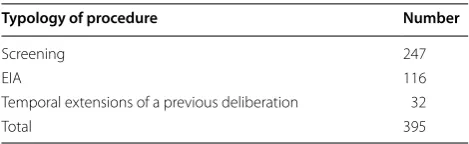
The deliberations have been classified on three catego-ries of procedures, like reported in Table 1.
The number of screening procedures is about double than the EIAs. We found 32 requests of temporal exten-sion of previous positive deliberations on Screening or
EIA. Considered the time necessary to arrive to have a deliberation, the uncertainty of the result of an EIA pro-cedure and that in general these decisions are still valid for 5 years, it seems strange that a proponent don’t imple-mented its project in time.
On a total of 395, 32 cases represent a relevant share (8%). It is a signal of a lack of effectiveness but more related to the entire process of a proposal development, rather than to the EIA.
It is useful analyze the number of procedures per year. It is easy to see that, on average, the numbers are almost the same in all the years (Table 2) and there are always more screening rather than EIA.
The article chooses to study in a separate way the dif-ferent objects of the procedures (Screening and EIA), to better debate their differences.
The Screening procedures
Actually, the Screening procedure in Italy requires the production of a preliminary EIS, for this reason it can be considered a “little EIA”. During the analyzed period to understand better the environmental implications, it was mandatory to present a preliminary project.
The procedure starts with the publication of an advice and of all the materials on the website of CA, that are freely consultable by everyone.
Any agency potentially involved and every citizen have 45 days to make comments and observations. The CA can request additional documentation. The proponent can ask for a suspension if he needs more time to furnish the integrations. On the basis of all the documentation the CA makes its technical evaluation on environmental compatibility of the project.
Overall, 246 Screening procedures were analyzed in the period under investigation.
The Table 3 shows the distribution in the eight Sardinia provinces. The 45% of projects are on Cagliari and Sas-sari, while the rest are distributed in the other provinces. The provinces with fewer projects are the ones fewer populated and with many crisis signals, especially on unemployment and income levels.
The categories of projects presented for the Screening are listed in Table 4.
Table 1 Number and categories of procedures
Typology of procedure Number
Screening 247
EIA 116
Temporal extensions of a previous deliberation 32
Total 395
5 Number of deliberation, date of deliberation, project title, municipality,
The normative divided the projects on eight cat-egories. In these 5 years, the projects refer just on six categories and two of them include only one project. No project involves the categories 5—Textile, leather,
wood and paper industries and 6—Rubber and plastic
industries. Considered the important role of agriculture in Sardinia it is strange that we had just five projects on this sector. It can be linked both to the traditional and medium small dimension of the activities that are conducted (excluded by EIA), and to a lack of entneurial initiative. To discuss in deep the other repre-sentative sectors for number of projects it is important to detail them (Table 5).
Half of procedures involves projects of infrastructures, often promoted by public or semi-public proponent. The projects for infrastructures proposed by private subjects regards essentially waste treatment. The majority of pro-jects (36) of the sector 2—Energy and extractive indus-tries referred to little solar plants or wind farms while the rest (12/13) are essentially projects for mining research.
Despite the name, the category 2 does not include quarries and peat bogs that are included in the category 8—Other projects. The majority of the projects of this category are quarries (49/67). The rest are modifications of projects included in Annexes A1 or B1 (12), and three projects for holiday villages.
From these numbers we can understand that the pro-jects subjected to Screening in Sardinia do not refer to many different categories and typologies. In these years, they have essentially concentrated on infrastructure, production of energy from renewable resources (surely linked to government financial incentives) and quarries.
The Environmental Impact Assessments
Since 2012 to 2016, we find 116 projects, subdivided in all the districts present in Sardinia (Table 6). The major-ity of the projects originate from the southern part of the island, in particularly in the district of Cagliari (23 EIA procedures) and Carbonia—Iglesias (26). In the north, the district of Sassari has 26 while Olbia-Tempio counts 12 procedures. The procedures in the center are concen-trated on Nuoro (15) while all the others three districts (OR, VS, OG) together sum 14 EIAs.
This is an important image of what happens today in Sardinia. While in the south and in the north more ini-tiatives related to industry are starting, the middle of the island remains linked to traditional agriculture, rearing and pastoralism. These are places in between in this his-torical moment, where both public administrations and private operators do not propose to conduct complex projects.
It is important to discuss more in detail which are the different categories of EIA and which are the focus of the different ones per district.
The wind farms are the biggest field of application of EIA, with 31 procedures, above all in the districts of Sassari and Carbonia-Iglesias, with 10 and 9 EIA dures. Wind farms are the 26.3% of all analyzed proce-dures. Geographically, wind farms have no interest in the middle and in the northeast of the island. The proposal for mineral and mining research are 14, and just one is located in the central districts. The extractive industry registered seven proposal, particularly to cultivate min-eral quarries or use minmin-eral waters, coming from natural
Table 2 Procedures per year
2012 2013 2014 2015 2016 Total
Screening 64 47 36 54 46 247
EIA 13 24 30 32 17 116
Total 77 71 66 86 63 363
Table 3 Screening procedures by province
Province CA CI NU OG OR OT SS VS Tot
Screening 56 14 25 15 32 37 55 13 247
Table 4 Screening: categories and number of projects
Categories of project Number
1. Agriculture 5
2. Energy and extractive industries 50 3. Processing of metals and mineral products 1
4. Food industry 1
7. Infrastructures 123
8. Other projects 67
springs or wells. The projects are mainly located in the districts of Cagliari and Sassari. The projects that are likely to have a significant effect on a Natura 2000 site are
16, and all of them pass the EIA. On 24 projects for which an EIA has been required after the Screening procedure, the majority regards quarries (12) and wind farms (8).
Table 5 Screening detailed categories of projects
Screening—categories of projects No.
1. Agriculture 5
1.a) Change of use of non-cultivated areas, semi-natural or natural for their intensive cultivation 1
1.b) Forestation or deforestation 2
1.c) Installations for the intensive rearing of animals 1
1.e) Fish-farming activities 1
2. Energy and extractive industries 50
2.a) Thermal plants for the production of energy, steam and hot water 1 2.b) Mining exploration, including geothermal resources research 12 2.c) Nonthermal plants for the production of energy, steam and hot water and thermodynamic solar plants 21
2.d) Wind farms 15
2.j) Exploration for oil and gas on mainland 1
3. Processing of metals and mineral products 1
3.c) Installations for the processing of ferrous metals 1
4. Food industry 1
4.f ) Slaughterhouses and Installations for the disposal or recycling of animal carcasses and animal waste 1
7. Infrastructures 123
7.b) Urban development projects 15
7.d) Derivation of surface water or groundwater and related drilling 1
7.g) Secondary non-urban roads 4
7.h) Construction of express roads in urban areas or reinforcement of existing roads of four or more lanes 1
7.i) Regional or local railway lines 1
7.l) Coastal work to combat erosion and maritime works capable of altering the coast- 6 7.m) Works of adjustment of the course of rivers and streams, channeling and remediation 30
7.o) Yacht marinas 2
7.q) Installations for the disposal of non-hazardous waste by incineration 3 7.v) Installations for the disposal and recovery of hazardous waste 9 7.w) Installations for the disposal of non-hazardous waste 48 7.e) logistic centers, intermodal platforms and terminals 1 7.j) Sistemi di trasporto a guida vincolata (tramvie e metropolitane), funicolari o linee simili di tipo particolare, esclusivamente o principalmente
adibite al trasporto di passeggeri 1
7.r) Installations for the disposal of non-hazardous special waste with a preliminary storage 1
8. Other projects 67
8.a) Holiday villages, hotel complexes 3
8.b) Permanent racing and test tracks for cars and motorcycles 1 8.g) Storage of oil, petroleum products, petrochemicals and hazardous chemicals 1
8.i) Quarries and peat bogs 49
8.j) Treatment of intermediate products and manufacture of chemical products 1 8.s) Modifications to development projects included in Annex I and projects in Annex I 12
Total 247
Table 6 EIA procedures by province
Province CA CI NU OG OR OT SS VS Tot
Agricultural EIA procedures are practically absent: in 5 years, the data show only one proposal. Evidently, in Sardinia the will to operate in the agricultural field transposes itself only in projects with less impact, as said previously.
Effectiveness of EIA: evaluation on Sardinia practice
Pre and Post EIA stages: EIA normative evolution in Italy and Sardinia
Here is presented a revision of normative evolution on EIA in Italy and Sardinia. The normative framework about EIA represent at the same time the bases of EIA (and then it refers to the pre-EIA stage) and, at the same time, it is influenced by the feedbacks of practice on EIA, because it is continually revisioned to improve the effec-tiveness of the laws (and therefore it refers to post-EIA stage).
It is important to start from a review of the normative evolution to assure a better understanding of the frame-work in which proposals are evaluated.
Nowadays, one of the limits on the effectiveness of EIA is linked to its continuous normative evolution (and vice versa: the normative continuously evolves because some aspects of EIA are ineffective).
Especially in Italy (and consequently in Sardinia), the EIA normative has a troubled route (still today) that does not help to consolidate and adjust an effective sys-tem of evaluation. From 1985 to 1996, in fact, Italy does not transpose in a correct way the Directive 85/337 and the general system of EIA has not been effective, but has resulted more as another bureaucratic procedure, then an important tool for the improvement of environmental care.
It seems useful to introduce briefly what has been the transposition of EIA directive in Italy, and when, and how, Sardinia starts to work on EIA.
Sardinia is a special administrative Region and it has to adapt its regional laws to the national ones, with a signifi-cant degree of freedom, that adds more difficulties and delays to the implementation of UE directives. There are cases in which Sardinia has promulgated laws in contrast with the Italian ones, with some institutional clashes, and court processes, which sometimes took years to be resolved.
In 1985, the CE approved the directive on EIA 85/337/ EEC. EIA do not become immediately operative between all Member States (MS) because it has to be transposed it in a national law. With the law 349/1986 Italy appoints and refers to other laws the need to transpose the envi-ronmental impact directive, and at the same time estab-lishes the Ministry of the Environment, which until then did not exist.
Italy did the first transposition with two decree (377/1988 and DPCM 27/12/1988) but they completely ignored the projects listed in the Annex II (the list of the projects to screening for EIA). Therefore, in 1992 the European Commission opened an infringement procedure against Italy.
Just with the DPR approved on April 12, 1996 it is given to regions and autonomous provinces the task to implementing the EIA directive for all the categories of projects listed in the two annexes and not yet included in the national legislation. It means that for 8 years in Italy EIA worked just for nine tipologies of projects, without any screening.
The law of 1996 individuate the Ministry of Environ-ment as CA for the EIA of projects with more poten-tial impacts, of national interest or that involve more regions, and the Regions as CA for projects under a certain dimensional threshold or just of regional inter-est. Its implementation required another normative act by every single Region, and then EIA still remained an underused tool, still quite ineffective, despite the new legislation.
The Sardinia’s answer to this task required 3 years. In 1999 (art. 31. Regional Law-R.L.-no. 18, 1999) the Region starts to legislate on EIA, and just on January of 2000, the first regional office for EIA has been set up. Currently this office is called “Service for Environmental Evalua-tion” (the acronym in Italian is SVA). Therefore, the expe-rience of EIA in Sardinia started at the beginning of the millennium. It is important to underline that since the first moment, the procedure stated a technical evalua-tion on the environmental impact of the projects that is concluded with a technical opinion on the authorization. After, it is a political deliberation of the Regional Council that, starting from the findings of the technical analysis, assumes the final decision. This political choice is consid-ered another limit to effectiveness of EIA. “The outcomes of political decisions often are difficult to predict because they are reached through a process that involves trade-offs, compromise and stakeholder interactions, and may reflect power relationships and vested interests” (Cash-more et al. 2004).
In 2006 (152/2006, “Environment code”) Italy trans-poses in organic way the new EIA and SEA directives (2003/35/CE and 2001/42/CE), and the Region prom-ulgates a new law (R.L. no. 9, 12/06/2006) on EIA and VAS, identifying and dividing the competences between Region and Provinces.
These guidelines have been updated with the R.D. n. 34/33 of 07/08/2012 that essentially introduced the Annex D.
The procedures of EIA carried out in the period ana-lyzed by the article refer to these guidelines, but the process of transposition of the VIA directives in Italian national and regional legislation is still in progress. Italy had another infringement procedure (2009/2086) for the incomplete implementation of the directive, and in 2014, the Ministry of Environment issued new guidelines for the Screening of projects where Regions are CA.
Meanwhile the UE issued the Directive 2011/92/EU amended in 2014 by Directive 2014/52/EU.
In Italy, the D.Lgs. N. 104/2017 adapted the EIA pro-cess to the European framework, and some projects changed the CA for the EIA, as their interest has passed from regional to national level. On September 2017, in Sardinia the R.D. n. 45/24 regulates the transitional pro-cedures relating to the EIA. We are still in between, wait-ing for a new complete and updated text.
The initial Directive of 1985 has been amended three times (1997, 2003, 2009), codified by Directive 2011/92/ EU of 2011 and re-amended in 2014 by Directive 2014/52/EU.
Looking to this large amount of normative changes, from the point of view of the feedback of results of proce-dures on policies, it seems that EIA has an effectiveness. At the same time, it seems that too many corrections are linked to the initial theoretical weakness of EIA and its procedural formulation. Different authors (Glasson et al.
2005; Sadler 1996, Cashmore et al. 2004; Jay et al. 2007), as mentioned before, recognize it as a substantive limit to effectiveness.
Pre EIA stage: the Screening procedures
Supply of additional information and project changes
During the Screening procedure the CA can request additional documentation. Even the proponent can sub-mit new information. They can regard both some design specifications and/or some preliminary EIS aspects.
This information sometimes is devoted to integrate the EIS, improving its quality. It is important to under-line that if the proposal is well presented, it does not need to be supplemented with further information. Then an absence of the provision of additional information can be related to an initial documentation enough developed to permit a clear understanding of the project and of its impacts and a decision if an EIA is required or not can be taken.
The presentation of additional documents during the Screening stage can be correlated to an effectiveness of the procedure that acts to improve the quality of the proposal.
An effective procedure have to lead to an improvement of the preliminary EIS and of the proposal design, orient-ing them to the reductions of environmental impact.
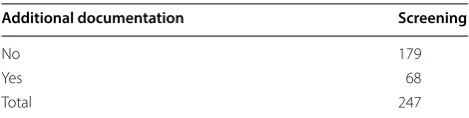
During the screening we have found (Table 7) that on 27.5% of cases the proponent (on a request of CA or by its initiative) submit additional information. This means that more of a quarter of documentation at the beginning of the process were insufficient to take a decision.
On the total, the 12% of the projects have been modi-fied during the procedure (Table 8). A major objective of the procedure is to establish a dialogue between the pro-ponent and the authorities. The dialogue can generate new ideas or new alternatives for the projects or, again, different solutions to reduce the impacts (Christensen et al. 2005), and is influenced by the kind of inputs that the different actors promote. Considering that during the screening the project is at a preliminary level, this stage can be very effective in the promotion and orientation of project changes, often leading to major revisions.
“Nielsen et al. (2005) asserted that screening is not only a filtering mechanism but also effectively a more independent regulatory instrument, as deci-sions are based on modifying the project proposal” (Zhang et al. 2012).
These changes often leads to the choice of alternative project locations or to other design modifications (i.e. analyzing the documents we found that for many lit-tle wind farms the changes involve a new localization of the wind turbine or a technical solution that reduces the height of the wind turbine).
The project and EIS revisions do not ensure a positive result. On 74 proposal that registered the provision of additional documentation or of design changes, for 10 an EIA has been requested.
Judgement of CA on the quality of EIS
Another element of Effectiveness of EIA is related to the EIS quality. We decided do not make a direct evalua-tion of the quality of EIS, but analyzing the deliberaevalua-tion on the proposals, we find some judgements made by the CA (Table 9). Then it is a global judgment that considers all the submitted documents. Most evaluations related that the level of quality of documents is sufficient to
Table 7 Additional documents
Additional documentation Screening
No 179
Yes 68
evaluate properly the project and its potential impacts (94%), but it happens that they can be considered insuf-ficient (5%) or scarce (1%). In the last cases, an EIA has always been requested.
The great majority of proposal, at the end of the Screening, are well documented. These data show that the procedure is quite effective in improving the quality of the proposals.
Public comments and opinions
According to Palerm (2000), the access to knowledge is of key importance to the public, and public empowerment is fundamental when the public is not well educated and informed. In many cases the effectiveness of the proce-dure occurs during public meetings, in which it is pos-sible to communicate, even with non-technical language, contents sometimes difficult to understand, and those cases are vital for promoting public support (Cashmore et al. 2008).
As shown in Table 10 only 6% of Screening proce-dures registered comments or opinions by the public. The majority of them are related to projects that seems to have either great visual impacts or effects on pub-lic health. This means that participation is often condi-tioned by the NIMBY syndrome, that’s to say that the
participation is limited to those directly interested by the proposals.
It is a signal of lack of effectiveness of the procedure, because the directives put a great emphasis on the public involvement. It should be underlined that in the major-ity of cases that registered public comments and opinions the procedure ends with the request of an EIA. It seems that this point can be improved, with a more direct com-munication about the proposals (Alemagi et al. 2007; Cashmore et al. 2008). Actually the procedure does not include the obligation to make a public presentation of the proposal, and its start, after the last changes to the national law, is no more publicized in the main regional newspapers, so it is more difficult to be informed and, consequently, to participate.
The duration of the screening
The deliberation 34/33 evaluates that the screening pro-cedure lasts 90 days. This time does not include eventual suspensions for requested additional information and/or explanations. The time starts with the publication of the public advices on the beginning of the procedure.
However, what is the real duration of this procedure? We choose to calculate the total time passed between the deposit of the first request of the proponent and the date of deliberation (Table 11).
The average duration is 257 consecutive days, about three times the time required by the norms; 46 proce-dures last more than 1 year, while just 7 have been con-cluded in the provided time of 90 days.
If we analyze the proposals by category, regarding the more represented ones (2, 3 and 8) the category 8 “other projects” (quarries essentially) has the longer average duration, while the infrastructure have the shorter one. Proposals on energy and mining research stay perfectly in media.
The longest procedure regards a project for mining research that had a troubled route to arrive at a delibera-tion. There has been an error in the necessary involve-ment of a public authority, a suspension waiting the adoption of a new regional law on mining research, and some delays in various parts of the process that led to these huge delays.
In the cases of long duration of the procedure, we often found problems linked to the relations between regional and national laws, still unresolved or, in some cases,
Table 8 Project changes
Project changes Screening
No 217
Yes 30
Total 247
Table 9 Judgement of CA on EIS
Judgement of CA on EIS Screening
Scarce 2
Insufficient 12
Sufficient 233
Total 247
Table 10 Public comments and opinions
Public comments and opinions N°
of screening procedures
No 231
Yes 16
Total 247
Table 11 Screening procedures duration
Province Number Average
duration Minimum duration Maximum duration
solved just after a Court decision. In these case effective-ness seems to have a structural problem, more linked to the special government of Sardinia than to a good nor-mative transposition.
About the duration we can also report that the actual effectiveness of the EIA should be measured by compar-ing the total time required to obtain an authorization when there was no EIA with the current one. Unfortu-nately, this is a very complex comparison to be imple-mented, so we can just measure the effectiveness with respect to the time length prescribed by the law. Then from these point of view the Screening procedure is ineffective.
The results of Screening
Speaking about the results of screening (whether an EIA has or not been required) we have the following Table 12.
EIA has been required for an important number of proposals (15.4%). This share growth to 48% for the pro-posals on energy and extractive industries. Specifically, on 24 analyzed proposals, 23 were related to the produc-tion of energy from renewable sources (11 wind farms, 11 solar parks, 1 parabolic trough power plant). EIA has not been required for 14 presented proposals of energy production. It means that, in general, this category has been evaluated with potential relevant impact for the environment.
The time spent to have a positive or a negative result of screening in total is similar. For groups 2 and 8 the pro-posals have required more time for a result without an EIA request, on the contrary of group 7, where, on aver-age, it has been spent more time to request an EIA.
The great number of proposals on renewable sources for which EIA has been required underline, for us, a problem of effectiveness. If the legislation imposes a screening procedure, it means that these projects should have (on average) fewer impact on the environment. To request too often an EIA is like inserting them in the
same list of those with more impact that is to have an ineffective normative application.
The EIA stage
Supply of additional information and design changes
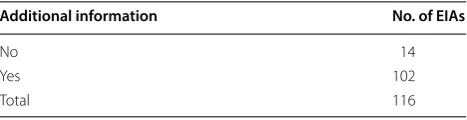
As in the case of Screening, even during the evalu-ation procedure of the VIA by the CA, changes are made to the projects or additional information is requested (Table 13).
In the case study it is noted that additional information is usually required, in fact it is evident that the 88% of the cases. This is the signal that this procedure enters deeply in the study of the impacts and it permits to improve the efficiency both of the procedure and of the projects.
With regard to the projects, in 48% of the cases (Table 14), they are modified during the proce-dure, either because of the additional information and the consequent debate, or from choices that forced to change them due to the evaluation process, or following the requirements that are affixed to the conclusion of the procedure.
There are no radical changes in the projects, however there is a general improvement of the same, in fact the change in the project always follows an approval in the final evaluation.
Judgement of CA on the quality of EIS
The method to evaluate and collect the judgements of CA on EIS it is the same used for the Screening procedure.
Table 15 shows that even in this case the great major-ity of EIS are sufficiently developed to take an informed
Table 12 Screening results and average duration
Result EIA is required EIA is not required
Typologies of project No. % Avg dur No. % Avg dur
1. Agriculture 1 20.0 147 4 80.0 208
2. Energy and extractive industries 24 48.0 227 26 52.0 290 3. Processing of metals and mineral products 1 100.0 189
4. Food industry 1 100.0 209
7. Infrastructures 6 4.9 278 117 95.1 221
8. Other projects 7 10.4 281 60 89.6 328
Total 38 15.4 243 209 84.6 260
Table 13 Supply of additional information
Additional information No. of EIAs
No 14
Yes 102
decision about the compatibility of the proposal with the environment. In this case too, the proposals whose EISs did not receive sufficient judgment had a negative outcome.
Public comments and opinions
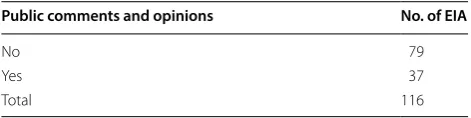
In the analyzed cases the EIA stage registers about a 32% of cases with public comments (Table 16).
It is a great improvement if compared with the pre EIA stage (6%). This stage seems then more effective to stimulate and encourage public participation. It can be linked to the procedure, that provides a public presenta-tion of the project. Usually it is done in the municipal-ity interested by the project. During this public assembly everyone can make observations that the CA register and on which the proponent is called to give answers and counter arguments. It is at this point that most of the comments arise and many of them are subsequently transmitted in writing, witnessing their importance.
The duration of EIA
The deliberation n. 34/33 states that the necessary time to conclude an EIA is 150 days, except any suspension for additional information or explanations. However, real-ity shows that the average duration of EIAs is about 702 consecutive days, more than four times than expected (Table 17).
The average duration of an EIA procedure in EU is about 11.3 months, with an average of 1.2 month required for prior screening in certain MS. The average duration excluding screening is 10.1 months (GHK Con-sulting Ltd 2010). Therefore, we can conclude that in Sar-dinia EIAs last more than in other countries, and this is surely an effectiveness problem.
Between the evaluations, those last more than 1000 days (totally 27) there are mainly wind farms (14). In general, EIAs are longer when the proposals present relevant impacts or there are shortcomings in the pre-sented documentation. It means interruptions, requests of additional information with Environmental Impact Statement (EIS) or project revisions and resubmissions.
The reasons of these long durations are numerous. Firstly, the complexity in evaluating environmen-tal impact needs to have both project and EIS correctly designed. Projects or/and EISs of poor quality require revision, additional information and resubmission. The question of the quality of EIS is on the table of CE (CE 2003, 2009) but it remains unsolved.
Every EIS is composed by a great amount of hetero-geneous documents. Even if the procedure is the same, every project is different and it means that it needs spe-cific studies and has spespe-cific impacts.
Last, but not least, Sardinia is a special administra-tive Region and in some cases we found that conflicts between regional and national laws produced significant delays on EIAs. Therefore, Italian and Sardinian public bodies have still to work on the reduction of the duration of EIAs, for a better and effective result.
EIA results
The 116 considered EIAs have 23 negative decisions and 93 positive decision, i.e. the 80%; it means that at the end of the procedure EISs and projects are properly designed (Table 18).
On the 23 negative results, 19 regards wind farms that totally registered 31 EIAs. The majority of them had a negative decision due to important environmental impact, deficits in projects and EIS, serious infrastruc-tural problems and so on. This number seems important, and maybe it is influenced by the general debate on this type of plants. The other rejected projects refer to photo-voltaic solar plants (2), one installation for the disposal of
Table 14 Design changes
Design changes No. of EIAs
No 60
Yes 56
Total 116
Table 15 Public comments and opinions
Judgement of CA on EIS No. of EIAs
Scarce 10
Insufficient 2
Sufficient 104
Total 116
Table 16 Public comments and opinions
Public comments and opinions No. of EIA
No 79
Yes 37
Total 116
Table 17 EIA procedure duration
Province number Average
duration Minimum duration Maximum duration
hazardous waste (but the other five have a positive result) and one mine (13 have a positive decision).
A great number of EIAs have a positive decision, after a previous screening procedure: 22 on 24. In these cases, EIA seems to be quite ineffective, may be some of these proposals could have closed the screening procedure without requiring an EIA.
In general, a negative decision requires more time than a positive one. It is not surprising because the propo-nents do not easily accept a failure of their proposal and try to have a positive result with additional information, project and EIS improvement and so on. In many cases, we found a lot of exchange of communications between CA and proponent before arriving at a negative result.
Conclusions
In this evaluation of Sardinia experiences, the paper has firstly focused on the state of art of EIA procedures. The GHK report (2010) underline how in 2010 in Italy there was not the information available about EIA procedures. It is a fundamental element to study a better implemen-tation of this tool. The same report (pp 9–16) estimates (basing on correlation between population and average annual screening numbers) that Italy should be one of the nations that made more EIAs in Europe.
Even if the EIA Directives emphasize the public infor-mation and participation, and the Italian law obliges to the publication of EIAs procedures on line, there are many difficulties to build an historical trend on what is happening in the various Regions.
Due the great number of EIA carried out in Italy (the GHK report estimates about 1550 Screening and 2700 EIA procedures per year) should be necessary to build an accessible database of all these processes. In every case it is mandatory do it to make any typology of study. We found these weakness of EIA system underlined in many academic contributes (Barker and Wood 1999; Cashmore et al. 2004; Christensen et al. 2005; Glasson et al. 2005; Banias et al. 2017) and European reports and studies (EC 2003, 2009; GHK 2010). Despite many progresses of EIA this point seems still unresolved.
The methodology adopted to collect the data in this paper is exportable in other contexts. The CA always publishes the final disposals on the decision of the EIA. They are formal acts (deliberations) of a political author-ity that is normally mandatory to publish and make easily
accessible. Their search and collection, in the absence of other official statistics, seems simpler than other meth-ods (many studies collect all the materials regarding the EIAs, i.e. see Wood 1996).
A secondary aim of the paper was to make some evalu-ation about the effectiveness of EIA, and the same meth-odology allows collecting important elements for this scope.
Moreover, it permits a general and complete investiga-tion on all EIA procedures carried out by the CA in the studied period and not a sample search as other studies did (i.e. Christensen et al. 2005; Banias et al. 2017). The deliberation closes the EIA process, and then it is possi-ble investigating all the process stages.
Obviously, this methodology allows making some interesting and important inferences, but for a more in-depth analysis, it is necessary to study all the documenta-tion related to each case.
The paper started from the evaluation of the legislative framework of EIA. It shows that Italy arrives to a good transposition of the Directive 85/335 only around the year 2000. Then for 15 years EIA procedures (especially the Screening) have been practically ineffective. Even the EU is trying to improve and better implement EIA, with continuous feedback on the normative from the experi-ences. Nevertheless, it requires the knowledge of the state of the art, that is another reason to make national and regional databases.
Other effectiveness evaluations has been made by dividing the pre-EIA stage (Screening procedure) study from that of the actual EIA stage.
The paper used as indicators the provision of additional information and the project changes during the proce-dure, the quality of EIS as evaluated by the CA, the pres-ence of public comments and opinions, the duration and the results of each procedure.
The article adopts a dialogical vision of EIA proce-dures, giving importance to the entire process, and not focalizing on the initial quality of submitted EIS. In this vision, the Screening and EIA procedures seem quite effective about the improvement of EIS quality and the introduction of project changes, according with other authors (Christensen et al. 2005; Banias et al. 2017). By evaluating the results of previously studies on this topic (Sadler 1996; Wood and Jones 1997), it can be said that procedure effectiveness is improving over time.
Table 18 EIA results and average duration
Result Negative environmental impact assessment Positive environmental impact assessment
Procedure No. % Avg dur No. % Avg dur
Unfortunately, public involvement has still to improve. Especially during the Screening stage there is a lack of participation. Some authors link it to a general problem of empowerment (Ogunba 2004; Kruopiene et al. 2009), public hearings (Ahammed and Harvey 2004; Toro et al.
2010), accessible information and effective communica-tion (Palerm 2000; Baker and McLelland 2003; Alemagi et al. 2007; Cashmore et al. 2008). On the other hand, during the EIA stage there is a 32% of proposals that reg-istered public opinions and comments. Probably some mechanism of this stage work better than the Screening stage ones.
The medium duration of the two procedures seems always excessive, compared to the provisions of the law. The risk is that after a long time the projects get older and less useful and that the EIA procedures rather than being a driving force for a more sustainable development could become a bureaucratic burden that discourages entrepreneurs.
From the point of view of the results there are some elements of effectiveness. An EIA has been required and after have a positive EIA decision for numerous projects. To make too many avoidable EIAs means to spend in vain a lot of time, efforts and sources. Another element that put in evidence a scarce effectiveness of EIA is that related to the decision on projects related to the produc-tion of energy from renewable resources. It can be related to the political nature of these decisions. The EIA is only a part of the entire decision-making process involving stakeholders, political choices and balances of power (Cashmore et al. 2004).
Although EIAs effectiveness has still to be improved significantly, it is important to recognize that the major-ity of the analyzed projects obtained the environmental authorization, and that the continuous dialogue between proponent and CA permitted the improvement of the projects and lead to the reduction of their environmental impact.
Moreover, EIA is a component that intervenes modify-ing the institutional and design attitude to the environ-ment. It is a cultural change, integrated and supported by a wide range of policy initiatives and with amplifying effects in the social, cultural and institutional field.
For these reasons, the EIA is a fundamental tool that cannot be abandoned to assess the environmental impact of our actions in a vision of a more sustainable and envi-ronmentally compatible development.
Authors’ contributions
The authors contributed equally to this work. Both authors read and approved the final manuscript.
Competing interests
The authors declare that they have no competing interests.
Availability of data and materials
The datasets used and analyzed during the current study are available from the corresponding author on reasonable request.
Funding
This research received no specific grant from any funding agency in the pub-lic, commercial, or not-for-profit sectors.
Publisher’s Note
Springer Nature remains neutral with regard to jurisdictional claims in pub-lished maps and institutional affiliations.
Received: 27 November 2018 Accepted: 8 March 2019
References
Ahammed R, Harvey N (2004) Evaluation of environmental impact assessment procedures and practice in Bangladesh. Impact Assess Project Apprais 22:63–78
Alemagi D, Sondo VA, Ertel J (2007) Constraints to environmental impact assessment practice: a case study of Cameroon. J Environ Assess Policy Manag 9:357–380
Baker DC, McLelland JN (2003) Evaluating the effectiveness of British Colum-bia’s environmental assessment process for first nations’ participation in mining development. Environ Impact Assess Rev 23:581–603 Banias G, Lampridia M, Pediaditia K, Achillas C, Sartzetakisc E, Bochtis D,
Ber-ruto R, Busato P (2017) Evaluation of environmental impact assessment framework effectiveness. Chem Eng Trans 58:805–810
Barker A, Wood C (1999) An evaluation of EIA system performance in eight EU countries. Environ Impact Assess Rev 19:387–404
Bond AJ, Wathern P (1999) Environmental impact assessment in the European Union. In: Petts J (ed) Handbook of environmental impact assessment, vol 2. Blackwell Science, Oxford, pp 223–248
Bond A, Langstaff L, Baxter R, Kofoed H, Lisitzin K, Lundström S (2004) Dealing with the cultural heritage aspect of EIA in European developments. Impact Assess Project Apprais 22(1):37–45
Braun C (1993) EIA in the 1990s: the view from Marsham Street. In: EIA in the UK: Evaluation and prospect conference, 6 April 1993. University of Manchester, Manchester
Caldwell LK (1993) Achieving the NEPA intent: new directions in politics, sci-ence, and law. In: Cannon JB, Hildebrand SG (eds) Environmental analysis. The NEPA experience. Lewis Publishers, London, pp 12–21
Cannaos C, Onni G (2017) Sardegna: ad marginem. Archivio di Studi Urbani e Regionali 118:27–48
Canter L (1977) Environmental impact assessment. McGraw-Hill, New York Cashmore M, Gwilliam R, Morgan R, Cobb D, Bond A (2004) The interminable
issue of effectiveness: substantive purposes, outcomes and research chal-lenges in the advancement of environmental impact assessment theory. Impact Assess Project Apprais 22:295–310
Cashmore M, Bond A, Cobb D (2008) The role and functioning of environmen-tal assessment, theoretical reflections upon an empirical investigation of causation. J Environ Manag 88:1233–1248
Christensen P, Kørnøv L, Nielsen EH (2005) EIA as regulation: does it work? J Environ Plan Manag 48(3):393–412
Doyle D, Sadler B (1996) Environmental assessment in Canada: frameworks, procedures and attributes of effectiveness. Canadian Environmental Assessment Agency, Ottawa
Ensminger JT, McLean RB (1993) Reasons and strategies for more effective NEPA implementation. Environ Prof 15:45–56
Ferrary C (1994) Environmental assessment: our client’s perspective. In: Envi-ronmental assessment: RTPI Conference, 20 April. Andover
Frost R (1997) EIA monitoring and audit. In: Weston J (ed) Planning and environmental impact assessment in practice. Addison Wesley Longman, Harlow, pp 141–164