R E S E A R C H
Open Access
A new hybrid algorithm and its numerical
realization for two nonexpansive mappings
Qiao-Li Dong
1,2, Songnian He
1,2and Yeol Je Cho
3,4**Correspondence: [email protected] 3Department of Mathematics
Education and RINS, Gyeongsang National University, Jinju, 660-701, Korea
4Department of Mathematics,
Faculty of Science, King Abdulaziz University, Jeddah, Saudi Arabia Full list of author information is available at the end of the article
Abstract
In the paper, first, we introduce a new hybrid projection algorithm and present its strong convergence theorem. Next, we analyze different hybrid algorithms in computing and conclude that our proposed algorithm has an advantage. Finally, the numerical experiments validate the efficiency and advantages of the new algorithm.
MSC: 90C47; 49J35
Keywords: nonexpansive mapping; hybrid algorithm; cyclic algorithm; parallel algorithm; strong convergence
1 Introduction
LetH be a real Hilbert space with the inner product·,·and the norm · andCbe a nonempty closed convex subset ofH. Recall that a mappingT :C→C is said to be nonexpansiveif
Tx–Ty ≤ x–y
for allx,y∈C. We denote byFix(T) the set of fixed points ofT,i.e.,Fix(T) ={x∈C:Tx= x}.
The construction of common fixed points for a finite family of nonlinear mappings is of practical importance. In particular, iteration algorithms for finding common fixed points of a finite family of nonexpansive mappings have received extensive investigation (see [– ]) since these algorithms have a variety of applications in inverse problem, image recov-ery, and signal processing (see [–]).
Mann’s iteration algorithm [] is often used to find a fixed point of nonexpansive map-pings, but it has only weak convergence (see [] for an example). However, strong conver-gence is often much more desirable than weak converconver-gence in many problems that arise in infinite dimensional spaces (see [] and references therein). So, attempts have been made to modify Mann’s iteration algorithm so that strong convergence is guaranteed. Let T:C→Cbe a nonexpansive mapping. ThenI–Tis a maximal monotone operator []. Inspired by Solodov and Svaiter’s hybrid method for finding a zero of a maximal monotone operator [], Nakajo and Takahashi [] first introduced a hybrid algorithm for a nonex-pansive mapping. Thereafter, some hybrid algorithms have been studied extensively since they have strong convergence (see [–]).
In this paper, motivated by Eckstein and Svaiter’s splitting methods for approximating a zero of the sum of two maximal monotone operators [], we introduce a new hybrid algorithm. LetT,S:C→Cbe two nonexpansive mappings such thatFix(T)∩Fix(S)=∅. We consider the following algorithm.
Algorithm
⎧ ⎪ ⎪ ⎪ ⎪ ⎪ ⎪ ⎪ ⎪ ⎪ ⎪ ⎪ ⎨ ⎪ ⎪ ⎪ ⎪ ⎪ ⎪ ⎪ ⎪ ⎪ ⎪ ⎪ ⎩
x∈Cchosen arbitrarily,
yn=αnxn+ ( –αn)Txn,
zn=βn[γnyn+ ( –γn)xn] + ( –βn)Syn,
Cn={z∈C:σzn–z+ ( –σ)yn–z≤ xn–z}, Qn={z∈C:xn–z,xn–x ≤},
xn+=PCn∩Qnx
()
for eachn≥, wherePKdenotes the metric projection onto the setKandαn,βn∈[, – δ],δ∈[, ),γn∈[, ],σ∈(, ) with some conditions.
2 Relation to the previous work
In this section, we analyze and compare Algorithm with two important hybrid algo-rithms which are simple and easily realized. For the purposes of comparison, setγn= in Algorithm , which is reasonable from the numerical experiments in Section . In the case whereγn= , Algorithm actually is a modification of the following cyclic algorithm:
⎧ ⎨ ⎩
yn=αnxn+ ( –αn)Txn, xn+=βnyn+ ( –βn)Syn
()
for eachn≥, wherex∈C.
In [], Takahashiet al.modified the cyclic algorithm () and introduced another hybrid algorithm.
Algorithm
⎧ ⎪ ⎪ ⎪ ⎪ ⎪ ⎪ ⎪ ⎪ ⎨ ⎪ ⎪ ⎪ ⎪ ⎪ ⎪ ⎪ ⎪ ⎩
x∈Cchosen arbitrarily,
yn=αnxn+ ( –αn)T[n]xn,
Cn={z∈C:yn–z ≤ xn–z}, Qn={z∈C:xn–z,xn–x ≤},
xn+=PCn∩Qnx
for eachn≥, where ≤αn≤α< ,T[n]=Tn modand the mod function takes values in
{, }andT=T andT=S.
By modifying the parallel algorithm (see []), it is easy to obtain the following algorithm (see [] for details).
Algorithm
⎧ ⎪ ⎪ ⎪ ⎪ ⎪ ⎪ ⎪ ⎪ ⎨ ⎪ ⎪ ⎪ ⎪ ⎪ ⎪ ⎪ ⎪ ⎩
x∈Cchosen arbitrarily,
yn=αnxn+βnTxn+γnSxn, Cn={z∈C:yn–z ≤ xn–z}, Qn={z∈C:xn–z,xn–x ≤},
xn+=PCn∩Qnx
for each n ≥ , where αn,βn,γn ∈ [, ], αn + βn + γn = and lim supn→∞αn < , lim infn→∞βnγn> .
In the sense of computational complexity Algorithm is similar to Algorithm . How-ever, it is generally recognized that the cyclic algorithm (like the Gauss-Seidel iteration) is faster than the parallel algorithm (like Jacob iteration).
3 Preliminaries
We use the following notation:
• for weak convergence and→for strong convergence; • ωw(xn) ={x:∃xnjx}denotes the weakω-limit set of{xn}.
We need some facts and tools in a real Hilbert spaceHwhich are listed as lemmas be-low.
Lemma . We have the identity in a real Hilbert space H:
u–v=u–v– u–v,v
for all u,v∈H.
Lemma .(Goebel and Kirk []) Let C be a nonempty closed convex subset of a real Hilbert space H and T :C→C be a nonexpansive mapping such thatFix(T)=∅.If a sequence{xn}in C is such that xnz and xn–Txn→,then z=Tz.
Lemma . Let C be a nonempty closed convex subset of real Hilbert space H and let PC be the(metric or nearest point)projection from H onto C(i.e.,for any x∈H,PCx is the only point in C such thatx–PCx=inf{x–z:z∈C}).Then,for any x∈H and z∈C, z=PCx if and only if
x–z,y–z ≤
for all y∈C.
satisfies the condition
xn–u ≤ u–q
for all n≥,then xn→q.
Lemma . Let H be a real Hilbert space.Let C be a nonempty closed convex subset of H and let x,y,z∈H.For any real numberσ∈[, ],the set
D:=v∈C:σz–v+ ( –σ)y–v≤ x–v
is convex(and closed).
Proof In fact, the defining inequality inDis equivalent to the inequality
σ(z–x) + ( –σ)(y–x),x–v ≤–
σz–x+ ( –σ)y–x.
This inequality is affine invand hence the setDis convex.
4 Main results
In this section, we first present a strong convergence theorem and its proof for Algorithm . Then we extend it to a finite family of nonexpansive mappings.
Theorem . Let C be a nonempty closed convex subset of a Hilbert space H and T,S: C→C be two nonexpansive mappings such thatFix(T)∩Fix(S)=∅.Assume that{αn}, {βn},and{γn} are the sequences in[, ]such thatαn,βn≤ –δ for someδ∈(, ]. As-sume σ ∈(, ).Then the sequence{xn}generated by Algorithm converges in norm to PFix(T)∩Fix(S)x.
Proof First, observe thatCnis convex by Lemma .. Next, we show thatFix(T)∩Fix(S)⊂ Cnfor alln≥. To observe this, arbitrarily takep∈Fix(T)∩Fix(S), and we have
yn–p ≤αnxn–p+ ( –αn)Txn–p ≤ xn–p
and
zn–p ≤βn
γnyn–p+ ( –γn)xn–p
+ ( –βn)Syn–p ≤βnxn–p+ ( –βn)yn–p
≤ xn–p.
Combining the above inequalities, it follows that, for anyσ∈(, ),
σzn–p+ ( –σ)yn–p≤ xn–p,
Next, we show that
Fix(T)∩Fix(S)⊂Qn ()
for all n≥ by induction. For n= , we haveFix(T)∩Fix(S)⊂C=Q. Assume that
Fix(T)∩Fix(S)⊂Qn. Sincexn+is the projection ofxontoCn∩Qn, by Lemma ., we
have
xn+–z,xn+–x ≤
for allz∈Cn∩Qn. SinceFix(T)∩Fix(S)⊂Cn∩Qn, by the induction assumption, the last inequality holds, in particular, for allz∈Fix(T)∩Fix(S). This together with the definition ofQn+implies thatFix(T)∩Fix(S)⊂Qn+. Hence () holds for alln≥.
Now, sincexn=PQnx(by the definition ofQn) andFix(T)∩Fix(S)⊂Qn, we have xn–x ≤ p–x
for allp∈Fix(T)∩Fix(S). In particular,{xn}is bounded and
xn–x ≤ q–x, ()
whereq=PFix(T)∩Fix(S)x. The fact thatxn+∈Qnimplies thatxn+–xn,xn–x ≥. This
together with Lemma . implies that
xn+–xn=(xn+–x) – (xn–x)
=xn+–x–xn–x– xn+–xn,xn–x
≤ xn+–x–xn–x,
which implies
xn+–xn → ()
asn→ ∞. Observe thatxn+∈Cnimplies that σzn–xn++ ( –σ)yn–xn+≤ xn–xn+.
Due toσ∈(, ), we have
zn–xn+ →, yn–xn+ → ()
asn→ ∞, which yields
zn–yn →. ()
Combining () and (), we obtain
asn→ ∞. Noting that ( –αn)(Txn–xn) =yn–xn, we obtain
Txn–xn= –αn
yn–xn.
Sinceαn≤ –δ, by (), we have
Txn–xn → ()
asn→ ∞. Fromzn=βn[γnyn+ ( –γn)xn] + ( –βn)Syn, we have
Syn–zn= βn –βn
γn(yn–zn) + ( –γn)(xn–zn)
≤
–βn
γnyn–zn+ ( –γn)xn–zn
,
which, from ()-(), yields
Syn–zn →
asn→ ∞and so
Sxn–xn ≤ Sxn–Syn+Syn–zn+zn–xn ≤ xn–yn+Syn–zn+zn–xn
→ ()
asn→ ∞. Therefore, by ()-() and Lemma ., we obtain
ωw(xn)⊂Fix(T)∩Fix(S).
This, together with () and Lemma ., guarantees the strong convergence of{xn} to PFix(T)∩Fix(S)x. This completes the proof.
LetS=Tin Algorithm , we have a hybrid algorithm for a nonexpansive mappingT:
⎧ ⎪ ⎪ ⎪ ⎪ ⎪ ⎪ ⎪ ⎪ ⎪ ⎪ ⎪ ⎨ ⎪ ⎪ ⎪ ⎪ ⎪ ⎪ ⎪ ⎪ ⎪ ⎪ ⎪ ⎩
x∈Cchosen arbitrarily,
yn=αnxn+ ( –αn)Txn,
zn=βn[γnyn+ ( –γn)xn] + ( –βn)Tyn,
Cn={z∈C:σzn–z+ ( –σ)yn–z≤ xn–z}, Qn={z∈C:xn–z,xn–x ≤},
xn+=PCn∩Qnx
()
for eachn≥, whereαn,βn∈[, –δ],δ∈[, ),γn∈[, ],σ∈(, ).
following algorithm:
⎧ ⎪ ⎪ ⎪ ⎪ ⎪ ⎪ ⎪ ⎪ ⎪ ⎪ ⎪ ⎨ ⎪ ⎪ ⎪ ⎪ ⎪ ⎪ ⎪ ⎪ ⎪ ⎪ ⎪ ⎩
x∈Cchosen arbitrarily,
yn=αnxn+ ( –αn)Txn, zn=βnxn+ ( –βn)Tyn, Cn={z∈C:zn–z≤β
nxn–z+ ( –βn)yn–z}, Qn={z∈C:xn–z,xn–x ≤},
xn+=PCn∩Qnx
()
for eachn≥, where{αn},{βn}are the sequences in [, ] such thatαn→ andβn≤ –δ for someδ∈(, ].
It is easily observed that the algorithm () withγn= is different from the algorithm () in the definitions of the setsCnand the conditions onαn.
From Theorem ., we get directly the following result.
Corollary . Let C be a nonempty closed convex subset of a Hilbert space H and T:C→ C be a nonexpansive mapping such thatFix(T)=∅.Assume that{αn},{βn},and{γn}are the sequences in[, ]such thatαn,βn≤ –δfor someδ∈(, ].Assumeσ∈(, ).Then the sequence{xn}generated by the algorithm()converges in norm to PFix(T)x.
Lettingγn= in Algorithm , from Theorem ., we obtain the following result.
Corollary . Let C be a nonempty closed convex subset of a Hilbert space H and T,S: C→C be two nonexpansive mappings such thatFix(T)∩Fix(S)=∅.Assume that{αn}and {βn}are the sequences in[, ]such thatαn,βn≤ –δfor someδ∈(, ].Assumeσ∈(, ). Then the sequence{xn}generated by the following algorithm:
⎧ ⎪ ⎪ ⎪ ⎪ ⎪ ⎪ ⎪ ⎪ ⎪ ⎪ ⎪ ⎨ ⎪ ⎪ ⎪ ⎪ ⎪ ⎪ ⎪ ⎪ ⎪ ⎪ ⎪ ⎩
x∈C chosen arbitrarily,
yn=αnxn+ ( –αn)Txn, zn=βnyn+ ( –βn)Syn,
Cn={z∈C:σzn–z+ ( –σ)yn–z≤ xn–z}, Qn={z∈C:xn–z,xn–x ≤},
xn+=PCn∩Qnx for each n≥
()
converges in norm to PFix(T)∩Fix(S)x.
Let{Tk:C→C,k= , , . . . ,N}be a finite family of nonexpansive mappings such that
N
mappings as follows:
⎧ ⎪ ⎪ ⎪ ⎪ ⎪ ⎪ ⎪ ⎪ ⎪ ⎪ ⎪ ⎨ ⎪ ⎪ ⎪ ⎪ ⎪ ⎪ ⎪ ⎪ ⎪ ⎪ ⎪ ⎩
x∈Cchosen arbitrarily,
yn,=αn,xn+ ( –αn,)Txn,
yn,k=αn,kyn,k–+ ( –αn,k)Tkyn,k–,
Cn={z∈C:Nk=σkyn,k–z≤ xn–z}, Qn={z∈C:xn–z,xn–x ≤},
xn+=PCn∩Qnx
()
for eachn≥ andk= , . . . ,N, whereαn,k∈[, –δ],δ∈(, ],σk∈(, ) for eachk= , , . . . ,N, andNk=σk= . Note that the algorithm () is different from the cyclic and parallel algorithms [, ] and other algorithms for finding a common fixed point of a finite family of nonexpansive mappings.
Extending Corollary . to a finite family of nonexpansive mappings, we can easily ob-tain the strong convergence for the algorithm (), whose proof is similar to Theorem . and omitted here.
Corollary . Let C be a nonempty closed convex subset of a Hilbert space H and
{Tk : C → C,k = , , . . . ,N} be a finite family of nonexpansive mappings such that
N
k=Fix(Tk)=∅. Assume that {αnk} is the sequence in[, ] such that αnk ≤ –δ for
each k= , , . . . ,N for someδ∈(, ].Assume thatσk∈(, )for each k= , , . . . ,N,and
N
k=σk= .Then the sequence{xn}generated by the algorithm()converges in norm to PN
k=Fix(Tk)x.
5 Numerical experiments
Many authors studied hybrid algorithms and analyzed strong convergence of the algo-rithms, however, as far as we know, the results of the realization for the algorithms are very limited (see, for example, [, ]).
Recently, Heet al.[] pointed out that it is difficult to realize the hybrid algorithm in actual computing programs because the specific expression ofPCn∩Qnxcannot be got, in
general. For the special caseC=H, whereCnandQnare two half-spaces, they obtained the specific expression ofPCn∩Qnxand thus easily realized the hybrid algorithm proposed
In the caseC=H, following some ideas of Heet al.[], we obtain the specific expression ofPCn∩Qnxof Algorithm as follows:
⎧ ⎪ ⎪ ⎪ ⎪ ⎪ ⎪ ⎪ ⎪ ⎪ ⎪ ⎪ ⎪ ⎪ ⎪ ⎪ ⎪ ⎪ ⎪ ⎪ ⎪ ⎪ ⎪ ⎪ ⎨ ⎪ ⎪ ⎪ ⎪ ⎪ ⎪ ⎪ ⎪ ⎪ ⎪ ⎪ ⎪ ⎪ ⎪ ⎪ ⎪ ⎪ ⎪ ⎪ ⎪ ⎪ ⎪ ⎪ ⎩
x∈Hchosen arbitrarily,
xn+=xn ifTxn=Sxn=xn, yn=αnxn+ ( –αn)Txn,
zn=βn[γnyn+ ( –γn)xn] + ( –βn)Syn,
⎫ ⎬
⎭ ifTxn=xnorSxn=xn,
un=σzn+ ( –σ)yn–xn, vn=–(σzn–xn+(–σ)yn–xn)
,
Cn={z∈H:un,xn–z ≤vn}, Qn={z∈H:xn–z,xn–x ≤},
xn+=pn, ifpn∈Qn, xn+=qn, ifpn∈/Qn
()
for eachn≥, where
pn=x–
un,x–xn+vn
un un,
qn=
– x–xn,xn–pn x–xn,wn–pn
pn+
x–xn,xn–pn
x–xn,wn–pn
wn,
wn=xn– vn unun.
Let R be a -dimensional Euclidean space with the usual inner productv(),v()=
v() v() +v()v() for allv()= (v() ,v
()
)T,v()= (v () ,v
()
)T∈R, and the normv=
v +v
(v= (v,v)T∈R). Heet al.[] defined a mapping:
T:v= (v,v)T→
sinv√+v ,cos
v+v
√
T
and showed thatT is nonexpansive. It is easily to observe thatThas a fixed point in the unit disk. Define a mappingS:R→Ras follows:
S(v) :=PK(v)
for allv∈R, whereK={v∈R:v ≤}. It is well known thatSis nonexpansive (actually firmly nonexpansive) andFix(S) =K. Thus we getFix(T)∩Fix(S) =Fix(T)=∅.
Denote byE(x) = x–Tx+xx–Sx the relative rate of convergence of the algorithms since we do not know the exact value of the projection ofxonto common fixed points set ofS
andT.
In the numerical results listed in the following tables,Iter.andSec.denote the number of iterations and the cpu time in seconds, respectively. We tookE(x) <εas the stopping criterion andε= –unless specified otherwise. We chose differentx
as initial point.
Table 1 Algorithm 1 withαn= 0.1,βn= 0.1,γn= 1.0
x0 σ 0.1 0.2 0.3 0.4 0.5 0.6 0.7 0.8 0.9
(0, 0) Iter. 372 472 404 538 539 417 461 452 523
(2, 7) Iter. 167 760 249 897 385 321 615 355 1,182
(–5, 2) Iter. 915 1,424 2,047 1,597 972 1,077 1,672 2,309 2,101
(–3, –4) Iter. 1,032 669 1,930 1,166 934 766 753 1,181 530
Table 2 Algorithm 1 withαn= 0.1,βn= 0.1,σ= 0.1
x0 γn 0.0 0.1 0.2 0.3 0.4 0.5 0.6 0.7 0.8 0.9 1.0
(0, 0) Iter. 539 626 393 441 408 303 576 759 469 422 372
(2, 7) Iter. 205 825 242 488 1,278 214 301 362 174 750 167
(–5, 2) Iter. 1,237 1,373 1,853 1,627 2,275 2,173 1,609 2,036 1,316 2,633 915
(–3, –4) Iter. 919 780 1,647 958 875 957 1,411 663 1,146 573 1,032
Table 3 Algorithm 1 withβn= 0.1,γn= 1.0,σ= 0.1
x0 αn 0.1 0.2 0.3 0.4 0.5 0.6 0.7 0.8 0.9
(0, 0) Iter. 372 524 853 1,080 1,398 – – – –
(2, 7) Iter. 167 482 625 1,479 2,186 2,046 3,115 4,111 14,440
(–5, 2) Iter. 915 1,418 2,950 3,998 6,098 6,827 1,330 20,114 68,421
(–3, –4) Iter. 1,032 2,306 2,262 1,975 4,341 2,882 6,321 11,761 38,330
In Algorithm , there are four parameters,σ,αn,βn,γn(indeed three nonnegative se-quences). Thus we need to set them before performing the algorithm.
Tables and show the effect of different choice ofσ andγnand illustrated that the number of iteration was relatively small asσ= . andγn= . for the initial points (, ), (, ), and (–, ).
Table lists the impact of αnon the efficiency of the algorithm and showed that the number of iteration was increasing withαn, with few exceptions. Forαn≥., the stopping criterion could not even be satisfied at initial point (, ). The impact ofβnwas similar to that ofαnand we do not list it here.
Next, we discuss the choice of parameters in Algorithms and . We tookε= ×–,
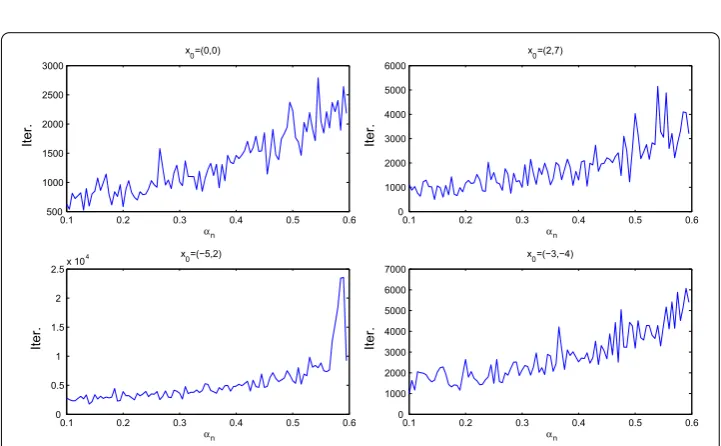
since for Algorithms and , it was difficult for the relative rate of convergence to run up to –. For Algorithm , we testedαn= [., .] and the numerical results are reported in Figure , which showed that the number of iterations was less for smallαn. Since the number of iterations forαn> . was generally larger than those forαn≤., we only report the results for .≤αn≤.. For Algorithm , Figure reports the number of iterations for .≤αn≤., whereβn=γn= ( –αn)/. The conclusion was similar to Algorithm , that is, smallαnwas better.
Finally, we compare Algorithm with Algorithms and . We tookαn= .,βn= ., γn= .,σ = . for Algorithm ,αn= . in Algorithm and αn= .,βn=γn= . in Algorithm . The stopping criterion was E(x) <ε= ×–. Table illustrates the
efficiency of the Algorithm , both from the points of view of number of iterations and cpu time.
6 Conclusions
Figure 1 Comparison of the number of iterations of Algorithm 2 with different initial values.
Figure 2 Comparison of the number of iterations of Algorithm 3 with different initial values.
Table 4 Comparison of Algorithm 1 with Algorithms 2 and 3
x0 Algorithm 1 Algorithm 2 Algorithm 3
Iter. Sec. Iter. Sec. Iter. Sec.
(0, 0) 238 0.0156 290 0.0156 610 0.0625
(2, 7) 162 0.0313 922 0.0781 792 0.0781
(–5, 2) 532 0.0469 1,524 0.1094 2,305 0.3594
(–3, –4) 511 0.0625 1,356 0.0938 1,034 0.1250
Competing interests
The authors declare that they have no competing interests.
Authors’ contributions
All authors contributed equally to the writing of this paper. All authors read and approved the manuscript.
Author details
1College of Science, Civil Aviation University of China, Tianjin, 300300, China.2Tianjin Key Lab for Advanced Signal
Processing, Civil Aviation University of China, Tianjin, 300300, China.3Department of Mathematics Education and RINS, Gyeongsang National University, Jinju, 660-701, Korea.4Department of Mathematics, Faculty of Science, King Abdulaziz University, Jeddah, Saudi Arabia.
Acknowledgements
The authors would like to express their thanks to Professor Peichao Duan for her help in program. The first and second authors were supported by National Natural Science Foundation of China (No. 11201476) and Fundamental Research Funds for the Central Universities (No. 3122013D017), in part by the Foundation of Tianjin Key Lab for Advanced Signal Processing and the third author was supported by Basic Science Research Program through the National Research Foundation of Korea (NRF) funded by the Ministry of Science, ICT and future Planning (2014R1A2A2A01002100).
Received: 30 December 2014 Accepted: 7 August 2015 References
1. Chang, SS: Viscosity approximation methods for a finite family of nonexpansive mappings in Banach spaces. J. Math. Anal. Appl.323, 1402-1416 (2006)
2. Atsushiba, S, Takahashi, W: Strong convergence theorems for a finite family of nonexpansive mappings and applications. Indian J. Math.,41(3), 435-453 (1999). BN Prasad birth centenary commemoration volume.
3. Yao, Y: A general iterative method for a finite family of nonexpansive mappings. Nonlinear Anal.66, 2676-2687 (2007) 4. Xu, HK: A variable Krasnosel’ski˘ı-Mann algorithm and the multiple-set split feasibility problem. Inverse Probl.22,
2021-2034 (2006)
5. Combettes, PL: On the numerical robustness of the parallel projection method in signal synthesis. IEEE Signal Process. Lett.8, 45-47 (2001)
6. Podilchuk, CI, Mammone, RJ: Image recovery by convex projections using a least-squares constraint. J. Opt. Soc. Am.
7, 517-521 (1990)
7. Youla, D: Mathematical theory of image restoration by the method of convex projection. In: Stark, H (ed.) Image Recovery Theory and Applications, pp. 29-77. Academic Press, Orlando (1987)
8. Mann, WR: Mean value methods in iteration. Proc. Am. Math. Soc.4, 506-510 (1953) 9. Genel, A, Lindenstrass, J: An example concerning fixed points. Isr. J. Math.22, 81-86 (1975)
10. Bauschke, HH: The approximation of fixed points of compositions of nonexpansive mappings in Banach spaces. J. Math. Anal. Appl.202, 150-159 (1996)
11. Wang, F: Iterative methods for nonlinear optimization problems in Hilbert spaces (in Chinese), Ph.D. thesis, East China University of Science and Technology (2011).
12. Solodov, MV, Svaiter, BF: Forcing strong convergence of proximal point iterations in a Hilbert space. Math. Program., Ser. A87, 189-202 (2000)
13. Nakajo, K, Takahashi, W: Strong convergence theorems for nonexpansive mappings and nonexpansive semigroups. J. Math. Anal. Appl.279, 372-379 (2003)
14. Kim, TH, Xu, HK: Strong convergence of modified Mann iterations. Nonlinear Anal.61, 51-60 (2005)
15. Marino, G, Xu, HK: Weak and strong convergence theorems for strict pseudo-contractions in Hilbert spaces. J. Math. Anal. Appl.329, 336-346 (2007)
16. Wei, L, Cho, YJ, Zhou, HY: A strong convergence theorem for common fixed points of two relatively nonexpansive mappings and its applications. J. Appl. Math. Comput.29, 95-103 (2009)
17. Zhou, H, Su, Y: Strong convergence theorems for a family of quasi-asymptotic pseudo-contractions in Hilbert spaces. Nonlinear Anal.70, 4047-4052 (2009)
18. Nilsrakoo, W, Saejung, S: Weak and strong convergence theorems for countable Lipschitzian mappings and its applications. Nonlinear Anal.69, 2695-2708 (2008)
19. Eckstein, J, Svaiter, BF: A family of projective splitting methods for the sum of two maximal monotone operators. Math. Program., Ser. B111, 173-199 (2008)
20. Takahashi, W, Takeuchi, Y, Kubota, R: Strong convergence theorems by hybrid methods for families of nonexpansive mappings in Hilbert spaces. J. Math. Anal. Appl.341, 276-286 (2008)
21. Plubtieng, S, Ungchittrakool, K: Strong convergence theorems for a common fixed point of two relatively nonexpansive mappings in a Banach space. J. Approx. Theory149, 103-115 (2007)
22. Goebel, K, Kirk, WA: Topics in Metric Fixed Point Theory. Cambridge Studies in Advanced Mathematics, vol. 28. Cambridge University Press, Cambridge (1990)
23. Martinez-Yanes, C, Xu, HK: Strong convergence of theCQmethod for fixed point processes. Nonlinear Anal.64, 2400-2411 (2006)
24. Ishikawa, S: Fixed points by a new iteration method. Proc. Am. Math. Soc.44, 147-150 (1974)
25. Dong, QL, Lu, YY: A new hybrid algorithm for a nonexpansive mapping. Fixed Point Theory Appl.2015, 37 (2015) 26. He, S, Yang, Z: Realization-based method of successive projection for nonexpansive mappings and nonexpansive
semigroups (submitted)