R E S E A R C H
Open Access
Three-dimensional analysis of the anterior
loop of the inferior alveolar nerve in
relation to the growth pattern of the
mandibular functional subunit
Seungkyu Yoon
1, Jae-Young Kim
1, Cheol-Hee Jeong
1, Jengbin Park
2, Jong-Ki Huh
1and Kwang-Ho Park
1*Abstract
Background:The purpose of the present study was to investigate the differences in the position and shape of the anterior loop of the inferior alveolar nerve (ALIAN) in relation to the growth pattern of the mandibular functional subunit.
Methods:The study was conducted on 56 patients among those who had undergone orthognathic surgery at the Gangnam Severance Hospital between January 2010 and December 2015. Preoperative computerized tomography (CT) images were analyzed using the Simplant OMS software (ver.14.0 Materialise Medical, Leuven, Belgium). The anterior and inferior lengths of ALIAN (dAnt and dInf) and each length of the mandibular functional subunits were measured. The relationship between dAnt, dInf, and the growth pattern of the mandibular subunits was analyzed.
Results:The length of the anterior portion of ALIAN (dAnt) reached 3.34 ± 1.59 mm in prognathism and 1.00 ± 0.97 mm in retrognathism. The length of the inferior portion of ALIAN (dInf) reached 6.81 ± 1.33 mm in prognathism and 5.56 ± 1.34 mm in retrognathism. The analysis of Pearson’s correlation coefficiency on all samples showed that the lengths of functional subunits were positively correlated with the loop depth. The length of the symphysis area in prognathic patients was positively correlated with the anterior loop depth (p= 0.005).
Conclusions:Both the anterior and inferior length of ALIAN are longer in prognathic patients. Especially, it seems to be associated with the growth of the symphysis area.
Keywords:Mandibular nerve, Genioplasty, Computed tomography, Chin, Chin repositioning
Background
Iatrogenic damage to the inferior alveolar nerve (IAN) can cause temporary or permanent discomfort in the lower la-bium and labial gingival, and therefore, accurate preopera-tive identification of its location is imperapreopera-tive. Although the location of the mental foramen can be predicted through clinical and radiological means, the anterior loop area of the mandibular canal can often be difficult to iden-tify. Because of this, unintended damage to the inferior al-veolar nerve can occur while performing implantation, open reduction, and genioplasty on the mandibular
premolar region. Precedent studies have reported pre- and postoperative inferior alveolar nerve damage rates of 8.5~24% during implant placement [1–4] and 17~38% during genioplasty [5–8].
It has been reported that the location of the mental foramen may vary according to the pattern of growth and asymmetry of mandibular growth and various stud-ies have reported the length of the anterior loop of the mandibular canal itself to reach 0.11~10 mm [9–11].
The present study aimed to investigate the differences in the position and shape of the anterior loop of inferior alveolar nerve (ALIAN) in relation to the growth pattern of the mandibular functional subunit.
* Correspondence:[email protected]
1Department of Oral and Maxillofacial Surgery, Gangnam Severance Hospital,
Yonsei University College of Dentistry, 211 Eonju-ro, Gangnam-gu, Seoul 06273, South Korea
Full list of author information is available at the end of the article
Methods
Subjects
Among 417 patients who underwent orthognathic surgery between January 2010 and December 2015 at the Depart-ment of Oral and Maxillofacial Surgery, Gangnam Sever-ance Hospital, those who had taken preoperative CT images were selected as the study candidates. Among them, those who underwent concomitant TMJ open sur-gery, such as total joint replacement or arthroplasty, were excluded, and patients in whom canal location could not be identified on CT due to low bone density were also ex-cluded. Ultimately, a total of 56 patients (28 with retro-gnathism and 28 with proretro-gnathism) were included.
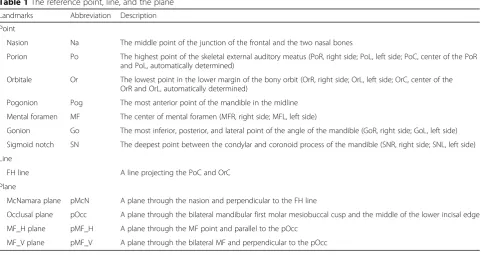
Reference points, line, and planes (Table1)
Nasion (Na), porion (Po), orbitale (Or), pogonion (Pog), mental foramen (MF), gonion (Go), and sigmoid notch (SN) were set as the reference points (Table 1). FH line was drawn connecting the center of the porion (PoC) and orbitale (OrC), which were automatically determined. Mc-Namara plane (N-perpedicular plane, pMcN) was defined as the plane perpendicular to the FH line and bypassing the Na [12]. To evaluate the anterior and inferior distance of the anterior loop of IAN, occlusal plane (pOcc) and planes passing through MF (pMF_H and pMF_V) were also determined. They were summarized in Table1.
Measurement of mandibular functional unit (Table2)
The diagnosis of dentofacial deformity was made accord-ing to three-dimensional McNamara analysis usaccord-ing Sim-plant OMS (ver.14.0, Materialise Medical, Leuven, Belgium) [12]. Mandibular prognathism was defined
when Pog was located more than 2 mm anteriorly to the pMcN. Conversely, if Pog is located more than 2 mm posteriorly to the pMcN, it was diagnosed as mandibular retroganthism [13].
The most posterior, inferior point of the mandibular body was defined as gonion (Go), and the distance from the most inferior point of the sigmoid notch (SN) to Go, from Go to MF, and from MF to Pog was defined as dRa-mus, dBody, and dSymphysis, respectively (Fig.1, Table2).
Reconstruction and measurements of the anterior loop of IAN
For the inferior alveolar nerve reconstruction, a single researcher marked the midpoint of the inferior alveolar nerve canal on each plane by visual inspection, and re-construction was performed by using the create nerve function in the software.
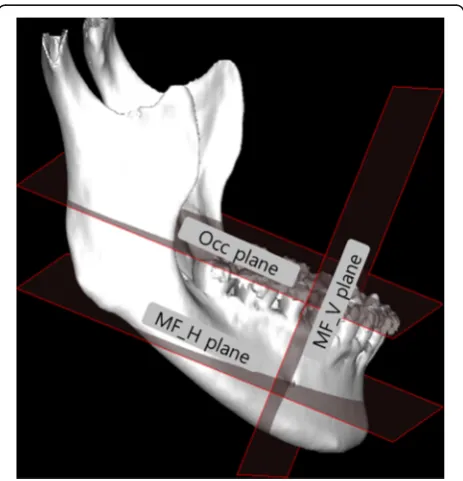
A plane bypasses the mesiobuccal cusps of bilateral mandibular first molars, and the midpoint of the man-dibular incisal edge was defined as the occlusal plane (pOcc). A plane perpendicular to the occlusal plane and bypassing MF points was defined as pMF_V. A plane parallel to Occ plane and bypassing MF points was de-fined as pMF_H (Fig. 2). The planes of right and left sides were determined separately.
With respect to the loop, distance from the most an-terior point of reconstructed IAN to pMF_V (dAnt) and distance from the most inferior point of reconstructed IAN to pMF_H (dInf ) were measured on both the left and right side. In cases where the loop was not deep enough so that it was positioned anteriorly to MF-V plane, dAnt was assumed to be 0 (Fig.3).
Table 1The reference point, line, and the plane
Landmarks Abbreviation Description
Point
Nasion Na The middle point of the junction of the frontal and the two nasal bones
Porion Po The highest point of the skeletal external auditory meatus (PoR, right side; PoL, left side; PoC, center of the PoR and PoL, automatically determined)
Orbitale Or The lowest point in the lower margin of the bony orbit (OrR, right side; OrL, left side; OrC, center of the OrR and OrL, automatically determined)
Pogonion Pog The most anterior point of the mandible in the midline
Mental foramen MF The center of mental foramen (MFR, right side; MFL, left side)
Gonion Go The most inferior, posterior, and lateral point of the angle of the mandible (GoR, right side; GoL, left side)
Sigmoid notch SN The deepest point between the condylar and coronoid process of the mandible (SNR, right side; SNL, left side)
Line
FH line A line projecting the PoC and OrC
Plane
McNamara plane pMcN A plane through the nasion and perpendicular to the FH line
Occlusal plane pOcc A plane through the bilateral mandibular first molar mesiobuccal cusp and the middle of the lower incisal edge
MF_H plane pMF_H A plane through the MF point and parallel to the pOcc
Statistical analyses
All statistical analyses were performed using SPSS Statis-tics v23.0 (IBM Corp). Student’st tests were performed on the dAnt and dInf. Pearson’s correlations of the lengths of each mandible subunits were analyzed in rela-tion to the dAnt and dInf.
Results
The subjects of the study consisted of a total of 56 pa-tients; 22 males and 34 females, with a mean age of 26.14 ± 5.79 years. Among them, there were 28 man-dibular prognathism (14 males and 14 females, mean age of 23.11 ± 2.42 years) and 28 mandibular retrognath-ism (8 males and 20 females, mean age of 29.18 ± 6.58 years). The distance from the pMcN to Pog was 10.20 ± 4.73 mm in prognathism and−19.12 ± 8.13 mm in retrognathism.
Fig. 1Functional subunit of the mandible. dRamus, distance from the sigmoid notch to the gonion; dBody, distance from the gonion to the MF point; dSymphysis, distance from the MF point to the pogonion
Table 2Distance measurements of loop of the inferior alveolar nerve and the mandibular functional units
Measurement Description
dAnt Distance from the most anterior point of the inferior alveolar nerve to pMF_V
(If there is no anterior curvature, dAnt is defined as“0”)
dInf Distance from the most inferior point of the inferior alveolar nerve to pMF_H
dPog Distance from the Pog to the pMcN
dRamus Distance from the SN to the Go
dBody Distance from the Go to the MF
dSymphysis Distance from the MF point to the Pog
In prognathic patients, dAnt was 3.34 ± 1.59 mm and dInf was 6.81 ± 1.33 mm, with maximum value for each being 7.12 mm and 10.38 mm, respectively. In retro-gnathic patients, dAnt was 1.00 ± 0.97 mm and dInf was 5.56 ± 1.34 mm, with maximum value for each being 2.89 mm and 8.68 mm, respectively (Table3).
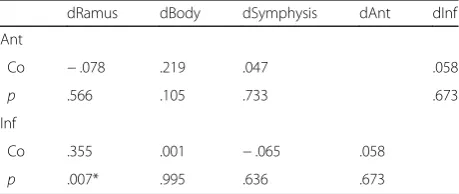
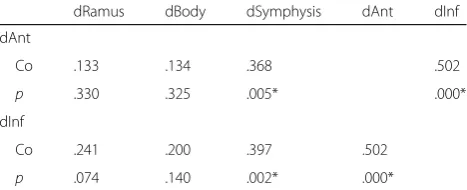
The length of each mandibular functional subunit has a positive correlation with dAnt and dInf when evaluat-ing both retrognathic and prognathic patients (Table4). In retrognathism, there was no significant difference be-tween the length of mandibular subunit and dAnt and dInf (Table 5) except dInf and dRamus, whereas prog-nathism patients showed a statistically significant correl-ation coefficient value 0.368 between symphysis and dAnt and 0.397 between symphysis and dInf (Table6).
Discussion
The location of the inferior alveolar nerve acts as a limit-ing factor when various surgical approaches are attempted
on the mandible. Because the nerve changes direction right before it comes out of the mental foramen and forms an anterior loop, it is necessary to create a safety margin that is more anterior and inferior to the location of the mental foramen when attempting a surgical approach on the premolar region or anterior mandible. However, the location of the mental foramen can be predicted by clin-ical and radiologclin-ical means, whereas the identification of the anterior loop of the mandibular canal is often difficult. If iatrogenic damage to the inferior alveolar nerve occurs from the inability to identify the location of the anterior loop, it can lead to temporary or permanent discomfort in the lower labium and labial gingival. Various studies have reported pre- and postoperative inferior alveolar nerve damage rates of 8.5~24% during implant placement [1–4] and 17~38% during genioplasty [5–8].
The association between the location of the mental for-amen and the pattern of the mandibular growth was proven by the functional matrix theory. The direction of the mental foramen is pointed coronally upon birth but gradually moves laterally as the mandible grows [14]. The present study assumed that as the direction of the mental foramen changed, the shape and length of inferior alveolar Fig. 3Measurement of dAnt and dInf. dAnt, distance from the most
anterior point of the inferior alveolar nerve from MF_V. If there is no anterior curvature, dAnt is defined as“0”; dInf, distance from the most inferior point of the inferior alveolar nerve from MF_H
Table 3Comparison of average distance of dAnt and dInf between prognathism and retrognathism (mm)
Mean ± SD Minimum Maximum pvalue
dAnt
Prognathism 3.34 ± 1.59 0.51 7.12 < 0.001
Retrognathism 1.00 ± 0.97 0 2.89
dInf
Prognathism 6.81 ± 1.33 3.89 10.38 < 0.001
Retrognathism 5.56 ± 1.34 2.87 8.68
dPogdistance from the pogonion to the Mcnamara plane,dAntdistance from
the most anterior point of the inferior alveolar nerve from the MF_V. If there is no anterior curvature, dAnt is defined as“0”,dInfdistance from the most inferior point of inferior alveolar nerve from MF_H
Table 4Pearson’s correlation coefficiency in all patients
dRamus dBody dSymphysis dAnt dInf
dAnt
Co .274 .510 .505 .502
p .003** .000* .000* .000*
dInf
Co .401 .336 .347 .502
p .000* .000* .000* .000*
dAntdistance from the most anterior point of the inferior alveolar nerve from MF_V. If there is no anterior curvature, dAnt is defined as“0,”dInfdistance from the most inferior point of the inferior alveolar nerve from MF_H,dRamus distance from the sigmoid notch to the gonion,dBodydistance from the gonion to the MF point,dSymphysisdistance from the MF point to the pogonion,CoPearson’s correlation coefficiency
*p< 0.001 **p< 0.05
Table 5Pearson’s correlation coefficiency in retroganthic patients
dRamus dBody dSymphysis dAnt dInf
dAnt
Co −.078 .219 .047 .058
p .566 .105 .733 .673
dInf
Co .355 .001 −.065 .058
p .007* .995 .636 .673
dAntdistance from the most anterior point of the inferior alveolar nerve from MF_V. If there is no anterior curvature, dAnt is defined as“0”,dInfdistance from the most inferior point of the inferior alveolar nerve from MF_H,dRamus distance from the sigmoid notch to the gonion,dBodydistance from the gonion to the MF point,dSymphysisdistance from the MF point to the pogonion,CoPearson’s correlation coefficiency
nerve anterior loop would also change accordingly, based on which comparative analysis was performed on the pat-tern of mandibular growth and the shape of inferior alveo-lar nerve anterior loop.
The inferior alveolar nerve anterior loop was located more anteriorly and inferiorly in prognathic patients (dAnt = 3.34 ± 1.59, dInf = 1.00 ± 0.97) than in retrognathic patient (dAnt = 6.81 ± 1.33, dInf = 5.56 ± 1.34). The absence of an-terior loop was found in 22 canals (dInf = 0), all of which were identified in the retrognathic mandible.
At this study, there were prognathic cases which the loop was located inferiorly at a depth of≥10 mm, which suggested that the safety margin of 3 mm generally used in genioplasty [15] may not be enough.
Correlation analyses performed separately for prognathic and retrognathic patients (Tables5 and6) showed that the anterior and inferior depth of the anterior loop was positively correlated with the length of symphysis in prognathic pa-tients, whereas the length of each of the mandibular subunits did not show statistically significant correlations with each other in retrognathic patients. These results suggested that the growth in the symphysis area can affect the formation of the anterior loop during the mandibular growth process.
Correlation analysis performed on both prognathic and retrognathic mandibles together (Table 4) showed that the length of each mandibular subunit was highly correlated with the depth of the anterior loop. Therefore, it was demonstrated that, in general, as the length of each mandibular area becomes longer, the length of the anterior loop can also be longer as well.
Conclusion
According to our study, especially, the anterior loop of inferior alveolar nerve was located more anteriorly and inferiorly in prognathic patients. It seems to be associ-ated with the growth of the symphysis area. Therefore, surgeons should take care to avoid nerve damage at gen-ioplasty or implant placement in the symphysis area in prognathism patients.
Abbreviations
ALIAN:Anterior loop of the inferior alveolar nerve; dAnt: Distance from the most anterior point of the inferior alveolar nerve from MF_V; dBody: Distance from the gonion to the MF point; dInf: Distance from the most inferior point of the inferior alveolar nerve from MF_H; dRamus: Distance from the sigmoid notch to gonion; dSymphysis: Distance from the MF point to the pogonion; FH line: Frankfort horizontal line; Go: Gonion; GoL: Left side of the gonion; GoR: Right side of the gonion; MF: Mental foramen; Na: Nasion; Or: Orbitale; OrC: Center of OrR and OrL; OrL: Left side of the orbitale; OrR: Right side of the orbitale; pMcN: Macnamara plane; pMF_H: A plane through the MF point and parallel to the the pOcc; pMF_V: A plane through the bilateral MF and perpendicular to the pOcc; Po: Porion; PoC: Center of PoR and PoL; pOcc: Occlusal plane; Pog: Pogonion; PoL: Left side of the porion; PoR: Right side of the porion; SN: Sigmoid notch; SNL: Left side of the sigmoid notch; SNR: Right side of the sigmoid notch
Acknowledgements
We would like to thank help with statistical analysis forthe Biostatistics Collaboration Unit, Yonsei University College of Medicine, Seoul, Korea, for their help with the statistical analysis.
Availability of data and materials Please contact the author for data request.
Authors’contributions
JBP and CHJ collected and analyzed the data. SKY wrote the article and analyzed the data. JYK translated and designed the study. JKH and KHP set the direction and supervised the study. All authors read and approved the final manuscript.
Ethics approval and consent to participate
This study had the approval of Yonsei Institutional Review board (IRB No.3-1015-0113).
Consent for publication Not applicable
Competing interests
The authors declare that they have no competing interests.
Publisher’s Note
Springer Nature remains neutral with regard to jurisdictional claims in published maps and institutional affiliations.
Author details
1Department of Oral and Maxillofacial Surgery, Gangnam Severance Hospital,
Yonsei University College of Dentistry, 211 Eonju-ro, Gangnam-gu, Seoul 06273, South Korea.2Department of Dentistry, Armed Forces Guri Hospital, Guri-si, Korea.
Received: 30 August 2018 Accepted: 5 September 2018
References
1. Bartling R, Freeman K, Kraut RA (1999) The incidence of altered sensation of the mental nerve after mandibular implant placement. J Oral Maxillofac Surg 57:1408–1412
2. Walton JN (2000) Altered sensation associated with implants in the anterior mandible: a prospective study. J Prosthet Dent 83:443–449
3. Wismeijer D, van Waas MA, Vermeeren JI, Kalk W (1997) Patients’perception of sensory disturbances of the mental nerve before and after implant surgery: a prospective study of 110 patients. Br J Oral Maxillofac Surg 35: 254–259
4. Dao TT, Mellor A (1998) Sensory disturbances associated with implant surgery. Int J Prosthodont 11:462–469
5. Hoenig JF (2007) Sliding osteotomy genioplasty for facial aesthetic balance: 10 years of experience. Aesthet Plast Surg 31:384–391
6. Jones BM, Vesely MJ (2006) Osseous genioplasty in facial aesthetic surgery—a personal perspective reviewing 54 patients. J Plast Reconstr Aesthet Surg 59:1177–1187
Table 6Pearson’s correlation coefficiency in prognathic patients
dRamus dBody dSymphysis dAnt dInf
dAnt
Co .133 .134 .368 .502
p .330 .325 .005* .000*
dInf
Co .241 .200 .397 .502
p .074 .140 .002* .000*
dAntdistance from the most anterior point of the inferior alveolar nerve from MF_V. If there is no anterior curvature, dAnt is defined as“0”,dInfdistance from the most inferior point of the inferior alveolar nerve from MF_H,dRamus distance from the sigmoid notch to the gonion,dBodydistance from the gonion to the MF point,dSymphysisdistance from the MF point to the pogonion,CoPearson’s correlation coefficiency
7. Sati S, Havlik RJ (2011) An evidence-based approach to genioplasty. Plast Reconstr Surg 127:898–904
8. Westermark A, Bystedt H, von Konow L (1998) Inferior alveolar nerve function after mandibular osteotomies. Br J Oral Maxillofac Surg 36:425–428 9. Kuzmanovic DV, Payne AG, Kieser JA, Dias GJ (2003) Anterior loop of the
mental nerve: a morphological and radiographic study. Clin Oral Implants Res 14:464–471
10. Rosenquist B (1996) Is there an anterior loop of the inferior alveolar nerve? Int J Periodontics Restorative Dent 16:40–45
11. Rothman SL, Chaftez N, Rhodes ML, Schwarz MS (1988) CT in the preoperative assessment of the mandible and maxilla for endosseous implant surgery. Work in progress. Radiology 168:171–175
12. Wong RW, Chau AC, Hagg U (2011) 3D CBCT McNamara’s cephalometric analysis in an adult southern Chinese population. Int J Oral Maxillofac Surg 40:920–925
13. McNamara JA Jr (1984) A method of cephalometric evaluation. Am J Orthod 86:449–469
14. Warwick R (1950) The relation of the direction of the mental foramen to the growth of the human mandible. J Anat 84:116–120