Ef
fi
cient Task Scheduling Approach
Relevant to the Hardware/Software
Co-Design of Embedded System
Barbara Korou
si´c Seljak
ˇ
Computer Systems Department, “Jozef Stefan” Institute, Ljubljana, Sloveniaˇ
Task scheduling is the primary multitasking activity con-trolled by the real-time executive. As hardware/software co-design of embedded systems has been enabled by advances in computer technologies, reprogrammable hardware can be used to implement a co-processor to perform most of the kernel functions, including task scheduling. In this kind of system design, more complex scheduling approaches can be applied. In this paper, a complex scheduling approach, which takes into account advantages of evolutionary computation(i.e., neurocom-puting and genetic search and optimization)is presented. First, we present a model based on the Hopfield-Tank neural network11]. Then, we introduce modifications of the method based on the network model to improve the quality of the solutions. Finally, we propose a mixed approach of this evolutionary computation method and an extension of the Earliest Deadline First approach 3]for scheduling both types of periodic and aperiodic tasks. We also discuss simulation results that demon-strate performance that could be obtained by using this approach.
Keywords: task scheduling, embedded systems, hard-ware/software co-design, neural network, genetic algo-rithm.
1. Introduction
Embedded systems(ESs)have been around for
several decades already. There are many ESs of different categories with or without strict real-time requirements. Generally, an ES may be de-scribed as a computing system that operates in concert with the real physical system, and is an integral part of the equipment. ESs are tradition-ally classified intocontrol systems, where some-thing has to be controlled or regulated (e.g.,
an assembly line), and communication systems (e.g., a telephone switching station). However,
there are other classifications of ESs:
soft real-time(e.g., an office automation
sys-tem)vs. hard real-time systems (e.g., a
fly-by-wire system), and
slow (e.g., a patient-monitoring system) vs.
fast systems(e.g., a radar system).
The world in which an ES is placed is almost always truly asynchronous and concurrent: events requiring response from the computer may occur at any time and simultaneously. Em-bedded computers must deliver their results cor-rectly and within certain time bounds — dead-lines. The term hard real-time refers to ESs that may malfunction if any deadline is missed. Soft real-time systems can operate satisfactorily even if some deadlines are missed 14]. Slow
ESs respond at a rate commensurate with human reaction time, while fast ESs are now being built with response times below 1 microsecond. As technology has advanced over the years, ESs have been growing in size, complexity and speed. Let us mention three application ar-eas for ESs with very different system require-ments:
Consumer products, where low price and high performance are required(e.g., mobile
phones, cars and video recorders).
Safety-related systems, where product relia-bility and safety are of major concern (e.g.,
aircraft and medical equipment). In these
systems, it has to be possible to formally ver-ify their performance.
Complexlarge-scale communication and con-trol systems, where time-to-market is very important(e.g., telephone switching stations
and oil platforms).
What characterizes all different types of ESs is that they are typicallydedicated systems. When developing such systems using traditional de-sign methodologies, the hardware and software components are developed separately and their final integration is based on anad hocmethod. Such an approach increases time-to-market and cost, and very often decreases quality and reli-ability of the product. Advances in some key enabling technologies, like system-level spec-ification and simulation environments, formal design and verification methods, and high-level synthesis and framework technology, have en-abled thehardware/software co-designof ESs
2].
2. An Embedded Operating System
The major part of hardware/software co-design
is the partitioning. This is not just partition-ing between hardware and software. It takes also reprogrammable hardware into account, letting designers analyse the additional trade-offs that this kind of design implies. Config-urable hardware has advantages and disadvan-tages: it enables some flexibility and the use of more complex scheduling algorithms, and increases the cost of debugging hardware, re-spectively. Therefore, many developers of ESs choose to run their applications on top of ei-ther anembedded operating systemorreal-time executive.
As applications of ESs get more complex, algo-rithms have to be broken down into tasks. The central function of an embedded operating sys-tem is to remove the burden of task handling from the code writer. Detailed knowledge of interrupts, timers, analog-to-digital converters, etc., are no longer needed. Besides, an appli-cation software that uses facilities provided by an embedded operating system is easier to be analysed.
An embedded operating system is smaller and simpler than the mini/mainframe type5]. Its
middle part is thereal-time executive(RTEX).
In embedded computers, each application task is written separately, calling on other system activities(resources)via the RTEX. The RTEX
itself controls all multitasking activities:
scheduling and dispatching (deciding when
and why tasks should be run),
mutual exclusion (policing the use of
re-sources shared between tasks),
synchronization and data transfer (making
tasks possible to communicate with each other).
To perform these activities the executive calls on the procedures, which are facilities provided by the inner part of the real-time operating sys-tem, the kernel. The outer part of an embed-ded operating system consists of theapplication program interfaces and real world interfaces. The latter handle the system hardware that is driven by standard software routines, which typ-ically includes AD/DA controllers, keyboard
controllers, programmable timers, configurable I/O ports, serial communication devices, and
the like.
The primary multitasking activity controlled by the RTEX is scheduling. However, it is an
NP-complete combinatorial optimization(CO)
problem14]. It means that the problem of
de-ciding when and why tasks should be run cannot be solved by an exact algorithm(such as linear
integer programming15])because the number
of schedules grows very fast with the number of application tasks.
This paper deals withheuristic scheduling con-ceptsbased on neurocomputing(i.e., the
Hop-field-Tank neural network (H-T NN) 11]) and
genetic search and optimisation. Although for scheduling algorithms applying such concepts there is no guarantee that for each problem case a solution found is the best, polynomial bounds on their computation times can be given.
3. Preliminaries
1. Application tasks are ofperiodicand ape-riodic types, and are interrelated by prece-denceandmutual exclusion relations. In general, they are pre-emptive, but under some circumstances for safety and security reasons, a task may temporarily become non-preemptive. This mutual exclusion requirement is modelled by usingcritical sections. Under certain constraints criti-cal sections are allowed to be pre-emptive. Moreover, tasks are not equally impor-tantfor the system.
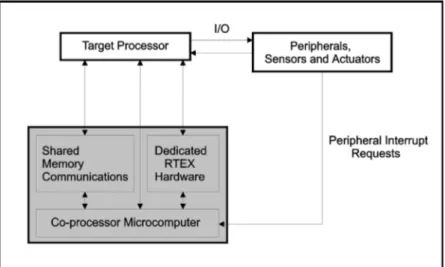
2. A configurable hardwarekernel co-proces-sor is used to remove the burden of sup-porting the multitasking operations from the target processor. Such an approach is required to keep unpredictable time over-heads on the target processor to an abso-lute minimum. A time overhead happens when the multitasking activities are per-formed entirely by software that is execut-ing by the target processor. Time taken to execute this software is lost to the ap-plication tasks. However, in fast, com-plex or hard real-time ESs, this is not suit-able. Figure 1shows an architecture sug-gested by Cooling and Fox 6] and
pro-ceeds from the dual-processor approach proposed by Halang and Colnaricˇ 9, 4].
Here, low-level scheduling and dispatch-ing are implemented in co-processor con-figurable hardware, while other kernel func-tions are implemented in co-processor soft-ware.
3. The scheduling concepts apply to single target processor systemsonly.
A brief description of the scheduling problem: Given a set of periodic and aperiodic tasks that are interrelated by precedence and mutual ex-clusion relations, a feasible schedule must be found. A schedule is feasible when tasks are ordered so that all their deadlines are met, with the minimum number of task pre-emptions and shortest possible time spent waiting for lower priority tasks to finish execution in critical sec-tions.
InSection 4, we review the Hopfield-Tank neu-ral network, and describe the approach used to solve the scheduling problem. We continue with the discussion regarding several of the H-T NN modifications, including the genetic search and optimization 8]. In Section 5, we propose a
complex scheduling algorithm that is a mixed approach of the modified H-T NN and a special-ized heuristic scheduling policy, an extended version of the Earliest Deadline First (EDF) 3]. Finally, in Section 6, we summarize and
conclude the paper.
4. The Hopfield-Tank Neural Network
The H-T NN is aHopfield neural network10],
which is a biologically inspired mathematical tool that has extensively been used to solve diffi-cult CO problems, like the Travelling Salesman Person problem 7]. The great advantage of
this network is that it generates solutions with-out necessity of training iterations. However, it has also a disadvantage that it does not always move from an initial state to the nearest stable
state. In order to improve the solution quality, we propose a stochastic approach of embedding the principles of genetic search and optimisation into the H-T NN to escape from local minima. Let us briefly describe Hopfield networks. They belong to the class ofrecurrentneural networks. In a continuous version of the Hopfield network, which is an alteration of the primary discrete Hopfield network and origination of the H-T NN, the input of neuron i and its state are de-noted byuiandVi, respectively.Vihas the range
0,1], and is bounded by the asymptotes of the
sigmoid function g(ui). In most cases, this
func-tion meets the Cohen-Grossberg requirements for stability18]. The basic idea is that a
Hop-field network is started at some initial state, and converges to the one of a finite number of stable states, which is closest to the initial state. This corresponds to minimizing an energy function that formulates the optimization problem as a constrained problem. A typical choice of the energy function is
E =;
1 2
X
i j i6=j
ωi jViVj+ X
i
IiVi (1)
which is aLiapunov function4]for the system.
Parameter ωi j determines (weights) the effect
of the connections from neuroni to j, while Ii
denotes the bias current of neuroni.
One of the principal advantages of Hopfield net-works is the rapid computation power and speed which can be obtained through hardware imple-mentation, and this consideration is even more valuable for ESs17].
4.1. Formulation of the Scheduling Problem
We applied the H-T NN to the scheduling prob-lem ofperiodic tasks, which is a subproblem of task scheduling. Periodic tasks have an impor-tant feature that their invocations repeat in the same pattern through consecutive major time
frames(MTFs). Possibly in most applications
of embedded computers, the MTF is identified by a preliminary harmonisation of task frequen-cies (periods). This feature allows us to
con-centrate on scheduling tasks within one MTF. Let us define a set of n invocations of np
pre-emptive and partially ordered periodic tasks, wheren=
nP P
i=1
F=pi,Fis the length of the MTF
and pi is the period of task Pi. Given an
ini-tial ordering of the set, a feasible uniprocessor schedule must be found.
The problem solution may be represented as a
(np+1)F permutation matrix. Each of the
firstnpmatrix rows corresponds to a particular
periodic task, while each column corresponds to a particular position in the schedule. The last matrix row is an auxiliary one, and it corre-sponds to the processor state(idle/active).
Example 4.1. An embedded computer may be
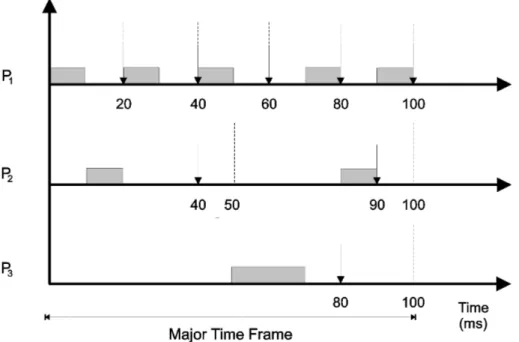
required to manage a sample loop at 50Hz, while performing signal processing at 20Hz, and displaying results at 10Hz. Details of the application tasks are given inTable 1.
Processor execution time should be organized as a series of time slots. Each one has the same duration, in this case 10ms. Tasks may be al-located to specific time slots, resulting in the scheduling ofFigure 2. The point at which the allocation repeats defines the duration of the MTF, here being 100ms.
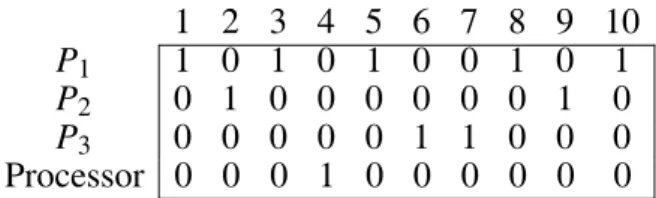
InTable 2, a translation of the diagram of Fig-ure 2into a permutation matrix is given:
1 2 3 4 5 6 7 8 9 10
P1 1 0 1 0 1 0 0 1 0 1
P2 0 1 0 0 0 0 0 0 1 0
P3 0 0 0 0 0 1 1 0 0 0
Processor 0 0 0 1 0 0 0 0 0 0
Table 2.Permutation Matrix Representing a Feasible Schedule.
Periodic Task Period(ms) Computation Time(ms) Deadline(ms)
P1 20 10 20
P2 50 10 40
P3 100 20 80
Fig. 2.Illustration of a Feasible Schedule.
The matrix elements of the firstnp(three)rows
and F (ten) columns with the value 1 define
the active state of a corresponding task. Sim-ilarly, the elements from the first np rows and
F columns with the value 0 define the ready-to-run or suspended state of a corresponding task. The elements of the last matrix row define the processor state, which is idle if the element value is 1, and active otherwise. Time periods that correspond to the matrix elements of the last row with the positive value could be used to schedule aperiodic tasks. However, in this sim-ple examsim-ple, aperiodic tasks are not considered. But in modern ESs, the multitasking design has to forsee situations when aperiodic tasks arrive
(are put into the ready-to-run state). Therefore,
a schedule of periodic tasks has to be formed so that processor loading is spread evenly over the MTF to give the best performance in the presence of aperiodic tasks.
4.2. The H-T NN Model
In the H-T NN model for the scheduling prob-lem, each entry(Pik)in the permutation matrix (where Pi denotes the task/row and k the
po-sition/column) is represented by neuron state
Vi k. While matrix values are allowed to vary
continuously, the final result is interpreted by replacing each entry with either 1 or 0, depend-ing on whether the neuron state value is high or low. Figure 3 shows the structure of the
H-T NN ofnneurons, where ncorresponds to
(np+1F).
The scheduling problem has to be encoded so that its cost and penalty functions correspond to the network energy function. It is required that the network favours stable states that cor-respond to the problem permutation matrices representing feasible schedules. Thus, in a state representing a feasible schedule,
(a) at most one element in each matrix column, and
(b) exactly(ci+Bi)F=Pi elements in the
ma-trix row corresponding to taskPimust be of
value 1, and all the others of value 0. The parametersci andBidenote the worst-case
computation time and blocking time of task
Pi, respectively. TaskPiis blocked when it
is waiting for lower priority tasks to finish execution in critical sections.
For example, the terms of the energy function, which satisfy issue(a)
0
@1 ;
np+1 X
i=1
Vi k
1
A
2
+
np+1 X
i=1
Vi k(1;Vi k) (2)
give a minimum when exactly one of the net-work neurons that correspond to k-th (k = f12:::Fg)matrix column have an output of
1(i.e., there is one entry of 1 in each matrix
col-umn). The requirement that no more than one
element in each matrix column can be of value 1 requires an addition ofFslack neurons in the network. These correspond to the elements of the last matrix row that represents the processor state(idle/active)in each time slot of the MTF.
In a similar way we satisfy issue(b), as well as other problem constraints, like partial ordering of tasks related by precedence relations, criti-cal sections, infrequent pre-emptions of running tasks, and even spread of processor loading14].
Once the energy function is formed, it can be used to derivestrength of connectionsbetween pairs of neurons (ω
(i k)(j l)
), as well as values
of external inputsto the neurons(Ii k). For
ex-ample, if we expand equation (2) and ignore
the constant, we can rewrite the(a)part of the energy function as
;
1 2
np+1 X
i=1
np+1 X
j=1 j6=i
ω(i k)(j k)Vi kVj k ;
np+1 X
i=1
Ii kVi k
(3)
which is identical to the typical form of the en-ergy function of the H-T NN(see equation(1)),
provided we make the following definitions:
ω(i k)(j k) =
;2 i6=j
0 otherwise
Ii k=1:
(4)
When these parameters are defined for all the problem constraints, the H-T NNupdating rules:
u(t+1)
i k =u (t)
i k +∆t(
np+1 X
j=1
F
X
l=1
ω(i k)(j l)Vj l
+Ii k;u (t)
i k)
Vi k =g(ui k)=
1+th(λui k)
2
(5)
andinitial conditions:
uinit =;
ath
2 1
np+1 ;1
λ (6)
can be generated. In order to prevent the net-work being trapped in an unstable equilibrium in which the voltage of each neuron is equal, a certain amount of noise must be added to this initial value of equation (6). A random value
distributed linearly on0:1uinit is added to the
mean value to give the initial voltage on each neuron.
4.3. Evaluation
We simulated this H-T NN model by using
Mathematica19]as a prototyping tool for
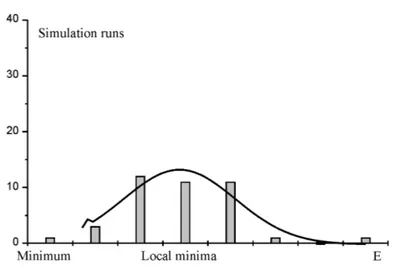
ex-perimenting with the neural network paradigm. The simulation results showed that the con-straints of the task scheduling problem are com-peting with each other. Problem solutions were local minima and not feasible schedules. Fig-ure 4shows a distribution of solutions generated by the H-T NN for the problem case of Exam-ple 1. The largest number of simulation runs gave locally optimized solutions, and only few solutions were either very close to or very far away from the global optimum.
4.4. Method Modifications and Extensions
In order to improve the quality of the solutions, we have made some modifications and exten-sions of the H-T NN.
Fig. 4.Distribution of the Scheduling Problem Solutions.
The next step was an application ofthe
Increas-ing Gain Hopfield Network model 16]. The
idea of this model is that thegain(λ, see
equa-tion(5))is increasing exponentially during the
state evolution.
Finally, we tried to improve the quality of net-work results by genetic search and optimisa-tion:
First, we used the elitism approach12]and
selected 25 best above-average H-T NN so-lutions of the scheduling problem to gener-ate an initial population. These solutions were encoded using binary strings of length of(np+1)F. String positions corresponded to
task locations in the schedule, and their values of 1 or 0 to the running or suspended state, respectively. In other words, j-th position with value of 1 implied taskito start running at time (k;1)∆t, wherej = (i;1)F+k,
k 2 f12:::Fg and ∆t denoted the basic
time slot. Similarly,j-th position with value of 0 implied task i to be suspended at time
(k;1)∆t.
Then, a cost function needed to evaluate fit-ness of population members was selected. We decided to choose the same form as for the H-T NN energy function:
E=;
1 2
X
i j i6=j
ωi jViVj+ X
i
IiVi (7)
whereωi j is the connection weight between
string positions iand j,Vi and Vj are binary
values ofiandjrespectively, andIiis the bias
valuei. We obtained the connection weights and bias values by translating the terms of the problem constraints into the form of the H-T NN energy function.
Finally, we applied multi-point crossover and mutationgenetic operatorsto recombine in-formation from two high-ranked parent strings
(chromosomes)drawn from the current
popu-lation. The crossover operator produced two offsprings by exchanging one or more sub-strings between the parents. The mutation operator altered values at the randomly se-lected string positions. Mutation was applied at far lower rate than crossover. Crossover may not always work the way we want to. By occasionaly subjecting each of the genes in a chromosome to a small probability of mutation, the results of a bad crossover can be reversed.
The simulation results of the H-T NN applied to the task scheduling problem14]showed that,
with respect to all modifications and extensions, this heuristic method is stillunpredictable. The
rejection rate of 20% at the processor utilisa-tionof 90%(i.e., the probability that a
readied-to-run task will fail to meet its deadline) is
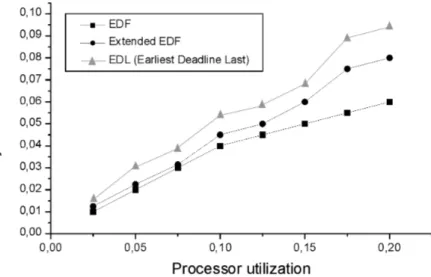
favourable when compared with other special-ized scheduling heuristics13]. In Figure 5, it
will meet their deadlines. However, the method could be very efficient for scheduling problems without competing constraints.
5. Mixed Approach
In order to guarantee the best possible per-formance, we suggested a mixed approach for schedulingperiodicandaperiodic tasksin em-bedded and real-time systems.
The H-T NN could be used for time-driven scheduling of periodic tasks within the MTF. Schedules produced by the H-T NN carry in-formation about the processor activity/idleness.
The elements of the last row in the permutation matrix with the value of 1 denote time slots in which the processor is idle.
When a given aperiodic task is readied, a current schedule of periodic tasks and already readied-to-run aperiodic tasks must bedynamically
up-graded. We use an extension of the EDF policy
14] for dynamic upgrading of task schedules.
This policy extension considers realistic factors of tasking in real-time and ESs. We extended the EDF policy with anacceptance test, which is calculated each time a new aperiodic task is readied-to-run:
The testing algorithm reuses the permutation matrix generated by the H-T NN as a slack
search domain. A slack is an amount of time that can be used to execute a given task
with-out causing any other more important task to miss its deadline.
The algorithm takes into account the problem of the search space limitation caused by the MTF bound. Besides, it considers variations in task computation times (instead of fixed
worst-case computation times).
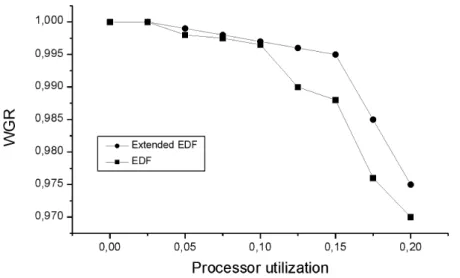
In comparison with the EDF, the extension gives a good performance. We usedprocessor rejec-tion rate(seeFigure 5)andweighted guarantee
ratio(seeFigure 6)as two measures of
perfor-mance. The rejection rate is the probability that a ready-to-run task will fail to meet its dead-line. The weighted guarantee ratio is the perfor-mance metric that reflects both the percentage of tasks which make their deadlines, and their relative worth to the system. It is expressed
asWGR= 100 Pn
i=1 (e
i;1
jfτGgj) Pn
i=1 (e
i;1
jfτAgj)
, wherei de-notes the task importance level (tasks may be
differently important for the application),e
i;1
corresponds to the default weight of task im-portance leveli, jfτGgj is the total number of
tasks at importance leveli, that are guaranteed to meet their deadlines, and jfτAgj is the total
number of all tasks at this level1].
Fig. 6.Weighted Guarantee Ratio vs. Processor Utilisation.
The reader interested in EDF and its extensions is referred to13, 14].
The mixed task scheduling approach could be used to solve the problem of jointly scheduling periodic and aperiodic application tasks in hy-brid static/dynamic systems for the following
reasons:
It attempts to service both periodic and aperi-odic types of interrelated tasks without caus-ing their deadlines to be missed.
Priority is given to the most important tasks. Our goal was to minimise the amount of cal-culation. The algorithm is polynomial in time complexity.
Moreover, it offers remarkable scheduling predictability since the algorithm refers the timetable of periodic tasks given as a permu-tation matrix, which is built (and modified
when needed)by the H- T NN before
appli-cation run-time.
6. Conclusion
The mixed approach of evolutionary computa-tion techniques and the Earliest Deadline First policy is a new concept, of our own devising. It has a sound theoretical basis. Unlike many other scheduling policies, it takes into account practical, realistic factors of tasking in embed-ded systems. Its performance was validated by simulation. We used Mathematica as a pro-totyping tool for experimenting with our task scheduling concept.
Acknowledgement
The author gratefully acknowledges the contri-butions of Professor Jim E. Cooling.
References
1] S. R. BIYABANI, J. A. STANKOVIC, The Integration of Deadline and Criticalness in Hard Real-Time Scheduling, presented at the Proceedings of the real-time systems symposium, (1988) Huntsville, Alabama.
2] R. CAMPOSANO, J. WILBERG, Design Automation
for Embedded Systems, Kluwer Academic Publish-ers, Boston, 1996.
3] M. I. CHEN, K. J. LIN, Dynamic Priority Ceilings: A Concurrency Control Protocol for Real-Time Systems, Real-Time Systems — The International Journal of Time-Critical Computing Systems, 2:4
(1990)pp. 325-345.
4] M. COLNARICˇ, W. A. HALANG, Predictability of
Temporal Behaviour of Hard Real-Time Systems, PhD. Thesis, University of Maribor, Slovenia, 1992.
5] J. E. COOLING,Real-Time Software Systems, Inter-national Thompson Computer Press, 1997.
6] A. M. FOX, J. E. COOLING, A Co-Processor Sched-uler for Embedded Real-Time Systems, Pre-sented at theProceedings of Mechatronics,(1996) Guimaraes, Portugal, 1996.
7] M. R. GAREY, D. S. JOHNSON, Computers and
8] D. E. GOLDBERG,Genetic Algorithms in Search,
Op-timisation, and Machine Learning, Addison-Wesley Publishing Company, Inc., 1989.
9] W. A. HALANG, A. D. STOYENKO, Constructing
Predictable Real Time System, Kluwer Academic Publishers, 1991.
10] J. J. HOPFIELD, Neurons with graded response have collective computational properties like those of two-state neurons, Biophysics, 81 (1984), 3088-3092.
11] J. J. HOPFIELD, D. W. TANK, ‘Neural’ Computation of Decisions in Optimization Problems,Biological Cybernetics, 52(1985), 141-152.
12] K. A.DEJONG, An Analysis of the Behavior of a
Class of Genetic Adaptive Systems, Ph. D. Thesis, University of Michigan, 1975.
13] B. KOROUSIˇC´-SELJAK, Task scheduling policies for real-time systems,Microprocessors and Microsys-tems, 18:9(1994), 501-511.
14] B. KOROUSIˇC´-SELJAK,Methods and Tools for
Devel-opment of a Real-Time Kernel, Co-Processor Unit. PhD. Thesis, University of Ljubljana (Slovenia), 1997.
15] E. LAWLER,Combinatorial Optimization: Networks
and Matroids Holt, Reinhart and Winston, 1976.
16] M. A. ODIJK,Two models solving the increasing
en-ergy problem of the Continuous Hopfield Network model, Technical report 93-87, Faculty of Technical Mathematic and Informatics, Delft University of Technology, Julianalaan 132, 2628 BL Delft(The Netherlands), 1993.
17] K. SMITH, M. PALANISWAMI, M. KRISHNAMOOR
-THY, Neural Techniques for Combinatorial
Opti-mization with Applications,IEEE Transactions on Neural Network, 9:6(1998), 1301-1318.
18] G. A. TAGLIARINI, J. F. CHRIST, E. W. PAGE, Optimi-sation Using Neural Networks,IEEE Transactions on Computers, 40:12(1991), 1347-1358.
19] S. WOLFRAM, Mathematica, A System for Doing
Mathematics by Computer, Addison-Wesley, 1996.
Received:April, 2000
Revised:June, 2000
Accepted:July, 2000
Contact address:
Barbara Korousi´c Seljakˇ
Computer Systems Department “Jozef Stefan” Instituteˇ
Jamova 39 1000 Ljubljana Slovenia phone:+386 1 4773-363
fax:+386 61 2519-385
e-mail:[email protected]
BARBARAKOROUˇSIC´SELJAKwas born in Ljubljana, Slovenia. She re-ceived the B. Sc., M. Sc. and Ph. D. degrees in computer science and informatics from the University of Ljubljana in 1989, 1992 and 1997, respectively. Presently, she works as a research assistant in the Com-puter Systems Department at the “Jozef Stefan” Institute in Ljubljana.ˇ