The Thirty-Third AAAI Conference on Artificial Intelligence (AAAI-19)
Random Dictators with a Random Referee:
Constant Sample Complexity Mechanisms for Social Choice
Brandon Fain
Duke UniversityAshish Goel
Stanford UniversityKamesh Munagala
Duke UniversityNina Prabhu
Stanford UniversityAbstract
We study social choice mechanisms in an implicit utilitar-ian framework with a metric constraint, where the goal is to minimizeDistortion, the worst case social cost of an ordinal mechanism relative to underlying cardinal utilities. We con-sider two additional decon-siderata:Constant sample complexity andSquared Distortion. Constant sample complexity means that the mechanism (potentially randomized) only uses a con-stant number of ordinal queries regardless of the number of voters and alternatives. Squared Distortion is a measure of variance of the Distortion of a randomized mechanism. Our primary contribution is the first social choice mechanism with constant sample complexityandconstant Squared Dis-tortion (which also implies constant DisDis-tortion). We call the mechanismRandom Referee, because it uses a random agent to compare two alternatives that are the favorites of two other random agents. We prove that the use of a comparison query is necessary: no mechanism that only elicits the top-k pre-ferred alternatives of voters (for constant k) can have Squared Distortion that is sublinear in the number of alternatives. We also prove that unlike any top-k only mechanism, the Dis-tortion of Random Referee meaningfully improves on benign metric spaces, using the Euclidean plane as a canonical ex-ample. Finally, among top-1 only mechanisms, we introduce Random Oligarchy. The mechanism asks just 3 queries and is essentially optimal among the class of such mechanisms with respect to Distortion.
In summary, we demonstrate the surprising power of constant sample complexity mechanisms generally, and just three ran-dom voters in particular, to provide some of the best known results in the implicit utilitarian framework.
1
Introduction
Consider the social choice problem of deciding on an al-location of public tax dollars to public projects. This is a voting problem over budgets. Clearly, the number of voters in such situations can be large. More interestingly, unlike in traditional social choice theory, there is no reason to believe that the number of alternatives (budgets) is small. It is there-fore unreasonable to assume that we can elicit full ordinal preferences over alternatives from every agent. For a voting mechanism to be practical in such a setting, one would ide-ally like it to require only an absolute constant number of
Copyright c2019, Association for the Advancement of Artificial Intelligence (www.aaai.org). All rights reserved.
simple queries, regardless of the number of voters and alter-natives. We call this property constant sample complexity, and we explore mechanisms of this sort in this paper.
We define our model more formally in Section 4, but at a high level, we have a set N of agents (or voters) and a set of alternatives S, from which we must choose a single outcome. We assume thatN andS are both large, and that eliciting the full ordinal rankings may be prohibitively dif-ficult. Instead, we work with an ordinal query model, and a constant sample complexity mechanism uses only a constant number of these queries.
Top-kQuery. “What are yourkfavorite alternatives, in or-der?” (We call a top-1query afavoritequery); and Comparison Query. “Which of two given alternatives do
you prefer?”
Query models are not just of theoretical interest. They can be used to reduce cognitive overload in voting. For example, in the context of Participatory Budgeting (Goel et al. 2015), the space of possible budget allocations is large, and one mechanism is to ask voters to compare two proposed bud-gets. Similarly, in a context like transportation policy for a city, a single alternative can be an entire transportation plan. In such examples, not only are there many alternatives, but it may be infeasible to expect voters to compare more than two alternatives at the same time. We stress that constant sample complexity is particularly important in settings where there may be a large number of possibly complex alternatives.
2
Results
The starting point for our inquiry is the constant sam-ple comsam-plexity Random Dictatorship mechanism. The al-gorithm asks a single favorite query from an agent chosen uniformly at random, and has a tight Distortion bound of 3 (Anshelevich and Postl 2017). In this paper, we provide two new mechanisms (Random Referee and Random Oli-garchy) that improve on this simple baseline in three differ-ent ways, outlined in each of our three technical sections. We hope that our work inspires future research on similarly lightweight mechanisms for social choice in large decision spaces. Any omitted proofs for our results can be found in the full version of this paper (Fain et al. 2018).
Random Referee: Comparison Queries and Squared Dis-tortion. In Section 5, we show that one disadvantage of Random Dictatorship lies not in its Distortion, but in its vari-ance. For randomized mechanisms, Distortion is measured as the expected approximation to the first moment of social cost. However, in many social choice problems, we might want a bound on the risk associated with a given mechanism. We capture this viaSquared Distortion, as suggested in (Fain et al. 2017). The Squared Distortion (see Definition 2 in Sec-tion 4) is the expected approximaSec-tion to the second moment of social cost. A mechanism with constant Squared Distor-tion has both constant DistorDistor-tion and constant coefficient of variation of the Distortion.
We show that mechanisms using only top-k queries (including Random Dictatorship) have Squared Distortion
Ω(|S|). This motivates us to expand our query model to incorporate information about the relative preferences of agents between alternatives,i.e.use comparison queries. We define a novel mechanism calledRandom Referee(RR) that uses a random voter as a referee to compare the favorite al-ternatives of two other random voters (see Definition 3 in Section 5). Our main result in Section 5 is Theorem 2: The Squared Distortion of RR is at most 21. This also immedi-ately implies that the Distortion of RR is at most 4.583.
Random Referee: Euclidean Plane. In Section 6, we show that top-konly mechanisms (including Random Dic-tatorship) achieve their worst case Distortion even on be-nign metrics like low dimensional Euclidean spaces. We an-alyze a special case on the Euclidean plane and prove that the Distortion of Random Referee beats that of any top-k
only mechanism. While the improvement is quantitatively small, it is qualitatively interesting: we demonstrate that by using asinglecomparison query, Random Referee can ex-ploit the structure of the metric space to improve Distortion, whereas Random Dictatorship or any other top-konly mech-anism cannot. We conjecture this result extends to Euclidean spaces in any dimension, and present some evidence to sup-port this conjecture in Section 8.
Random Oligarchy: Favorite Only Mechanisms. In Section 7, we consider mechanisms that are restricted to favorite queries and show that constant complexity mech-anisms are nearly optimal. We present a mechanism that
uses only three favorite queries that has Distortion at most 3 for arbitrary|S|; however, it also has Distortion for small
|S|that improves upon the best known favorite only mech-anism from (Gross, Anshelevich, and Xia 2017) that uses at mostmin(|N|+ 1,|S|+ 1)favorite queries. Comparing with a lower bound for favorite only mechanisms, Random Oligarchy has nearly optimal distortion and constant sample complexity. Though this mechanism does not have constant Squared Distortion like Random Referee, we present it to demonstrate again the surprising power of constant sample complexity randomized social choice mechanisms in gen-eral, and of queries to just three voters in particular.
Techniques. We use different techniques to prove our dif-ferent positive results. The proof of Squared Distortion (Theorem 2 in Section 5) relies heavily on Lemma 1, in which we prove (essentially) that Random Referee chooses a low social cost alternative as long as at least two of the three agents chosen at random are near the social optimum.
The proof of Distortion for Euclidean spaces (Theorem 5 in Section 6) is the most technical result. We upper bound the Distortion of a mechanism by the worst case “pessimistic distortion,” of just a constant size tuple of points, where the “pessimistic distortion” considers all permutations of the points as participating in Random Referee and allows OPT to choose the optimal point on just this tuple. This allows us to employ a computer assisted analysis by arguing that if a high Distortion instance exists, we can detect it as an instance with a small constant number of points on a suffi-ciently fine (but finite) grid. This approach may be of inde-pendent interest for providing tighter Distortion bounds for mechanisms in specific structured metric spaces.
3
Related Work
Distortion of Randomized Social Choice Mechanisms in Metrics. The Distortion of randomized social choice mechanisms in metrics has been studied in (Boutilier et al. 2015; Anshelevich and Postl 2017; Goel, Krishnaswamy, and Munagala 2017; Gross, Anshelevich, and Xia 2017). Of particular interest to us are the Random Dictatorship mecha-nism that uses a single favorite query and the 2-Agree mech-anism (Gross, Anshelevich, and Xia 2017) that uses at most mostmin(|N|+ 1,|S|+ 1)favorite queries. Random Dic-tatorship has an upper bound on Distortion of 3 (Anshele-vich and Postl 2017), and 2-Agree provides a strong guar-antee on Distortion when|S| is small (better than Random Dictatorship for |S| ≤ 6). There is ongoing work on an-alyzing the Distortion of randomized ordinal mechanisms for other classic optimization problems like graph optimiza-tion (Abramowitz and Anshelevich 2018) and facility loca-tion (Anshelevich and Zhu 2018).
focus on characterizing the tradeoff between welfare and variance. Using Squared Distortion as a proxy for risk was introduced in (Fain et al. 2017) along with the se-quential deliberation protocol. Unlike sese-quential delibera-tion, Random Referee makes a constant number of ordinal queries. The most important baseline for Squared Distor-tion is the deterministic Copeland rule, which has DistorDistor-tion
5 (Anshelevich et al. 2018) and therefore Squared Distor-tion 25. However, Copeland requires the communicaDistor-tion of
Ω(|N||S|log(|S|))bits (Conitzer and Sandholm 2005), es-sentially the entire preference profile. Our Random Referee mechanism has constant sample complexity, and has better bounds on Squared Distortion (21) and Distortion (4.583).
Communication Complexity. For a survey on the com-plexity of eliciting ordinal preferences to implement social choice rules, we refer the interested reader to (Brandt et al. 2016). Of particular interest to us is (Conitzer and Sand-holm 2005), in which the authors comprehensively charac-terize thecommunication complexity(in terms of the num-ber of bits communicated) of common deterministic voting rules. A favorite query requiresO(log(|S|))bits of commu-nication, so our mechanisms have constant sample complex-ity, but logarithmic communication complexity. (Bouveret et al. 2017) and (Caragiannis and Procaccia 2010) design so-cial choice mechanisms with low communication complex-ity when there are a small number of voters, but potentially a large number of alternatives. All of our mechanisms have guarantees that are independent of the number of voters.
Strategic Incentives. We do not consider truthfulness in this paper, and we do not use the term mechanism to im-ply any such property. While strategic incentives are not the focus of this work, we note that any truthful mecha-nism must have Distortion at least 3 (Feldman, Fiat, and Golomb 2016). Random Dictatorship has a Distortion of 3, and is therefore in some sense optimal among exactly truthful mechanisms. Other works suggest that truthfulness is also incompatible with the weaker notion of Pareto ef-ficiency in randomized social choice (Brandl et al. 2018; Aziz, Brandl, and Brandt 2014). Still other authors have con-sidered the problem of truthful welfare maximization un-der range voting (Filos-Ratsikas and Miltersen 2014) and threshold voting (Bhaskar, Dani, and Ghosh ).
4
Preliminaries
We have a setN of agents (or voters) and a setSof alter-natives, from which we must choose a single outcome. For each agentu ∈ N and alternative a ∈ S, there is some dis-utilitydu(a). Letpu =argmina∈Sdu(a), i.e.,pu is the most preferred alternative for agentu. Ordinal preferences are specified by a total order σu consistent with these dis-utilities (i.e., an alternative is ranked above another only if it has lower dis-utility). A preference profileσ(N)specifies
the ordinal preferences of all agents. A deterministic social choice rule is a functionf that maps a preference profile
σ(N) to an alternativea ∈ S. A randomized social choice
rule maps a preference profileσ(N)to a distribution overS.
We consider mechanisms that implement a randomized social choice rule using a constant number of queries of two types. A top-k queryasks an agent u ∈ N for the firstk
preferred alternatives according to the orderσu(ties can be broken arbitrarily). We refer to a top-1 query as a favorite query, that asks an agent u ∈ N for her most preferred alternative pu. Atop-k only mechanismf uses only top-k queries, for some constant k(constant with respect to|N|
and|S|). Most of our lower bounds or impossibilities will be for any top-konly mechanism (for constantk), whereas our positive results will only need favorite and comparison queries. Acomparison query with alternativesa ∈ S and
b∈ Sasks an agentu∈Nfor argminx∈{a,b}du(x). We use the term mechanism to clarify that our algo-rithms are in a query model. However, it is important to note that mechanisms so defined are still randomized social choice rules in the formal sense as long as they do not make queries based on exogenous information (e.g., names of par-ticipants). Our mechanisms will in fact be randomized so-cial choice rules, and thus can be appropriately compared to other such rules in the literature that do not explicitly use a query model. By using the term mechanism, we do not mean to imply any strategic properties.
Distortion and Sample Complexity. We measure the quality of an alternativea ∈ Sby itssocial cost, given by
SC(a) = P
u∈Ndu(a). Leta∗ ∈ S be the minimizer of social cost. We define the commonly studied approximation factor called Distortion (Procaccia and Rosenschein 2006), which measures the worst case approximation to the opti-mal social cost of a given mechanism. We use the expected social cost ifais the outcome of a randomized mechanism, and we seek to minimize Distortion.
Definition 1. The Distortion of an alternative a is Distortion(a) = SCSC((aa∗)).The Distortion of a social choice
mechanismf is
Distortion(f) = sup
{du(a)}
Ef(σ(N))Distortion(a)
whereσ(N)is a preference profile consistent with{d
u(a)}. We assume that S is a set of points in a metric space such that dis-utility can be measured by the distance from an agent. Specifically, we assume there is a distance func-tiond: (N∪ S)×(N∪ S)→R≥0satisfying the triangle
inequality such thatdu(a) = d(u, a). The metric assump-tion is common in the implicit utilitarian literature (Anshele-vich and Postl 2017; Goel, Krishnaswamy, and Munagala 2017; Fain et al. 2017; Gross, Anshelevich, and Xia 2017; Cheng, Dughmi, and Kempe 2017; Anshelevich et al. 2018; Feldman, Fiat, and Golomb 2016). It is also a natural as-sumption for capturing social choice problems for which there is a natural notion of distance between alternatives. For example, in our original motivating example of public budgets, there is are natural notions of distance between al-ternatives in terms of dollars.
ordinal in the sense that they can be answered given only the information inσ(N). A mechanismf hasconstant sam-ple comsam-plexity if there is an absolute constantc such that for allS,N, andσ(N),f can be implemented using at most cqueries. In this paper, we consider top-k(and the special case of favorite) and comparison queries, and explore mech-anisms with constant sample complexity.
Squared Distortion. It is easy to see that randomization is necessary for constant sample complexity mechanisms to achieve constant Distortion. AsN grows large, any ministic mechanism with constant sample complexity deter-ministically ignores (asks no queries of and receives no in-formation from) an arbitrarily large fraction ofN. An adver-sary can therefore place an alternative with 0 dis-utility for arbitrarily many agents; this gives a lower bound for Distor-tion approachingNasN becomes large.
This naturally leads us to ask: If we look at the distribution of outcomes produced by the mechanism, is this distribution well behaved? Following (Fain et al. 2017), we capture this notion viaSquared Distortion: essentially the approximation to the optimal second moment of social cost.
Definition 2. TheSquared Distortionof an alternativea∈
S is Distortion2(a) = SC(a)
SC(a∗) 2
. The Distortion of a
social choice mechanismfis
Distortion2(f) = sup
{du(a)}
Ef(σ(N))Distortion 2(a)
whereσ(N)is a preference profile consistent with{d
u(a)}. Note that a mechanism with constant Squared Distortion has both constant Distortion (by Jensen’s inequality), and constant coefficient of variation. One way to interpret having constant Squared Distortion is that the deviation of the social cost around its mean falls off quadratically instead of lin-early, which means that the social cost of such a mechanism is well concentrated around its mean value. We note that this interpretation gives randomized social choice mechanisms with constant Squared Distortion an interesting application in candidate selection. In particular, one can imagine run-ning such a mechanism (like our Random Referee) to gen-erate a candidate list on which one can use a deterministic (but potentially complex) voting mechanism like Copeland. A related approach to understanding the distributional properties of a randomized mechanism is to characterize the tradeoff between Distortion (approximation to the first mo-ment) and the variance of randomized mechanisms (Procac-cia, Wajc, and Zhang 2018). Our specific goal in this paper is to develop a mechanism that achieves constant Distortion
andconstant variance, and this combination is captured by having constant Squared Distortion. We leave characterizing the exact tradeoff between the quantities as an interesting open direction.
5
Random Referee and Squared Distortion
Our first result is Theorem 1: Mechanisms that only elicit top-k preferences, for constant k, must necessarily have
Squared Distortion that grows linearly in the size of the in-stance. This holds even for mechanisms that elicit the top-k
preferences of all of the voters, mechanisms which would not have constant sample complexity.
Theorem 1. Any top-konly social choice mechanism has Squared DistortionΩ(|S|).
The problem with top-k only mechanisms, exploited in the proof of Theorem 1, is that they treat agents as indifferent between their(k+ 1)st favorite alternative and their least fa-vorite alternative. This motivates the expansion of our query model to includecomparison queries. Recall that a compar-ison query with alternativesa∈ Sandb∈ Sasks an agent
u∈Nfor argminx∈{a,b}du(x). We use a single comparison query in our Random Referee mechanism.
Definition 3. TheRandom Referee (RR)mechanism sam-ples three agentsu, v, w ∈N independently and uniformly at random with replacement.uandvare asked for their fa-vorite feasible alternativespu and pv inS, and thenwis
asked to compare pu andpv. Output whichever of the two
alternativeswprefers.
Upper Bound for Random Referee. Our main result in this section is Theorem 2: The Squared Distortion of RR is at most 21. This also implies that the Distortion of RR is at most 4.583. As far as we are aware, no randomized mechanism has lower Squared Distortion in general.
We will need the following technical lemma. Leta∗ ∈ S
be the social cost minimizer. The basic intuition behind Random Referee is that it will choose a low social cost alternative as long as any two out of the three agents se-lected are near the optimal alternativea∗. Lemma 1 makes this intuition formal. For convenience, let Zu = d(u, a∗) for u ∈ N, i.e., the dis-utility of a∗ for agent u. Let
C({u, v}, w) = argminy∈{p
u,pv}d(w, y), that is, the
alter-native Random Referee outputs whenuandv are selected to propose alternatives andwchooses between them.
Lemma 1. For allu, v, w, x∈N,
d(C({u, v}, w), x)≤Zx+ 2 min
max(Zu, Zv),
Zw+ min(Zu, Zv)
.
Proof. One should think ofu, v ∈ N as the agents drawn to present their favorite alternative,was the referee, andx
as the agent from whom we measure the dis-utility of the resulting outcome. The triangle inequality implies that
d(C({u, v}, w), x)≤Zx+d(a∗, C({u, v}, w)).
We give two separate upper bounds ond(a∗, C({u, v}, w)), thus yielding the min. We will frequently use the fact that for allu∈N,d(u, a∗)≤d(pu, u) +d(u, a∗)≤2Zu. This follows from the the definition ofpu: the favorite alternative of u, and thus no greater in distance fromuthana∗. The first bound is straightforward:C({u, v}, w) ∈ {pu, pv}by definition of Random Referee, so
d(a∗, C({u, v}, w))≤max (d(a∗, pu), d(a∗, pv))
In a sense, this bound concerns the situation where bothu
andv are neara∗, butwis far away froma∗. Now we ar-gue for the second bound. Suppose without loss of general-ity thatZu ≤Zv.wchooses eitherpuorpv. Ifwchooses
pu, thend(a∗, C({u, v}, w)) = d(a∗, pu) ≤ 2d(a∗, u) =
2 min(Zu, Zv), and so the bound holds. If w chooses pv, thend(w, pv)≤d(w, pu), which implies
d(a∗, C({u, v}, w)) =d(a∗, pv)
≤d(a∗, w) +d(w, pu)
≤Zw+d(w, a∗) +d(a∗, pu)
≤2Zw+ 2Zu
= 2 (Zw+ min(Zu, Zv)). In either case, d(a∗, C({u, v}, w)) is at most
2 (Zw+ min(Zu, Zv)). Intuitively, this bound concerns the situation where w and u are close toa∗, but v is far away from a∗. Taking the better of this bound with the
d(a∗, C({u, v}, w)) ≤ 2 max(Z
u, Zv)bound through the min and factoring out the 2 yields the lemma.
Using Lemma 1, we can upper bound the Squared Dis-tortion of Random Referee by 21. This is in contrast to the
Ω(|S|)Squared Distortion of any favorite only mechanism (see Theorem 1).
Theorem 2. The Squared Distortion of Random Referee is at most 21.
Proof. LetOP T be the optimal squared social cost, that is, the squared social cost ofa∗, wherea∗∈ Sis the social cost minimizer. Recall thatZu=d(u, a∗). Then
OP T = X
u∈N
Zu !2
= X
u∈N X
v∈N
ZuZv.
Let ALGbe the expected squared social cost of Random Referee. The expectation can be written out as
ALG= 1
|N|3
X
u,v,w∈N X
x∈N
d(C({u, v}, w), x)
!2
.
Letα = min (max(Zu, Zv), Zw+ min(Zu, Zv)).We ap-ply Lemma 1 and simplify.
ALG≤ 1
|N|3
X
u,v,w∈N X
x∈N
(Zx+ 2α) !2
Noting that α does not depend on x, we can expand the square and simplify to find
ALG≤OP T+ 4
|N|3
X
u,v,w∈N
α2|N|2+α|N|X x∈N
Zx !
.
Now we sum each term separately. Let
T1=
4
|N|3
X
u,v,w∈N
α2|N|2
T2=
4
|N|3
X
u,v,w∈N
α|N|X
x∈N
Zx
We will use the following basic facts: for any real numbers
a, b ≥ 0,(min(a, b))2 ≤ a·b, max(a, b) ≤ a+b, and
min(a, b)·max(a, b) =a·b.
T1≤
4
|N|
X
u,v,w∈N
(max(Zu, Zv) (Zw+ min(Zu, Zv))
≤ 4 |N|
X
u,v,w∈N
((Zu+Zv)Zw+ZuZv)
= 12OP T
Similarly, we analyze the second term using the fact that
α≤Zu+Zv.
T2=
4
|N|3
X
u,v,w∈N
α|N|X
x∈N
Zx
≤ 4
|N|2
X
u,v,w∈N
(Zu+Zv) X
x∈N
Zx
= 8OP T
Adding together all of the terms,ALG≤21OP T.
This immediately yields the root mean square Distortion bound via Jensen’s inequality.
Corollary 1. The Distortion of Random Referee is at most
√
21≈4.583.
6
Distortion of Random Referee on the
Euclidean Plane
Though the upper bound on the Distortion of Random Ref-eree is slightly worse than that of Random Dictatorship, we now show another advantage of using a comparison query: Such mechanisms can exploit structure in specific metric spaces that favorite-only mechanisms cannot. In other words, we show that the Distortion of Random Referee im-proves significantly for more structured metric spaces, while top-konly mechanisms do not share this property.
We examine the Distortion of Random Referee on a spe-cific canonical metric of interest: the Euclidean plane when
d(u, pu) = 0 for everyu ∈ N. The second assumption, functionally equivalent to assumingN ⊆ S, simplifies our analysis considerably, and corresponds to the 0-decisive case in (Anshelevich and Postl 2017; Gross, Anshelevich, and Xia 2017). We note that in examples where|S|is very large, the assumption becomes more innocuous. If we consider our opening example of public budgets, the assumption is some-thing like this: every agent is allowed to propose their abso-lute favorite over all budgets, and we assume that this budget
puhas dis-utility of 0. We consider the Euclidean plane be-cause the problem of minimizing distortion on the real line can be solved exactly (Anshelevich and Postl 2017), whereas we are unaware of any results for the Euclidean plane that are stronger than those for general metric spaces.
in two senses: (1) the Distortion of randomized social choice mechanisms are still bounded away from 1 and (2) any top-k
only mechanism (one that elicits the topkpreferred alterna-tives of agents) for constantkhas Distortion at least 2 as|N|
and|S|become large.
Theorem 3. The Distortion of a randomized social choice mechanism is at least 1.2 generally, and at least 1.118 for the Euclidean plane, even whend(u, pu) = 0for everyu∈N. Theorem 4. The Distortion of any top-k only mechanism goes to2as|S|and|N|become large, even on the Euclidean plane whend(u, pu) = 0for everyu∈N.
Upper Bound for Distortion of Random Referee in the Restricted Model. Our positive result in this section demonstrates that a single comparison query is sufficient to construct a mechanism (Random Referee) with Distor-tion bounded below1.97for arbitrary|S|and|N|. We note that the bound in the theorem seems very slack; our goal is simply to show that using a comparison query provably de-creases Distortion. We conjecture the actual bound is below 1.75 based on computer assisted search, but leave proving this stronger bound as an interesting open question.
Theorem 5. The worst case distortion of Random Referee is less than 1.97 whend(u, pu) = 0for everyu∈N,S ⊆R2,
and forx, y∈R2d(x, y) =kx−yk2.
In the remainder of this section, we sketch the proof of Theorem 5. Suppose for a contradiction that there is a setN
of agents inR2such that the Distortion of Random Referee
is at least1.97under the Euclidean metric. We will succes-sively refine this hypothesis for a contradiction, finally argu-ing that it implies that some “bad” instance would appear on an exhaustive computer assisted search over a finite grid.
The crucial lemmas bound the pessimistic distortionof any set of five points in R2 and relate this to the
ac-tual distortion. The quantity is pessimistic because it al-lows “OPT” to choose a separate point for every 5-tuple; the numerator of each 5-tuple is just a rewriting of the ex-pected social cost of Random Referee. In this section, since we assume d(u, pu) = 0, it will not be necessary to re-fer to uandpu separately, and it will be convenient to let
C({pu, pv}, pw) =argmina∈{pu,pv}d(pw, a).
Definition 4. The pessimistic distortion1 of P = {x1, x2, x3, x4, x5} ⊂R2is defined as
P D(P) := SCRRavg(P)
OP Tavg(P)
whereSCRRavg(P)is the average social cost of Random
Referee, which we can write as
1 30
5
X
i=1 5
X
j>i X
k6=i,j X
l6=i,j,k
d(xl, C({xi, xj}, xk)),
1
Note that pessimistic distortion is technically a function of the mechanism used; we will use it exclusively in reference to Random Referee.
and the average cost of the optimal solution is
OP Tavg(P) := min y∈R2
1 5
5
X
r=1
d(xr, y).
Finally,P D(P) = 1ifx1=x2=x3=x4=x5.
The first lemma relates this pessimistic distortion to the actual Distortion of Random Referee. The worst case (over 5-tuples) pessimistic distortion upper bounds the Distortion of Random Referee. Interestingly, this statement is not spe-cific to the Euclidean plane, suggesting that our approach may be broadly applicable for proving stronger Distortion bounds on other specific metrics of interest.
Lemma 2. IfP D(P)≤βfor allP ={x1, . . . , x5} ⊂R2
then the Distortion of Random Referee is at mostβonR2.
Proof. Observe that we can rewrite the Distortion of Ran-dom Referee as a summation over all possible 5-tuples of points. LetP be a multiset of points (i.e., possibly with re-peats). Letρ(P)be an ordering ofP. Let
C(ρ(P)) =C({ρ1(P), ρ2(P)}, ρ3(P)).
We can rewrite the Distortion of Random Referee over per-mutations of 5-tuples as
1 |N|4
P
i,j,k,l∈Nd(pl, C({pi, pj}, pk)
1 |N|
P
i∈Nd(pi, a∗)
=
P
P⊂PNPr(P)
1 5!
P ρ(P)
P
l∈{4,5}d(ρl(P), C(ρ(P)))
1 |N|
P
i∈Nd(pi, a∗)
.
In words, we are considering all 5-tuples (with replacement) of agent points, and for each we consider the average tance over all orderings of the five agent points of the dis-tance between the last two points and the outcome of Ran-dom Referee when the first three agents participate. This is in turn upper bounded by allowing OPT to choose a different
a∗for every 5-tuple, so that the Distortion is at most
X
P⊂PN
Pr(P)
1 5!
P ρ(P)
P
l∈{4,5}d(ρl(P), C(ρ(P)))
OP Tavg(P)
≤ max
P⊂PN
Pr(P)
1 5!
P ρ(P)
P
l∈{4,5}d(ρl(P), C(ρ(P)))
OP Tavg(P)
.
To complete the proof, note thatSCRRavg(P)is equal to the numerator. We start with all 120 orderings of the 5
points and avoid double counting the symmetric cases that arise from swapping the two points from which we take the argmin and swapping the two points from which we measure distance.
Now we can refine our original hypothesis: without loss of generality, assume for a contradiction that there is a multiset
P ={x1, . . . , x5} ⊆R2withP D(P)≥1.97.
Lemma 3 provides the contradiction to our hypothesis and establishes Theorem 5. We outline the main ideas of the proof. First, we consider a grid on the Euclidean plane, and argue that we can assume a certain canonical structure ofP
in relation to that grid by scaling, translating, and rotating. Next, we carefully argue for how much the pessimistic dis-tortion would change if every point inP were snapped to a grid point. We show that if there is somePwith pessimistic distortion at least 1.97, there must be a 5-tuple of points on a sufficiently fine (but finite) grid with a sufficiently large pes-simistic distortion. However, we employ computer assisted analysis to brute force search over such a grid, and find no such bad example.
Discussion. Our analysis is slack in two ways: (1) we have to interpolate between grid points, and (2) we consider pessimistic distortion over 5-tuples. Both are computational constraints: (1) because we cannot simulate an arbitrarily fine grid, and (2) because there is a combinatorial blow up in the search space when considering larger tuples (note that by considering 5-tuples, we implicitly allow OPT to choose a separate optimal solution for each 5-tuple). For Random Referee, the worst case example found by computer simu-lations for grid points is fairly simple: The 5 points lie on a straight line with pessimistic distortion 1.75. We conjecture the same example is the worst case even in the continuous plane, which suggests a distortion bound of at most 1.75. We leave finding the exact bound as an open question, as our re-sult is sufficient to demonstrate that comparison queries can take advantage of structure that top-kqueries cannot.
7
Favorite Only Mechanisms: Random
Oligarchy
Recall that a favorite query asks an agentu ∈ N for her most preferred feasible pointpu. In this section, we return to the general model (arbitrary metrics and not assuming thatd(u, pu) = 0) and study mechanisms that are restricted to only use favorite queries. We show that essentially opti-mal Distortion as a function of|S|is achieved by a simple mechanism that uses just3queries. We call this mechanism Random Oligarchy.
Definition 5. The Random Oligarchy (RO) mechanism samples three agentsu, v, w ∈ N independently and uni-formly at random with replacement. All three are asked for their favorite alternativespu,pv, andpwinS. If the same
alternative is reported at least twice, output that, else output one of the three alternatives uniformly at random.
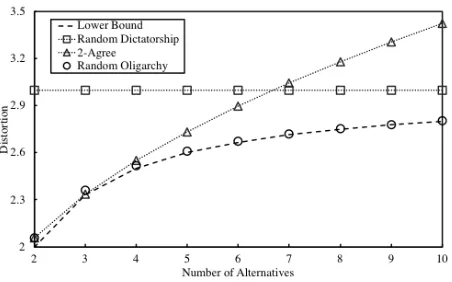
We prove that Random Oligarchy has the best of both worlds with respect to the other favorite only mechanisms of Random Dictatorship and 2-Agree. Unlike 2-Agree, Ran-dom Oligarchy has constant sample complexity and the same Distortion bound of 3 for large|S|as Random Dicta-torship. However, like 2-Agree, it outperforms Random Dic-tatorship for small|S|.
Theorem 6. The Distortion of Random Oligarchy is upper bounded by3for arbitrary|S|, and by the following
expres-Figure 1: Distortion of Favorite Only Mechanisms. Upper bounds for Random Oligarchy are from Theorem 6. Lower bounds and 2-Agree upper bounds are from (Gross, An-shelevich, and Xia 2017). Random Dictatorship is analyzed in (Anshelevich and Postl 2017).
sion for particular|S|.
1 + 2 max
p∈[0,1]
1 +p2(p−2) +(p−1)
3
|S| −1
Figure 1 shows the Distortion bounds of favorite only mechanisms. Comparing against the lower bound for any fa-vorite only mechanism from (Gross, Anshelevich, and Xia 2017) allows us to see that Random Oligarchy is essen-tially optimal among all favorite only mechanisms. In com-parison to existing mechanisms, Random Oligarchy out-performs Random Dictatorship for small |S|, and outper-forms 2-Agree for large|S|, while only using three favorite queries.
8
Open Directions
In this paper, we have considered constant sample complex-ity mechanisms. At a high level, we hope that our work in-spires future research on lightweight mechanisms for social choice in large decision spaces. We also mention some nat-ural technical questions raised by our work.
gen-eral interest for proving tighter Distortion bounds of mecha-nisms on restricted metric spaces.
It remains unclear whether using a constant number of queries greater than 3 would meaningfully improve our re-sults. E.g., consider the natural extension of Random Ref-eree: sample the favorite points ofkagents and ask a random referee to choose their favorite from among these. Using
k >2does not straightforwardly decrease the Squared Dis-tortion bound of 21 fork= 2. Also, askbecomes large, this mechanism devolves to Random Dictatorship. Another nat-ural question is whetherO(k)comparison queries are neces-sary/sufficient to bound thek’th moment of Distortion. We leave these as additional open questions.
Acknowledgments
Brandon Fain is supported by NSF grants CCF-1637397 and IIS-1447554. Ashish Goel is supported by NSF grant CCF-1637418 and ONR grant N00014-15-1-2786. Kamesh Munagala is supported by NSF grants 1408784, CCF-1637397, and IIS-1447554. Much of this work was done while Nina Prabhu was a student at The North Carolina School of Science and Mathematics, in cooperation with Duke University.
References
Abramowitz, B., and Anshelevich, E. 2018. Utilitarians without utilities: Maximizing social welfare for graph prob-lems using only ordinal preferences. InProceedings of the Thirty-Second AAAI Conference on Artificial Intelligence, 894–901. AAAI Press.
Anshelevich, E., and Postl, J. 2017. Randomized social choice functions under metric preferences. Journal of Arti-ficial Intelligence Research58(1):797–827.
Anshelevich, E., and Zhu, W. 2018. Ordinal approximation for social choice, matching, and facility location problems given candidate positions. InThe 14th Conference on Web and Internet Economics (WINE), 3–20. Springer.
Anshelevich, E.; Bhardwaj, O.; Elkind, E.; Postl, J.; and Skowron, P. 2018. Approximating optimal social choice under metric preferences. Artificial Intelligence 264:27 – 51.
Aziz, H.; Brandl, F.; and Brandt, F. 2014. On the incom-patibility of efficiency and strategyproofness in randomized social choice. InProceedings of the Twenty-Eighth AAAI Conference on Artificial Intelligence, 545–551. AAAI Press. Bhaskar, U.; Dani, V.; and Ghosh, A. Truthful and near-optimal mechanisms for welfare maximization in multi-winner elections. InProceedings of the Thirty-Second AAAI Conference on Artificial Intelligence, 925–932.
Boutilier, C.; Caragiannis, I.; Haber, S.; Lu, T.; Procaccia, A. D.; and Sheffet, O. 2015. Optimal social choice func-tions: A utilitarian view.Artificial Intelligence227:190–213.
Bouveret, S.; Chevaleyre, Y.; Durand, F.; and Lang, J. 2017. Voting by sequential elimination with few voters. In Pro-ceedings of the Twenty-Sixth International Joint Conference on Artificial Intelligence, 128–134.
Brandl, F.; Brandt, F.; Eberl, M.; and Geist, C. 2018. Proving the incompatibility of efficiency and strategyproofness via smt solving. Journal of the ACM65(2):6:1–6:28.
Brandt, F.; Conitzer, V.; Endriss, U.; Lang, J.; and Procaccia, A. D. 2016. Handbook of Computational Social Choice. Cambridge University Press, 1st edition.
Caragiannis, I., and Procaccia, A. D. 2010. Voting almost maximizes social welfare despite limited communication. In
Proceedings of the Twenty-Fourth AAAI Conference on Ar-tificial Intelligence, 743–748. AAAI Press.
Cheng, Y.; Dughmi, S.; and Kempe, D. 2017. Of the peo-ple: Voting is more effective with representative candidates. InProceedings of the 2017 ACM Conference on Economics and Computation (EC), 305–322. ACM.
Conitzer, V., and Sandholm, T. 2005. Communication com-plexity of common voting rules. InProceedings of the 6th ACM Conference on Electronic Commerce, 78–87. ACM. Esfandiari, H., and Kortsarz, G. 2016. A bounded-risk mechanism for the kidney exchange game. In Kranakis, E.; Navarro, G.; and Ch´avez, E., eds.,LATIN 2016: Theoretical Informatics, 416–428. Springer.
Fain, B.; Goel, A.; Munagala, K.; and Sakshuwong, S. 2017. Sequential deliberation for social choice. InThe 13th Con-ference on Web and Internet Economics (WINE), 177–190. Springer.
Fain, B.; Goel, A.; Munagala, K.; and Prabhu, N. 2018. Random Dictators with a Random Referee: Constant Sample Complexity Mechanisms for Social Choice - Full Version.
ArXiv e-prints.
Feldman, M.; Fiat, A.; and Golomb, I. 2016. On voting and facility location. InProceedings of the 2016 ACM Confer-ence on Economics and Computation, 269–286. ACM. Filos-Ratsikas, A., and Miltersen, P. B. 2014. Truthful ap-proximations to range voting. In The 10th Conference on Web and Internet Economics (WINE), 175–188. Springer. Goel, A.; Krishnaswamy, A. K.; Sakshuwong, S.; and Aita-murto, T. 2015. Knapsack voting.Collective Intelligence. Goel, A.; Krishnaswamy, A. K.; and Munagala, K. 2017. Metric distortion of social choice rules: Lower bounds and fairness properties. InProceedings of the 2017 ACM Con-ference on Economics and Computation, 287–304. ACM. Gross, S.; Anshelevich, E.; and Xia, L. 2017. Vote until two of you agree: Mechanisms with small distortion and sample complexity. InProceedings of the Thirty-First AAAI Con-ference on Artificial Intelligence, 544–550. AAAI Press. Procaccia, A. D., and Rosenschein, J. S. 2006. The dis-tortion of cardinal preferences in voting. In Klusch, M.; Rovatsos, M.; and Payne, T. R., eds.,Cooperative Informa-tion Agents X, 317–331. Springer.