World Maritime University
The Maritime Commons: Digital Repository of the World
Maritime University
World Maritime University Dissertations Dissertations
1999
The position of the Republic of Senegal in the
proposed West and Central [African]
memorandum of understanding on port state
control
Papa Mor Thiam World Maritime University
Follow this and additional works at:http://commons.wmu.se/all_dissertations Part of theAdmiralty Commons
Recommended Citation
Thiam, Papa Mor, "The position of the Republic of Senegal in the proposed West and Central [African] memorandum of understanding on port state control" (1999).World Maritime University Dissertations. 64.
WORLD MARITIME UNIVERSITY
Malmö, Sweden
THE POSITION OF THE REPUBLIC OF
SENEGAL
IN THE SUPPOSED WEST AND CENTRAL
MEMORANDUM OF UNDERSTANDING
ON PORT STATE CONTROL
BY
PAPA MOR THIAM
Senegal
A dissertation submitted to the World Maritime University in partial fulfillment of the requirements for the award of the degree of
MASTER OF SCIENCE
In
MARITIME SAFETY AND ENVIRONMENT PROTECTION
DECLARATIONS
I certify that all the material in this dissertation that is not my own work has been
identified, and that no material is included for which a degree has previously been
conferred on me.
The content of this dissertation reflected my own personal views, and are not necessarily
endorsed by the University.
P. M THIAM
15 August 1999
Supervised by:
Name: J.Å. JÖNSSON
Office: Professor
World Maritime University
Assessor:
Name: P.K. MUKHERJEE
Office: Course Professor
Institution/organization: World Maritime University
Co-assessor:
Name:
Office:
ACKNOWLEDGEMENTS
Presenting this dissertation, I commence by extending acknowledgements to CESTING
(Cabinet de Control Expertise Surveillance Techniques Ingenierie), and the Federal
Republic of Germany and C.D.G. enabling the embarking and part taking in the World
Maritime University master of maritime safety program of 1999.
Recognizing the significant impact of professors, without whose knowledge and
academic propellants the successful completion of the course would have been less
feasible, I wish to emphasize my gratitude to my supervisors professors Jönsson and
Mukherjee of exceptional support.
Indeed, pleased with the professionalism of numerous fellow students, my thanks for
camaraderie shown is with equal sincerely expressed.
Of paramount importance to all of my endeavours; my parents to whom I dedicate this
thesis, and family members to whom I due to firm, unrelenting encouragement, through
ASBSTRACT
Title of the dissertation: The position of the Republic of Senegal in the West and
Central African Memorandum of Understanding on Port
State Control
Degree MSc
The dissertation is an analysis of the WCAMOU on PSC which is for the time
being in the phase of establishment and the role of Senegal as state member in the
organisation.
The adoption of the WCAMOU is encountering lot of difficulties related to the
specificity of the region. Such specificity has to be seen in terms of safety concept,
environment consideration, lack of resources, and diversities of the countries members.
Globally talking, PSC is of great importance since it contributes to the struggle
against substandard ships and generated hazards jeopardising the life at sea and the
marine environment. Both of these latter indeterminable value justifies the necessity for
protection as much as possible. However, there exist certain no negligible secondary
effects of direct economic impact that have to be highlighted and taken into
consideration in a region where the economic development is one of the lowest in the
World.
This does not change the need for a regime of PSC and accordingly there are
collective and individual actions to be undertaken.
The dissertation conclusion is a synthesis of the discussed subjects which are
TABLE OF CONTENTS
Declarations i
Acknowledgements ii
Abstract iii
Table of contents iv
List of tables vii
List of figures viii
List of Abbreviations ix
1 Introduction 1
2 The WCAMOU on PSC 6
2.1 Presentation of the WCAMOU 6
2.2 Establishment of the WCAMOU 7
2.3 Objectives of the WCAMOU 8
2.3.1 Responsibilities of the Ports States 9
3 Port state control procedure 11
3.1 Legal basis of Port State Control 11
3.2 Port State Control procedure 12
3.2.1 Verification of ship certificates and documents 12
3.2.2 More detailed inspection 14
3.2.3 Substandard ship and detention 16
4 The constraints of the WCAMOU 18
4.1 The West and Central African ports
4.2 The human factor 20
4.3 Ratification of the international conventions 21
4.4 Culture differences 23
4.5 Financial needs 25
4.6 Lack of ports infrastructures 25
5 Economic impact of PSC in the States members of The WCAMOU 27
5.1 Economy of the countries members of the WCAMOU 27
5.2 Export impact on Gross Domestic Product in the region 29
5.3 Role of maritime transport in the foreign trade 30
5.4 Influence of Port State Control on the sea transport 31
5.4.1 Influence on the capital costs 32
5.4.2 Influence on the operating costs 33
5.4.3 Influence on the voyage costs 34
5.5 Risk of local shipping companies collapse 35
6 Position of Senegal in the WCAMOU on PSC 38
6.1 Traffic of the foreign vessels in the Senegalese ports 38
6.2 Importance of the sea transport in the Senegalese economy 39
6.3 Geographical position of the Port Autonome de Dakar 42
6.3.1 Port Autonome de Dakar infrastructures 41
6.3.2 Vessels traffic in the Port Autonome de Dakar 44
6.4 Implementation of PSC in Senegal 45
6.4.1 The Senegalese Merchant Marine Directorate 46
6.4.2 Performance of Port State Control in Senegal 49
6.4.3 WCAMOU relevant international instruments in the Senegalese legislation 51
7 Conclusion and Recommendations 53 7.1 Conclusion 53 7.2 Recommendations 55 7.2.1 No use of Port State Control in ports competition 55
7.2.2 Financial solution for the WCAMOU 56
7.2.3 Training of the WCAMOU Port State Control officers 56
7.2.4 Role of the Classification societies in the WCAMOU 57
7.2.5 Necessity of setting up shipping safety culture within the WCMOU 58
LIST OF TABLES
Table 1: The West and Central African Ports
Table 2: Status of the ratification of WCAMOU relevant International conventions by the States members
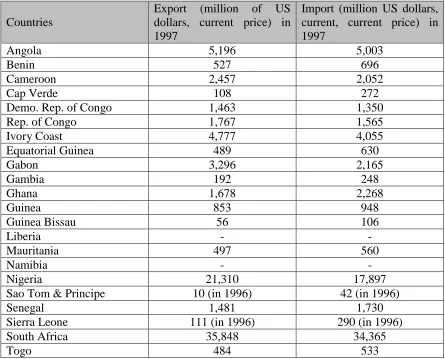
Table 3: Export and import of the countries members of the WCAMOU
Table 4: New ships prices
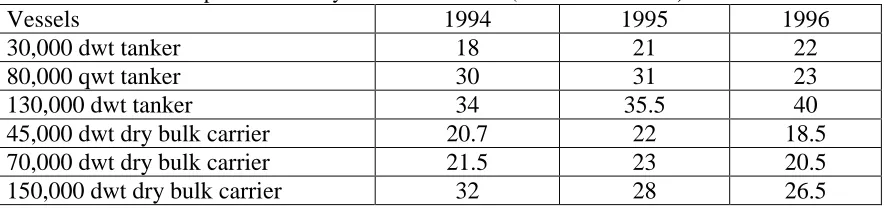
Table 5: Second hand prices for five years old vessels
Table 6: WCAMOU countries fleets
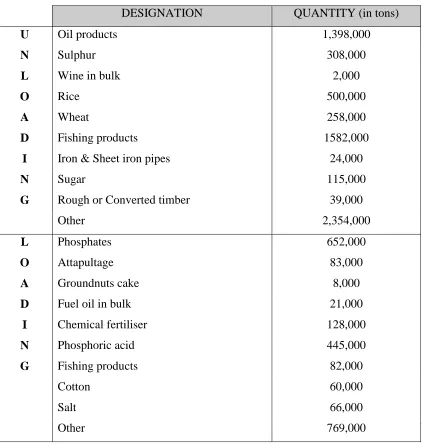
Table 7: Goods traffic structure in the Port Autonome de Dakar
LIST OF FIGURES
Figure 1: The supposed states members of the WCAMOU on PSC
Figure 2: Export impact on GDP IN THE African countries
Figure 3: Transport costs and distance relationship
Figure 4: Location of the Port Autonome de Dakar
Figure 5: Configuration of the Port Autonome de Dakar
LIST OF ABBREVIATIONS
COLREG: International Regulation for Preventing Collisions at Sea 1972.
IMO: International Maritime Organisation.
ILO: International Labour Organisation.
MINCOMAR: Ministerial Conference on Maritime Transport of West and Central
African States.
ECA: Economic Commission for Africa
MARRPOL 73/78: The International Convention for the Prevention of Pollution from
ships 1973 as modified by Protocol of 1978 relating to as amended.
MOU: Memorandum of understanding.
UNCLOS: United Nations Conference on the Law of the Sea 1982.
ILO Convention N°: The Merchant Shipping (minimum standards) convention 1976.
N°: Number.
PSC: Port State Control.
PSCO: Port State Control Officer.
SOLAS 74: The International Convention for the Safety of Life at Sea 1974 as
amended.
STCW: International Convention on Standards on Training Certification and Watch
Keeping for Seafarers 1978 as amended.
WMU: World Maritime University.
UN: United Nations.
Reg: Regulation.
Res: Resolution.
WCAMOU: West and Central African Memorandum of Understanding.
IOPP: International Oil Pollution Prevention.
LL 66: International Convention on Load Lines 1966
Prt: Protocol.
Grt: Gross Tonnage.
CHAPTER 1
INTRODUCTION
For different purposes, ships have been used for several hundreds years. One
category of ships such as trawler for instance, is used for fishing. Cargo ships like
dry cargo ships or tankers convey merchandises of different nature in liquid, bulk or
package form. The passenger ships are devoted primarily for the transport of persons
either in yachting, cruise or travelling. The warships sail for military needs. The
scientific ships route for scientific research like oil exploration. Finally come mobile
platforms such as the oil platform that are used for offshore oil exploitation.
Both the different countries economy developing and the world population
growing have caused huge people need of voyage by ship and the import and export
expansion through the sea-borne trade. The world fleet have therefore increased in
terms of ships over years in order to supply the world ships demand for the
international transport. This phenomenon led to the rise of the number of ships and
their capacity. For instance, from 9 million of gross tons in 1860, the world
merchant fleet grew in 1995 to more than 491 million gross tons of which 82,890
vessels were of more than 100 gross tons. Since, year by year, the sea traffic has
become more and more dense rendering higher the risk of sea accidents. As a result,
the loss of life at sea and the environment disasters that are caused by ships became
disquieting. Several accidents of different category of vessels have occurred in the
past. Amongst them, the Titanic disaster had the biggest impact than any other on
maritime safety because of the largest number of casualties the world has never seen:
As a proverb says that it is an ill wind that blows nobody any good, the
Titanic event represented the prelude to the creation of the International Maritime
Organisation, a United Nations agency dealing with the maritime safety and the
environment protection.
In reality, IMO is not the first precursor of the safety of ships. As early as
1912, after the Titanic sinking, there were voices rising to denounce the setting of
international safety standard of ships. So in 1914, the first SOLAS convention that
did not entered into force due to the First World War was adopted under the aegis of
the British government at that time. Another version of SOLAS was edited in 1929
followed by the Loadline convention in 1931. Although there had already been
agreements on ship safety between some countries, it is the creation in 1948, after the
Second World War, of IMO as agency of the United Nations that indeed gave ruling
on international standards on ship safety.
Composed nowadays by 156 state members with the same concern on safety
of life at sea and the protection of the marine environment, IMO endeavours to
minimise as much as possible the risk of ship accidents and related environment
consequences through international treaties. Thanks to IMO, at least 35 international
conventions and agreements and their protocols and/or amendments are adopted. In
addition, a multitude of codes, recommendations, resolutions, circulars, and
guidelines are under credit of IMO.
After a convention has entered into force, the IMO member states are bound
by the requirements of that convention. Consequently each respective flag state shall
itself implement the international instrument within the area of its jurisdiction
through appropriate provisions, of which prior is the introduction of the convention
However, for one reason or another, the flag states do not always fulfil their
commitment vis-à-vis their international obligations by effective application and
enforcement of the IMO conventions.
Still with the same major concern of ship safety and the pollution of the
marine environment, IMO through its resolution A.787 (19) adopted in November
1995, initiated Port State Control (PSC).
The Port State Control consists of inspection of ships when they call foreign ports.
The Port State Control is just a complementary measure to ensure the respect of the
IMO international requirements, as supported by Plaza (1997, 30):
In an ideal world, Port State Control would not exists, but when
shipowners, classification societies, insurers, or flag states
administrators have in one way or another failed to their job, Port State
Control comes into scene.
In addition, it is paramount to notify that Port State Control cannot substitute the flag
state role.
The efforts of the flag states are of primarily importance in ensuring that
ships conform to the international safety standards. Plaza (1997, 30)
The history of Port State Control started several years before the IMO resolution
A.787 (19). Even if it was not called port state control, every port authority used to
set its individual requirements of safety to vessels coming to its port under national
legislation. As early as 1978 the Hague Memorandum was created. That
memorandum was an agreement on port control between maritime authorities of
eight countries bordering the North Sea. Four years later in 1982, the Hague
Memorandum was changed to the Paris Memorandum that strengthened port control
by making it a concern of the port states. The idea of involving the port states in the
increasing number of substandard ships and the growth of the flags of convenience.
Subsequently, the IMO resolution A.787 (19), that gives authority to the port state to
go on board foreign vessels within its port for inspection was, drafted and adopted on
the 23 November 1995. The inspection is based on the following international
instruments:
- The International Convention for the Safety of Life at Sea, 1974, as amended
(SOLAS 74), and modified (SOLAS Protocols 1978 and 1998)
- The international Convention on Load Lines, 1966 (Load Lines 66) as modified
(Protocol 1988)
- The international Convention for the prevention of the pollution from ships, 1973
as modified by the protocol of 1978 relating thereto, as amended (MARPOL
73/78)
- The Collision Regulation (CORLEG 72)
- The International Convention on Standards of Training, Certification and
Watch-keeping for seafarers, 1978, as amended (STCW 78)
- The international Convention on Tonnage Measurement of ships, 1969
To the above listed conventions, which are IMO’s instruments, is added the ILO
Convention 147 dealing with the living condition of the seafarers.
To make port state control more efficient, IMO is promoting a regional
approach through memoranda of understanding according to the geographical
location of the countries.
A world network of memoranda of understanding is setting up. Already five
memoranda are existing. They are the Paris MOU (European countries and Canada),
the Acuerdo de Viña del Mar (Latin American countries), the Tokyo (Asian and
Pacific countries), the Caribbean (countries of the Caribbean region), and the
Mediterranean (Maghrebean countries). Other memoranda of understanding on port
Memorandum of understanding (WCAMOU) which is in a very advanced stage of
establishment.
The WCAMOU may encounter different obstacles of various natures during
the setting up of the organisation and later on when achieving the required tasks of
ship control. Indeed, despite their geographical neighbourhood, the countries which
are members of the WCAMOU are far of composing one bloc with the same concern
of sub-standard ships and the action that should be taken as foreign ship enter their
ports or harbours. Such situation comes from the fact that the state members of the
WCAMOU, despite their appurtenance of the same African continent are different in
terms of people and history, internal structure and political stability, capacity of
self-management and autonomy, and shipping level. In addition, there is a serious
competition and conflict between countries of the sub-region .
With such a situation, the success of the WCAMOU is a challenge for all
state members, which have to undertake appropriate collective and individual
measures. Since then, what can be the position of Senegal within the supposed
WCAMOU on PSC?
CHAPTER 2
THE SUPPOSED WEST AND CENTRAL AFRICAN
MEMORANDUM ON PSC
2.1 Presentation Of the WCAMOU
MAP
The WCAMOU is composed of 22 countries along the East Atlantic Ocean. It
goes from Mauritania in the North to South Africa in the South.
The current member states of the WCAMOU region are in alphabetic order: Angola.
Benin, Cameroon, Cape Verde, Congo, Ivory Coast, Gabon, Democratic Republic of
Congo, Equatorial Guinea, Gabon, Gambia, Ghana, Guinea, Guinea Bissau, Liberia,
Mauritania, Namibia, Nigeria, Sao-Tomé & Principe, Senegal, Sierra Leone, South
Africa, and Togo.
2.2 Establishment of the WCAMOU
The idea of the creation of the WCAMOU was risen during the 18th IMO
Assembly. Representatives of the West and Central Africa countries decided after a
discussion to establish a port state control agreement in the Eastern Atlantic Ocean.
The Ministerial Conference of the West and Central African states on maritime transport
(MINCONMAR) was agreed as the co-ordination body. Following that, the creation of
the WCAMOU has been undertaken.
The first preparatory meeting was held from 17 to 20 February 1998 in Accra in
Ghana with the participation of 20 of the 22 concerned countries. Also the following
observers were present at the meeting: IMO, the International Labour Organisation
(ILO), the Communauté Economique et Monetaire de l'Afrique Central (CEMAC), the
Economic Commission for Africa (ECA), The International Association of
Classification Societies (IACS), the Ministerial Conference of Maritime Transport of the
West and Central African states (MINCONMAR), The United Nations Development
Programme (PNUD), and the International Transport Federation (ITF).
2.3 Objectives of the WCAMOU
The aim of the WCAMOU is to take part in the global struggle to enhance ship
safety and the protection of the environment. So within the regional agreement and
through a unified and harmonised system on port state control, the different countries
that compose the WCAMOU decided, with joined action, to eliminate sub-standard ship
entering their respective ports.
A sub- standard ship is any ship that for one reason or another jeopardises:
- The safety of life at sea
- The living and working condition on board ship
- The environment
To reach the above mentioned objectives, it is agreed that the performance of port
state control shall be based on the conventions below:
- The International Convention on Load Lines, 1966
- The International Convention for the Safety of Life at sea , 1974 (SOLAS 74)
- The Protocol of 1978 relating to the International Convention for the Safety of Life
at Sea,1974
- The International Convention for the Prevention of Pollution from ships, 1973, as
modified by the Protocol of 1978 relating thereto (MARPOL 73/78)
- The International Convention on Standards of Training, Certification and
Watch-keeping for Seafarers, 1978 (STCW 78)
- The Convention on the International Regulation for Preventing Collision at Sea,
1972
- The International Convention on Tonnage Measurement of Ships, 1969
- The Merchant Shipping ( Minimum Standards) Convention, 1976 (ILO Convention
Also the amendments to these instruments, once entered into force and ratified by a
state, should be considered by the states as relevant instrument for port state control.
2.3.1 Responsibilities of the Port States
Its is important to mention first that port state control is not an imperative duty of
the states, but a right they have to go on board targeted ship to check the compliance
with the requirements of the international standards. However, within the WCAMOU
the following obligations are to be fulfilled by every state member:
- The number of ship inspections: " Each Authority will achieve within a period of
three years from the coming into effect of the Memorandum an annual total
inspection corresponding to 15% of the estimated number of individual foreign
merchant ships, herein after referred as "ship", which entered the ports of its state
during a recent representative period of 12 months."
- The co-operation between port state authorities: The port state authorities have the
obligation to carry out ship inspection aiming the effectiveness of the MOU as the
common concern. Owing to that, they shall communicate each other about their
inspection results through a network of information, co-ordinate their actions and
share their experience relating to port state control.
2.3.2 Application of the WCAMOU
In a port of country members of the WCAMOU, port state control applies to all
merchant ships that are engaged in international voyage unless such ship is exempted by
specific reasons. Two cases have to be taken into consideration. Firstly, the ships of
Convention size such as cargo ships of 500 grt and above or any passenger ship in
international traffic is subject to inspection according to the regional agreement
regulation. These ships are targeted with regard to their age, their owner, their class and
Within the WCAMOU ship should not be inspected more than once in a six months
period unless there is a clear ground of the hazard of that ship.
The clause of "No more favourable treatment" as stated in the SOLAS Protocol 78;
MARPOL 73/78; STCW; and ILO Convention N°147 binds ships flying the flag of
states, which is not party to the relevant conventions.
Secondly, concerning ships below Convention size (ships less than 500 grt), the states
national legislation applies to them. They may be inspected according to their type, size,
and the voyages they are intended to do. It is up to the respective national maritime
administration to decide whether or not such a non-Convention ship represents a hazard
according to the required standards of ship safety, crew condition of living, and
CHAPTER 3
PORT STATE CONTROL PROCEDURE
The control of foreign ships is not a duty, but a right the Port States have to
ensure that ships calling at their ports do not endanger neither the safety of the crew and
passengers on board nor the maritime environment.
3.1 Legal basis of Port State Control
Several international treaties contain provisions dealing with PSC. They consist
of the following conventions of UN and its agencies IMO and ILO.
UNCLOS (entered into force 28 July 1996) in its Article
ILO Convention 147 (entered into force 28 October 1980) in its Article 4
SOLAS 74 (entered into force 25 May 1980) in its Regulation 19 Chapter I and
Regulation 4 Chapter XI
Load Lines 1966 (entered into force 21 July 1968) in its Article 21
MARPOL 73/74 (entered into force 20 October 1983) in its Article 5 and 6,
Regulation 8 of Annex I; Regulation 15 of Annex II; Regulation 8 of Annex III;
Regulation 8 of Annex V
STCW 1978 (entered into force 28 April 1984) in its Article X
Tonnage 1969 (entered into force 18 July 1982) in its Article 12
In addition, IMO Resolution A.19/Res.787, that revokes resolutions A.466(XII) as
requirements of the above mentioned conventions. Adopted on 23 November 1995, its
provides a guideline for PSC, that is followed in the different MOUs as far set up.
3.2 Port State Control procedure
Thus the procedure is basically the same and consists of three main parts: inspection
of certificates and documents, hull and machinery inspection, and ship operation
inspection. The performance of the two last inspections depends mainly to the results of
the first one and the professional judgement of the inspection executor .
3.2.1 Verification of ship certificates and documents
A port state control visit on board a ship will normally start with verification of the
following certificates and documents issued in accordance with, the relevant instruments
of the regional agreement:
- International safety construction certificate
- International safety equipment certificate
- IOPP certificate
- Oil records book
- Record of construction and equipment
- International tonnage certificate (1969)
- Minimum safe manning document
- Certificates of competency
- International certificates of fitness for the carriage of liquefied gases in bulk or
dangerous chemicals in bulk (if relevant)
- Medical certificates
- If appropriate, class certificates as to the ship's hull strength and machinery
installations
- Radio certificate
In addition, there will be a general inspection of several areas on board to verify that the
condition of the ship complies with that required by the various certificates.
In one hand, if the ship is found to comply, a "clean" inspection report is issued to the
master of the ship. Moreover, the data of the respective ship and the inspection results
will be recorded and communicated to the other port state members.
On the other hand, if valid certificates or documents are not on board, or if there are
"clear grounds" to believe that the condition of the ship, its equipment or its crew does
not substantially meet the requirement of a relevant convention, a more detailed
inspection will be carried out.
"Clear grounds" for detailed ship inspection
When talking about "clear grounds" for more detailed inspection, two cases have
to be taken into consideration:
a) The notification of ship deficiencies
Such notification may be of divers forms
- A report by another authority
- A report or complaint by the master, a crew member or any person or organisation
with a legitimate interest in the safe operation of the ship, unless this complaint is
clearly deemed to be unfounded
In addition there are requirements for expanded inspections for bulk carriers and tankers
above a certain age and for passenger ships.
b) Unsatisfactory results from the first phase of inspection
The approbation of these results depends on the relative severity of the non-compliance
with the requirements and the personal judgement of the inspector. For instance, for on
board operational performances, "clear grounds" are mainly the following:
- Evidence of operational shortcomings revealed during port state control procedures
in accordance with SOLAS 74/78 and SOLAS Protocol 88, or MARPOL 73/78 or
STCW 78
- Evidence of cargo operations procedure or other procedures not being conducted
safely or in accordance with IMO guidelines
- Involvement of the ship in accidents due to failure to comply with operational
requirements
- Evidence from the witnessing of fire or abandon ship drills, that the crew is not
familiar with essential procedures
- Absence of an up-to-date muster list
- Indication that key crew members may not be able to communicate with each other
or with other persons on board.
Furthermore, control on compliance with other on board operational requirements may
be included in the control procedures, particularly if there are reasons to believe that the
3.2.2 More detailed Inspection
"Clear grounds" does not lead to the checking up of the entire ship. It allows the
port state officer to go deepest in the inspection focusing in certain optional aspects of
the ship, that he judges necessary to verify. Guidelines are given in the IMO resolution
A19/Res.787 on port state control for the detailed inspections on the following ship main
aspects
a) Ship structure and equipment
- The ship structure
- The machinery space
- The condition of assignment of load lines
- The life saving appliances
- The safety of life
- The regulations for prevention of collision at sea
- The cargo ship safety construction certificate
- The cargo ship safety radio certificate
- The equipment in excess of convention or flag state requirements
b) Discharge requirements under MARPOL
- Annex I for the prohibition of oil discharge (MARPOL Regulations 9 and 10)
- Annex II for the prohibition of noxious liquid discharges (MARPOL Regulation 5)
- Inspection of crude oil washing system operation
- Inspection of unloading, stripping and prewash operations
c) Control of operational requirements
- Muster list
- Communication between crew
- Fire and abandon ship drill
- Damage control plan and Shipboard Oil pollution emergency plan (SOPEP)
- Fire control plan
- Bridge operation
- Cargo operation
- Operation of machinery
- Manuals instructions
- Handling of Oil and oily mixtures from machinery
- Dangerous goods and harmful substances in packaged form
- Garbage handling
d) Minimum manning standards and certification
- Manning control
- Control under the STCW 78
When deficiencies are found during the inspections, the ship may be qualified as
substandard ship and subsequently being detained.
3.2.3 Substandard ship and detention
IMO resolution A19/Res787 on port state control, Chap 4, paragraph 4 defines a
substandard ship as a ship of which the hull, machinery, equipment or operational
safety, is substantially below the standard required by the relevant conventions, or
whose crew is not in conformance with the safe manning document owing to, inter alia,
1 The absence of principal equipment or arrangement required by the conventions
2 Non-compliance of equipment or arrangement with relevant specifications of the
conventions
3 Substantial deterioration of the ship or her equipment because of, for instance, poor
4 Insufficiency of operational proficiency or unfamiliarity of the essential operation of
procedures by the crew, and
5 Insufficiency on manning or insufficiency of certificate of seafarers
According to this definition, the term substandard ship is a relative term. Therefore
a professional judgement that is based on the number and degree of deficiencies is
necessary to consider a ship as substandard in order to detain her.
The following are the main criteria for the detention of a ship
- A ship which is unsafe to proceed to sea will be detained upon the first inspection,
irrespective of the time the ship is scheduled to stay in port
- The deficiencies on a ship are so serious that they must be rectified before sailing.
In case the deficiencies are clearly hazardous to safety, health or the environment,
the maritime authorities will ensure that the hazard is rectified before the ship is allowed
to proceed to sea. For this purpose they will either detain the vessel or issue a formal
prohibition of the ship to continue an operation.
Since then, certain circumstances should be taken into consideration, like:
. The length and nature of the intended voyage or service
. Whether or not the deficiency poses a danger to the ship, persons on board or the
environment
. Whether or nor appropriate rest periods of the crew can be maintained
. The size and type of ship and the equipment provided
CHAPTER 4
THE CONSTRAINTS OF THE WCAMOU
As all organisations, the success of the WCAMOU on PSC necessitates an
amalgamation of various elements. These elements can be resumed in human, financial,
technological, and political factors. Unfortunately, in the concerned countries of the
WCAMOU, the mentioned factors are of crucial shortage. Consequently, the
effectiveness of the regional agreement on port state control as it should be will likely be
difficult to realise despite all the efforts laid down for its success.
4.1 The West and Central African ports
Along the Eastern Atlantic Ocean are located many African ports of different
purposes. Certain are of multipurpose and others are oil terminals. The number of ports
and their distribution varies among the countries.
Table 1: The West and Central African ports
Countries Number of ports Names of the ports
Angola 18
Ambriz, Cabinda, Essungo Marine Terminal, Futila Terminal, Kiabo Marine Terminal, Lobito, Lombo Marine Terminal, Luanda, Malongo Terminal, Mocamedes, Namibe, Palanca Terminal, Porto Amboim, Porto Saco, Quinfuquena Terminal, Soyo, Sumbe, Takula Terminal
Benin 2 Cotonou, Seme Terminal
Terminal, Moudi Terminal, Tiko, Victoria
Cape Verde 7
Mindelo, Palmera Bay, Pedra De Lume, Porto Grande, Porto Praia, Sal Island, Santa Maria Bay
Congo 3 Dieno, Pointe-Noire, Yombo
Ivory Coast 6
Abidjan, Banco Bay, Canal de Vridi, Locodjo, Port Bouet Tanker Terminal, San Pedro
Democratic Republic of Congo
5 Ango-Ango, Banana, Boma, Matadi, Moanda Oil Terminal
Equatorial Guinea 9
Bata, Benito, Cogo, Luba, Malabo, Puerto Iradier, Puerto Macias, Punto Europa Terminal, Rey Malabo
Gabon 11
Cap Lopez, Gamba, Libreville, Lucina Terminal, M'Bya Terminal, Mayumba, Nyanga, Oguendjo Terminal, Ovendo, Owendo, Port Gentil.
Ghana 3 Saltpond, Takoradi, Tema
Gambia 1 Banjul
Guinea 4 Conakri, Dougoufissa Creek,
Kakande, Port Kamsar
Guinea Bissau 2 Bissau, Baloma
Liberia 5 Buchanan, Cape Palmas, Greenville,
Harper, Morovia
Mauritania 5
Nouadibou, Nouakchott, Point Central, Port de l' Amitie, Port Etienne
Namibia 2 Luderitz, Walvis Bay
Nigeria 26
Pennington, Port Harcourt, Qua Iboe, Sapele, Tin Can Island, Ukpokiti Marine Terminal, Warri
Sao-Tomé & Principe 2 Santo Antonio, Sao Tome
Senegal 5 Dakar, Kaolack, Lyndiane, M'Bao
Oil Terminal, Ziguinchor
Sierra Leone 4 Freetown, Kissy Oil Terminal,
Pepel, Sherbro Island
South Africa 10
Cape Town, Durban, East London, Mossel Bay, Port Elizabeth, Port Natal, Port Nolloth, Richards Bay, Saldanha Bay, Simonstown
Togo 2 Kpeme, Lome
All the mentioned ports in Table1 are frequented by foreign vessels. Therefore, they
constitute the places where ship inspection will take place on behalf of the MOU.
Viewing the number of concerned ports and the procedure of PSC operation as
earlier described, it can be seen that the work to be done is both complex and difficult to
handle. There are many factors relating either to the entire region or to the respective
member countries of the WCAMOU that may hamper the effective implementation of
PSC within the region.
4.2 The human factors
The magnitude of ship inspection for the port state members of the WCAMOU
depends on the number of ports in the country and the frequency of the visiting vessels.
Following that, the need of PSCOs is not the same everywhere. However, whatever the
situation is, the skills below must be available for the allocated task:
- Nautical surveyors
- Hull surveyors
- Radio surveyors
It is required in the IMO Res. 787 that PSCOs should be an experienced officer, who is
qualified as flag state surveyor. Indeed, few states have in their Maritime
Administration the qualified people to carry out PSC because of two main reasons.
Firstly, for many countries, the national fleet is only composed of a limited number of
fishing vessels with difficult conditions of working. As a result of that, only a small
number of people have been interested on a carrier in the maritime field, where the
demand of officers of high skills is low. Consequently, well trained officers, naval
architects, and marine engineers are relatively rare. Secondly, the people that fulfil the
criteria of PSCO are not usually willing to work in the administration where the wage is
often paltry. For instance, the sailing officer salary can be four or even five times the
salary of the maritime administration officer. Subsequently, the existing officers are not
at all motivated of being PSCO. In addition, the new STCW-95 renders the situation
more difficult. In fact, the training of the African seafarers as required, is almost
impossible in a region where there are very few maritime institutes fulfilling the
STCW-95 standard. And the worst thing is that the classification societies may enter in the
scene of PSC by delegation. As a result, the eventual new role of the classification
societies in addition to their classical role will create a conflict of interests and will
render the regional PSC agreement inefficient.
4.3 Ratification of the international conventions
As mentioned before, the WCAMOU provision consist of Load-Line 1966,
SOLAS 74 and its Protocol 1978, MARPOL 73/78 and its Protocol 1978, STCW 1978,
CORLEG 1972, Tonnage measurement convention 1969, and the ILO convention N°
Before the regional PSC can start, the port states should have ratified the conventions
and implemented them by means of national legislation. But many of the state members
of the WCAMOU have not yet satisfied these conditions.
Table 2: Status of the ratification of WCAMOU relevant international Conventions by the States members C O U N T R I E S S O L A S 74 S O L A S Prt 78 L L 6 6 T O N N A G E 6 9 C O L R E G 7 2 S T C W 78 M A R P O L A.I/II M A R P O L A.III M A R P O L A.IV M A R P O L A.V I L O N° 147
Angola R R R R R R
Benin R R R R
Cameroon R R R R
Congo R R R
Ivory Coast R R R R R R R R R R R
Republic of Congo R R R
Equatorial Guinea R R R R R R R R R R R
Gabon R R R R R R R R R
Gambia R R R R R R R R R
Ghana R R R R R R R
Guinea R R R R R
Guinea Bissau
Liberia R R R R R R R R R R R
Mauritania R R R R R R R R R R R
Namibia
Nigeria R R R R R R
Sao-Tome
Senegal R R R R R R R R R R R
Sierra Leone R R R R
South Africa R R R R R R R R R R
Togo R R R R R R R R R R
Concerning the IMO conventions the table shows that only seven of twenty two
of the WCAMOU states have already ratified all the relevant conventions. These are
Ivory Coast, Equatorial Guinea, Liberia, Mauritania, Senegal, South Africa, and Togo.
Certain state members such as Guinea Bissau, Namibia, and Sao Tomé & Principé have
not yet ratified any of the instruments as provisions of the agreement on the regional
MOU.
The situation is the same for the labour Convention N°147 on Shipping
Minimum Standards. The difficulties of this convention must be placed within a global
context of the ILO concern with the rest of the labour matters in the region. It is quite
impossible to give particular treatment to the seafarers in order to fulfil the requirements
of the ILO Convention N°147 in an undesirable environment of working condition that
characterises in general the labour community as a whole in almost all the countries of
the region.
4.4 Cultural differences
When talking about cultural difference, there are two main factors that have to be
taken into consideration: the language of communication and the behavior or
interpretation.
Communication is one of the crucial problems in many cross organizations like
the WCAMOU which involves people who are originating from different countries.
Amongst the twenty two states that compose the WCAMOU, there are distinct countries
of three different official languages: French, Portuguese, and English. Since the latest is
chosen as the language of communication in the regional agreement, the lusophone and
within the organization. Obviously, some members will be less privileged. In such a
prevailed situation, it will likely happen that people speaking French and those speaking
Portuguese interpret this as a sign of English countries predominance as it is usually the
case in the existing African organizations. Therefore, there is a high risk of leadership
and frustration that can cause lot of internal discrepancies for the PSC regime. Such
barriers of communication and mutual comprehension resulting from the “ balkanization
“ of the African continent, will encourage division in the regional organization on PSC
with the growing up of clans according to the linguistics appurtenance or other related
interests. Subsequently, members unity and full cooperation which are indispensable to
the success of PSC may be negatively affected.
In addition to the above mentioned problems of communication, there is also crucial
interpretation and behavior difference viewing the multitude of ethnic groups that
compose the sub-region.
“ People of different cultures share basic concepts but view
them from different angles and perspectives, leading them to
behave in a manner which we may consider irrational or even in
direct contradiction of what we hold sacred.” (Richard, 1996).
Furthermore, apart from the practical and technical part which is clearly defined,
national psychology and characteristics may interfere at the executive level, where
decisions tend to be more complex than the practical accords reached between the state
members. The setting up of a real regional agreement on PSC is not something
willy-nilly. Some people would like to prioritize the competency of their port in terms of
income by ignoring their commitments vis-à-vis of the agreement. So, while ship
inspection in one port state is rare and less rigorous, there is a natural shifting of foreign
In some of the contracting twenty two countries there is in addition the phenomenon of
bribery which is highly developed in such way that it will be a challenge for the regional
PSC to be exempted of this reality linked to the citizen ethics. The bribery may be
materialized by cash, gift or by a casual relationship that jeopardize the effectiveness of
the application of many regulations. As a mentality concern, the bribery has reached all
the different levels of the population who do believe in its necessity.
4.5 Financial needs
The WCAMOU is a non profit organization. However, like many organizations,
it requires money for the acquisition of equipment for the functioning of the organization
itself. In fact, to allow the twenty two maritime administrations in charge of the regional
agreement on PSC to exchange information and to avoid the duplication of inspection,
there should exist a network of information between the member. Such network is
composed of a computer center that receives daily reports from the countries terminals
to which it is connected. As a mailbox, the computer center will be able to give to the
terminal operators the necessary information about targeted ships. It is also
indispensable for the organization to have a substantial budget for the wages of its
permanent secretariat personal and to undertake regular seminars that ensure the
effective and harmonized inspection procedures of the PSCOs and keep them informed
of the new technical developments and amendments. Also to ensure there is a uniform
standard in all regional states.
To the above financial need which is for the organization itself, every member country
have to ensure its own logistics and personal for the inspection of ships calling its ports.
4.6 Lack of ports infrastructures
It is said in the WCAMOU provisions that, if the deficiencies found during the
inspection of ship are clearly hazardous to the safety, health or the environment, the
maritime authorities should ensure that the hazard is rectified before the ship is allowed
to proceed to sea. However there exist some factors that render laborious the application
of these measures as stated. Indeed, many West and Central African ports are of low
capacity of ship berthing, due to their very limited number of adequate rooms to receive
big size foreign vessels that are used for the seaborne trade. Certain countries major
ports dispose of less than ten berths and the situation is worst in the secondary ports.
Thus detained ships and generated port congestion will hamper many ports activities.
Subsequently, there is a risk of compromising ports commercial aspects.
Moreover, along the West coast of Africa very few Port States provide ship repair
facilities. Therefore, it will be absurd to require remedial action for the release of
defective vessels where the means of repair are not available. Otherwise there will be
tremendous endue delay to ship and bother to ship-owners.
Last but not least, it is stated in MARPOL Annex I Reg 12, Annex II Reg 7, Annex IV
Reg 10, and Annex V Reg 7, that Parties to the Convention shall ensure the facilities for
the reception of ship waste and cargo residues. Unfortunately, the sub-region ports do
not as far provide those facilities to allow ships to discharge generated waste ashore.
CHAPTER 5
ECONOMY IMPACT OF PSC IN THE STATES MEMBERS OF
THE WCAMOU
There is no doubt that PSC in the West coast of Africa is of paramount
importance for the safety of life at sea and the protection of the environment. But as
many agreements in this order there will also be some negative consequences that should
be taken into consideration: the direct economic impact. This aspect of PSC in the
region should not be concealed. From this approach, there will a better balance of PSC
implementation within the global economic activity of the respective countries and the
entire concerned region .
5.1 The economy of the WCAMOU countries
According to the World Bank statistics, the West and Central African countries
that compose the MOU are all classified amongst the developing countries. Their
principal resources consist of agriculture and industry.
In the past, the agriculture was mainly of subsistence. Using primitive technology with
a low productivity, the culture of grain and the fishery served only the local population
consumption. Over the years, modern technology was developed with the aim to
produce for the international market things like tea, coffee, cocoa, oilseeds, and rubber
plantation, peanut etc. Beside the artisanal fishery the industrial fishery has grown, of
which the catch is in major part exported out of the region.
Although the agriculture remains important in term of its contribution to the gross
international market. Among these the industrial products are for instance clothing, oil,
chemical goods, coal, phosphates and iron, that are often transported in form of raw
material.
The aim of the agriculture and industry product export is to diversify the means
of earning foreign currency but also to rise the countries GDP through the enlargement
of their share of the World trade.
Table 3: Export and import value of the countries members of the WCAMOU
Countries
Export (million of US dollars, current price) in 1997
Import (million US dollars, current, current price) in 1997
Angola 5,196 5,003
Benin 527 696
Cameroon 2,457 2,052
Cap Verde 108 272
Demo. Rep. of Congo 1,463 1,350
Rep. of Congo 1,767 1,565
Ivory Coast 4,777 4,055
Equatorial Guinea 489 630
Gabon 3,296 2,165
Gambia 192 248
Ghana 1,678 2,268
Guinea 853 948
Guinea Bissau 56 106
Liberia -
-Mauritania 497 560
Namibia -
-Nigeria 21,310 17,897
Sao Tom & Principe 10 (in 1996) 42 (in 1996)
Senegal 1,481 1,730
Sierra Leone 111 (in 1996) 290 (in 1996)
South Africa 35,848 34,365
Togo 484 533
their level of development. However, whichever country it is, the international trade
plays an important role in its economy.
5.2 Export impact on Gross Domestic Product in the region
Export has a significant impact on the GDP, mostly in the developing countries.
In Africa the increase of the GDP depends mainly on the export growth due to the high
value of the foreign trade.
Figure 2 shows that all the countries, which are members of the WCMOU, depend
closely to their export. The countries with less export value are of a lower GDP. Since
the GDP measures the economic health and development in a country, one can see the
important impact of export in the global economy of the West and Central African
region and the respective countries.
5.3 The role of maritime transport in the foreign trade
The means which are used for the transportation of goods from one region to
another are of four modes: air, road, rail, and sea.
The most important factor that determines the transport mode option, is the cost of
transport since the final aim is to make profit on the exported goods. However, this
transport cost depends mainly to the voyage distance and the transport mode.
Figure 3: Transport cost and distance relationship
Shipping is the source of the cheapest transport which can open up
wider markets to specialisation, by offering transport for even the
most everyday products at prices far below those that can be
achieved by any other means. Economic development has gone
hand in hand with sea trade for sound economic reasons. (Martin,
1997, 3)
Moreover, the sea transport capacity is very big, following the increase of the ships
tonnage. For instance, there exist nowadays bulk carriers of 300,000 dwt and container
ships of more than 6,000 TEU.
The rapidity of air transport competes the sea transport, but only in the transportation of
products of high value. Road and rail transport stand mainly for internal or regional
use, but not for international transport between continents.
Although shipping constitutes the cheapest and the most common means of
transport in foreign trade, it remains quite expensive and the regional agreement on PSC
may make it even more expensive in certain measures.
5.4 Influence of PSC on the sea transport
The tendency is to neglect the influence of transport cost on developing countries
trade, because of the presuming that freight costs are less important than tariffs. In fact
transport costs can outweigh the impact of transport.
The freight cost for African export and import to the Western countries, such as
the United States and Europe, are usually considerably high. It is now fluctuating to a
The implementation of PSC may increase the freight cost with the elimination of
many ships seen as substandard and the investments needed to keep certain ships on the
so called standard level or to acquire new ones. Talking about ship cost transport price
is directly linked, three aspects have to be taken into consideration: the capital costs, the
operation costs, and the voyage costs. All these costs are subject to increase under the
PSC regime.
5.4.1 Influence on the capital costs
The capital cost is used for the acquisition of a ship. It is fixed in one hand by
the type and the size of the ship, and in another hand by the age, and the state of the ship.
To fulfil the requirements of the international conventions, which are the provisions of
PSC, there are special design and fittings for tanker, passenger ship, and general cargo
respectively. For instance, the double bottom and the crude oil washing system is
indispensable for the oil tankers to minimise the risk for oil pollution according to
MARPOL, while emphasis is put to the safety equipment on board passenger ship
according to SOLAS, in order to diminish the risk of loss of life at sea. Furthermore,
new ships are always more expensive than second hand ships, since the cost for
compliance with conventions is bigger for new ships than for existing ships.
Table 4: New ship prices (in millions of dollars)
Vessels 1994 1995 1996
30,000 dwt bulk 20 21 198
32,000 dwt tanker 28 30 32
70,000 dwt bulk 27 28 28
80,000 dwt tanker 42 43 43
120,000 dwt bulk 40 40 41
250,000 dwt tanker 82 84 85
125,000 m3 LNG 255 255 255
Table 5: Second hand prices for five years old of vessels (in millions dollars)
Vessels 1994 1995 1996
30,000 dwt tanker 18 21 22
80,000 qwt tanker 30 31 23
130,000 dwt tanker 34 35.5 40
45,000 dwt dry bulk carrier 20.7 22 18.5
70,000 dwt dry bulk carrier 21.5 23 20.5
150,000 dwt dry bulk carrier 32 28 26.5
5.4.2 Influence on the operating costs
The operating costs consist of the needed cost to operate the ship. In addition to
the insurance cost, the operating cost involves the labour costs and the repair and
maintenance costs.
Concerning labour costs matter, ILO Convention N° 147 requires certain standard of the
living conditions for the crew. As a consequence there are, regardless to the nationality,
fixed minimum wages for seafarers, minimum decency of accommodation and working
condition, and maximum working hours. Hence, the labour cost word wide is nowadays
basically the same and more expensive. Consequently, the attracting low labour cost
that earlier characterized the seafarers of the region and encouraged foreign shipping
companies to engage African crew may be seriously affected. This situation can lead to
a substantial increase of seafarers unemployment in a region, where the countries fleets
are mostly too small to satisfy the employment demands.
About ship maintenance, it is difficult to estimate the costs increase due to the
influence of PSC. Ship maintenance is more frequent and regular as a routine daily task.
However, the costs are mainly allocated to the acquisition of more spare parts, the repair
5.4.3 Influence on the voyage costs
The voyage costs includes mainly the expenditure for fuel oil and port dues.
Also to avoid PSC burden, the main propulsion machinery is among other ship
equipment to be kept in good condition. This necessitates the use of fuel of higher
quality for better combustion and less hazardous exhausted gas. Viewing the important
daily ship combustible consumption up to 60 tons for instance, one can see that the
required additional cost for good fuel can be tremendous.
The port due is paid as long as a ship stays in a given port. Since the detention
after PSC may require many days to rectify deficiencies, it is a lot of money involved.
Moreover, there exists penalty clause between charterer and shipowner for any ship
delay in the scheduled time. And the issue is more sensitive if the cargo to be
transported is perishable.
This scope can be seen through the need of combustibles of better quality and
higher price to keep the main engine and the auxiliaries in good condition. Moreover, a
time delay that may be caused for instance if a ship is detained by PSCO, can increase
the port costs and eventually also the canal dues owing to the non respect of the booked
time or turn of passage that is usually applied several days in advance.
In a region of which the countries are among the poorest of the world according
to the World Bank statistics, an increase of the freight cost, whatever the reason is, will
likely negatively influence the economy of the region. Indeed the inflation rate will
accordingly rise in addition to its nowadays high level, resulting from the recent
5.5 Risk of Local shipping companies collapse
The shipping business involves highly capital-intensive equipment and
operations in which middle and high income companies have a comparative advantage.
Unfortunately, most of the existent African shipping companies are nowadays under
perfusion and their major concern is to survive the burden of being in dept and the lack
of capital for investment. This situation explains the very low tonnage of the West
African countries and the critical high age of their ships.
Table 6: WCAMOU countries fleets
Fleet Number Gross Tonnage Age
Angola 113 81856 17
Benin 7 1,022 27
Cameroon 50 36,726 28
Cape Verde 37 14,882 27
Congo 20 6,250 27
Ivory Coast 45 12,730 33
Equatorial Guinea 29 20,618 27
Gabon 37 33,183 23
Gambia 6 1490 20
Ghana 195 134,686 24
Guinea 25 6,704 22
Guinea Bissau 21 5,891 18
Liberia 1684 59,988,908 12
Mauritania 131 42,679 19
Namibia 114 58,591,22 22
Nigeria 288 447,164 19
Sao Tome & Principe 5 2,848 19
Senegal 189 49,601 28
Sierra Leone 56 19,361 24
South Africa 182 371,396 24
Togo 6 1,128 21
The West African fleets are very old. The ships average age is over 23 years.
Only the Liberian fleet, which is an international registration has young ships that
mainly sail on other destination than the West African waters. Its shipowers or operators
are mostly European or American that can afford the necessary investments to meet the
requirements of the international instruments. Otherwise, the rest of the fleets do not
have that capacity owing to their small asset. Consequently, most of the few existing
shipping companies of which ships are intended to international voyages, are subject to
bankrupt. They do not have the cash either for the acquisition of new ships or for the
maintenance of ships of more than 23 years old to reach the minimum required standard
as internationally agreed.
The difficult situation for the West African shipping companies that is coming
from the implementation of PSC will generate, apart from the individual effect in each
country, an undesirable effect on the process of regional integration that has been in
progress so far.
5.6 Impact of PSC on the regional economic integration
The foreign trade of the West African countries consisted of export and import
mostly in the direction of Europe for historical reasons. The price of the commodities
were in one way or another fixed by the European ex-mother countries to the prejudice
of the African interest. Fully aware of this phenomenon and the expensiveness of
transport costs due to the long distance between the two continents, the different
Authorities of the West Africa have been establishing a regional integration that is based
on the intra-regional trade with free circulation of commodity between the countries. As
a result of that, during the recent years, food and beverages in intra-regional trade rose
registered an increase of 47.1 percent, while chemicals increased sharply by 211.5
percent, and machinery by 231 percent.
This intra-regional trade is maintained by sea transport owing to the fact that very few
trans-regional rail ways or roads exist. Furthermore, the air traffic within the region is
irregular and too expensive to be used as means of transport. Consequently, it was
created a Ministerial Conference on the Maritime Transport of West and Central African
states (MINCOMAR) to promote the regional exchange of commodities by sea
transport. However there is definitely a high risk that most of the existing shipping
companies, which play an important role, will close down or limit their activities to
domestic transport. Such a situation will likely jeopardize the transport facilitation
which is the objectives of MINCOMAR. Subsequently, the economic integration will
be seriously affected due to the shortage of means of transport between the countries of
CHAPTER 6
POSITION OF SENEGAL IN THE WCAMOU ON PSC
Senegal is situated at the Westernmost point of the African continent at the
Atlantic Ocean. The country has a long history of shipping and is very much
concerned by shipping activities. After its independence in 1960, the Republic of
Senegal became a member of IMO and participates in the achievement of the
International Organisation objectives: Safety at sea and the protection of the marine
environment.
The state of Senegal is one of the twenty-two members composing the WCAMOU,
an organisation that endeavours the control of visiting vessels compliance with the
international instruments under the legal framework of the PSC. The aim of the
regional agreement is the unification of foreign ships inspection in the West African
ports of the Atlantic Ocean for more effectiveness and efficiency. In this global
perspective of PSC the Republic of Senegal, as all the other state members, has an
individual role to play for the edification of the MOU. The magnitude of the task is
proportional to the foreign ships traffic to the Senegalese ports and depends also on
the rigour and tenacity of which the inspection is handled.
6.1 Traffic of the foreign vessels in the Senegalese ports
In Senegal, the so called secondary ports, Ziguinchor, Kaolack, and Saint
Louis are located in the provinces and are all characterised by the shortage of
infrastructures and the lack of maintenance. Their viability in the past was linked to
the absence of consistent investment. As seaborne trade depends on the economical
health, these secondary ports are very rarely called by foreign ships. They are mostly
frequented by fishing vessels and other vessels intended for the domestic transports.
Thus talking about PSC in Senegal, it must be mainly considered ships calling the
Port Autonome de Dakar (PAD), the Senegal capital city harbour.
To understand the frequency of the visiting vessels in the Senegalese ports, the
inter-link between the economy in the country and the sea transport must be highlighted.
6.2 Importance of sea transport in the Senegalese economy
The importance of the transport by sea in particular the role of the Port of
Dakar in the Senegalese economy, has to be appreciated in terms of import of
merchandises for the industrial development and the social welfare of the Senegalese
population in one hand, and in another hand the export of national resources and
products, on which the country GDP depends very much.
The base of the Senegalese economy is still the agriculture, which is
dominated by the mono-culture of groundnuts inherited from the colonialism period.
The production of this grain as well as the new and timid development of other cash
crops such as cotton, sugar and market garden products are mostly for the supply of
the foreign market. The government policy on the cash crops has led to the lack of
culture diversification with the receding of the traditional culture of subsistence, like
millet and sorghum. The state encounter a situation of non self-sufficient agriculture
produce and the basic food of the population nowadays consists mainly of cereals
(rice, wheat) products which are purchased from the Asian, European , and American
countries.
Senegal has the most developed manufacturing sector in the francophone West
Although the Senegal’s foreign trade has consistently been in deficit, there is
a national policy of boosting the export for a relative equilibrium of the trade
balance. Presently in Senegal the mining sector, that is dominated by the calcium
and aluminium phosphates, becomes an important source of export earning as well
as the development of the fishing industry, which provides about 30% of the country
annual export earning.
Table 7: Goods traffic structure in the Port of Dakar (1997)
DESIGNATION QUANTITY (in tons)
U Oil products 1,398,000
N Sulphur 308,000
L Wine in bulk 2,000
O Rice 500,000
A Wheat 258,000
D Fishing products 1582,000
I Iron & Sheet iron pipes 24,000
N Sugar 115,000
G Rough or Converted timber 39,000
Other 2,354,000
L Phosphates 652,000
O Attapultage 83,000
A Groundnuts cake 8,000
D Fuel oil in bulk 21,000
I Chemical fertiliser 128,000
N Phosphoric acid 445,000
G Fishing products 82,000
Cotton 60,000
Salt 66,000
It is approximately a total import and export of 6,168,000 tons of merchandises that
are conveyed via the PAD. Since the Senegalese fleet is mainly composed of fishing
vessels only, the country seaborne trade is ensured by ships flying various foreign
flags.
Apart from the supply of the domestic Senegalese demand, also many other
vessels, loading the neighbouring countries cargo, call the PAD. This phenomenon
is to be attributed to the strategic location of the port and the facilities it offers.
6.3 Geographical position of the PAD
The PAD is situated on the Eastern coast of the Atlantic Ocean at the latitude
14°40 and the longitude 17°26 West. It is an ideal position at the cross-road of the
major maritime routes to the Western Africa
At the junction of the major sea lanes linking Europe and South America, North
America and South Africa the port is the first deep sea water port called by vessels
from the North. As an international forwarding port, Dakar is a gateway of the
Republic of Mali with the possibility of serving Niger and Burkina Faso, all three
locked countries without access to the sea.
6.3.1 The PAD infrastructures
The Port of Dakar is designed in a manner that it can accommodate various
type of ships of different sizes. It has an inner water surface area of 177 ha, which is
dredged at 10 to 11 meters along 10 kilometres of quays, 40 berths, and 53.000
square meters of sheds. Moreover, it offers the largest vessels enough space to move
and allows certain operations to be carried out without tug assistance.
The Port of Dakar is divided into two main areas, North and South, which are
separated by the fishing port and a workshop for naval repairs.
The Southern area
This area is essentially allocated for the general cargo, for the container traffic (25 to
30 percent) goods in transit to Mali and the passenger traffic as well. Three berths
are assigned to RoRo carriers, twelve to multipurpose vessels and two for tugs and
launches.
The Northern area
It is doted with specific facilities for liquid in bulk (refined hydrocarbons, oils, and
wine) and solid in bulk (phosphates, wheat). It has also container terminal handling,
more than 70 percent of the container traffic.
The naval repairs
The PAD provides many possibility for various kinds of ship repair: hull, engine,
electrical and electronic installations, and other ship fittings.
The repairs are undertaken by several firms. The most famous are Dakar Marine and
the Manutention Africaine with the following equipment.
♦ A floating dock of 235 m capable of lifting vessel up to 60,000 tons
♦ A dry dock fitted to accommodate ship of 195 m length, 23 m of width, and 9,5
m of draught
♦ A ship lifter with 63 m long and 15 m wide platform for vessels up to 1,200 tons
♦ A slip-way
♦ Two floating cranes of 60 and 120 tons of capacity respectively.
Thanks to the all above mentioned facilities, the PAD is one of the most