World Maritime University World Maritime University
The Maritime Commons: Digital Repository of the World Maritime
The Maritime Commons: Digital Repository of the World Maritime
University
University
World Maritime University Dissertations Dissertations
1999
A proposal for further improvement of port state control in China
A proposal for further improvement of port state control in China
Tianbing Huang WMU
Follow this and additional works at: https://commons.wmu.se/all_dissertations
Recommended Citation Recommended Citation
Huang, Tianbing, "A proposal for further improvement of port state control in China" (1999). World Maritime University Dissertations. 1091.
https://commons.wmu.se/all_dissertations/1091
WORLD MARITIME UNIVERSITY
Malmö, Sweden
A PROPOSAL FOR FURTHER
IMPROVEMENT OF PORT STATE CONTROL
IN CHINA
By
HUANG TIANBING
The People’s Republic of China
A dissertation submitted to the World Maritime University in partial
fulfilment of the requirements for the award of the degree of
MASTER OF SCIENCE
in
MARITIME SAFETY AND ENVIRONMENT PROTECTION
(Policy)
1999
Declaration
I certify that all the material in this dissertation that is not my own work has been
identified, and that on material is included for which a degree has previously been
conferred on me.
The contents of this dissertation reflect my own personal views, and are not
necessarily endorsed by the University.
……….. Signature
……… Date
Supervised by:
Name:………..
Office:………..
World Maritime University
Assessor:
Name:………..
Office:………..
World Maritime University
Co-assessor:
Name:
Office:………
Acknowledgements
My special thanks and gratitude goes to the Ministry of Communications of People's
Republic of China, the Maritime Safety Administration of People's Republic of China
and Shanghai Maritime Safety Administration for nominating me for the course, to
World Maritime University Special Funds for sponsoring my study in the University.
My thanks and appreciation also goes to all WMU staff and faculty, especially to
professor G. Zade, professor P.K Mukerjee as course professors during my study. I
am deeply indebted to professor J-Å. Jönsson for supervising this dissertation. His
invaluable comments and unremitting advice throughout the preparation of this
dissertation guided and developed my research and writing. I am grateful to captain
S-Å. Wernhult and captain A. Ulstrup for assessing my work.
I would like to thank all my Chinese colleagues, especially to Mr Song Zhen, Mr
Zhang Xiaojie. We share the same feeling and always encourage ourselves to work
harder.
Last, but not at least, my deepest thanks to my parents, my sister, and especially to
my beloved wife, Chen Jie, for their continuous support, encouragement and
Abstract
The primary purpose of this dissertation is to present a proposal to the Ministry of
Communications and the Maritime Safety Administration of the People’s Republic of
China for further improvement of port State control in China.
A brief look is taken at the necessity of better performance of port State control in
China from the Chinese national interests.
A critical analysis is made on the present situation of port State control performance
in China, from the point of view of legislation and administrative system, a member
State of Tokyo MOU as well. Furthermore, major problems associated with present
situation are investigated.
On the basis of good understanding of the present situation and problem areas, a
series of recommendations are made, together with a feasibility study of such
recommendations.
Table of Contents
Declaration ii
Acknowledgements iii
Abstract iv
Table of Contents v
List of Table vii
List of Figures viii
List of Abbreviations ix
1 Introduction 1
1.1. What is port State control 1
1.2. The necessity for better performance of port State
control in China 3
1.3. Dissertation objective and research methodology 6
II Port State Control in China: Present Situation 8
2.1. Port State control Administrative system in China at present 8
2.1.1 The Ministry of Communications 9
2.1.2 The China MSA 10
2.2. Port State control legislation system in China at present 16
2.2.1. International conventions 16
2.2.2. National legislation 20
2.3. Member state of Tokyo MOU 26
2.3.1 General overview of the Tokyo MOU 26
2.3.2 Training of port State control officer programs 27
2.3.3 A unique target regional inspection rate 29
2.4. Port State control in relation with Flag State Control in China 30
2.5. Recent annual statistics 33
III Port State Control in China: Problem Areas at Present 36
3.3. Incomplete legislation by not being a ratifying State of ILO 147
Convention 39
3.3.1. The origin of ILO 147 Convention 40
3.3.2. ILO 147 Convention: an important tool for combating
substandard ships 41
3.3.3. The disadvantage of not having ratified ILO 147 44
3.4. Lack of harmonisation of inspection procedure 46
3.4.1. Different interpretation of IMO Resolution A.787(19) 46
3.4.2. Detention procedure in China 47
3.4.3. Difficulties in information exchange 48
IV Port State Control in China: Proposal for Further Improvement 51
4.1. Streamline administrative system 51
4.2. Ratify ILO 147 and improvement of national legislation 54
4.2.1. Process of ratification and implementation 54
4.2.2. A feasibility study of ratifying ILO 147 by China 56
4.2.3. Enabling legislation 63
4.2.4. The role of MOC in the process of ratification and
implementation 64
4.3. Harmonisation inspection procedure 65
4.3.1 General overview 65
4.3.2 Using targeting methods 67
4.3.3 Possibility of uniform of initial inspection procedure 70
4.4. International and regional co-operation 74
V Conclusion and Recommendations 76
Bibliography 82
Appendix Memorandum of Understanding on Port State Control
List of Tables
Table 1 Port State Control Provisions 18
Table 2 Ratification of Port State Control Instruments by China 19
Table 3 Three Years Port State Control Statistics carried out by
Chinese Authority 34
Table 4 Port State Inspection carried out by Authorities of Tokyo
MOU, 1997 35
Table 5 Major Deficiencies of Living and Working Conditions in
Tokyo MOU 43
Table 6 Major Deficiencies of Living and Working Conditions in
Pairs MOU 43
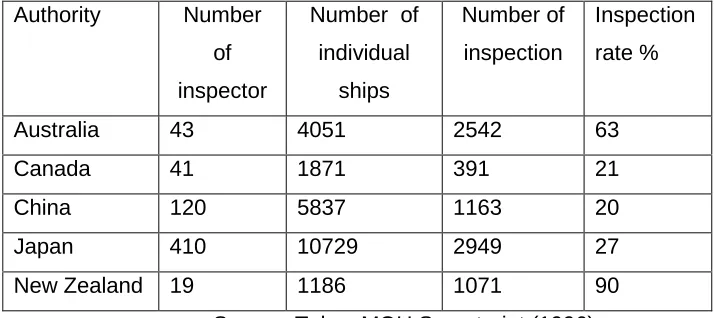
Table 7 Survey on the Number of Port State Control Officer 52
Table 8 Process for Implementation of International Maritime Convention 55
List of Figures
Figure 1 Major Chinese Ports 5
Figure 2 Organisational Structure of MOC at Present 11
Figure 3 China MSA Organisation Structure 15
Figure 4 Four Levels of Legislation in China 22
Figure 5 The Main Duties of Maritime Administration in terms of
List of Abbreviations
AMSA Australia Maritime Safety Administration
APCIS Asia-Pacific Computerised Information System
CCS China Classification Society
China MSA Maritime Safety Administration of People's Republic of China
COLREG 72 Convention on the International Regulations for Preventing
Collisions at Sea, 1972
COSCO China Ocean Shipping (Group) Corporation
DOC Document of Compliance
ESCAP United Nations Economic and Social Commission for Asia
and the Pacific
GMDSS Global Maritime Distress & Safety System
IACS International Association of Classification Societies
ILO International Labour Organisation
IMO International Maritime Organisation
ISM International Safety Management
LL 1966 International Convention on Load Line
MARPOL 73/78 International Convention for the Prevention of Pollution from
Ships, 1973, as modified by the Protocol of 1978 relating
thereto, as amended
MOC Ministry of Communications
MOU Memorandum of Understanding
MSA Maritime Safety Administration
NPCC National People’s Congress of China
PSC Port State Control
PSCO Port State Control officer
SMC Safety Management Certificate
SOLAS 74 International Convention for the Safety at Sea, 1974, as
amended
STCW 78 International Convention on Standards of Training,
Tonnage 69 International Convention on Tonnage Measurement of Ships,
1969
UNCLOS United Nations Convention on Law of the Sea
Chapter One
Introduction
1.1 What is port State control
Port State control is the inspection by the surveyors of a maritime authority of foreign
vessels visiting the country's ports to ensure compliance with international maritime
safety and pollution conventions. (Dayton, 1993, 15) Its underlying objective lies in
eliminating the operation of substandard ships from the trade routes of the world.
Port States enjoy sovereignty over their internal waters, including their ports and
harbours. (Article 2 and 11 of UNCLOS). It is also generally accepted that there is no
customary international law restrict the competence of port States to regulate foreign
vessels voluntarily present in their ports and presenting pollution hazards. The basis
of the port State's jurisdiction over foreign ships is territorial: it stems from the
presence within internal waters of a merchant ship, which thereby owes temporary
allegiance to the sovereign, and the occurrence of acts or omissions by or on board
ship within its territorial waters. (Plant, 1998)
Much publicised in recent years, port State control is not new. It was actually built
into the 1929 Safety of Life at Sea convention (SOLAS). (Bond, 1995,61) However,
for many years the world community relied almost wholly upon the flag State to
maintain standards of safety and protection of life, property and the environment.
Since the efforts of flag States are of primary importance in ensuring that ships
conform to international standards. It is also the responsibility of shipowners and
classification society (particular when acting on behalf of the flag State) to ensure
that the ship always comply with the international standards. In an ideal world, port
State control would not exist, but when shipowners, classification societies and flag
In the early 1970s, the increases in substandard ships arouse more and more
international concern. Most literatures attributed the increasing substandard ships to
the extremely rapid development of open registries. Port State control jurisdiction
was first introduced for detailed international consideration at the 1973 IMO
Conference on Marine Pollution. (Kasoulides, 1993, 113) Article 6(2) of the MARPOL
Convention adopted at that Conference provides that port officials in the contracting
parties may inspect a foreign vessel in order to verify whether it has discharged in
any sea area harmful substance in violation of the regulations annexed to the
Convention. In 1975, the first port State control procedure was adopted by IMO by
Resolution A.321 (IX)” procedures for the control of ships”. Port State control regime
was endorsed by United Nations Convention on the Law of Sea in 1982. Article 218
“Enforcement by port State” has been well recognised as the principle law of port
State control. Until now, port State control provisions have been introduced in many
IMO and ILO conventions, including the most important ones. Meanwhile, a set of
inspection procedures has been developed.
The first regional co-operation on port State control was established by eight North
Sea States in 1978, known as Hague Memorandum of Understanding. The need for
more stringent measures against substandard vessels was first felt in the North Sea
area after the foundering of the Amoco Cadiz in March 1978. This was superseded in
1982 when 14 European counties agreed to establish a harmonised system of port
State control resulting in the signing of Paris Memorandum. The MOU has been
duplicated in the other regions in 1990s. Agreement has been reached in Latin
American, Asia-Pacific, Caribbean Mediterranean and Indian Ocean most recently.
The future regional agreement would be centred on the Persian Gulf and West and
Central Africa. A world-wide application of port State control regime will be realistic in
the near future. The expansion of port State control supplements the opportunity to
eliminate substandard ships, having much more influence for safe shipping.
1.2 The necessity for better performance of port State control in China
As a major developing country with long coastline, China attaches great importance
to marine development and protection. China boasts a mainland coastline of more
than 18,000 kilometres and more than 5,000 islands in China's territorial waters.
Chinese sea areas have comparatively advantageous natural environmental and
resource conditions. Some 20,278 species of sea creatures have been verified there.
square nautical miles. The shallow seas and tidelands have a total area of 13.33
million hectares, of which 2.6 million hectares of water surface are suitable for raising
aquatic products in terms of the current scientific level. So far, 938,000 hectares are
being utilised for this purpose. (The Development of China’s Marine Programmes,
1998) There are more than 1,500 tourist, scenic and recreational spots favourable
for developing marine tourism. In addition, China's offshore areas abound in
seawater resources and renewable marine energy resources.
China is well recognised as one of the most important developing maritime states in
the world today by its enormous population, maritime tradition, large import and
export, trade, geographical location, maritime infrastructure etc.
Since the economy reform and open door policy, china is already the world’s fifth
largest trading power, and the second largest recipient of foreign investment.
(Ruggiero, 1997) China has become more economically interdependent than ever
upon access to global markets. China economic growth is closely linked to the world
economy as a whole and the majority of the trade is carried on and over the world’s
oceans. Seaborne trade accounts for 90 per cent of trade among nations. In 1997,
foreign trade of export and import reached $325.1 billion; ports throughput of foreign
trade cargoes was 359.15 million tons, up by 12.1 and 12.5 over previous year.
(Statistical Communiqué, 1998) China owned fifth largest merchant fleet in the world
at the beginning of 1997 excluding Hong Kong, Taiwan and Macao, aggregated 1785
ships and 35 million gross tonnage. (ISL, 1998,30) 37,873 ships from 95 countries
called at 130 Chinese ports in1997. (China MSA, 1998)
Shipping is of international attribute; China has consistently taken an active part in
international and regional maritime affairs. From the 16th sessions of IMO, China has successively elected as an A-level council member State. China has also ratified and
acceded to the 30 some conventions formulated by the IMO.
The human society will inevitably come to depend more and more on the ocean, the
environment protection and pollution prevention becomes more pressing. At the
same time, economic and foreign trade growth brings more sea traffic, the potential
1.3 Dissertation objectives and research methodology
This dissertation is aiming at by critical analysis of present situation of port state
control in China, particularly from legislative, administrative and human resource
aspects, identify the areas which need to be improved by comparison with relevant
IMO, ILO instruments, practice of Tokyo MOU, Paris MOU, present
recommendations for overcoming problems and barriers which impede further
improvement.
To achieve the above objective, a research plan has been made in early October
1998. Contact has been made with the Ministry of Communications, the Chinese
Maritime Safety Administration and local branches for the latest reform and policy. A
literature search has been undertaken to examine the development and trend of port
State control regime, relevant international conventions, especially on IMO and ILO
instruments. Studies are continued on the profile of other countries Port State Control
procedures undertaken and delivered by various resourceful persons. Contact has
been also made with Tokyo MOU Secretary, AMSA and USCG. Field studies have
be attended with the various ports and maritime administration of other countries,
especially of those Nordic countries.
Chapter One of this dissertation takes a brief look at the origin and development of
port State Control regime and illustrate the significance of improvement of Port State
Control in China from national interests.
Chapter Two is a critical analysis of port State control present implementation
situation in China, by looking at the present administration, legislation, and member
State of Tokyo MOU as well. It also looks resent annual inspection statistics from
various aspects
Chapter Three identifies the barriers and problems affecting the further improvement
of port State control performance in China based on the analysis of present situation
in previous chapter. Those problems are mainly reflecting unreasonable distribution
of functions within the administration and lack of expertise, incomplete legislation by
not being ratifying State of ILO 147 Convention and lack of harmonisation of
identified in the previous chapter. The recommendations concentrate on streamlining
the administrative system, ratifying ILO147 Convention, harmonising inspection
procedures and international and regional co-operation. Chapter Five concludes the
Chapter Two
Port State Control in China: Present Situation
This chapter is a critical analysis of port State control present implementation situation in China, by looking at the present administration, legislation, and member State of Tokyo MOU as well. It also looks resent annual inspection statistics from various aspects.
2.1 Port State Control Administrative system in China at Present
The maritime administration of a country with maritime interest is an integral part of
its public administration. It plays a very active part in the maritime world. Since
shipping industry is on the international trade basis, the concept and the function of
maritime administration are almost same among countries. On the other hand, the
structure of the maritime administration differs from country to country. Nevertheless,
whatever structure is applied, it must be appropriate to its present needs, political
system and culture, while at the same time being flexible enough to permit change.
Being a centralized country, all the things in China are controlled by the corresponding organization at national level. The Ministry of Communications (MOC) is the competent authority that is solely responsible for all the maritime administration, except that the National Oceanography Administration is in charge of observation and protection of marine resources and the Ministry of Agriculture is responsible for the administration of fishery and fishing ships.
Port State control implementation in China is directed and supervised by the Chinese Maritime Safety Administration under the leadership of the MOC. Practical inspections are carried out by the inspectors in the district offices which nearly embracing the whole coastal area of China and covering the Yangtse River areas.
2.1.1 The Ministry of Communications (MOC)
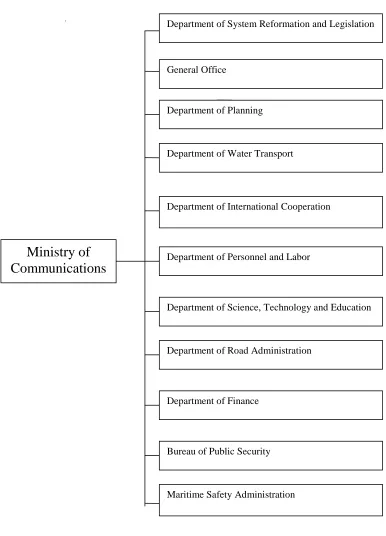
reformed several times to be in line with external environmental changes in terms of political, economical, social and technical aspects. At present, MOC is being undergone a most significant structure reform ever since. The reform is planned to lasting for three years from 1998 to 2000. The core tasks of the present reforming is to separate the administration functions from business management, for example, COSCO (China Ocean Shipping (Group) Corporation) is no longer belonging to MOC. Meanwhile much more emphasis will be put on the aspects of marine safety and environment protection. Figure () shows the organizational structure of MOC at present.
In the MOC, there are some departments that are more connected with maritime affairs.
1. Maritime Safety Administration
Under the leadership of the MOC, the Chinese Maritime Safety Administration is key body to control all the aspects related to the maritime safety and maritime environment. As the result of reorganization of the MOC, the Maritime Safety Administration becomes a relatively independent governmental body. Although it is still under the MOC, but has its own budget and income, remains as a non-profit organization. Another big change is that it has merged with Chinese Register of Shipping. In order to enhance the position of the new administration, one deputy minister is appointed to be the director of the Administration concurrently. The detailed information will be given further on.
2. Department of Water Transport
Its main functions are: undertaking the administration of water transportation; taking care of shipping, port operation policy, freight rate and port dues rate, port production control in general; negotiating the bilateral agreements with foreign counterparts in the field of water transport.
3. Department of International Cooperation
Its main functions are: responsible and instruct maritime matters concerning
international co-operation; coordinate the relationship between the MOC with
international organizations; send appropriate delegates to international meeting,
prepare proposals, suggestion, etc. Formality the process of ratifying or accessing
Figure (). Organizational Structure of MOC at Present
Department of Planning
Ministry of
Communications
General Office
Department of Water Transport
Department of International Cooperation
Department of System Reformation and Legislation
Maritime Safety Administration
Department of Science, Technology and Education
Department of Road Administration
Bureau of Public Security
Department of Personnel and Labor
2.1.2 The Chinese Maritime Safety Administration
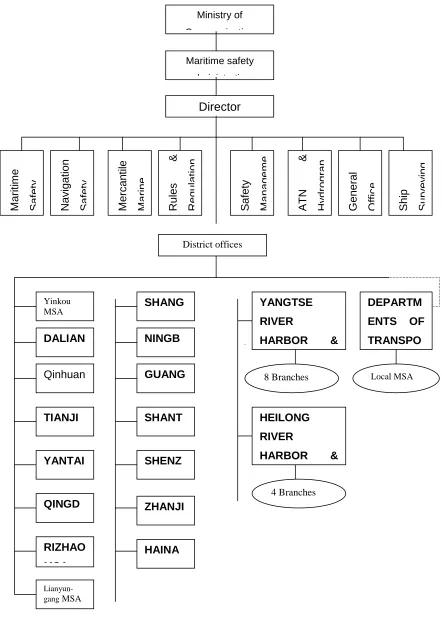
The Chinese Maritime Safety Administration (it is also called Harbor Superintendence Administration) is a specialized body to control all aspects related to the maritime safety and maritime environment. It undertake Chinese government’ obligations under the IMO conventions both as a port State and a flag State. Figure () shows the Chinese Maritime Safety Administration organization structure.
The Chinese Maritime Safety Administration ’s Head Office in the MOC instructs and control all the maritime safety administration activities at national level, drafts and promulgates maritime safety rules and regulations and gives advice and suggestions to the ministry on the maritime safety policy making. The detailed main functions are distributed in the following divisions:
1. Ship Safety and Environment Protection Division
- registration of national ships
- formalities for foreign vessels entering and departing Chinese ports
- safety inspection of national ships (unscheduled inspection)
- safety inspection of foreign ships ( port state control )
- ship minimum safety manning
- supervision and control of maritime dangerous goods
- control and supervision of discharge of pollutants from ships
- management of port reception facilities
2. Navigation Safety Division (Search and Rescue Center)
- commanding and co-ordination search and rescue operation
- the use and management of vessel traffic system (VTS) in China
- approval of application of foreign vessels for entering Chinese ports
- ship route and separation scheme
- promulgation of navigation warnings
- investigation maritime causalities
- approval of surface and under water projects
3. Mercantile Marine Division
- examination and certification of seafarers
- professional training, examination and certification of seafarers
- issuing and administration of seaman’s passports
4. Aids To Navigation and Hydrographic Division
- planning, construction and administration of coastal light houses and buoys
- administration of coastal radio navigation stations
- hydrographic survey in coastal waters
- production of nautical charts
5. Safety Management (ISM) Division
- verify compliance with requirements of the ISM Code
- issue Documents of Compliance(DOC) to shipping companies ( as to issue
Safety Management Certificate for each ship has been delegated to China Classification Society)
6. General Office & Planing and Development Division
- budget and payments control of local maritime safety administration
- MSA personal management and training
- other internal affairs
7. Rules & Regulation Division
- develop the drafts laws and regulations for maritime safety and environmental
protection in accordance with national needs and the international conventions, of which China is a contracting party
8. Ship Surveying Division
- carry out statuary surveys for non-convention vessels and domestic vessels
- issue these ships with appropriate construction and technical certificates
The Ship Surveying Division is a new division after Chinese Maritime Safety Administration merged with Chinese Register of Shipping in 1998.
administrations. This is due to some historical reasons and that China is so large a country, it is sometime difficult to control everything from the central government. However, it is the Chinese Maritime Safety Administration’s responsibility to offer technical guidance to such district offices.
All the district offices have the similar structure as the head office in the MOC. While in the district offices the statuary surveys for non-convention vessels and domestic vessels and issuing relevant certificates is still carried out by the former branches of Chinese Register of Shipping. The MOC plans to finish the merge by 2000.
Currently there are 24 district offices authorized by the Chinese Maritime Safety Administration to carry out port State control under their respective jurisdiction, these district offices are:
- the fifteen coastal maritime safety administrations
- Nanjing, Nantong, Jiangyin, Zhangjiagang, Zhengjiang district offices under the
Ysngtse River Harbor & Navigation Supervision Administration
- Weihai, Zhuhai Fuzhou, Xiamen district offices under Departments of
Figure () The Chinese Maritime Safety Administration Organization Structure
Ministry of
C i ti
Maritime safety d i i t ti
Director
Yinkou MSA DALIAN NINGB GUANG SHANG Qinhuan TIANJI YANTAI QINGD RIZHAO MSA Lianyun-gangMSA SHANT SHENZ HAINA ZHANJI Ma ri ti me S a fe ty District offices Navigat ion S a fe ty Me rca n ti le Ma ri n e Saf e ty M anagem e G ener al Of fi ce Ship Sur v eying A TN & Hydr ogr apRules & Regulat
2.2 Port State Control Legislation System in China at Present
The Chinese port state control legislation system contains two parts, i.e.,
implementation of international conventions and national legislation. Such legislation
is the basis and presuppositions for carrying out port state control in China. All the
administrative activities should be carried under the legislation and regulated by
them.
2.2.1 International Conventions
Shipping is of international attribute, operated and regulated internationally. There is no doubt that, international action is generally more effective than single national action, especially in the context of port state control. As a contracting state of most international conventions relating to port state control, it is also in China’s commitment and interest to properly implement these conventions within its territory.
United Nations Convention on the Law of the Sea (UNCLOS)
UNCLOS has been described as a constitution for the oceans and is widely considered to be a most significant achievement of the international community. It sets out principles and norms for the conduct of relations among States on marine-related issues and would be the order for the oceans at the turn of the century. (Nandan, 1998)
The “blue print” for port state control is contained in UNCLOS in the respect of ship safety and pollution prevention. Article 94 of UNCLOS “Duties of the flag State” has the provisions that “ Every State shall effective exercise its jurisdiction and control in administrative, technical and social matters over ships flying its flag…” While article 218 “Enforcement by port States” has been well known as the origin of the concept of port State control.
China has taken very positive attitude to UNCLOS and adopted the Convention on June 7, 1996.
Port state control provisions under IMO conventions
concept of an essential corrective kind: its exercise aims at correcting non-compliance or ineffective flag State enforcement of IMO regulations by foreign ships voluntarily in port.
The exercise of port State jurisdiction for the purpose of correcting deficiencies in the implementation of safety rules is established in the main IMO safety conventions, namely as follows:
International Convention for the Safety at Sea, 1974, as amended (SOLAS 74);
International Convention on Load Line, (LL 1966);
International Convention for the Prevention of Pollution from Ships, 1973, as
modified by the Protocol of 1978 relating thereto, as amended (MARPOL 73/78);
International Convention on Standards of Training, Certification and
Watchkeeping for Seafarers, 1978, as amended (STCW 1978);
International Convention on Tonnage Measurement of Ships, 1969 (Tonnage 69)
Convention on the International Regulations for Preventing Collisions at
Sea, 1972 (COLREG,72)
Table () Port State Control Provisions
Convention Port State Control Provision
SOLAS 74 Regulation I/19, XI/4
LL 66 Article 21
MARPOL 73/78 Annex I
Annex II Annex III Annex V
Article 5 Regulation 8A Regulation 15 Regulation 8 Regulation 8
STCW 78 Article X, Regulation I/4
TONNAGE 69 Article 12
The first port State control procedure was developed by MSC (Maritime Safety Committee) and adopted by the Assembly in 1973 by resolution A.321 (IX). Since then, IMO has developed a number of procedures for port State control of ships and discharges under the SOLAS, Load Line and MARPOL Conventions, i.e., resolutions A.466 (XII), A.542 (13) and MEPC.26 (23). Furthermore, port State control has been extended to cover operational requirements under resolution A.742 (18). The above control procedures have been amalgamated in a single document entitled “Procedures for port State control” which was adopted by the Assembly in 1995 by resolution A.787 (19).
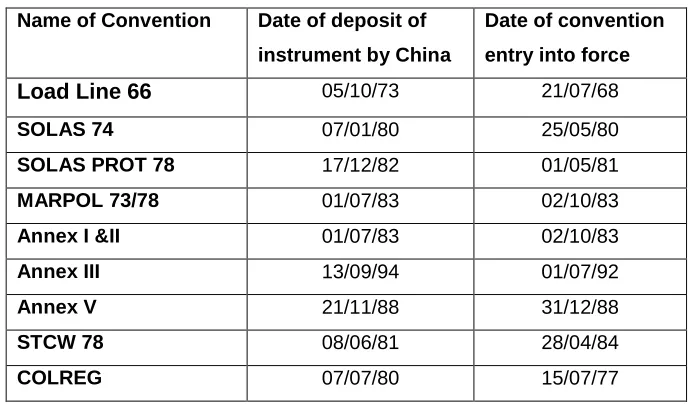
China has played a very active role in IMO since it became a Member State since 1973. Table () show the ratification of IMO conventions which are regarded as port State control instruments by China.
Table () Ratification of Port State Control Instruments by China
Name of Convention Date of deposit of instrument by China
Date of convention entry into force
Load Line 66 05/10/73 21/07/68
SOLAS 74 07/01/80 25/05/80
SOLAS PROT 78 17/12/82 01/05/81
MARPOL 73/78 01/07/83 02/10/83
Annex I &II 01/07/83 02/10/83
Annex III 13/09/94 01/07/92
Annex V 21/11/88 31/12/88
STCW 78 08/06/81 28/04/84
Port state control provisions under ILO conventions
Founded in 1919, the International Labour Organisation (ILO) is a specialised agency to bring governments, employers and trade unions together for united action in the cause of social justice and better living conditions everywhere. (Nilssen, 1998) The special nature of the conditions of work and life of maritime workers has led ILO to adopt an extensive range of conventions and recommendations applying specially to seafarers. The instruments, when referring to port State control are often known as the Merchant Shipping (minimum standard) Convention (ILO 147) which constitute a comprehensive set of minimum standards on board ships. Until now, China has not ratified this convention, further analysis will be made in Chapter three and four.
2.2.2 National Legislation
Implementation of international conventions into national legislation
International maritime legislation was initiated from the combination and unification of national maritime laws. After the adoption of a convention, the implementation of international conventions, which is the aim of international legislation, relies solely on national legislation and enforcement. Each IMO and ILO convention has prescribed the contracting party’s obligation under the convention. Similar wording can be found as the provisions in article I of SOLAS 74.
(a) The Contracting Governments undertake to give effect to the provisions of the
present Convention and the annex thereto...
(b) The Contracting Governments undertake to promulgate all laws, decrees,
orders and regulations and to take all other steps which may be necessary to give the present Convention full and complete effect, so as to ensure that, from the point of view of safety of life, a ship is fit for the service for which it is intended.
the People’s Republic of China contains provisions differing from those in the civil laws of the People’s Republic of China, the provisions of the international treaty shall apply, unless the provisions are ones on which the People's Republic of China has announced reservations.” Although this provision was initially to be limited in the content of civil law, virtually it becomes the prevailing principle of how to deal with the relationship between international convention and national legislation.
In practice, after ratifying the convention, an enabling notice is issued by relevant government body. As to the maritime safety and environment protection aspects, the MOC is responsible for issuing such enabling notice, sometime an official translation is attached (in most case, Chinese is one of the official language of the Conventions). As many conventions are not self-executive and in some case conventions leave the provision "to the satisfaction of the flag State", under such circumstance, a certain kind of supplemental national legislation is necessary to make the convention be executive.
Different levels of national legislation relating to port State control in China
In China, there are four levels of legislative power as shown in Figure (). The National People's Congress of China (NPCC) is the highest agency of the State power and its Standing Committee is its permanent body. The State Council is the executive body of the highest organ of State power and is the highest organ of State administration. The Ministries under the State Council may issue orders, directives and regulations within the jurisdiction of their respective mandates and in accordance with the laws enacted by the NPCC or its Standing Committee and administrative rules, regulations, decisions and orders issued by the State Council. Finally there are some local regulations enacted at the provincial, municipality levels.
Figure (). Four Levels of Legislation in China
NPCC
Ministries
Supreme People’s Procuratorate
State Council
SUPREME
Its Standing Committee
There are certain numbers of laws, regulations, rules falling into the above levels, especially in the first three levels, concerned with port State control.
At the first level, laws approved by the NPCC and its standing committee, there are
two important laws in this system, being regarding as the basic laws for maritime
safety and environment protection in China.
Maritime Traffic Safety Law of the People’s Republic of China of 1983;
Marine Environmental Protection Law of the People’s Republic of China of 1982;
In both these two laws, the Maritime Safety Administration (the Harbour Superintendency Administrations) was appointed as the competent authority solely responsible for the supervision and administration of maritime traffic safety and of the protection of marine environment within the water areas under the jurisdiction of Chinese government. This gives a clear definition of legal status of the Maritime Safety Administration in China.
The second level, rules and regulations approved by the State Council.
Regulations Governing Supervision and Control of Foreign Vessels by the
People’s Republic of China, 1979;
The Regulations concerning the Prevention of Pollution of Sea Areas by Vessels,
1983;
The Regulations concerning Investigation and Treatments of Maritime Traffic
Accidents of the People’s Republic of China, 1990
The third level, rules and regulations promulgated and issued by the Ministry of Communication. These instruments very often contain more professional provisions, technical requirements and detailed procedures.
Regulations Governing Penalty and Punishment on Maritime Traffic Supervision and Administration, 1998;
Regulations concerning the Safety Manning of Ships, 1998
Regulations Governing Ship Safety Inspection of the People’s Republic of China, 1997
This Regulation was promulgated by the MOC on November 5th, 1997 which supersede the
previous one under the same title in 1990. It contains comprehensive provisions governing implementation of ship safety inspection of Chinese vessels (unscheduled inspection) and port State control. It specifies the application, competent authority, relevant instruments and procedures, items for inspection, frequency of inspection, detention and appeal, etc. Following are the most important articles.(the text is translated by the author and is not an official translation)
The Regulation applies to all ships of foreign nationalities calling at Chinese ports and ships of Chinese nationalities of 200 gross tons or more and are not applicable to any military ships, fishery vessels and yachts, which are not engaged in commercial transportation services (Article 2).
The Chinese Maritime Safety Administration is empowered with the overall responsibility for ship safety inspection nation-wide. (Article 3).
Port State control shall be conducted in accordance with relevant Chinese Laws, decrees, regulations of the People’s Republic of China, the relevant international conventions and the Memorandum of Understanding on Port State Control in the Asia-Pacific Region. (Article 5).
Inspection includes the following sixteen items (Article 7):
- ship’s certificates and relevant documents
- seafarers’ certificates and manning
- life saving appliance
- fire fighting appliance
- accident prevention
- safety in general
- alarm signals
- cargo stowage and loading and unloading equipment
- load lines and stability
- mooring arrangements
- propulsion & auxiliary machinery
- radio installations
- pollution preventing equipment
- liquid cargo handling system
- operational inspection
In the case of ship’s deficiencies which are seriously hazardous to safety, health or the environment, the Maritime Safety Administration shall issue the Notice of Departure Prohibition to prohibit the ship from leaving the port (Article 14).
The ship may appeal for reconsideration of the detention. (Article 19).
2.3 Member State of Tokyo MOU
The initiative of the Pairs MOU and its successful implementation in the 1980’s was endorsed by IMO, which adopted IMO Resolution A 682(17) “regional cooperation in the control of ships and discharges” in 1991. This resolution, in particular, recognized the important contribution to maritime safety and pollution prevention made through regional cooperation under the Pairs MOU in the preventing the operation of substandard ships and invited Governments to consider concluding regional agreements on the application of port State control measures.
Pursuant to the above resolution, as a consequence of developments, ten Latin American countries concluded a Memorandum of Understanding of port State control known as the Acuerdo de Vina del Mar in November 1992. Eighteen Asia-Pacific countries and associate members concluded Tokyo MOU in December 1993. In later 1990’s the Caribbean MOU and Mediterranean MOU have also been concluded.
2.3.1 General overview of the Tokyo MOU
During the fourth preparatory meetings dated 29 November to 2 December 1993, the Memorandum of Understanding of port State control in the Asia-Pacific Region known as Tokyo MOU was concluded. By the first port State control Committee held in Beijing, China in April 1994, it was signed by 18 maritime Authorities in the Asia-Pacific Region. The participant authorities are: Australia, Canada, China, Fiji, Hong Kong, Indonesia, Japan, Republic of Korea, Malaysia, New Zealand, Papua New Guinea, Philippines, Russian Federation, Singapore, Solomon Islands, Thailand, Vanuatu and Vietnam.
The MOU stipulated the following international convention as relevant instrument for the regional port State control:
- 1966 Load Line Convention
- 1974 SOLAS Convention, as amended by the 1978 Protocol
- MARPOL 73/78
- 1978 STCW Convention
- COLREG Convention
- 1969 Tonnage Convention
- ILO Convention No. 147( China has not ratified it yet)
As to the port State control inspection procedure, the Tokyo MOU closely follow the Paris MOU. After IMO Resolution A.787 “ Procedure for port State control” was adopted in 1995, a set of new amendments has been brought to the MOU in consistence with the resolution. Unlike the approach taken by Paris MOU that provisions of resolution has been directly introduced in the Paris MOU, only reference to Resolution A. 787(19) are made in Tokyo MOU, and the resolution is referred to as guideline for port State control.
A committee composed of a representative of each of the Authorities and observers from IMO, ILO, ESCAP (United Nations Economic and Social Commission for Asia and the Pacific), Paris MOU and United State Coast Guard, together with a secretariat based in Tokyo has been established under the MOU. For reporting and storing port State inspection results and facilitating exchange of information in the region, in accordance with the MOU, a computerized database system, the Asia-Pacific Computerized Information System (APCIS) was established in Ottawa, under the auspices of Transport Canada.
2.3.2 Training of port state control officer programs in Tokyo MOU
Considering that many maritime Authorities in the Asia-Pacific region are in the early stage of development of the port State control activity, special attention has been paid to the education and training of port State control officers (PSCO). An integrated strategic plan for the training and exchange of port State officer in the Asia-Pacific region was approved just after the inception of the MOU. The plan consists of three component programs, namely:
1. PSCO training program which includes:
- Basic training course which is aimed at training of junior or new PSCO to learn
- Expert mission whereby one or two experts from port State control advanced Authorities are sent to port State control developing Authorities specific training suitable for the need of the requesting Authorities.
- Fellowship training which is designed for PSCO in port State control developing
Authorities who have complete basic training course to have practical training in port State control advanced Authorities.
2. PSCO exchange program which is intended to establish a two way PSCO exchange scheme in the region, whereby each Authority could send out their officers to another Authority in exchange of receiving officers from the Authority
3. Seminar for PSCO, which is intended to provide a forum for exchange views and experiences of PSCO to, updated technical details of PSC procedures and improve their expertise.
By the end of 1997, five training course, in which 118 port State control officers from 14 Authorities obtained the training, and four seminars had been organized. These seminars and training courses are based yearly held, it would contribute to a significant extent to the development of port State control in the region as a whole, and at the same time, greatly promote port State control activities in Authorities who participated in the training.
2.3.3 An unique target regional inspection rate
Unlike the Pairs MOU and other MOUs, Tokyo MOU has adopted an unique regional target inspection rate, whilst preserving some latitude for individual administrations to set their own targets, as follows:
1. Each Authority will determine an appropriate annual percentage of individual foreign merchant ships to be inspected.
2. The Committee will monitor the overall inspection activity and its effectiveness throughout the region.
The reason for not setting an identical inspection rate for each authority, for example, 25% annul inspection rate per country within 3 years in Pairs MOU, is based on the consideration that the region does not enjoy the same nature advantages as Europe in terms of:
-Geographical proximity;
-Uniform level of economic development; -Close political ties;
-Maritime administration with a uniformly high standard of technical expertise. (Dayton, 1993, page 6)
2.4 Port State Control in Relation with Flag State Control in China
A government’s obligation under the conventions dealing with marine safety and environmental protection are of two main types:
1. As a Port State it must ensure that foreign ships visiting its ports are safe to proceed to sea and not likely to cause severe pollution.
2. As a Flag State it must ensure that the ships flying the flag of Flag State meet the standards of IMO conventions and it carries out certain other duties in respect of safe manning, and investigates casualties to ships and reports to the organization accordingly.
The allocation of available resources between these two functions causes major problem. The long and vulnerable coastline that China has and the greater the number of ship visits needs a large proportion of surveyor resources employed on port State control. On the other hand, the larger merchant fleets that China has, the greater proportion of resources employed on Flag State will be required.
Figure (). The Main Duties of Maritime Administration in terms of
Port State and Flag State
Source: Cowley (1989). The International Maritime Organization and National
Administration. Trans IMarE,
Marine Administration
Flag state duties (own ships)
Fixed duties under various conventions by own surveyors
or Classification
society
Discretionary work
PORT STATE
Port State control by
own surveyors ISSUE
OF
CONVE
NTION
Domestic ships Ships
below
Non-manda
tory
In China, the situation has changed several times since 1980’s. Before 1986, the China Classification Society (CCS) was only a sector of Chinese Register of Shipping. The Chinese Register of Shipping carried out the whole function of survey and certification of ships, both conventional and non-conventional ships. In 1986, CCS was separated from the Chinese register of Shipping and become an independent social non-profit making organization. Since then, CCS has been solely delegated by Chinese government to carry out statutory survey and certification to ships registered in China. Meanwhile the Chinese Register of Shipping remained responsible for survey and certification of non- conventional and domestic vessels. CCS joined the International Association of Classification Societies (IACS) in May 1988 as one of its 11 full members. From the early 1990’s the Chinese Maritime Safety Administration began to carry out port State inspection and unscheduled inspection to Chinese vessels. From 1998, the Chinese Maritime Safety Administration begins to merge with the Chinese Register of Shipping.
Unfortunately, China has appeared in the three-year rolling average table of above- average detentions published in the annual report of the Tokyo and Paris MOU during recent years. For example, in 1996, the three-year rolling average detention rate for ships flying Chinese flags in Tokyo MOU was 11.99%, with 6.74% above the average 5.25%, in 1997, the figure was 11.88%, 5.88% above the average. Meanwhile, statistics from Paris MOU shown that in 1996, the three-year rolling average detention rate for Chinese vessels was 17.73%, 1.38 % above the average 16.35%, the situation in 1997 was improved, 15.90% for Chinese vessel, 0.52% below the average 16.42%.
The reason is rather complicated, in my opinion it is mainly relating to the old average age of the Chinese vessel and improper maintenance. In order to improve the situation, in 1997 the MOC decided to amend the Regulations Governing Ship Safety Inspection of PRC. The new regulation came into force in the March of 1998 and from then on, the inspection standard apply to port State control will also apply to unscheduled inspection to Chinese vessels. The Chinese Maritime Safety Administration also decided that vessels bounding for the country belonging to the Paris MOU, Unite States and Australia must pass through the unscheduled inspection before departure from Chinese ports. This has made part of the unscheduled inspection become mandatory.
2.5 Recent Annual Statistics of Port State Control Carried out in China
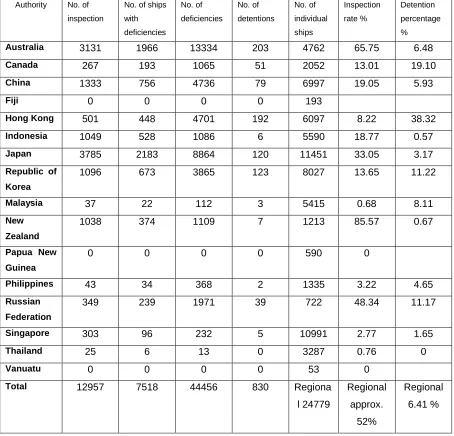
the Yangtse River areas. Table () show the three years (from 1995 to 1997) port State control statistics carried out by Chinese Maritime Safety Administration. Form the table we can see 1163 ships in 1995, 1229 ships in 1996, and 1333 ships in 1997 were inspected. The annual inspection rate is about 19%-20%, which contributes approximate 10% to the whole region. The number of deficiencies and the detention rate also shows a steady increase. Table () shows the 1997 statistics of port State inspection by Authorities in Tokyo MOU. In 1997, a total of 12,957 port State inspections were carried out by member Authorities of Tokyo MOU and this gives the regional annual inspection rate of 52%, attaining, for the second year, inspections of 50% of total number of ships operating in the region. This means that Tokyo MOU has achieved, three years in advance, the primary regional target inspection rate, as provided for in the Memorandum. The statistics also showing that there are huge difference in the performance among the whole region in term of inspection rate.
Table () Three Years Port State Control Statistics carried out by Chinese Authority
Year 1995 1996 1997
No. of inspection 1163 1229 1333
No. of ships with deficiencies
547 724 756
No. of deficiencies 2835 4048 4736
No. of detentions 17 32 79 No. of individual ships 5837 6468 6997
Inspection rate % 19.92 19.00 19.05
Detention percentage % 1.46 2.6 5.93
Table (). Port State Inspection carried out by
Authorities of Tokyo MOU, 1997
Authority No. of inspection
No. of ships with deficiencies No. of deficiencies No. of detentions No. of individual ships Inspection rate % Detention percentage % Australia 3131 1966 13334 203 4762 65.75 6.48 Canada 267 193 1065 51 2052 13.01 19.10 China 1333 756 4736 79 6997 19.05 5.93
Fiji 0 0 0 0 193
Hong Kong 501 448 4701 192 6097 8.22 38.32 Indonesia 1049 528 1086 6 5590 18.77 0.57
Japan 3785 2183 8864 120 11451 33.05 3.17 Republic of
Korea
1096 673 3865 123 8027 13.65 11.22
Malaysia 37 22 112 3 5415 0.68 8.11
New Zealand
1038 374 1109 7 1213 85.57 0.67
Papua New Guinea
0 0 0 0 590 0
Philippines 43 34 368 2 1335 3.22 4.65 Russian
Federation
349 239 1971 39 722 48.34 11.17
Singapore 303 96 232 5 10991 2.77 1.65
Thailand 25 6 13 0 3287 0.76 0
Vanuatu 0 0 0 0 53 0
Total 12957 7518 44456 830 Regiona
l 24779 Regional approx. 52% Regional 6.41 %
Chapter Three
Port State control in China: Problem areas at present
This chapter identifies the barriers and problems affecting the further improvement of
port State control performance in China based on the analysis of present situation in
previous chapter. Those problems are mainly reflecting unreasonable distribution of
functions within the administration and lack of expertise, incomplete legislation by not
being ratifying State of ILO 147 Convention and lack of harmonisation of inspection
procedures.
3.1 Basic Problems
As we all know that the establishment and maintain an appropriate maritime
administration is the basis and prerequisite of effective implementation of port State
control in each country. However, there are problems that affect the performance of
the maritime administration, particular in developing countries. As Professor
Vanchiswar identified in his manual “Establishment Administration of Maritime
Matters with Particular Reference to Developing Countries” that, the following are the
basic problems as regards matters pertaining to maritime administration in
developing countries:
- Inadequate awareness of the basic problems themselves;
- Non-involvement in the evolution of international standards and the
consequential problem of having to deal with them in isolation;
(a) proper standards of maritime safety on board ships and prevention of
pollution from ships, which cover not only the ships themselves but
also the personnel manning them
(b) maritime development
(c) attention to allied maritime matters
- Shortage (acute shortage in many counties) of marine officers with the
needed qualifications and experience;
- Lack of training facilities for marine officers and seamen.
China is still a developing country although there are significant progress and
development in economy and in maritime field as well. It is no exception that those
problems exist in China, but the extent of the problems, may differ from country to
other counties.
Considering the above mentioned problems, in my opinion there are some special
problems within the Chinese Maritime Safety Administration which affect the
functions and implementation of port State control in China. These problems are:
- Incomplete maritime legislation regarding port State control, mainly reflects in
not being ratifying State of ILO 147 Convention.
- Unreasonable distribution of functions and lack of expertise
- Lack of harmonisation of port State control inspection procedure and
information exchange
3.2 Unreasonable distribution of functions and lack of expertise
China has developed a relatively complete and functional port State control
administrative system. However, there are still some problems associated with the
First, there are two kinds of Maritime Safety Administration organisations exist in
China. One is belonging to the Ministry of Communications, and the other is under
the leadership of Department of Transport of the provincial governments. (Refer to
2.1.2) The result is that some port State control district offices are not directly under
the supervision of MOC and Chinese Maritime Safety Administration. As the main
responsibility of Department of Transport in provincial governments is to ensure ship
safety and environment protection of inland water areas. Sometime, port State
control has been considered less important and to which not enough attention has
been paid. Moreover, bureaucracy has caused the delay of passing instruction from
MOC and Chinese Maritime Safety Administration to actual inspectors and
information exchange within different ports.
Secondly, in my opinion, the major problem connected with Chinese port State
control administrative system is that the long-time separation of Chinese Maritime
Safety Administration with the Chinese Register of Shipping. This has caused in
China flag State control and port State control are almost completely separated,
except that the Chinese Maritime Safety Administration is responsible for exercising
unscheduled inspection on Chinese vessels until early 1990s. As the flag State and
port State survey and inspection are conducted by surveyors and inspectors from two
different organisations and system, limited administrative facilities and human
resource has not been reasonably exploited and to some extent be wasted.
Furthermore, such separation has affected the qualification of port State control
officer in China by and large. The qualification requirements of port State control
officer set out by IMO Resolution A 787(19), inter alia, requires that " the port State
control officer should be an experienced officer qualified as flag State surveyor."
Tokyo MOU has applied the same criteria as section 3.5 of the MOU states "
Inspection will be carried out by properly qualified persons authorised for that
purpose by the Authority …having regard to section 2.4 and 2.5 of IMO Resolution A.
787(19)". The criteria set out by Paris MOU is much more explicit, as stipulated in
Annex 6 of the MOU, " A proper qualified port State control officer must have
completed a minimum of one year's service as a flag State surveyor dealing with
surveys and certification in accordance with the relevant instruments…" The reason
would have developed his basic profession knowledge and experience as a previous
flag State surveyor.
However, the situation in China has caused that most of port State Control officers do
not have the crucial background as flag State surveyors. In the early 1990s, when
Chinese Maritime Safety Administration decided to conduct port State inspection, it
had to train and develop port State control officer by itself. At very begin, the Chinese
Maritime Safety Administration held a six month training course for selected
candidates from district offices in major ports, mainly young officers just graduated
from maritime college. Some of the candidates had short period of sea experience
and holding a mariner certificate, some of the candidates did not have sea
experience. At that time, there were not such incentive to recruit experience sea
masters and chief engineers because of the huge difference of salary and welfare
between government officers and shipping companies. Later on, similar training
program was held by Dalian Maritime University for several times approved by the
Chinese Maritime Safety Administration. The training program mainly covers
international Conventions and English communication skill.
As port State control inspection has developed as such that more and more items
would be covered by inspection, an assessment of the ability of ship's crew to
perform their duties in respect of operational requirement may also be included. Lack
of background as Flag State surveyor and enough sea experience may prevent
Chinese port State control officers from further improvement of their performance.
3.3 Incomplete legislation by not being ratifying State of ILO 147 Convention
It is obvious that the major problem associated with Chinese port State control
legislation system is that China is still not a ratifying State of ILO 147 Convention.
Port State control officers are frustrated in its efforts to enforce the ILO Conventions
on foreign vessels calling at Chinese ports in case of there are poor working and
living conditions on board ships.
3.3.1 The origin of ILO 147 Convention
International shipping is a highly competitive business. The profit margins are small
and market forces cause every shipping company to pay careful attention to its
capital and operating expenses and to continuously search for economies. The
the predominant phenomenon in today’s shipping industry. In 1997, it is estimated,
the share of world tonnage registered in Open Registry was about 45%. (ISL, 1997)
The percentage is still growing. The reasons for which shipowners put their vessels
under foreign flags are believed to be from two concerns: (Ma, 1998)
1. Cost, including lower crewing costs/manning requirements, unrestricted
choice of crew in the international market and not being subject to onerous
national wage scales, lower operating cost generated by “lighter”
maintenance, the probable avoidance of tax;
2. Accessibility of the register and standards enforced by the State of register,
mainly reflecting in less regulatory control and less stringent enforcement of
safety and labour standards;
ILO had noticed the rapid growth of Open Registry in early 1970s and observed that
Open Registry shipowners were trying to avoid safety and labour standards in order
to make excessive profits. ILO further observed that Open Registry States failed to
implement properly ILO standards and regulations governing the safe operation of
ships and crew conditions and Open Registry vessels were likely to cause accidents
and pollution owing to the poor physical condition of such ships, inadequate manning
standards, the use of crew comprising different nationalities and the lack of properly
trained and properly certified seafarers in such vessels. Attention had also been paid
that such phenomenon did happen to some national registry ship and did not
including all Open Registry ships. As part of its long-standing efforts and in response
to great international concern for safety at sea and the prevention of marine pollution,
ILO adopted the Merchant Shipping (Minimum Standards) Convention, (No. 147) in
October 1976. This convention is recognised as having strengthened substantially
the international will to eliminate the operation of substandard ships. It aims to
improve the efficiency and safety of navigation, enhance measures to protect the
marine environment and advance seafarers’ interests in the fields of health and
safety, working conditions and trade union rights. The convention, which essentially
applies to every seagoing ship employed for any commercial purpose, entered into
force in November 1981. Until December of 1998, 37 States has ratified the ILO 147
3.3.2 ILO 147 Convention: an important tool for combating substandard ships
ILO 147 Convention prescribes a set of minimum standards relating to safety, social
security, shipboard conditions of employment and living arrangements to be
observed in merchant shipping registered under any flag, by reference to a number
of other ILO Conventions listed in an Appendix to Convention No.147. These
conventions cover minimum age, medical examination, articles of agreement,
officers’ competency certificates, food and catering on board ship, crew
accommodation, and prevention of occupational accidents, sickness or injury benefits
and repatriation. The appendix also refers to conventions on freedom of association
and the protection of the right to organise, and on collective bargaining.
Article 2 of the ILO 147 Convention contains extensive provisions on obligation with
respect to ships registered in ratifying members’ territory. Meanwhile, under Article 4
of the Convention, a ratifying State may, on the basis of a complaint or evidence that
a ship does not conform to the standards of the Convention, inspect any foreign ship
calling at its ports, regardless of whether the flag States has ratified the Convention.
This represents an innovation since, prior to the adoption of the Convention No. 147,
port States refrained from intervening in the internal affairs of ships, such as crew
conditions, except for certain matters affecting safety. (ILO, 1988) The adoption of
Convention No. 147 in 1976 has enlarged the concerns of international shipping
regulations. An inspection may be made by the port State whenever it obtains
evidence that a ship does not conform to the standards of the Convention or when it
receives a complaint from a member of the crew, or any other person or entity
concerned with the safety of the ship and the well-being of its crew. In addition, the
port State can take action, including detention, to ensure the rectification of any
conditions on board which are clearly hazardous to safety or health.
ILO 147 Convention has been playing an important role in combating substandard
ships since it has been included as a relevant instrument regarding port State
inspection along with IMO conventions. Not only the IMO Resolution A. 787(19)
Procedures for Port State Control but also the Pairs MOU, Tokyo MOU, Caribbean
MOU and Mediterranean MOU have included the ILO 147 Convention as a relevant
instrument. Table () and Table () show the inspection results of major deficiencies in
respect of living and working condition by Tokyo MOU and Paris MOU in the year
From the tables, we can see that the deficiencies in living and working conditions on
board ship have made up a significant percentage of the total deficiencies during the
port State control inspection. It also shows an increasing of percentage during recent
years. In 1997, the percentage in Tokyo MOU was 6.30%, while in Paris MOU it
reached to 10.33%. Attention shall be paid that this is not an exhaust statistic since
there is overlapping between ILO147 Convention and IMO conventions, mainly in the
respect of crew competency and other ship and personnel safety requirements.
Table () Major deficiencies of living and working conditions in Tokyo MOU
Number of Deficiencies Percentage of total
deficiencies Deficiencies
Categories
1995 1996 1997 1995 1996 1997
Accommodation 419 850 1102 2.16 2.69 2.66
Food and Catering 349 496 520 1.81 1.10 1.25
Working Space 68 123 306 0.35 0.39 0.74
Accident
Prevention
115 257 289 0.60 0.81 0.70
Mooring
Arrangements
243 387 393 1.26 1.22 0.95
Total 1194 2113 2610 6.17 6.69 6.30
Source: Tokyo MOU, 1997 Annual Report.
Table () Major deficiencies of living and working conditions in Pairs MOU
Number of Deficiencies Percentage of total
deficiencies Deficiencies
Categories
1995 1996 1997 1995 1996 1997
Accommodation 1381 1417 2183 2.54 2.63 4.09
Food and Catering 623 686 1508 1.14 1.27 2.83
Working Space 485 408 505 0.89 0.76 0.95
Accident
Prevention
665 684 911 1.22 1.27 1.71
Mooring
Arrangements