R E S E A R C H
Open Access
Characterization of the novel In1059
harbouring VIM gene cassette
Dongguo Wang
1*†, Jinhong Yang
2†, Meiyu Fang
3†, Wei He
4†, Ying Zhang
4, Caixia Liu
2and Dongsheng Zhou
5,1*Abstract
Background:VIM-type enzyme encodes the most widely acquired metallo-β-lactamases in Gram- negative bacteria. To obtain current epidemiological data for integrons from enterobacteriae in hospital, the study characterizes the genetic structure in In1059 by comparison with In846 integrons harbouring VIM gene and other class 1 integrons including In37, In62, In843 and In1021 with the aim of identifying the putative mechanisms involved integron mobilization and infer evolution of relevant integrons.
Methods:Six of 69 recombinant plasmids from clinical strains were found to be class 1 integrons by digestion with BamHI, drug susceptibility testing, conjugation experiments, PCR amplification, integron cloning and sequencing, genome comparison, and detection of carbapenemase activity.
Results:The sequences of the six recombinant plasmids encoding In1021, In843, In846, In37, In62, and the novel In1059 integron had approximate lengths of ~4.8-, 4.1-, 5.1-, 5.3-, 5.3- and 6.6- kb, respectively. The genetic structures of these integrons were mapped and characterized, and the carbapenemase activities of their parental strains were assessed.
Conclusions:Our results suggest that the six variable integron structures and regular variations that exist in the gene cassettes provide a putative mechanism for the integron changes. Our study has also shown that the genetic features in the integrons named above fall within a scheme involving the stepwise and parallel evolution of class 1 integron variation likely under antibiotic selection pressure in clinical settings.
Keywords:Novel integron, In1059, Plasmid digestion, Cloning, Mobilization inference, Evolution
Background
Multidrug resistance can occur by the acquisition of DNA, and the horizontal transfer of drug-resistance genes or drug-resistance gene arrays from one cell to another also occurs and this process transfers drug resistance genes via plasmids and transposons. In recent years, most of the resistance genes found on the plasmids and transposons of Gram-negative bacilli have been found to be integrated into DNA elements called integrons [1]. These integrons contain potential mobile
genetic elements that feature a site-specific recombin-ation system capable of integrating and expressing gene cassette structures in the host bacterium [2].
Integrons are the most efficient genetic elements in terms of their ability to disseminate drug-resistance genes between bacteria [3]. Depending on the sequence of the intI gene, integrons have been confirmed to be many classes, and only class 1, 2 and 3 integrons were first identified association with mobile genetic elements [4], intIA with chromosomal integrons and VchintIA with V. cholerae chromosomal integrons [5]. By captur-ing exogenous cassettes and ensurcaptur-ing expression of the captive genes, an integron plays important role in the horizontal dissemination of antibiotic-resistance genes [6–8]. The mechanisms of integration and excision of gene casettes are well described with integrations known to occur at attI ×attC recombination sites [9, 10], and excisions requiring attC × attC recombination sites, * Correspondence:[email protected];[email protected]
†Equal contributors
1Department of Clinical Laboratory Medicine, Taizhou Municipal Hospital affiliated with Taizhou University and the Institute of Molecular Diagnostics of Taizhou University, 381 Zhongshan Eastern Road, Taizhou, Zhejiang 318000, China
5State Key Laboratory of Pathogen and Biosecurity, Beijing Institute of Microbiology and Epidemiology, 20 Fengtai Eastern Avenue, Beijing 100071, China
Full list of author information is available at the end of the article
which occur in single-stranded sequences and activate the folded bottom strand [11, 12]. Because of their link-age with transposons or being plasmid encoded, class 1 integrons can capture genetic structures, express gene cassettes, and facilitate their own mobility, but they are incapable of self-mobilization [5, 13].
Integrons usually contain three functional compo-nents: an integrase gene (intI), a primary recombination site (attI), and an outward-orientated promoter (PC) [14]. Cassette integrations occur mainly at the attI site and this ensures the expression of the captured cassettes under the control of thePC promoter [7, 15]. For most class 1 integrons, the 5′-CS regions are similar and includeintIand attI genes; however, differences exist in the 3′-CS sequences and the three open reading frames (ORFs) [16].
VIM-type metallo-β-lactamases were first isolated from Pseudomonas aeruginosaand other Gram-negative nonfer-menting bacteria in Europe [17–20]. These enzymes were subsequently observed worldwide in Gram-negative non-fermentative bacteria and in Enterobacteriaceae. Class 1 integrons harbouring VIM-type gene cassettes have spread among various Gram-negative pathogens [21]. Therefore, this study aimed to characterize the genetic structures of the novel In1059 integron by comparison with the In846 integron and other structural class 1 integrons from enterobacteriaceae in terms of the VIM-type gene cassettes. From this analysis, we have also identified the described mechanism underlying integron mobilization, revealing the relations amongst structures of class 1 integrons including novel In1059 and other integrons in the study.
Methods
Clinical bacterial isolates and drug susceptibility testing
In total, 69 non-redundant multidrug-resistant enterobac-teria strains, including non-typhoidalSalmonella Nsa243 and Nsa217 (harbouring In37 and In1021), Enterobacter cloacae Ecl175 (In843), Klebsiella pneumoniae Kpn761 and Kp3349 (In62 and novel In1059), and Enterobacter aerogenes Eae634 (In846), were recovered from hospital-ized patients with clinical infections. The strains were assessed for integrons at the Taizhou Municipal Hospital of China (July 2013 to July 2015). Bacterial species was identified by 16 S rRNA gene sequencing [22]. All the above integron-harbouring isolates, plus Escherichia coli TOP10 (Invitrogen, USA), were used in the study.E. coli TOP10 was used as the host for the cloning experiments and for susceptibility testing experiments.
The minimum inhibitory concentration (MIC) values of 12 antimicrobial agents, including cephalosporins (cefazo-lin, ceftazidime and ceftriaxone), aminoglycosides (netilmi-cin, tobramycin and amikacin), carbapenems (ertapenem, meropenem and imipenem), and quinolones (norfloxacin, ofloxacin and ciprofloxacin), were determined using drug
susceptibility plates and the Microscan broth dilution method (Microscan, Washington, USA). The MICs were interpreted according to the Clinical and Laboratory Standards Institute guidelines [23].
Plasmid digestion, integron cloning and DNA sequencing
Plasmids from six integron-harbouring isolates were collected using an AxyPrep Plasmid Miniprep kit (Axygen Biosciences, Beijing, China) according to the manufacturer’s instructions and according to Wang et al., 2014 [24]. The plasmids were digested with BamHI (TaKaRa, Dalian, China), and the six integron-harbouring recombinant plasmids were electrophoretically resolved to generate genetic maps.
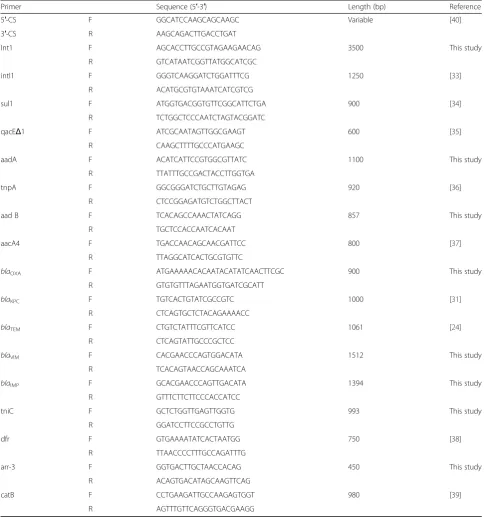
To characterize the recombinant plasmid-encoding integrons from the above six isolates, we digested the plasmids with BamHI and ligated the relevant fragments to the pMD19-T cloning vector (TaKaRa, Dalian, China), and then transformed the ligation mixture into E. coli TOP10 host bacteria. Colonies that were aacA4-positive were isolated and the inserts within the recombinant pMD19-T vectors were sequenced using the primers specified in Table 1 and the following PCR conditions: 3 min at 94 °C, 30 cycles of 1 min each at 94 °C, 50–59 °C and 72 °C, followed by 10 min at 72 °C. The total reaction volume was 25 μL, and the eluent volume was 10 μL. After amplification, the PCR products were separated by gel electrophoresis on a 0.6% agarose gel run at 90 V for 90 min in 0.5 × TBE buffer. Next, the plasmid DNAs or fragments of different sizes that harboured integrons were recovered, and the initial positions of the relevant genes in the recombinant plasmids were determined according to a previously established method for estimating plasmid DNA sizes [25]. After that, the integron sequences in-volving different genes were obtained, and the genetic structures were mapped and characterized.
Sequence annotation and genome comparison
Carbapenemase activity detection
The activities of A, B and D carbapenemase classes in the bacterial cell extracts for the above mentioned six isolates were determined using a modified CarbaNP test [26]. Over-night bacterial cell cultures in Mueller-Hinton (MH) broth were each diluted 1:100 into 3 mL of fresh MH broth, and the bacteria were grown at 37 °C with shaking at 200 rpm to reach OD600s of 1.0 to 1.4. When required, ampicillin was used (200μg/mL). Bacterial cells were harvested from
2 mL of each culture, and each pellet from the individual cultures was washed twice with 20 mM Tris-HCl (pH 7.8). Each cell pellet was resuspended in 500μL of 20 mM Tris-HCl (pH 7.8), lysed by sonication and spun at 10000×g at 4 °C for 5 min. Each 50μL supernatant (containing the en-zymatic bacterial suspension fraction) was mixed with 50μL of the following substrates (I to V), followed by incu-bation at 37 °C for a maximum of 2 h: substrate I: 0.054% phenol red plus 0.1 mM ZnSO4 (pH 7.8), substrate II: Table 1Primers used for PCR amplification and sequencing
Primer Sequence (5′-3′) Length (bp) Reference
5′-CS F GGCATCCAAGCAGCAAGC Variable [40]
3′-CS R AAGCAGACTTGACCTGAT
Int1 F AGCACCTTGCCGTAGAAGAACAG 3500 This study
R GTCATAATCGGTTATGGCATCGC
intI1 F GGGTCAAGGATCTGGATTTCG 1250 [33]
R ACATGCGTGTAAATCATCGTCG
sul1 F ATGGTGACGGTGTTCGGCATTCTGA 900 [34]
R TCTGGCTCCCAATCTAGTACGGATC
qacEΔ1 F ATCGCAATAGTTGGCGAAGT 600 [35]
R CAAGCTTTTGCCCATGAAGC
aadA F ACATCATTCCGTGGCGTTATC 1100 This study
R TTATTTGCCGACTACCTTGGTGA
tnpA F GGCGGGATCTGCTTGTAGAG 920 [36]
R CTCCGGAGATGTCTGGCTTACT
aad B F TCACAGCCAAACTATCAGG 857 This study
R TGCTCCACCAATCACAAT
aacA4 F TGACCAACAGCAACGATTCC 800 [37]
R TTAGGCATCACTGCGTGTTC
blaOXA F ATGAAAAACACAATACATATCAACTTCGC 900 This study
R GTGTGTTTAGAATGGTGATCGCATT
blaKPC F TGTCACTGTATCGCCGTC 1000 [31]
R CTCAGTGCTCTACAGAAAACC
blaTEM F CTGTCTATTTCGTTCATCC 1061 [24]
R CTCAGTATTGCCCGCTCC
blaVIM F CACGAACCCAGTGGACATA 1512 This study
R TCACAGTAACCAGCAAATCA
blaIMP F GCACGAACCCAGTTGACATA 1394 This study
R GTTTCTTCTTCCCACCATCC
tniC F GCTCTGGTTGAGTTGGTG 993 This study
R GGATCCTTCCGCCTGTTG
dfr F GTGAAAATATCACTAATGG 750 [38]
R TTAACCCCTTTGCCAGATTTG
arr-3 F GGTGACTTGCTAACCACAG 450 This study
R ACAGTGACATAGCAAGTTCAG
catB F CCTGAAGATTGCCAAGAGTGGT 980 [39]
0.054% phenol red plus 0.1 mM ZnSO4 (pH 7.8), and 0.6 mg/μL imipenem, substrate III: 0.054% phenol red plus 0.1 mM ZnSO4 (pH 7.8), 0.6 mg/μL imipenem, and 0.8 mg/μL tazobactam, substrate IV: 0.054% phenol red plus 0.1 mM ZnSO4 (pH 7.8), 0.6 mg/μL imipenem, and 3 mM EDTA (pH 7.8), and substrate V: 0.054% phenol red plus 0.1 mM ZnSO4 (pH 7.8), 0.6 mg/μL imipenem, 0.8 mg/μL tazobactam, and 3 mM EDTA (pH 7.8).
Nucleotide sequence accession numbers
In1021Nsa217, In843Ecl175, In846Eae634, In37Nsa243, and
In62Kpn761sequences, along with In1059Kp3349, a novel
se-quence, were deposited in GenBank under the accession numbers KR338349, KR338350, KR338351, KR338352, KJ716225 and KM589496, respectively.
Results and discussion
Integron cloning experiments and antibiotic susceptibility testing
Six of 69 isolates, which resistance to aminoglycoside, quin-olone, cephalosporin, and carbapenem antibiotics, from the clinical patients met the requirements of this study. Isolates Kpn761, Eae634, and Kp3349 were collected from blood cul-ture, head wound secretion, and sputum, respectively, from ICU patients. Isolate Ecl175 came from a blood culture from a respiratory medical patient. Isolates Nsa217 and Nsa243
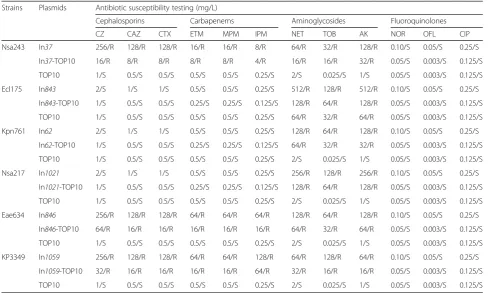
were collected from patient blood cultures in the hospital’s Infectious Disease Unit. Following BamHI digestion and ligation to a pMD19-T cloning vector, the recombinant plas-mids were transformed into the competent cells, E. coli TOP10, by heat shock conversion, then, achieved the positive transformants which were selected by blue-white spot exper-iments, and sequenced. The six integron-containing recom-binant plasmids transformed into E. coli TOP10 cells were used for the integron cloning conjugation experi-ments. The susceptibility test results are listed in Table 2. Concurrently, the six recombinant plasmids were elec-trophoresed to estimate their sizes (Fig. 1). The suscepti-bility test results indicated that the conjugation experiments were successful and that the resultant anti-biotic resistance was caused by plasmid-mediated genes. The electrophoresis results following BamHI digestion in-dicated that the sizes of In1021, In843, In846, In37, In62 and the novel In1059 integron were ~4.8 kb, 4.2 kb, 5.1 kb, 5.3 kb, 5.3 kb and 6.6 kb each in length, respect-ively (Fig. 1). Usually, class 1 integrons that integrate with transposons or are encoded on plasmids can ex-press regular mobilization and transformation capabil-ities, but they lack self-mobility [5, 13]. In view of these features, integrons can change from one type to another, with the possibility of generating novel types (Fig. 3).
Table 2Antimicrobial drug susceptibility profiles
Strains Plasmids Antibiotic susceptibility testing (mg/L)
Cephalosporins Carbapenems Aminoglycosides Fluoroquinolones
CZ CAZ CTX ETM MPM IPM NET TOB AK NOR OFL CIP
Nsa243 In37 256/R 128/R 128/R 16/R 16/R 8/R 64/R 32/R 128/R 0.10/S 0.05/S 0.25/S
In37-TOP10 16/R 8/R 8/R 8/R 8/R 4/R 16/R 16/R 32/R 0.05/S 0.003/S 0.125/S
TOP10 1/S 0.5/S 0.5/S 0.5/S 0.5/S 0.25/S 2/S 0.025/S 1/S 0.05/S 0.003/S 0.125/S
Ecl175 In843 2/S 1/S 1/S 0.5/S 0.5/S 0.25/S 512/R 128/R 512/R 0.10/S 0.05/S 0.25/S
In843-TOP10 1/S 0.5/S 0.5/S 0.25/S 0.25/S 0.125/S 128/R 64/R 128/R 0.05/S 0.003/S 0.125/S
TOP10 1/S 0.5/S 0.5/S 0.5/S 0.5/S 0.25/S 64/R 32/R 64/R 0.05/S 0.003/S 0.125/S
Kpn761 In62 2/S 1/S 1/S 0.5/S 0.5/S 0.25/S 128/R 64/R 128/R 0.10/S 0.05/S 0.25/S
In62-TOP10 1/S 0.5/S 0.5/S 0.25/S 0.25/S 0.125/S 64/R 32/R 32/R 0.05/S 0.003/S 0.125/S
TOP10 1/S 0.5/S 0.5/S 0.5/S 0.5/S 0.25/S 2/S 0.025/S 1/S 0.05/S 0.003/S 0.125/S
Nsa217 In1021 2/S 1/S 1/S 0.5/S 0.5/S 0.25/S 256/R 128/R 256/R 0.10/S 0.05/S 0.25/S
In1021-TOP10 1/S 0.5/S 0.5/S 0.25/S 0.25/S 0.125/S 128/R 64/R 128/R 0.05/S 0.003/S 0.125/S
TOP10 1/S 0.5/S 0.5/S 0.5/S 0.5/S 0.25/S 2/S 0.025/S 1/S 0.05/S 0.003/S 0.125/S
Eae634 In846 256/R 128/R 128/R 64/R 64/R 64/R 128/R 64/R 128/R 0.10/S 0.05/S 0.25/S
In846-TOP10 64/R 16/R 16/R 16/R 16/R 16/R 64/R 32/R 64/R 0.05/S 0.003/S 0.125/S
TOP10 1/S 0.5/S 0.5/S 0.5/S 0.5/S 0.25/S 2/S 0.025/S 1/S 0.05/S 0.003/S 0.125/S
KP3349 In1059 256/R 128/R 128/R 64/R 64/R 128/R 64/R 128/R 64/R 0.10/S 0.05/S 0.25/S
In1059-TOP10 32/R 16/R 16/R 16/R 16/R 64/R 32/R 16/R 16/R 0.05/S 0.003/S 0.125/S
TOP10 1/S 0.5/S 0.5/S 0.5/S 0.5/S 0.25/S 2/S 0.025/S 1/S 0.05/S 0.003/S 0.125/S
Abbreviations:CZCefazolin,CAZCeftazidime,EPMErtapenem,MPMMeropenem,IPMImipenem,NETNetilmicin,TOBTobramycin,AKAmikacin,NORNorfloxacin,
Strain carbapenemase activities and genetic features of integrons
The following strains (transformants) In37-TOP10, In846-TOP10 and In1059-TOP10 have class D, B and B carbapenemase activities, respectively, while In37 (isolate Nsa243) appears to have class D activity, while In846 (Eae634) and In1059 (Kp3349) appear to have class B activities, respectively (data not shown). All the above strains were resistant to the cephalo-sporin, carbapenem and aminoglycoside drugs but they were susceptible to fluoroquinolones (Table 2). In62 apparently represents the most primitive form among these integrons. In62 carries two different re-sistance markers, while In37, In843, In846, In1021 and In1059 have evolved to capture the determinants of at least three different antibiotic classes, and they most likely confer MDR.
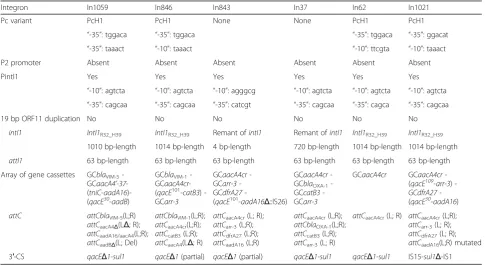
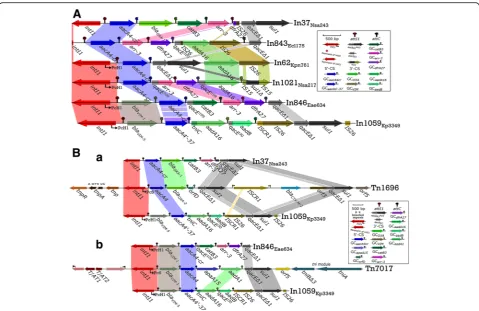
In1059 and In846 integrons differed markedly from the other integrons (In37, In843, In62 and In1021) in this study (Table 3 and Additional file 1). Seemingly, their genetic differences appeared to involve the pres-ence of an additional gene cassette containing blaVIM
downstream of the intI1 gene when compared with the other integrons in this study (Fig. 2a). Therefore, the biochemistries of In1059 and In846 should differ from the other integrons. Four gene cassettes and one remnant of dfrA27 were identified in In37 between aacA4cr gene cassette (GCaacA4cr) and GCcatB3,
Table 3Comparison of novel In1059 with other integrons in the study
Integron In1059 In846 In843 In37 In62 In1021
Pc variant PcH1 PcH1 None None PcH1 PcH1
“-35”: tggaca “-35”: tggaca “-35”: tggaca “-35”: ggacat “-35”: taaact “-10”: taaact “-10”: ttcgta “-10”: taaact
P2 promoter Absent Absent Absent Absent Absent Absent
PintI1 Yes Yes Yes Yes Yes Yes
“-10”: agtcta “-10”: agtcta “-10”: agggcg “-10”: agtcta “-10”: agtcta “-10”: agtcta “-35”: cagcaa “-35”: cagcaa “-35”: catcgt “-35”: cagcaa “-35”: cagca “-35”: cagcaa
19 bp ORF11 duplication No No No No No No
intI1 IntI1R32_H39 IntI1R32_H39 Remant ofintI1 Remant ofintI1 IntI1R32_H39 IntI1R32_H39
1010 bp-length 1014 bp-length 4 bp-length 720 bp-length 1014 bp-length 1014 bp-length
attI1 63 bp-length 63 bp-length 63 bp-length 63 bp-length 63 bp-length 63 bp-length
Array of gene cassettes GCblaVIM-5 -GCaacA4’-37 -(tniC-aadA16 )-(qacE30-aadB)
GCblaVIM-1 -GCaacA4cr -(qacE101-catB3) -GCarr-3
GCaacA4cr -GCarr-3 -GCdfrA27
-(qacE101-aadA16Δ::IS26)
GCaacA4cr -GCblaOXA-1 -GCcatB3 -GCarr-3
GCaacA4cr GCaacA4cr
-(qacE109-arr-3)
-GCdfrA27 -(qacE30-aadA16)
attC attCblaVIM-5(L;R)
attCaacA4Δ(LΔ; R);
attCaadA16/aacA4(L;R);
attCaadBΔ(L; Del)
attCblaVIM-1(L;R);
attCaacA4cr(L;R);
attCcatB3(L;R);
attCaacA4(LΔ; R)
attCaacA4cr(L; R);
attCarr-3(L;R);
attCdfrA27(L;R);
attCaadA16(L;R)
attCaacA4cr(L;R);
attCblaOXA-1(L;R);
attCcatB3(L;R);
attCarr-3(L; R)
attCaacA4cr(L; R) attCaacA4cr(L;R);
attCarr-3(L; R);
attCdfrA27(L; R);
attCaadA16(L;R) mutated
3′-CS qacEΔ1-sul1 qacEΔ1(partial) qacEΔ1(partial) qacEΔ1-sul1 qacEΔ1-sul1 IS15-sul1Δ-IS1
Abbreviations: attC (L; R)left- and right-hand parts ofattCin gene cassettes,attC (LΔ; R)truncated left- and normal right- hand parts ofattCin gene cassettes,attC (L; Del)normal left- and deleted right-hand parts ofattCin gene cassettes, suggesting no functional gene cassette,attC (L; R) mutatedmutated left- and mutated right-hand parts ofattCin gene cassettes,GCabbreviation of gene cassette
Fig. 1Electrophoretogram of recombinant plasmids encoding In1021, In843, In846, In37, In62, and novel In1059 with genetic mapping.Lane M,λHindIII DNA marker (Amersham Biosciences, Shanghai, China).Lane 1, recombinant plasmids encoding In1021 from the isolate Nsa217 estimated to be approximately 4.8 kb-long;
while the existence of GCblaOXA-1 indicates that this
integron differs in its biochemistry to In843, In62 and In1021. In37 and In843 differ from In62, In846, In1021 and In1059 class 1 integrons in their 5′-CSs (remnant of intI1), and both lack Pc variant (Table 3 and Additional file 1). In62 appears to have the basic pattern identified in the six class 1 integrons, all of which commonly contain GCaacA4cr. But only GC aa-cA4cr exists in In62. Notably, one aadA16 and four gene cassetts in the In843 gene are inserted into IS26 in two parts, before reintegrating with the qacE109 (109 nucleotide remanants of qacE) gene (Table 3 and Additional file 1). Unusually, some fragments such as qacE109orqacE30combined with GCaadA16in In843 and In1021, GCarr-3 in In1021 and In846, and GCaadBin In1059 have never been recovered from any class 1 integron to date, and these may have “ pseudo-gene cassette”functions (Table 3 and Additional file 1). Indeed, qacE101 was discovered in class 1 integrons [27], and no qacE30 or qacE109 elements have previ-ously been found. In the novel In1059 integron, the GCaacA4 gene coding sequence displays a previously
unseen duplication and an unusual 9 bp deletion (cccttcCAT) in itsattC, thereby inactivating it (Table 3 and Additional file 1). The duplication extends the se-quence to 576-bp in length instead of the usual 555-bp. The resulting gene, which is a novel allele, has been assigned aacA4’-37 (Fig. 3 and Table 3 and Additional file 1), and the fragment itself appears to be embedded within the start of GCaadA16, resulting in a change in its right-hand part of attC site (e.g. the motif locates upstream of the coding sequence), and the remaining part of the attC site in GCaadA16 seems to be a hy-brid between the usual one in GCaadA16 and the usual one in GCaacA4 (attCaadA16/aacA4, Table 3 and
Additional file 1); furthermore, the GCaadB sequence lacks a right-hand attC part making it look like a pseudo-gene cassette (Table 3 and Additional file 1). However, GCblaVIM-5 appears to be usual attC and
normal gene cassette functional in novel In1059 integron.
Sequence comparisons of InV117 [28] (part of Tn1696, GenBank accession number DQ310703), In1059 and In37 reveal high levels of sequence homology among them (Fig.
2B-a), and In37 in particular shares high sequence identity with In1059. Because the Tn1696 module (including InV117) has the potential to transpose, this suggests that In37 and In1059 should also potentially be mobile ele-ments. Compared with In70 [20] (part of Tn7017, GenBank accession number KJ571202), In1059 and In843 share the most sequence homology with In70 (Fig. 2B-b), and this is especially so for novel In1059. These results provide new insight about the structure of In1059, which coupled with the known plasticity of the In70 genetic context in the re-combination plasmids, means that this might have medi-ated mobilization of theblaVIM-1-containing In70 integron
platform [21].
Mobilization and evolutionary inferences for In0 to In1059
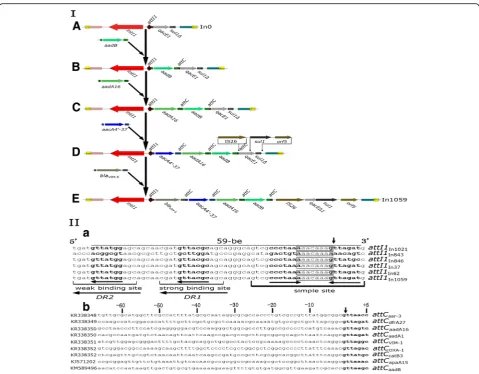
Generally, In0 could emerge from excision of all cas-settes of an integron. If In0 captures GCaadB onattI1 site likely under antibiotic pressure, structure A might be transferred to structure B, maybe becoming a novel integron (Fig. 3I); then, likely under similar conditions, if joining with GCaadA16, structure B might become structure C, too (Fig. 3I); Also, if joined by GCaacA4’-3, structure C might turn into structure D, perhaps involv-ing a novel integron as well; meanwhile, if inserted into GCblaVIM-5 on attI1 site and IS26 on site between
GCaadB and qacE1, then, replaced sul1Δ withsul1and
Fig. 3Genetic structures and proposed mobilization and evolution of In0 to In1059 and the analysis ofintI1andattCin class 1 integrons from this study. I, genetic structures and putative mobilization. A, In0; B, A + GCaadB; C, B + GCaadA16; D, C + GCaacA4’-3; E, In1059 = D + GCblaVIM-5+IS26 + (sul1+orf5) (replacingsulΔ1); II, Sequences and structures ofattI1(59-be, 59-base elements) andattC.II-a, theattI1(59-be) site positions are denoted by thebold black line.Open barsindicate potentialIntI1recognition sites, andarrowsunder the 7-bp core sites indicate relative orientations. The 7-bp core site sequences are shown inbold type, and the strong and weakIntI1-binding sites and direct repeats,DR1andDR2, are indicated in accordance with the literature [29]. The simple site locations are denoted by anopen bar. The“aacaaag(a)”sequences in theblack boxesare reminiscent of the spacer inattI1and occur between the two gene cassettes; recombination or excision of gene cassettes occurs frequently at these sites as indicated inpanel I, process C to D.II-b, theattC
sequences of class 1 integrons. Thebold blackletters denote the 7-bp core site, while the numbers are the nucleotide positions (left, negative, right, positive) of the recombinationcross-over points, as indicated by avertical arrowwhere the recombination or excision of gene cassettes regularly occurs, as shown in
orf5, structure D will convert into structure E, likely under the right conditions, just as novel In1059 assigned in the study (Fig. 3 and Table 3 and Additional file 1). According to Collis et al., 1998 [29], the recombination or excision of gene cassettes from class 1 integrons fre-quently occurs at sites of vertical arrow (Fig. 3II-a) be-tween the″aacaaag(a)″array and its next nucleotide in attI1, and sites of vertical arrow (Fig. 3II-b) between″g″ and ″t″ of ″gtttrrry″ array in attC; however, the study appears slightly mutant sequences in terms of the cross-over point ofattI1 andattC(Fig. 3II-a and b). Integrons are associated with MDR in Gram-negative bacteria [30, 31, 32] and have been determined as the primary source of drug-resistance genes, and they are also suspected to be reservoirs of drug-resistance genes in patients with bacterial infections [20].
Conclusions
Antibiotic overuse makes it likely that more and more MDR strains will appear in clinical isolates, and most of these strains will contain class 1 integrons. The features of the integrons described above denote a scheme involving the stepwise and parallel evolution of class 1 integron variation likely under antibiotic selection pressure in clinical settings.
Additional files
Additional file 1:Analysis for integrons: In1059, In843, In846, In37 and In62. (XLS 48 kb)
Acknowledgements
We are grateful to Professor Thomas Jové (INTEGRALL curator), for his designation of In1021, In843, In846, In37, In62 and the novel In1059 integron, all of which are registered in the INTEGRALL database.
Funding
This work was supported by grants from the Foundation of Department of Science and Technology of Zhejiang Province (2014C33153), the Foundation of Zhejiang Health Department (2014KYB218 and 2017KY717) and the Foundation of Taizhou Science and Technology Bureau (14SF05,1301KY36 and 1201KY22).
Availability of data and materials
Please contact author for data requests.
Authors’contributions
Conceived and designed the experiments: DW. Performed the experiments: all authors. Analyzed the data: DW and DZ. Contributed to the writing of the manuscript: DW. Read and approved the final manuscript: all authors.
Competing interests
The authors declare that they have no competing interests.
Consent for publication
Not applicable.
Ethics approval and consent to participate
The use of patient specimens and all related experimental protocols were approved by the Committee on Human Research at the institutions indicated. The study was carried out in accordance with the approved guidelines of the Ethics Committee of our Hospital, China.
Author details
1Department of Clinical Laboratory Medicine, Taizhou Municipal Hospital affiliated with Taizhou University and the Institute of Molecular Diagnostics of Taizhou University, 381 Zhongshan Eastern Road, Taizhou, Zhejiang 318000, China.2Department of Clinical Laboratory Medicine, the Second Affiliated Hospital and Yuying Children’s Hospital of Wenzhou Medical University, 109 Xuanyue Western Road, Wenzhou, Zhejiang 3250027, China. 3
Department of Clinical Laboratory Medicine, Hangzhou First People’s Hospital of Nanjing Medical University, 261 Huansha Road, Hangzhou, Zhejiang 310006, China.4Department of Clinical Laboratory Medicine, Wenzhou Hospital of Integrated Traditional Chinese and Western Medicine, 75 Jinxiu Road, Wenzhou, Zhejiang 325001, China.5State Key Laboratory of Pathogen and Biosecurity, Beijing Institute of Microbiology and
Epidemiology, 20 Fengtai Eastern Avenue, Beijing 100071, China.
Received: 10 February 2017 Accepted: 3 May 2017
References
1. Hall RM. Gene cassettes and integrons: moving single genes. In: Syvanen M, Kado CI, editors. Horizontal gene transfer. 2nd ed. San Diego: Academic Press; 2002. p. 19–28.
2. Leverstein-van Hall MA, M Blok HE, T Donders AR, Paauw A, Fluit AC, Verhoef J. Multidrug resistance among Enterobacteriaceae is strongly associated with the presence of integrons and is independent of species or isolate origin. J Infect Dis. 2003;187:251–9.
3. Huang L-Y, Chen T-L, Lu P-L, Tsai C-A, Cho W-L, Chang F-Y, et al. Dissemination of multidrug-resistant, class 1 integron-carryingAcinetobacter baumanniiisolates in Taiwan. Clin Microbiol Infect. 2008;14:1010–9. 4. Partridge SR, Tsafnat G, Coiera E, Iredell JR. Gene cassettes and cassette
arrays inmobile resistance integrons. FEMS Microbiol Rev. 2009;33:757–84. 5. Mazel D. Integrons: agents of bacterial evolution. Nat Rev Microbiol. 2006;4:608–20. 6. Hall RM, Stokes HW. Integrons: novel DNA elements which capture genes
by site-specific recombination. Genetica. 1993;90:115–32. 7. Collis CM, Hall RM. Expression of antibiotic resistance genes in the
integrated cassettes of integrons. Antimicrob Agents Chemother. 1995;39:155–62.
8. Hall RM, Collis CM. Antibiotic resistance in gram-negative bacteria: the role of gene cassettes and integrons. Drug Resist Updat. 1998;1:109–19. 9. MacDonald D, Demarre G, Bouvier M, Mazel D, Gopaul DN. Structural
basis for broad DNA-specificity in integron recombination. Nature. 2006; 440:1157–62.
10. Loot C, Ducos-Galand M, Escudero JA, Bouvier M, Mazel D. Replicative resolution of integron cassette insertion. Nucleic Acids Res. 2012;40:8361–70. 11. Bouvier M, Demarre G, Mazel D. Integron cassette insertion: a
recombination process involving a folded single strand substrate. EMBO J. 2005;24:4356–67.
12. Bouvier M, Ducos-Galand M, Loot C, Bikard D, Mazel D. Structural features of single-stranded integron cassetteattCsites and their role in strand selection. PLoS Genet. 2009;5:e1000632.
13. Carattoli A. Plasmid-mediated antimicrobial resistance inSalmonella Enterica. Curr Issues Mol Biol. 2003;5:113–22.
14. Collis CM, Kim MJ, Stokes HW, Hall RM. Integron-encodedIntIintegrases preferentially recognize the adjacent cognateattIsite in recombination with a 59-be site. Mol Microbiol. 2002;46:1415–27.
15. Levesque C, Brassard S, Lapointe J, Roy PH. Diversity and relative strength of tandem promoters for the antibiotic-resistance genes of several integrons. Gene. 1994;142:49–54.
16. Stokes HW, Hall RM. A novel family of potentially mobile DNA elements encoding site-specific gene integration functions: integrons. Mol Microbiol. 1989;3:1669–83.
17. Lauretti L, Riccio ML, Mazzariol A, Cornaglia G, Amicosante G, Fontana R, et al. Cloning and characterization ofblaVIM, a new integron-borne
metallo-β-lactamase gene from aPseudomonas aeruginosaclinical isolate. Antimicrob Agents Chemother. 1999;43:1584–90.
18. Poirel L, Naas T, Nicolas D, Collet L, Bellais S, Cavallo JD, et al.
Characterization of VIM-2, a carbapenem-hydrolyzing metallo-β-lactamase and its plasmid-and integron-borne gene from aPseudomonas aeruginosa
19. Riccio ML, Pallecchi L, Fontana R, Rossolini GM. In70of plasmid pAX22, a
blaVIM-1-containing integron carrying a new aminoglycoside phosphor-transferase gene cassette. Antimicrob Agents Chemother. 2001;45:1249–53. 20. Tsakris A, Pournaras S, Woodford N, Palepou MF, Babini GS, Douboyas J,
et al. Outbreak of infections caused byPseudomonas aeruginosa
producing VIM-1 carbapenemase in Greece. J Clin Microbiol. 2000;38:1290–2.
21. Di Pilato V, Pollini S, Rossolini GM. Characterization of plasmid pAX22, encoding VIM-1 metallo-β-lactamase, reveals a new putative mechanism of In70 integron mobilization. J Antimicrob Chemother. 2014;69:67–71. 22. Frank JA, Reich CI, Sharma S, Weisbaum JS, Wilson BA, Olsen GJ. Critical
evaluation of two primers commonly used for amplification of bacterial 16S rRNA genes. Appl Environ Microbiol. 2008;74:2461–70.
23. Clinical and Laboratory Standards Institute. Performance standards for antimicrobial susceptibility testing, document M100–25. Wayne: Clinical and Laboratory Standards Institute; 2015.
24. Wang D, Hou W, Chen J, Mou Y, Yang L, Yang L, et al. Characterization of theblaKPC-2andblaKPC-3genes and the novelblaKPC-15gene inKlebsiella
pneumoniae. J Med Microbiol. 2014;63:981–7.
25. Wang M, Tran JH, Jacoby GA, Zhang Y, Wang F, Hooper DC. Plasmid-mediated quinolone resistance in clinical isolates ofEscherichia colifrom shanghai, China. Antimicrob Agents Chemother. 2003;47:2242–8. 26. Chen Z, Li H, Feng J, Li Y, Chen X, Guo X, et al. NDM-1 encoded by a
pNDM- BJ01-like plasmid p3SP-NDM in clinicalEnterobacter aerogenes. Front Microbiol. 2015;6:294.
27. Raherison S, Jove T, Gaschet M, Pinault E, Tabesse A, Torres C, Ploy MC. Expression of theaac(6′)-Ib-crgene in class 1 integrons. Antimicrob Agents Chemother. 2017;61(5):e02704–16. [Epub ahead of print]
28. Soler Bistué AJ, Martín FA, Petroni A, Faccone D, Galas M, Tolmasky ME, et al. Vibrio cholerae InV117, a class 1 integron harbouringaac(6′)-Iband
blaCTX-M-2, is linked to transposition genes. Antimicrob Agents Chemother. 2006;50:1903–7.
29. Collis CM, Kim M-J, Stokes HW, Hall RM. Binding of the purified integron DNA integraseIntI1to integron and cassette-associated recombination sites. Mol Microbiol. 1998;29:477–90.
30. Ochman H, Lawrencem JG, Groisman EA. Lateral gene transfer and the nature of bacterial innovation. Nature. 2000;405:299–304.
31. Sallen B, Rajoharison A, Desvarenne S, Mabilat C. Molecular epidemiology of integron-associated antibiotic resistance genes in clinical isolates of Entero-bacteriaceae. Microb Drug Resist. 1995;1:95–202.
32. Kitchel B, Rasheed JK, Patel JB, Srinivasan A, Navon-Venezia S, Brolund A, et al. Molecular epidemiology of KPC-producingKlebsiella pneumoniae
isolates in the United States: clonal expansion of multilocus sequence type 258. Antimicrob Agents Chemother. 2009;53:3365–70.
33. Mazel D, Dychinco B, Webb VA, Davies J. Antibiotic resistance in theEcoR collection: integrons and identification of a novelaadgene. Antimicrob Agents Chemother. 2000;44:1568–74.
34. Grape M, Farra A, Kronvall G, Sundstrom L. Integrons and gene cassettes in clinical isolates of co-trimoxazole-resistant gram-negative bacteria. Clinic Microbiol Infect. 2005;11:185–92.
35. Sandvang D, Aarestrup FM, Jensen LB. Characterisation of integrons and antibiotic resistance genes in Danish multiresistantSalmonella enterica
Typhimurium DT104. FEMS Microbiol Lett. 1997;157:177–81.
36. Han HS, Koh YJ, Hur J-S, Jung JS. Occurrence of thestrA-strBstreptomycin resistance genes inPseudomonas speciesisolated from kiwifruit plants. J Microbiol. 2004;42:365–8.
37. Fihman V, Lartigue MF, Jacquier H, Meunier F, Schnepf N, Raskine L, et al. Appearance ofaac(6′)-Ib-crgene among extended-spectrumβ -lactamase-producingEnterobacteriaceaein a French hospital. J Inf Secur. 2008;56:454–9. 38. Wei Q, Jiang X, Yang Z, Chen N, Chen X, Li G, et al.dfrA27, a new
integron-associated trimethoprim resistance gene fromEscherichia coli. J Antimicrob Chemother. 2009;63:405–19.
39. Cámara B, Bielecki P, Kaminski F, dos Santos VM, Plumeier I, Nikodem P, et al. A gene cluster involved in degradation of substituted salicylates via ortho cleavage inPseudomonas sp. strain MT1 encodes enzymes specifically adapted for transformation of 4-methylcatechol and 3-methylmuconate. J Bacteriol. 2007;189:1664–74.
40. Levesque C, Piche L, Larose C, Roy PH. PCR mapping of integrons reveals several novel combinations of resistance genes. Antimicrob Agents Chemother. 1995;39:185–91.
• We accept pre-submission inquiries
• Our selector tool helps you to find the most relevant journal • We provide round the clock customer support
• Convenient online submission • Thorough peer review
• Inclusion in PubMed and all major indexing services • Maximum visibility for your research
Submit your manuscript at www.biomedcentral.com/submit