User Interface Design and Development: The role of Open Source Systems
C. Jayakumar, E. Soundararajan, J.V.M. Joseph, V. Rajendran and M. Somasekharan Scientific Information Resource Division
Indira Gandhi Centre for Atomic Research Kalpakkam, Tamil Nadu -603 102, India
Email : [email protected] Abstract
Open Source movement has tremendously influenced Information industry, in particular the Digital Library Environment where the Information Systems and services are inevitable. This has helped the Library and Information Centers in developing User Interface to render web based services to the patrons. Wherever the network infrastructure and the target users are in place, the design and development of IR user interface using Open Source system for a specific application is very much possible. This paper highlights the role of Open Source Systems in detail and explains a prototype IR User Interface which was developed in-house at Indira Gandhi Centre for Atomic Research, Kalpakkam.
Keywords : Open Source Software; Online Information Retrieval; User Interface; Web based access; LAMP.
1. Introduction
Advances in Communication and Information Technologies have revolutionized the way users interact with Computer systems and are bringing a whole new set of task needs. Presently, Users prepare to have web enabled search interface to explore the Information resource which are developed for a networked environment. Basic Search Interface with cumulative results display satisfies the target users. Use of Open Source systems in an academic and research environment enable us to have full control of the design and development of the system from the user access point of view.
2. User Interface
In digital libraries, the web-based electronic databases have become important resources to the patrons for supporting their research and development activities. It provides functionality and ease of use superior to print counterparts. The search interfaces for these resources are aimed at helping users in retrieving results with high precision and recall value. An efficient information system helps in problem solving, research and decision making.
• find and retrieve pertinent information through interfaces which are simple, intuitive and homogeneous;
• retrieve documents meeting specific criteria, such as a given date, language, or type;
• have the results of a browse or search presented in an easy-to-understand format; • view and download parts or all of documents retrieved.
Scientific users also want,
• Access information on a given domain, using a familiar classification scheme; • Proper metadata of the information retrieved (i.e. date, version and source).
3. Open Source
Open Source Solutions are the emerging trend today and started dominating the information industry. In particular, the libraries are the great beneficiaries of these open source technology. The following are some the benefits of open source systems are
• Enables librarians and libraries to have more control over their information systems and services.
• Provides the means to explore and implement ways of doing librarianship without the reliance on a software vendor.
• Illustrates how librarianship can facilitate library services and collections that go beyond book lending.
• Enables libraries to meet the quickly changing information needs, desires, and expectations of users.
Fortunately for Digital Library Applications, there are lot of open source systems available namely DSpace, Green Stone Digital Library (GSDL), e-prints, fedora, Linux, XML etc. They are not only cost effective but also capable of handling DL challenges like content/metadata management, information dissemination etc. Extensibility is achieved from plug-ins that is available under GNU public license. The types of open source systems may include
• Operating Systems • HTTP Servers and clients • SMTP Servers and clients • Database Systems
• Programming Languages
• XML Processors and other application software
3.1 Linux Operating System
electronic resource management, web publishing and other activities of digital library at nominal cost. Linux device drivers are easy to install and supports plug and play facilities. Linux is not only meant for the technically sound users, but also for wide spectrum of other users.
3.2 Apache Web Server
“A–Patch” which was the original name which later became Apache. Apache is a centralized repository of patches of codes required to fix bugs or add features of whatever wanted. The core group of volunteers all round the world known as Apache group coordinate and continue to develop the Apache project. It is the most widely used web server on the Internet today and is the default web server of Linux. It runs on different architectures besides Linux including Solaris, Windows NT Sun OS etc. It is a stable, full featured, robust commercial grade web server.
3.3 MySQL
MySQL is a multithreaded Relational Database Management System (RDBMS). It is called so because it enables to build relations between various data tables. MySQL is easy to use database, which can be used as an API for C, Java, Perl, PHP and many other languages. The multithreaded processing prevents two threads from writing the same table at the same time. Another advantage is that all the threads execute individually though they share the same process space. Because of this separation, multiprocessor machines can spread the load of each thread across many CPUs. Most of the MySQL commands are the subset of Structured Query Language (SQL). MySQL supports various data types and many SQL functions
MySQL Advantages
Stable and works with different platforms Fast memory allocation systems, Join operations Handles large data bases
ODBC Support for Win32
Full text indexing & searching support Support various character sets
3.4 PHP
PHP powers millions of websites with its high performance support to a range of operating systems, database systems, web servers, etc. It is simple to learn PHP and use. People can build dynamic HTML pages and develop database retrieval engines easily using PHP. It Supports:
- OOPS - XML
- Various image formats
- Provision to execute system commands
PHP can be used with leading web servers like Apache, Microsoft IIS etc. 4. LAMP (Linux, Apache, MySQL and PHP)
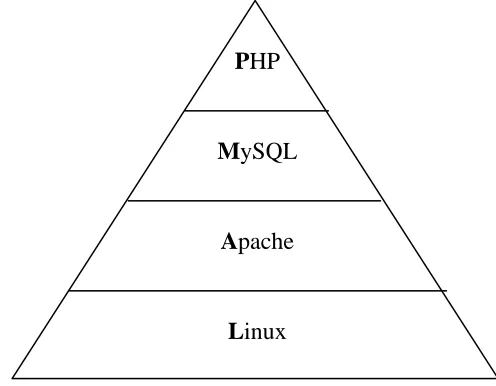
LAMP is the abbreviation for Linux Apche MySQL PHP. Linux operating system serves as the core of web server installation in the LAMP model. The remaining components are the applications that run on top of Linux. The apache web server makes the Web pages available from Linux servers so that users can access and view the pages with their web browsers.. By integrating MySQL into a web sever environment, it becomes possible to develop a dynamic database driven web sites. MySQL databases can hold a wide variety of contents that can be made searchable through website search interfaces. By incorporating MySQL with apache, web contents can be updated more quickly thereby making the information available in real time.
Fig. 1. Open Source Information System - LAMP
The P in LAMP is for one or more of the following scripting and programming languages: PHP, Python or Perl. All the three languages can be used to build powerful interactions with databases such as MySQL. All the LAMP components are fully extensible and modular allowing for variety, customization and specialized development. LAMP model can be a applicable to digital library development environment. The flexibility and affordability of the LAMP model makes digital libraries and its services a reality.
5. Information Resource Management
The exponential growth of information and the new evolutionary technologies have made the information professionals to provide effective search and indexing functions for information access. Digital libraries should integrate a variety of information
technologies and provide opportunities to organize and access large volumes of information from multiple repositories. Through this integration, the distributed heterogeneous resources spread across the network appear to be a single uniform federated source. Metadata is one of the important concepts for the description, organization, exchange and retrieval of information in a networked environment. It is one of the critical components of digital resource developments and use, and is needed at all stages in the creation and management of resources. Well-formed metadata is the most efficient and effective tool for managing and finding objects in the complex information spaces.
6. IGCAR Research Contribution (IRC) Repository
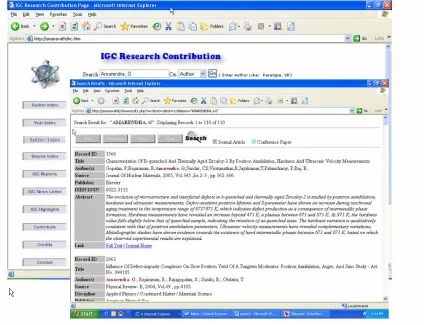
IRC Repository contains the publication information of IGC Scientists and engineers. A switched network with fiber optic backbone of the organizational Intranet enables to deliver information services to the patrons on their
Fig. 2 Search Interface
published by the scientists and engineers with metadata and links to full papers wherever possible within copyright limitations.
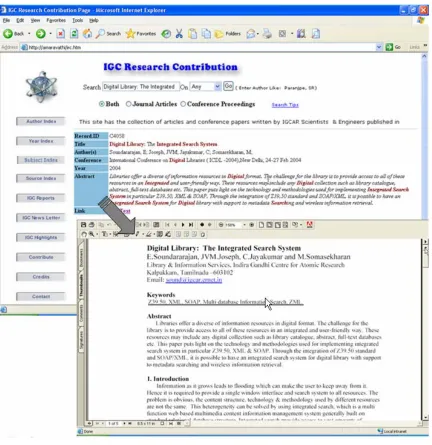
Fig. 3 Results Display
The search results were displayed as comprehensive list and bibliographic format. Dynamic link was made available to the full text from the local server or from the publisher’s site. Additional link leading to the individual journal home pages helps the users to browse the contents of the publication.
7. Conclusion
used widely to manage the digital collections and electronic databases. The developer has got leverage to choose from the freely available DL software or develop one using open source systems. The organizations where the network infrastructure and targeted user base are available, the development and implementation of such a system is possible. LAMP Technology enables the information professionals in achieving the design and implementation of Information Systems which can always be customizable, flexible and portable. The security and performance features of LAMP add value to the user interface and access.
References
1. Using LAMP Applications to make our library shine. Andrew White and Joseph Balsamo Computers in Libraries Vol.25 (5) p.6, 2005
2. Rehat Linux System Administration Unleashed Thomas Schenl et al., BBP
Publications, 2000
3. Exploring behaviour of E-Journal users in science and technology : Transaction log analysis of Elsevier’s ScienceDirect OnSite in Taiwan Hao-Ren Ke, Rolf Kwakkelaar, Yu-Min Tai and Li-Chun Chen Library & Information Science Research Vo. 24, pp.265-291, 2002.
4. Digital Information Dissemination: A Comprehensive Approach. Soundararajan, E; Joseph, JVM; Jayakumar, C; Somasekharan, M; 22nd Annual Convention and Conference of Society for Information Science ( SIS 2004) Indian Institute of Technology, Chennai, 2004
5. Networked Information Services: A case study of IGCAR Library Soundararajan, E;Joseph, JVM;Jayakumar, C; Venkadesan, S; Manlibnet National Convention, at XLRI, Jamshedpur, March 6-8, 2003
6. Network Administration and Security in a Digital Library Environment Joseph, JVM;Soundararajan, E;Jayakumar, C;Venkadesan, S; Convention on Automation of Libraries in Education and Research Institutions (CALIBER -2003), Ahmedabad,Feb.13-15, 2003
7. Linux, the next generation operating system Jehadheesan, R. Proceedings of the Conference DAE Vision of Information Exchange; November 13-14 2000.
8. Information Resource Management on ANUNET (IRMA): The IGCAR Experience
Joseph, JVM;Soundararajan, E; Jayakumar, C; Venkadesan, S;