Refrigeration System Cho Lin Hana, Thida Ooa
a
Department of Mechanical Engineering, West Yangon Technological University Myanmar
Abstract
Solar refrigeration system has the potential to improve the quality of life of people who live in area of insufficient electricity. This paper is about the study and analysis of solar powered vapour compression refrigeration system to keep vaccine placed at rural area in the temperature range between 2 to 8 °C without grid. The cooling load to be met by the photovoltaic generator depends on ambient air temperature, the special condition of refrigerator to preserve vaccine at this temperature range and size of the cooling space and matching condition between the photovoltaic module and compressor’s power. This paper presents the calculation of the heat gain through the refrigerator wall and heat absorbed by the vaccine bottle based on ambient air temperature of the hottest months (March, April, and May). And then, the performance analysis of refrigeration system is represented by using experimental result data. The photovoltaic generator and vapour compression refrigerator are matched by DC inverter. The relationship of outside temperature of surrounding and power of photovoltaic module are deal by MATLAB software.
© 2018 Published by IJRP.ORG. Selection and/or peer-review under responsibility of International Journal of Research Publications (IJRP.ORG) Keywords:Solar energy, photovoltaic module, vapour compression, refrigeration system, vaccine
International Journal of Research Publications
Volume-18, Issue-1,December 2018
Accepted and Published Manuscript
Design and Analysis of Solar Powered Vapour Compression Refrigeration System
Cho Lin Han
PII : Cho Lin Han.100181122018456
DOI: 100181122018456
Web: http://ijrp.org/paper-detail/457
To appear in: International Journal of Research Publication (IJRP.ORG)
Received date: 14 Dec 2018
Accepted date: 16 Dec 2018
Published date: 23 Dec 2018
Please cite this article as: Cho Lin Han , Design and Analysis of Solar Powered Vapour Compression
Refrigeration System , International Journal of Research Publication (Volume: 18, Issue: 1),
http://ijrp.org/paper-detail/457
Available online at www.ijrp.org
International Journal of Research Publications
Design and Analysis of Solar Powered Vapour Compression
Refrigeration System
Cho Lin Han
a, Thida Oo
aaDepartment of Mechanical Engineering, West Yangon Technological University Myanmar
Abstract
Solar refrigeration system has the potential to improve the quality of life of people who live in area of insufficient electricity. This paper is about the study and analysis of solar powered vapour compression refrigeration system to keep vaccine placed at rural area in the temperature range between 2 to 8 °C without grid. The cooling load to be met by the photovoltaic generator depends on ambient air temperature, the special condition of refrigerator to preserve vaccine at this temperature range and size of the cooling space and matching condition between the photovoltaic module and compressor’s power. This paper presents the calculation of the heat gain through the refrigerator wall and heat absorbed by the vaccine bottle based on ambient air temperature of the hottest months (March, April, and May). And then, the performance analysis of refrigeration system is represented by using experimental result data. The photovoltaic generator and vapour compression refrigerator are matched by DC inverter. The relationship of outside temperature of surrounding and power of photovoltaic module are deal by MATLAB software.
© 2018 Published by IJRP.ORG. Selection and/or peer-review under responsibility of International Journal of Research Publications (IJRP.ORG)
1.Introduction
Energy is a vital input for sustainable development and economic growth of any country. Electrical energy is considered as the most convenient form of energy sources in rural and urban areas. Photovoltaic (PV) systems sometimes called solar cells have found widespread application because they are simple, compact and have high power to weight ratio. The solar photovoltaic system has no moving parts and probably yields the highest overall conversion of the solar energy into electricity. There are several cases, where small or medium size PV powered refrigerators are required. Those have to be optimized in size; both the PV generator and its components, as well as the refrigerator volume, in order to meet efficiently the start-up power and the cooling load, in general. The cooling load to be met by the PV generator depends essentially on: (1) the ambient temperature, (2) the refrigerator’s room temperature, determined by the special conditions of the refrigerator has to be operate, i.e.,
food preservation 10-20 C, preservation of vaccines 2-8C, etc, (c) the size of the cooling space, and (d) the
matching conditions between the PV generator and the power consuming compressor.
2.Solar Powered Vapour Compression Refrigeration System
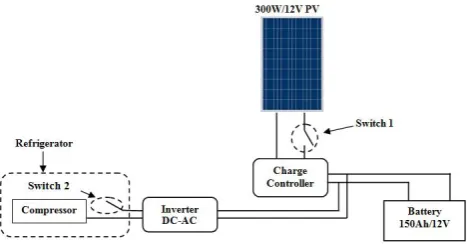
So far most of the work on solar cooling has been on absorption machines, possible because only large systems have been built and also because of their reduced maintenance compared with mechanical compression systems. PV cells open the field for small mechanical systems using reciprocating type compressors that are widely developed. The system configuration of a solar powered refrigerator is shown in Fig. 1.
Fig. 1 System Configuration of Solar Refrigerator
2.1.Photovoltaic Conversion
Solar energy can be converted directly into electricity in photovoltaic (PV) panels. Such panels are direct current generators whose output is proportional to solar irradiance. A PV panel is characterized by its peak power (Wp ) which is the electric power delivered at 25° C under an irradiance of 1000 W per square meter in clear sky conditions. For small power applications electrochemical storage plays the role of an imperfect impedance adapter by keeping the voltage at a constant value.
First Author name / International Journal of Research Publications (IJRP.ORG) 3
Reliability of PV generators has been demonstrated and a life time of at least 15 years can be guaranteed. For small daily energy consumption (10 to 50 kWh) or in locations far from the power grid PV generators are cost effective compared to diesel engine generators; they are more reliable and require no maintenance.
2.2.Vapour Compression Refrigeration System
As mentioned, vapour compression refrigeration systems are the most commonly used among all refrigeration systems. As the name implies, these systems belong to the general class of vapour cycles, wherein the working fluid (refrigerant) undergoes phase change at least during one process. In a vapour compression refrigeration system, refrigeration is obtained as the refrigerant evaporates at low temperatures. The input to the system is in the form of mechanical energy required to run the compressor. Hence these systems are also called as mechanical refrigeration systems. Vapour compression refrigeration systems are available to suit almost all applications with the refrigeration capacities ranging from few Watts to few megawatts. A wide variety of refrigerants can be used in these systems to suit different applications, capacities etc.
3.Design Calculations
A cooling cabinet is a refrigerated space where evaporation of water vapour and refrigeration effect takes place. A well-insulated rectangular type cabinet was chosen to save the cooling coil length and simplify the
design. The cabinet is designed for storing 200 bottles of 20 g vaccine.
3.1.Solar Radiation
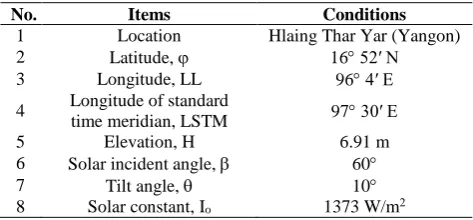
Solar radiation is an important variable to consider when estimating the potential photovoltaic electrical output along with temperature, wind, and precipitation. The possible assumptions shown in Table 1 are taken for design calculations.
Table 1. Design Considerations
No. Items Conditions
1 Location Hlaing Thar Yar (Yangon)
2 Latitude, 16 52′ N
3 Longitude, LL 96 4′ E
4 Longitude of standard
time meridian, LSTM 97 30′ E
5 Elevation, H 6.91 m
6 Solar incident angle, 60
7 Tilt angle, 10
8 Solar constant, Io 1373 W/m2
Table 2. Annually Result Data of Solar Radiation at Noon
Month Date Hb
(W/m2)
Hd
(W/m2)
Hh
(W/m2)
HT
(W/m2)
Jan 17 751.93 107.81 605.58 851.64
Feb 16 775.52 110.51 671.98 880.22
Mar 16 799.85 113.45 759.73 910.77
Apr 15 810.43 114.78 824.72 925.44
May 15 804.72 113.96 834.99 919.72
Jun 11 795.28 112.63 818.84 908.61
Jul 17 791.35 112.08 806.88 903.74
Aug 16 797.89 113.01 812.76 911.17
Sep 15 804.74 113.99 807.68 918.39
Oct 15 798.88 113.31 758.80 909.66
Nov 14 776.79 110.67 675.39 881.77
Dec 10 755.99 108.28 615.54 856.49
3.2.Determination of Solar Arrays
The daily energy output from the PV array, Pmodule can be determined by the daily solar radiation in the plane
of the PV array, HT (W/m2) as below:
Pmodule = HT Aprp (1)
Where, Apr = area of the PV module, m2
p = overall efficiency of the PV panel
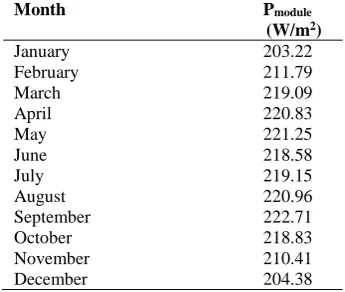
Table 3 shows the annually result data of PV array output power.
Table 3. Annually Result Data OF Array Output Power
Month Pmodule
(W/m2)
January 203.22
February 211.79
March 219.09
April 220.83
May 221.25
June 218.58
July 219.15
August 220.96
September 222.71
October 218.83
November 210.41
First Author name / International Journal of Research Publications (IJRP.ORG) 5
The next step is to determine the hourly solar radiations and hourly module output power for the three hottest months (March, April, May), July, August and the two coldest months (November, December) in Myanmar. These values are shown in Table 4.
Table 4. Result of Hourly Module Output Power, Pmodule (w)for March, April, May, November and December
Month 10:00 11:00 12:00 13:00 14:00 15:00
Mar 221.5 229.9 232.2 228.8 219.2 201.2
Apr 218.7 229.1 232.5 232.0 220.4 201.8
May 211.6 220.2 221.9 218.5 209.5 192.8
July 217.4 225.4 228.1 225.5 217.4 201.9
Aug 218.4 228.8 231.5 231.6 220.1 201.4
Nov 214.6 223.4 224.5 218.4 203.5 174.8
Dec 196.6 207.6 209.9 204.4 189.3 159.9
3.3.Determination of Heat Rate and Compressor Power
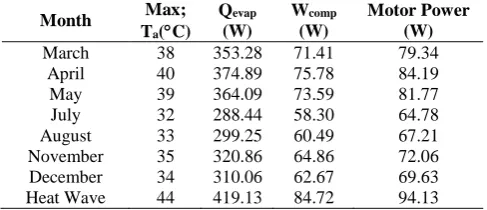
The daily heat rate of the evaporator, Qevap, can be determined by the refrigeration load. Then the compressor
power, Wcomp and the compressor motor power are calculated for the three hottest months (March, April, May),
July, August and for the two coldest months (November and December) in Myanmar. Next, the previous values
are also determined for the maximum temperature of 44C due to the heat wave of uncharacteristically strong
El Nino effect. The results of the hottest day in each month and outside temperature 44C due to heat wave are
shown in Table 5.
Table 5. Results of Qevap, Wcomp, and Motor Power for March, April, May, July, August, November, December and Heat Wave
Month Max; Ta(C)
Qevap (W) Wcomp (W) Motor Power (W)
March 38 353.28 71.41 79.34
April 40 374.89 75.78 84.19
May 39 364.09 73.59 81.77
July 32 288.44 58.30 64.78
August 33 299.25 60.49 67.21
November 35 320.86 64.86 72.06
December 34 310.06 62.67 69.63
Heat Wave 44 419.13 84.72 94.13
3.4.PV Module Sizing
For the high reliability of the system 300 W Mono-crystalline PV module is selected for solar powered vapour compression refrigerator. Then the required battery, controller and inverter sizes are also determined.
A.Battery Sizing: Taking the daily energy requirement as 600 Whr, battery nominal voltage as 12 V, the energy
storage requirement for 2 days of ‘No Sun’ condition as 1200 Whr and the maximum discharge capacity as 70% of the rating, the ampere-hour rating of the battery is obtained as 150 Ah. Thus, one unit of 150
Ah battery is needed for the refrigeration system.
B.Controller Sizing: The controller rating is can be determined by the maximum output current of PV module
and obtained as 17.7 A. According to the market availability, HF - 110 D controller is selected for the
cooling system.
C. Inverter Sizing: Inverter rating can be determined by the following equation and is obtained as 127 VA.
Inverter rating = (Load + (1 + Af)) / inv (2)
Table 5 shows the parameters for components used in the solar powered vapour compression refrigeration system.
Table 5. Parameters for Components Used in Refrigeration System
No. Component Quantity
1 OPAI 300 W Monocrystalline Model
Max; power, Wp = 300 W Max; voltage = 22.3 V Max; current = 17.7 A
1
2 Battery
Nominal voltage = 12 V Storage capacity = 150 Ah
1
3 Controller
Input voltage = 12 V Input current = 10 A
1
4 Inverter
Power = 127 VA 1
4.Results and Discussion
4.1.Energy Consumption
The energy is necessary for compression of the refrigerant vapour by increasing its pressure and temperature. The mechanical energy necessary to drive the compressor is finally converted into heat. This heat must be removed by the condenser to condense the refrigerant vapour. The energy consumption of a refrigeration system is determined by the refrigeration capacity and the difference between the condensation and evaporation temperatures.
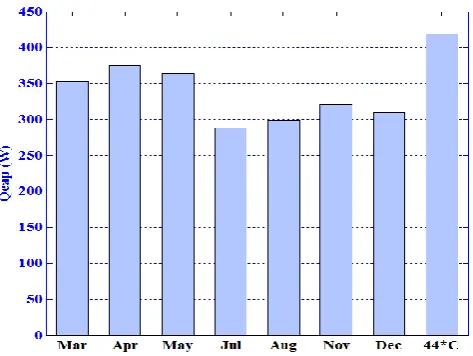
The amounts of heat absorbed by the evaporator, Qevap, for the three hottest months, the two coldest months
and the other two months with their respective monthly maximum temperatures are shown in Fig. 2. It can be
seen that the energy used by the evaporator, Qevap values depend upon the ambient temperature, Ta.
The energy consumption by the cooling system (evaporator) is varied from 234.41 W (27C at December) to
374.89 W (40C at April). For the heat wave due to El Nino effect, the energy consumption by the evaporator
First Author name / International Journal of Research Publications (IJRP.ORG) 7
Fig. 2 The values of Qevap for March, April, May, July, August, November, December and Ta=44C for heat wave with their atmospheric
temperature
The compressor power and motor power consumptions for three hottest months, two coldest months and Ta
= 44C for heat wave are shown in Fig. 3. All power consumption values are lower than 100 W. For the high
reliability of the system 300 W PV panel can be used for the refrigeration system.
Thus, the compressor power, Wcomp, is satisfied within the system even in very hot condition due to climate
change. If the compressor power is greater than the expected values, the energy can store with an extra battery connected in series with the previous one and can be charged the inverter.
Fig. 3 Motor and compressor power for March, April, May, July, August, November, December and Ta=44C for heat wave
4.2.Output from the PV array
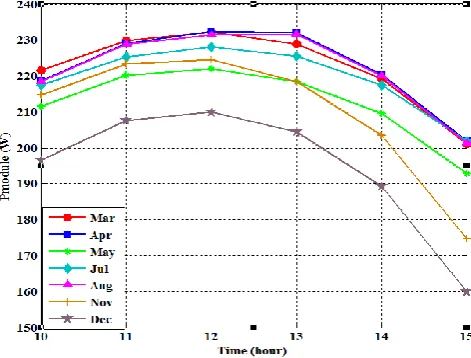
Fig. 4 shows the hourly energy output from the PV array, Pmodule of March, April, May, July, August,
of Year (n) for hottest three months is not much different from that of higher Day of Year (n) for coldest two
months. Pmodule values also satisfy with the selected PV panel.
Fig. 4 Hourly Pmodule values for March, April, May, July, August, November and December
5.Conclusions
Solar panel can serve as an alternative source of energy for powering refrigeration system. The performance
of solar refrigerator is sufficient for vaccine storage even in a very hot climate with ambient temperature 44C.
Finally, the solar refrigeration system can be used for remote off-grid area and this system is environmental friendly.
Acknowledgements
The author would like to thank Daw Thida Oo, Associate Professor, Department of Mechanical Engineering, West Yangon Technological University, Yangon, for her valuable guidance and suggestions.
References
[1] I. Dincer and M. Kanoglu, Refrigeration Systems and Applications, 2nd ed, 2010.
[2] A. M. Abu-Zour, S. B. Riffet, Solar Driven Air-conditioning Cycles: A Review,
[3] R. Best and A. Ortega, Solar Refrigeration and Cooling, Renewable Energy, 1999.
[4] A. R. Troot and T. Welch, Refrigeration and Air-conditioning, 3rd ed., 2000.
[5] R. Miller and M. R. Miller, Air-conditioning and Refrigeration, 2006.
[6] American Society of Heating, Refrigerating and Air-conditioning Engineers, Inc., 2010 ASHRAE Handbook Refrigeration, 2010.
First Author name / International Journal of Research Publications (IJRP.ORG) 9
[8] P. Breeze, M. Doble, H. Gupta and S. Kalogirou, Renewable Energy Focus Handbook, 1st ed., 2009.
[9] P. Jayakumar, Renewable Energy: Resource Assessment Handbook, 2009.
[10] J. A. Duffie, W. A. Beckman, Solar Engineering of Thermal Process, 4th ed., 2015.
[11] H. A. Wade, Solar Photovoltaic Systems Techanical Training Manual, 2003.
[12] D. Tan and A. K. Seng, Handbook for Photovoltaic (PV) Systems, Director Center of Sustainable Building and Construction
Authority, 2008.
[13] M. A. Eltawil and D. V. K. Samul, Vapour Compression Cooling System Powered by Solar PV array for Potato Storage, Agricultural
Engineering International: the CIGR Ejournal. Manuscript EE 06 003. Vol. IX. June, 2007.
[14] UNICEF, Battery Powered Solar Refrigerators and Freezers, Procurement Guidelines, 2014.
[15] WHO Library Cataloguing-in-Publication Data, Introducing solar-powered vaccine refrigerator and freezer systems, Guidance for
managers in national immunization programmes., World Health Organization, ISBN 978 92 4 150986 2, 2014.
[16] N. Saravanan, R. Rathnaswamy and V. Ananchasivan, Design and Analysis of Cooling Cabinet for Vaccine Storage, Advanced
Materials Research Vols. 984-985 (2014) pp 1180-1183, 2014.
[17] S. McCarney, J. Robertson and J. Arnaud, Using Solar-powered for Refrigeration for Vaccine Storage Where Other sources of
Reliable Electricity are Inadequate or Costly, Elsevier Ltd., Vaccine 31, 6050-6057, 2013.
[18] A. Pilatte, A Photovoltaic Refrigerator for Storage of Vaccines and Icemaking, Faculté Polytechnique de Mons et Université de
l'Etat à Mons, Service de Thermodynamique, Belgium.
[19] R. L. Field, Photovoltaic/Thermalelectric Refrigerator for Medicine Storage for Developing Countries, Solar Energy Vol. 25, pp,
445-447, 1980.
[20] A. H. Uppal, B. Norton and S. B. Probert, A Low-Cost Solar-Energy Stimulated Absorption Refrigerator for Vaccine Storage,