1
Bacterial Footprints in Elastic Pillared Microstructures
2
Arturo Susarrey-Arce,
*
,†,○Jose
́
Federico Herna
ndez-Sa
́
́
nchez,
*
,‡,○Marco Marcello,
¶3
Yuri Diaz-Fernandez,
†Alina Oknianska,
§Ioritz Sorzabal-Bellido,
†Roald Tiggelaar,
∥Detlef Lohse,
⊥4
Han Gardeniers,
#Jacco Snoeijer,
*
,⊥Alvaro Marin,
⊥and Rasmita Raval
*
,†5†Open Innovation Hub for Antimicrobial Surfaces at the Surface Science Research Centre and Department of Chemistry, University 6 of Liverpool, Oxford Street, Liverpool L69 3BX, United Kingdom
7‡Division of Physical Sciences and Engineering and Clean Combustion Research Center, King Abdullah University of Science and 8 Technology, Thuwal 23955-6900, Saudi Arabia
9¶Institute of Integrative Biology, University of Liverpool, Biosciences Building, Liverpool L69 7ZB, United Kingdom
10§School of Health Sciences, Liverpool Hope University, Hope Park, Liverpool L16 9JD, United Kingdom
11∥NanoLab Cleanroom, MESA+ Institute for Nanotechnology, University of Twente, P.O. Box 217, Enschede 7500AE, The 12 Netherlands
13⊥Physics of Fluids Group, MESA+ Institute for Nanotechnology, J.M. Burgers Centre for Fluid Dynamics, University of Twente, 14 P.O. Box 217, Enschede 7500AE, The Netherlands
15#Mesoscale Chemical Systems, MESA+ Institute for Nanotechnology, University of Twente, P.O. Box 217, Enschede 7500AE, The 16 Netherlands
17
*
S Supporting Information18 ABSTRACT: Soft substrates decorated with micropillar arrays are known to
19 be sensitive to deflection due to capillary action. In this work, we demonstrate 20 that micropillared epoxy surfaces are sensitive to single drops of bacterial 21 suspensions. The micropillars can show significant deformations upon 22 evaporation, just as capillary action does in soft substrates. The phenomenon 23 has been studied with five bacterial strains: S. epidermidis, L. sakei, P. 24 aeruginosa, E. coli, and B. subtilis. The results reveal that only droplets 25 containing motile microbes withflagella stimulate micropillar bending, which 26 leads to significant distortions and pillar aggregations forming dimers, trimers, 27 and higher order clusters. Such deformation is manifested in characteristic 28 patterns that are left on the microarrayed surface following evaporation and 29 can be easily identified even by the naked eye. Ourfindings could lay the 30 ground for the design and fabrication of mechanically responsive substrates, 31 sensitive to specific types of microorganisms.
32 KEYWORDS: bacteria, bending, elastic micropillars, capillarity, responsive substrates
33
■
INTRODUCTION34The fabrication of materials that are sensitive to physical, 35chemical, or biological stimuli has opened opportunities for the 36development of a wide variety of technological applications 37such as switchable adhesion, mechanosensing, and stimuli-38responsive materials.1−6In particular, the design of biomimetic 39structures,3,7inspired by natural systems, has been a powerful 40tool in the implementation of smart, artificial systems.8,9In this 41respect, the use of topographic surfaces is particularly 42interesting, with natural systems utilizing physical structures, 43from the nano- to the macroscale, to deliver functions such as 44superhydrophobicity, adhesion, and antibiofouling as demon-45strated by the lotus leaf, shark skin, and gecko feet.4,7,9−13 46 There has been particular interest in developing mechan-47ically responsive systems.8,14 An excellent example is the 48mechanical response of micropillar arrays upon drying of water
49
(or water-based solutions).15−26 When water droplets
50
evaporate on relatively soft elastic microstructured surfaces,
51
capillary action can generate a significant force that is able to
52
bend the soft micropillars. Depending on the geometry of the
53
arrays, the capillary and elastic forces can form different pillar
54
assemblies.15,16 The complexity of the assemblies varies with
55
the pillar height and the interpillar distance. For example, large
56
periodic chiral aggregates can be formed when the micropillars
57
are higher and closer to each other. Each cluster of aggregates
58
has a different potential to store elastic energy, embody
59
information, enhance adhesion, or capture particles.17,18
Received: May 31, 2018 Accepted: October 15, 2018 Published: October 15, 2018
Article
www.acsabm.org
© XXXX American Chemical Society A DOI:10.1021/acsabm.8b00176
60 The demonstration of mechanically responsive topographic 61surfaces to bacterial stimuli during evaporation of small 62droplets is of great interest and has not been demonstrated 63before. Furthermore, the deflections seen in our systems are 64significant, leading to pillar aggregations into dimers, trimers, 65and higher order clusters. Recently, the formation of biofilm 66strings and networks between topographic pillars has been 67demonstrated in liquid media;27 however, the mechanical 68response of the pillars to bacterial presence upon evaporation
69is not observed. Chew and coauthors have shown small
70deflections of macropillared surfaces in response to the 71differential pressure exerted by biofilm growth within a growth 72chamber over a 24 h period,28 while Biais29and Ng30 et al. 73have investigated the interaction of bacterial pili with pillared 74structures.
75 Here, we demonstrate how epoxy-made soft surfaces
76containing micropillar arrays interact with suspensions of 77different bacterial species. Our results suggest that the presence 78of motile bacteria with flagella drastically increases the 79mechanical response of the pillars, actively bending soft 80topographical substrates in the area contained within the 81contact line. In contrast, solutions containing nonmotile 82bacteria do not generate such responses. We attribute this to 83the ability of motile bacteria to interact with each other and 84with their topographical environment. Importantly, the 85response of the microarray is sensitive to the type and 86concentration of bacteria in the solution. These promising 87results could lay the foundation for the development of devices 88that are selectively responsive to specific microorganisms, 89paving the way to construct smart, fast, and cost-effective 90diagnostic tools.
91
■
RESULTS AND DISCUSSION92One of the key parameters in the mechanical response of soft 93micropillar arrays is the aspect ratio of a single pillar. We 94investigated the effect of the pillar aspect ratio by fabricating 95regular patterns of cylindrical pillars with a constant diameter 96(5 μm) and interspacing (5 μm) and with variable height 97(from 5 to 45μm). The patterns were created on epoxy resin 98using a method described before31−35 based on casting 99uncured epoxy on a negative polydimethilsiloxane (PDMS) 100mold, followed by curing and mechanically removing of the 101mold. The micropatterns were transferred efficiently, with a 102high degree of fidelity, as shown by scanning electron f1 103microscopy (SEM) imaging (Figure 1andFigure S1).
104 These microstructured substrates can be susceptible to 105elastocapillary forces in the presence of pure liquids. Therefore, 106we evaluated the effect of pure water over a surface decorated 107with micropillars with lengths varying from 5 to 45μm (Figure 1081) during the evaporation of water droplets (Figure 1). In 109these experiments, the liquid filled up the space between the 110pillars, resulting in an almost square-shaped droplet contour. 111Once the droplet spreads on the substrate, the liquid contact 112line is blocked by the pillared structure and remains 113immobilized (pinned) for the rest of the drying process.31 114Figure 1b shows that after complete evaporation, there is 115almost no trace of the droplet, except at the droplet contour, 116where lines of pillars were bent by capillary action at the 117contact line shown inVideo S1.18−23,31
118 In the systems studied, the pillar lattice was kept constant 119(i.e.,l=d= 5μm), but different pillar heights (h) ranging from
120h = 5 to 45 μm were fabricated. Thus, a range of
121micropatterned surfaces were generated with different aspect
122
ratios (i.e., h/d = 3 to h/d = 9). For large aspect ratio
123
structures, we observed significant perturbation of the
124
micropillars in the area within the contact line boundary.
125
Imaging at low magnifications, or even examination by the
126
naked eye, revealed that the inner part of the pattern was
127
opaque, suggesting that the whole array of pillars inside the
128
dried droplet perimeter was modified (Figure 1c). Higher
129
magnification SEM imaging showed that this optical contrast
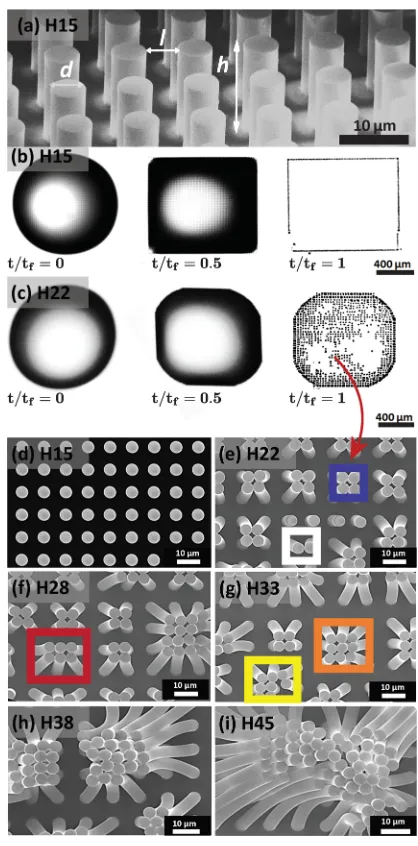
Figure 1.(a) Representative SEM image of pillared structure (H15), showing the topographic descriptors for the array. The pillars have a cylindrical shape and a height (h) of 15μm and a diameter (d) of 5
μm forming a square lattice with an interpillar distance (l) = 5μm. (b) Pure water droplet evaporating on the H15 substrate with micropillars leaving a distinct square-shaped contact line with no perturbation of pillars within this contour. (c) Pure water droplet evaporating on the H22 substrate with micropillars leaving a distinct shaped contact line pattern with significant modification of the micropillars within the contact line boundary. Time needed is represented in a dimensionless form as the ratio between the elapsed time (t) and thefinal evaporation time (tf). (d−i) Pillared structures with constant (d= 5μm) and different pillar heights (h) of (d) 15μm (H15), (e) 22μm (H22), (f) 28μm (H28), (g) 33μm (H33), (h) 38
μm (H38), and (i) 45μm (H45). SEM images are presented for the different heights after evaporation of pure water droplets, probing the sensitivity of the structures to pure elastocapillary bending.
DOI:10.1021/acsabm.8b00176
ACS Appl. Bio Mater.XXXX, XXX, XXX−XXX
130effect was caused by local bending of the micropillars (Figure 1311d−i), with the pillars bent toward each other forming clusters 132and adopting complex geometries, e.g., dimer (white box), 133tetramer (blue box), hexamer (red box), octamer (yellow box), 134and nonamer (orange box). Similar effects have been reported 135before for larger pillar aspect ratios18,24,25and were attributed 136to the elastocapillary coalescence of theflexible structures.15,18 137In our experiments, as the aspect ratio decreased, the clusters 138contained lower numbers of aggregated pillars until a critical 139aspect ratioh/d= 3, for which no clusters were observed in the 140inner part of the droplet (Figure 1d).
141 The deformation of the pillars, upon water evaporation, is 142induced by the surface tension (γ) of the water/air meniscus 143connecting the pillars, and the corresponding force scales asFc 144∼ γr, where r = d/2 is the pillar radius.21,36 The natural 145elasticity of the pillars resists deformation with an elastic force 146FE ∼ Elr4/h3, where E is the Young modulus and l the 147interpillar distance.18This expression is analogous to the usual 148beam theory for slender objects, showing that the resistance to 149bending decreases strongly when the pillars height increases. If 150we define the pillar bending sensitivity as the ratio of capillary 151and elastic forces,Fc/FE=γ/El(h/r)3, we can conclude that it 152is directly proportional to the cubic power of the pillar aspect 153ratio h/r; i.e., slender pillars are more prone to be bent by 154surface tension, while wide pillars tend to be more stable. 155 Under our experimental conditions, no pillar coalescence is 156observed in the area within the contact line boundary from 157pure water when the aspect ratio is belowh/d= 3,31suggesting 158that this is the critical aspect ratio threshold for which capillary 159action equals restoration mechanical stress on the micropillars. 160It is important to note that in this analysis, we are not 161considering the effect of the contact line. This effect is 162expected to have an enhanced deforming effect, but an 163accurate evaluation of this factor is beyond existing 164phenomenological modeling capabilities and will be the subject 165of future studies. Consequently, all of the results described 166below applies exclusively to the inner part of the dried pattern 167left by the droplet, ignoring possible contact line effects. 168 Bacterial-Triggered Coalescence of Pillars. From the 169elastocapillary assay discussed in the previous section, we 170identified the critical region within the topographic parameter 171space where the micropillared structure is able to resist 172capillary deformation in the presence of pure water droplets. 173Such a surface opens up the possibility to sense the presence of 174a second entity introduced into water (i.e., bacterial cells), 175which could induce a response in its own right. This critical 176structure corresponds to an aspect ratio h/d ≈ 3 and pillar 177height h = 15 μm (H15, Figure 1d), as discussed in the 178previous section.
179 We, therefore, investigated the drying process of droplets 180containing different bacteria species over the H15 pillared 181structures. Similar to the case of pure water droplets, a pinned 182square drop shape is found. However, the patterns observed 183within the contact line formed after complete evaporation of 184the droplets were surprisingly different for some bacteria as 185clearly observed inVideo S2.
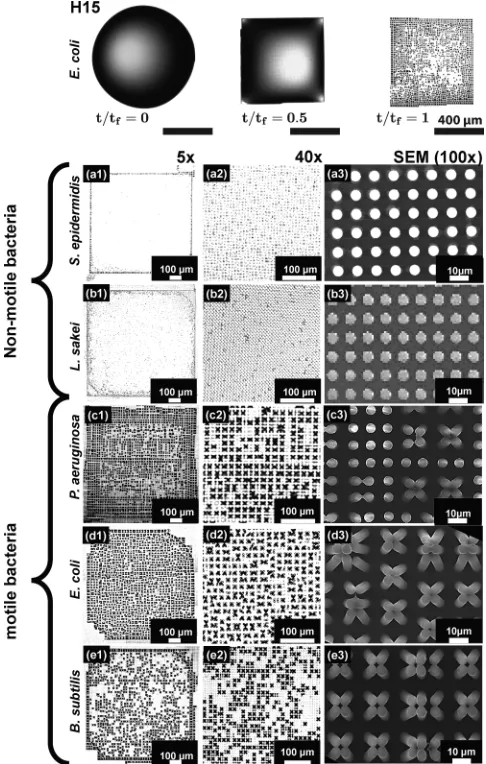
186 Five different bacterial species, with a wide range of 187morphological and biological characteristics were investigated: 188S. epidermidis,L. sakei,P. aeruginosa,E. coli, andB. subtilis. The 189patterns formed after evaporation of droplets containing f2 190different bacteria on H15 pillar substrates (Figure 2) can be 191classified in two main groups: one group displaying significant 192bending of the pillars within the pattern (P. aeruginosa,E. coli,
193
and B. subtilis) and another group that does not induce any
194
responsive bending of the pillars in the center of the dried
195
patterns (S. epidermidisandL. sakei). These distinct behaviors
196
could be observed even by the naked eye in the form of a local
197
change in contrast at the surface (Figure 2, 5×). At higher
198
magnifications, the difference is clearly revealed to be
199
associated with the coalescence of adjacent pillars (Figure 2,
200
40×and SEM (100×)).
201
We attempted to correlate these results to the general
202 t1
characteristics of the bacterial species used in this work (Table 203 t1 1). Atomic force microscopy (AFM) imaging confirmed the
204
expected size and cell morphology for these bacteria:
Gram-205
negative (−)P. aeruginosaandE. colias well as Gram-positive
206
(+) B. subtilis and L. sakei present a rod-like shape, while
207
Gram-positive (+) S. epidermidis has a spheroidal shape
208
(Figure S2). In addition, L. sakei and S. epidermidis are not
209
motile (noflagella present), while the other three strains have
210 flagella. From these considerations, we can conclude that the
211
different pattern types showed in Figure 2 (bending vs
212
nonbending) cannot be explained considering bacteria cell
Figure 2. Typical patterns left over H15 substrates after the evaporation of different bacterial species: (a1−a3) S. epidermidis,
(b1−b3)L. sakei, (c1−c3)P. aeruginosa, (d1−d3),E. coli, (e1−e3)B.
subtilis. Here, the concentration of the different bacterial species is 107
CFU/mL. The different columns correspond to different degrees of magnifications: 5×(left column), 40×(central column) by using a confocal microscope, and >100×with SEM (right column).
DOI:10.1021/acsabm.8b00176
ACS Appl. Bio Mater.XXXX, XXX, XXX−XXX
213morphology only. Similarly, the stiffness of the cell envelop 214does not appear to play a critical role, with rigid Gram-positive 215bacteria and softer Gram-negative bacteria distributed among 216both pattern groups.
217 Interestingly, the different response of the microstructures 218upon evaporation of the bacterial solutions correlates with the 219presence or absence of flagella. Bacteria with flagella clearly
220induce a bending response in the H15 pillars, while
221nonflagellated bacteria are unable to bend the pillars when 222used at the same bacterial concentration.
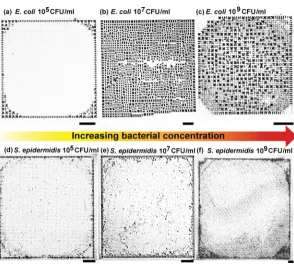
223 For the bacteria that induce a mechanical response, a 224concentration dependence is observed, with deformation of 225pillar clusters at the center of the dried droplet observed for 226bacteria concentrations between 107CFU/mL and 109CFU/ 227mL, while none is observed for lower bacteria concentrations 228(105 CFU/mL). At low concentrations, only the perimeter 229near the corners of the dried square pattern presented f3 230coalescence of the pillars (Figure 3a−c). This can be attributed 231to the coffee-stain-like effect, able to drag bacterial cells toward 232the droplet contact line, increasing the local concentration of 233bacteria during evaporation.31 Interestingly, bacterial cells 234withoutflagella confirm the absence of responsivity at different 235cell concentrations (Figure 3d−f).
236
No clear correlation was observed between bacterial species
237
and the cluster symmetries obtained (e.g., dimer, trimer,
238
tetramer, etc.). However, the data suggests that the assemblies
239
emerge due to perturbation of the balance between capillary
240
forces and elastic restoration forces in the presence of bacteria
241
with flagella. In the next section, we discuss a possible
242
mechanism for this distinctive behavior.
243
Possible Origin of Bacteria-Induced Coalescence. In
244
the previous sections, we determined the critical pillar aspect
245
ratio, below which surface tension forces were not able to
246
induce pillar coalescence in pure water. Interestingly, the
247
responsivity is dramatically enhanced when the droplets
248
containflagellated bacteria. While the bending process at the
249
perimeter of the contact line appears similar in both cases,
250
coalescence within the central area is triggered at smaller
251
aspect ratios by the presence of bacteria with flagella. This
252
enhanced pillar bending effect results in characteristic patterns
253
on the substrate, distinct for motile and nonmotile bacteria.
254
The possible origin of the enhanced pillar bending may be
255
related to the ability of the bacteria with flagella to adhere to
256
more than one pillar (Figure S3), thus connecting adjacent
257
pillars and inducing a mechanical deformation. In the presence
258
of bacteria with flagella, we observed, at SEM, after drying,
259
structures bridging bent pillars, while nonflagellated bacteria
260
appeared attached to single pillars. The morphology of the
261
single bacterial cells cannot be distinguished, probably due to
262
distortions on the cell envelop after evaporation, in the absence
263
of fixation.
264
These effects can also be understood by comparing the
265
length scales of bacterial structures and pillar interspacing
266
distances. The average size of the capsule for a single bacterial
267
cell is below 2μm (Table 1), whileflagella can reach tens of
268
μm beyond the outer cell membrane.37Considering that in our
269
microstructured surfaces the interpillar distance was 5 μm,
270
bacteria without flagella will predominantly fall between the
Table 1. General Characteristics of the Different Bacterial Strains Used in the Studya
strain gram shape L×Wa(μm2) flagella
(a)P. aeruginosa − rod 1.4(±0.2)×0.8(±0.2) yes
(b)E. coli − rod 1.7(±0.2)×0.9(±0.2) yes
(c)B. subtilis + rod 1.8(±0.4)×0.80(±0.2) yes
(d)L. sakei + rod 1.5(±0.4)×0.8(±0.2) no
(e)S. epidermidis + spherical 1.3(±0.3)×1.3(±0.3) no
aAFM images of cells are presented inFigure S2.
Figure 3.Effect of bacteria concentration on the bending pattern forE. coliandS. epidermidison the H15 pillared substrate. Representative optical microscopy images for (a) 105CFU/mL, (b) 107CFU/mL, and (c) 109CFU/mL. Scale bar in panels a−f is 100μm.
DOI:10.1021/acsabm.8b00176
ACS Appl. Bio Mater.XXXX, XXX, XXX−XXX
271pillars or strongly adhere38to single pillars. On the other hand, 272bacteria with flagella,32 in which appendage sizes exceed the 273interpillar distance, can potentially interact with more than one 274pillar, leading to the observed pillar deformation.
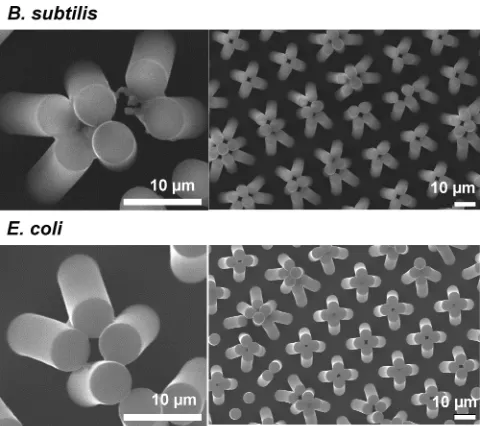
275 In support of this, we found evidence of bacterial matter 276residing between the bent pillars, after complete evaporation of f4 277droplets containing flagellated bacteria (Figure 4). Non-278flagellated bacteria, on the other hand, are found attached to 279individual pillars only, forming nonconnecting structures (see 280Figures S4−S7).
281 Although a more detailed investigation of bacterial behavior 282during the actual drying process is necessary to confirm the 283hypothesis proposed, our results support the potential use of 284pillared soft substrates to discriminate between motile and 285nonflagellated bacteria using a cost-effective and immediate 286assay based on droplet-drying, which can be performed and 287quickly analyzed by the naked eye. In addition, discrimination 288of bacterial concentration is also possible, with only samples 289containing concentrations above a critical threshold producing 290a response. We envision that by tuning the properties of the 291substrates, a more subtle differentiation between different 292microorganisms and different bacterial concentrations could be 293achieved in the future with this presented novel, easy to 294fabricate, and cost-effective technology.
295
■
CONCLUSIONS296We show that soft micropillared surfaces can be tailor-made 297sensitive to the presence of isolated bacterial cells in a single 298drop. The evaporation of water droplets and bacterial 299suspensions over fabricated micropillar arrays leads to very 300distinct micropillar deformations and patterns. Once the 301threshold for elastocapillary pillar coalescence is found, we 302observe that only bacteria with flagella can promote pillar 303coalescence. Such responsive micropillared surfaces could 304provide a platform for the development of fast and cost-305effective self-responsive surfaces for bacterial detection and 306differentiation.
307
■
EXPERIMENTS AND METHODS308 The epoxy micropillars were fabricated by casting EPO-TEK
OG142-309 13 from Epoxy Technology into a negative replica PDMS mold, as
310 described.31,32After the resin was casted, a 1.1 mm thick glass slide
311 was placed over the mold and placed below an ultraviolet light for 20
312 min until the epoxy pillar was cured. The epoxy micropillars were
313 mechanically removed from the mold. The SEM images of the epoxy
314 pillars are shown in Figure S1. After the sample preparation, we
315 measured the Young modulus (E) of the bulk material and the
316 micropillar via an axial compression test. The E value for the bulk
317 material was 1±0.3 GPa, and theEvalue for the H15 substrate was
318 0.5±0.2 GPa.
319 Bacterial cultures were performed following recommended growing
320 conditions for each species.P. aeruginosaATCC-8626,E. coli
ATCC-321 10798, andS. epidermidisATTC-12228 were grown overnight at 37
322
°C in liquid broth medium (Oxoid Ltd., Thermo Fisher).B. subtilis
323 subsp. subtilis ATCC-6051 and L. sakei DSMZ-20017 were grown
324 overnight at 30°C in MRS broth medium from Oxoid Ltd., Thermo
325 Fisher. All of the cells cultures were then centrifuged and redispersed
326 in sterile deionized water two times, finally adjusting the bacterial
327 concentration to 107colony-forming units per milliliter (CFU/mL),
328 unless differently specified. Note that colony counting was performed
329 after cell redispersion in deionized water to ensure cell viability.
330 The evaporation of all droplets was carried out placing a droplet of
331 5−10μL ± 4μL on the epoxy substrates. For droplets containing
332 bacteria, experiments were performed in triplicates drying 5 droplets
333 over substrates independently. The images were collected with a
334 CMOS camera PCO Sensicam at 1 frames per second (fps). The
335 droplet completely evaporated in approximately 2100 ± 300 s.
336 Evaporation experiments were assessed at room temperature (21±3
337 °C) in an atmosphere with a relative humidity of 35±5%.
338 The contact angle measurements of water and bacterial suspension
339 droplets on epoxy surfaces were carried out by placing a water droplet
340 with bacterial suspension of 107CFU/mL on the epoxy substrates.
341 The contact angle (CA) for H15 was 100° ±7°, whereas the CA was
342 92° ±5° for H22, H28, and H33. For longer pillars like H38 and
343 H45, the CA was 88° ±3°. CA hysteresis was carried out in a similar
344 manner as CA measurements but by tilting the substrate 45°.
345 Experiments were performed for the H15 substrate with and without
346 bacterial containing droplets only, the CA hysteresis was 50° ±8°. No
347 significant differences in CA and CA hysteresis were observed
348 between water droplets and the deposited bacterial containing
349 droplets. CA values are shown inTable S1.
350 Transmission light microscopy images of the dried patterns were
351 collected with a Zeiss 510 confocal microscope equipped with×10,
352 ×20, and×40 air objectives. AFM measurements from theSupporting
353
Information were obtained using a Bruker Multimode 8 and a 354 Keysights 5500 instrument. Prior to AFM morphological analysis, a
355 droplet of bacteria suspension (107CFU/mL) was deposited onto an
356 oxygen plasma-treated epoxy flat substrate and dried at room
357 temperature. Estimated length (L) × width (Wa) in Table 1 are
358 reported within a standard deviation of 10−25% obtained by
359 measuring 15−20 cells per bacterial strains. These tests were carried
360 out independently in triplicates. Top-view scanning electron
361 microscopy (SEM) imaging was performed at 20 kV. Side-view
362 SEM was recorded after fracturing the epoxy/glass with a diamond
363 cutter at accelerating voltages of 3 kV. Prior to SEM inspection in a
364 JSM-6610 JEOL system, all samples were coated with 20 nm of
365 chromium to increase the electrical conductivity. SEM images are
366 presented without fixation, which involves several solvent exchange
367 steps39preserving the bacterial footprints after droplet evaporation.
368
■
ASSOCIATED CONTENT369
*
S Supporting Information370
The Supporting Information is available free of charge on the
371 ACS Publications website at DOI:10.1021/acsabm.8b00176.
372
SEM images of some of the pillared arrays fabricated;
373
AFM images of bacterial cells dried over flat epoxy
Figure 4.Representative SEM images of H15 pillared structures after drying of bacterial suspensions, showing motile bacteria (B. subtilis
and E. coli) bridging the bent pillars. The concentration of the
different bacterial species is 107CFU/mL.
DOI:10.1021/acsabm.8b00176
ACS Appl. Bio Mater.XXXX, XXX, XXX−XXX
374 surfaces; close-ups ofE.colidried over the H15 pillared
375 substrate; additional SEM images of bacteria on H15
376 pillared structures; contact angle values for water and 377 bacterial suspensions on different pillared structures 378 (PDF)
379 Video S1: droplet contour impalement (AVI)
380 Video S2: pillar bending byB. subtilisat the latest stages
381 of evaporation (AVI)
382
■
AUTHOR INFORMATION383Corresponding Authors
384*E-mail:[email protected]. 385*E-mail:[email protected]. 386*E-mail:[email protected].
387*E-mail:[email protected].
388ORCID
389Arturo Susarrey-Arce: 0000-0003-2572-223X
390Detlef Lohse: 0000-0003-4138-2255
391Han Gardeniers: 0000-0003-0581-2668
392Author Contributions
○
393 A.S.-A. and J.F.H.-S. contributed equally to this work
394Notes
395The authors declare no competingfinancial interest.
396
■
ACKNOWLEDGMENTS397We would like to thank Dr. Joanna Wnetrzak and the
398Liverpool Centre for Cell Imaging (CCI) for help with 399experimental design and technical support. We also acknowl-400edge the support of the Nanoinvestigation Centre at University 401of Liverpool (NICAL) for access to the SEM facility. Stefan 402Schlautmann (Mesoscale Chemical Systems, MESA+ Institute 403of Nanotechnology, University of Twente) is also acknowl-404edged for sample fabrication. This work was partly funded by
405BBSRC (BB/R012415/1).
406
■
REFERENCES (1)407 Tawfick, S.; De Volder, M.; Copic, D.; Park, S. J.; Oliver, C. R.; 408Polsen, E. S.; Roberts, M. J.; Hart, A. J. Engineering of Micro-and 409Nanostructured Surfaces with Anisotropic Geometries and Properties.
410Adv. Mater.2012,24, 1628−1674.
(2)
411 Le, V.; Lee, J.; Chaterji, S.; Spencer, A.; Liu, Y.-L.; Kim, P.; Yeh, 412H.-C.; Kim, D.-H.; Baker, A. B. Syndecan-1 in Mechanosensing of 413Nanotopological Cues in Engineered Materials. Biomaterials 2018, 414155, 13−24.
(3)
415 Chakrapani, N.; Wei, B.; Carrillo, A.; Ajayan, P. M.; Kane, R. S. 416Capillarity-Driven Assembly of Two-Dimensional Cellular Carbon 417Nanotube Foams. Proc. Natl. Acad. Sci. U. S. A.2004,101, 4009− 4184012.
(4)
419 Boesel, L. F.; Greiner, C.; Arzt, E.; Del Campo, A. Gecko-420Inspired Surfaces: a Path to Strong and Reversible Dry Adhesives.
421Adv. Mater.2010,22, 2125−2137.
(5)
422 Prieto-López, L.; Williams, J. Using Microfluidics to Control Soft 423Adhesion.J. Adhes. Sci. Technol.2016,30, 1555−1573.
(6)
424 Prieto-López, L. O.; Williams, J. A. Switchable Adhesion Surfaces 425with Enhanced Performance Against Rough Counterfaces.Biomimetics
4262016,1, 2. (7)
427 Kwak, M. K.; Jeong, H.-E.; Kim, T.-i.; Yoon, H.; Suh, K. Y. Bio-428Inspired Slanted Polymer Nanohairs for Anisotropic Wetting and 429Directional Dry Adhesion.Soft Matter2010,6, 1849−1857.
(8)
430 Trichet, L.; Le Digabel, J.; Hawkins, R. J.; Vedula, S. R. K.; 431Gupta, M.; Ribrault, C.; Hersen, P.; Voituriez, R.; Ladoux, B. 432Evidence of a Large-Scale Mechanosensing Mechanism for Cellular 433Adaptation to Substrate Stiffness.Proc. Natl. Acad. Sci. U. S. A.2012, 434109, 6933−6938.
(9)Liu, K.; Jiang, L. Bio-Inspired Design of Multiscale Structures for 435 436 Function Integration.Nano Today2011,6, 155−175.
(10) Asayesh, F.; Zarabadi, M. P.; Greener, J. A New Look at 437 438 Bubbles During Biofilm Inoculation Reveals Pronounced Effects on
439 Growth and Patterning.Biomicrofluidics2017,11, 064109.
(11) Dean, B.; Bhushan, B. Shark-Skin surfaces for Fluid-Drag440 441 Reduction in Turbulent Flow: a Review.Philos. Trans. R. Soc., A2010,
442
368, 4775−4806.
(12)Guo, Z.; Liu, W. Biomimic from the Superhydrophobic Plant 443 444 Leave in Nature: Binary Structure and Unitary Structure. Plant Sci.
445 2007,172, 1103−1112.
(13)Feng, L.; Zhang, Y.; Cao, Y.; Ye, X.; Jiang, L. The Effect of 446 447 Surface Microstructures and Surface Compositions on the
Wett-448 abilities of Flower Petals.Soft Matter2011,7, 2977−2980.
(14)Fratzl, P.; Barth, F. G. Biomaterial Systems for Mechanosensing 449 450 and Actuation.Nature2009,462, 442−448.
(15) Bico, J.; Roman, B.; Moulin, L.; Boudaoud, A. Adhesion: 451 452 Elastocapillary Coalescence in Wet Hair.Nature2004,432, 690−690.
(16) Yeh, Y.-H.; Cho, K.-H.; Chen, L.-J. Effect of Softness of453 454 Polydimethylsiloxane on the Hydrophobicity of Pillar-Like Patterned
455 Surfaces.Soft Matter2012,8, 1079−1086.
(17) Nill, P.; Goehring, N.; Loeffler, R.; Peschel, A.; Kern, D. P.456 457 Studying Bacterial Adhesion Forces: Staphylococcus Aureus on
458 Elastic Poly (Dimethyl) Siloxane Substrates. Microelectron. Eng.
459 2011,88, 1825−1827.
(18) Pokroy, B.; Kang, S. H.; Mahadevan, L.; Aizenberg, J. Self- 460 461 Organization of a Mesoscale Bristle Into Ordered, Hierarchical
462 Helical Assemblies.Science2009,323, 237−240.
(19) Chandra, D.; Yang, S. Stability of High-Aspect-Ratio Micro- 463 464 pillar Arrays Against Adhesive and Capillary Forces.Acc. Chem. Res.
465 2010,43, 1080−1091.
(20) Chandra, D.; Yang, S. Capillary-Force-Induced Clustering of 466 467 Micropillar Arrays: is it Caused by Isolated Capillary Bridges or by the
468 Lateral Capillary Meniscus Interaction Force? Langmuir 2009, 25,
469 10430−10434.
(21) Roman, B.; Bico, J. Elasto-Capillarity: Deforming an Elastic 470 471 Structure with a Liquid Droplet.J. Phys.: Condens. Matter2010,22,
472 493101.
(22)Marchand, A.; Weijs, J. H.; Snoeijer, J. H.; Andreotti, B. Why is473 474 Surface Tension a Force Parallel to the Interface?Am. J. Phys.2011,
475
79, 999−1008.
(23)Weijs, J. H.; Andreotti, B.; Snoeijer, J. H. Elasto-Capillarity at476 477 the Nanoscale: on the Coupling between Elasticity and Surface
478 Energy in Soft Solids.Soft Matter2013,9, 8494−8503.
(24) Yang, M. T.; Fu, J.; Wang, Y.-K.; Desai, R. A.; Chen, C. S.479 480 Assaying Stem Cell Mechanobiology on Microfabricated Elastomeric
481 Substrates with Geometrically Modulated Rigidity.Nat. Protoc.2011,
482
6, 187−213.
(25) Wei, Z.; Schneider, T.; Kim, J.; Kim, H.-Y.; Aizenberg, J.; 483 484 Mahadevan, L. Elastocapillary Coalescence of Plates and Pillars.Proc.
485
R. Soc. London, Ser. A2015,471, 20140593.
(26)Ledesma-Aguilar, R.; Laghezza, G.; Yeomans, J. M.; Vella, D. 486 487 Using Evaporation to Control Capillary Instabilities in
Micro-488 Systems.Soft Matter2017,13, 8947−8956.
(27)Jahed, Z.; Shahsavan, H.; Verma, M. S.; Rogowski, J. L.; Seo, B.489 490 B.; Zhao, B.; Tsui, T. Y.; Gu, F. X.; Mofrad, M. R. K. Bacterial
491 Networks on Hydrophobic Micropillars. ACS Nano2017,11, 675−
492 683.
(28)Chew, S. C.; Kundukad, B.; Teh, W. K.; Doyle, P.; Yang, L.; 493 494 Rice, S. A.; Kjelleberg, S. Mechanical Signatures of Microbial Biofilms
495 in Micropillar-Embedded Growth Chambers. Soft Matter2016, 12,
496 5224−5232.
(29) Biais, N.; Ladoux, B.; Higashi, D.; So, M.; Sheetz, M. 497 498 Cooperative Retraction of Bundled Type IV Pili Enables Nanonewton
499 Force Generation.PLoS Biol.2008,6, 1−7.
(30)Ng, D.; Harn, T.; Altindal, T.; Kolappan, S.; Marles, J. M.; Lala, 500 501 R.; Spielman, I.; Gao, Y.; Hauke, C. A.; Kovacikova, G.; Verjee, Z.;
502 Taylor, R. K.; Biais, N.; Craig, L. The Vibrio cholerae Minor Pilin
DOI:10.1021/acsabm.8b00176
ACS Appl. Bio Mater.XXXX, XXX, XXX−XXX
503TcpB Initiates Assembly and Retraction of the Toxin-Coregulated 504Pilus.PLoS Pathog.2016,12, 1−31.
(31)
505 Susarrey-Arce, A.; Marin, A.; Massey, A.; Oknianska, A.; Díaz-506Fernandez, Y.; Hernández-Sánchez, J. F.; Griffiths, E.; Gardeniers, J. 507G. E.; Snoeijer, J. H.; Lohse, D.; Raval, R. Pattern Formation by 508Staphylococcus Epidermidis via Droplet Evaporation on Microoillars 509Arrays at a Surface.Langmuir2016,32, 7159−7169.
(32)
510 Hochbaum, A. I.; Aizenberg, J. Bacteria Pattern Spontaneously 511on Periodic Nanostructure Arrays.Nano Lett.2010,10, 3717−3721.
(33)
512 Li, X.; Cheung, G. S.; Watson, G. S.; Watson, J. A.; Lin, S.; 513Schwarzkopf, L.; Green, D. W. The Nanotipped Hairs of Gecko Skin 514and Biotemplated Replicas Impair and/or Kill Pathogenic Bacteria 515with High Efficiency.Nanoscale2016,8, 18860−18869.
(34)
516 Kim, P.; Epstein, A. K.; Khan, M.; Zarzar, L. D.; Lipomi, D. J.; 517Whitesides, G. M.; Aizenberg, J. Structural Transformation by 518Electrodeposition on Patterned Substrates (STEPS): A New Versatile 519Nanofabrication Method.Nano Lett.2012,12, 527−533.
(35)
520 Pokroy, B.; Epstein, A. K.; Persson-Gulda, M. C. M.; Aizenberg, 521J. Fabrication of Bioinspired Actuated Nanostructures with Arbitrary 522Geometry and Stiffness.Adv. Mater.2009,21, 463−469.
(36)
523 Hadjittofis, A.; Lister, J. R.; Singh, K.; Vella, D. Evaporation 524Effects in Elastocapillary Aggregation.J. Fluid Mech.2016,792, 168− 525185.
(37)
526 Haiko, J.; Westerlund-Wikström, B. The Role of the Bacterial 527Flagellum in Adhesion and Virulence.Biology2013,2, 1242−1267.
(38)
528 Hizal, F.; Choi, C.-H.; Busscher, H. J.; van der Mei, H. C. 529Staphylococcal Adhesion, Detachment and Transmission on Nano-530pillared Si Surfaces. ACS Appl. Mater. Interfaces 2016, 8, 30430− 53130439.
(39)
532 Susarrey-Arce, A.; Sorzabal-Bellido, I.; Oknianska, A.; McBride, 533F.; Beckett, A. J.; Gardeniers, J. G. E.; Raval, R.; Tiggelaar, R. M.; Diaz 534Fernandez, Y. A. Bacterial Viability on Chemically Modified Silicon 535Nanowire Arrays.J. Mater. Chem. B2016,4, 3104−3112.
DOI:10.1021/acsabm.8b00176
ACS Appl. Bio Mater.XXXX, XXX, XXX−XXX