O P I N I O N
Open Access
Treating frailty-a practical guide
Nicola Fairhall
1,2, Colleen Langron
3, Catherine Sherrington
2, Stephen R Lord
4, Susan E Kurrle
3, Keri Lockwood
3,
Noeline Monaghan
1, Christina Aggar
5, Liz Gill
1and Ian D Cameron
1*Abstract
Frailty is a common syndrome that is associated with vulnerability to poor health outcomes. Frail older people have increased risk of morbidity, institutionalization and death, resulting in burden to individuals, their families, health care services and society. Assessment and treatment of the frail individual provide many challenges to clinicians working with older people. Despite frailty being increasingly recognized in the literature, there is a paucity of direct evidence to guide interventions to reduce frailty. In this paper we review methods for identification of frailty in the clinical setting, propose a model for assessment of the frail older person and summarize the current best evidence for treating the frail older person. We provide an evidence-based framework that can be used to guide the diagnosis, assessment and treatment of frail older people.
Background
Identification and treatment of frailty is a challenge for clinicians. Frailty is a common geriatric syndrome, char-acterized by decreased reserve and increased vulnerabil-ity to adverse outcomes, including falls, hospitalization, institutionalization and death [1,2]. The prevalence and the consequences of frailty present a considerable bur-den to older people, their carers, health care services and the community. Interventions designed to reduce frailty therefore have the potential for profound and widespread benefits.
Management of the frail older individual is challenging on multiple levels. Understanding of frailty has increased dramatically over the past decade, thanks to research into the biological basis of frailty and methods to define and predict the syndrome. There is no firm consensus, however, on how to assess and diagnose frailty in the clinical setting [3]. Care of frail individuals is also diffi-cult, due to complex comorbidities, vulnerability to deterioration and increased social needs [1,4], com-pounded by the need for consistent ongoing manage-ment despite frequently fragmanage-mented health service delivery. A practical, evidence-based guide for clinicians is therefore needed.
There is a paucity of direct evidence guiding interven-tions to decrease frailty. Research has concentrated on
the effect of interventions on functional and nutritional outcomes in frail older people [5-9] and application of geriatric models of care to frail older people in a variety of settings [4,10]. However, clinical improvement from the frail state is possible [11,12] and there is an urgent need for effective interventions to mitigate frailty. As in other fields, clinicians should aim to integrate the high-est levels of evidence with clinical experience and patient values as suggested by Sackett and others [13,14]. A literature search identified no clinical trials that have investigated whether intervention can alter or reverse frailty. In the absence of such evidence, clini-cians can be guided by clinical trial evidence answering related questions and we also draw on our collective experience in aged care and rehabilitation.
This paper aims to provide a synthesis of the current available evidence concerning interventions to decrease frailty and provide practical information on identifica-tion of frailty in clinical practice and provision of inter-ventions to reduce frailty in the clinical setting.
Discussion
Identification and assessment of frailty
Screening and assessment of frailty are increasingly recommended components of the assessment of older people [10], yet there is no consensus definition of frailty. Multiple operational definitions of frailty have been proposed [15-19], and the components of the main phenotypes of frailty are well critiqued in a recent review [3]. The current literature has two primary * Correspondence: [email protected]
1
Rehabilitation Studies Unit, Faculty of Medicine, The University of Sydney, Ryde, Sydney 2112, Australia
Full list of author information is available at the end of the article
definitions of frailty. The Frailty Phenotype [1] diagnoses people as frail if they meet pre-determined values for three or more of five criteria: weak grip strength, slow walking speed, exhaustion, weight loss, low energy expenditure. Frailty indices have been developed to quantify accumulation of identified deficits present across multiple domains (for example cognition, mood, social resources, chronic diseases), an example of which is the Frailty Index [19]. Alternate measures include combinations of instruments each measuring a single aspect of frailty [2]. There will likely be future develop-ments in this area, and consensus on how to diagnose frailty will assist clinicians and researchers alike.
In the busy clinical setting, a single item assessment tool may indicate whether more comprehensive assess-ment is required in order to make a diagnosis of frailty. Reduced gait speed is clearly predictive of future vulner-ability [20,21] and although cut-off speeds are conten-tious, 0.8 m/sec was proposed as the result of a recent systematic review [21] and seems a useful starting point for further validation studies. In the event that potential for frailty is identified, we suggest referral for multi-dis-ciplinary assessment where resources are available. The simple assessment form provided in Additional file 1 (Frailty assessment form) is based upon comprehensive geriatric assessment and captures frailty using the Frailty Phenotype [1]. Completed during routine comprehensive geriatric assessment, this form may also be used to count deficits in health, to formulate a frailty index using the standardized procedure of Searle and collea-gues [22], as has been done with previous assessment tools [23,24].
Once frailty is identified, management is guided by multidisciplinary assessment using the principles of Ger-iatric Evaluation and Management (GEM) [10,25], while specifically targeting the problems associated with frailty. In order to overcome the problems associated with inconsistent definitions, we suggest frailty can manifest in a number of recognizable patterns that may be useful for guiding evaluations and intervention. Important fac-tors routinely assessed and common interactions between them, are described in Figure 1, using the fra-mework of the International Classification of Function-ing, Disability and Health (ICF) [26].
Suggested principles of assessment in older people diagnosed as frail are: (1) Comprehensive, interdisciplin-ary assessment of physical, emotional, psychological and social factors, and support mechanisms [25]. This may be time consuming due to comorbidities, polypharmacy, pain and disability resulting from impaired vision, hear-ing, speech and cognition. (2) Assessment of psychologi-cal and social factors that are potential barriers to implementation, uptake and adherence with the inter-vention. (3) Regular reassessment, particularly following an illness or injury, to detect changes in needs and ensure timely modifications of care provision.
Principles of intervention to reduce frailty
The lack of consensus regarding the definition and com-ponents of frailty will influence clinicians’ approach to intervention. For example, the Frailty Phenotype [1] identifies five potential deficits that may be targeted with treatment while an extensive frailty index will yield a more comprehensive picture of the individual, with
Level of the ICF Pattern of frailty Common causes Other causes
Health condition
Unstable health conditions
Infections, injuries, cardiorespiratory disease
Frequent transition between primary care and acute care Sub-optimal management Under nutritiona Inability to prepare meals Inability to purchase food
Exhaustion
Impairment of the
body’s
structure/function
Psychological factorsa Depression, grief Negative outlook
Impaired cognition Dementia Lack of compensatory strategies
Impaired vision / hearing
Macular degeneration, cataracts / presbycusis
Lack of appropriate equipment /aids / eye surgery
Activity limitationb Decreased mobilitya/ decreased self care
Impaired balance/co-ordination and /or strength
Environmental barriers Recent traumatic event
Decreased cardiovascular endurance
Fear of falling
Participation
restrictionc Lack of participation in life roles
Social barriers Limited family contact Environmental barriers
Decreased self-efficacy
Environmental contextual factors
Problems with services or support systems
Services not readily available Lack of service co-ordination
Carer stress
Interaction with support network Low income
Physical or social isolation
Figure 1Important factors to assess in the frail patient and the interactions between them.aCaptured in the Frailty Phenotype;bDefined as difficulty experienced by an individual when executing activities (International Classification of Functioning (ICF)[26]);cDefined as problems
the potential for broader intervention [23]. We propose clinicians should specifically identify and target the dimensions of frailty identified in the Frailty Phenotype, as highlighted in Additional file 2 (Additional recom-mendations for treatment of the frail older person), but also incorporate GEM to ensure the complex picture present in the frail older person is comprehensively addressed, as discussed by Rockwood and Mitnitski [23]. GEM decreases functional decline and the use of home health care services in older people susceptible to recur-rent hospitalization [10]. Intervention delivered to the frail older person should accord with the best available evidence for each problem identified at assessment. The challenge is to implement the evidence in the real-life setting of a health system, and to co-ordinate manage-ment of interventions addressing multiple problems, in a population vulnerable to adverse outcomes.
We propose that intervention be based upon six pre-mises: (1) Frailty can be mitigated. (2) Support will need to be individually tailored to address each person’s underlying problems as well as the contextual factors that influence their condition and response to interven-tion. (3) Support has to be delivered over a long period and systems must facilitate consistent management in the presence of acute health events. (4) Intervention aims to improve physical, cognitive and social function-ing and extend frail older individuals’ length of time in independence and self-management, living in their pre-ferred setting; in addition, intervention aims to decrease vulnerability to adverse outcomes, in particular falls, injury, hospitalization and institutionalization. (5) Most frail older people should be encouraged and supported to adhere to their intervention plan. (6) It is important to recognize the needs of family and/or carers and to engage with them.
Implementation of interventions to reduce frailty
The content
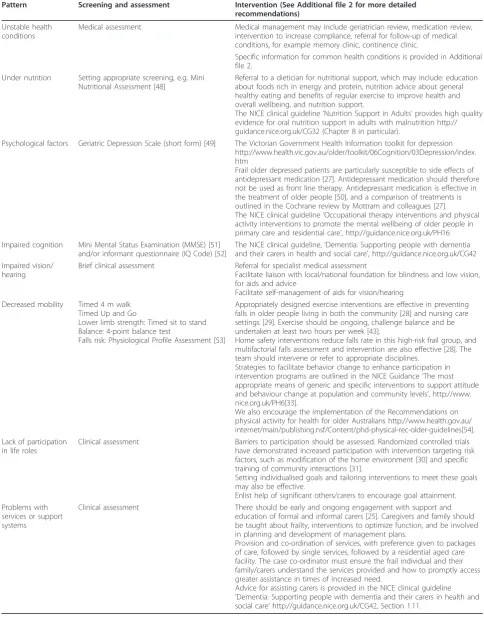
Interventions that address the common patterns of frailty are outlined in Table 1. Each intervention is drawn from the highest quality evidence available for an assessed problem and is consistent with management deliverable in clinical practice. Medical management of unstable health conditions may include the use of clini-cal guidelines, review of medications, intervention to increase compliance, and referral to other clinicians. Nutritional state, mood, cognition, vision and hearing should be addressed according to guidelines developed for older people, with interventions taking into account the susceptibilities associated with frailty, for example the side effects of antidepressant medication [27]. Decreased mobility and falls risk can be effectively addressed in the frail older person via appropriately designed exercise and home safety interventions [28,29],
and targeting the causes of decreased participation in life roles can improve involvement at the societal level [30,31]. The frailty management plan should be coordi-nated over a specified period, with case co-ordination and early and ongoing engagement of carers [25], to minimize problems with services and support systems. Most importantly, treatment needs to be personalized and adapted to the goals, capacity and context of the individual.
Focus on increasing adherence
Patient adherence has been shown to increase the effec-tiveness of health interventions [32]. Application of the principles of behavior change [33] to frail individuals involves acknowledging that components of frailty can be treated and specifying the link between the interven-tion and outcome. The targets of the interveninterven-tion should be described to the individual, the choice of intervention justified, and the method of evaluation dis-cussed, as agreement between the patient and primary care physician regarding health care significantly increases adherence to geriatric treatment plans [34]. Individuals should be supported, motivated, empowered, and given assistance to develop both goals and the stra-tegies to achieve them. Potential barriers to adherence should be assessed and addressed, with a particular reference to engagement of social support systems.
The team
Table 1 Interventions and guidelines to address the common patterns of frailty in the clinical setting
Pattern Screening and assessment Intervention (See Additional file 2 for more detailed recommendations)
Unstable health conditions
Medical assessment Medical management may include geriatrician review, medication review, intervention to increase compliance, referral for follow-up of medical conditions, for example memory clinic, continence clinic.
Specific information for common health conditions is provided in Additional file 2.
Under nutrition Setting appropriate screening, e.g. Mini Nutritional Assessment [48]
Referral to a dietician for nutritional support, which may include: education about foods rich in energy and protein, nutrition advice about general healthy eating and benefits of regular exercise to improve health and overall wellbeing, and nutrition support.
The NICE clinical guideline‘Nutrition Support in Adults’provides high quality evidence for oral nutrition support in adults with malnutrition http:// guidance.nice.org.uk/CG32 (Chapter 8 in particular).
Psychological factors Geriatric Depression Scale (short form) [49] The Victorian Government Health Information toolkit for depression http://www.health.vic.gov.au/older/toolkit/06Cognition/03Depression/index. htm
Frail older depressed patients are particularly susceptible to side effects of antidepressant medication [27]. Antidepressant medication should therefore not be used as front line therapy. Antidepressant medication is effective in the treatment of older people [50], and a comparison of treatments is outlined in the Cochrane review by Mottram and colleagues [27]. The NICE clinical guideline‘Occupational therapy interventions and physical activity interventions to promote the mental wellbeing of older people in primary care and residential care’, http://guidance.nice.org.uk/PH16 Impaired cognition Mini Mental Status Examination (MMSE) [51]
and/or informant questionnaire (IQ Code) [52]
The NICE clinical guideline,‘Dementia: Supporting people with dementia and their carers in health and social care’, http://guidance.nice.org.uk/CG42 Impaired vision/
hearing
Brief clinical assessment Referral for specialist medical assessment
Facilitate liaison with local/national foundation for blindness and low vision, for aids and advice
Facilitate self-management of aids for vision/hearing Decreased mobility Timed 4 m walk
Timed Up and Go
Lower limb strength: Timed sit to stand Balance: 4-point balance test
Falls risk: Physiological Profile Assessment [53]
Appropriately designed exercise interventions are effective in preventing falls in older people living in both the community [28] and nursing care settings [29]. Exercise should be ongoing, challenge balance and be undertaken at least two hours per week [43].
Home safety interventions reduce falls rate in this high-risk frail group, and multifactorial falls assessment and intervention are also effective [28]. The team should intervene or refer to appropriate disciplines.
Strategies to facilitate behavior change to enhance participation in intervention programs are outlined in the NICE Guidance‘The most appropriate means of generic and specific interventions to support attitude and behaviour change at population and community levels’, http://www. nice.org.uk/PH6[33].
We also encourage the implementation of the Recommendations on physical activity for health for older Australians http://www.health.gov.au/ internet/main/publishing.nsf/Content/phd-physical-rec-older-guidelines[54]. Lack of participation
in life roles
Clinical assessment Barriers to participation should be assessed. Randomized controlled trials have demonstrated increased participation with intervention targeting risk factors, such as modification of the home environment [30] and specific training of community interactions [31].
Setting individualised goals and tailoring interventions to meet these goals may also be effective.
Enlist help of significant others/carers to encourage goal attainment. Problems with
services or support systems
Clinical assessment There should be early and ongoing engagement with support and education of formal and informal carers [25]. Caregivers and family should be taught about frailty, interventions to optimize function, and be involved in planning and development of management plans.
Provision and co-ordination of services, with preference given to packages of care, followed by single services, followed by a residential aged care facility. The case co-ordinator must ensure the frail individual and their family/carers understand the services provided and how to promptly access greater assistance in times of increased need.
that inter-professional collaboration should be promoted [37]. Strategies include employing policies and systems that: facilitate a shared decision-making process, encou-rage communication regarding patient care and reduce duplication of patient information and testing.
Advocacy and coordination
Literature suggests multifaceted interventions including case co-ordination improve function in vulnerable older people [38,39], however the effect of case management alone has focused on health care utilization and is less conclusive [40,41]. It is not uncommon for the frail older person to move between settings, and receive mul-tiple services from varied service providers over the course of a single year. Case coordinators provide long-term advocacy and coordination of healthcare services to these high-risk individuals. A coordinator anticipates needs and reduces the number of interfaces encountered by the patient and his/her family, thus reducing the potential for confusion due to poor communication. Collaboration with the patient, general practitioner, carers, family and service providers ensures the older person and family are always aware of their care plan and options. A recent review of case management for long-term conditions found case management is more effective if the interventions and procedures are well-defined, caseload size is appropriate (for example there is adequate time for patient monitoring and review), and case-management practice allows for continuity of care in terms of assessment, monitoring, review and manage-ment of resources [42]. In addition, targeting those patients with identified problems that require interven-tion may increase the effectiveness of the interveninterven-tion [39].
Duration and frequency
The fluctuating care needs of frail older people require the provision of long-term management with flexible delivery. We propose that frailty intervention be pro-vided until end of life, or a time when specialist nursing or palliative services are indicated, or when the person moves to a residential aged care facility permanently. Capacity to modify the frequency of appointments is essential, due to vulnerability to deterioration. For example, to improve balance, regular appointments are necessary to ensure at least two hours of exercise occur per week on an on-going basis [43]. More frequent intervention may be required to optimize outcomes fol-lowing deteriorations.
Resources
Regular case conferences facilitate management by the team and assist in coordinating strategic involvement of external health professionals and service providers. The case coordinator requires long-term, centralized access to information about admission and service pro-vision. It is also necessary to have access to prompt
specialist medical care via the primary care provider, such as medication review and continence and memory clinics.
Structure of health service
The challenge of delivering an effective, co-ordinated intervention to decrease frailty, over a prolonged period of time and in times of crisis, is substantial. The chal-lenge is to embed an assessment and intervention pro-gram within the existing health care system which is often fragmented [38]. We propose that the optimal sys-tem would be an augmentation of an existing aged care health service, where patients are routinely assessed for frailty by primary or secondary health services, and a tailored program is delivered to decrease frailty in older people who are frail and are likely to be adherent to treatment. It may be practical for frail people to be iden-tified in general practice based upon hospital discharge reports, health assessments for people more than 75 years old, or reports of difficulty coping at home.
Additional recommendations for care of frail older people
Detailed recommendations concerning evidence-based intervention are presented using the ICF categories most relevant to frail older people [see Additional file 2: Additional recommendations for treatment of the frail older person]. This approach may not be realistic in resource-poor settings, however once more is under-stood about frailty and its modification, the most cost-effective interventions can be determined. There is a need for randomized controlled trials to evaluate the effect of intervention on frailty, in order to determine whether frailty can be reduced or reversed. To our knowledge, at least three trials measuring the outcome of frailty are in progress [44-46].
In the future it may also be useful to develop a formal ICF core set for frailty to identify subsets of the ICF categories most applicable to frail people, according to the perspective of the individual and based upon evi-dence and international consensus [47]. Already devel-oped for chronic conditions such as osteoarthritis and chronic pain, we propose an ICF core set describing the spectrum of problems characteristic of frail older people, which would aid assessment and documentation of health and functioning in research and the clinical setting.
Summary
problems, in a population vulnerable to adverse outcomes.
Additional material
Additional file 1: Frailty assessment form. Single page template to guide assessment of the frail older person.
Additional file 2: Additional recommendations for treatment of the frail older person, classified using the ICF framework. Table illustrating an extensive list of problems seen in the frail older person and evidence based intervention to address each of these problems.
Abbreviations
GEM: Geriatric Evaluation and Management; IQ Code: Informant questionnaire; ICF: International Classification of Functioning, Disability and Health; MMSE: Mini Mental Status Examination.
Acknowledgements and funding
The authors thank Stephanie Rowe, dietitian, for her input regarding intervention for under-nutrition. This work is funded by an Australian National Health and Medical Research Council Health Services Research Grant number 402791. N. Fairhall and C. Aggar’s salaries are funded by a scholarship from an Australian National Health and Medical Research Council Health Services Research Grant (402791). C. Sherrington’s salary is funded by an Australian National Health and Medical Research Council Fellowship (ID 632929). I. Cameron’s salary is supported by an Australian National Health and Medical Research Council Fellowship (ID 1002488). These funding bodies did not play a part in the research protocol, data analyses, data interpretation, or writing of the report.
Author details
1Rehabilitation Studies Unit, Faculty of Medicine, The University of Sydney,
Ryde, Sydney 2112, Australia.2The George Institute for Global Health, The
University of Sydney, Sydney 2000, Australia.3Rehabilitation and Aged Care
Services, Hornsby Ku-ring-gai Hospital, Hornsby, Sydney 2077, Australia.
4
Neuroscience Research Australia, University of New South Wales, Randwick, Sydney 2031, Australia.5Faculty of Nursing and Midwifery, The University of
Sydney, Sydney 2006, Australia.
Authors’contributions
NF participated in design and coordination of the project, contributed to the content of the manuscript and drafted the manuscript. CL, CS and SRL contributed to the design and content of the manuscript. KL, NM, LG and CA contributed to the content of the manuscript. IC and SK developed the concept of the study and contributed to its design and content. All authors contributed to revisions and approved the final manuscript.
Authors’information
NF is a Physiotherapist and a PhD candidate investigating participation in life roles by frail older people.
CL is a Physiotherapist working in aged care and rehabilitation and delivered intervention on the Frailty Intervention Trial.
CS is a Senior Research Fellow at the George Institute for Global Health, The University of Sydney. She is an Honorary Senior Research Associate at Neuroscience Research Australia, The University of New South Wales. SL is a Senior Principal Research Fellow at Neuroscience Research Australia, The University of New South Wales, Sydney, Australia.
SK is a Geriatrician and Clinical Director of Rehabilitation and Aged Care Services at Hornsby Ku-ring-gai Hospital.
KL is a Registered Nurse and Research Consultant, co-ordinating recruitment and data management on the Frailty Intervention Trial.
CA is a Registered Nurse and PhD candidate studying carers of frail older people.
NM is a Research Fellow at The University of Sydney and Research Program Manager for a NH&MRC Program Grant‘Transition Care: Innovation and Evidence’.
LG is in the final stage of a PhD. She has worked as a health professional at the direct service provision, the health system design, the policy and consulting levels.
IC is a Consultant Physician in Rehabilitation Medicine. He is the first named investigator for the NH&MRC Program Grant‘Transition Care: Innovation and Evidence’of which a randomized controlled trial of frail older people is one of a number of studies.
Competing interests
The authors declare that they have no competing interests.
Received: 8 February 2011 Accepted: 6 July 2011 Published: 6 July 2011
References
1. Fried LP, Tangen CM, Walston J, Newman AB, Hirsch C, Gottdiener J, Seeman T, Tracy R, Kop WJ, Burke G, McBurnie MA, Cardiovascular Health Study Collaborative Research Group:Frailty in older adults: evidence for a phenotype.J Gerontol A Biol Sci Med Sci2001,56:M146-156.
2. Pel-Littel RE, Schuurmans MJ, Emmelot-Vonk MH, Verhaar HJ:Frailty: defining and measuring of a concept.J Nutr Health Aging2009,
13:390-394.
3. Abellan van Kan G, Rolland Y, Houles M, Gillette-Guyonnet S, Soto M, Vellas B:The assessment of frailty in older adults.Clin Geriatr Med2010,
26:275-286.
4. Espinoza S, Walston JD:Frailty in older adults: insights and interventions.
Cleve Clin J Med2005,72:1105-1112.
5. Daniels R, van Rossum E, de Witte L, Kempen GI, van den Heuvel W:
Interventions to prevent disability in frail community-dwelling elderly: a systematic review.BMC Health Serv Res2008,8:278.
6. Milne AC, Potter J, Vivanti A, Avenell A:Protein and energy
supplementation in elderly people at risk from malnutrition.Cochrane Database Syst Rev2009, ,2:CD003288.
7. Latham NK, Anderson CS, Lee A, Bennett DA, Moseley A, Cameron ID:A randomized, controlled trial of quadriceps resistance exercise and vitamin D in frail older people: the Frailty Interventions Trial in Elderly Subjects (FITNESS).J Am Geriatr Soc2003,51:291-299.
8. Landi F, Onder G, Carpenter I, Cesari M, Soldato M, Bernabei R:Physical activity prevented functional decline among frail community-living elderly subjects in an international observational study.J Clin Epidemiol 2007,60:518-524.
9. Faber MJ, Bosscher RJ, Chin APMJ, van Wieringen PC:Effects of exercise programs on falls and mobility in frail and pre-frail older adults: A multicenter randomized controlled trial.Arch Phys Med Rehabil2006,
87:885-896.
10. Ko FC:The clinical care of frail, older adults.Clin Geriatr Med2011,
27:89-100.
11. Gill TM, Gahbauer EA, Allore HG, Han L:Transitions between frailty states among community-living older persons.Arch Intern Med2006,
166:418-423.
12. Xue QL:The frailty syndrome: definition and natural history.Clin Geriatr Med2011,27:1-15.
13. Sackett DL, Richardson WS, Rosenberg W, RB H:Evidence-Based Medicine-How to Practice and Teach EBMNew York: Churchill Livingstone; 1997. 14. Herbert R, Jamtfedt G, Mead J, Hagen K:Practical Evidence-Based
PhysiotherapyEdinburgh: Butterworth Heinemann; 2005. 15. Gill TM, McGloin JM, Gahbauer EA, Shepard DM, Bianco LM:Two
recruitment strategies for a clinical trial of physically frail community-living older persons.J Am Geriatr Soc2001,49:1039-1045.
16. Studenski S, Hayes RP, Leibowitz RQ, Bode R, Lavery L, Walston J, Duncan P, Perera S:Clinical Global Impression of Change in Physical Frailty: development of a measure based on clinical judgment.J Am Geriatr Soc 2004,52:1560-1566.
17. Winograd CH, Gerety MB, Chung M, Goldstein MK, Dominguez F, Vallone R:
Screening for frailty: criteria and predictors of outcomes.J Am Geriatr Soc 1991,39:778-784.
18. Mitnitski AB, Song X, Rockwood K:The estimation of relative fitness and frailty in community-dwelling older adults using self-report data.J Gerontol A Biol Sci Med Sci2004,59:M627-632.
20. Guralnik JM, Ferrucci L, Pieper CF, Leveille SG, Markides KS, Ostir GV, Studenski S, Berkman LF, Wallace RB:Lower extremity function and subsequent disability: consistency across studies, predictive models, and value of gait speed alone compared with the short physical
performance battery.J Gerontol A Biol Sci Med Sci2000,55:M221-231. 21. van Kan A, Rolland Y, Andrieu S, Bauer J, Beauchet O, Bonnefoy M,
Cesari M, Donini LM, Gillette Guyonnet S, Inzitari M, Nourhashemi F, Onder G, Ritz P, Salva A, Visser M, Vellas B:Gait speed at usual pace as a predictor of adverse outcomes in community-dwelling older people. An International Academy on Nutrition and Aging (IANA) Task Force.J Nutr Health Aging2009,13:881-889.
22. Searle SD, Mitnitski A, Gahbauer EA, Gill TM, Rockwood K:A standard procedure for creating a frailty index.BMC Geriatr2008,8:24. 23. Rockwood K, Mitnitski A:Frailty defined by deficit accumulation and
geriatric medicine defined by frailty.Clin Geriatr Med2011,27:17-26. 24. Jones DM, Song X, Rockwood K:Operationalizing a frailty index from a
standardized comprehensive geriatric assessment.J Am Geriatr Soc2004,
52:1929-1933.
25. Gallo JJ, Fulmer T, Paveza GJ, Richel W:Handbook of Geriatric Assessment.3 edition. Maryland: Aspen Publishers; 2000.
26. WHO:International Classification of Functioning, Disability and HealthGeneva: World Health Organization; 2001.
27. Mottram P, Wilson K, Strobl J:Antidepressants for depressed elderly.
Cochrane Database Syst Rev2006, CD003491.
28. Gillespie LD, Robertson MC, Gillespie WJ, Lamb SE, Gates S, Cumming RG, Rowe BH:Interventions for preventing falls in older people living in the community.Cochrane Database Syst Rev2009, CD007146.
29. Cameron ID, Murray GR, Gillespie LD, Robertson MC, Hill KD, Cumming RG, Kerse N:Interventions for preventing falls in older people in nursing care facilities and hospitals.Cochrane Database Syst Rev2010, CD005465. 30. Mann WC, Ottenbacher KJ, Fraas L, Tomita M, Granger CV:Effectiveness of
assistive technology and environmental interventions in maintaining independence and reducing home care costs for the frail elderly. A randomized controlled trial.Arch Fam Med1999,8:210-217.
31. Logan PA, Gladman JR, Avery A, Walker MF, Dyas J, Groom L:Randomised controlled trial of an occupational therapy intervention to increase outdoor mobility after stroke.BMJ2004,329:1372-1375.
32. DiMatteo MR, Giordani PJ, Lepper HS, Croghan TW:Patient adherence and medical treatment outcomes: a meta-analysis.Med Care2002,40:794-811. 33. The most appropriate means of generic and specific interventions to
support attitude and behaviour change at population and community levels.[http://www.nice.org.uk/PH6].
34. Maly RC, Leake B, Frank JC, DiMatteo MR, Reuben DB:Implementation of consultative geriatric recommendations: the role of patient-primary care physician concordance.J Am Geriatr Soc2002,50:1372-1380.
35. Productivity Commission:Trends in aged care services: some implications.
Commission Research Paper, Canberra2008.
36. Henderson EJ, Caplan GA:Home sweet home? Community care for older people in Australia.J Am Med Dir Assoc2008,9:88-94.
37. A Summary of Key Reference Documents & Selected Highlights from the Literature. [http://www.hprac.org/en/projects/resources/hprac-collaboration.LitReviewENFINAL.feb1208.pdf].
38. Bernabei R, Landi F, Gambassi G, Sgadari A, Zuccala G, Mor V, Rubenstein LZ, Carbonin P:Randomised trial of impact of model of integrated care and case management for older people living in the community.BMJ1998,316:1348-1351.
39. Melis RJ, van Eijken MI, Teerenstra S, van Achterberg T, Parker SG, Borm GF, van de Lisdonk EH, Wensing M, Rikkert MG:A randomized study of a multidisciplinary program to intervene on geriatric syndromes in vulnerable older people who live at home (Dutch EASYcare Study).J Gerontol A, Biol Sci Med sci2008,63:283-290.
40. Johri M, Beland F, Bergman H:International experiments in integrated care for the elderly: a synthesis of the evidence.Int J Geriatr Psychiatry 2003,18:222-235.
41. Gravelle H, Dusheiko M, Sheaff R, Sargent P, Boaden R, Pickard S, Parker S, Roland M:Impact of case management (Evercare) on frail elderly patients: controlled before and after analysis of quantitative outcome data.BMJ2007,334:31.
42. Reilly S, Hughes J, Challis D:Case management for long-term conditions: implementation and processes.Ageing Soc2010,30:125-155.
43. Sherrington C, Whitney JC, Lord SR, Herbert RD, Cumming RG, Close JC:
Effective exercise for the prevention of falls: a systematic review and meta-analysis.J Am Geriatr Soc2008,56:2234-2243.
44. Fairhall N, Aggar C, Kurrle SE, Sherrington C, Lord S, Lockwood K, Monaghan N, Cameron ID:Frailty Intervention Trial (FIT).BMC Geriatr2008,
8:27.
45. RESTORE: Recovery exercises and Stepping On after fracture.[http:// www.anzctr.org.au/trial_view.aspx?ID=335781].
46. The effect of testosterone and a nutritional supplement on hospital admissions in under-nourished, older people.[http://www.anzctr.org.au/ trial_view.aspx?ID=335291].
47. Cieza A, Ewert T, Ustun TB, Chatterji S, Kostanjsek N, Stucki G:Development of ICF Core Sets for patients with chronic conditions.J Rehabil Med2004, ,Suppl:9-11.
48. Vellas B, Villars H, Abellan G, Soto ME, Rolland Y, Guigoz Y, Morley JE, Chumlea W, Salva A, Rubenstein LZ, Garry P:Overview of the MNA-Its history and challenges.J Nutr Health Aging2006,10:456-463, discussion 463-455.
49. Yesavage JA, Brink TL, Rose TL, Lum O, Huang V, Adey M, Leirer VO:
Development and validation of a geriatric depression screening scale: a preliminary report.J Psychiatr Res1983,17:37-49.
50. Wilson K, Mottram P, Sivanranthan A, Nightingale A:Antidepressant versus placebo for depressed elderly.Cochrane Database Syst Rev2001, CD000561.
51. Folstein MF, Folstein SE, McHugh PR:“Mini-mental state”. A practical method for grading the cognitive state of patients for the clinician.J Psychiatr Res1975,12:189-198.
52. Jorm AF, Korten AE:Assessment of cognitive decline in the elderly by informant interview.Br J Psychiatry1988,152:209-213.
53. Lord SR, Menz HB, Tiedemann A:A physiological profile approach to falls risk assessment and prevention.Phys Ther2003,83:237-252.
54. Physical Activity Recommendations for Older Australians.[http://www. health.gov.au/internet/main/publishing.nsf/Content/phd-physical-rec-older-guidelines].
Pre-publication history
The pre-publication history for this paper can be accessed here: http://www.biomedcentral.com/1741-7015/9/83/prepub
doi:10.1186/1741-7015-9-83
Cite this article as:Fairhallet al.:Treating frailty-a practical guide.BMC Medicine20119:83.
Submit your next manuscript to BioMed Central and take full advantage of:
• Convenient online submission
• Thorough peer review
• No space constraints or color figure charges
• Immediate publication on acceptance
• Inclusion in PubMed, CAS, Scopus and Google Scholar
• Research which is freely available for redistribution
![Figure 1 Important factors to assess in the frail patient and the interactions between themas difficulty experienced by an individual when executing activities (International Classification of Functioning (ICF)[26]);](https://thumb-us.123doks.com/thumbv2/123dok_us/8913916.1838080/2.595.59.538.488.694/interactions-difficulty-experienced-individual-activities-international-classification-functioning.webp)