VOLUME 36, ARTICLE 4, PAGES 111
−
144
PUBLISHED 6 JANUARY 2017
http://www.demographic-research.org/Volumes/Vol36/4/ DOI: 10.4054/DemRes.2017.36.4
Research Article
Parents’ time with a partner in a cross-national
context: A comparison of the United States,
Spain, and France
Joan García-Román
Sarah M. Flood
Katie R. Genadek
©2017 Joan García-Román, Sarah M. Flood & Katie R. Genadek.
This open-access work is published under the terms of the Creative Commons Attribution NonCommercial License 2.0 Germany, which permits use, reproduction & distribution in any medium for non-commercial purposes, provided the original author(s) and source are given credit.
1 Introduction 112
2 Assessing parents’ shared time 114
3 Intersections between the welfare state, paid work, and parenting 115
3.1 Welfare state 115
3.2 Paid work across countries 116
3.3 Parenting and time with children across countries 118
4 Data and methodology 119
5 Results 124
5.1 Descriptive analyses 124
5.1.1 Time with a partner in the United States, France, and Spain 124
5.1.2 Breakdown of time spent with a partner 127
5.1.3 Types of activities done with a partner 130
5.2 Multivariate models 131
6 Conclusion 134
7 Acknowledgments 137
Parents’ time with a partner in a cross-national context:
A comparison of the United States, Spain, and France
Joan García-Román1 Sarah M. Flood2 Katie R. Genadek3
Abstract
BACKGROUND
Time shared with a partner is an indicator of marital well-being and couples’ want to spend time together. However, time spent with a partner depends on work and family arrangements as well as on the policies, norms, and values that prevail in society. In contrast to time spent with children, couples’ shared time is underresearched in a cross-national context. Previous studies from specific countries show that dual-earner couples spend less time together and that parents spend less time alone with each other.
OBJECTIVE
The aim of our study is to investigate partnered parents’ shared time across countries to understand how social conditions, cultural norms, and policy contexts are related to the amount and nature of couples’ shared time. Specifically, we compare time spent with a partner in the United States, France, and Spain.
METHODS
Studying data from national time use surveys conducted in the United States, France, and Spain, we extract information about who undertakes certain activities in order to examine three types of time shared with a partner for parents with children under age 10: total time with a partner indicates the minutes per day spent in the presence of a partner, exclusive time corresponds to the minutes per day spent alone with a partner when no one else is present, andfamily time indicates the minutes per day spent with a partner and a child at the same time.
1
Minnesota Population Center, University of Minnesota, 50 Willey Hall. 225 19th Avenue South, Minneapolis, USA. E-Mail:[email protected].
2
RESULTS
Our results show that US couples spend the least time together and Spanish couples spend the most time together. Parents in France spend the most time alone with each other. The most striking difference across countries is in time with a partner and children, which is much higher among Spanish families.
CONCLUSION
The constraints of paid work explain a small part of the differences in couples’ shared time observed between countries. Differences in couples’ shared time across countries seem to be related to social norms surrounding family and general time use.
1. Introduction
Time shared with a partner is an indicator of marital well-being, and previous research shows that couples want to spend time with their partner (and children4) (Hallberg and Klevmarken 2003; Glorieux, Minnen, and van Tienoven 2011). But the extent to which couples can spend time together depends on the demands of paid work and parenting (Flood and Genadek 2016). And parents in particular often share time with their partner in different ways than nonparents (Huston and Vangelisti 1995) and struggle to find enough time to spend with their families (Daly 2001; Mattingly and Sayer 2006). Furthermore, spousal interaction and shared leisure time are positively associated with marital stability (Hill 1988), which is especially important for parents, as divorce is often found to have negative consequences for children (Amato 2000; Kalmijin 2010; Strohschein 2005).
A cross-national comparison of couples’ shared time is absent in the literature but would be useful because it would allow consideration of how couples’ shared time, which is linked to marital well-being, may be influenced by welfare policies, cultural norms, and social expectations (Yu 2015). As Western industrialized nations, the United States, France, and Spain exhibit patterns characteristic of the second demographic transition, such as decline in fertility and increase in out-of-marriage fertility, delay in the age of first marriage, and increase in divorce and cohabitation (Lesthaeghe 1995). These changes have been accompanied by a rise in maternal labor force participation, dual-earner couple arrangements, and greater gender equality (Bianchi, Robinson, and Milkie 2006; Gershuny 2000). However, they have occurred unevenly across countries. The United States, France, and Spain also vary in the
policies surrounding work and parenthood, as well as in general norms and social values.
By examining cross-national variation in work and family demands on parents’ time with a partner in these three countries, each of which has different social and policy contexts as well as cultural norms about the desire to spend more or less time with a partner, this research begins to fill the current void in the literature. Country-specific studies show that dual-earner couples spend less time together than single-earner couples (Flood and Genadek 2016 for the United States; Glorieux, Minnen, and van Tienoven 2011 for Belgium; García-Román and Cortina 2016 for Spain) and shared time alone with each other in the United States is lower when couples have children (Dew 2009; Flood and Genadek 2016; Genadek, Flood, and García Román 2016). The limited research to date on couples’ shared time is country-specific and there is no test of differences in parents’ shared time across countries. The different social, cultural, and policy contexts of the United States, France, and Spain allow us to extend research on couples’ shared time by examining if and how parents’ time with a partner, including time with their children present, varies across countries. Given the relationship between time spent with a partner and well-being (Flood and Genadek 2016; Sullivan 1996), this research has the potential to affect the well-being of many couples and families in different contexts.
We analyse national time use survey data collected in the United States, France, and Spain, which allows us to link what individuals are doing to whom they are with and to analyze the amount of time spent with others. Thanks to the richness of this data, we can compare how time is shared with others across countries and how it varies with the demands of paid work and cultural context, that is, parenting ideologies. We examine the similarities and differences in three types of shared time for partnered parents with children under age 10 in the United States, Spain, and France.
In this paper we answer the following research questions:
1. Does the amount of time parents spend together differ across countries? Do any observed differences in couples’ shared time persist after accounting for cross-country variation in work arrangements and demographic characteristics?
2. Assessing parents’ shared time
The limited evidence to date suggests the importance of time-based conflict between work and family for understanding couples’ shared time (Greenhaus and Beutell 1985). A time-based conflict perspective implies a trade-off between activities; in this case, the more time one spends in paid work, the less time is available to spend with a partner. Indeed, paid work and parenthood determine the time that couples have available for one another (e.g., Flood and Genadek 2016; Dew 2009; Glorieux, Minnen, and van Tienoven 2011). Parenthood quite clearly involves a trade-off between exclusive time with a partner and time as a family (with a partner and children), though not necessarily any less time overall spent with a partner compared to nonparents (Flood and Genadek 2016). However, the relationship between paid work and couples’ shared time is complex and requires thorough examination in order to understand the multiple dimensions (Flood and Genadek 2016; Genadek, Flood, and García Román 2016) and cross-place distinctions.
The extant research suggests that paid work is negatively associated with time with a partner and that parents spend more time with one another when their children are present than when they are alone with one another (Flood and Genadek 2016; Barnet-Verzat, Pailhe, and Solaz 2011; Dew 2009; Glorieux, Minnen, and van Tienoven 2011; Hill 1988; Mansour and McKinnish 2014; Voorpostel, Van der Lippe, and Gershuny 2009). Kingston and Nock (1987) showed that dual-earner couples in the United States during the 1980s spent less time together than single-earner couples; this pattern persists to the present day (Dew 2009), though the differences between single- and dual-earner couples are small (Flood and Genadek 2016). A similar pattern of differences between dual- and single-earner couples has also been found in Belgium (Glorieux, Minnen, and van Tienoven 2011) and Spain (García-Román and Cortina 2016). There have been no systematic comparisons, however, of the relationship between paid work and time shared with a partner across countries. Such comparisons are important in order to understand the extent to which patterns are simply a product of time scarcity or are also related to particular social and policy contexts.
spent alone with a partner is only a small proportion of married couples’ total time spent together (Flood and Genadek 2016). Accordingly, our primary focus is with whom time is spent outside of paid work and sleep; of secondary interest is what individuals do with their partners and when they are with them. Therefore, our research considers time with a partner broadly, comparing differences in total time with a partner (and others) across countries as well as the nature of couples’ shared time.
3. Intersections between the welfare state, paid work, and parenting
3.1 Welfare state
We consider how the social and policy environments of the United States, Spain, and France impact shared time with a partner. These three countries are usually classified under different welfare regimes. For the purposes of considering similarities and differences across countries, this is important as the United States, Spain, and France vary in terms of women’s employment and childcare supports, parenting norms, and time spent with children.
3.2 Paid work across countries
Patterns of paid work vary considerably across the United States, Spain, and France. Table 1 shows that Americans work the most hours per year, on average (1,790), with 11.4% reporting very long work hours. While a slightly lower percentage of the French work long hours (8.7%), they work considerably fewer hours per year (1,479), on average, than Americans. Long working hours are the least common in Spain (only 5.9% of workers), but the average total number of hours per year (1,686) is closer to the United States than to France.
Table 1: Demographic characteristics and institutional context in the United States, France, and Spain
United States France Spain
Total fertility rate (TFR)* 1.9 2.0 1.4
Age at first marriage* Female 26.1 30 31
Male 28.2 31.8 33.2
Mean age at childbearing* 25.4 28.1 29.8
Crude divorce rate** 2.8 2.1 2.2
Percentage of cohabitors. Population
20 and more** 7.1 14.7 8.8
Female employment rate** 69.3 76.3 61.2
Maternal employment rate** 65 72 57.3
Proportion of working population
working 40 hours or more per week** Female 83 44 80
Male 65 24 51
Employees working very long hours*** 11.4 8.7 5.9
Hours worked per year*** 1,790 1,479 1,686
Public spending on family benefits in cash, services, and tax
measures as % of GDP ** 1.19 3.61 1.51
Notes:* w3.unece.org; ** www.oecd.org/els/family/database.htm; *** www.oecdbetterlifeindex.org/
(Boeckman, Misra, and Budig 2015; Esping-Andersen 1999). In France publicly supported childcare is the norm, and the state provides generous and diversified childcare; in the United States publicly supported childcare is largely the exception; Spain falls between France and the United States in terms of publicly supported childcare (Boeckman, Misra, and Budig 2015; Fagnani and Letablier 2005). US and French mothers have the highest participation in the labor market at 65% and 72% respectively, while only about 57% of Spanish mothers are employed (see Table 1). US mothers also spend the longest hours, on average, working per week (Boeckman, Misra, and Budig 2015). In the case of Spain the labor market is characterized by a lower degree of flexibility, with work schedules that often involve very long breaks and late finishes (Gutierrez Domenech 2010; Gracia and Kalmijn 2016).
Women’s employment is tied in varying ways to norms about caring and parenting (Pfau-Effinger 1999). State policies create and reinforce these arrangements. France, for example, has high levels of parental (especially mothers’) employment and state-provided childcare. There are additional policies to balance family life and work life that support women as mothers and workers, although some government policies provide incentives for mothers to stay at home (Lewis et al. 2008; Windebank 2001). In Spain the substantial incorporation of women into the labor market occurred later than in other countries and the male-breadwinner model was predominant until the end of the 20th century (Alberdi 1999). Public support for families is scarce and help from relatives is crucial for balancing family and work (Lapuerta, Baizán, and González 2011; Esping-Andersen et al. 2013; Baizán, Domínguez, and González 2014). The maternal employment rate is lower in Spain than in the United States or France, and care for children is largely performed by the family, though the extent of formal childcare is moderate compared to other European countries (Pfau-Effinger, Flaquer, and Jensen 2009). In the United States there are strong norms concerning the importance of hands-on parenting (Hays 1996). Public childcare support is limited, and figuring out how to care for children when parents work is largely the responsibility of individual households (O’Connor, Orloff, and Shaver 1999).
cross-national differences in paid work time and work arrangements should reduce any observed differences in couples’ shared time between countries.
Furthermore, while couples try to coordinate their schedules (Hammermesh 2002), parents may desynchronize their work schedules to care for children (Presser 1988). The need to coordinate work schedules should vary across countries with different standard work hours and childcare policy supports. The work schedule in Spain may be conducive to parents’ shared time in Spain, while the greater variation in work hours and schedules in the United States may decrease time available to spend with a partner. Access to public childcare in France should facilitate easier coordination of work schedules, thereby giving couples more time to spend together (Sayer and Gornick 2012). Thus, our first hypothesis is as follows:
H1: Parents in the United States will spend less total time together than parents in Spain and France.
3.3 Parenting and time with children across countries
In the United States, and in the Anglo-Saxon countries more generally, children are considered ‘private goods,’ and fathers and mothers spend more time with children than in other Western countries, where children are considered ‘public goods’ (Sayer and Gornick 2012). There has been an increase in parents’ time with children in the United States over the last 50 years even with the increasing maternal labor force participation rates (Bianchi 2011; Sayer, Bianchi, and Robinson 2004; Aguiar and Hurst 2007; Bianchi et al. 2012). French mothers and fathers spend less time with children than parents in other countries, including the United States, despite high parental employment rates and low work hours (Craig and Mullan 2010, 2013; Sayer and Gornick 2012). Parents in France also spend less leisure time with children than US parents, but more time than parents in some other countries (Craig and Mullan 2013). These differences between the United States and France are largely attributable to parenting norms; parents in France do not privilege time with children over adult-only time (Lesnard and Chenu 2006). Therefore, we expect French parents to spend less time with their partners and children (as a family) and more time alone with each other than parents in the United States.
United States (Dew 2009; Flood and Genadek 2016; Genadek, Flood, and García Román 2016). For parents, much time with a partner also involves children (Flood and Genadek 2016). The emphasis on hands-on parenting in the United States, US parents’ ability to carve out time for children despite high levels of mothers’ paid work, and substantial amounts of time with a partner and child (as a family) all suggest that time with a partner and children should be higher in the United States. In Spain the strong emphasis on family could result in large amounts of time spent together with children and a partner. Time alone with a partner may be lower in countries like the United States and Spain, where time with children is extremely important, as opposed to the less child-centered France.
Given that the number of children a couple has is negatively associated with time spent alone with a partner (Spain has the lowest fertility rate) and publicly supported childcare (only in France) may give couples more opportunities to spend time alone, we hypothesize the following:
H2: Parents in the United States will spend the least amount of exclusive time with a partner compared to parents in France and Spain.
Similarly, for family time, the availability of publicly supported childcare in France may mean that French parents spend less time together with their children. Norms about intensive parenting, which are pervasive in the United States, as opposed to a more hands-off parenting approach, as in France, along with the family-oriented culture in Spain, which encourages time spent as a family, suggest the following:
H3: French parents will spend less time with their partner in the presence of children (family time) than parents in Spain or the United States.
4. Data and methodology
Time diary surveys generally collect information about activities carried out during a 24-hour period. Survey instruments vary, but daily diary information usually includes the main activity, a secondary activity, and with whom the activity is done. Demographic and socioeconomic information about respondents (and sometimes all household members) is also collected.
data. For our analysis of coupled parents’ shared time, data must be collected on the copresence of others during the activity. This requirement prohibited the inclusion of data from the Netherlands and the United Kingdom.5 We have harmonized the sociodemographic and time use information from each survey in order to make it comparable between countries.
Our focus is on couples with children because previous research shows that their behavior differs considerably from that of nonparents (Flood and Genadek 2016; Genadek, Flood, and García Román 2016). For comparability across surveys, we limit our sample in the following ways. First, we include only heterosexual couples aged 20– 65 in which one member is working for pay, because we want to examine how different paid work arrangements contribute to couples’ shared time. Second, given the limited copresence information for children in the Spanish survey (discussed further below), we only include couples whose oldest child is under age 10 (for similar comparability issues and sample restrictions see Mullan and Craig 2009). Couples who live with children older than 10 or with other adults are excluded from our analysis. If we did not restrict the sample to households with a child under 10, we would not be able to distinguish time with a partner in the presence of a child over 10 from time with a partner in the presence of a sibling for example, because both children over 10 and siblings are coded as “other household members” in Spain.6
Data for the United States is from the American Time Use Survey (ATUS). This survey began in 2003 and is conducted annually. The sample comprises a subset of households that previously participated in the Current Population Survey. For each household, one member aged 15 or older is randomly selected to complete the time diary by telephone. Respondents report the main activity, when the activity starts and ends, secondary childcare (which is key, and is discussed further below), and the copresence of household members and non-members for all activities from 4:00 a.m. to 4:00 a.m. For household members present during the activity, additional information is available, including age and relationship to the respondent. For household members, demographic information is collected as a part of the ATUS. We use the 2010 sample from the integrated ATUS data (Hofferth, Flood, and Sobek 2013), which consists of 13,260 respondents, 1,614 of whom are in our final sample.
The French and Spanish data follows the time diary guidelines from EUROSTAT with some country-specific variations. According to the guidelines, all household members aged 10 or older must complete a time diary and report all of their activities spanning 24 hours. The information is collected via a self-completed time budget diary
5
The United Kingdom’s Time Use Survey in 2001 has information about the copresence of others, but we do not include it here because it is not in our period of study.
6
instrument, where each person reports their activities in 10-minute intervals. In addition to the main activity, the respondent specifies the presence during the activity of their partner, father or mother, children of the household (with restriction of age in some cases), others members of the household, and known nonhousehold members.
Data for France is from the Enquête Emploi du Temps et Décisions dans les Couples 2009‒2010. In this case, up to two household members were interviewed. Some respondents complete two diaries: one on a weekday and one on a weekend day.7 The diary spans the period from 12:00 a.m. to 12:00 a.m. and the presence of household children is not limited by age. The sample contains 27,903 diaries, 3,129 of which meet our sample criteria.
Data for Spain is from La Encuesta de Uso del Tiempo 2009‒2010. All members of the household aged 10 and older complete a time diary and report their activities from 6:00 a.m. to 6:00 a.m. Specific information about the copresence of children is only available for children under 10. The presence of children 10 and older is captured in an “other household members” category, which means that we cannot distinguish children 10 and older from other household members such as siblings or other relatives. Our sample selection procedures account for this aspect of the survey design and ensure comparable measure across countries. For our analysis, we retain 1,840 of the original 19,295 diaries in the survey.
We use the information about the copresence of others during the activity to establish the presence of the partner, children, and others persons during the activity. This type of data is often collected in time use surveys and allows for a wider definition of family time based not only on the activity carried out, but also on the copresence of the partner and children. In studies of time with children, a definition of time with children based on the presence of children is broader than simply performing childcare as the main activity (Bianchi, Robinson, and Milkie 2006; Craig and Mullan 2009; Folbre and Yoon 2007). There is also evidence to suggest that data on copresence is reliable since couples often report similar amounts of time together (Kingston and Nock 1987; García Román 2013).
We assume that copresence indicates that the respondent is with another person even if they are not engaged in the same activity; in that sense, copresence is a measure of proximity as opposed to doing the exact same activity as someone else. The ‘with whom’ question differs slightly across the three surveys. In the United States the question refers to persons who are in the same room. For Spain and France the question considers persons who are close physically but not necessarily in the same room; the respondent is left to interpret what physically close means. The restriction in the United States of being in the same room may result in lower estimates of time with a partner (and children) (Mullan and Craig 2009). For the purposes of studying time with
children, Mullan and Craig (2009) recommend that researchers address this comparability issue between the United States and other countries by creating a measure of time with children that incorporates both the information about copresence and time spent in secondary childcare, which is when the respondent has a child in their care. Thus, for the United States, time spent with a spouse and child includes time when both a spouse and child are indicated as present in the ‘with whom’ question, and time when the respondent indicates a household child is in their care and their spouse is present. Given data limitations, we are unable to make this type of adjustment for all time with a partner.
To examine the different types of time with a partner based on the copresence of a partner by the time diary respondent, we have constructed three dependent variables. First,total time with a partner indicates the minutes per day spent in the presence of a partner; this includes time where other people are present or not. Second,exclusive time
corresponds to the minutes per day spent alone with a partner when no one else is present. Third,family time indicates the minutes per day spent with a partner and a child at the same time. Time with partner and others captures time with a partner and other people who are not coresident children; we use this only for descriptive purposes. The sum of exclusive time, family time, and time with a partner and others equals the total time with a partner.
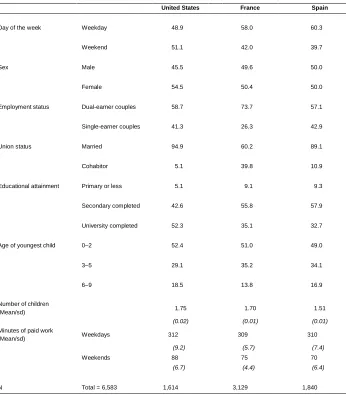
Table 2: Sample description. Percentages/means, by country
United States France Spain
Day of the week Weekday 48.9 58.0 60.3
Weekend 51.1 42.0 39.7
Sex Male 45.5 49.6 50.0
Female 54.5 50.4 50.0
Employment status Dual-earner couples 58.7 73.7 57.1
Single-earner couples 41.3 26.3 42.9
Union status Married 94.9 60.2 89.1
Cohabitor 5.1 39.8 10.9
Educational attainment Primary or less 5.1 9.1 9.3
Secondary completed 42.6 55.8 57.9
University completed 52.3 35.1 32.7
Age of youngest child 0–2 52.4 51.0 49.0
3–5 29.1 35.2 34.1
6–9 18.5 13.8 16.9
Number of children
(Mean/sd) 1.75 1.70 1.51
(0.02) (0.01) (0.01)
Minutes of paid work
(Mean/sd) Weekdays 312 309 310
(9.2) (5.7) (7.4)
Weekends 88 75 70
(6.7) (4.4) (6.4)
N Total = 6,583 1,614 3,129 1,840
(personal care/sleep and paid work) and, for time eligible to be with a partner, daily minutes with (total shared time) and apart from the partner. Next, we examine how time with a partner is distributed among our three dependent variables of interest – total time, exclusive time, and family time – both in total and by weekend/weekday across countries. Finally, we consider more qualitative aspects of time with a partner: what they do with a partner and when they do it. We examine the amount of time spent with a partner in the following activities: housework, childcare, adult care, meals, leisure, watching television, travel, and other activities, as well as the timing of activities done with a partner over the course of the day. The descriptive analyses are followed by multivariate analyses to test the three hypotheses presented above. We pool the time diary data from the three countries and use ordinary least squares (OLS) regression to test for differences between countries for our three shared time-dependent variables, while controlling for characteristics that affect time with a partner.
5. Results
5.1 Descriptive analyses
5.1.1 Time with a partner in the United States, France, and Spain
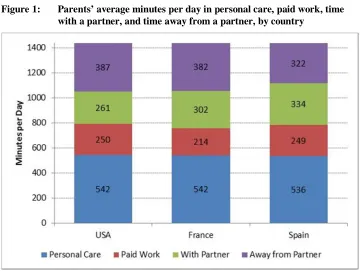
The average daily minutes spent in personal care, paid work, time with a partner, and time away from a partner for parents in the United States, France, and Spain are shown in Figure 1. The time for each country is 1,440 minutes, or 24 hours in a day, and each segment of the bar represents a different type of time use (personal care, paid work, time with a partner, time away from a partner).
Figure 1: Parents’ average minutes per day in personal care, paid work, time with a partner, and time away from a partner, by country
Source: Own calculation, using American Time Use Survey 2010, Enquête Emploi du Temps et Décisions dans les Couples 2009‒
2010, and La Encuesta de Uso del Tiempo 2009‒2010
Figure 2: Parents’ average minutes per day in exclusive time, family time, and other partner time, by country
Source: Own calculation, using American Time Use Survey 2010, Enquête Emploi du Temps et Décisions dans les Couples 2009‒
2010, and La Encuesta de Uso del Tiempo 2009‒2010
Figure 3: Parents’ average minutes per day in exclusive time and family time on weekends and weekdays, by country
Source: Own calculation, using American Time Use Survey 2010, Enquête Emploi du Temps et Décisions dans les Couples 2009– 2010, and La Encuesta de Uso del Tiempo 2009–2010
The dramatic difference between weekday and weekend time with a partner is largely driven by family time (with a partner and children). Family time on weekdays is around 3 hours in Spain (176 minutes), around 2½ hours in the United States (146 minutes) and around 2 hours in France (116 minutes). In each of the three countries, average family time on weekends is more than double the average family time on weekdays. Family time is especially large in Spain on the weekends, resulting in an even larger gap between Spain and the other countries in family time. Spanish couples with children spend nearly 7 hours with partners and children during weekends (411 minutes), which is 56 minutes more than in the United States and 101 minutes more than in France.
5.1.2 Breakdown of time spent with a partner
of the diary day as opposed to the end. Intervals are by the minute in the United States and every 10 minutes for France and Spain. Percentages represent with whom the activity is being done. Orange corresponds to personal care and paid work, which are not considered activities done with a partner in our data. Blue represents time eligible to be with a partner, but not with one’s partner. Time with a partner is then divided into exclusive time, family time (time with a partner and children), and time with a partner and others, excluding children.
Time with a partner over the course of the day reflects the daily schedule in each country, even if the general patterns are very similar. Compared to other countries, daily activities in the United States begin earlier: At 6:00 a.m. almost 20% of the parents are doing an activity eligible to be performed with their partner, though the majority of them are not doing the activity with their partner. The pattern of time shared with a partner in France is more similar to that of the United States than of Spain, but shifted slightly later in the day. In Spain daily activities begin later and also finish later.
There are two peaks in time with one’s partner, concentrated during the two main mealtimes of the day. In the United States lunch is around noon and the proportion of individuals who share time with their partners then is lower than in France and Spain and the peak is not as wide. In France lunch is also around noon and 30% of individuals share time with a partner, with a peak of 32.4% at 12:40 p.m. In Spain the peak for lunchtime is observed at 2:30 p.m., when 42.9% of respondents are with their partner. There is also a higher proportion of individuals in Spain with both a partner and children during lunchtime than in the United States and France.
Figure 4: Tempograms showing the percent and type of time shared with one’s partner, by country
Source: Own calculation, using American Time Use Survey 2010, Enquête Emploi du Temps et Décisions dans les Couples 2009‒
2010, and La Encuesta de Uso del Tiempo 2009‒2010 USA France Spain 0% 10% 20% 30% 40% 50% 60% 70% 80% 90% 100%
5.1.3 Types of activities done with a partner
Table 3 shows the average total time spent in housework, eating, leisure, travel, television, and childcare per day,8 the time shared with a partner during those activities, and the average proportion of total time on the activity that is spent with a partner. Examining specific activities helps us understand some of the qualitative differences in time with a partner between the United States, France, and Spain. Activities such as eating, watching television, and leisure are more commonly done with a partner than housework, travel, and childcare; this pattern is consistent across countries. There are also noteworthy differences. In Spain compared to the United States and France, time shared with a partner is greater in all activities except watching television and the proportion of time with a partner in the activity is also greater. More than half of Spanish parents’ time eating, watching television, and in leisure is spent with a partner. Eating together and watching television are also the most commonly shared activities with a partner in France and the United States. However, total time spent on meals differs considerably. In France and Spain individuals spend around 80 minutes per day, on average, with a partner during meals and the average is only 41 minutes in the United States, which is a by-product of spending much less time overall on meals compared to France and Spain. In contrast, total time with a partner watching television is almost the same in the three countries. But because individuals in the United States spend more time watching television than in Spain and France, the proportion of time spent watching television with a partner is smaller than in the other countries. The French spend more time in non-television leisure but a lower proportion of leisure time is with a partner. Time with a partner during childcare is also lower in France than in the United States and Spain; Spanish couples spend the most time in joint childcare. The proportion of childcare done with a partner is almost the same in the United States and France, but French parents spend less total time in childcare. For Spanish parents, both total time in childcare and the proportion of childcare performed with a partner are higher than among parents in the United States and France.
Table 3: Average total time, time shared with a partner, and proportion of total time spent with a partner per day during specific activities, by country
Activity Time United States France Spain
Housework Total minutes with partner 41 41 53
Total minutes in activity 138 144 138
Proportion (in %) 29.7 28.6 38.2
Eating Total minutes with partner 41 82 76
Total minutes in activity 68 126 108
Proportion (in %) 60.2 64.8 70.5
Leisure Total minutes with partner 55 60 58
Total minutes in activity 110 130 105
Proportion (in %) 49.7 46.3 55.2
Travel Total minutes with partner 20 21 27
Total minutes in activity 75 82 86
Proportion (in %) 26.3 25.9 31.7
TV Total minutes with partner 65 64 62
Total minutes in activity 109 95 86
Proportion (in %) 59.8 68.1 72.4
Childcare Total minutes with partner 37 31 56
Total minutes in activity 118 97 125
Proportion (in %) 31.7 32.4 44.5
Source: Own calculation, using American Time Use Survey 2010, Enquête Emploi du Temps et Décisions dans les Couples 2009‒
2010, and La Encuesta de Uso del Tiempo 2009‒2010
5.2 Multivariate models
understand whether bivariate differences in parents’ shared time across countries remain. Table 4 shows the results from the OLS models estimating the total time, exclusive time, and family time.
Table 4: OLS models for the three measures of time with partner. Minutes per day
Total time with
partner Exclusive time Family time
Model 1 Model 2 Model 3
Country (ref. United States) France 25.027* 50.473*** ‒32.100***
(10.007) (5.221) (8.939)
Spain 71.731*** 34.288*** 34.501***
(8.149) (4.026) (7.699)
Sex (ref. Male) Female ‒62.267*** ‒7.837 ‒50.373***
(10.960) (5.007) (10.160)
Day of the week (ref. Weekday) Weekend 148.570*** 0.886 144.963***
(12.890) (5.715) (12.322)
Employment (ref. Dual earner) Single earner 10.945 2.219 7.174
(10.747) (4.904) (10.027)
Number of children ‒9.482 ‒3.659 ‒4.981
(6.932) (2.821) (6.368)
Education (ref. Primary) Secondary ‒30.655 18.700* ‒49.485*
(24.373) (9.026) (23.462)
Higher ‒8.882 28.978** ‒41.890+
(24.179) (8.904) (23.335)
Marital status (ref. Married) Cohabitor ‒16.091 4.551 ‒20.783
(19.970) (9.979) (17.858)
Age youngest child (ref. 0–2) 2–5 ‒10.520 4.292 ‒19.843+
(11.551) (5.245) (10.485)
6–9 ‒30.447* 14.467+ ‒46.661***
(14.633) (7.729) (14.118)
Paid work ‒0.341*** ‒0.039*** ‒0.294***
(0.023) (0.010) (0.021)
Constant 372.384*** 39.127** 326.988***
(34.110) (12.714) (32.791)
N 6,583 6,583 6,583
R2 0.330 0.029 0.316
Notes:Robust standard errors in parentheses *** p < 0.001, ** p < 0.01, * p < 0.05 + p < 0.1
find support for this hypothesis, with couples in Spain spending 72 more minutes together in total than partnered parents in the United States, and couples in France spending 25 minutes more together than US parents. These differences are very similar to the mean differences across countries; the difference between Spanish and US couples is reduced by 1 minute and the difference between Spanish and French couples is reduced 7 minutes compared to the means in Figure 1. Model 1 also shows that couples with children spend much more time together on weekends compared to weekdays (149 minutes or about 2½ hours more), and every minute in paid work is associated with 0.34 fewer minutes with a partner (20.4 seconds); an 8-hour work day corresponds to 163 fewer minutes with a partner (about 2½ hours). Controlling for the respondent’s time in paid work on the diary day, we find no significant differences between dual- and single-earner couples in time spent with a partner.
Model 2 in Table 4 shows estimates of exclusive shared time for couples with children in the three countries. Our second hypothesis was that parents in the United States would have the least amount of time alone with each other because of less access to public childcare than in France and higher fertility rates than in Spain. Parents in the United States are the most disadvantaged in exclusive time with a partner. French parents spend 50 minutes more alone with each other than US parents, on average, and we observe a 34-minute advantage for Spanish over US parents in exclusive time with a partner. Model 2 also shows that more highly educated parents spend more time alone with each other than less educated parents (19 minutes for those with secondary education and 29 minutes for the most educated).
8-hour day spend over 2¼ 8-hours less (139 minutes) with their partner in family time, on average.
6. Conclusion
From research on specific countries, time with a partner is associated with higher marital satisfaction and couples’ want to spend time with a partner. Yet, contrary to time spent with children, time spent with a partner is a topic relatively unexplored from a cross-country perspective. In this paper we analyzed parents’ time shared with partner in the United States, France, and Spain for parents with children under age 10. Our analysis was limited to this subset of parents for comparability with the available data. Our first research question addressed differences in couples’ shared time across countries. Our results show that time spent with a partner is much higher in Spain than in the United States and France and that parents in the United States spend the least amount of time together. Both French and Spanish couples spend more time alone with each other than US couples, and Spanish couples spend more time with a partner and children than either French or US couples.
We expected that paid work demands would be the primary factor driving differences in time spent with a partner among parents with young children in the United States, France, and Spain (Hypothesis 1), but the observed impact of paid work on couples’ shared time is smaller than expected. As the multivariate models show, how much individuals work explains some of differences observed in family time between the United States and France. But daily work demands do not explain the differences between the United States and Spain; nor does it explain the gap observed in exclusive time between the United States and the two other countries.
Differences in time spent with a partner across countries persist on weekends, when far fewer people work. In each of the three countries we observed more time spent with a partner on weekends, when couples have more free time and fewer work constraints compared to weekdays. But family time is substantially higher on weekends and especially in Spain; the larger amount of time spent with a partner and children in Spain on weekends makes the differences between Spain and the United States and France even more dramatic. These pronounced weekend differences in time spent with a partner suggest that, while paid work may be an important factor determining time spent with a partner across countries, there are other forces at work as well.
what we find. While we are not able to tease out whether higher fertility than Spain or lack of publicly supported childcare is the primary driver of this pattern in the United States, the differences between Spain and France provide some insights. The fertility rate in France is the highest among the three countries we consider ‒ but only slightly higher than that in the United States ‒ and French parents have more exclusive shared time with a partner than parents in the United States and Spain net of differences in time spent working for pay. Our results suggest that the cost of an additional child for couples’ alone time, which is not significant in our model, may be lower than the cost of the context in which one is partnered and parenting. That is, higher fertility does not appear to be driving differences in time alone with a partner among couples in the United States, France, and Spain. Rather, other mechanisms must be at work. Two possible mechanisms, which we alluded to earlier, are publicly supported childcare and norms around parenting. The scarcity of childcare provision in the Spanish welfare state may help explain the large amount of time that Spanish parents spend with their children. Indeed, this finding is consistent with the notion that French parents privilege adult-only time over time with children. It is also possible that the extensive childcare provision in the French welfare state affords French couples greater opportunity to spend time together without children in their company.
Weekend patterns of more exclusive shared time among French compared to Spanish couples and less family time among French compared to Spanish couples, however, undermine the possibility that state-provided childcare facilitates more opportunities for couples to spend time together. If state-provided childcare was the primary factor leading French couples to spend more time alone with each other on weekdays, we would expect weekend differences across countries to be less pronounced. But our descriptive results in the Spanish case suggest that family time (with a partner and children) is dramatically higher on weekends compared to weekdays, though exclusive time is largely unchanged on weekends compared to weekdays. French and US couples’ shared time is quite similar on weekends, with couples in each country spending more time together both alone and as a family. The Spanish and French differences lend partial support for Hypothesis 3 that French parents will spend the least time together as a family. The family-time patterns for France and Spain suggest the importance of the family orientation ideals and time together as a family in Spain. Similarly, in the United States, lower levels of couples’ exclusive shared time on weekdays and weekends compared to France is consistent with the intensive parenting norm, which privileges parents’ time with children.
and suggests a different daily rhythm of time use in each country. In the United States daily activities begin and finish earlier than in France and Spain. US couples spend less time in activities more likely to be shared with a partner (except watching television) than French and Spanish couples, and the proportion of time in specific activities that is shared with one’s partner in the United States is also lower than in Spain and France. In Spain daily activities begin later and end later, and we see a high proportion of couples spending time together late at night. Spanish and French parents spend more time eating and doing leisure activities, which are the things that are most commonly shared with a partner. Shared childcare is also more common in Spain.
The results suggest that differences in parents’ shared time across countries are related to social norms surrounding family and general time use. Spanish society is more family-oriented and places greater emphasis on spending time with family than is the case in France and the United States. Time spent with a partner (and children) is relatively high in Spain, even though typical work schedules do not encourage a balance between work and family life. This is largely achieved through the extended later-day schedule in Spain (evident in tempograms), which facilitates spending time with family in the evening. Contrary to expectations, intensive parenting in the United States does not result in children spending more time with both parents at the same time compared to the situation in France and Spain, despite US parents doing more single-parenting, on average, per day (3 hours and 52 minutes per day with children and without a partner, which is 1 hour and 25 minutes more than in Spain and 1 hour and 33 minutes more than France, on average). Similarly, meals are a less common primary activity in the United States, and this is when relatively large amounts of time are spent with family.
Román and Cortina 2016; Freedman et al. 2012). Furthermore, even if the wording of specific questions affects our estimates of differences between the United States and France and Spain, the differences are substantial and it is unlikely that they are attributable only to the wording of questions.
A data-driven limitation of our study is the focus on families with children under 10. Unfortunately, the Spanish data does not distinguish between children over 10 and other household members, which means that we cannot generalize our findings to all parents. Nonetheless, our analysis is inclusive of many families in the countries analyzed.9 Additionally, the results observed are similar to those obtained for a broader set of families. Sensitivity analyses using data from the United States and France for couples with children under 18 yield similar estimates of total shared time.10
In conclusion, time with a partner is associated with several different factors. There are constraints, such as paid work, that limit the time available to spend with a partner. However, there are differences as well that appear to be rooted more in norms about family life and the cultural rhythms of daily life, such as the importance of meals and how non-work time is allocated.
7. Acknowledgments
This study was supported by the Minnesota Population Center at the University of Minnesota (HD041023) and the Data Extract Builder of the American Time Use Survey (University of Maryland, HD053654), both funded through grants from the Eunice Kennedy Shriver National Institute for Child Health and Human Development (NICHD).
9
In the United States and France, respectively, 42% and 47% of families with children under 18 have only children under 10.
10
References
Aguiar, M. and Hurst, E. (2007). Measuring trends in leisure: The allocation of time over five decades. Quarterly Journal of Economics 122(3): 969‒1006.
doi:10.1162/qjec.122.3.969.
Alberdi, I. (1999).La nueva familia española. Madrid: Grupo Santillana de Ediciones, S.A.
Amato, P.R. (2000). The consequences of divorce for adults and children. Journal of
Marriage and Family 62(4): 1269–1287. doi:10.1111/j.1741-3737.2000.012
69.x.
Anxo, D., Mencarini, L., Pailhé, A., Solaz, A., and Flood, L.R. (2011). Gender differences in time use over the life course in France, Italy, Sweden and the US.
Feminist Economics17(3): 159‒195.doi:10.1080/13545701.2011.582822.
Arts, W. and Gelissen, J. (2002). Three worlds of welfare capitalism or more? A state-of-the-art report.Journal of European Social Policy 12(2): 137‒158.doi:10.117 7/0952872002012002114.
Baizán, P., Domínguez, M., and González, M.J. (2014). Couples bargaining or socio-economic status?European Societies 16(1): 3‒27.doi:10.1080/14616696.2013. 859717.
Barnet-Verzat, C., Pailhé, A., and Solaz, A. (2011). Spending time together, the impact of children on couples’ leisure synchronization. Review of Economics of the Household 9(4): 465–486.doi:10.1007/s11150-010-9112-3.
Bianchi, S.M. (2011). Family change and time allocation in American families.Annals
of the American Academy of Political and Social Science 638(1): 21‒44.
doi:10.1177/0002716211413731.
Bianchi, S.M., Robinson, J.P., and Milkie, M.A. (2006). Changing the rhythms of American family life. New York: Russell Sage Foundation.
Bianchi S.M., Sayer L.C., Milkie, M., and Robinson, J.P. (2012). Housework: Who did, does or will do it, and how much does it matter? Social Forces 91(1): 55‒63.
doi:10.1093/sf/sos120.
Craig, L. and Mullan, K. (2013). Parental leisure time: A gender comparison in five countries.Social Politics 20(3): 329‒357.doi:10.1093/sp/jxt002.
Craig, L. and Mullan. K. (2010). Parenthood, gender and work-family time in the United States, Australia, Italy, France, and Denmark. Journal of Marriage and Family 72(5): 1344‒1361.doi:10.1111/j.1741-3737.2010.00769.x.
Daly, K.J. (2001). Deconstructing family time: From ideology to lived experience.
Journal of Marriage and Family 63(2): 283–294. doi:10.1111/j.1741-3737.20
01.00283.x.
Dew, G. (2009). Has the marital time cost of parenting changed over time? Social Forces 88(2): 519‒541.doi:10.1353/sof.0.0273.
Esping-Andersen, G. (1999).Social foundations of post-industrial economies. Oxford: Oxford University Press.doi:10.1093/0198742002.001.0001.
Esping-Andersen, G. (1997). Hybrid or unique? The Japanese welfare state between Europe and Americas. Journal of European Social Policy 7(3): 179‒189.
doi:10.1177/095892879700700301.
Esping-Andersen, G., Boertien, D., Bonke, J., and Gracia, P. (2013). Couple specialization in multiple equilibria.European Sociological Review 29(6): 1280‒ 1294.doi:10.1093/esr/jct004.
Fagnani, J. and Letablier, M.T. (2005). Social rights and care responsibility in the French welfare state. In Pfau-Effinger, B. and Geissler, B. (eds.). Care and
social integration in European societies. Bristol: Policy Press: 135‒152.
doi:10.1332/policypress/9781861346049.003.0007.
Flood, S. and Genadek, K. (2016). Time for each other: Work and family constraints among couples. Journal of Marriage and Family 78(1): 142‒164. doi:10.1111/ jomf.12255.
Folbre, N. and Yoon, J. (2007). What is child care? Lessons from time-use surveys of major English-speaking countries.Review of Economics of the Household 5(3): 223‒248.doi:10.1007/s11150-007-9012-3.
García-Román, J. (2013). El tiempo con la familia en las parejas de doble ingreso. Un análisis a partir de la Encuesta de Empleo del Tiempo 2009‒2010.Estadistica Española 55(182): 259‒282.
García-Román, J. and Cortina, C. (2016). Family time of couples with children: Shortening gender differences in parenting? Review of Economics of the Household14(4): 921–940.doi:10.1007/s11150-015-9315-8.
Genadek, K., Flood, S., and Garcia-Roman, J. (2016). Trends in partner’s shared time in the United States, 1965–2012.Demography53(6): 1801–1820.doi:10.1007/s13 524-016-0512-8.
Gershuny, J. (2000). Changing times, work and leisure in postindustrial society. Oxford: Oxford University Press.
Gestel, N. and Sarkisian, N. (2006). Marriage, the good, the bad, and the greedy.
Contexts 5(4): 16–21.doi:10.1525/ctx.2006.5.4.16.
Glorieux, I., Minnen, J., and van Tienoven, T. (2011). Partner together time, quality time within the household. Social Indicators Research 101(2): 281–287.
doi:10.1007/s11205-010-9648-x.
Gracia, P. and Kalmijn, M. (2016). Parents’ family time and work schedules: The split-shift schedule in Spain. Journal of Marriage and Family 78(2): 401–415.
doi:10.1111/jomf.12270.
Greenhaus, J. and Beutell, N. (1985). Sources of conflict between work and family roles.The Academy of Management Review10(1): 76–88.
Gutierrez-Domenech, M. (2010). Parental employment and time with children in Spain.
Review of Economics of the Household 8(3): 371–391. doi:10.1007/s11150-010-9096-z.
Hallberg, D. and Klevmarken, A. (2003). Time for children: A study of parent’s time allocation. Journal of Population Economics 16(2): 205–226. doi:10.1007/s00 1480200133.
Hammermesh, D. (2002). Timing togetherness and time windfalls. Journal of Population Economics 15(4): 601–623.doi:10.1007/s001480100092.
Hill, M.S. (1988). Marital stability and spouses’ shared time: A multidisciplinary hypothesis. Journal of Family Issues 9(4): 427–451.doi:10.1177/01925138800 9004001.
Hofferth, S.L., Flood, S.M., and Sobek, M. (2013). American Time Use Survey Data Extract System: Version 2.4 [Machine-readable database]. Maryland Population Research Center, University of Maryland, College Park, Maryland, and Minnesota Population Center, University of Minnesota, Minneapolis, Minnesota.
http://www.atusdata.org.
Hook, J.L. (2006). Gender inequality in the welfare state: Sex segregation in housework, 1965‒2003. American Journal of Sociology 115(5): 1480‒1523.
doi:10.1086/651384.
Hook, J.L. and Wolfe, C. (2013). Parental involvement and work schedules: Time with children in the United States, Germany, Norway, and the United Kingdom.
European Sociological Review 29(3): 411‒425.doi:10.1093/esr/jcr081.
Huston, T.L. and Vangelisti, A.L. (1995). How parenthood affects marriage. In Fitzpatrick, M.A. and Vangelisti, A.L. (eds.). Explaining family interactions. Thousand Oaks: Sage: 147–176.doi:10.4135/9781483326368.n5.
Institut National de la Statistique et des Études Économiques (2011). Enquête emploi du temps 2009‒2010. Paris: INSEE.
Instituto Nacional de Estadística (2011). Encuesta de empleo del tiempo 2009‒2010. Madrid: INE.
Kalmijn, M. (2010). Racial differences in the effects of parental divorce and separation on children: Generalizing the evidence to a European case.Social Science Research 39(5): 845‒856.doi:10.1016/j.ssresearch.2010.05.002.
Kalmijn, M. and Bernasco, W. (2001). Joint and separated lifestyles in couple relationships. Journal of Marriage and Family 63(3): 639–654. doi:10.1111/ j.1741-3737.2001.00639.x.
Kingston, P.W. and Nock, S.L. (1987). Time together among dual-earner couples.
American Sociological Review 52(3): 391–400.doi:10.2307/2095358.
Lesnard, L. and Chenu, A. (2006). Parental Trends and Predictors in France: 1965‒ 1999. In Bianchi, S.M., Robinson, J.P., and Milkie, M.A. (eds.). Changing Rhythms of American family life. New York: Russell Sage Foundation: 200‒203.
Lesthaeghe, R. (1995). The second demographic transition in Western countries: An interpretation. In Oppenheim Mason, K. and Jensen, A.-M. (eds.). Gender and family change in industrialized countries.Oxford: Clarendon Press: 17‒62.
Lewis, J., Knijn, T., Martin, C., and Ostner, I. (2008). Patterns of development in work/family reconciliation policies for France, Germany, The Netherlands, and the UK in the 2000s.Social Politics 15(3): 261‒286.doi:10.1093/sp/jxn016.
Mansour, H. and McKinnish, T. (2014). Couples’ time together: complementarities in production versus complementarities in consumption. Journal of Population Economics 27(4): 1127‒1144.doi:10.1007/s00148-014-0510-3.
Mattingly, M.J. and Sayer, L.C. (2006). Under pressure: Gender differences in the relationship between free time and feeling rushed. Journal of Marriage and Family68(1): 205–221.doi:10.1111/j.1741-3737.2006.00242.x.
Mullan, K. and Craig, L. (2009). Harmonising extended measures of parental childcare in the time-diary surveys of four countries: Proximity versus responsibility.
Electronic International Journal of Time Use Research 6(1): 48‒72.
doi:10.13085/eIJTUR.6.1.48-72.
O’Connor, J., Orloff, A., and Shaver, S. (1999). States, markets, families: Gender, liberalism and social policy in Australia, Canada, Great Britain and the United
States. Cambridge: Cambridge University Press. doi:10.1017/cbo9780511597
114.
Pfau-Effinger, B. (1999). Change of family policies in the socio-cultural context of European Societies.Comparative Social Research 18: 135‒159.
Pfau-Effinger, B., Flaquer, L., and Jensen, P.H. (eds.) (2009). Formal and informal work in Europe: The hidden work regime. London & New York: Routledge.
Presser, H.B. (1988). Shift work and child care among young dual-earner American parents. Journal of Marriage and the Family 50(1): 133‒148. doi:10.2307/ 352434.
Sayer, L.C., Bianchi, S., and Robinson, J. (2004). Are parents investing less in children? Trends in mothers’ and fathers’ time with children.American Journal of Sociology110(1): 1‒43.doi:10.1086/386270.
Sayer, L.C. and Gornick, J.C. (2012). Cross-national variation in the influence of employment hours on child care time. European Sociological Review 28(4): 421‒442.doi:10.1093/esr/jcr008.
Sevilla-Sanz, A., Gimenez-Nadal, J.I., and Fernandez, C. (2010). Gender roles and the division of unpaid work in Spanish households.Feminist Economics 14(4): 137– 184.doi:10.1080/13545701.2010.531197.
Sevilla, A., Gimenez-Nadal, J.I., and Gershuny, J. (2012). Leisure Inequality in the United States: 1965–2003. Demography 49(3): 939‒964. doi:10.1007/s13524-012-0100-5.
Strohschein, L. (2005). Parental divorce and child mental health trajectories.Journal of
Marriage and Family 67(5): 1286–1300. doi:10.1111/j.1741-3737.2005.0021
7.x.
Sullivan, O. (1996). Time co-ordination, the domestic division of labour and affective relations: Time use and the enjoyment of activities within couples. Sociology
30(1): 79–100.doi:10.1177/0038038596030001006.
Voorspostel, M., Van der Lippe, T., and Gershuny, J. (2009). Trends in free time with a partner: A transformation of intimacy? Social Indicators Research 93(1): 165– 169.doi:10.1007/s11205-008-9383-8.
Wight, V., Raley, S., and Bianchi, S. (2008). Time for children, one’s spouse and oneself among parents who work nonstandard hours.Social Forces 87(1): 243– 271.doi:10.1353/sof.0.0092.
Windbank, J. (2001). Dual-earner couples in Britain and France: Gender divisions of domestic labour and parenting work in different welfare states. Work,
Employment and Society 15(2): 269–290.doi:10.1177/09500170122118959.