Please cite this article as: A. H. Mohammed, R. D. khalaf , T. K. Mohammedali, A. K. Hussin, Experimental Study on Performance of Fiber Concrete-filled Tube Columns under Axial Loading, International Journal of Engineering (IJE), IJE TRANSACTIONS C: Aspects Vol. 32, No. 12, (December 2019) 1726-1732
International Journal of Engineering
J o u r n a l H o m e p a g e : w w w . i j e . i rExperimental Study on Performance of Fiber Concrete-filled Tube Columns under
Axial Loading
A. H. Mohammed*, R. D. khalaf, T. K. Mohammedali, A. K. Hussin
Department of Civil Engineering, University of Diyala, Diyala, Iraq
P A P E R I N F O
Paper history:
Received 20 September 2019
Received in revised form 20 October 2019 Accepted 08 November 2019
Keywords: Steel Tube Concrete Steel Fiber Axial Loading Columns Composite
A B S T R A C T
There have been great developments in the area of civil engineering in the recent few decades and among these, construction and material innovation are quite prominent. Steel-concrete composite construction has emerged as one of the fastest methods of construction. Even though considerable research efforts on conventional reinforced concrete columns have been executed prior to now, concrete filled steel tube (CFST) composite columns however have received limited attention. This work aims to study the experimental behavior of steel tubular specimens. Plastic and steel specimens are considered with circular and square sections filled with the concrete with the steel fiber and as well, plain concrete. Four parameters are considered in this study which are sectional designs (circular and square), tube thickness (2 and 5 mm), tube material (plastic and steel) and content of steel fiber (0 and 5%). Ten concrete filled steel tubular columns were cast and tested. Two circular columns were made from plastic and the other made from steel. The main purpose of this work are study the effect of steel fiber and cross section on the ultimate load capacity of columns. It was discovered the utilization of steel fiber reinforced concrete filled steel tubular columns have comparatively substantial stiffness in comparison with plain concrete filled columns.
doi: 10.5829/ije.2019.32.12c.05
1. INTRODUCTION1
In residential models ın which area value is at a superior, any cost savings in floor area will be of considerable benefit in both conditions of cost of the construction of floor and enhanced usage of resources. With this in view, a number of the improvements that are popular in the basement floors for parking goal to be able to climb above land / space scarcity, are utilization of steel in columns for decrease in region in comparison to concrete and utilization of steel-concrete composite offsetting a number of the costs in employing steel totally.
In composite construction, the steel sections assist the primary construction loads, such as the weight of structure within the construction. Concrete is eventually cast surrounding the steel sections, or filled inside tubular sections. The steel and concrete are compounded in such a combination which the benefits of both components are
*Corresponding Author Email: [email protected] (A. H. Mohammed)
used successfully in composite column. To be able to seriously assess the exploration works done in the region of concrete filled steel tubular composite columns, a detailed report on literature with regards to CFST column has been carried out .
CFST is dependent on the material of tube, shape of section and type of concrete. In general, a circular CFST under axial loading will have the good confinement effect. For a square CFST, however, the confining stresses in the concrete are non-uniform. Addition of the steel fiber to the cocrete lead to change the properties of concrete. Nevertheless, for functional reasons, the CSFT often has to be square. Therefore, need to study the performance and behavior of square CFST in terms of strength and study the performance of fiber CFST.
loading. The concrete strengths utilized were 35 as well as, 92 MPa with a load eccentricity of 20 mm. crucial variables which include concrete strength, concrete as well as, steel strains, cracking, mid height deflection, and loading rate were researched. It was noticed the high strength concrete (HSC) columns exposed to short term loading exhibited much less ductility and had extra immediate failures compared to the normal strength concrete (NSC) column .
Investigators like Elremaily and Azizinamini [2] explored the performance of composite column within seismic loads were by examining 6 specimens exposed to an axial load. Experiments were carried out for cyclic lateral loads. An analytic model was created to forecast the capability of circular CFST columns- beam counting for the connection between the concrete and steel. They concluded that the column capability had considerably advanced due as a result of concrete strength obtained from confinement supplied by the steel tube .
Sakino et al. [3] examined an overall of 114 composite column in the experimental research on centrally loaded CFT short composite column and hollow. The targets of the testing were to research the restraining impact of the concrete fill on local buckling of the steelltube wall and the confining impact of steel tubes on concrete strength, as well as obtain techniques to assess supreme load and load-deformation relationships. Another interesting investigation was carried out by Kuranovas and Kvedaras [4]. They used steel circular hollow sections (CHS) for their investigation. Theoretical and experimental research demonstrated that conduct of hollow steel tube elements was more advanced than that of solid ones. They likewise mentioned the Poisson’s ratio of the CFST and as well, concrete columns, and found that the average value of Poisson’s ratio for steelttube was 0.28 and that of the concrete column was observed to become close to equal to 0.175 .
Dalin Liu [5] carried out testing employing 22 specimens in 4 series which were created and as well, examined in the investigation programme. The author recommended that the rectangular steel hollow sections were completely regarded as ineffectve as opposed to circular ones in relation to supplying confinement to the concrete core .
Han et al. [6] experimentally researched the conduct of concrete filled steel tubular stub columns which were exposed to axial compression. An overall total of thirty-two specimens were examined. The authors concluded that the bigger the end plate thickness, the higher the strength index (SI) and ductility index (DI) .
Gopal and Manoharan [7] conducted experimental research of 12 slender steel tubular columns of circular sections filled with both plain and fibre reinforced concrete. The composite columns were examined under
eccentric compression to review the consequence of fibre reinforced concrete on the strength and as well, conduct of slender specimens.
Rahmani et al. [8] modeled thirteen HSPCE-CFST beams by ABAQUS software. The study include the steel yield strength, compressive strength of concrete and the tube diameter to width of section ratio. The results confirm that increasing the tube diameter to width of section ratio leads a minorr increase in the ultimate bendingi moment .
Wayghan et al. [9] studied the effect of size of spiral, spiral pitch, concrete cover, concrete strength, longitudinal rebar area and column diameter on the confinement and therefore increase of compressive axial capacity of the concrete column reinforced with GFRP rebar. They found the declining the column diameter from 1000 mm to 250 mm, increased the contribution percentage parameter by 33.2%.
Abdulsattar and Al-Baghdadi [10] presented an experimental program for strengthening columns against axial loads. Alkufi and Al-Sherrawi [11] investigated an experimental program to find the beneficialeeffect of adding steel fiber to reinforcedcconcrete square columns. The resultssshowed that increasing steellfiber ratio is caused aniincreasing in the first crackinglload and an increase in the ultimatelload for all tested columns .
Askari et al. [12] studied the UPVC columns reinforced with polypropylene fiber, they found that the fibers increase the strength of columns. Gholampour and Ozbakkaloglu [12] presented an experimental and analytical study for the behavior of confined steel fiber-reinforced concrete. Lu et al. [13] study the effect of polypropylene-steel fiber on the axial loading behavior of CFST, the result shown that the hybrid fiber has negligible effect on the ultimate capacity and failure mode. The structural performance of concrete-filled FRP tube with a hybrid steel/glass fiber reinforced tube was investigated by Hain et al. [14], they found the hybrid concrete-filled FRP tube specimens exhibited lower degradations in stiffness and higher energy absorption .
2. EXPERIMENTAL PROGRAM
Steel tubular sections or hollowssections are the mainly successful of all the structural steellsections in resisting compression. Their supply with the considerable yield strength gives them a highsstrength to weight ratio and as well, make them an all-natural choice for building structures. By filling hollow sections with concrete, a composite section is developed (see Figure 1), which is popularlyiknown as ConcreteeFilled Steel Tubular (CFST).
In the current experimental study, the variables of the testing composite columns are sectional types (circular and square), tube thickness (2 and 5 mm), tube material (plastic and steel) and content of steel fiber (0 and 5%). Two shapes of columns such as circular and square were utilized. Also, steel tubes of different thickness of 2 mm, 5 mm were utilized as displayed in Table 1. The height of all columns are 300 mm.
The designed and adopted concrete mix proportion was 1:2:2.3. A constant water cement ratio of 0.55 was utilized. The same mix was used for all types of concrete.
Figure 1. Section in concrete filled steel tubular columns
TABLE 1. Details of specimens
Specimen No.
Shape of Column
Thickness (mm)
Tube material
Steel Fiber content by volume (%)
CS-2-0
Circle
100 mm Dia.
2 Steel ــــــــ
CS-2-1 2 Steel 0.5
CP-5-0 5 Plastic ــــــــ
CP-5-1 5 Plastic 0.5
CS-5-0 5 Steel ــــــــ
CS-5-1 5 Steel 0.5
RS-2-0
Square 100*100 mm
2 Steel ــــــــ
RS-2-1 2 Steel 0.5
RS-5-0 5 Steel ــــــــ
RS-5-1 2 Steel 0.5
The physical properties of steel fiber, steel tube and plastic tube are listed in Table 2.
Cylinders of size 150 mm diameter and 300 mm height were cast for compressive strength test. The compressive strength of the concrete is very important, since concrete is very good in compression. Table 3 displays the compressive strength of the concrete.
Experiments were conducted on composite columns, to be able to identify the supreme axial load carrying capability of the columns and likewise to review the also to study the mode of failure and deflection characteristics of them. Axial loading was applied on concrete filled steel tubular columns of height 300 mm.
3. TEST RESULTS AND DISCUSSION
The findings of strength testing executed on composite columns of structural column components are presented in this section, the behavior of columns for conventional concrete and partial added steel fibers to the conventional concrete under axial loading are also presented and discussed. Evaluation results are shown in Table 4 form the axial load test.
Table 4 show the results for circular and square columns of 100 mm in diameter with 2 and 5 mm thickness and with a height 300 mm.
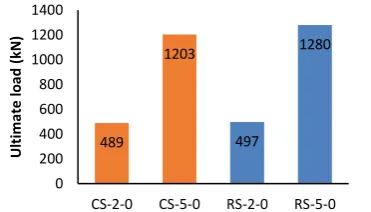
3. 1. Shape Effects on Ultimate Load Figure 2 shows the ultimate load for steel composite columns with normal concrete. From this figure, can be found the ultimate load for circular specimens are 489 kN and 1203 kN when the thickness is 2 mm and 5mm, respectively. The ultimate load for square specimens are 497 kN and 1280 kN when the thickness is 2 mm and 5mm,
TABLE 2. physical properties of steel fiber, stel tube and plastic tube
Modulus of elasticity
(GPa)
Yield tensile stress (MPa)
Ultimate tensile strength (fy)(MPa)
Density (g/cm3)
Steel
fiber 210 1200 ــــــ 7.85
Steel
tube 200 410 ــــــ 7.85
Plastic
tube 2.9 ــــــ 51.4 ــــــ
TABLE 3. Compressive strength of the concrete
Concrete 𝒇𝒄′ (MPa)
Normal concrete 33.3
TABLE 4. Ultimate load for specimens
Specimen No. Ultimate load (kN)
CS-2-0 489
CS-2-1 505
CP-5-0 286
CP-5-1 304
CS-5-0 1203
CS-5-1 1219
RS-2-0 497
RS-2-1 558
RS-5-0 1280
RS-5-1 1340
respectively. The ultimate load for square specimens are higher than circular about 1.6 % and 6.4 % when the thickness is form 2 mm to 5mm, respectively.
3. 2. Effect of Steel Fiber on Ultimate Load Figure 3 shows the ultimate load for circular steel specimens with normal concrete and concrete with steel fiber. From this figure, can be found the ultimate load for 5 mm circular columns normal concrete is 1203 kN and for 5 mm circular columns with fiber steel is 1219 kN the
Figure 2. Ultimate load for steel specimens with normal concrete
Figure 3. Ultimate load for circular steel specimens with normal concrete and concrete with steel fiber
increase in capacity by 1.3 %, and for 2 mm circular columns the capacity increase by 3.2 %.
Figure 4 depicts the ultimate load for square steel specimens with normal concrete and concrete with steel fiber. From this figure, can be found the ultimate load for 5 mm square columns normal concrete is 1280 kN and for 5 mm square columns with fiber steel is 1340 kN the increase in capacity by 4.6 %, and for 2 mm the capacity increase by 12.27 %.
Figure 5 shows the ultimate load for circular plastic specimens with normal concrete and concrete steel fiber. From this figure, can be found the ultimate load for 5 mm circular plastic normal concrete are 286 kN and with fiber steel are 304 kN The ultimate load are increased 6.3 % when we added steel fiber to normal concrete.
3. 3. Effect of Tubes Material on Ultimate Load The ultimate load for circular plastic specimens and circular steel specimens with normal concrete are shown in Figure 6. From this figure, can be found the ultimate load for circular steel specimens are 489 kN and for circular plastic are 286 kN. The ultimate load are increased about 71 %.
Figure 7 shows the ultimate load for circular plastic specimens and circular steel specimens with steel fiber. From this figure, can be found the ultimate load for circular steel specimens are 505 kN and for circular plastic are 304 kN. The ultimate load are increased about 66 %.
Figure 4. Ultimate load for square steel specimens with normal concrete and concrete with steel fiber
Figure 5. Ultimate load for circular plastic specimens with normal concrete and concrete with steel fiber
489
1203
497
1280
0 200 400 600 800 1000 1200 1400
CS-2-0 CS-5-0 RS-2-0 RS-5-0
Ul
tim
ate
lo
ad
(
kN
)
489
1203
505
1219
0 200 400 600 800 1000 1200 1400
CS-2-0 CS-5-0 CS-2-1 CS-5-1
(U
lt
im
at
e
load
(kN
497
1280
558
1340
0 500 1000 1500
RS-2-0 RS-5-0 RS-2-1 RS-5-1
U
lt
im
at
e
load
(kN
)
286
304
275 280 285 290 295 300 305 310
CP-5-0 CP-5-1
U
lt
im
at
e
load
(kN
Figure 6. Ultimate load for circular plastic specimens and circular steel specimens with normal concrete
Figure 7. Ultimate load for circular plastic specimens and circular steel specimens with steel fiber
3. 4. Effect of Tube Thickness on Ultimate Load The ultimate load for square steel specimens are shown in Figure 8. From this figure, can be found the ultimate load for square specimens with normal concrete are increased from 497 kN to 1280 kN when the thickness is increased form 2 mm to 5mm respectively. And the ultimate load for square specimens with fiber steel are increased from 558 kN to 1340 kN when the thickness is increased form 2 mm to 5mm, respectively. The ultimate load are increased about 158 % and 140 % when the thickness is increased form 2 mm to 5mm for square with normal concrete and square with fiber steel specimens respectively.
Figure 8. Ultimate load for square steel specimens
Figure 9 shows the ultimate load for circular steel specimens. From this figure, can be found the ultimate load for circular specimens with normal concrete are increased from 489 kN to 1203 kN when the thickness is increased form 2 mm to 5mm, respectively. The ultimate load for circular specimens with fiber steel are increased from 505 kN to 1219 kN when the thickness is increased form 2 mm to 5mm, respectively. The ultimate load are increased about 146 % and 141 % when the thickness is increased form 2 mm to 5mm for circular with normal concrete and circular with fiber steel specimens, respectively.
It is observed that the CFST columns with concrete with steel fiber are stiffer than normal mix concrete columns.
The loads at failure circular steel section 2 mm for normal concrete (CS-2-0) are 489 kN and 497 kN for square (RS-2-0) gives a ratio of 1.016 for load. This means a 1.6 % increase in load for the change in shape of similar size columns that because the cross area of circular column is 78.54 cm2 and area of square column is 100 cm2 giving a ratio of 1.273 for area, this means a 27.3 % increase in area.
For 5 mm square columns normal concrete the ultimate load (RS-5-0) is 1280 kN and for 5 mm square columns with fiber steel (RS-5-1) is 1340 kN. Fiber concrete fill shows a different as compared to other columns, load increase due to material fill has a higher bearing.
The failure patterns for all columns fall as pure compression. Stiffness values at yield, ultimate and failure for circular columns plastic are lower than circular steel and square. Variations are clearly seen with materials ranging from a low value of ultimate load 304 kN (CP-5-1) and circular steel tube has 505 kN (CS-2-1), this means a 66 % increase in capacity .
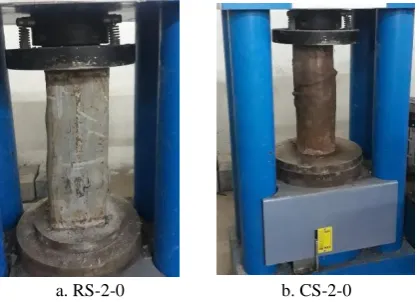
3. 5. Failure Modes The failure modes of the RS-2-0 and CS-2-RS-2-0 columns are illustrated in Figure 1RS-2-0. The typical failure mode was local materialssfailure; specimen CS-2-0 showed concentratedlareas of local failure, in contrast to specimen RS-2-0. Specimen RS-2-
Figure 9. Ultimate load for circular steel specimens
489
286
0 100 200 300 400 500 600
CS-2-0 CP-5-0
U
lt
im
at
e
load
(kN
)
505
304
0 100 200 300 400 500 600
CS-2-1 CP-5-1
(U
lt
im
at
e
load
(kN
)
497
1280
558
1340
0 200 400 600 800 1000 1200 1400 1600
RS-2-0 RS-5-0 RS-2-1 RS-5-1
U
lt
im
at
e
load
(kN
)
489
1203
505
1219
0 200 400 600 800 1000 1200 1400
CS-2-0 CS-5-0 CS-2-1 CS-5-1
U
lt
im
at
e
load
(kN
0 haveemore one local that due to the square shape. The difference in failure modes between square and circular specimens explains the difference in the transitionffrom pre-peak region to post-peak region thesesspecimens, as shown in Figure 10. The shear failure mode was not observed, this may be due to the greater confinement provided by the steel tube.
a. RS-2-0 b. CS-2-0
Figure 10. Ultimate load for steel specimens
4. CONCLUSIONS
The present study is aimed in this direction and focuses attention on hollow steel columns filled with concrete using different types of materials, ranging from plain concrete to fiber steel for environmental sustainability. Both hollow circular and square sections of steel tubes of length 300 mm was taken in 10 specimens. These were tested under compression. The main purpose of this work are study the effect of steel fiber and cross section on the ultimate load capacity of columns. Depending on these considerable experimental, essential findings have been reached and they are the following:
1. For specimens with concrete filled circular sections, the confinement impact of concrete enhances the resistance to axial load.
2. The buckling failure can be prevented and the load carrying capacity can be improved by decreasing the slenderness ratio for CFST columns.
3. The deflection is low, where L/D ratio is 3 compared with the ratios of 6 and 9 in another research respectively.
4. Plastic tube is weaker than steel tube by 450 %. 5. Addition of fiber steel in concrete influences the load
carrying capacity of composite columns at all the salient stages such as yielding and ultimate. 6. Ultimate load capacity of CFST column square shape
is higher than circular specimen which is filled by the same infill materials.
7. The local buckling of steel tube gets delayed due to the infilled concrete.
5. REFERENCES
1. Claeson, C. and Gylltoft, K., "Slender concrete columns subjected to sustained and short-term eccentric loading", Structural Journal, Vol. 97, No. 1, (2000), 45-52.
2. Elremaily, A. and Azizinamini, A., "Behavior and strength of circular concrete-filled tube columns", Journal of Constructional Steel Research, Vol. 58, No. 12, (2002), 1567-1591.
3. Sakino, K., Nakahara, H., Morino, S. and Nishiyama, I., "Behavior of centrally loaded concrete-filled steel-tube short columns", Journal of Structural Engineering, Vol. 130, No. 2, (2004), 180-188.
4. Kuranovas, A. and Kvedaras, A.K., "Behaviour of hollow concrete‐filled steel tubular composite elements", Journal of Civil Engineering and Management, Vol. 13, No. 2, (2007), 131-141.
5. Liu, D., "Tests on high-strength rectangular concrete-filled steel hollow section stub columns", Journal of Constructional Steel Research, Vol. 61, No. 7, (2005), 902-911.
6. Han, L.-H., Liu, W. and Yang, Y.-F., "Behaviour of concrete-filled steel tubular stub columns subjected to axially local compression", Journal of Constructional Steel Research, Vol. 64, No. 4, (2008), 377-387.
7. Gopal, S.R. and Manoharan, P.D., "Experimental behaviour of eccentrically loaded slender circular hollow steel columns in-filled with fibre reinforced concrete", Journal of Constructional Steel Research, Vol. 62, No. 5, (2006), 513-520.
8. Rahmani, Z., Naghipour, M. and Nematzadeh, M., "Flexural performance of high-strength prestressed concrete-encased concrete-filled steel tube sections", International Journal of Engineering, Vol. 32, No. 9, (2019), 1238-1247.
9. Wayghan, A.R.T., Mofid, M., Ravandi, B.B. and Yazdi, S.M.Z., "Increasing the contribution of gfrp bars on the compressive strength of concrete columns with circular cross section", Civil Engineering Journal, Vol. 5, No. 8, (2019), 1850-1862. 10. Abdulsattar, A.W. and Al-Baghdadi, H.A., "Circularization
technique for strengthening of plain concrete short square columns subjected to a uniaxial compression compressive pressure", Civil Engineering Journal, Vol. 5, No. 3, (2019), 636-648.
11. Alkufi, H.A. and Al-Sherrawi, M.H., "Efficiency of steel fiber on carrying capacity of short square columns", Civil Engineering Journal, Vol. 4, No. 7, (2018), 1584-1594.
12. Askari, S.M., Khaloo, A., Borhani, M.H. and Masoule, M.S.T., "Performance of polypropylene fiber reinforced concrete-filled upvc tube columns under axial compression", Construction and Building Materials, Vol. 231, (2020), 117049. DOI: 10.1016/j.conbuildmat.2019.117049
13. Lu, Y., Liu, Z., Li, S. and Hu, J., "Axial compression behavior of hybrid fiber reinforced concrete filled steel tube stub column",
Construction and Building Materials, Vol. 174, (2018), 96-107. 14. Hain, A., Zaghi, A.E. and Saiidi, M.S., "Flexural behavior of hybrid concrete-filled fiber reinforced polymer tube columns",
Experimental Study on Performance of Fiber Concrete-filled Tube Columns under
Axial Loading
A. H. Mohammed, R. D. khalaf, T. K. Mohammedali, A. K. Hussin
Department of Civil Engineering, University of Diyala, Diyala, Iraq
P A P E R I N F O
Paper history:
Received 20 September 2019
Received in revised form 20 October 2019 Accepted 08 November 2019
Keywords: Steel Tube Concrete Steel Fiber Axial Loading Columns Composite
هديكچ
ریخا ههد رد نارمع یسدنهم ملع ریگمشچ هعسوت زاس و تخاس یارب داوم یزولونکت یروآون
عیرس تشاد هارمهب ار ه
تیزوپمک
شور دلاوف دنوش یم بوسحم عیرس زاس و تخاس
لاکشا هب هک هدیدرگ زکرمت یا هریاد
.تسا زا هدشرپ یدلاوف نوتس هب
.تسا هدش یکدنا هجوت نتب لکش یا هناوتسا یدلاوف نوتس
آ دروم نتب زا هدش رپ یا هریاد نوتس و .تسا هتفرگ رارق شیامز
ت رفص اب هارمه نتب لصا رد ا
5 تسا هدش رپ دلاوف فایلا دصرد نتب اب هک لیتسا یا هلول نوتس یور رب یبرجت راک هلاقم نیا .
ش زکرمتم تسا هارمه دلاوف فایلا اب ن .تسا هد
طاقم تروصب دلاوف و کیتسلاپ یاه هنوم ع
فایلا ریثات هلاقم نیا یلصا فده
تب یدلاوف .دشاب یم لکش یا هناوتسا نوتس رد هداس نتب اب نآ هسیاقم و حلسم ن