Vol. 6, Issue 9, December 2016 Page 1
Modern Journal of Language Teaching Methods
(MJLTM)
ISSN: 2251 – 6204
www.mjltm.org
Editor – in – Chief
Hamed Ghaemi, Assistant Professor in TEFL, Islamic Azad University (IAU)
Editorial Board:
1.
Abednia Arman, PhD in TEFL, Allameh Tabataba’i University, Tehran,
Iran
2.
Afraz Shahram, PhD in TEFL, Islamic Azad University, Qeshm Branch,
Iran
3.
Amiri Mehrdad, PhD in TEFL, Islamic Azad University, Science and
research Branch, Iran
4.
Azizi Masoud, PhD in Applied Linguistics, University of Tehran, Iran
5.
Basiroo Reza, PhD in TEFL, Islamic Azad University, Bushehr Branch,
Iran
6.
Dlayedwa Ntombizodwa, Lecturer, University of the Western Cape, South
Africa
7.
Doro Katalin, PhD in Applied Linguistics, Department of English
Language Teacher Education and Applied Linguistics, University of
Szeged, Hungary
8.
Dutta Hemanga, Assistant Professor of Linguistics, The English and
Foreign Languages University (EFLU), India
9.
Elahi Shirvan Majid, PhD in TEFL, Ferdowsi University of Mashhad, Iran
10.
Fernández Miguel, PhD, Chicago State University, USA
11.
Ghaemi Hamide, PhD in Speech and Language Pathology, Mashhad
University of Medical Sciences, Iran
12.
Ghafournia Narjes, PhD in TEFL, Islamic Azad University, Neyshabur
Branch, Iran
13.
Grim Frédérique M. A., Associate Professor of French, Colorado State
University, USA
Vol. 6, Issue 9, December 2016 Page 2
14.
Izadi Dariush, PhD in Applied Linguistics, Macquarie University, Sydney,
Australia
15.
Kargozari Hamid Reza, PhD in TEFL, Payame Noor University of Tehran,
Iran
16.
Kaviani Amir, Assistant Professor at Zayed University, UAE
17.
Kirkpatrick Robert, Assistant Professor of Applied Linguistics, Shinawatra
International University, Thailand
18.
Mehrani Mehdi, PhD in TEFL, University of Neyshabur, Neyshabur, Iran
19.
Morady Moghaddam Mostafa, PhD in TEFL, University of Tabriz, Iran
20.
Mouton Nelda, PhD in Education Management, North-West University
(NWU), South Africa
21.
Najafi Sarem Saeid, PhD Candidate in TEFL, Islamic Azad University,
Science and Research Branch, Tehran, Iran
22.
Naicker Suren, Department of Linguistics and Translation, University of
South Africa
23.
Ndhlovu Finex, PhD, Linguistics Programme, University of New England,
Australia
24.
Raddaoui Ali Hechemi, PhD, Associate Professor of Applied Linguistics,
University of Wyoming in Laramie, USA
25.
Rezaei Saeed, PhD in TEFL, Sharif University of Technology, Tehran, Iran
26.
Rolstad Kellie, PhD, Associate Professor of Education, University of
Maryland, USA
27.
Roohbakhshfar Hamid, PhD in TESOL, Islamic Azad University,
Neyshabur Branch, Iran
28.
Sanatifar Mohammad Saleh, PhD in Translation Studies, Tabaran Institute
of Higher Education, Mashhad, Iran.
29.
Shafiee Sajad, Department of English, Shahrekord Branch, Islamic Azad
University, Shahrekord, Iran
30.
Stobart Simon, PhD, Dean of Computing, Teesside University, UK
31.
Suszczynska Malgorzata, Senior Assistant Professor, University of Szeged,
Hungary
32.
Tabeifard Sayed Javad, PhD in ELT, University of Tehran, Kish
International Campus, Iran
33.
Weir George R. S., PhD in Philosophy of Psychology, University of
Strathclyde, Glasgow, UK
34.
Zabihi Reza, PhD in TEFL, University of Neyshabur, Neyshabur, Iran
35.
Zegarac Vladimir, PhD, University of Bedfordshire, UK
Vol. 6, Issue 9, December 2016 Page 3
Abstracting/Indexing
Index
Copernicus 2011
Linguistics Abstract
Vol. 6, Issue 9, December 2016 Page 4
EBSCO Publication
Lulu Publication
Directory of Open Access Journals
Vol. 6, Issue 9, December 2016 Page 5
ProQuest
Modern Language Association
Cabell's Directories
COPE
Vol. 6, Issue 9, December 2016 Page 6
Directory of Research Journal Indexing (DRJI)
Indian Citation Index
International Society of Universal Research in Sciences
Vol. 6, Issue 9, December 2016 Page 7
Ulrich's
Vol. 6, Issue 9, December 2016 Page 8
Table of contents
The Relationship Between Self-Efficacy And Anxiety And Speaking Ability Of
Iranian Intermediate Efl Learners
Shima Kord
Seyed Jalal Abdolmanafi-Rokni
The Effect Of Higher-Order Questions On The Speaking Ability Of Iranian EFL
Learners Through Using Concept Mapping Strategy: A Gender Study Case
Shahrzadchahardahcherik
Amin Marzban
Educational Challenges Of Iranian Students With Visual Limitations For Learning
English As A Foreign Language
Tayebehghojavand
Royabaharlooie
A Review Of EFL Learners’ Speaking Skill And The Strategies For Improvement
Arefehnasiri
Abbas Pourhoseingilakjani
The Effect Of Clil Method On Teaching Reading Comprehension to Junior High
School Students
Nadia Hamidavi
Mansoore Shekaramiz
Bahman Gorjian
Using Grammar Techniques in teaching Wh-Questions To High School Students
Reza Prorkar
Bahman Gorjian
Acomparative Study Of The Effect Of Field Dependence/Independence on Narrative
Writings Of Iranian Efl Students In Jahad University Of Ahvaz
Shahrzad Momtaz
Sasansharafi
Bahman Gorjian
An Investigation On The Comparative Effectiveness Of Implicit Vs. Explicit
Call-Based Instruction On Development Of Syntactic Knowledge Of Iranian EFL Learners
Yaghoobjavadi
Mohammad Khatib
Parviz Birjandi
The Effect Of Interactive Speaking Activities on Developing EFL Learners' Speaking
Accuracy And Fluency Among Pre-Intermediate Learners
Sahar Mehrabi
Mansourehshekar Amiz
Bahman Gorjian
The Role Of Interpersonal Communication Skills In EFL Learners' Oral Performance
Bahman Gorjian
Vol. 6, Issue 9, December 2016 Page 9
Morteza Sodaienezhad
A Revision Strategic mediation questionnaire: Assessment And Validation Within
Sociocultural Framework
Maryam Niami
Parviz Maftoon
Language pedagogy and discourse Analysis: The Move towards a Da-Oriented TEFL
Abbas Bayat
Negar Nowroozzadeh
The Role Of Needs Analysis In English Language Teaching
Ali Akbar Khansir
A Study On The Relationship Between Adaptive-Maladaptive Perfectionist EFL
Learners And Their Willingness To Communicate In Classroom
Maryam Moheimany
Aram R. Sadeghi
Effects Of Task-Based Vs. Explicit Teaching Of Grammar On Learning Conditional
Sentences Among Iranian EFL Learners
Anisnazari
Omid Tabatabaei
The Effect Of E-Assessment On Writing Skill Of Iranian Upper Intermediate EFL
Learners
Abouzar shojaei
Mohammad Ali Fatemi
The Effect Of Using Colligational Corpus-Based Instruction On Enhancing The
Pragmalinguistic Knowledge Of Speech Act Of Apology Among Iranian Intermediate
EFL Learners
Batoulsabzalipour
Mansour Koosha
Effect Of Homonyms Instruction On Vocabulary Development And Retention Of
Iranian Young Female Elementary EFL Learners Through Call-Mediated Tasks
Maryam Safataj
Mohammad Amiryousefi
The Role Of Think-Aloud Protocols On Improving Iranian EFL Learners’ Reading
Comprehension And Written Performance: The Reading-Writing Connection
Farnaz Sahebkheir
Hanieh Davatgari Asl
Mohammad Ali Torabi
The Role Of Self-Regulated Learning Through Think-Aloud Strategies On Improving
Iranian EFL Learners’ Written Performance
Farnazsahebkheir
Haniehdavatgarias
Mohammad Ali Torabi
On The Effects Of A Specialized Vocabulary- Training Application On The
Development Of English Vocabulary Among Iranian High School Students
Maryam Sayyarmiyandehi
Hamedbabaie
Vol. 6, Issue 9, December 2016 Page 10
Arashsaharkhiz
Cognitive Task Complexity: Skehan’s Limited Attentional Capacity Model And
Robinson’s Cognition Hypothesis
Nasrin Sanajoo
Bridging The Capacity Gap Through Adversity Quotient (AQ):
Yazdani Moghaddam, Masood
Teimourtash,Morteza
The Nexus Between Reflective Teaching And Teachers’ Emotional Intelligence
Somayeh Daghayesh
Reza Zabihi
The Impact Of Logical Intelligence On Iranian Advanced EFL Learners' Paragraph
Writing Ability Across Gender
Homa Zomorrodpour
Ramin Rahimy
Iranian efl learners' attitude towards different Englishes in terms of language
proficiency
Sondos mansouri
The effect of readers theater on intermediate iranian EFL learners in terms of oral
performance and L2 vocabulary knowledge
Sondos mansouri
Laya heidari darani
The impact of choosing title activities as a post-reading task on learning reading
comprehension among pre-intermediate language learners
Fereshteh Jahan Bozorgi Motlagh
Bahman Gorjian
Comparatıve lınguıstıc and cultural corpus of Englısh and turkısh proverbs ınterrelated ın chıldren
Halis Gözpınar
A review of using technology in EFL learning and teaching: call in EFL context
Habib Rouzitalab Amin Marzban
Relationship Between Iron Deficiency Anemia And Long-Term Vocabulary Retention Amon0.G Efl Learners
Hossein Ali Manzouri Roya Movahed Amir Shahraki
Vol. 6, Issue 9, December 2016 Page 11
THE RELATIONSHIP BETWEEN SELF-EFFICACY
AND ANXIETY AND SPEAKING ABILITY OF
IRANIAN INTERMEDIATE EFL LEARNERS
Shima Kord1, Seyed Jalal Abdolmanafi-Rokni2*
1(Department of English Language Teaching, Gorgan Branch, Islamic Azad University, Gorgan, Iran
& Department of English Language Teaching, Science and Research Branch, Islamic Azad University, Gorgan, Iran)
2(Department of English Language and Literature, Golestan University, Gorgan, Iran)
*corresponding author email: [email protected]
Abstract
Affective factors such as anxiety play important roles in language learning. In order to optimize learners’ performance and minimize the negative effect of anxiety, it seems indispensable for teachers to take cognizance of language learning anxiety. Self-efficacy is another affective factor which plays a significant role in learners’ performance. It refers to learners’ judgments of their own potentials to perform and carry out different courses of actions. In other words, self-efficacy is people's perception of their potentiality and self-concept. This study was intended to investigatewhether there would be a relationship between language anxiety and EFL learners’ speaking ability, and whether there would be a relationship between self-efficacy of learners and their speaking skill. To this end, 60 Iranian intermediate EFL learners took part in this correlational study. Instruments such as Interchange Objective Placement test (IOPT), Foreign Language Anxiety Scale, and Language Self-Efficacy Scale, and speaking test were utilized. The results of IOPT showed that the participants were homogeneous. The results of the two scales showed that there was a negative correlation between language anxiety and speaking performance while there was a positive correlation between language self-efficacy and speaking performance. The study can help the language learners and teachers to take a new look toward affective factors such as anxiety and self-efficacy in order to maximize the learning experience.
Keywords: affective factor, anxiety, self-efficacy, speaking
Introduction
The English language has succeeded to establish its status as a medium of communication as well as in educational system around the globe and in Iran as well. As crystal (2000) asserts, English
Vol. 6, Issue 9, December 2016 Page 12
language has turned into an international language for business and trade, science and technology, the Internet, tourism and even sports events. In Iran, English has been gaining greater and greater importance in our educational system in a way that it is presented in all educational levels except primary schools. Its importance becomes more evident when Iranian students want to pursue their education at post graduate levels.Despite prominent presence of English language teaching programs in our national curriculum, there seems to be a great gap between learner and family expectations and the current English education policy. Most Iranian learners are not able to communicate in English due to many reasons one of which is the inefficiency of language teaching programs in Iran. In order to alleviate the problems, it seems necessary to restructure the language teaching system in Iran and shift the attention from focusing on reading and grammar approaches to more communicative and oral based approaches so that the learners will be able to speak the language fluently.
According to Krashen (1985), the acquisition of a language becomes easier if learners have more self-confidence and self-efficacy, high motivation and low anxiety in affective filter hypothesis. In accordance with Yukina’s (2003) framework, the external factors lead to a change which instructors are able to change in the object of foreign language acquisition research, the internal factors of second/foreign language learners like age, sex, attribute, learning style, motivation, learning strategy, and language anxiety.
According to Horwitz, Horwitz and Cope (1986), as speaking in the target language appears to be the most threatening aspect on foreign language learning, the current focus on the development of communicative competence imposes particularly great problems for anxious learners. Consequently, foreign language anxiety is one of the deciding factors that would influence the learning effects, especially speaking a foreign language in the language learning classes.
By studying previous experiences and the current situation, it is significant for us to study and investigate if language anxiety plays a significant role for intermediate EFL learners' learning speaking skill. Rogers (1983) believe learning truly takes place when the cognitive and affective domains of the learner are actively involved in the process. It is argued that foreign language anxiety has three components: communication apprehension, test anxiety, and fear of negative evaluation. Communication apprehension is a kind of shyness associated with fear of or anxiety about communicating with other people.
People who generally face difficulty in speaking in groups are most likely to have even greater problem in speaking in the foreign language class where they have no control over the situation and where their performance is constantly monitored. Test anxiety refers to a kind of performance anxiety resulting from a fear of failure. Learners who have high test anxiety often demand more of themselves than they can achieve and worry about their performance. Fear of negative evaluation refers to apprehension about other people's evaluations, avoiding evaluative situations, and expectation that other people would evaluate oneself negatively (Watson & Friend, 1969 as cited in Horwitz et al., 1986). These learners tend to sit passively in the classroom, to avoid active participation in classroom activities that increase their language abilities.
Affective factors play a significant role in the process of language acquisition in a way that they overshadow cognitive factors. Learners of all levels of language achievement and intellectual capabilities are, inevitably, affected by anxiety in language learning. Anxiety exists in different individuals in varying degrees and it is described as emotional feelings of worry, fear, and apprehension. Different individuals show it anxiety in different levels (McDonald, 2001). As learners progress they may experience overwhelming pressure and anxiety level that influence their performance negatively. In order to optimize learners’ performance and minimize the negative effect of anxiety it seems to be indispensable for teachers to take cognizance of language learning anxiety.
Vol. 6, Issue 9, December 2016 Page 13
Self-efficacy is another affective factor which plays a significant role in learners’ performance. It refers to learners’ judgments of their own potentials to perform and carry out different courses of actions (Badura, 1997). Fundamentally, it concerns the answer to the question of if a person could do a specific task in a specific situation. In other words, self-efficacy is people's perception of their potentiality and self-concept (Pintrich&Schunk, 1996).Of course, there is a distinction between self-efficacy and self-concept. According to Bang (2003), self-efficacy is primarily a matter of cognitive judgments of one’s own capabilities on the basis of mastery criteria, while the self-concept deals with both cognitive and affective responses toward the self. These two terms can be compared from three different perspectives. First perspective is construct composition and the second is nature of comparison and the last is generality of structure.
As far as language anxiety is concerned, Horwitz, Horwitz and Cope (1986) came to the conclusion that adult language learners by and large feel anxious during their learning experience and it also hinders their learning. Most recent research studies indicate that anxiety acts as a counterproductive and hindrance that decreases motivation, and interferes with learning experience, and leads to poor performance (Sparks &Ganschow, 2007).Despite the decisive role of affective factors such as anxiety and self-efficacy, little research has been carried out to better understand their impact on Iranian EFL learners' performance. Investigating these factors can help our teachers and learners to better cope with psychological factors so that they get more desirable results from their studies.
The main significance of the study is to come up with some new methods of dealing with learners’ affective features that enable and students to better cope with their affective problems and overcome these obstacles to increase their language development especially speaking ability. The findings of the current research can also be of great significant to educational policy makers to take the issues of affective factors more seriously and incorporate them into educations programs. It can be of great importance for both researchers to investigate the issue from different perspectives.
This study will also highlight the importance of recognizing learner’s anxiety and self-efficacy and their significant role in educational and career success of our students. The results of the current study can help teachers to move in the direction of lowering anxiety of our learners and strengthening their self-efficacy so that they can handle the issue of language learning more successfully.
The purpose of the current research is to find out whether there is a relationship between language anxiety and speaking ability of EFL learners. The study will focus on the relationship between language anxiety and English language speaking ability.Another aim of the study is to find out if there is relationship between self-efficacy and speaking ability of EFL learners and to show if learners with higher self-efficacy beliefs outperform the learners with lower self-efficacy beliefs.
Research Hypotheses
1. There is no significant relationship between Iranian intermediate EFL learners’ language anxiety and their speaking ability.
2. There is no significantrelationship between Iranian intermediate EFL learners’ self-efficacy beliefs and their speaking ability.
3. There is no significantrelationship between gender and anxiety. 4. There is no significantrelationship between gender and self-efficacy
Methodology
Participants
Vol. 6, Issue 9, December 2016 Page 14
From among EFL learners (N=70) studying English at Azar language institute in GonbadKavoos, 60intermediate EFL learners were chosen based on their performance in an Interchange Objective Placement test (IOPT). They were selected based on their availability. The participants aged within the range of 18-22. Their general English proficiency level was intended to be intermediate learners since according to the scoring guide of the IOPT those who scored between 37 and 49 were considered as intermediate learners. All of the participants spoke English as their foreign language in their classroom. After the placement test had been conducted, ten students were excluded from the study. Sixty of the subjects were considered homogenous since they performed the same on both written and oral placement test.Instrumentation
In order to come up with satisfactory answers to the research questions, the Interchange Objective Placement Test (IOPT), the Foreign Language Anxiety Scale which was developed form Horwitz, Horwitz and Cope’s (1986) Foreign Language Anxiety Scale, a speaking test and the Foreign Language Self-Efficacy Scale were used. These instruments are explained in detail in the following section.
Interchange Objective Placement Test (IOPT)
The purpose of using the IOPT was twofold: First, it was used to measure the participants’ language proficiency and to determine if they were all intermediate level EFL learners and second, to establish the homogeneity of the participants. The score range for intermediate EFL learners according to the scoring guideline is between 37 and 49.The IOPT was used to measure the general language proficiency of the participants. This test consists of fifty items with different question formats comprising grammar, vocabulary, and 5 paragraphs of reading texts. There are multiple choice, item matching, and cloze test type items in the test. In each item there is a missing word for which there are four options. Students should find the correct item among these options. All of the 60 chosen participants for the present study were able to pass the test with a score ranging from 37 to 49. Based on the test scoring level chart, those whose scores in the test were between 37 and 49 were considered as the intermediate-level and categorized to be at the same level according to the IOPT results. The reason why the researchers of the study decided to utilize IOPT as the students’ measure of proficiency was due to the fact that the test is a standard test of proficiency, and its validity and reliability were assumed to be satisfactory.
Horwitz, Horwitz and Cope's (1986) Foreign Language Classroom Anxiety Scale (FLCAS)
The foreign language anxiety scale was developed from Horwitz, Horwitz and Cope's (1986). It consists of 33 statements, each to be rated by the respondents on 1 (no anxiety) to 5 (high anxiety) Likert scale. The statements describe language learning situations, which are rated as to the degree of anxiety that respondents perceived they would experience in certain situations. In order to prevent any misunderstanding on the part of learners, a Persian equivalent of this questionnaire was provided for the participants. It was back translated into English.
Foreign Language Self-Efficacy Scale
The foreign language self-efficacy scale consisted of 14 items in a Likert format with 1 indicating no confidence in the student's ability to complete a task, to 5 indicating that the learner was very confident in completing a task. This questionnaire which was used in order to assess the participants' efficacy in speaking was a new scale for assessing EFL learners speaking self-efficacy based on these three related questionnaires: 1) The Persian Adaptation of General Self-Efficacy Scale developed by Nezami, Schwarzer, and Jerusalem (1996); 2) Morgan-Links Student Efficacy Scale (MLSES) constructed by Jinks and Morgan (1999); 3) Beliefs about Language Learning (BALL) designed by Horwitz (1988). This scale includes fourteen 5-point Likert type items ranging from "strongly disagree" to "strongly agree" based on the items of the previous questionnaires. A value of 1 is assigned to strongly disagree, and 5 to strongly agree. Cronbach's
Vol. 6, Issue 9, December 2016 Page 15
alpha was used to determine the reliability of the scale, and a principle component analysis was used to analyze its construct validity. The Cronbach alpha coefficient for the scale was 0.78. In order to prevent any misunderstanding on the part of learners, this scale was also translated into Persian and back translated into English, and the Cronbach Alpha Coefficient for it was 0.81. Speaking TestIn order to make sure of the homogeneity of the groups they were given a speaking test. The speaking test was adopted form an interview developed for the intermediate speaking test from the website www.examsreform.hu. The test was in the form of an interview which was rated by two raters based on a specific TOEFL iBT scoring rubric. As it is commonly accepted, TOEFL iBT test is a reliable and valid test to measure the general proficiency level of foreign language learners.
Procedure
The participants of the study were 60 intermediate Iranian EFL learners. At the outset of the study, in order to choose and make sure of the homogeneity of these participants in terms of their general language proficiency, the IOPT was run among all the students studying at Azar language institute in GonbadKavoos. It should be said that before administering each questionnaire or running each test, the participants were given enough information about the topic of the questionnaires or tests and also enough procedures on how to complete them. In addition, before administering the questionnaires, the participants were asked whether they were willing to complete the questionnaires or not and they were assured that their information would remain confidential. The students were also told that there was no right or wrong answer for the items in questionnaire, and the items just asked about their personal views. Both questionnaires were distributed among those who agreed to answer. They were instructed to answer the items in the questionnaires at their own pace. This study was carried out during three successive language classes. As the topic of this study suggests, this research was going to study any possible relationship between the learning anxieties, self-efficacy and speaking ability of language learners; therefore, in order to make sure of the homogeneity of the participants, a speaking test was run among them. In the second session of the study, the foreign language classroom anxiety scale was distributed among the participants. Then, the questionnaires were collected for the quantitative analysis of the data. In the third session, the second questionnaire which was a foreign language self-efficacy scale was administered among the participants. The researchers were present while the participants were completing the questionnaires and provided help in case of any questions or ambiguity.
Data Analysis
For the statistical analysis of the gathered data, the statistical package for social sciences (SPSS) version 19 was used. Statistical analysis of this study included the descriptive statistics of the result of the anxiety and self-efficacy scales. In this study, the reliability of the instruments was measured by using Cronbach Alpha. The researchers also used Pearson-Product-Moment Correlation for inferential statistics in order to test research hypotheses and describe the strength and direction of the relationship between the variables. Pearson-Product-Moment Correlation was used since it gives a good measure of correlation between the variables.
Results
Results of the Placement Test
The Interchange Objective Placement Test was given to the participants.Those who scored between 37 and 49were considered as intermediate learners. The test consisted of 50 items. The following table 1 shows the results of mean score of the participants.
Table 1 Mean score of male and female participants on placement test
N Mean Std. Deviation Std. Error Mean
Vol. 6, Issue 9, December 2016 Page 16
Males 30 41.6000 2.62087 .47850
Females 30 41.5000 2.44597 .44657
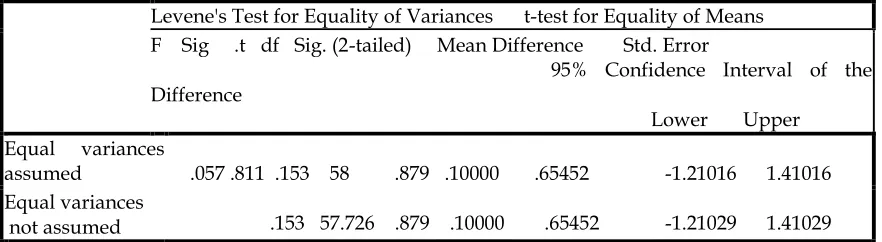
As displayed in Table 1, there is almost no difference between mean scores of the participants on placement test. Males had a mean score of 41.60 while females had a mean score of 41.50. In order to base our judgment on more reliable statistical test, an independent samples t-test was run to make sure of the homogeneity of the participants. Table 2 illustrates the point.
Table 2 Independent Samples t-test on placement test
According to Table 2, the sig (2-tailed) is 0.879 which is much higher than the significance level 0.05. Therefore, all the participants were the same proficiency level and homogenous. The next step was administering anxiety questionnaire that was adapted from Horwitz, Horwitz and Cope's (1986) foreign language anxiety scale. The scale consisted of 33 statements, each to be graded by the participants as to the degree of anxiety that respondents perceived they would experience in specific situations.
Analysis of Research Question One
To detect the relationship between language anxiety and English speaking proficiency through statistical analysis, correlation coefficient was processed based on the language anxiety scores from the FLCAS and English speaking proficiency scores. The results (Table 3) showed a significant negative correlation (r = -0.333, p<0.01).
Table 3 Correlation coefficient between language anxiety and English speaking proficiency Language anxiety speaking skills
Language anxiety 1 -.333 Speaking proficiency -.333 1
According to Table 3, the correlation coefficient is -.333, significance level at 0.05. As Cohen and Holiday (1982) believe, this is a weak correlation. Cohen and Holiday's definition of correlation coefficient if it is below or equal to 0.19 indicates a very low correlation, in case it is between 0.20 and 0.39 signifies a low correlation and between 0.40 and 0.69 proves a moderate correlation and finally if it is between 0.70 and 0.89 indicates a high correlation. On the other hand, a correlation coefficient between -1 to -0.8 shows a negative strong correlation; while between -0.6 to -0.79 signifies a high negative correlation and between -0.4 to -0.59 is an indicator of a modest negative correlation; and between -0.2 to -0.39 shows a very weak negative correlation.
Levene's Test for Equality of Variances t-test for Equality of Means F Sig .t df Sig. (2-tailed) Mean Difference Std. Error
95% Confidence Interval of the Difference
Lower Upper Equal variances
assumed .057 .811 .153 58 .879 .10000 .65452 -1.21016 1.41016
.153 57.726 .879 .10000 .65452 -1.21029 1.41029 Equal variances
not assumed
Vol. 6, Issue 9, December 2016 Page 17
The negative correlation indicates that learners who have high language anxiety are more likely to achieve low English speaking proficiency and those with low language anxiety are more likely to develop a higher level of speaking proficiency.In order to scrutinize the different aspect of anxiety and its relationship with language proficiency, the results of descriptive statistics were analyzed. As it was mentioned earlier in the anxiety scale, there were five factors which were included in the scale questionnaire.
Table 4 Descriptive statistics among six factors
According to the results of descriptive statistics, the current research showed that the participants had six factors about language learning anxieties. The results were illustrated in Table 4.
From the six factors, the factor number 5, feeling unable to deal with the task of English learning turned out to be the strongest form of anxiety with the mean score of 3.06 and SD=0.91. The next highest form of anxiety was fear of negative evaluation with the mean of 3.00 and SD of 1.02, followed by test anxiety with the mean score of 2.98 and SD of 1.10. Being afraid of making mistakes had the next highest form of anxiety with the mean of 2.95 and SD of 1.23, and speech anxiety with the mean of 2.84 and SD of 1.04 was the next highest form of anxiety and finally the last one was communication apprehension with the mean of 2.78 and SD of 1.07. In other words, the findings showed that the participants in the current study generally believed that feeling unable to cope with the task of English learning was the strongest factor influencing their English speaking proficiency.
According to Horwitz, Horwitz and Cope (1986), the highly anxious learners responded to the 33 items in the questionnaire revealing the point that they suffered from different forms of anxiety such as communication apprehension, test anxiety, fear of negative evaluation during their foreign language learning. The 33 items of the questionnaire were categorized into six groups. According to the results, highly anxious learners responded to the 33 items in the FLCAS saying their anxiety in communication apprehension, text anxiety, fear of negative evaluation during their foreign language learning experiences.
Analyzing the Second Research Question
The second research question was formulated to check if there was a relationship between learners' self-efficacy and speaking ability. In analyzing the data, some statistical procedures were carried out in this study: (1) Descriptive statistics including Cronbach alphas, means and standard deviations computed to summarize the students' responses to the self-efficacy questionnaire and speaking ability. (2) Pearson correlation was conducted to examine the relationship between the students’ self-efficacy and speaking proficiency.
Descriptive Statistics of Second Research Question
Table 5 shows the Cronbach Alphas, means and standard deviations of the questionnaire and the test.
Table 5 Descriptive statistics of the self-efficacy questionnaire and speaking test Number of items Cronbach's Alpha mean SD Self-efficacy questionnaire 14 0.73 31.45 5.812 Speaking test performance 50 0.69 27.63 5.18 Factor1 factor 2 factor 3 factor 4 factor 5 factor 6 Average 2.84 2.78 3.00 2.95 3.06 2.98 SD 1.04 1.07 1.01 1.23 0.90 1.10
Vol. 6, Issue 9, December 2016 Page 18
As illustrated in Table 5, the reliability of the questionnaire was 0.73 and that of speaking test was 0.69 that is satisfactory. Means of the self-efficacy questionnaire and the speaking test were 31.45 and 27.63, respectively.Analysis of Correlation between Self-Efficacy and Speaking
Table 6 shows the correlation between total scores of the questionnaire and the speaking test. Table 6 Pearson correlation between the questionnaire and the speaking
Self-efficacy speaking test scores Pearson correlation 0.78
Significance 0.03
As illustrated in table 6, findings of data analysis using Pearson correlation proved that there was a direct and significant correlation between the participants' self-efficacy beliefs about language learning and their speaking performance. This finding is in agreement with other studies. It specially supports Bandura's (1997) claim that an individual's level of self-efficacy is thought to relate to the individual's choice of activities, effort in those activities, and perseverance in the activities. A paired sample t-test was run to determine if the degree of self-efficacy had any effect on speaking performance. For doing this the participants were divided into two groups. One group consisted of participants with high self-efficacy beliefs and the other group included low-efficacy participants. The total score of self-low-efficacy was 100. Those whose self-low-efficacy was above 40 were considered as high group and those with lower than 40 were regarded as low efficacy group. Out of 60 participants, 35 belonged to high efficacy group and 25 belonged to low efficacy group.
Table 7 Paired samples t-test for high and low self-efficacy
Mean SD t df sig (2tailed) Pair 1 high group -2.47 6.89 1.45 60 0.041 Pair 2 low group 4.19 8.87 -3.78 60 0.015
As reported in table 7, it became evident that high self-efficacy affected speaking performance significantly and positively, but low self-efficacy had a significant negative effect on their speaking performance. This is in conformity with other studies carried out on the issue.
Analysis of Results of Research Question Three
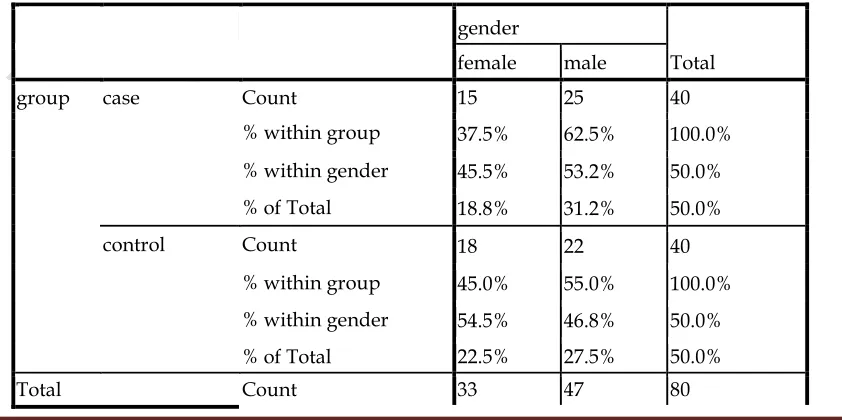
In order to understand other factors which may influence the relationships between foreign language anxiety and speaking proficiency, the researchers measured the gender difference and the reliability of the FLCAS first in order to ensure the accuracy of the data and avoiding other possible factors affecting the result of this research. The following section would present the relationships between foreign language anxiety and the gender difference. Compared to studies by Awan, Azher, Anwar, and Naz (2010) and Jingjing (2011), the present study indicates that there was no significant gender difference between anxiety score and their gender: t(84)=.70, r=- .048. The mean scores for males (n=30) and females (n=30) were 98.39 and 95.49, respectively. The standard deviation for males was 27.40, and females was 31.10. The reason of the significant gender difference may be because of Awan et al.'s study, the researchers used the abbreviated version of FLCAS to conduct the study that leads to the gender difference result. And inJingjing’s study, the researcher did not provide the Cronbach’s alpha value; therefore, we are not sure whether the instruments were reliable or not. With regards to this point, the present study provides a very reliable Cronbach’s value (.916). The results are shown in Table 8.
Table 8:Gender difference Male female
Vol. 6, Issue 9, December 2016 Page 19
Sample size 30 30Student age 18 -22 18-22 Cronbach's Alpha 0.916
Correlation r = -0.084 P<0.01
According to Cohenand Holiday's definition, the correlation coefficient between English learning anxiety and gender difference are moderate negative correlation and there is no significance between gender and English oral proficiency. Therefore, the gender difference would not be considered as an influential factor in anxiety study.
Analysis of Results of Research Question Four
With regard to research question four, the correlation was utilized. The table showed that girls had higher degree of self-efficacy (t=–2.7; X=35.5; SD=4.5; p=0.006) in English language compared to boys. This finding on the gender differences is similar to many previous studies done on the relationship between gender and self-efficacy. Results have shown that girls are found to show higher self-efficacy in areas related to language (Pajares, 1996). In the study by Pajares, it was stated that students were asked to provide confidence judgments on their academic skills and the girls reported they judged themselves to be better speakers than the boys. This boosted their self-efficacy. Generally, language is associated with feminine orientation and most learners believe that speaking is the domain in which girls outperform boys (Eccles, 1987). In this study, it was found that girls had higher self-regulated learning, which is one of the self-efficacy dimensions (t=–3.7; X=2.38; p=0.000) as compared to boys. According to Noran (1993) the psychological factors in English language learning that girls have higher positive attitude towards the language and a liking for it. However, Bandura's theory does not endow gender or gender beliefs with any genetic properties (Bussey& Bandura, 1999).
Discussion
Discussion on Research Question One
The findings of this question are consistent and in line with the literature of foreign language anxiety. A number of studies such as Gardner (1997), Horwitz (2001), Park and Lee (2005), Liu (2006), and Atasheneh and Izadi (2012) have concluded that FLCA associates negatively to English achievement. Gardner (1997) examined the relationship between foreign language anxiety and different affective variables and achievement in French. He found that there was a negative relationship in language anxiety and two measures of achievement as objective measures (r=-.66, p=.001, n=102) and French grades (r=-.33, p=.01, n=102). In the Korean situation, Park and Lee (2005) investigated relationship between language anxiety and oral performance. Results indicated an important negative correlation between them(r=-.321, p=.001, n=132).
In a recent study, Al-Shboul, Sheikh Ahmad, SahariNordin and Abdul Rahman (2013) investigated the relationship between foreign language anxiety and achievement. It is prominent that foreign language anxiety affects the students’ learning process and results. They concluded that the important negative relationship between foreign language anxiety and achievement mainly array from moderate to strong.
Discussion on Research Question Two
Many studies have been done on this issue of self-efficacy in the academic settings. Research findings have indicated that mathematics self-efficacy is a good predictor of mathematics interest and choice of mathematics-related courses (Lent, Lopez, &Bieschke, 1993; Pajares& Miller, 1994). In other studies conducted on science and engineering college students (Lent, Brown, & Larkin, 1984), it was reported that high self-efficacy seemed to influence academic persistence necessary
Vol. 6, Issue 9, December 2016 Page 20
to maintain high academic achievement. Pintrich and Groot (1990) reported that academic self-efficacy is correlated with academic performances in examinations and quizzes, and Schunk (1984) found that mathematics self-efficacy influenced mathematics performance directly (beta=0.46).In a related research study, Schunk (1995) stated that when students are engaged in activities, they are affected by personal (e.g., goal setting, information processing) and situational influences (e.g., rewards, feedbacks). These provide students with idea of how well they have learned. Self-efficacy was enhanced when students perceived they performed well. On the other hand, Bandura, Barbaranelli, Caprara, and Pastorelli (1996) reported that parents' academic aspirations for their children influenced the children's academic achievement directly or indirectly by influencing their self-efficacy.
Discussion on Research Question Three
In general, most studies show that, on average, girls do better in school than boys do. This shows that girls have less anxiety than boys. Girls get higher grades and complete high school at a higher rate compared to boys (Jacobs, 2002). Standardized achievement tests also show that females are better at spelling and perform better on tests of literacy, writing, and general knowledge.
In addition, Aida (1994) reported that females received significantly higher grades than males in Japanese in the final exam, females scoring an average of 89.7%, as against an average mark of 86.1% for males. There was a trend in highly anxious students of both sexes to obtain lower exam scores than more relaxed students. Onwuegbuzie, Bailey and Daley (1999) encountered a statistically significant correlation between gender and foreign language anxiety in Anglophone students of four foreign languages (French, Spanish, German, and Japanese), as measured by course grades: .16* (*p<.05), indicating that in their investigation “low foreign-language anxious students tended to be men” (p. 9).
Discussion on Research Question Four
The results of the current study on the gender differences revealed that there is a similar trend among many previous studies carried out on the relationship between gender and self-efficacy. Results have produced evidence that girls are more likely to show higher self-efficacy in language learning settings (Pajares, 1996). In an investigation by Pajares, it was revealed that learners who were asked to make judgments on their academic skills, the female learners judged themselves to be better speakers than the boys. This has led to their higher self-efficacy. Commonly, language is believed to be associated with feminine orientation and most learners are of the opinion that speaking is the domain in which girls perform better than boys (Eccles, 1987). In this study, the same results as previous ones produced. It was found that girls had higher self-regulated learning, which is one of the dimensions of self-efficacy (t=-3.7; X=2.38; p=0.000) as compared to boys. According to Noran (1993), the psychological factors in English language learning that girls have higher positive attitude towards the language and a liking for it. However, Bandura's theory does not endow gender or gender beliefs with any genetic properties (Bussey& Bandura, 1999).
Conclusion
Much research in second/foreign language acquisition has been devoted to exploring the relationship between motivation and language learning success. Certainly, most teachers, if asked to identify dominant influences on language learning, would cite motivational factors somewhere on their lists, and Naiman, Frohlich, Stern, and Todesco (1978), suggest that the most successful language learners display a host of characteristics, most of them clearly linked to motivation. The majority of this research, however, has been centered on integrative/instrumental motivations
Vol. 6, Issue 9, December 2016 Page 21
while neglecting to explore other motivational theories, such as Bandura’s (1986) theory of self-efficacy. Despite the fact that innumerable studies across a host of fields have established a positive correlation between high self-efficacy beliefs and performance, the self-efficacy construct has received comparably little attention in the field of second language learning (Multon, Brown & Lent, 1991; Nicholls, 1979; Pajares, 1997).Accordingly, this study was conducted to ascertain the correlation between English speaking self-efficacy beliefs and the English speaking performance of Iranian EFL learners. Itwas sought to establish whether or not there was a correlation between high English speaking self-efficacy beliefs and high English speaking performance on end-of-term language assessments. Furthermore, language anxiety has been an important factor which acts as an impediment to language performance. There has been little research that attempted to investigate the correlation between self-efficacy and anxiety and speaking performance of EFL learners. The study was an attempt to fill this gap in the field of language learning.
Conclusion for the First Research Question
To conclude, the present study is preliminary research on the effects between English learning anxiety and the English speaking proficiency, but its relevance to the parents’ involvement can also be seen. In the quantitative research results sections of the students’ FLCAS questionnaire and English speaking proficiency scores, the researchers used SPSS 12.0 Program and Excel 2003 version to analysis the data using descriptive statistics, Chi-Square, and Pearson Correlation as presented in the previous chapter. A major finding is that among the six factors of FLACS, the Feeling unable to deal with the task of English learning is the highest factor. In the qualitative research results sections, the researchers collected the data from the questionnaire which were sorted and analyzed as presented in the previous chapter. The conclusions from above research results will be summarized in this section in response to the research questions proposed in Chapter One. Correlations between foreign language and the English speaking proficiency According to the result of Pearson Product-moment correlation, the result indicates that the significant negative correlation between foreign language speaking proficiency and the foreign language anxiety (r=-.333, p<.01).
According to the chi-square results of FLCAS, the student participants were feeling very anxious and nervous when they were speaking English and fear of been called by the teacher in the English class. Student participants expressed that they feel anxious when they didn’t understand what the teacher said. But according to the FLCAS, students also showed their ambitions to be better than others and they really care about the evaluation from other students. Moreover, the student participants do not feel that their English is worse than other students; it may be because the student’s self-esteem is higher than before and they have been given the high expectation from their parents to contribute their fear of negative evaluation from their peers.
The result greatly resembles Jinging’s study. Jinging (2011) described this phenomenon in his research: "It is the cultural tradition that Chinese people care much about saving their faces, so they don’t like to receive low evaluations or criticism about themselves." The same notion is true about Iranian people because both Chinese and Iranian belong to oriental societies. This is the reason why they experienced more fear of negative evaluation than any other kind of anxiety. The result of factor 4-being afraid of making mistakes in the English class,the result indicating the student participants would worry about being corrected by the English teacher when they have any grammatical or pronunciation error and it would affect their willingness to speak up in the English class. This result may correlate with the factor 3- fear of negative evaluation. Because of the fear of negative evaluation, when students are corrected by the English teacher when they commit to any grammatical or pronunciation error, it would make the subject student feel that he
Vol. 6, Issue 9, December 2016 Page 22
or she has lost their face to contribute their unwillingness to speak up in the English class. The factor 5- feeling uniquely unable to deal with the task of English learning, as the result of all items having significant difference, according to the descriptive statistics, this is also the main anxiety factor of elementary school students (M=3.06, SD=0.91). Although this factor is the main anxiety source, the participants still tend to have positive feedback. It may be because the participants still enjoy learning English and the instructors have enhanced the student’s learning motivation.English is an international language and it has played an increasingly important role in people’s work and life. While the importance of the English language is greatly emphasized in Iranian education policy, it is also important to understand what kind of problem students will encounter during the process of language learning. This research study focuses on language anxiety, particularly investigating the relationship between the foreign language anxiety and the interest of Iranian intermediate students in their foreign language speaking proficiency. The result of FLCAS shows that the main factor of students’ anxiety is speech anxiety, which explains that no matter whether students’ English speaking proficiency is good or not, they still feel anxious when they are speaking in English. However, the result of the FLCAS also shows that there are other anxiety factors that can affect the student’s English speaking proficiency besides the six factors of FLCAS when a low correlation coefficient between language anxiety and English speaking proficiency occurs. Therefore, the 15 open-ended questions were generated to detect other anxiety factors which may affect students’ English speaking proficiency. In order to increase students’ language learning motivation and ability, there is a need to decrease students’ language anxiety. It is hoped that this results of this research study can shed some light on language education and bring some insights to English teachers, educators and education policy makers. With all the collaborative efforts contributed to this matter, students will be able to increase the level of their proficiency and really enjoy learning a language.
Neither Bandura’s theory of self-efficacy nor this study purports that people can perform given tasks simply because they believe they can, without prerequisite skills. This study suggests, rather, that an individual’s perceived confidence positively corresponds to his subsequent behavior. For EFL learners, these behaviors could include the confidence to seek out additional language instruction, apply for a job in an English speaking environment, or participate in a social group – all behaviors that would aid in a more successful language proficiency. Successful integration into target language depends on an individual’s ability to realize his goals. On a smaller scale, within our English language classrooms, language instructors have the ability to promote positive self-efficacy beliefs. These, in turn, can ameliorate some of the barriers encountered by EFL learners as they attempt to improve their target language proficiency.
References
Aida, Y. (1994). Examination of Horwitz, Horwitz and Cope's construct of foreign language anxiety: the case of students of Japanese. The Modern language Journal, 78(2), 155-168.
Al-Shboul, M., Sheikh Ahmad, I., Sahari Nordin, M., & Abdul Rahman, Z. (2013). Foreign Language Anxiety and Achievement: systematic Review. Institute of Education,International Islamic University Malysia. 3(2).Published by Canadian Center of Science and Education.
Atasheneh, N., & Izadi, A. (2012). The role of teachers in Reducing- Increasing Listening Comprehension Test Anxiety: A case of Iranian EFL Learners. English Language Teaching Journal, 5(3), 178-187.
Awan, R.,Azher, M., Anwar, M., & Naz, A. (2010). An investigation of foreign language classroom anxiety and its relationship with students' achievement. Journal of College Teaching & Learning, 7(11), 33-40.
Vol. 6, Issue 9, December 2016 Page 23
Bandura, A. (1986). Social foundations of thought and action: A social cognitive theory. Englewood Cliffs, NJ: Prentice-Hall.Bandura, A. (1997). Self-efficacy: The exercise of control. New York, NY: Freeman.
Bandura, A. Barbaranelli, C. Caprara, V. G., &Pastorelli, C. (1996). Multifaceted impact of self-efficacy beliefs on academic functioning. Child Development, 67(3), 1206-1222.
Bang, Y.J. (2003). Developing communicative competence through role-play activities in an EFL
classroom. Retrieved July 12, 2006 from
http://www.paaljapan.org/resources/proceedings/2003/youngjoobang.pdf.
Bussey, K., & Bandura, A. (1999). Self-regulatory mechanisms governing gender development. Child Development, 63, 1236-1250.
Cohen, L. &Holliday, M.G. (1982). Statistics for social scientists: an introductory text with computer programs in BASIC. London: Harper & Row.
Crystal, D. (2000). Language death. Cambridge: Cambridge University Press.
Eccles, J. S. (1987). Gender roles and women’s achievement-related decisions. Psychol.Women Q. 11(8), 135–72.
Gardner, R. C. (1997). Individual Differences and Second Language Learning. In G. R. Tucker & D. Corson (Eds.), Encyclopedia of Language and Education, Volume 4: Second Language Education. The Netherlands: Kluwer Academic Publishers.
Horwitz, E.K. (1988). The beliefs about language learning of beginning university foreign language students. Modern Language Journal, 72(3), 283–294.
Horwitz, E. K. (2001). Language anxiety and achievement. Annual Review of Applied Linguistics, 21, 112-126. http://dx.doi.org/10.1017/S0267190501000071.
Horwitz, E. K., Horwitz, M. B., & Cope, J. (1986). Foreign Language Classroom Anxiety. The Modern Language Journal,70, 125-132.
Jacobs, G. M. (2002). Using games in language teaching. Retrieved October 20, 2010, from http://www.georgejacobs.net/MIArticles/Games%20for%20Language.
Jingjing, C. (2011). Research on High School Students’ English Learning Anxiety. Journal of Language Teaching and Research,2(4), 875-880.
Jinks, J., & Morgan, V. (1999). Children’s perceived academic self-efficacy: An inventory scale. The Clearing House, 72(4), 224-230.
Krashen, S. D. (1985). The role of the first language in second language acquisition. London: Longman. Lent, R.W., Lopez, F.G. &Bieschke,K.J.(1991). Mathematics self-efficacy: sources and relation to science-based career choice.Journal of Counseling Psychology, 38(12), 424-430.
Lent, R.W., Brown, S.D., & Larkin, K.C. (1984). Relation of self-efficacy expectations to academic achievement and persistence. Journal of Counseling Psychology, 31, 356-362. http://dx.doi.org/10.1037/0022-0167.31.3.3.
Liu, Y. (2006). How to play the magic? Role-play in ESL classroom practice in China. Unpublished Master’s thesis, the University of Western Ontario, London, Ontario, Canada.
McDonald, A.S. (2001). The Prevalence and Effects of Test Anxiety in School Children. Educational Psychology, 21(1), 89-98.
Multon, K.D., Brown, S.D. & Lent, R.W. (1991). Relation of self-efficacy beliefs to academic outcomes: A meta-analytic investigation.Journal of Counseling Psychology,38, 30-38.
Naiman, N., Frohlich, M., Stern, H.H. &Todesco, A. (1978). The Good Language Learner. Toronto, Ontario: Ontario Institute for Studies in Education.
Nezami, E., Schwarzer, R., & Jerusalem, M. (1996). Persian Adaptation (Farsi) of the General Self-Efficacy Scale. Retrieved July 29, 2007from user page. Fuberlin. de/~health/persean.htm.
Nicholls, J. G. (1979). Development of perception of one attainment and causal attributions for success and failure in reading. Journal of Educational Psychology, 71(21),94–99.
Vol. 6, Issue 9, December 2016 Page 24
Noran, F. (1993). Psychological factors influencing English language learning among university students. Research report, Faculty of Educational Studies, University Putra Malaysia.Onwuegbuzie, A. J., Bailey, P., & Daley, C. E. (1999). Relationship between anxiety and achievement at three stages of learning a foreign language. Perceptual and Motors Skills, 88(6), 1085-1093.
Pajares, F. (1996). Self-efficacy beliefs in achievement settings. Review of Educational Research,66, 543-587.
Pajares, F. (1997).Current directions in self-efficacy research. In M. Maehr, M. & P.R. Pintrich (Eds),Advances in motivation and achievement (pp.1-49). Retrieved November 21, 2008 from http://www.des.emory.edu/mfp/effchapter.html.
Pajares, F., & Miller, M. D. (1994). Mathematics self-efficacy and mathematics outcomes: The need for specificity of assessment. Journal of CounselingPsychology, 42, 190-198.
Park, H., & Lee, A. R. (2005). L2 Learners’ Anxiety, Self-Confidence and Oral Performance. Paper presented at the Pan-Pacific Association of Applied Linguistics (PAAL), Japan.
Pintrich, P. R., & Groot, E. V. (1990). Motivational and self-regulated learning components of classroom academic performance. Journal of Educational Psychology, 82, 33–40.
Pintrich, P.R. & Schunk, D. (1996). Motivation in Education: Theory, research & Applications. Englewood Cliffs: Printice Hall.
Rogers, C. (1983). Freedom to learn for the 80’s. Columbus, Ohio: Charles E. Merrill Publishing Company.
Schunk, D.H. (1984). Self-efficacy perspective on achievement behavior. Educational Psychologist, 19, 48–58.
Schunk, D.H. (1995). Self-regulation of self-efficacy and attributions in academic settings. American Educational Research Journal, 33, 359-382.
Sparks, R.L. &Ganschow, L. (2007). Is the foreign language classroom anxiety scale measuring anxiety or language skills? Foreign Language Annals, 40(3), 260-287.
Watson, D., & Friend, R. (1969). Measurement of social-evaluative anxiety. Journal of Consulting and Clinical psychology, 33, 448-457. http://dx.doi.org/10.1037/h0027806.
Yukina, K. (2003). Exploring relationships between English proficiency and individual factors during junior high school years in Japan. Unpublished DoctoralDissertation, Graduate School of Education, Waseda University.
Vol. 6, Issue 9, December 2016 Page 25
THE EFFECT OF HIGHER-ORDER QUESTIONS ON
THE SPEAKING ABILITY OF IRANIAN EFL
LEARNERS THROUGH USING CONCEPT
MAPPING STRATEGY: A GENDER STUDY CASE
Shahrzad Chahardahcherik
Department of Foreign Languages, Sepidan Branch, Islamic Azad University, Sepidan, Iran.
Amin Marzban*
Department of Foreign Languages, Sepidan Branch, Islamic Azad University, Sepidan, Iran. (Corresponding Author)
Abstract
This study aimed at investigating the effect of concept mapping strategy on Iranian foreign language learners’ speaking proficiency. This work deals with the study of change in learners’ speaking ability using concept mapping in the context of foreign language learning and teaching. The main research questions were: 1) Does concept mapping strategy in asking and answering higher-order questions affect the speaking proficiency of Iranian learners? 2) Is there any difference between male and female learners achieving English speaking proficiency using concept mapping strategies in answering higher-order questions? The study utilized a true-experimental method with pre and post-test control and true-experimental group design. In order to answer the research questions eighty foreign language learners at high-intermediate level at ShamimArghavan Language Academy (SALA) in Shiraz were selected via administering on OPT to 300 language learners. Then they were divided into experimental and control groups through simple random sampling. The experimental group was taught with concept mapping instructional strategy, while the control group was taught with the ordinary method of teaching. The high cognitive questions were used to evaluate meaningful learning. Descriptive and t-test statistics were used for answering the research hypotheses. The results indicate that speaking performance among experimental group learners after the treatment improved as compared to the control group learners. Students’ speaking proficiency was also found to be not limited by gender. Therefore, there is a need for teachers, curriculum developers, and teacher training institutions to develop the process of concept map strategy integration in the EFL teaching and learning contexts.
Keywords: Concept Mapping, Higher-Order Questions, Speaking Proficiency, Bloom’s taxonomy.
Vol. 6, Issue 9, December 2016 Page 26
1. Introduction
Concept mapping can be used to transform theoretical knowledge and understanding into concrete visual signs and descriptions that are suitable for comparison and measurement. The concept-map strategy can show who is in most need of support and when this support should be given by making the learning process visible. Through communication people discuss and share ideas either orally or in writing. In this study, communication is considered as fluency and accuracy. According to Alam (2013), Oral communication is a bidirectional process between the speaker and the listener which involves the productive skills of speaking and the receptive skills of comprehension (Byrne, 1986).
Stabb (1992) considers listening and speaking as oral communication skills. As he says, “spoken communication abilities mean both speaking and listening to oral language, either process of talking and listening are lifelong activities and probably our crucial communication device”. Stabb emphasizes that, while good instructions and lots of practice can help improve listening skills, this won't happen without meaningful talk in the classroom” (p.7). Fundamentally, oral language is concerning communicating with other people. It involves a process of using thinking, knowledge and skills in order to listen and speak effectively. Oral language presents in every part of the school curriculum. The advancement of oral language has gained an importance as great as that of reading and writing skills, at every level, in the lesson planning. Chaney argues that “speaking is the process of making and exchanging meaning through the use of verbal and non-verbal symbols, in different contexts” ( 1998, p. 13).
Today's world says that the goal of teaching speaking should be improvement of students' communicative skills because, only in that way, students will be able to express themselves and learn how to follow the social and cultural rules in each communicative situation, appropriately. English speaking proficiency is considered one of these important skills; so the learners should be provided with an overall understanding of speaking skills. In the Applied Linguistics literature, although the word ‘proficient’ is often used interchangeably with words such as ‘good’, ‘fluent’, ‘knowledgeable’, ‘bilingual’, ‘competent’, and so on, it is not always easy to understand what speaking proficiency involves; the term may be applied quite differently from researcher to researcher (Galloway, 1987; McNamara, 1996).
One of the most important educational strategies introduced since the 1970s was concept-mapping. They allow the existing experience and understanding to be taken into consideration when building new concepts into the more noticeable framework. By using concept maps, learners make use of their previous knowledge to understand the new concepts. It establishes a link between unknown and known information that leads to a great knowledge and understanding (Novak, 2010). Gunter and Mintz (2010) state that the teacher -according to Socrates- should help the learners organize their thoughts in order to build new understanding from prior knowledge. Socrates method is learning by process of asking questions and answering perplexing questions.
Concept-mapping is a kind of learning strategy in which writing and drawing have a vital role. Folse (2010) noticed that when you ask people to write about his thoughts relating to a particular topic before speaking about it, either the quantity and/or the quality of discussion will be improved. According to Mayer (2003), concept mapping is used to prepare knowledge to the learners in order to form a mental framework and retain new information for recalling and producing. Questioning techniques used as teaching strategies and their possible impact on learners’ learning has led many researchers in this field to examine the relationship between their integration into teaching speaking strategies. As Novak and Canas (2006) state concept maps represent hierarchical tree structure in which the main concept is located at the top followed by
Vol. 6, Issue 9, December 2016 Page 27
subordinate words or concepts in less important positions. In other words, to draw a map there needs to be a word or concept as the starting point which represents an answer to a focus question.According to Smith and Higgins (2006), questioning procedure is one of the most common techniques used by teachers and it is helpful as the main method in which teachers control the classroom interaction. It has been discovered that classroom questions can also be used to motivate students, to review, control, assess, explore, explain, encourage students to give special attention on a particular subject, elicit information, and assess understanding and to monitor behavior (Richards and Lockhart, 1994). Therefore, teachers’ most important role is to develop and plan different types of questioning activities that make learning materials meaningful and appealing to students.
Cazden (1988) states that the most common applied method for analyzing classroom interactions was categorizing the teacher’s questions based on some cognitive scale. One of the most widely used resources for cognitive questions is Bloom’s taxonomy which describes the goals relating to knowledge and intellectual abilities. Bloom’s taxonomy was first suggested by Bloom and his colleagues at the University of Chicago in 1956 (Forehand, 2005). Bloom created a taxonomy that could be applied in classifying pedagogical objectives of thinking skills. Researchers have designed experiments which investigate the effectiveness of questions framed at differing levels of Bloom's Taxonomy of School Learning. These levels, arranged in ascending order of complexity, are: (1) knowledge, (2) comprehension, (3) application, (4) analysis, (5) synthesis, and (6) evaluation.
Higher level thinking skills involve application, analysis, synthesis, and evaluation; which are important activities in the concept map strategy, because the main goal is to teach the correct ways of thinking (Notar, Wilson, & Montgomery, 2005). This organized hierarchy involved lower level thinking skills such as, memorization, knowledge, and comprehension which require the least amount of skill and thought. According to Bernadowski (2006), questions which are part of lower cognition level make learners just recall the information from memory, focusing on facts; whereas, the skills belonging to higher level cate