Core Reflection as a Way Towards Integrating
Theoretical Knowledge and Pedagogical Practice in
the Iranian Context: The Case of Prospective
Language Teachers
Bahareh Khazaeenezhad
University of Isfahan
Mansoor Tavakoli
1University of Isfahan
Zahra Amirian
University of Isfahan
Abstract
This study was an attempt to examine the levels of teacher activity and reflection phases Iranian prospective language teachers go through in a way to put into practice the concepts and theories explored on campus within their workplace. To this end, Core Reflection Model was practiced by drawing on reflective journals, focus group discussions, and field notes collected over a four month period. The findings indicated that reflections on all six levels of the core reflection model took place mostly being on the level of convictions or beliefs, followed by competencies, behavior, environment, identity, and mission. Moreover, through the movement of reflection among the five phases, a shift from the second phase, looking back at action, to the third one, awareness of essential aspects, was observed and held on to the last phase; the reason could be the lack of mentorship and supervisory interventions for promoting guided reflection practice for prospective teachers in English language teacher education in Iran. In general, utilizing core reflection model in language teacher education for prospective teachers seems to be successful, because the model fostered the reflection of language teachers on all levels and phases and could empower them in their practice.
Keywords: Core Reflection, Theoretical Knowledge, Pedagogical Practice, Reflection Levels, Reflection Phases, Teacher Education
Received on July 25, 2017 Accepted on February 20, 2018
1. Introduction
Recently, integration of theoretical knowledge and pedagogical practice has increasingly attracted the attention of most scholars in teacher education. Within this realm, one of the main challenges of prospective language teachers has been to merge theory and practice (Cochran-Smith, 2001; Korthagen, Loughran, & Russell, 2006; Smith, 2000). According to Levine (cited in Hartocollis, 2005, p. 2), a widely held concern is that "one of the biggest dangers we face is preparing teachers who know theory and know nothing about practice". Studies show that prospective teachers who have recently entered the workplace often indicated that theoretical knowledge acquired on campus did not enable them to handle the troubles and difficulties of real practice context (Korthagen, Loughran, & Russell, 2006; Oosterheert, 2001).
Future practitioners should be given the opportunity to construct their own theories from their own practice, and to thoughtfully generate authentic episodes of practice from their own theories. We have proposed that the university should take on the task of helping learners integrate and transform their knowledge by theorizing practice and particularizing theory. We believe that the university can facilitate this process because it can create opportunities for time and pace alteration, reflection on practice, and examination of consequences. (p. 404)
In line with the above-mentioned quotation, Rodgers (2002) defines reflection as:
A systematic and disciplined way of thinking that comprises the following phases: spontaneous interpretation of an experience; naming the problem(s) and question(s) that arise out of the experience; generating possible explanations for the problem(s) posed; developing and testing the explanations; and efforts to sort out, or live with, the problem(s) posed. (p. 25)
In addition, Korthagen (2005) differentiates the two concepts of reflection and core reflection in a way that reflection can be understood as a systematic way of improving one's practice but core reflection involves questioning and reframing a person's deepest levels of functioning such as identity and mission (p. 5). As Korthagen (2005) points out, "core reflection aims at more durable changes in a person in comparison to reflection" (p. 5).
(ELT) teaching programs and more specifically to any Iranian contexts yet; therefore, the study attempts to shed some light on this area of language teacher education which has received little or no attention from the researchers and practitioners of the field. Considering the reported effects of reflection in teaching, teacher education and positive psychology along with the lack of research with regard to the possible role of core reflection approach which may integrate theory and practice in English language pedagogy, the study is an attempt to see how core reflection approach can examine and possibly bridge the gap between theoretical knowledge and pedagogical practice in the context of EFL teacher education; this may help them put into practice the concepts and theories explored on campus within their workplace. More specifically, the study is designed to examine the levels of teacher activity (competency, behavior, environment, identity, & mission) and the reflection phases (action, looking back at action, awareness of essential aspects, creating alternative methods of action, and trial) which the prospective language teachers go through while practicing core reflection approach.
As the results of the study can tap on some unexplored aspects of language teaching profession, it can be of some interest to both researchers and practitioners in terms of its pedagogical implications, which, in turn, may contribute to fundamental positive changes in language teacher education and guide language teachers towards their proximal development.
2. Review of Literature
to produce an enabling model of reflection-on-practice, leading to decisions and actions that help teachers to understand teaching and learning. Ghaye and Ghaye (1998) argue that by reflecting on their practice, teachers are enabled to make 'wise and principled decisions' (p. 3) that are based on self-knowledge and experience. These decisions lead to improvements in teachers' practice, and in their understanding of the complexity of their students' and their own learning.
Along with the emotional side of reflection practice which may facilitate teachers personal and professional development. Loughran (2006) argues that:
Reflection can promote pedagogy of teacher education by making the underlying principles of teacher educators' practice explicit to students of teaching; by reflecting on their own practices, beliefs and assumptions language teacher educators are better placed to understand these practices and to make them clearer to their students. Student teachers in turn have an opportunity to gain insights into teaching and learning by participating in such processes rather than being instructed by their teachers (p. 25).
Brandenburg (2008) made use of Korthagen's (2001) ALACT (Action, Looking back at action, Awareness of essential aspects, Creating alternative methods of action, & trial) framework in her teaching of student teachers and promoted structured self-reflection in order to unpacked hidden aspect of teaching. Brandenburg found that through reflection (her own & that of her students) there emerged a "reconceptualised approach to learning and teaching [and that] more has been exposed about how examining the ordinary can lead to extra-ordinary insights about teaching and learning about teaching" (p. 179). She argues that reflection for both teacher educators and prospective teachers, is a powerful way to improve their professional practice.
learning and teaching; and between valuing experience that student teachers bring to teacher education and challenging them to reconstruct such experience in order to reconceptualize their personal theories of learning and teaching (p. 12).
accomplishment) can considerably predict teachers' reflection (Khatib & Javadi, 2014, p. 10).
In spite of the fact that, the notion of reflection in and on practice is examined extensively in the literature, the model of core reflection is more recently developed by Korthagen and Vasalos as an extension of Korthagen's earlier reflective model, known as the ALACT model (Korthagen, 2001). This approach is more holistic than the less rational sources of teacher behavior. The ALACT model describes a structured reflective process, but it does not tell us much about the content of reflection: what does or should the teacher reflect upon? (Korthagen & Vasalos, 2005).In order to answer this question the onion model was suggested. It contains six levels which can influence the functioning of a teacher. These levels are: the environment that refers to everything that is outside of the person; behavior; competencies that include different competences of a person; beliefs that include different beliefs of a person; identity that refers to the self-understating of a person; mission that refers to callings and inspirations of a person. Reflection on the level of mission triggers such issues as 'why' the person decided to become a teacher, or even what he sees as his calling in the world. In essence, this level is concerned with what inspires us, and what gives meaning and significance to our work or our lives (Korthagen, 2004).
3. Method
3.1 Research Design
This study used a qualitative action research approach to integrate theoretical knowledge and pedagogical practice through using core reflection model. This approach reflects a desire to construct a coherent and authentic narrative of prospective language teachers that makes sense of theory-practice gap which has been at the center of national and international debates in language teacher education. The study is modestly descriptive in nature, and data analysis is done qualitatively; therefore, this study is designed to provide real flavor by building narratives from descriptions of various data sources rather than by overlaying brief summations with elaborate analysis.
3.2 Participants
Through purposeful sampling, 10 participants (two males &eight females) were selected. The selected participants were identified with the following selection criteria: (1) MA undergraduate of TEFL, (2) currently teach general English course to nonEnglish-major students at university level, (3) have less than a year of experience in teaching English at university level, (3) acknowledge a concern to integrate on-campus knowledge with pedagogy.
The opportunities provided for participants involved in the study are: (1) exploring their own perspectives on both theory and pedagogy in teaching English, (2) reflecting on the practices they bring to the classroom regarding their planning, points of strength and weakness, questions, challenges, and troubles, (3) familiarizing other participants plus the researcher who is a participant observer in focus groups with their experiences.
3.3 Instrumentation
with member checking and auditing as ways of ruling out misinterpretation of ideas and boosting the credibility of the results. Attempts were made to use triangulation through utilizing a combination of data collection approaches to complete the process of validating the accuracy of results and increase more consistency.
3.4 Data Collection
As the first stage of the study, the selected participants were invited to attend an introduction meeting to be familiarized with the aims and procedures of the study as the vague definition of core reflection for the participants could indeed serve as barriers to them for practicing it. The participants were encouraged to discuss about the topic within the introduction meeting in which the researcher further elaborated on the phenomena of core reflection practice. Such effort to develop an authentic understanding of the participants' experiences regarding core reflection practice was very important to develop inquiry that set aside embedded assumptions regarding how this concept might be defined and understood in language teacher education. This was done in order to develop an understanding of how participants perceive and construct their own understanding of what it meant to reflect on their teaching and recognize their core qualities in order to integrate their theoretical knowledge with their pedagogical practice. Then the participants were asked to keep a reflective journal to reflect on their own practice after each session of teaching general English at Sheikhbahaee University during the semester under study. The reflective journals were
shared by the researcher before any focus group discussion in order for the researcher to be able to orchestrate the focus group discussions.
individual prospective language teachers. Each discussion was audio-recorded and subsequently transcribed by the researcher. At the focus group discussion, prospective language teachers came together to reflect on their teaching practice, and to discuss on their points of strength and weakness and suggest solutions for the problems. The focus group discussions clarified the interpretations emerging within the participants’ reflective journals. During and immediately following all discussions field notes were used by the researcher to track information. As the researcher might not clearly recall thoughts and insights that come up during the discussions or when reviewing the data; therefore, field notes were used to highlight such ideas, questions, and insights. This process helped to encourage further description of ideas, thoughts, and interpretations, as well as to highlight further research questions and ideas. After the discussions, field notes were revisited by the researcher to expand on any fragmented ideas or clarify questions or thoughts. The data collected in field notes throughout the discussions were used as a resource to offer a further interpretive stance on what might not have been understood, what was questioned, or what was thought at the time of the discussion.
discussion transcripts was provided for another researcher who was not involved in the study in order to be examined and reassessed whether the study's findings were grounded in the data and whether the inferences were logical. This process of auditing also helped other readers follow each stage of the study and trace through the research logic accordingly.
3.5 Data Analysis
The analysis of the whole data set was guided by grounded theory procedures (Strauss & Corbin, 1990) and analytical induction techniques (Le Compte & Preissle, 1993). Analytic induction involves scanning the data for themes and relationships among these themes, and developing and modifying hypotheses on the basis of the data. This was done through hermeneutic cycles of close interpretative readings (Kelchtermans & Vandenberghe, 1994) of each transcript in order to identify recurrent themes that emerge from prospective language teachers' articulations about their experiences of turning theory into practice within their workplace. In order to extrapolate thematic interpretations, the steps of qualitative data analysis explained by Rubin and Rubin (2005) were used: (1) recognition, (2) examination, (3) coding, (4), sorting, and (5) synthesis. Recognition, examination, and coding were used to prepare the data while sorting and synthesis to analyze the data. In order to locate frequently referenced concepts and themes to clarify meaning and comprehension of the research topic, recognition was implemented, which involved the process of reading, reviewing, and studying the data. When completing the data analysis process, the concepts and themes were combined to tease out insight in relation to the research questions.
study" (Janesick, 2004, p. 7). Themes that exist across the experiences of the participants were highlighted and a description of their experiences was emphasized by utilizing direct quotations, but only those that were meaningful and relevant, "substantively significant and providing enough detail and evidence to illuminate and make that case" (Patton, 2002, p. 503). In other words, data were given open-ended and holistic treatment to allow main features to emerge that best answer the research questions. Also, the participants in the study were invited to read and make comments on the draft of data analysis in the process of member checking. Moreover, in order to foster the accuracy and validity of the research study auditing was also used. For the sake of a detailed audit check, a log of all research activities, data collection, and analysis procedures along with all data was provided for another researcher who was not involved in the study in order for the study's findings and the inferences to be examined. Finally, the focus remained on constructing an accurate portrayal of the prospective teachers' perspectives surrounding their understandings of their teaching and their core qualities.
4. Result and Discussion
4.1 Reflection Level Analysis
from reflective journals, 220 from focus group discussion transcripts and 190 from field notes which were all coded accordingly.
As the second step of the analysis all the meaningful units were coded according to the coding scheme of Korthagen and Vasalos (2005) that was created on the basis of the reflection model. Thereafter, in order to develop a detailed auditing, a log of all research activities, data collection and analysis procedures along with all data which were collected through using research instruments was provided for another researcher who was not involved in the study in order to be examined whether the study's findings were grounded in the data and whether the inferences were logical. Concurrency of 80% in units of analysis and 75% in reflection levels was found in 10% sample of all data log; the result could be considered acceptable as it was a first-time introduction of the coding schema of reflection levels in researching prospective language teachers in Iranian context.
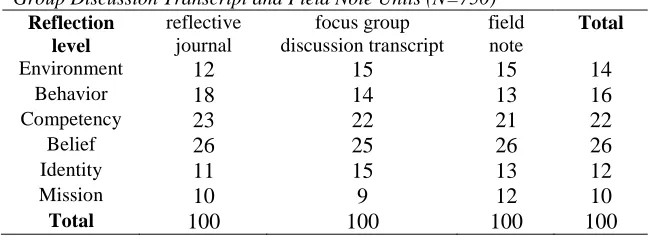
The percentage of all units of analysis in reflective journals, focus group discussion transcripts and field notes has been written down with each category that describes a specific reflection level in Table 1. As shown, the most reflected level of reflection was belief or conviction (26%). This was followed by the level of competency (22%), behavior (16%), environment (14%), identity (12%) and mission (10%).
Table 1
Percentage of Occurrence of Reflection Levels in Reflective Journal, Focus Group Discussion Transcript and Field Note Units (N=750)
Reflection level
reflective journal
focus group discussion transcript
field note
Total
Environment
12
15
15
14
Behavior
18
14
13
16
Competency
23
22
21
22
Belief
26
25
26
26
Identity
11
15
13
12
Mission
10
9
12
10
Units in which the prospective teachers mentioned their convictions, beliefs, principles and value judgments fell into the category of the belief level (26%). Such beliefs and convictions occurred in reflective journals as well as in focus group discussions. Convictions were expectedly most frequent topics that discussed the principles of teaching or principles that were gained mostly on campus. Here prospective teachers brought out how language should be taught and how a language teacher should behave, as one of the teachers in this study indicated: I think teaching a foreign language cannot be that much fruitful by just exposing the students to language.
Students need to be aware of the principles and rules. This idea is strongly
connected to my view about language teaching and learning. In line with
what is believed by this teacher another prospective teacher in this study claimed that: We shouldn't overlook the experiential aspect of language learning because it reduces the value of teaching. In my view, to achieve high
quality of language education especially in foreign contexts we need both
knowledge of use and usage of language. Therefore, we should teach the
students the language besides teaching about the language. Such convictions
are sometimes very deeply rooted in the mind of the teachers which can easily shape their professional identity.
The next proportionate level, competency (22%), included units that discussed competencies and skills such as theoretical concepts that are already mastered and the ones that are not. This category included competencies and skills that are mentioned by the prospective teachers as their points of strength and weakness in theory and what they have been exposed to on campus. For instance, one of the teachers in this study indicated: I know grammar very well so I try to challenge my students by attracting their attention to grammatical points in the context. Another one
class, I think I need to work on my pronunciation more. Since the teachers in
the study had recently finished their studies of higher education, they were more inclined to theories rather than experience and tried to elaborate on pedagogical issues through theoretical lenses. At this point guided reflection is required for the beginner teachers to practice merging theory into real practice.
The level of behavior (16%) followed competency level which included idea units that were defined as the behavior of teachers. The level included answers to the following questions: what did I do? How did I behave? What were my models of behavior and behavior limiting circumstances? Answers included: I try to behave as an open-minded person so I allow my students to have comments about my methodology, material and in general my teaching.
Another answer was: the behavior of students is the reflection of our behavior in the class, therefore, if we respect them, we will receive care and
respect in return.
The next level, environment (14%), included units that were considered distinct from the teachers themselves, including the position of the classroom, curriculum, students and their action. The main aspects that were included on the level of environment were about students' attitude, behavior, hopes and wishes, and less about school environment. One of the prospective teachers in the study expressed the situation as: Since the students in my class are non-English majors, they are not motivated to learn the language well and they
don't consider the course serious. Another one added: In my opinion, a
two-credit course of general English is not enough for students at university level
to learn English considerably; we should add an extension to this curriculum.
individually. This level has to do with how we experience ourselves and our self-concept. The most identity level idea units were brought out in answering a question: Who are you? How and as whom do you perceive yourself? Also, many identity level units were brought out with questions: what have you learned about yourself through teaching? Answers included: I love teaching and I can cope with it very well; I am very patient and I do not
lose my nerve very quickly so I think I was born to be a teacher; I think
teaching can improve my character since I learn many things when I am
teaching.
The last level, mission (10%), included units that discussed role in life and chosen specialty, calling, inspiration, wishes and accomplishments. Reflection on the level of mission triggers such issues as 'why' the person decided to become a teacher, or even what he sees as his calling in the world. In essence, this level is concerned with what inspires us, and what gives meaning and significance to our work or our lives (for an elaboration of the issue of the teachers calling see Hansen,1995; Palmer, 1998; Korthagen, 2004). This is a transpersonal level, since it involves becoming aware of the meaning of our own existence in the world, and the role we see for ourselves in relation to our fellow man (Korthagen, 2004). Such role is mentioned by one the teachers in this study as: I would like to help my students build their self-esteem in order to believe that everything is possible. I try to teach them
how to set their goals as I believe that as a teacher we are responsible to
teach beyond the teaching subject. Another teacher answered the Why
question of being a teacher in this way: To be a teacher is not just teaching the content but to teach humanity. In my view, the aim to be a teacher is to
teach creativity and open mindedness to students, in this way we as teachers
can be influential in our students lives. We can give them voice to express
Actually the ultimate goal of core reflection model is to lead teachers towards this last level of reflection in a way to live to teach rather than teach to live. The mission of teacher educators would surely be guiding prospective teachers to learn how to move from their outer world of teaching towards their inner selves through reflection practice in a way to make use of their theoretical knowledge for shaping their professional identity.
4.2 Reflection Phase Analysis
In addition to analysis of reflection levels, the ALACT model (Korthagen, 2001) identifies five phases named after the first letters of the model. The five phases are action, looking back on the action, awareness of essential aspects, creating alternative methods of action, and trial. These phases are
still used in many countries as a basis for systematic reflection through which teachers can reflect structurally on their own teaching.
The analysis of transcribed focus group discussions and written reflections along with field notes began by dividing data into units of analysis which singled out different phases of reflection practiced by the teachers in the study. The data were coded thought by thought, one unit of analysis being one understandable thought or idea with a distinct meaning. Dividing of all data resulted in 620 units of analysis of which 250 were found from reflective journals, 230 from focus group discussion transcripts and 140 from field notes which were all coded accordingly. The result of auditing 10 percent of data by another researcher indicated concurrency of 82% in units of analysis and 80% in reflection phases which could be considered acceptable as it was a first-time introduction of the coding schema of reflection levels in researching prospective language teachers in Iranian context.
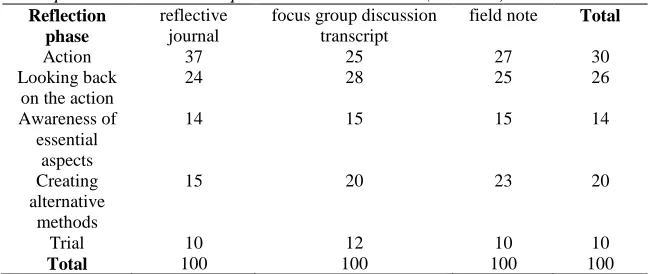
all units which identified the five phases of reflection as described above. (Table 2)
Table 2
Frequency of Occurrence of Reflection Phases of Reflective Journal, Focus Group Discussion Transcript and Field Note Units (N = 620)
Reflection phase
reflective journal
focus group discussion transcript
field note Total
Action 37 25 27 30
Looking back on the action
24 28 25 26
Awareness of essential
aspects
14 15 15 14
Creating alternative
methods
15 20 23 20
Trial 10 12 10 10
Total 100 100 100 100
Actually, the first phase of reflection is the essential phase which all teachers need to experience; through this phase teachers come across many different events in the educational setting; these events such as being annoyed by one student, not knowing the answer of a certain question asked by a student, being pressed by time, not being able to teach according to the plan, or many similar cases require different actions by the teachers. All teachers inevitably pass the first phase when they teach in an educational context and more or less come across such unexpected events. As indicated in Table 2, the most proportionate unit of analysis belongs to action phase which describes the actions done by the language teachers of the study at the time of teaching.
they do? and What did they feel? These questions point to the dimensions of wanting, feeling, thinking, and doing in the second phase of cyclical reflection. Because the dimensions influence both teacher and students, it is important for teachers to include all the areas in their reflection practice. Of course, the supervisor can help the teacher discover how to address them more systematically. Only then can we say that someone is truly learning how to reflect (Korthagen, 2001).An important intervention in supervisory conferences is empathy, which has to do with an explicit understanding of how another person feels, and being able to put a name to what triggered those feelings (Carkhuff, 1969; Egan, 2000). Such emphatic intervention of a supervisor contributes to lead prospective teachers from the second phase to the third one.
As it was reported in Table 2, the units of thought related to the last 3 phases of reflection in reflective journals written by the prospective teachers were noticeably less than those of focus group discussions and the reason may be the similarity of such discussions with those with supervisors where prospective language teachers have the opportunity to consult about their actions and receive emphatic feedback with regard to awareness of essential aspects and creation of alternatives. Such emphatic support from a mentor would help prospective teachers cross the theory-practice gap through reflection practice besides learning how to deal with unexpected events in classroom setting utilizing pedagogical reflection based strategies.
5. Conclusion
There has been a growing concern within the field of teacher education about the division between theory and practice, often termed as 'the theory–practice gap' (Van de Ven, 2007, p. 11). From the teachers' perspective, failure to utilize academic knowledge might result in missed opportunities to improve the quality of their practice or the assumption that theory is useless. In this regard, teacher educators may play an important role to help prospective teachers acknowledge their roles as teachers in bringing about educational change, to support them in integrating theory and practice and to help them find ways to mediate between curriculum ideas and practices within their context through actions and reflections (Lieberman, 2007).
identity and mission. Reaching core reflection especially the deeper levels could help prospective teachers to better handle critical situations. Besides the importance of reaching deeper levels of reflection, it is important to note the value of the prospective language teachers' reflection movement between different levels from outward to inward as well as the other way round.
As Korthagen and Vasalos (2005) bring out in case of deep reflection less emphasis should be put on the analysis of problematic situations because it leads to a decrease in the course of activity and therefore loses contact with the deeper levels. Similarly, in case of the research the focus was on finding the new possibilities rather than merely analyzing the problematic situations. Such possibilities were discussed by means of the following questions in focus group discussions. What is the ideal solution that you as a teacher want to bring out? What are the limiting factors preventing the achievement of that ideal situation?
These findings suggest that reflection practice helped to specify on which levels are the prospective teachers' problems located and which levels can direct the teaching process. This type of reflective interactions in focus group discussions is especially important for new and beginning teachers when they move into their profession. As research has shown (Dinkelman, Margolis & Sikkenga, 2006a, 2006b; Ritter, 2007), there is a strong connection between professional identity, self-efficacy and collegiality, and that opportunities for collegial interactions which have important roles in developing a professional identity as a teacher.
References
Akkerman, S., Admiral, W., Brekelmans, M. & Oost, H. (2006). Auditing quality of research social sciences. Quality & Quantity, 42(2), 111-113. Allen, J. M. (2009). Valuing practice over theory: How beginning teachers
re-orient their practicing the transition from the university to the workplace. Teaching and Teacher Education, 16(2), 647-654.
Berry, A. (2007). Tensions in teaching about teaching. The Netherlands: Springer.
Brandenburg, R. (2008). Powerful pedagogy: Self-study of a teacher educators' practice. The Netherlands: Springer.
Bredeson, P. (2003). Designs for learning. A new architecture for professional development in schools. Thousand Oaks: Corwin Press. Cochran-Smith, M. (2001). Higher standards for prospective teachers.
Journal of Teacher Education, 52(3), 179-181.
Creswell, J. W. & Miller, L. (1998). Qualitative inquiry and research design choosing among five traditions. Thousand Oaks, CA: Sage Publications. Dinkelman, T., Margolis, J., & Sikkenga, K. (2006). From teacher to teacher
educator: Experiences, expectations, and expatriation. Studying teacher education, 2(1), 5-23.
Fatemi, A., Shirvan, M., & Rezvani, Y. (2011). The effect of teachers' self-reflection on EFL learners' writing achievement. Cross-Cultural Communication Journal, 7(3), 175-181.
Ghaye, A., & Ghaye, K. (1998). Teaching and learning through critical reflective practice. London: David Fulton.
Jadidi, E., & Keshavarz, Z. (2013). The impact of Iranian teachers' reflection on their incorporation of strategy-based instruction. International Journal of Language Learning and Applied Linguistics World (IJLLALW), 11(4), 140-148.
Jamshidi, H., & Sadeghi, B. (2014). A comparative study of teacher education in Iran and the UK. Journal of Language Teaching and Research, 5(5), 1153-1159.
Janesick, V. J. (2004). Stretching exercises for qualitative researchers. Thousand Oaks, CA: Sage.
Javadi, F., & Khatib, M. (2014). On the relationship between reflective teaching and teachers' burnout. International Journal of Research Studies in Language Learning, 3(4), 85-96.
Kelchtermans, G., & Vandenberghe, R. (1994). Teachers' professional development: A biographical perspective. Journal of Curriculum Studies, 26(1), 45–62.
Koch, T. (2006). Establishing rigor in qualitative research: the decision trail. Journal of Advanced Nursing. 53(1), 91-103.
Korthagen, F. (2001). Linking practice and theory: The pedagogy of realistic teacher education. New Jersey: Lawrence Erlbaum Associates.
Korthagen, F., & Vasalos, A. (2005). Levels in reflection: Core reflection as a means to enhance professional growth. Teachers and Teaching: Theory and Practice, 11(1), 47-71.
Korthagen, F., & Vasalos, A. (2008). Quality from within as the key to professional development. Paper presented at the Annual Meeting of the American Educational Research Association.
Korthagen, F., Loughran, J., & Russell, T. (2006). Developing fundamental principles for teacher education programs and practices. Teaching and Teacher Education, 22(8), 1020-1041.
Le Compte, M. D., & Preissle, J. (1993). Ethnography and qualitative design in educational research. New York: Academic Press.
Leinhardt, G. (1988). Getting to know: Tracing student's knowledge from intuition to competence. Educational Psychologist, 23(2), 119-144. Lieberman, M. D. (2007). Social cognitive neuroscience. In R. F. Baumeister
& K. D. Vohs (Eds.), Encyclopedia of social psychology. Thousand Oaks, CA: Sage Press.
Loughran, J. (2006) Teaching about teaching. In P. Aubusson & S. Schuck (Eds.), Teacher learning and development: The mirror maze. Dordrecht, the Netherlands: Springer.
Loughran, J., & Russell, T. (2002). Improving teacher education practices through self-study. London: Routledge.
Loughran, J. (2004). A history and context of self-study of teaching and teacher education practices. In J. Loughran, M. L. Hamilton, V. La Boskey & T. Russell (Eds.), International handbook of self-study of teaching and teacher education practices. Dordrecht: Kluwer Academic Publishers.
Loughran, J. (2006). Developing a pedagogy of teacher education: Understanding teaching and learning about teaching. London: Routledge.
Lovat, T. J. (2003). The Role of the 'Teacher' coming of Age? Australian Council Deans of Education. London: Routledge.
Marcos, J. & D. Denyer (2012). Crossing the sea from They to We? The unfolding of knowing and practicing in collaborative research. Management Learning, 43(1), 443-459.
Maxwell, J. A. (2005). Qualitative research design: An interactive approach (2nd Ed.). Thousand Oaks, CA: Sage.
Merriam, S. (2009). Qualitative research: A guide to design and implementation. San Francisco, CA: Jossey-Bass.
Moore, R. (2003). Re-examining the field experiences of preservice teachers. Journal of Teacher Education, 54(1), 31-41.
Noormohammadi, S. (2014). Teacher reflection and its relation to teacher efficacy and autonomy. Science Direct, Procedia, Social and Behavioral Sciences 98, 1380-1389.
Oosterheert, I. E. (2001). How student teachers learn. Groningen: UCLO. Osterman, K. F. (1990). Reflective practice: anew agenda for education.
Education and Urban Society 22(2), 133-152.
Patton, M. Q. (2002). Qualitative research & evaluation methods (3rd ed.). Thousand Oaks, CA: Sage.
Peterson, C., & Seligman, M. E. P. (2003). Character strengths and virtues: A classification and handbook. New York: Oxford University Press/Washington, DC: American Psychological Association.
Ritter, J. (2007). Forging a pedagogy of teacher education: The challenges of moving from classroom teacher to teacher educator. Studying Teacher Education, 3(1), 5-22.
Rodgers, K. B. (2002). Re-framing gifted education: Matching the program to the child. Scottsdale, AZ: Great Potential Press.
Rubin, H. J., & Rubin, I. S. (2005). Qualitative interviewing: The art of hearing data (2nd ed.). Thousand Oaks, CA: Sage.
Sarlak, N., & Vafaeimehr, R. (2014). Iranian EFL teachers’ reflection on current teachers training programs. International Journal of Language Learning and Applied Linguistics World (IJLLALW). 6 (1), 47-58.
Schon, D. (1983). The reflective practitioner: How professionals think in action. New York: Basic Books
Seligman, M. E. P. (2002). Positive psychology, positive prevention, and positive therapy. In: C.R. Snyder & S.J. Lopez (Eds.), Handbook of positive psychology (pp. 3-9). Oxford: Oxford University Press.
Seligman, M. E. P., & Csikszentmihalyi, M. (2000). Positive psychology: An introduction. American Psychologist, 55(1), 5-14.
Silverman, D. (2006). Interpreting qualitative data: Methods for analysing talk, text and interaction (Third edition). London: Sage.
Strauss, A., & Corbin, J. (1998). Basics of qualitative research: Techniques and procedures for developing grounded theory (2nded.). Thousand Oaks, CA: Sage.
Taylor, S. J., & Bogdan, R. (1998). Introduction to qualitative research methods: A guidebook and resources. New York: John Wiley & Sons. Tickle, L. (1999). Teacher self-appraisal and appraisal of self. In R. P. Lipka
& T. M. Brinthaupt (Eds.), The role of self in teacher development (pp. 121-141). Albany, NY: State University of New York Press.
Trumbull, D. (2006). Sharing my teaching journal with my students. In P. Aubusson & S. Schuck (Eds.), Teacher learning and development: The mirror maze (pp. 50-58). Dordrecht, The Netherlands: Springer.