The Effect of Low‑Dose Ketamine (Preemptive Dose) on Postcesarean
Section Pain Relief
Forozan Milani, Katayoun Haryalchi, Seyedeh Hajar Sharami, Roya Faraji, Maryam Asgharnia, Fatemeh Salamat1,
Seyedeh Saeedeh Hashemi
Reproductive Health Research Center, Alzahra Hospital, School of Medicine, 1Guilan University of Medical Sciences, Guilan, Iran
A B S T R A C T
Background: Postsurgical pain is the main cause of anxiety in patients; therefore, analgesics (adjuvants) such as preemptive doses of ketamine with minimal adverse effects would be beneficial. However, studies are needed regarding their efficacy. Aim: To determine the preemptive effect of intravenous ketamine on pain intensity and need to opioids in cesarean section which performed under spinal anesthesia. Subjects and Methods: The study was a randomized, double‑blinded, clinical trial involving 60 term parturients for cesarean, using random block method, they were divided into two groups of each. The case group received ketamine with dose of 0.2 mg/kg and the control one normal saline with the same volume. Pain intensity was compared in 0,30,60,90,120,150, and 180 min and 6,12,18, and 24 h after surgeries with visual analog scale (VAS) index. The average opioid usage was compared during 24 h after those too. Final analyses were done with Mann‑Whitney, Chi‑square, and Spss.v. 16 (P < 0.05 was meaningful level). Results: There was not significant statistical difference on average VAS during interrupted times (F = 0.15, P = 0.70). Average dosage of diclofenac suppository and mean time for taking the first dosage of opioids have not statistical difference too (respectively; P = 0.76, P = 0.87). Average dose of pethidine was lesser than placebo statistically. It means, the case group did not take pethidine but this amount was 6 (20%) in the control one (P = 0.02). Conclusion: Taking the preemptive dosage of ketamine (0.2 mg/kg) before cesarean could act as a probably model for decreasing opioid consumption.
KEY WORDS: Ketamine, low dose, pain relief, preemptive
INTRODUCTION
Mechanisms of pain perception are so complicated and adjustable. The sensitivity of pathways of pain radiation could be arranged by pathologic, physiologic, or psychiatric basis.[1-3] An effective pain control could bring consent and alleviate annoyance.[1-4] It seems that after several decades of research, there has not been much improvement in field of “pain control.” Therefore, postoperative pain remains one of the main causes of patients’ anxiety, and its control become so important at the present time.[5,6] Not only, adequate pain relief leads to more comfort and faster ambulation, but also brings a better recovery, decreases hospitalization, complications (thromboemboli, risk of infection), and cost. Indeed, better acute pain control
leads to decrease the prevalence of chronic pain in the future.[7] In cesarean section pain alleviation could prevent the mentioned complications, and resulting successful breast feeding or better rooming in.
Opioid is one of the most efficient tranquilizers (narcotics) that used after surgeries, but it has some adverse effects like; respiratory depression, pruritus, nausea, vomiting, and intestinal paralysis. On the contrary, sometimes there is a weak response to narcotics.[8] In this regard, seems to need to pain killers with less adverse effect and better convenience. Nowadays, there are some types of adjuvants which alleviate pain with less complications or adverse effects but require more studies to approve their efficacy. Ketamine as an unique adjuvant used for deep analgesia” with a low cardiovascular stimulation,” it could be used during labor pain with the dosage of 0.2-0.5 mg/kg.[8,9] It has not got depressant effect on fetus and could not make teratogenicity
Address for correspondence
Dr. Katayoun Haryalchi, Reproductive Health Research Center, Alzahra Hospital, Guilan University of Medical Sciences, Namjostreet, Rasht, Guilan, Iran. E‑mail: [email protected]
Original Article
Access this article online Quick Response Code
Website:
www.jbcrs.org
DOI:
Milani, et al.: Low dose ketamine on pain relief and narcotics in cesarean section
Journal of Basic and Clinical Reproductive Sciences · July - December 2014 · Vol 3 · Issue 2 98
or other complications by preemptive doses.[8] Its long lasting analgesia made by “central spinal cord block”.[3,4] Intravenous ketamine was effective to pain relief in some studies,[10,11] but some ones refused its benefits.[12-15] For these contradictory results, the current study was arranged to assess the ketamine efficacy as a preemptive adjuvant on pain intensity” and postoperative opioid consumption.[16]
SUBJECTS AND METHODS
The current study was, randomized, double blinded, and clinical trial which performed after Ethical committee’s approval at Guilan University, with recording in Iranian Registration Clinical Trials base (code: IRCT 201103133485N2). Sample size was estimated on the base of comparing the visual analog scale (VAS) score mean In the first 24 h after surgery in ketamine group versus placebo group (3 ± 2.6 vs. 5 ± 2.2) in Ghazi-Saidi and Hajipour K study[11] Patients included into the study after taking the inform consent. Sixty terms parturient (single-tone pregnancy), who referred to the Alzahra Hospital, were selected and patients with the following medical histories were not included into the study; (1) high blood pressure, (2) convulsion, (3) drug abuse, (4) previous abdominal surgeries, (5) diabetes mellitus, (6) prechlampsia, (7) infection, 8) history of postsurgical bleeding, (9) known allergy to ketamine, (10) ASA I, II, and 10 increased intracranial pressure. Patients divided into two groups of 30 each with random-block method [Ketamine group (ketamine + normal saline), control group (normal saline)]. All patients, recieved the equal dosage of lidocaine + adrenaline. Spinal anesthesia was performed from L4-L5 space with 24-gauge needle (from midline with lidocaine 5%+ adrenaline 0.2% in sitting position). Then patients were supined and level of block assessed precisely with a needle. The case group received, 0.2 mg/kg ketamine + 2cc normal saline with the same volume (intravenous), before the level reached to the dermatome of T6. In all cases surgical incision, were the same (on uterine and skin), patients and surgeons did not know about the anesthetic solutions, indeed the duration of surgeries were approximately 1 h. Throughout the surgery, blood pressure, pulse rate, SpO2 were measured routinely, and Apgar score[1-5] recorded after delivery. VAS has been explained to patients before the operation. Patients were visited at [0,30,60,90,120,150,180 min intervals] then [6,12,18,24 h after that]. According to VAS score and need for opioid, by an assistant who blinded incognizant to the
group number. Patients with VAS ≥5, received suppository
diclofenac” with dosage of 200 mg/BD.” In this case, more need for analgesics” Pethidine 50 mg/IM” should be considered too. The first time of opioid request, total dosage of application, and VAS score (in the mentioned times) were recorded exactly. Also other variants like; mothers’ age, gestational age, body mass index, parity, gravidity, abortion, 1 and 5 min Apgar score, adverse drug reactions (nausea, vomiting, and
hallucination) were recorded in the information forms. All data were entered into the SPSS.v. 16, and analyzed by X2, Chi-square, Fisher’s exact test, and Mann-Whitney (P < 0.05 vas considered as meaningful level).
RESULTS
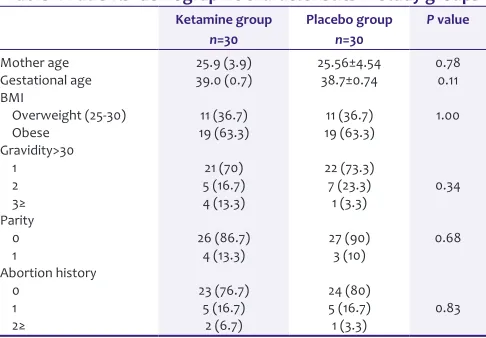
The study was performed on 60 patients who divided into two groups of 30 each. The average age was 25.6 (4.5) in the case group and 25.9 (3.9) in the control one. With no statistical differences (P = 0.78) [Table 1].
Average gestational age was 38.7 (0.7) weeks in the case group and 39.0 (0.7) in the control one, the distribution frequency has no statistical difference between two groups [respectively P = 1.0, P = 0.11] [Table 1].
The gravidity, parity, and abortion did not illustrate significant difference, respectively [respectively P = 0.83, P = 0.68, P = 0.34] [Table 1].
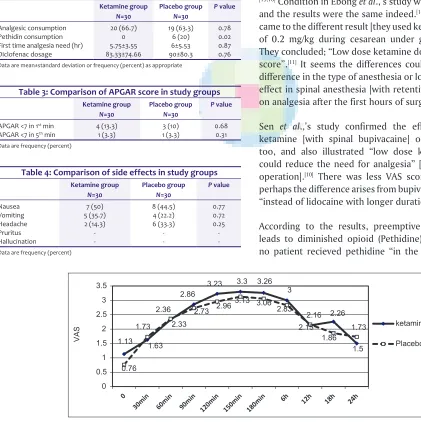
Opioid consumption “during 24 h” was 66.7% in the case group and 63.3% in the control one. Average time for analgesic request was 5.8 (3.6) h in the case group and 6 (5.5) in the other group. Also, diclofenac consumption “during 24 h” was 83.3 (74.7) mg in the case group and 90 (80.3) in the control one. And, there were no significant difference in all groups (respectively P = 0.79, P = 0.87, P = 0.76).
Petidine consumption “during 24 “ was lesser in ketamine group than the other one. So no one need for petidine in ketamine group, but six cases (20%) need that in the other one. It considered as a significant result (P = 0.02). [Table 2].
The assess of mean VAS “after the surgeries” present significant alteration process of pain in both two groups during 24 h (P < 0.001, F = 27.74). Furthermore, it also
Table 1: Patients’ demographic characteristics in study groups Ketamine group
n=30
Placebo group n=30
P value
Mother age 25.9 (3.9) 25.56±4.54 0.78
Gestational age 39.0 (0.7) 38.7±0.74 0.11
BMI
Overweight (25‑30) 11 (36.7) 11 (36.7) 1.00
Obese 19 (63.3) 19 (63.3)
Gravidity>30
1 21 (70) 22 (73.3)
2 5 (16.7) 7 (23.3) 0.34
3≥ 4 (13.3) 1 (3.3)
Parity
0 26 (86.7) 27 (90) 0.68
1 4 (13.3) 3 (10)
Abortion history
0 23 (76.7) 24 (80)
1 5 (16.7) 5 (16.7) 0.83
2≥ 2 (6.7) 1 (3.3)
important role on better movement and more satisfaction after surgeries. Specially, it could be so important in cesarean, for its effects on a successful rooming in and breast feeding.
According to the VAS results; average scores did not have significant difference in the different interrupted times “Ketamine had not any effect on the first request time of analgesics (case group 5.75 ± 3.55 h vs. 6 ± 5.53 h in control one). But Ghazisaeedee, Ennia, and Ebong’s showed the first request was longer significantly, in the ketamine group.[11,14,17] These differences could have been arisen from the type of spinal drug, dose, and method of Ketamine prescription and in the end general anesthesia. Current study and other ones concluded; low dose ketamine in both two groups (P = 0.66). EnniaSuppa [who were used higher
dose ketamine in cesarean under spinal anesthesia] and Bilgen [who were used higher dose ketamine in cesarean under general anesthesia] illustrated the same results, “according to the no statistical difference in VAS scores”. [15,16] Condition in Ebong et al.,’s study was the same as ours,
and the results were the same indeed.[14] But Ghazisaeede’s came to the different result [they used ketamine with dosage of 0.2 mg/kg during cesarean under general anesthesia]. They concluded; “Low dose ketamine does not impress VAS score”.[11] It seems the differences could have arisen from difference in the type of anesthesia or long lasting analgesic effect in spinal anesthesia [with retentive role of Ketamine on analgesia after the first hours of surgery].
Sen et al.,’s study confirmed the effect of preemptive ketamine [with spinal bupivacaine] on pain relief (VAS) too, and also illustrated “low dose ketamine (0.15 mg) could reduce the need for analgesia” [during 24 after the operation].[10] There was less VAS score in S.sen’s study, perhaps the difference arises from bupivacaine consumption “instead of lidocaine with longer duration”.
According to the results, preemptive dose of ketamine leads to diminished opioid (Pethidine) consumption, and no patient recieved pethidine “in the case group, during illustrated; no statistical difference for that process
[P = 0.70, F = 0.15] [Figure 1].
The distribution frequency illustrated no significant difference at first and 5th second Apgar Score (P = 0.68,
P = 0.31) [Table 3].
Also, there was not statistical difference according to the adverse drug reactions (nausea, vomiting, and headache) (respectively, P = 0.77, P = 0.72, and P = 0.25). And no one
had hallucination or pruritus [Table 4].
DISCUSSION
Prevention or alleviation of postsurgical pain remains a big challenge in postoperative care units likewise. It has an
Table 2: Comparison of analgesic, pethidin and diclofenac consumption during 24 hours after surgery in study groups
Ketamine group N=30
Placebo group N=30
P value
Analgesic consumption 20 (66.7) 19 (63.3) 0.78
Pethidin consumption 0 6 (20) 0.02
First time analgesia need (hr) 5.75±3.55 6±5.53 0.87
Diclofenac dosage 83.33±74.66 90±80.3 0.76
Data are mean±standard deviation or frequency (percent) as appropriate
Table 3: Comparison of APGAR score in study groups Ketamine group
N=30
Placebo group N=30
P value
APGAR <7 in 1st min 4 (13.3) 3 (10) 0.68 APGAR <7 in 5th min 1 (3.3) 1 (3.3) 0.31 Data are frequency (percent)
Table 4: Comparison of side effects in study groups Ketamine group
N=30
Placebo group N=30
P value
Nausea 7 (50) 8 (44.5) 0.77
Vomiting 5 (35.7) 4 (22.2) 0.72
Headache 2 (14.3) 6 (33.3) 0.25
Pruritus - -
-Hallucination - -
-Data are frequency (percent)
9$
6 NHWDPLQH
3ODFHER
Milani, et al.: Low dose ketamine on pain relief and narcotics in cesarean section
Journal of Basic and Clinical Reproductive Sciences · July - December 2014 · Vol 3 · Issue 2 100
24 h” and 6 (20%) ones received that in the control one. This finding is important with considering to the side effects of opioid. Nevertheless to the similar to the results of “Ghazisaeede, EnnaSuppa”, Wagner and colleagues showed “Low dose ketamine; reduce post-operative opioid consumption in pediatric spinal surgeries.[11,17,18] Darabi
et al., did not confirm the effect of preemptive ketamine on pediatric inguinal herniorrhaphy.[19] Perhaps, it illustrates the effect of “the type of surgery” and low pain threshold in pediatrics”.
This research presented, and “Ketamine” had not any effect on the first request time of analgesics (case group 5.75 ± 3.55 h vs. 6 ± 5.53 h in control one). But Ghazisaeedee, Ennia, and Ebong’s showed the first request was longer significantly, in the ketamine group.[11,14,16] These differences could have been arisen from the type of spinal drug, dose, and method of Ketamine prescription and in the end general anesthesia. Current study and other ones concluded; low dose ketamine is a safe drug with no side effects and it does not make nausea, vomiting, headache, and hallucination; furthermore, there was not any effect on first and 5th second Apgar score.[10,15,16]
So according to the present results; it could be deduced, preemptive intravenous ketamine could reduces opioid consumption after cesarean with no more non-steroid “analhesic drugs (NSAIDs) need.” But that method has not any effect on pain intensity. It seems, ketamine with dosage of 0.2 mg/kg “just before cesarean” could lead to reduction the opioid consumption “throughout 24 h after surgeries”. But it needs more researches to confirm and approve the impression of that dose on postoperative pain intensity. But to approve and confirm that results, need more expanded studies.
ACKNOWLEDGMENT
The article was extracted from Dr. Hashemi’s thesis.
REFERENCES
1. Reves JG, Fukuda K, Harley RW. Acute postoperative pain Intravenous Anesthetic Opioid. In: Miller R, Editor. Miller’s Anesthesia. 7th ed. Elsevier; 2010. P. 743-4, 798-800, 2774-5.
2. Hunt SP, Mantyh PW. The molecular dynamics of pain control. Nat Rev Neurosci 2001;2:83-91.
3. Julius D, Basbaum AI. Molecular mechanisms of nociception. Nature 2001;3:203-10.
4. McCleskey EW, Gold MS. Ion channels of nociception. Annu Rev Physiol 1999;61:835-56.
5. Basbaum AI. Distinct neurochemical features of acute and persistent pain. Proc Natl Acad Sci U S A 1999;96:7739-43.
6. Pandey CK, Singhal V, Kumar M, Lakra A, Ranjan R, Pal R, et al. Gabapentin provides effective postoperative analgesia whether administered pre-emptively or post-incision. Can J Anaesth 2005;52:827-31. 7. Rawal N, Berggren L. Organization of acute pain services: A low-cost
model. Pain 1994;57:117-23.
8. Dickenson AH. Neurophysiology of opioid poorly responsive pain. Cancer Surv 1994;21:5-16.
9. Elia N, Tramer MR. Ketamine and postoperative pain – a quantitative systematic review of randomised trials. Pain 2005;113:61-70. 10. Sen S, Ozmert G, Aydin ON, Baran N, Caliskan E. The persisting
analgesic effect of low-dose intravenous ketamine after spinal anaesthesia for caesarean section. Eur J Anaesthesiol 2005;22:518-23. 11. Ghazi-Saidi K, Hajipour A. Effects of preemptive Ketamine on
post-cesarean analgesic requirement. Acta Med Iran 2002;40:100-3. 12. Fazel Mohamad R, Forghani Z, Fakharian E, Akbari H. Preemptive
analgesic effect of ketamine in patients undergoing elective cesarean section. Clin J Pain 2010;26:223-6.
13. DA Conceição MJ, Bruggemann DA, Conceição D, Carneiro Leão C. Effect of an intravenous single dose of ketamine on postoperative pain in tonsillectomy patients. Paediatr Anaesth 2006;16:962-7. 14. Ebong EJ, Mato CN, Fyneface-ogans. Pre-incisional intravenous
low- dose ketamin does not cause pre-emptive an analgesic effect following cesarean section under spinal ananesthesia. J Anesth Clin Res 2011;2:1-6.
15. Bilgen S, Köner O, Türe H, Menda F, Fiçicioğlu C, Aykaç B. Effect of three different doses of ketamine prior to general anaesthesia on postoperative pain following Caesarean delivery: A prospective randomized study. Minerva Anestesiol 2012;78:442-9.
16. Subramaniam K, Subramaniam B, Steinbrook RA. Ketamine as adjuvant analgesic to opioids: A quantitative and qualitative systematic review. Anesth Analg 2004;99:482-95.
17. Suppa E, Valente A, Catarci S, Zanfini B, Draisci G. A study of low-dose S-Ketamine infusion as “preventive” pain treatment for cesarean section with spinal anesthesia: Benefits and side effects. Minerva Anestesiol 2012:1-21.
18. Tsui B, Wagner A, Malherb A, Mahood J, Moreau M. Low-dose ketamine does not reduce morphine use after spine surgery. Can J Anesth 2007;54:1-2.
19. Darabi ME, Mireskandari SM, Sadeghi M, Raimi E. Ketaine has no pre – emptive analgesic Effect in children undergoing inguinal hernia repair. Acta Med Iran 2008;46:451-6.
How to cite this article: Milani F, Haryalchi K, Sharami SH, Faraji R, Asgharnia M, Salamat F, Hashemi SS. The effect of low-dose ketamine (preemptive dose) on postcesarean section pain relief. J Basic Clin Reprod Sci 2014;3:97-100.
Source of Support: Nil, Conflict of Interest: None declared