AmniSure: A Point of Care Diagnostic for Preterm, Term Prelabor
Rupture of Membranes
Shakuntala Chhabra, Naina Kumar, Preeti Kalra
Department of Obstetrics and Gynecology, Mahatma Gandhi Institute of Medical Sciences, Sewagram, Wardha, Maharashtra, India
INTRODUCTION
Prelabor rupture of membranes (PROM) at term occurs in 10% births, preterm prelabor rupture of membranes (PPROM) in 2-3.5% births.[1-3] Rapid diagnosis, appropriate management are essential for best pregnancy outcome.[4,5] Therefore, timely, accurate diagnosis is essential.
Three commonly used methods for confirming rupture of membranes (ROM) are obvious leakage of fluid from the cervix, positive nitrazine test, and ferning. Sonography may be used to confirm oligohydramnios, but is not confirmatory of ROM. Neither of these tests have been found to be 100% sensitive or specific. Despite the significant advances in technology, diagnosis of ROM still requires integration of symptomatology, physical examination, laboratory testing.
The present study was done to determine the sensitivity and specificity of the AmniSure rapid immunoassay for the detection of true PROM and PPROM.
SUBJECTS AND METHODS
The study was carried out in women presenting with ROM to the labor room of a referral rural medical institute in Central India after approval from Ethical Committee. A total of 200 consecutive pregnant women who had reported with complaints of watery vaginal discharge, during the study period of around 1 year were enrolled in the study. Patients included in this study were between 18 and 44 years of age and ≥28 and ≤42 weeks of gestation. They had symptoms suggestive of PROM and gave consent to participate.
Women who had fetal genitourinary/renal anomalies, placenta previa or had a digital vaginal examination performed prior to evaluation for PROM, or who had active labor, were excluded.
Original Article
Access this article online Quick Response Code
Website:
www.jbcrs.org
DOI:
10.4103/2278-960X.153522
Address for correspondence Prof. Shakuntala Chhabra, Department of Obstetrics and Gynecology, Mahatma Gandhi Institute of Medical Sciences, Sewagram, Wardha ‑ 442 102, Maharashtra, India. E‑mail: [email protected] A B S T R A C T
Background: Accurate, early diagnosis, prompt appropriate intervention is essential in the management of rupture of membranes (ROM), especially preterm. Aim: The aim was to determine efficacy of AmniSure rapid immunoassay placental
alpha‑microglobulin‑1 test for accurate diagnosis of true ROM in women with watery discharge after 28 weeks gestation, compare with conventional methods. Subjects andMethods: Study was carried out in women presenting with ROM to labor
the room of referral rural medical institute in Central India after ethical approval. Prospective study was performed in women
presenting with symptoms/signs of ROM after 28 weeks of gestation. Sterile speculum examination was performed to observe pooling of liquor. Nitrazine, ferning tests were done to diagnose ROM. Vaginal examination was performed to determine cervical dilatation, effacement, station of presenting part in term cases. If all or 2 of 3 tests (pooling, ferning, and nitrazine) were positive, provisional diagnosis of ROM was made. Confirmation of ROM was done at birth. However, if 2 of 3 tests were negative, sterile speculum examination was repeated after 30 min of the first test. Test performance was calculated by comparing AmniSure results against final diagnosis at birth. Of 200 patients between 28 and 42 weeks gestation recruited for study, 31.5% (63/200) were preterm, 68.5% (137/200) term. Statistical analysis of data collected in the electronic database using SPSS version (Amnisure International LLC, 30 JFK Street, 4th Floor, Cambridge, MA 02138, USA). Results: AmniSure rapid immunoassay, rapid method for diagnosis of ROM, has 100% specificity, 99.44% sensitivity (one false negative due to meconium and immediate cesarean section).
Conclusion: In comparison to nitrazine, pooling, ferning, AmniSure has almost 100% sensitivity, specificity.
Chhabra, et al.: Rupture of membranes, diagnosis by AmniSure
Journal of Basic and Clinical Reproductive Sciences · January - June 2015 · Vol 4 · Issue 1 30
An informed written consent was taken for each case. After a thorough history and clinical examination to exclude patients with vaginal bleeding, a blind vaginal swab was placed in the vagina for 1 min, and then dipped for 1 min in the solvent vial provided with the AmniSure test kit (AmniSure International LLC, Boston, MA, USA). The sample was then stored to be evaluated by the research assistant, who was blinded to the findings of the clinical examination. The AmniSure strip was dipped in the solvent for 5 min, and the result was observed and interpreted. The presence of two lines indicated a positive result, while a single line indicated a negative result. Sterile speculum examination was performed to observe pooling of liquor, collect specimens for the nitrazine and ferning tests. Sterile vaginal examination was then performed in term cases to determine cervical dilatation, effacement, and station of the presenting part. If all or at least, 2 out of the 3 traditional tests (i.e. pooling, ferning, and nitrazine) were positive, the membranes were considered to be clinically ruptured. However, if 2 out of 3 tests were negative, then a speculum examination was done with aseptic precautions, 30 min after the first, to allow the nitrazine, pooling, and ferning tests to be run again. Final test performance was calculated by comparing the results of the AmniSure test against final diagnosis at birth and the results of other tests performed during the evaluation.
An obstetric ultrasonography (USG) was performed for gestation, presentation, congenital anomalies, and amniotic fluid index (AFI). USG revealing oligoamnios further suggested ROM. The management protocol for confirmed PROM was followed. All the results were documented in the data sheets used for analysis. Statistical analysis of data collected the electronic database was done using SPSS version.
RESULTS
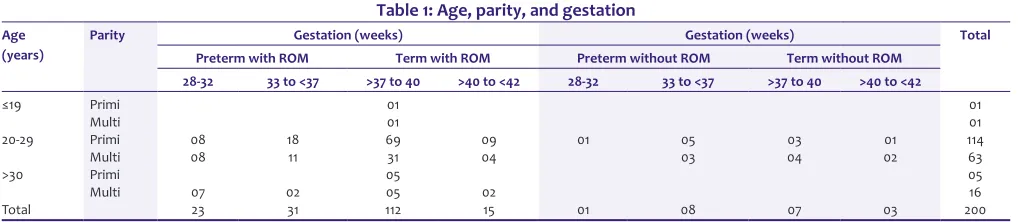
Of 200 women, two were younger than 20 years of age, 115 between 20 and 24 years, 62 between 25 and 29 years, 16 between 30 and 34 years and five were 35 years or above. A total of 120 women were primigravida, 47 second gravida, 20 third gravida, 9 fourth gravida, and 4 were fifth gravida. Twenty-four women had gestation between 28
and 32 weeks, 39 between 33 and 36 weeks (63 preterm), 119 between 37 and 40 weeks, and 18 between 40 and 42 weeks (137 term). Of 63 women with preterm gestation, 54 (85.72%) were diagnosed to be having ROM and 9 (14.28%) no ROM. Of the 137 women with term gestation, 127 (92.70%), had ROM, but 10 (7.29%) did not. Overall, 181 (90.5%) were diagnosed to have ROM and 19 (9.5%) no ROM at initial evaluation [Table 1].
In 19 cases, the AmniSure test was negative, in 180 cases, it was positive and in one case, the liquor had a lot of meconium, the woman had to undergo an emergency cesarean section, so second speculum examination (as per the protocol in cases of an initial negative result) could not be done for this case. This patient was deemed to have a false negative result by the AmniSure test. Ideally for false negative, repeat test should have been done. Pooling was positive in 177 cases, nitrazine test in 173 cases, and ferning in 178 cases. Hence, in comparison to AmniSure test which had 100% specificity and 99.44% sensitivity due to incomplete evaluation, nitrazine test had 95.58% sensitivity and 100% specificity, Pooling has 97.79% sensitivity and 100% specificity, whereas ferning has 98.34% sensitivity and 100% specificity.
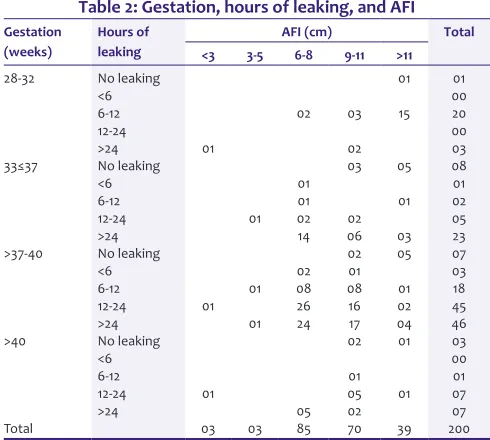
At the time of admission, the majority of women complained of leaking for more than 24 h prior to their visit, and AFI was typically between 6 and 8 cm. Some patients reported leakage for <6 h prior to presentation, and the AFI was either <3 cm or between 3 and 5 cm [Table 2].
Of 181 women with confirmed ROM, 45 had a cesarean section, 39 of which were directly related to ROM, the remaining 6 were done for other reasons. Of 19 women with no ROM, 8 underwent cesarean section for various reasons. Overall 39 cesarean sections were done in women with term pregnancy and 14 in women with preterm gestation.
Overall, of the 181 women who had ROM, 1 had intrauterine death, 1 had stillbirth, 3 babies had neonatal death, and 20 (11.04%) babies were admitted to the neonatal intensive care unit (NICU). Of the 19 babies of women who had no ROM, 9 (47.36%) were admitted to the NICU. In total, there
Table 1: Age, parity, and gestation
Age (years)
Parity Gestation (weeks) Gestation (weeks) Total
Preterm with ROM Term with ROM Preterm without ROM Term without ROM 28-32 33 to <37 >37 to 40 >40 to <42 28-32 33 to <37 >37 to 40 >40 to <42
≤19 Primi 01 01
Multi 01 01
20-29 Primi 08 18 69 09 01 05 03 01 114
Multi 08 11 31 04 03 04 02 63
>30 Primi 05 05
Multi 07 02 05 02 16
Total 23 31 112 15 01 08 07 03 200
ROM – Rupture of membranes
were six perinatal deaths (3.09%). The causes of deaths included small for gestational age, low birth weight, sepsis, severe birth asphyxia, respiratory distress and hydrops fetalis, the perinatal deaths possibly linked to ROM were five.
Overall of 200 cases in whom AmniSure test was performed, 180 were true positive, 19 were true negatives, 1 was a false negative, as repeat testing was not done. There was no false positive. Accordingly, the AmniSure test had 100% specificity and almost 100% sensitivity also. In one case in which the test was false negative, the liquor had a lot of meconium and on account of emergency cesarean section; a second AmniSure test could not be done, so ideally no comments can be made about only one false negative.
DISCUSSION
Rupture of membrane is largely a clinical diagnosis. It is typically suggested by history of watery vaginal discharge on sterile speculum examination. The traditional diagnosis of ROM is by clinician’s ability to document three clinical signs on sterile speculum examination: (1) Visual pooling of clear fluid in posterior fornix of vagina or leakage of fluid from cervical os; (2) an alkaline pH of cervicovaginal discharge, demonstrated by nitrazine test; and/or (3) ferning of cervicovaginal discharge on drying. Moreover, sensitivity and specificity of the nitrazine test has been reported at 90-97% and 16-70%, respectively.[6-10] In the present study also, it was found that the nitrazine test had 95.58% sensitivity and 100% specificity, pooling has 97.79% sensitivity and 100% specificity, ferning has 98.34% sensitivity and 100% specificity. Further, the use of all three tests is not mandatory for diagnosis of ROM, when 2 of 3 are positive, clinical correlation is exercised.
Amnio-dye infusion is the only procedure that provides a 100% accurate result. After amniocentesis, a dye (Evans Blue or fluorescein) is injected into the amniotic cavity, and if a tampon placed in the vagina is stained blue following the procedure, ROM is confirmed unequivocally. However, this procedure is invasive, expensive, and is associated with risk to the pregnancy, including bleeding, infection, iatrogenic ROM, and possibly, loss of pregnancy (approximately 1 in 270).[11,12] Hence, this procedure is not used in day to day practice. Evidence of diminished amniotic fluid volume (by Leopold’s examination or ultrasound) alone cannot confirm the diagnosis,[3] but may help in the clinical setting. With the possible exception of direct visualization of amniotic fluid spurting from cervical os, all of these clinical signs have limitations in terms of diagnostic accuracy, cost, and technical ease. Moreover, such tests become progressively less accurate when more than 1 h has elapsed after membranes have ruptured or in certain nonobvious circumstances, where fluid may not be present in vagina for evaluation or what is present may be contaminated with urine, cervical mucus, vaginal discharge, blood, or meconium. Because of these difficult situations, multiple cytological, biochemical, colorimetric, and sonographic methods have been proposed for detection of ROM, however, no one test has been found to be completely accurate and diagnosis often requires an integration of historic factors, physical examination, and laboratory testing.
Many trials aimed at finding more accurate ways to detect ROM in nonobvious cases have evaluated biochemical markers including those based on the detection of fetal fibronectin,[13,14] alpha feto protein,[15] β-human chorionic gonadotropin in cervicovaginal secretions,[16] and insulin-like growth factor binding protein (IGFBP).[15,17] None of these markers, however, have proven to be reliable means to accurately diagnose true ROM. A recent study has revealed that IGFBP-1 is also an effective method with high sensitivity and specificity for the diagnosis of PROM.[18] To the contrary, investigators have demonstrated an excellent performance for test based on detection of placental alpha microglobulin-1 (PAMG-1), a rapid 5 min noninstrumented qualitative immunochromatographic test cleared by the FDA in 2004 (AmniSure ROM test, AmniSure International LLC, Boston, MA, USA). The test employs monoclonal antibodies, detects even a miniscule amount of PAMG-1, which is found in high concentrations in cervicovaginal secretions after ROM has occurred. AmniSure is believed to be highly accurate (over 99% sensitivity) and is easy to use.[19-26]
In the present study, 200 women who had presented with watery discharge, but did not have obvious membranes ruptured were evaluated for ROM by AmniSure test. Finally, the diagnosis of ROM was determined at birth. Overall, 200 cases available for analysis, the AmniSure test was Table 2: Gestation, hours of leaking, and AFI
Gestation (weeks)
Hours of leaking
AFI (cm) Total
<3 3-5 6-8 9-11 >11
28-32 No leaking 01 01
<6 00
6-12 02 03 15 20
12-24 00
>24 01 02 03
33≤37 No leaking 03 05 08
<6 01 01
6-12 01 01 02
12-24 01 02 02 05
>24 14 06 03 23
>37-40 No leaking 02 05 07
<6 02 01 03
6-12 01 08 08 01 18
12-24 01 26 16 02 45
>24 01 24 17 04 46
>40 No leaking 02 01 03
<6 00
6-12 01 01
12-24 01 05 01 07
>24 05 02 07
Total 03 03 85 70 39 200
Chhabra, et al.: Rupture of membranes, diagnosis by AmniSure
Journal of Basic and Clinical Reproductive Sciences · January - June 2015 · Vol 4 · Issue 1 32
positive in 180 of these, 19 were true negatives, 1 was false negative and there was no false positive. Accordingly, the AmniSure test had 99.44% sensitivity, though with problem of loss of the second test and 100% specificity.
The study revealed excellent accuracy of the AmniSure test in the Indian population presenting with watery vaginal discharge. In comparison to nitrazine, pooling, and the ferning tests, the AmniSure test had better sensitivity and specificity.
ACKNOWLEDGMENTS
We are thankful to all the women who gave consent to participate in the study. We are thankful to AmniSure International LLC (Boston, MA, USA) for providing AmniSure ROM test kits.
REFERENCES
1. Mercer BM. Preterm premature rupture of the membranes. Obstet Gynecol 2003;101:178-93.
2. Nili F, Ansari AA. Neonatal complications of premature rupture of membrane. Acta Med Iran 2003;41:175-9.
3. ACOG Committee on Practice Bulletins-Obstetrics. ACOG practice bulletin no 80: Premature rupture of membranes. Clinical management guidelines for obstetrician-gynecologists. Obstet Gynecol 2007;109:1007-19.
4. Loeb LJ, Gaither K, Woo KS, Mason TC. Outcomes in gestations between 20 and 25 weeks with preterm premature rupture of membranes. South Med J 2006;99:709-12.
5. Medina TM, Hill DA. Preterm premature rupture of membranes: Diagnosis and management. Am Fam Physician 2006;73:659-64. 6. Gorodeski IG, Haimovitz L, Bahari CM. Reevaluation of the pH,
ferning and nile blue sulphate staining methods in pregnant women with premature rupture of the fetal membranes. J Perinat Med 1982;10:286-92.
7. Kishida T, Yamada H, Negishi H, Sagawa T, Makinoda S, Fujimoto S. Diagnosis of premature rupture of the membranes in preterm patients, using an improved AFP kit: Comparison with ROM-check and/or nitrazine test. Eur J Obstet Gynecol Reprod Biol 1996;69:77-82. 8. Gaucherand P, Salle B, Sergeant P, Guibaud S, Brun J, Bizollon CA,
et al. Comparative study of three vaginal markers of the premature
rupture of membranes. Insulin like growth factor binding protein 1 diamine-oxidase pH. Acta Obstet Gynecol Scand 1997;76:536-40. 9. Esim E, Turan C, Unal O, Dansuk R, Cengizglu B. Diagnosis of premature
rupture of membranes by identification of beta-HCG in vaginal washing fluid. Eur J Obstet Gynecol Reprod Biol 2003;107:37-40. 10. Erdemoglu E, Mungan T. Significance of detecting insulin-like growth
factor binding protein-1 in cervicovaginal secretions: Comparison with nitrazine test and amniotic fluid volume assessment. Acta Obstet Gynecol Scand 2004;83:622-6.
11. Eddleman KA, Malone FD, Sullivan L, Dukes K, Berkowitz RL, Kharbutli Y,
et al. Pregnancy loss rates after midtrimester amniocentesis. Obstet
Gynecol 2006;108:1067-72.
12. Odibo AO, Gray DL, Dicke JM, Stamilio DM, Macones GA, Crane JP. Revisiting the fetal loss rate after second-trimester genetic amniocentesis: A single center’s 16-year experience. Obstet Gynecol 2008;111:589-95.
13. Gu H, Ding Y, Li Y. Fetal fibronectin diagnosis of premature rupture of the amniotic membranes. Zhonghua Fu Chan Ke Za Zhi 1995;30:533-5. 14. Abdelazim IA, Abdelrazak KM, Al-Kadi M, Yehia AH, Abdulkareem AF.
Fetal fibronectin (Quick Check fFN test) versus placental alpha microglobulin-1 (AmniSure test) for detection of premature rupture of fetal membranes. Arch Gynecol Obstet 2014;290:457-64.
15. Gaucherand P, Guibaud S, Rudigoz RC, Wong A. Diagnosis of premature rupture of the membranes by the identification of alpha-feto-protein in vaginal secretions. Acta Obstet Gynecol Scand 1994;73:456-9. 16. Kim YH, Park YW, Kwon HS, Kwon JY, Kim BJ. Vaginal fluid beta-human
chorionic gonadotropin level in the diagnosis of premature rupture of membranes. Acta Obstet Gynecol Scand 2005;84:802-5.
17. Jeurgens-Borst AJ, Bekkers RL, Sporken JM, van den Berg PP. Use of insulin like growth factor binding protein-1 in the diagnosis of ruptured fetal membranes. Eur J Obstet Gynecol Reprod Biol 2002;102:11-4. 18. Abdelazim IA, Makhlouf HH. Placental alpha microglobulin-1 (AmniSure
test) versus insulin-like growth factor binding protein-1 (Actim PROM test) for detection of premature rupture of fetal membranes. J Obstet Gynaecol Res 2013;39:1129-36.
19. Lee SE, Park JS, Norwitz ER, Kim KW, Park HS, Jun JK. Measurement of placental alpha-microglobulin-1 in cervicovaginal discharge to diagnose rupture of membranes. Obstet Gynecol 2007;109:634-40. 20. Di Renzo GC, Roura LC, Facchinetti F, Antsaklis A, Breborowicz G,
Gratacos E, et al. Guidelines for the management of spontaneous preterm labor: Identification of spontaneous preterm labor, diagnosis of preterm premature rupture of membranes, and preventive tools for preterm birth. J Matern Fetal Neonatal Med 2011;24:659-67. 21. Tagore S, Kwek K. Comparative analysis of insulin-like growth factor
binding protein-1 (IGFBP-1), placental alpha-microglobulin-1 (PAMG-1) and nitrazine test to diagnose premature rupture of membranes in pregnancy. J Perinat Med 2010;38:609-12.
22. Birkenmaier A, Ries JJ, Kuhle J, Bürki N, Lapaire O, Hösli I. Placental a-microglobulin-1 to detect uncertain rupture of membranes in a European cohort of pregnancies. Arch Gynecol Obstet 2012;285:21-5. 23. Phupong V, Sonthirathi V. Retraction. Placental alpha-microglobulin-1
rapid immunoassay for detection of premature rupture of membranes. J Obstet Gynaecol Res 2012;38:962.
24. Abdelazim IA, Makhlouf HH. Placental alpha microglobulin-1 (AmniSure(®) test) for detection of premature rupture of fetal membranes. Arch Gynecol Obstet 2012;285:985-9.
25. Lee SM, Romero R, Park JW, Kim SM, Park CW, Korzeniewski SJ, et al. The clinical significance of a positive Amnisure test in women with preterm labor and intact membranes. J Matern Fetal Neonatal Med 2012;25:1690-8.
26. Eleje GU, Ezugwu EC, Ogunyemi D, Eleje LI, Ikechebelu JI, Igwegbe AO,
et al. Accuracy and cost-analysis of placental alpha-microglobulin-1
test in the diagnosis of premature rupture of fetal membranes in resource-limited community settings. J Obstet Gynaecol Res 2014.
How to cite this article: Chhabra S, Kumar N, Kalra P. Amnisure: A point of care diagnostic for preterm, term prelabor rupture of membranes. J Basic Clin Reprod Sci 2015;4:29-32.
Source of Support: Financial support for the research assistant who did tests and AmniSure kits committed by company, partly paid, Conflict of Interest: None declared