Tests for paired count outcomes
James A Proudfoot,1 Tuo Lin,1 Bokai Wang,2 Xin M Tu1,3
To cite: Proudfoot JA, Lin T,
Wang B, et al. Tests for paired count outcomes. General Psychiatry
2018;31:e100004. doi:10.1136/ gpsych-2018-100004 Received 13 August 2018 Accepted 13 August 2018
1Clinical and Translational Research Institute, University of California San Diego, San Diego, California, USA
2Departments of Biostatistics & Computational Biology and Anesthesiology, University of Rochester, Rochester, New York, USA
3Department of Family Medicine and Public Health, University of California San Diego, San Diego, California, USA
Correspondence to James A Proudfoot; jproudfoot@ ucsd. edu © Author(s) (or their employer(s)) 2018. Re-use permitted under CC BY-NC. No commercial re-use. See rights and permissions. Published by BMJ.
Summary
For moderate to large sample sizes, all tests yielded pvalues close to the nominal, except when models were misspecified. The signed-rank test generally had the lowest power. Within the current context of count outcomes, the signed-rank test shows subpar power when compared with tests that are contrasted based on full data, such as the GEE. Parametric models for count outcomes such as the GLMM with a Poisson for marginal count outcomes are quite sensitive to departures from assumed parametric models. There is some small bias for all the asymptotic tests, that is,the signed-ranktest, GLMM and GEE, especially for small sample sizes. Resampling methods such as permutation can help alleviate this.
InTroduCTIon
Although not as popular as continuous and binary variables, count outcomes arise quite often in clinical research. For example, number of hospitalisations, number of suicide attempts, number of heavy drinking days and number of packs of cigarettes smoked per day are all popular count outcomes in mental health research. Studies yielding paired outcomes are also popular. For example, to evaluate new eye-drops, we can treat one eye of a subject with the new eye-drops and the other eye with a placebo drop. To evaluate skin cancer for truck drivers, we can compare skin cancer on the left arm with the right arm, since the left arm is more exposed to sunlight. To evaluate the stress of combat on Veterans’ health, we may use twins in which one is exposed to combat and the other is not, as differences observed with respect to health are likely attributable to combat experience. In a pre-post study, the effect of an intervention is evaluated by comparing a subject’s outcomes before (pre) and after (post) receiving the intervention. In all these studies, each unit of analysis has two outcomes arising from two different condi-tions. Interest is centred on the difference between the means of the two outcomes.
For continuous outcomes, the paired t-test is the standard statistical method for evaluating differences between the means. However, the paired t-test does not apply to non-continuous variables such as binary and count (frequency) outcomes. For binary
outcomes, McNemar’s test is the standard. For count or frequency outcomes, there is not much discussion in the literature. Many use Wilcoxon’s signed-rank test because this method is applicable to paired non-contin-uous outcomes such as count responses. One major weakness of the signed-rank test is its limited power. As observations are converted to ranks and only ranks are used in the test statistic, the signed-rank test does not use all available information in the original data, leading to lower power when compared with tests that use all data. This is why t-tests are preferred and widely used to compare two independent groups for continuous outcomes.
With recent advances in statistical method-ology, there are more options for comparing paired count responses. In this paper, we discuss some alternative procedures that use all information in the original data and thus generally provide more power than the signed-rank test. In the second section, we first provide a brief review of paired outcomes and methods for comparing continuous and binary paired outcomes. We then discuss the classic signed-rank test and modern alterna-tives for comparing paired count outcomes. In the third section, we compare different methods for comparing paired count outcomes using simulation studies. In the fourth section, we present our concluding remarks.
meThodS for paIred CounT ouTComeS paired continuous and binary outcomes
Consider a sample of n subjects indexed by i
and let yi1 and yi2 denote the paired outcomes
from the i th subject. The subject may be an
individual or a pair of twins, depending on applications. For example, in a pre-post study, the paired outcomes correspond to the pretreatment and post-treatment assessment and the subject is an individual. In studies involving twins, the paired outcomes come from each pair of twins. Because the two outcomes are correlated, statistical methods for comparing independent samples such as the t-test cannot be applied.
on September 12, 2020 by guest. Protected by copyright.
Table 1 A 2×2 contingency table displaying joint distributions of paired binary outcomes, with a, b, c and d denoting cell count
yi2
0 1
yi1 0 a b
1 c d
For a continuous outcome, the paired t-test is gener-ally applied to evaluating differences in the means of
the paired outcomes. If we assume that yi1 and yi2 follow
a bivariate normal distribution, then the difference
between the two outcomes, di= yi2−yi1 , is also normally
distributed. Under the null of no difference between the
means of the two outcomes, di has a normal distribution
with mean 0 and variance σd2 . Thus, we can apply the t-test
to the differences di to test the null:
td = ¯dsd·
√n ∼tn−1, (1)
where tk denotes the t distribution with k df, and ¯d· and
sd denote the sample mean and SD. We can also use this
sampling distribution to construct CIs.
In practice, the bivariate normal distribution
assump-tion for the paired outcomes yi1 and yi2 is quite strong and
may not be met in real study data. If the assumption fails,
the differences di= yi2−yi1 generally do not follow the
normal distribution and thus the td statistic in Equation
(1) may not follow the t distribution. For large samples
such as n> 200 , td follows approximately a standard
normal distribution. Thus, one may replace tn−1 with the
‘asymptotic’ standard normal, N(0, 1) , to test the null as
well as construct CIs, even if the outcomes yi1 and yi2 are
not bivariate normal.
In what follows, we assume large samples, since all the tests to be discussed next are asymptotic tests, that is, they approximately follow a mathematical distribution such as the normal distribution only for large samples. For small to moderate samples, all these tests have unknown distri-butions and asymptotic mathematical distridistri-butions such as the standard normal for large samples for the paired t-test may not work well. We discuss alternatives for small to moderate samples in the discussion section.
If the paired outcomes are binary, the above hypothesis
becomes the comparison of the proportions of yi1 and yi2 .
McNemar’s test is the standard for comparing the paired
outcomes. Let p1 and p2 denote the proportions
associ-ated with yi1 and yi2 , that is,
p1= Pr(yi1= 1) and p2= Pr(yi2= 1). Then the hypothesis to be tested is given by:
H0: p1= p2, vs. Ha: p1̸= p2. (2) McNemar’s test is premised on the idea of comparing concordant and discordant pairs in the sample.
Shown in table 1 is a 2×2 cross-tabulation for the two
levels of the binary outcomes. Let pa , pb , pc and pd denote
the cell probabilities (or proportions) for the four cells in the table, that is,
pa= Pr(yi1= 0, yi2= 0), pb= Pr(yi1= 0, yi2= 1),
pc= Pr(yi1= 1, yi2= 0), pd= Pr(yi1= 1, yi2= 1).
Then, p1 can be expressed in terms of the cell
probabil-ities as follows:
p1= Pr(yi1= 1) = Pr(yi1= 1,yi2= 0 oryi2= 1) =pc+pd.
Similarly, p1 can be expressed as:
p2= pb+ pd.
Thus, p1=p2 implies pb= pc and vice versa. The
hypoth-esis of interest in Equation (2) involving p1 and p2 can be
expressed in terms of pb and pc :
H0:pb=pc, vs. Ha:pb̸=pc.
McNemar’s test evaluates the difference between the
concordant and discordant pairs, b and c , that is,
zm= |b−√c|−1
b + c .
A large difference leads to rejection of the null. By
normalising this difference, the statistic zm above follows
approximately the standard normal for large sample size.
paired count outcomes
For count outcomes, McNemar’s test clearly does not apply. The paired t-test is also inappropriate for such
outcomes. First, the difference di= yi2−yi1 does not
follow a normal distribution. Second, even if both yi1 and
yi2 follow a Poisson distribution, the difference di is not a
Poisson variable; di in general is not even guaranteed to
have non-negative values.
One approach that has been used to compare paired count outcomes is the Wilcoxon signed-rank test. Within
our context, let Ri denote the rank of di based on its
absolute value |di| . The ranks are integers that indicate
the position of |di| after rearranging them in ascending
order.1 The signed-rank test has the following statistic:
Wilcoxon signed rank test : Wn+= n ∑
i=1I
{
di>0}Ri,
where I{
di>0} denotes an indicator with the value 1 (0) if
the logic di >0 is true (otherwise). Thus, Wn+ only adds up
the ranks for the positive di ’s.
The statistic Wn+ ranges from 0 to n(n+1)2 . Under H0 ,
about one-half of the di 's are positive. Thus, any pair ( di ,
dj ) has 50% chance that di+dj > 0 . In terms of ranks, this
means that the sum of Ri for positive di is about half of the
range n(n+12 ) . Thus, we can specify the null as:
H0:θ= 1
2, vs. H0:θ̸= 1 2,
where θ= Pr(di+dj> 0) . Under the null H0 , Wn+ has
mean n(n+14 ) , half of the range n
( n+1)
2 . The normalised Wn+ :
Un=
( n 2
)−1
Wn+
(3)
on September 12, 2020 by guest. Protected by copyright.
has approximately a normal distribution with mean 1 2
and SE √1
3n for large samples, which is readily applied to
calculate p values and/or confidence bands.
Since paired outcomes are a special case of general longitudinal outcomes, longitudinal methods can be applied to test the null. For example, both the generalised linear mixed-effects model (GLMM) and generalised esti-mating equations (GEE), two most popular longitudinal models, can be specialised to the current setting. When applying GLMM, we specify the following model:
yi1∼Poisson(µ1), yi2∼Poisson(µ2),
log(µ1)=β0+ z, log(µ2)=β0+β1+ z, z∼N(0, σ2), (4)
where z denotes a random effect to account for
corre-lation between the paired outcomes, Poisson(µ) denotes
a Poisson distribution with mean µ , exp(·) denotes the
exponential and log(·) denotes the log function. The null
of same mean between y1 and y2 can be expressed as:
H0:β1= 0, vs. H0:β1̸= 0.
Note that since the random effect z may be positive or
negative and the random of the normal distribution is unbounded, the log transformation of the Poisson mean
in Equation (4) is necessary to ensure that µ1 and µ2 stay
positive.
For applying GEE, we only need to specify the mean of each paired outcome. This is because unlike GLMM, GEE is a ‘semi-parametric’ model and imposes no mathe-matical distribution on the outcomes. Thus, under GEE, both the Poisson distribution for each outcome and the
random effect z for linking the paired outcomes are
removed. The corresponding GEE is given by:
log[E(yi1)]=β0, log[E(yi2)]=β0+β1, 1≤i≤n. (5)
Since there is no random effect in Equation (5), the log transformation is also not necessary and thus the GEE can be specified simply as:
E(yi1)=γ0, E(yi2)=γ0+γ1, 1≤i≤n. (6)
Compared with the GLMM in Equation (4), the GEE above imposes no mathematical distribution either jointly or marginally, allowing for valid inference for a broad class of data distributions. The GLMM in Equation (4) may yield biased inference if: (1) at least one of the outcomes
does not follow the Poisson; (2) the random effect z
follows a non-normal distribution; and (3) y1 and y2 are
not correlated according to the specified random-effect structure. In contrast, the GEE in Equation (5) forgoes all such constraints and yields valid inference regardless of the marginal distribution and correlation structure of
the outcomes y1 and y2 .
SImulaTIon STudy
In this section, we evaluate and compare the perfor-mances of the different methods discussed above by simulation. All simulations are performed with a Monte
Carlo (MC) sample of M= 2000 under a significance
level of α= 0.05 . Performance of a test is characterised
by: (1) bias and (2) power. We consider both aspects when comparing the different methods.
Bias
If a test performs correctly, it should yield type I error
rates at the specified nominal level α= 0.05 . Several
factors can affect the performance of the test. First, if data do not follow the assumed mathematical distribu-tions, the test in general is biased. For example, if the paired t-test is applied to paired outcomes that are not bivariate normal, it will generally be biased. Second, with the exception of the paired t-test, all tests discussed above rely on large samples to provide valid results. When applied to small or moderate samples, such tests may have bias. For example, the normal distribution may not provide a good approximation to the sampling
distribution of the statistic Un of the Wilcoxon
signed-rank test Wn+ when applied to a sample size of, say, n = 20
. Thus, to compare the performance of each different method, we consider sample sizes ranging from n = 10 to 200.
To evaluate the effects of model assumptions on test
performance, we simulate correlated count responses yi1
and yi2 using a copula approach,2 where each outcome
marginally follows a negative binomial (NB) distribution: yi1∼NB(µ1,τ), yi2∼NB(µ2,τ),
µ1= exp(β0+z), µ2= exp(β0+β1+z). (7)
The above model deviates from the GLMM in
Equa-tion (4) in two ways. First, yi1 ( yi2 ) follows an NB, rather
a Poisson. Second, correlation between yi1 and yi2 does
not follow the normal distribution based on random
effect. Unlike Poisson, NB has an extra parameter τ
controlling for dispersion (variability). Thus, although Poisson and NB have the same mean, NB has a different
(larger) variance than Poisson.1
Since NB(µ,τ) converges
to Poisson(µ) as τ increases, selecting a relatively small τ allows us to examine the impact of the Poisson assump-tion on inference when the GLMM in Equaassump-tion (4) is applied to count outcomes that are not compliant with the Poisson model.
For the simulation study, we set µ1=µ2= 5, τ = 1 and
5, and correlation between yi1 and yi2 to 0.5. To evaluate
bias using MC simulation, we simulate paired outcomes
yi1 and yi1 from the model in Equation (7), apply each
of the tests discussed in the third section and compute p values for testing the null hypothesis. This process is
repeated M = 2000 times. A test has little or no bias if the
proportion of nulls rejected over the M = 2000 times is
close to the nominal value α= 0.05 .
Shown in table 2 are averaged p values for the different
tests from their applications to the M = 2000 simulated
paired outcomes, where GLMM (Poisson) denotes the GLMM for Poisson in Equation (4), GLMM (NB) denotes the GLMM for NB distribution (by replacing the Poisson in the GLMM in Equation (4) with NB), GEE denotes the GEE without log transformation in Equation (6) and GEE (log-link) denotes the GEE with log transformation in
on September 12, 2020 by guest. Protected by copyright.
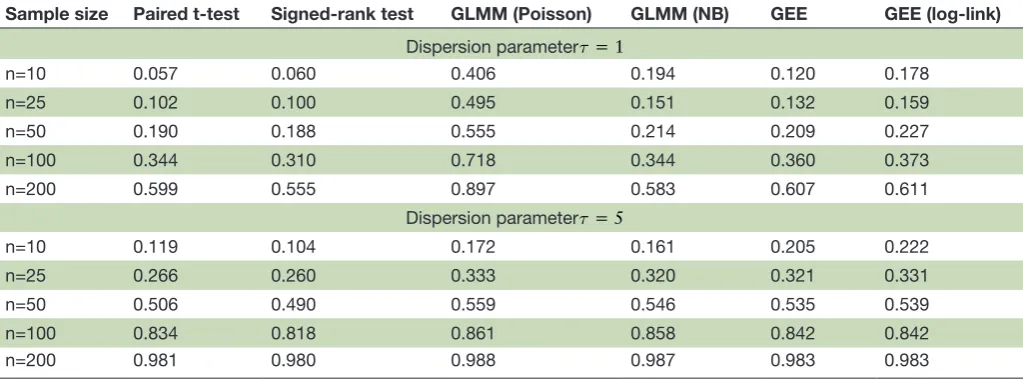
Table 3 Power estimates from testing the null of no difference between paired outcomes by different methods over M=2000 MC replicates
Sample size Paired t-test Signed-rank test GLMM (Poisson) GLMM (NB) GEE GEE (log-link) Dispersion parameterτ= 1
n=10 0.057 0.060 0.406 0.194 0.120 0.178
n=25 0.102 0.100 0.495 0.151 0.132 0.159
n=50 0.190 0.188 0.555 0.214 0.209 0.227
n=100 0.344 0.310 0.718 0.344 0.360 0.373
n=200 0.599 0.555 0.897 0.583 0.607 0.611
Dispersion parameter τ= 5
n=10 0.119 0.104 0.172 0.161 0.205 0.222
n=25 0.266 0.260 0.333 0.320 0.321 0.331
n=50 0.506 0.490 0.559 0.546 0.535 0.539
n=100 0.834 0.818 0.861 0.858 0.842 0.842
n=200 0.981 0.980 0.988 0.987 0.983 0.983
GEE, generalised estimating equation; GLMM, generalised linear mixed-effects model; MC, Monte Carlo; NB, negative binomial.
Table 2 Averaged p values from testing the null of no difference between paired outcomes by different methods over M=2000 MC replicates
Sample size Paired t-test Signed-rank test GLMM (Poisson) GLMM (NB) GEE GEE (log-link) Dispersion parameterτ= 1
n=10 0.042 0.042 0.380 0.154 0.089 0.136
n=25 0.043 0.050 0.371 0.092 0.064 0.076
n=50 0.045 0.050 0.295 0.069 0.056 0.065
n=100 0.049 0.050 0.268 0.058 0.052 0.056
n=200 0.052 0.060 0.284 0.059 0.054 0.057
Dispersion parameter τ= 5
n=10 0.046 0.035 0.068 0.054 0.094 0.101
n=25 0.051 0.050 0.054 0.051 0.065 0.070
n=50 0.051 0.046 0.059 0.058 0.059 0.062
n=100 0.046 0.040 0.054 0.05 0.051 0.052
n=200 0.046 0.049 0.050 0.049 0.047 0.049
GEE, generalised estimating equation; GLMM, generalised linear mixed-effects model; MC, Monte Carlo; NB, negative binomial.
Equation (5). For moderate to large sample sizes, n=100,
200, all tests yielded p values close to the nominal α= 0.05
, except for GLMM (Poisson), which had highly inflated
type I errors for τ = 1 . As indicated earlier, with a small
dispersion parameter such as τ= 1 , NB has much more
variability than its Poisson counterpart, leading to poor fit when fitting simulated data with the GLMM assuming the Poisson. Thus, the high bias in the type I error reflects model mis specification.
Although the paired t-test is not a valid test, it performed well for all sample sizes considered, although showing small downward bias, especially for small sample sizes. For extremely small sample sizes such as n=10, all three asymptotically valid methods, signed-rank test, GLMM (NB) and GEE, showed small upward bias, especially
when τ = 1 . As the sample size increased, the bias
dimin-ished, as expected.
power
If a group of tests all provide good type I error rates, we can further compare them for power. It is common that two unbiased tests may provide different power, because they may use a different amount of informa-tion from study data or use the same informainforma-tion differently. For example, within the current study, the signed-rank test may provide less power than the GEE, because the former only uses the ranks of the original
count outcomes, completely ignoring magnitudes of di
’s. Thus, it is of interest to compare power across the different tests.
on September 12, 2020 by guest. Protected by copyright.
Figure 1 Power for each method under different alternative hypotheses. Data are generated with larger dispersion (ie, τ = 1 ). GEE, generalised estimating equation; GLMM, generalised linear mixed-effects model; NB, negative binomial.
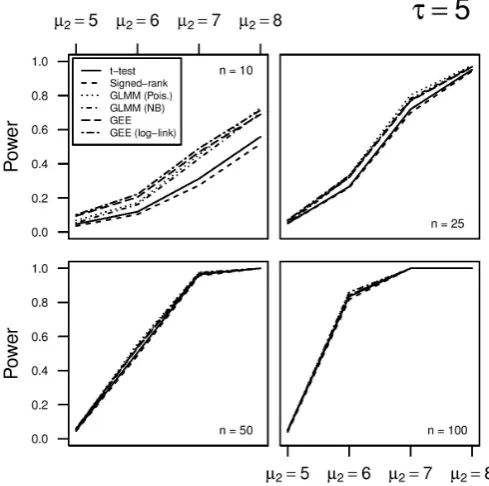
Figure 2 Power for each method under different alternative hypotheses. Data are generated with smaller dispersion (ie, τ = 5 ), more similar to a Poisson distribution. GEE, generalised estimating equation; GLMM, generalised linear mixed-effects model; NB, negative binomial.
We again use the MC approach to compare power across the different methods. However, unlike the evalua-tion of bias, we must also be specific about the difference in the means of paired outcomes so that we can simulate
the outcomes under the alternative hypothesis. For this study, we specify the null and alternative as follows:
H0:µ1=µ2= 5, Ha:µ1= 5, µ2= 6. (8)
We simulate correlated outcomes (yi1, yi2) again using
the copula from the GLMM in Equation (7), but with
µ2= 5 and µ2= 6 as specfied under Ha in Equation (8).
For each simulated outcome (yi1,yi2) , we apply the
different methods and test the null hypothesis under α= 0.05 . This process is repeated M = 2000 times and the power for each method is estimated by the per cent of times the null is rejected.
Shown in table 3 are power estimates from testing the null hypothesis in Equation (8) by the different methods
from their applications to the M = 2000 paired count
outcomes simulated under the alternative hypothesis in Equation (8). As type I error rates for GLMM (Poisson) were highly biased, power estimates from this method are not meaningful. Among the remaining four tests, the signed-rank test has the lowest power. The paired t-tests, GLMM (NB) and both GEE methods yield comparable power estimates, though both GEE methods and GLMM (NB) appear to perform best with a sample size of at
least 25. When τ= 5 and the sample size is high (more
than, say, 50 subjects) all tests have comparable power and correct nominal significance level. Figures 1 and 2 show the power estimates under additional alternative hypotheses. The GLMM (NB) method appears to be less efficient for larger differences in means with sample sizes
around 50 when τ = 1 .
dISCuSSIon
In this report, we discussed several methods for testing differences in paired count outcomes. Unlike paired continuous and binary outcomes, analysis of paired count outcomes has received less attention in the literature. Although the signed-rank test is often used, it is not an optimal test. This is because it uses ranks, rather than original count outcomes (differ-ences between paired count outcomes), resulting in loss of information and leading to reduced power. Thus, unless study data depart severely from the normal distribution, the signed-rank test is not used for comparing paired continuous outcomes, as the paired t-test is a more powerful test. Within the current context of count outcomes, the signed-rank test again shows subpar power when compared with tests that are contrasted based on full data, such as the GEE.
The simulation study in this report also shows that para-metric models for count outcomes such as the GLMM with a Poisson for marginal count outcomes are quite sensitive to departures from assumed parametric models. As expected, semiparametric models like the GEE provide better performance. Also, the paired t-test seems to perform quite well. This is not really surprising, since within the current context the GEE and paired t-test are
on September 12, 2020 by guest. Protected by copyright.
James Proudfoot obtained a master’s degree in statistics from the University of British Columbia. He is currently in the Biostatistical and Epidemiology Research Division at UC San Diego, CA. His work involves manuscripts preliminary assessment, biostatistical analysis counseling, and research on the application of statistical methods in psychiatric studies.
essentially the same, except that the former relies on the asymptotic normal distribution for inference, while the latter uses the t distribution for inference. As the sample size grows, the t becomes closer to the standard normal distribution. Thus, p values and power estimates are only slightly different between the two for small to moderate samples.
The simulation results also show some small bias for all the asymptotic tests, that is, the signed-rank test, GLMM and GEE, especially for small sample sizes. In most clinical studies, sample sizes are rela-tively large and this limitation has no significant impact. For studies with small samples, such as those in bench sciences, bias in type I error rates may be high and require attention. One popular statis-tical approach is to use resampling methods such as
permutation.3 Within the current context of paired
count responses, the permutation technique is readily implemented. For example, we first decide whether
to switch the order of the paired outcomes (yi1,yi2)
in a random fashion and then apply any of the tests considered above, such as the GEE, and compute the statistic based on the ‘permuted’ sample. We repeat this process M times (such as M=1000) and obtain a sampling distribution of the test statistic. If the statistic based on the original data falls either below the 2.5th or above the 97.5th percentile, we reject the null. Under permutation, model assumptions such as
the Poisson in the GLMM have no impact on infer-ence and all the tests provide valid inferinfer-ence.
Contributors JAP directed all simulation studies, ran some of the simulation examples and helped edit and finalise the manuscript. TL helped run some of the simulation examples and drafted some parts of the manuscript. BW helped check some of the simulation study results and draft part of the simulation results. XMT helped draft and finalise the manuscript.
funding The report was partially supported by the National Institutes of Health, Grant UL1TR001442 of CTSA funding.
disclaimer The content is solely the responsibility of the authors and does not necessarily represent the official views of the NIH.
Competing interests None declared. patient consent Not required.
provenance and peer review Not commissioned; externally peer reviewed. data statement No additional data are available.
open access This is an Open Access article distributed in accordance with the Creative Commons Attribution Non Commercial (CC BY-NC 4.0) license, which permits others to distribute, remix, adapt, build upon this work non-commercially, and license their derivative works on different terms, provided the original work is properly cited and the use is non-commercial. See: http:// creativecommons. org/ licenses/ by- nc/ 4.0
referenCeS
1. Tang W, He H, Tu XM. Applied categorical and count data analysis. Florida, FA: Chapman & Hall/CRC, 2012.
2. Yan J. Enjoy the Joy of Copulas: With a Package copula. J Stat Softw
2007;21:1–21.
3. Efron B, Tibshirani R. An introduction to the bootstrap. New York, NY: Springer Science+Business Media, 1993.
on September 12, 2020 by guest. Protected by copyright.