Procedia
Social and
Behavioral
Sciences
Procedia - Social and Behavioral Sciences 00 (2013) 000–000www.elsevier.com/locate/procedia
ICIMTR 2013
International Conference on Innovation, Management and Technology Research,
Malaysia, 5 – 6 June, 2013
Knowledge Transfer Conceptualization and Scale
Development in IT Outsourcing: The Initial Scale Validation
A.H. Nor Aziati
a, S. Juhana
b, A. Nor Hazana
caLecturer,Department of Production and Operation Management, Faculty of Technology Management and Business, Universiti Tun
Hussein Onn Malaysia, 86400 Parit Raja, Batu Pahat, Johor, Malaysia
b
Proffessor,Knowledge Technology Research Group, Faculty of Technology and Information Science, Universiti Kebangsaan Malaysia
c
Senior Lecturer,Department of Technology Management, Faculty of Technology Management and Business, Universiti Tun Hussein Onn Malaysia, 86400 Parit Raja, Batu Pahat, Johor, Malaysia
Abstract
Previous studies focused on business related knowledge transfer from the background of multinational companies and international joint venture with emphasize on factors that impeded the knowledge transfer process. However, empirical research regarding technical knowledge transfer in the context of public agencies IT outsourcing is inconclusive. This occurs because most of the knowledge transfer research approach was in-depth case studies. A few empirical studies that claimed to conceptualize and operationalize the knowledge transfer remain a theoretical conjecture. The use of concepts such as absorptive capacity and knowledge creation as a proxy for measuring the transfer of knowledge raises the shortcoming of the knowledge transfer measurements made in the literature. Therefore, the objective of this study is to identify the knowledge transfer measurement item that suitable with the context of IT outsourcing. Data was gathered through a survey among 180 IT scheme staff at three e-government lead agencies in Malaysia was done. The research employed descriptive and factor analysis to confirm that the measurement is valid as well as reliable. The results of this study confirmed that knowledge transfer in IT outsourcing context is multidimensional construct. As such, the proposed scale of knowledge transfer constitutes a valid and reliable measurement for future use in the scientific community in future empirical research.
© 2013 Published by Elsevier Ltd. Selection and peer-review under responsibility ofUniversiti Malaysia Kelantan, Malaysia
1.Introduction
Academic interest in knowledge transfer has grown rapidly over the past decades. Previous research had focused knowledge transfer effects on organizational learning (Chua & Pan, 2008; Cha et al., 2008), firm performance and innovation (Tsai, 2001). Knowledge transfer, particularly in the context of outsourcing of government IT projects is not well represented in past studies. The main reason for this as argued by Willcocks (2011), is the outsourcing industry itself is still in the early stages of professionalizing, even struggling with developing its own body of knowledge. Furthermore, most previous research has discussed knowledge transfer from the inter-organizational (Easterby-smith et al., 2008; Martinkenaite, 2011) or intra-organizational (Schotter & Bontis, 2009; Wijk & Jansen, 2008) perspectives with emphasis on multinational companies (MNC) (Martins & Antonio, 2010; Shiue et al., 2010), international joint venture (IJV) (Park, 2011) and Universities-private partnership (Alexander & Childe, 2012; Landry et al., 2007). Recent research on knowledge transfer conducted by Chang and Gurbaxani (2012) in IT outsourcing has shown that knowledge transfer gives substantial impact on client productivity. There are only a few studies conducted on the transfer of knowledge in the context of IT outsourcing or offshoring (Williams, 2011; Oshri et al., 2008). Thus, even though much research on knowledge transfer exits, there is quite a gap between the theoretical recommendations and the concrete task of establishing and executing knowledge transfer in IT outsourcing context.
the effects of knowledge transfer in IT outsourcing on knowledge replication and adaptation routines; and the changes in knowledge or skill based among project team members.
The remainder of the paper is organized as follows. The second section explained in detailed the processes undertake for scale development in this study. We start our first step in scale development by reviewing various conceptualizations of knowledge transfer used by past scholars and justify the definition of knowledge transfer employed by this study. Based upon this literature review, in the third section, we report on the methods for knowledge transfer scale item generation that can be a valuable extension to the simple proxies of absorptive capacity and knowledge creation that are commonly used in the literature. Additionally, in section three, we present the data analysis results based from the self-administered survey method at three federal Malaysia public agencies. The data were analysed using SPSS statistical tools. In the fourth section we conclude with some general suggestions for improving the scale, future validity testing and limitations of the research.
2.Scale Development Process
The main steps taken in developing the scale were adapted from the scale development process outlined by MacKenzie et al. (2011) because those steps strike a balance between depth of treatment and breadth of coverage and had been discussed elsewhere (e.g. DeVellis, 2003). Originally, MacKenzie et al. (2011) outlined ten steps in scale development. However, for the purpose of this study, we only employed four steps since this paper address the initial stage of scale validation. The steps employed in this study are; (i) construct conceptualization, (ii) generation of initial scale items, (iii) pilot testing and scale purification and lastly (iv) data collection and analysis.
2.1 Step 1: Knowledge Transfer Conceptualization
knowledge (Ko et al., 2005; King, 2008). However, those definitions do not specifically explain how and in what way does one unit affected the other. Thus, Easterby-smith et al. (2008) suggested that the effect of inter-organizational knowledge transfer is in terms of the learning and understanding that the second unit experiences in sustaining a competitive advantage. The consequences of learning and understanding process are manifested through changes in knowledge or performance of the recipient unit. Williams (2011) for example took this approach by defining knowledge transfer in terms of mechanisms employed by vendor to gain understanding of their client and utilize the knowledge for the benefit of the client.. When knowledge transfer is associated with the organizational dimension or learning, then the knowledge can be spread (Schneider, 2009). For the purpose of this study, we conceptualize knowledge transfer unidirectional communication between the client and the vendor exchange and share their useful information, skill, competencies or routines about the project and both parties is affected by changes in the recipient replication capacity, adaptation capacity and changes in skill or knowledge based that occurs as a function of experience from each other. We note that the term of KT is chosen to embrace rather than to exclude the meanings of the earlier discussed KT concepts.
2.2 Step 2: Knowledge Transfer Scale Items Generation
To date, there are no specific measures for knowledge transfer, especially in the context of IT outsourcing since KT is heavily affected by the types of knowledge, project complexity and outsourcing approach. In echoing to this, the current study attempts to develop a new multi-dimensions measurement scale for assessing the KT in IT outsourcing. From the literature review, we classify KT measurement into three approaches. In the first approach, KT is measured from the various changes at the recipient side (Argote & Ingram, 2000); (i) the changes in recipient’s performance or (ii) the induced changes of recipient knowledge base (iii) changes in collective knowledge that resides in multiple repositories. In the second approach, KT is measured by the outcome and process dimensions. The outcome dimension measures KT from the financial and non financial criteria. From financial criteria, KT is measured by the project cost reduction, stakeholder’s equity, intellectual property or number of patents (e.g. Lichtenthaler, 2010; Perez-Nordtvedt et al., 2008); whilst, for non financial criteria, some researcher measured KT from the number of successful KT engagements during a certain period of time (Li & Hsieh, 2009), marginal change in learning-by-doing knowledge level at certain period (Cha et al., 2008) and frequency of contact with knowledge source (Kang et al., 2010). Basically, the financial and non-financial measurement of knowledge transfer view IT outsourcing as a transactional contract; whereas, IT outsourcing in public agencies is more towards relational partnership (Cha et al., 2008) with a fixed price contract that transfer the risk and obligation to the vendor. Hence, some researcher embarked with the third approach. The third approach measure KT from the learning performance or learning capabilities - the speed, extent, type and nature of the “new knowledge learned” (Martinkenaite, 2011). Predominantly, past researchers measured KT from the outcome perspectives since it is more tangible with accurate supporting data and mostly in documented form compared to process perspectives.
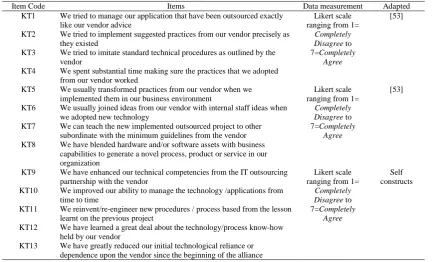
Empirical evidence confirms that some degree of replication and adaptation gives an impact towards inter-organization KT (e.g. Szulanski & Jensen, 2006; Williams, 2007; Chen & Mcqueen, 2010). Besides, KT is also a manifestation of the changes of knowledge-based or skill-based. Changes in knowledge based is operationalized as client’s efforts toward the goal of generating new ideas, solutions or reinvent practices the vendor held that deemed useful in practice. A client’s commitment to increase their knowledge or skill based will significantly improve organizational competitive advantage and foster ongoing success. This study conceptualized changes of knowledge based from process-outcome view of innovation as suggested by Quintane et al. (2011). The changes of knowledge or skill based measures used in this study are generated from qualitative and quantitative studies done by various researchers (e.g. Willians, 2011; Oshri et al., 2008; Karlsen et al. 2011). Additionally, the development of knowledge transfer measures in this study is also based from Scarso & Bolisani (2012) suggestion. According to them, one way of measuring KT is from measuring the induced changes of recipient knowledge base as the implication of transferring knowledge. With regard to the IT outsourcing, knowledge transfer is measured at the client’s team level instead of individual level. Table 1 lists all 13 pool items for knowledge transfer measurement. The items for replication and adaptation were adapted from previous work; whereas, items for changes in skill or knowledge level is a newly constructed item.
Table 1. Knowledge Transfer Item Measurement
Item Code Items Data measurement Adapted
KT1 We tried to manage our application that have been outsourced exactly like our vendor advice
Likert scale ranging from 1=
Completely Disagree to 7=Completely
Agree
[53]
KT2 We tried to implement suggested practices from our vendor precisely as they existed
KT3 We tried to imitate standard technical procedures as outlined by the vendor
KT4 We spent substantial time making sure the practices that we adopted from our vendor worked
KT5 We usually transformed practices from our vendor when we implemented them in our business environment
Likert scale ranging from 1=
Completely Disagree to 7=Completely
Agree
[53]
KT6 We usually joined ideas from our vendor with internal staff ideas when we adopted new technology
KT7 We can teach the new implemented outsourced project to other subordinate with the minimum guidelines from the vendor KT8 We have blended hardware and/or software assets with business
capabilities to generate a novel process, product or service in our organization
KT9 We have enhanced our technical competencies from the IT outsourcing partnership with the vendor
Likert scale ranging from 1=
Completely Disagree to 7=Completely
Agree
Self constructs KT10 We improved our ability to manage the technology /applications from
time to time
KT11 We reinvent/re-engineer new procedures / process based from the lesson learnt on the previous project
KT12 We have learned a great deal about the technology/process know-how held by our vendor
KT13 We have greatly reduced our initial technological reliance or dependence upon the vendor since the beginning of the alliance
2.4 Step 3: Pilot-testing and Scale Purification
management such as Director, Deputy Director, and Chief Director. As suggested by Johanson and Brooks (2009), the suitable pilot testing sample size for instrument development is between 25 to 30 respondents as there is no substantial changes in confidence interval value, even when the number of measured items increases. Therefore, this study collected 32 respondents for pilot testing. As a prerequisite for reliability analysis, the instrument needs to be purified. Purification is a procedure by which the items which do not contribute to the internal consistency of a particular construct are removed. The decision to remove or retain an item is made based on “alpha if deleted” value. The initial total Cronbach’s alpha value for KT was 0.688. Based on the Cronbach’s alpha “if item deleted” values, the authors did several iterations to purify the scale. We deleted two items (KT2 and KT10), after careful consideration of the impact on the construct. The resultant scale had a Cronbach’s alpha of 0.714. The widely-accepted minimum cutoff point is Cronbach’s alpha ranges from 0.60 to 0.7. After purification of all the scales, the instrument had 11 items. These items were subjected to data collection phase for further psychometric property analysis.
2.5 Step 4: Data Collection
The population of this study is ICT scheme personnel of three government agencies in Malaysia; X, Y and Z. Non IT-scheme personnel are not included in this research. These three agencies have been managing e-government IT outsourcing project since 2000 which shows more than 11 years of experience in dealing with outsourcing projects. Non-probability purposive sampling was used in this study due to the limited numbers of personnel involved with the project. This research advocates agencies directory profile which is accessible from the agency’s web site or via personal approach to the agency’s help desk officer or public relation officer. The frame used in this research is accurate as the agency’s directory profile is updated every six months to ensure data accuracy and latest information of the particular directory. A questionnaire using a seven-point Likert scale was used as suggested by Weijters et al. (2010) with endpoint labels without intermediary labels in the data collection stage. A total of 200 purified questionnaires were distributed to the potential respondents. A cross sectional self-administered survey approach was adopted. Both self-completion and interviewer-filled survey techniques were used to receive higher valid response. The process of distribution and collection of questionnaires was carried out over a period of 3 months. All respondents were requested to respond to the survey based on their recent experience in an IT project and all were assured that their response is confidential. A total number of 180 effective responses were obtained from the first stage survey which translates to about a 40.27% response rate. With 180 respondents collected for scale validation, the sample size is deemed enough to achieve a high level of statistical power and sufficient for exploratory factor analysis (Reise et al., 2000). The next section presents the scale validation process.
3.Scale Validation
Different authors disagree on what constitutes an adequate demonstration of validity. Nevertheless, a minimal demonstration of the validity of any variable should probably include the content or face validity of its indicators, the variable's construct validity, and its convergent and discriminant validity (DeVellis, 2003). In this research, all 11 items (refer to Table 1) were subjected to exploratory factor analysis (EFA) a for validation purposes. EFA was employed to assess construct, convergent and discriminant validity of the scores obtained from the instrument.
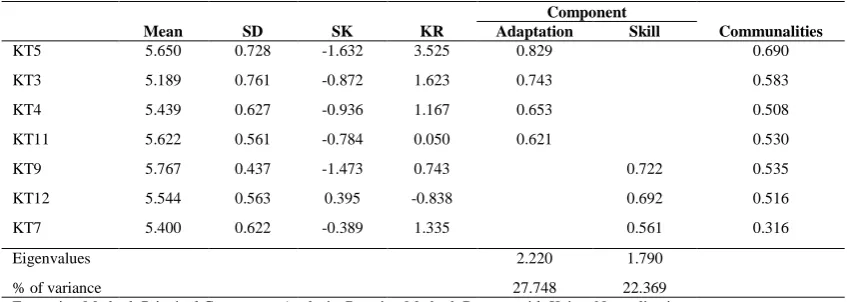
Exploratory factor analysis (EFA) is popular items reduction method used in scale development. The major objective of EFA is to reduce a number of observed variables in order to enhance interpretability The items will be extracted in different components or observed variables based from the loadings. Subsequently, the components are used as constructs in corresponding model. In this study, we employed exploratory factor analysis with the principal component extraction method (PCA) and promax rotation which is by far the most popular type in IS research; whereby, the aim of PCA is to retain as a mush as possible the original measures’ total variance. Besides, the normal distribution is not a prerequisite for PCA since the data collected for the study is still at the preliminary stage. Finally, we validate the measurement based from three validation criteria; construct, convergent and discriminate validation.
Table 2. Factor Analysis result of Knowledge Transfer
Mean SD SK KR
Component
Communalities Adaptation Skill
KT5 5.650 0.728 -1.632 3.525 0.829 0.690
KT3 5.189 0.761 -0.872 1.623 0.743 0.583
KT4 5.439 0.627 -0.936 1.167 0.653 0.508
KT11 5.622 0.561 -0.784 0.050 0.621 0.530
KT9 5.767 0.437 -1.473 0.743 0.722 0.535
KT12 5.544 0.563 0.395 -0.838 0.692 0.516
KT7 5.400 0.622 -0.389 1.335 0.561 0.316
Eigenvalues 2.220 1.790
% of variance 27.748 22.369
Extraction Method: Principal Component Analysis. Rotation Method: Promax with Kaiser Normalization. SD: Standarad Deviation; SK: Skewness; KR: Kurtosis
Once item validity and reliability have been assessed, the next step is to evaluate convergent validity. Convergent validity of a construct is confirmed when the construct is measured by multiple indicators. For convergent validity, again we employed factors analysis within the earlier determined factor in order to obtain a more in-depth judgment of the dimensionality of the construct under study. Convergent validity is established when items all fall into one factor as theorized. All the three components displayed unidimensionality with adaptation dimension exhibits KMO value at 0.698 explaining 52.24% of the variation; while changes in skill-based dimension indicates KMO value as 0.578 explaining 50.25% of the variation. Thus, the analysis provided evidence of convergent validity. Finally, we proceeded to test the discriminant validity. The discriminant validity is the degree to which items differentiate among constructs or measure distinct concepts. A bivariate correlation analysis was done on the two components generated from the factor analysis and the result is presented in Table 3. In this analysis, we tested the measurement against IT outsourcing success construct. As can be seen, all components are not perfectly correlated where their correlation coefficient value is 0.005. This indicates that, each dimension measure unique characteristics based from the tested item. Hence, we can conclude that discriminant validity has been established.
Table 3. Bivariate correlation analysis
Mean SD Adaptation Skill
Adaptation 5.475 0.487 1.000 0.005
Skill-Based 5.570 0.382 0.005 1.000
4.Discussion and Conclusion
The initial development has shown an acceptable measure of knowledge transfer that can be enhanced. All components show that the proposed scale of knowledge transfer constitutes a valid and reliable measurement, making it appropriate for use in the scientific community in future empirical research. The results of this study follow those obtained by Williams (2007), which indicate that knowledge transfer in IT outsourcing is a process composed of knowledge adaptation routines. Further, we enhanced knowledge transfer measurement by incorporating the changes in skill or knowledge based among the IT staff. The study outlined the procedures involved in the development and validation of an instrument to measure the knowledge transfer of IT outsourcing project team members, specifically to the Malaysian public agency context. The new measurement instrument was constructed and validated following the most frequent recommendations in the scientific literature on the development of scales in the IS research. We operationalized the knowledge transfer construct based on the review of literature pertaining to theories of communication and organizational learning. From the foregoing, it can be concluded that the theoretical and practical contribution of this paper is important. From a theoretical perspective, the paper reduces the problem of measuring and identifying the dimensions that shape knowledge transfer. Besides, the study incorporates construct validation or scale development process based from Mackenzie et al. (2011) seminal paper in MIS and behavioural research; thus guarantees a rigorous empirical validation and methodological process. From a practical point of view, this instrument develops empirical research much needed in the academic community that includes some of the dimensions of knowledge transfer.
different situations or context. Cross-validation of the psychometric properties in different setting are important especially when researchers develop a new scale for example changes in skill or knowledge developed in this study. Second, this scale is only tested using limited sample size for initial validation. Future studies should be based on larger samples and different sector, preferably in private organization which has different environment of managing the outsourced technologies or applications. Third, the cross-sectional nature of the research into a dynamic concept allows analysis of the teams’ situation at only one specific point in time, not their overall conduct over a period of time. Other research recommends using an additional time lag in data collection, but this was not possible due to cost and time constraints. Future research should focus on a longitudinal study to see the absolute changes in knowledge and skill as the implication of transferring knowledge. Further, empirical papers, especially longitudinal studies, supporting (or rejecting) these results in different contexts about the three constituents of knowledge transfer would be welcomed. Finally, this paper had presented steps and types of information needed to show the validity and reliability of the measures used in survey research.
References
Alexander, A. T., & Childe, S. J. (2013). Innovation: a knowledge transfer perspective. Production Planning & Control, 24(2-3), 208–225. doi:10.1080/09537287.2011.647875
Argote, L., Ingram, P., Levine, J. M., & Moreland, R. L. (2000). Knowledge Transfer in Organizations: Learning from the Experience of Others. Organizational Behavior and Human Decision Processes, 82(1), 1–8. doi:10.1006/obhd.2000.2883
Bagozzi, R. P. (2011). Measurement And Meaning In Information Systems And Organizational Research : Methodological And Philosophical Foundations. MIS Quarterly, 35(2), 261–292.
Bollen, K. A. (2011). Research Commentary Evaluating Effect , Composite , And Causal Indicators In Structural Equation Models. MIS Quarterly, 35(2), 359–372.
Cha, Hoon, S., Pingry, D. E., & Thatcher, M. E. (2008). Managing The knowledge Supply Chain: An Organizational Learning Model of Information Technology Offshore Outsouring. MIS Quarterly, 32(2), 281–306.
Chang, Y. B., & Gurbaxani, V. (2012). Information Technology Outsourcing, Knowledge Transfer and Firm Productivity: An Empirical Analysis. MIS Quarterly, 36(4), 1043–1063.
Chen, J., & McQueen, R. J. (2010). Knowledge transfer processes for different experience levels of knowledge recipients at an offshore technical support center. Information Technology & People, 23(1), 54–79. doi:10.1108/09593841011022546
Chua, AChua, L. A., & Pan, S. L. (2008). Knowledge transfer and organizational learning in IS offshore sourcing. Omega, 36(2), 267–281. doi:10.1016/j.omega.2006.06.008
Easterby-smith, M., Lyles, M. A., & Tsang, E. W. K. (2008). Inter-Organizational Knowledge Transfer: Current Themes and Future Prospects. Journal of Management Studies, 45(4), 677–690.
Hair JF, Black WC, Babin B. J., Anderson R. E. (2010). Multivariate Data Analysis: A Global Perspective (7th ed.). Pearson Education.
Hansen M.T. (1999). The search-transfer problem: the role of weak ties in sharing knowledge across organization subunits. Administrative Science Quarterly 44(1): 82–111.
Johanson, G. a., & Brooks, G. P. (2009). Initial Scale Development: Sample Size for Pilot Studies. Educational and Psychological Measurement, 70(3), 394–400. doi:10.1177/0013164409355692
Kang, J., Rhee, M., & Kang, K. H. (2010). Revisiting knowledge transfer : Effects of knowledge
characteristics on organizational effort for knowledge transfer. Expert Systems with Applications, 37(12), 1–6. doi:10.1016/j.eswa.2010.05.072
King, W. R. (2008). An integrated architecture for an effective knowledge organization. Journal of Knowledge Management, 12(2), 29–41. doi:10.1108/13673270810859497
Kumar, J. A., & Ganesh, L. S. (2009). Research on knowledge transfer in organizations: a morphology. Journal of Knowledge Management, 13(4), 161–174. doi:10.1108/13673270910971905
Landry, R., Amara, N., & Ouimet, M. (2007). Determinants of knowledge transfer: evidence from Canadian university researchers in natural sciences and engineering. The Journal of Technology Transfer, 32(6), 561–592. doi:10.1007/s10961-006-0017-5
Li C.Y., and Hsieh C.T. (2009). The impact of knowledge stickiness on knowledge transfer
implementation, internalization, and satisfaction for multinational corporations. International Journal of Information Management, 29(6), 425-435.
Li, X., Mao, J., & Qian, J. (2010). Control in outsourced ISD projects based on psychological contract: a multiple case study. Nankai Business Review International, 1(4), 373–394.
doi:10.1108/20408741011082552
Lichtenthaler U. (2010). Outward knowledge transfer: the impact of project-based organization on performance. Industrial and Corporate Change Advance, 1-35. doi:10.1093/icc/dtq041
MacKenzie S.B., Podsakoff P.M. and Jarvis C.B. (2005). The problem of measurement model
misspecification in behavioral and organizational research and some recommended solutions. The Journal of applied psychology, 90(4), 710-30. doi:10.1037/0021-9010.90.4.710
Martinkenaite, I. (2011). Antecedents and consequences of inter-organizational knowledge transfer: Emerging themes and openings for further research. Baltic Journal of Management, 6(1), 53-70. doi:10.1108/17465261111100888
Martins J and Antonio N (2010). Knowledge transfer to the subsidiaries operating in overseas. Industrial Management & Data Systems, 110(4), 516-531. doi:10.1108/02635571011039007
Oshri, I., Fenema, P. C. V., & Kotlarsky, J. (2008). Knowledge Transfer in Globally Distributed Teams: The Role of Transactive Memory. Information Systems Journal, 18(6), 593–616.
Park B.I. (2011). Knowledge transfer capacity of multinational enterprises and technology acquisition in international joint ventures. International Business Review, 20(1), 75-87. Elsevier Ltd.
doi:10.1016/j.ibusrev.2010.06.002
Pérez-Nordtvedt, L., Kedia, B. L., Datta, D. K., & Rasheed, A. A. (2008). Effectiveness and Effciency of Cross-Border Knowledge Transfer: An Empirical Examination. Journal of Management Studies, 45(4), 714–744.
Quintane, E., Casselman, R. M., Reiche, B. S., Nylund, P., Quintane, C. E., Casselman, M., & Reiche, S. (2011). Innovation As A Knowledge-Based Outcome. Journal of Knowledge Management, (March), 1– 36.
Reise, S. P., Waller, N. G., & Comrey, A. L. (2000). Factor analysis and scale revision. Psychological Assessment, 12(3), 287–297. doi:10.1037//1040-3590.12.3.287
Scarso, E., & Bolisani, E. (2012). Trust in knowledge exchanges between service providers and clients: a multiple case study of KIBS. Knowledge Management Research & Practice, 10(1), 16–26.
doi:10.1057/kmrp.2011.28
Schneider K.. (2009). Experience and Knowledge Management in Software Engineering. Springer-Verlag Berlin Heidelberg.
Schotter, A., & Bontis, N. (2009). Intra-organizational knowledge exchange: An examination of reverse capability transfer in multinational corporations. Journal of Intellectual Capital, 10(1), 149–164. doi:10.1108/14691930910922969
Shiue, Y.-C., Chang, C.-C., Yang, S.-Y., & Chen, C.-A. (2010). Organizational knowledge transfer within multinational corporations. Journal of Chinese Entrepreneurship, 2(1), 76–92.
doi:10.1108/17561391011019032
Szulanski, G., & Jensen, R. J. (2006). Presumptive Adaptation And The Effectiveness Of Knowledge Transfer. Strategic Management Journal, 27(February), 937–957. doi:10.1002/smj
Business Journal incorporating Journal of Global Competitiveness, 19(4), 323–341. doi:10.1108/10595420910977434
Tsai, W. (2001). Knowledge Transfer In Intra-Organizational Networks: Effects Of Network Position And Absorptive Capacity On Business Unit Innovation And Performance. Academy of Management Journal, 44(5), 996–10.
Weijters, B., Cabooter, E., & Schillewaert, N. (2010). The effect of rating scale format on response styles: The number of response categories and response category labels. International Journal of Research in Marketing, 27(3), 236–247. doi:10.1016/j.ijresmar.2010.02.004
Wijk, R. V., & Jansen, J. J. P. (2008). Inter- and Intra-Organizational Knowledge Transfer: A Meta-Analytic Review and Assessment of its Antecedents and Consequences. Journal of Management Studies, 45(4), 830–853.
Willcocks, L. (2011). Machiavelli, management and outsourcing: still on the learning curve. Strategic Outsourcing: An International Journal, 4(1), 5–12. doi:10.1108/17538291111108408
Williams, C. (2007). Transfer in context: Replication and adaptation in knowledge transfer relationships. Strategic Management Journal, 28(9), 867–889.
Williams, C. (2011). Client-vendor knowledge transfer in IS offshore outsourcing: insights from a survey of Indian software engineers. Information Systems Journal, 21(4), 335–356.