BIBECHANA
A Multidisciplinary Journal of Science, Technology and Mathematics
ISSN 2091-0762 (Print), 2382-5340 (0nline)
Journal homepage: http://nepjol.info/index.php/BIBECHANA
Publisher: Research Council of Science and Technology, Biratnagar, Nepal
General relativity, quantum behavior and Doppler factor basics in
laser-driven light sailing and solar sailing
Gabriel James Tambunga
916 S. Delhi Street, Philadelphia, PA, U.S.A. E-mail: [email protected]
Article history: Received 12 May, 2016; Accepted 2 August, 2016
DOI: http://dx.doi.org/10.3126/bibechana.v14i0.15407
This work is licensed under the Creative Commons CC BY-NC License.
https://creativecommons.org/licenses/by-nc/4.0/
Abstract
Basic concepts of the Quantum Behavior of atoms and molecules, modified concepts of General
Relativity and the Doppler Factor were applied to a reflection associated with solar sailing and
laser-driven light sailing, which provides the motion in the sailing due to energy and momentum transfer of the
photons to the sail. The result of this application is the energy and momentum being conserved, for the
first time, from the perspective of the reflector and the source. The magnitude and the direction of the
reflector, after a reflection, are not consistent with current beliefs of the reflection of a photon, which is a
consequence of the conservation proposed in this paper. An experimental test to verify the actual energy
and momentum transfer from a photon to a reflector is also proposed.
Keywords: General Relativity; Quantum Behavior; Doppler Factor; Laser-Driven Light Sailing; Solar Sailing.
.
1. Introduction
Quantum Electrodynamics (QED) and the Doppler Factor were previously applied to Laser-Driven Light
Sailing [1], where these applications indicated the laser source used to propel the reflector needed to
decrease the wavelength of the photons as the sail increased in velocity. This is because the atoms or
molecules associated with the reflection would observe a larger wavelength due to the Doppler Factor
when the reflectors velocity increases away from the source, where the atoms or molecules would absorb
and emit photons, a reflection, at discrete energies. However, in the paper the conservation of energy
from the reflectors perspective indicated the reflector should not be in motion, as the photon energy
reflector should be in motion, a kinetic energy, after a reflection, but the paper indicated the reflector
should not be in motion as kinetic energy cannot be gained per the conservation of energy.
The current paper will continue the research and show how energy and momentum is conserved, from
both a reflector and sources perspective, by using the Quantum Behavior of atoms and molecules and
modified concepts of General Relativity (GR), while maintaining the use of the Doppler Factor. The
results of this current paper will indicate changes to current beliefs of a reflection and will suggest an
experimental apparatus that can used to confirm or challenge current beliefs. Only parallel vectors will be
used in this paper, for simplicity. As the current paper is only an introduction of the Quantum Behavior
of atoms and molecules and modified concepts of GR to a reflection, performing the suggested
experiment is beyond the scope of the current paper.
Emitted Energy and the Einstein Field Equations
When a source emits a photon, the photon has an energy hfs, a momentum h/λs, and a space-time
geometry Gμν, where Gμν is calculated from the energy-momentum tensor, Tμν [4]. That is,
𝐺𝜇𝜈=
8𝜋𝐺
𝑐4 𝑇𝜇𝜈 (1)
This space-time geometry would also be observed by a reflector, when both source and reflector are in the
same reference frame. However, if a reflector is in motion and requires the photon to be at an energy hfr,
for a reflection, then the source would need to emit a photon energy of
√1+𝛽
√1−𝛽ℎ𝑓𝑟, (2)
due to the Doppler Factor, where β is the velocity of the reflector from the sources perspective divided by the speed of light. As a result, per Equation (1), the space-time geometry of the photon, from the sources
perspective, would also change. That is, the emitted photon from the sources perspective would have a
space-time geometry of Rμν, and the space-time geometry from the reflectors perspective would be Gμν.
However, for this paper, the space-time geometry observed by the reflector will be the same space-time
geometry the source observes, Rμν, as this will be necessary, as will be shown, for balancing the
conservation of energy and momentum.
Reflector Physical Description
To facilitate the discussion in this paper the physical characteristics of a reflector may be necessary. A
reflector is composed of atoms and molecules, where one side of a reflector absorbs then emits photons, a
reflection, in the opposite direction of the original photon. The other side of the reflector does not absorb
Energy and Momentum of a Non-Moving Source
According to Quantum Theory [5], when an atom or molecule within the reflector absorbs a photon the
atom or molecule is in an excited state, where the electron is at a higher energy level and is equal to the
energy of the photon. For the atom or molecule to be in motion both momentum and energy must be
conserved. As there is no excess energy for the atom or molecule to be in motion after absorption, then
the momentum of the photon must be changed to momentum within the atom or molecule, similar to the
way a photons energy changes to an electrons excited energy state within an atom or molecule. Further,
the direction of the momentum, prior to absorption, does not affect the excited state after absorption. For
this paper, there is no excess momentum to cause motion of the atom or molecule, as the momentum from
the photon is absorbed into the atom or molecule.
After a photon is absorbed, the photon energy and momentum remains in the atom or molecule for time τ, the decay time. That is; the time it takes for the atom or molecule to be in this excited state; from
absorption to emission. During this time, the side of the reflector that absorbs and emits the photon is in a
higher energy state, where there is a small increase of the space-time geometry according to the Einstein Field Equations. As a result, a small acceleration occurs for time τ for each atom or molecule that absorbs a photon.
Energy and Momentum of a Moving Source
If a moving source emits a photon energy as indicated in Equation (2), but the reflector observes a
space-time geometry of Rμν, the space-time geometry observed by the source, this would indicate to the reflector
there will be more or less energy and momentum associated with the photon than what will be absorbed.
For a source moving away from a reflector, the enlarged space-time geometry, from the reflectors
perspective, indicates there is an excess energy of
√1+𝛽
√1−𝛽ℎ𝑓𝑟− ℎ𝑓𝑟 (3)
and an excess momentum of
√1+𝛽 √1−𝛽
ℎ 𝜆𝑟−
ℎ
𝜆𝑟, (4)
pointing toward the reflector.
For a source moving toward a reflector the β values would be negative, so the energy value would be less than what is required to excite the atom or molecule. From the reflectors perspective, equations (3) and
(4) are still used but the energy would be negative with the momentum pointing in the direction of the
As in a non-moving source, after absorption, there would be an enlarged energy state on the reflection side of the reflector for time τ, resulting in an acceleration for the atoms or molecules that absorbed a photon.
Emission for a Non-Moving and Moving Source
After emission, the energy state and momentum within the atom or molecule are return to its state prior to
absorption. The momentum of the photon contains a direction; however, this direction has no effect on
the energy state and momentum within the atom or molecule after emission. As the emitted photon has
the same energy and momentum as the excited state of the atom or molecule, there would be no excess for
motion. Further, as there is no more excited state, the space-time geometry of the atom or molecule
returns to the geometry prior to absorption.
After the emission, the reflector emits and observes a photon with an energy, momentum, and space-time
geometry of hfr, h/λr and Gμν, respectively, where the momentum is pointing toward the source. The
source would observe an energy and momentum of
√1+𝛽’ √1−𝛽’ℎ𝑓𝑟
and
√1+𝛽’ √1−𝛽’ ℎ 𝜆𝑟
respectively, where β’ is the velocity of the reflector from the sources perspective divided by the speed of
light. However, by maintaining the space-time geometry from the reflectors prespective, Gμν, there is
more or less energy and momentum associated with the photon than what is observed. This being an
energy and momentum of hfr and h/λr, respectively. Taking the difference of what was emitted by the
source and what was observed by the source, after the reflectors emission, through Gμν determination,
results in an energy difference of
(√1+𝛽
√1−𝛽ℎ𝑓𝑟− ℎ𝑓𝑟),
and a momentum of
(√1+𝛽
√1−𝛽 ℎ 𝜆𝑟−
ℎ 𝜆𝑟),
This energy value and this scalar value of the momentum are the same values as the energy and
molecule, equations (3) and (4). Equations (3) and (4) apply to a moving source and a non-moving
source, as the results of a non-moving source would be zero.
Necessities for Energy and Momentum Conservation
The reasoning and analysis provided in his paper shows energy and momentum as conserved. However, for the conservations to uphold the following was used and, to the author’s knowledge, has not been considered in laser-driven light sailing or solar sailing.
(a) The space-time geometry associated with the photon at the source is maintained with the photon despite observers or reflectors relative motion.
(b) The energy and momentum of an absorbed photon becomes the energy and momentum within the atom or molecule, leaving no excess of energy and momentum.
(c) The direction of the photon’s momentum, when absorbed in an atom or molecule, does not impact the excited state of the atom or molecule.
(d) The energy and momentum of an emitted photon originates from the energy and momentum within the atom or molecule, leaving no excess of energy and momentum.
(e) The direction of the photon’s momentum, when emitted from an atom or molecule, does not impact the state of the atom or molecule after emission.
(f) Despite absorbed energy and momentum of a photon, the space-time geometry of the photon determines the excess or deficiency of the actual energy and momentum of a photon.
For (e) above, the direction of the photon is engineered, via the reflector, to emit in a certain direction.
However, only the state of the careful placement of molecules, after an emission, is affected. That is, the
molecule decreases to a lower state only.
2. Discussion
Current beliefs for motion of a reflector in laser-driven light sailing and solar sailing do not consider
individual events, such as a photons energy and momentum changing to energy and momentum within an
atom or molecule, and energy and momentum within an atom or molecule changing to a photons energy
and momentum. By not considering the individual events, the conservation laws were not satisfied for
both the source and reflector. However, by considering the individual events, as what was done in this
paper, the conservation laws are satisfied between each event.
In a previous paper [1], it was determined motion due to a reflection was a result of the Doppler Shift.
However, the balancing of the energy and momentum in the current paper indicates limitations in the
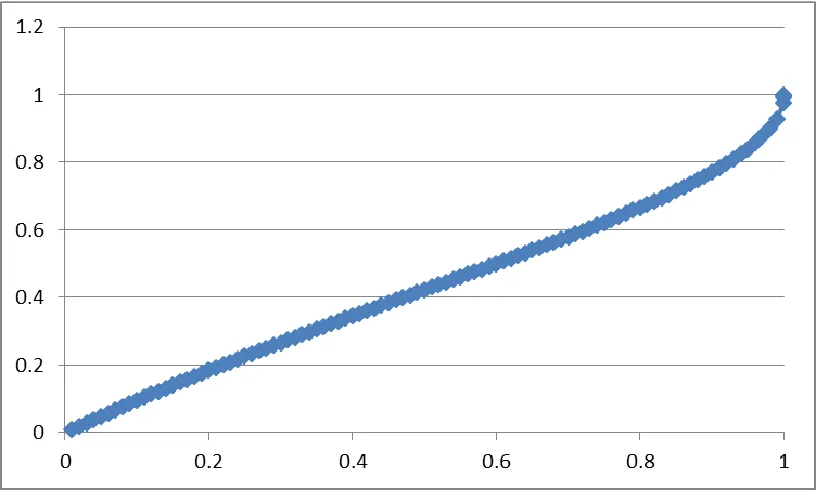
Fig. 1: A plot of β (X-axis), and the excess energy, in hfr, of a single atom or molecule applied to a reflector (Y-axis), when a source is moving away from a reflector. This plot indicates that the velocity of the source must be at approximately 0.8 times the speed of light for the reflector to be twice the energy of a single photon. Current beliefs indicate that twice the momentum of a photon [6, 7], at minimum, will be applied to reflector despite the speed or direction of the source.
A Proposed Experimental Test for Verification
Though the conservation of energy and momentum are balanced, the direction of motion of the atom or
molecule, during absorption, is inconsistent with current beliefs and practices. That is, when a source and
reflector are moving towards each other, this result in a reflector increasing its velocity towards the
source, according to the viewpoint presented in this paper. However, current beliefs, such as Doppler
Cooling [8], indicate the atom or molecule would slow down in this same situation. A test to determine
the actual direction of a reflector due to a reflection, from a moving or non-moving source, can be
performed as follows:
Engineered Molecule: A molecule would need to be engineered that can align in a magnetic field in a
way that will cause a photon to emit vertically, where the location on the molecule where the photon
emits from will contain an unoccupied energy state in the environment where the molecule will be used,
Magnetic Field: A magnetic field will cause the molecule to orbit an apparatus, where sensors to detect
the molecule and photon will be above and below the path the molecule follows. The magnetic field will
need to be designed to not be strong enough to maintain the molecule in the magnetic field if a vertical
momentum of the molecule is above a threshold.
Source: The path of the photons from the source, which is either moving away or towards the molecule,
to the molecule must be unperturbed. This is because, for example, funneling, reflecting or re-directing of
the photons will cause the space-time geometry of the photons to change to the space-time geometry of a
non-moving source. This will cause the molecule to not move from the magnetic field.
Further, this experimental setup may also determine the effect of the increased space-time geometry on
the molecule for a non-moving source during the time the photons energy and momentum are in the
molecule. This can be done by decreasing the threshold that holds the molecule in the magnetic field.
References
[1] G. J. Tambunga, International Letters of Chemistry, Physics and Astronomy, 19 (2013) 10-14.
[2] G. Vulpetti, L. Johnson, G. L. Matlof, Solar Sails: A Novel Approach to Interplanetary Travel,
second ed., Springer-Praxis, Chichester, UK, (2015).
http://dx.doi.org/10.1007/978-1-4939-0941-4
[3] Y. K. Bae, Physics Procedia, 38 (2012) 253-279.
http://dx.doi.org/10.1016/j.phpro.2012.08.026
[4] C. W. Misner, K. S. Thorne, J. A. Wheeler, Gravitation, W. H. Freeman and Company, New York, (1973).
[5] Information on http://www.feynmanlectures.caltech.edu/III_02.html
[6] M. Guthrie, Solar Sails – A Discussion ( 2011).
https://web2.ph.utexas.edu/~mwguthrie/p.solarsails.pdf
[7] Information on http://www.feynmanlectures.caltech.edu/I_39.html
[8] D. J. Wineland, W. M. Itano, Physical Review A, 20 (1979) 1521-1540.