Working Paper Series
Number 2004/2
Beyond Insatiability:
Needs Theory, Consumption and
Sustainability
Beyond Insatiability:
Needs Theory, Consumption
And Sustainability
Tim Jackson*
Wander Jager
Sigrid Stagl
Centre for Environmental Strategy,
University of Surrey,
Guildford, GU2 7XH
CONTENTS
Abstract………
2
The Discourse on Human Needs………..
2
Economics & the Doctrine of Insatiability…………..
3
Needs Theory……….
6
Seven ‘Deadly Needs’ – Over-Consumption As
a Social Pathology……… 1
7
‘A Naïve and Absurd Moralism?’
Against the Rhetoric of Needs……….. 2
2
From Needs to Functionings………. 2
6
Beyond Insatiability – Towards an Eco-Social
Theory of Wellbeing?………..
29
Abstract
The conceptual framework of human needs provides a potentially useful but often contentious vantage point from which to view contemporary debates about consumption and
sustainability. This chapter reviews a variety of different perspectives on needs, sets out the relevance of modern needs theories for sustainable development, and discusses some of the principal arguments for and against a needs-theoretical view of human well-being. We conclude by drawing out some lessons for sustainability from the continuing debate on needs, drawing attention in particular to key questions about the material requirements associated with social and psychological functioning.
The discourse on human needs
Ever since the Brundtland report, the language of human needs has been etched deeply into the conceptual framework of sustainable development (WCED 1987).1 For even longer than
that, the concept of ‘needs’ has played an important role in our understanding of consumer behaviour and has been a key input to the disciplines of economic psychology, consumer research and marketing (Kassarjian and Robertson 1968). Philosophers from Plato onwards have discussed the relevance of human needs to conceptions of the ‘good life’ and the role of governance (Haines 1985). More recently, the concept of needs has provided the foundation for an extended ecological and social critique of conventional development (Max-Neef 1991 eg).
In spite of these various manifestations, the discourse on human needs remains a fiercely contested one (Douglas et al 1998). Some argue that human needs can provide an organising framework within which to articulate themes about development, progress, quality of life, and human happiness. Others point to the failures of development strategies grounded on the idea of ‘basic needs’ and suggest the need for alternative conceptualisations based on ‘capabilities’ and ‘functionings’. Others again insist that needs are an irrelevant distraction from the pursuit of development and that conventional economic concepts of revealed preference and rational choice are more reliable instruments for understanding consumption and for negotiating sustainability.
One of the aims of this chapter is to provide a review of these different discourses. In particular, the paper identifies three main avenues of thought in relation to needs theories and explores the relationship between them: The first avenue flows from the discipline of
consumer insatiability that dominates economic thought and is supposed to characterise modern society.
A second major discourse affords the concept of needs a key structural role in
conceptions of human well-being. We discuss the historical pedigree of this idea and outline some of the modern needs-theoretic conceptions of human development that have been articulated in the literature. We also describe briefly the ecological and social critique of conventional development that flows from this construction. From the perspective of sustainability, perhaps the most interesting aspect of this critique is the suggestion that assumptions of insatiability are not only ecologically problematic but also psychologically and socially suspect. The needs-based construction appears to offer a kind of double dividend to sustainable development: the possibility of living better by consuming less.
At the same time, the continuing debate about ‘needs’ and ‘wants’ bears witness to the contentious nature of this conclusion (Campbell 1998). Nor is opposition to needs theory confined to economists. The third avenue of thought we examine in this chapter flows from a variety of rather modern intellectual positions, drawing from sociology, cultural anthropology and social philosophy which regard the entire needs-based discourse as rhetorical, naïve and moralistic. We outline the main contentions of this position and discuss its lessons for the project of sustainable development.
The tension between the different positions outlined here already suggests that a kind of dialectic inhabits the discourse on needs. The later part of the chapter explores this dialectic in more detail and attempts to articulate key lessons from needs theory for debates about lifestyle choice and sustainable consumption.
Economics and the doctrine of insatiability
Classical economics accepted a formal role for needs in which individual utility was taken to be a measure of ‘needs satisfaction’ (Smith 1776). But subsequent developments in
points out, need is a ‘non-word’. ‘Economics can say much which is useful about desires, preferences and demands,’ he insists. ‘But the assertion of absolute economic “need” – in contrast to desire, preference and demand – is nonsense.’
Equally striking in the conventional formulation is that economics also fails to say much about the nature of preference itself. It interests itself primarily in questions of
allocation of resources, and generally refuses resolutely to distinguish between different kinds of preferences or the motivations for the use of these resources. All transactions in the market are assumed to represent the rational decisions of informed consumers, attempting to maximise individual utility in the face of the available choices and their own resource constraints.
Consumer choice theory, after Samuelson (1938), has restricted itself essentially to deriving demand functions for consumer goods on the basis of ‘revealed preferences’ in the market. Thus, the best we can say about consumer preferences is what we can infer about them from the patterns of expenditure on consumer goods in the market. If the demand for a particular brand of car or washing-machine or video-recorder is high, then we can infer that consumers, in general, prefer that brand over other brands. The reasons for this preference remain opaque within economics, as do the reasons for choosing Sports Utility Vehicles, tumble-dryers and DVD players over, say, eco-holidays or leisure activities (Schor 1992).
Some economic analyses do attempt to distinguish between necessities and luxuries on the basis of the price (or income) elasticity of demand for these goods. Necessities are those goods that consumers attempt to procure no matter how high the price or how constrained their income; luxuries are those they are prepared to forego when the price goes up or economic hardship beckons (Begg et al 2003). This limited economic unpacking of the dimensions of consumer choice – which is flatly rejected by others (Lebergott 1993 eg) – just about exhausts any attempt either to distinguish between different kinds or levels of consumer preferences or to unravel consumer motivations in the demand for specific goods. Different categories of consumer needs are collapsed by economics into a ‘flat plain of wants’
(Georgescu-Roegen 1973, Lux and Lutz 1988).
of’ - when absolute needs had all been satisfied and we could devote our energies to non-economic purposes.
For the most part, however, the modern economics textbook does not even include the word ‘need’ in its subject index, choosing instead to cast its arguments in terms of wants, tastes or consumer preferences (Begg et al 2003). Where, occasionally, the concept of need is introduced, it will invariably appear only to be dismissed very quickly in favour of wants or preferences. Moreover, as McConnell (1981, p.23) is eager to point out ‘these material wants are for practical purposes insatiable or unlimited. This means that material wants for goods and services are incapable of being completely satisfied.’ It is not difficult to find similar positions on needs in many economic texts. Anderton (2000, p.3) for example, introduces the question of human needs on the first page of his undergraduate textbook on economics. ‘Human needs are finite…’ he concedes. ‘[But] no-one would choose to live at the level of basic human needs if he [sic] could enjoy a higher standard of living. This is because human wants are infinite.’ He goes on to use the insatiability of human wants as the motivation for what he calls the ‘basic economic problem’, namely the allocation of scarce resouces in the face of infinite wants. In this way, insatiability becomes not just a defining feature of consumer behaviour, but a core ideological assumption within economics, in some sense motivating the discipline itself and the social importance of the economist.
Perhaps more importantly, the concept of insatiability underlies the entire edifice of the consumer society. Modern economies are themselves structurally committed to a
p.80). ‘If he forgets, he will be gently reminded that he has no right not to be happy.’ Clearly the time foreseen by Keynes when ‘needs of the first class’ are all satisfied and economic expansion is no longer necessary has not yet arrived!
Interestingly, and in spite of the reticence of economic theorists to unravel the structure and nature of underlying human motivations, practitioners of economics have been more adventurous in adopting both the language of needs and its theoretical constructs in developing a ‘science’ of consumer behaviour. The fields of consumer research, economic psychology, marketing studies and motivation research – Ernest Dichter’s ‘science of desire’ (Dichter 1964) – have all provided a rather rich foundation for producers, retailers, marketers and advertisers wanting to know how to design and sell products that consumers will buy. These attempts to develop an understanding of consumer motivations have drawn quite specifically from the needs-theoretic framework that formal economics has rejected. It is to these needs-theoretic approaches that we now turn.
Needs theory
If we reject the economists’ antipathy to needs and accept that the concept has some kind of place in understanding human motivations, we are immediately faced with a variety of questions: What are needs? How does the concept of needs relate to concepts such as
motivation, attitude, value, and behaviour? What kinds of needs exist? Is it possible to derive some kind of taxonomy of needs? How might this taxonomy inform our understanding of human well-being? Can needs tell us anything at all about consumption and consumer behaviours? What are the relationships between needs and consumer goods? Modern needs theories emerged precisely in response to these kinds of questions.
One of the problems with the concept of needs is that the word itself is used in a variety of different idiomatic usages, both as a verb and as a noun. Gasper (1996) identifies three distinct generic meanings of the noun ‘need’. The first of these refers to underlying internal forces that drive or guide our actions. For example, a need for safety might refer to the underlying drive that people have to protect themselves and the motivation that this provides them with to build houses, buy clothes, enact punitive legislation against criminals and so on. Needs in this category are supposed to have a different ontological status from wants or preferences in two senses: firstly, they are considered non-negotiable; and secondly, the failure to satisfy such a need has a detrimental effect on the overall health of the
themselves, in this idiomatic usage, be construed as needs.5 Theories in this area tend to focus on the conditions under which individuals feel safe, or happy or contented (Scitovsky 1976, Argyle 1987 eg). A third usage of the term refers to needs as justified requirements for performing behaviour. Corresponding theory is concerned with the moral and ethical status of specific social characteristics, such as the ability to engage in autonomous action (Doyal and Gough 1991, eg).
Although all three of these usages are interesting in their own right, the one that corresponds most closely to the way in which needs are construed in most modern needs-theoretical frameworks is the first. Not surprisingly – since this usage is concerned primarily with links between motivation, values and behaviour – these theoretical frameworks have been developed primarily within various branches of psychology. One of the earliest ‘modern’ needs theories emerged in the social psychology of William McDougall (1928), who identified eighteen human needs, which he characterised as innate propensities or instincts. Examples from his typology are the need to seek (and perhaps to store) food, the need to explore strange places or things, the need to cry aloud for assistance when our efforts are utterly baffled, the need to laugh at the defects and failings of our fellow creatures and so on. McDougall’s listing of what people need represents an early attempt to state universal motivational forces.
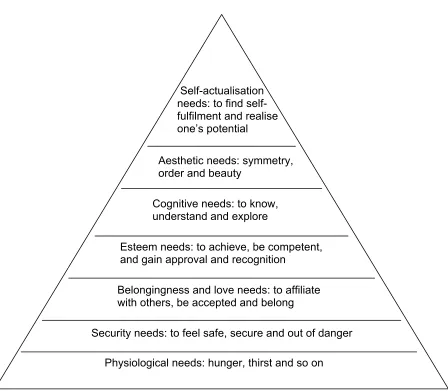
Figure 1: Maslow’s hierarchy of needs
Self-actualisation needs: to find self-fulfilment and realise one’s potential
Aesthetic needs: symmetry, order and beauty
Esteem needs: to achieve, be competent, and gain approval and recognition
Belongingness and love needs: to affiliate with others, be accepted and belong
Security needs: to feel safe, secure and out of danger Physiological needs: hunger, thirst and so on
Cognitive needs: to know, understand and explore
The hierarchical nature of needs has a long pedigree. Plato, for instance, declared in The Republic that ‘the first and chief of our needs is the provision of food for the existence of life..
the second is housing, the third is raiment’. There is moreover a sense in which some kind of hierarchy is self-evident. If the need for food is not met, the organism dies, and the
compromise even their most basic survival needs to the satisfaction of moral, psychological or spiritual needs. So, for example, the taboo against eating human flesh has often prevented people from taking measures for their own survival; the desire to fulfil a certain visual stereotype has led many people to starve themselves, sometimes literally to death; and Levenstein (1988, ix) describes how American prisoners in the Korean war died rather than stomach the (perfectly nutritional) local cuisine.
The hierarchical approach to human needs has also drawn criticism because it appears to deny access to the satisfaction of higher needs in less developed country populations and legitimises a distribution of power in favour of those who specialise in so-called ‘higher’ needs – such as intellectuals and ascetics (Galtung 1990) – in developed country populations. In fact, in his later writings, Maslow himself revised the hierarchy to place two different sets of needs on a more or less equal footing, reflecting what he saw as a clear ‘duality’ in human nature (Maslow 1968). According to this later view, we are not, as human beings, uniquely motivated by material concerns for physical survival. There is a part of the human psyche that hankers after esteem and transcendance, even as the person's basic material needs remain unfulfilled.
A further critique of the Maslovian approach is that it over-emphasises the
individualistic nature of needs-satisfaction and understates the importance of society, culture and the natural environment, by treating these as secondary in importance to individual motivation. Within this kind of framework it is rather difficult to say anything constructive about the political and social importance of debates about long-term environmental issues such as global climate change (for example) because, for the moment at least, they barely register directly on the question of individual human well-being at all. As Douglas et al (1998) point out, long-term global environmental issues tend to be sidelined because ‘[i]t is too easy to claim that there is another more urgent need to satisfy’ (op cit p.211).
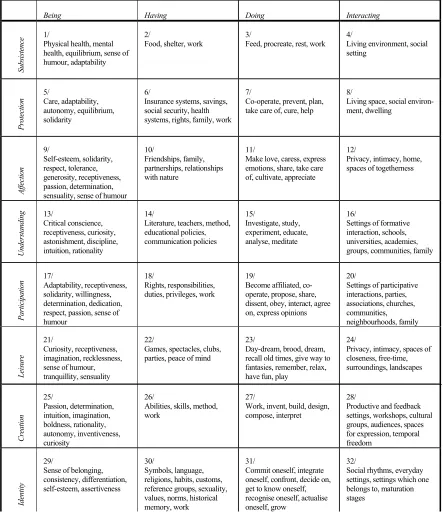
Some more recent theories of human needs have attempted to correct for these kinds of deficiency. Galtung (1980) proposed a four-fold typology of needs involving a two-dimensional matrix composed of material and non-material needs in one dimension, with actor-dependent and structure-dependent satisfaction in the other. Mallmann (1980) proposes another two-dimensional typology which juxtaposes ten needs categories against a three-fold categorisation of types of satisfiers: personal, social and ecological. This same idea is extended further in a typology derived by Max Neef (1991, 1992) which sets nine
and interacting (Figure 2). Whereas the first seven needs have existed since the origins of homo habilis, and, undoubtedly, since the appearance of homo sapiens, the latter two are assumed to have been developed later in the evolutionary process.
Figure 2: A categorisation of needs/satisfiers according to Max Neef (1991, 1992)
Being Having Doing Interacting
Su
bs
ist
enc
e 1/
Physical health, mental health, equilibrium, sense of humour, adaptability
2/
Food, shelter, work
3/
Feed, procreate, rest, work 4/
Living environment, social setting Pro te cti on 5/ Care, adaptability, autonomy, equilibrium, solidarity 6/
Insurance systems, savings, social security, health systems, rights, family, work
7/
Co-operate, prevent, plan, take care of, cure, help
8/
Living space, social environ-ment, dwelling Affecti on 9/ Self-esteem, solidarity, respect, tolerance, generosity, receptiveness, passion, determination, sensuality, sense of humour
10/
Friendships, family, partnerships, relationships with nature
11/
Make love, caress, express emotions, share, take care of, cultivate, appreciate
12/
Privacy, intimacy, home, spaces of togetherness
Un der stand in g 13/ Critical conscience, receptiveness, curiosity, astonishment, discipline, intuition, rationality 14/
Literature, teachers, method, educational policies, communication policies 15/ Investigate, study, experiment, educate, analyse, meditate 16/
Settings of formative interaction, schools, universities, academies, groups, communities, family
P ar tic ip at io
n 17/ Adaptability, receptiveness,
solidarity, willingness, determination, dedication, respect, passion, sense of humour
18/
Rights, responsibilities, duties, privileges, work
19/
Become affiliated, co-operate, propose, share, dissent, obey, interact, agree on, express opinions
20/
Settings of participative interactions, parties, associations, churches, communities, neighbourhoods, family Leis ure 21/ Curiosity, receptiveness, imagination, recklessness, sense of humour, tranquillity, sensuality
22/
Games, spectacles, clubs, parties, peace of mind
23/
Day-dream, brood, dream, recall old times, give way to fantasies, remember, relax, have fun, play
24/
Privacy, intimacy, spaces of closeness, free-time, surroundings, landscapes Cre ati on 25/ Passion, determination, intuition, imagination, boldness, rationality, autonomy, inventiveness, curiosity 26/
Abilities, skills, method, work
27/
Work, invent, build, design, compose, interpret
28/
Productive and feedback settings, workshops, cultural groups, audiences, spaces for expression, temporal freedom
Identity
29/
Sense of belonging, consistency, differentiation, self-esteem, assertiveness
30/
Symbols, language, religions, habits, customs, reference groups, sexuality, values, norms, historical memory, work
31/
Commit oneself, integrate oneself, confront, decide on, get to know oneself, recognise oneself, actualise oneself, grow
32/
Freedom
33/
Autonomy, self-esteem, determination, passion, assertiveness, open-mindedness, boldness, rebelliousness, tolerance
34/ Equal rights
35/
Dissent, choose, be different from, run risks, develop awareness, commit oneself, disobey
36/
Temporal/spatial plasticity
There are clearly some resonances between Max-Neef’s ‘axiological’ categories and Maslow’s early categorisation. In particular, the needs for subsistence and protection correspond closely with Maslow’s ‘material needs’, while participation and affection, for example, are closely linked to Maslow’s social needs. Although some of Maslow’s ‘growth needs’ appear to be absent in the later framework, Max-Neef has hypothesised a tenth need for ‘transcendence’ that fulfils some of these characteristics. Max-Neef argues that this need is today felt only by some, but that it may evolve, somewhere in the future, into a universal need.
Needs, Satisfiers and Need-Satisfaction
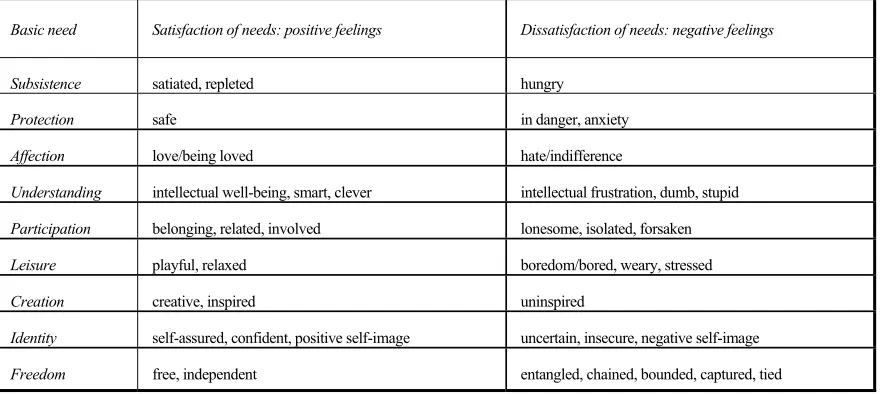
Perhaps the most critical aspect of modern needs theories is the importance assigned to the distinction between needs and satisfiers. Needs are conceived dualistically in Max-Neef’s framework as a ‘deprivation’ on the one hand and a ‘potential’ on the other. A need is a deprivation in the sense of something being lacking; it is a potential to the extent that it may also serve to motivate or mobilise the subject. Satisfiers, by contrast, represent different forms of being, having, doing, and interacting, which contribute to the ‘actualisation’ of these deprivations or potentials.
Table 1: A categorisation of feelings according to the typology of needs (Max-Neef, 1992).
Basic need Satisfaction of needs: positive feelings Dissatisfaction of needs: negative feelings
Subsistence satiated, repleted hungry
Protection safe in danger, anxiety
Affection love/being loved hate/indifference
Understanding intellectual well-being, smart, clever intellectual frustration, dumb, stupid
Participation belonging, related, involved lonesome, isolated, forsaken
Leisure playful, relaxed boredom/bored, weary, stressed
Creation creative, inspired uninspired
Identity self-assured, confident, positive self-image uncertain, insecure, negative self-image
Freedom free, independent entangled, chained, bounded, captured, tied
If a need is not satisfied, the related negative feeling (deprivation) will arouse a drive to satisfy this need. For example, if the need for subsistence is not satisfied because of a lack of food, the negative feeling will be hunger, arousing the drive to eat. If confronted with an opportunity to attempt to satisfy the need in question – say an array of foodstuffs – this drive will result in a motivation to use that opportunity. Often, of course, there will be a variety of possible opportunities available for pursuing the satisfaction of such a need. For example, one might equally choose a tuna sandwich, a banana, a gammon steak, some french fries, a ‘veggieburger’, some combination of these, or something else entirely in attempting to satisfy one’s hunger. The eating of one or all of these foods may alleviate the deprivation. The satisfaction of the underlying need will evoke positive feelings. If a need is fully satisfied, no drive will emerge and the motivation to use a relevant opportunity will be low.
subsistence, affection, participation, and identity - and the mother’s need for creation, participation, identity, and affection. Housing is a satisfier of the need for protection.
Democracy is a satisfier of the need for participation. Sport can be a satisfier of the needs for leisure, participation, identity and creation. Whereas needs are ‘finite, few and classifiable’, satisfiers are (generally speaking) culturally determined, and numerous (if not infinite) in variety. If we think of the matrix shown in Figure 2 as a means of identifying the way in which needs can be satisfied, then the number of needs is specified by the number of spaces in the matrix. But the satisfiers are as numerous as the things which could fill the spaces of the matrix. So for example, breast feeding is not the only way of ensuring that the subsistence needs of the infant are met. Formal education is not the only way of attempting to meet the need for understanding. There is a huge variety of different kinds of food which might contribute to satisfaction of the need for subsistence. Different kinds of housing could aid the protection need.
From the point of view of such a framework, what varies over time and across cultures is not the set of needs (ie the dimensions of the matrix), but the set of ways in which a
particular culture at a particular time chooses to satisfy - or attempt to satisfy - those needs (ie the contents of the spaces in the matrix). Cultural change, in this perspective, can be construed as the process of dropping one particular satisfier or set of satisfiers in favour of another. The underlying needs have not changed, but the particular forms of being, having, doing and interacting in which the culture engages in order to satisfy those needs may vary extensively.
A second important aspect of modern needs theories – which flows from the distinction between needs and satisfiers – is the critical recognition that not all the ways in which a particular culture or social group attempts to satisfy the spectrum of needs are equally successful. Thus the so-called ‘satisfiers’ which would occupy the spaces in the needs-satisfaction matrix of a particular group may in reality be more or less successful at actually satisfying the related needs. Max-Neef’s formulation distinguishes five different kinds of ‘satisfiers’:
• destroyers or violators occupy the paradoxical position of failing completely to satisfy the need towards which they are directed;6
• pseudo-satisfiers generate a false sense of satisfaction of the need;7
• singular satisfiers manage to satisfy a single category of need without affecting satisfaction elsewhere; and
• synergistic satisfiers manage simultaneously to satisfy several different kinds of needs.8
Of these different kinds of satisfiers, it is perhaps worth commenting a little more on inhibiting satisfiers which exhibit the important – and quite frequent – characteristic of a ‘trade-off’ between the satisfaction of different kinds of needs.9 Examples of inhibiting satisfiers might include cigarettes (which satisfy certain social needs for participation, identity or idleness but which inhibit the needs for subsistence and protection), cars (which satisfy the need for identity, freedom, participation and so on, but which inhibit long-term needs for protection), television (which satisfies the need for idleness but inhibits the need for creation) and so on. In fact, a more thorough typology of goods and satisfiers might well reveal that a large number of goods occupy the role of inhibiting satisfiers. In particular, it would seem likely that a variety of (environmentally) unsustainable goods and behaviours fall into this category where the satisfied need is a short-term need, and the inhibited needs are longer-term. In this sense, inhibiting satisfiers can be thought of as ‘behavioural traps’.
Though this classification represents a potentially confusing use of language – how can a satisfier also be a violator? – it does capture a level of sophistication that is lacking both in the economic model and in some previous needs theories. In particular it allows for a much more complex and multifaceted model of development than is provided by the unidimensional concept of economic growth. Using the characterisation outlined here, the provision of well-being can be represented as the process of satisfying underlying needs. Poverty, by contrast, can be seen as the failure to satisfy needs. Interestingly, this implies that there is no single concept of poverty, defined simply in terms of low per capita income. Instead, we open the possibility of defining a multiplicity of poverties corresponding to failures to satisfy different kinds of needs. The converse of this is that we can no longer expect economic growth
necessarily to alleviate poverty, since poverty is no longer defined in purely monetary terms.10 Perhaps the most interesting questions raised by the needs-theoretic framework
goods actually contribute to the satisfaction of human needs and promote human well-being, and which simply serve as pseudo-satisfiers or destroyers of the underlying needs?
In a sense, these questions are amongst the most crucial questions of our time. In a world in which economic consumption is threatening to erode the integrity of the global ecosystems, it is particularly vital to be able to identify which bits of consumption contribute to human needs satisfaction, and which simply operate as pseudo-satisfiers and destroyers. And yet, the truth is that we have barely even scratched the surface in asking such questions, let alone formulated coherent answers for them.
Two things can however be said about the relationship between economic goods and needs satisfaction. First, that it is extremely complex; there is certainly no simple one-to-one map between individual consumer goods and individual needs. Secondly, any relation that does exist between consumption and need satisfaction is highly non-linear. A straightforward example illustrates both these points. As we have already noted, foodstuffs are economic goods which can serve, in part, as a satisfiers of the needs for subsistence (by ensuring survival) and protection (by maintaining good health). But even in this relatively
straightforward example, there are a number of complexities. For a start, in addition to the foods themselves, the satisfaction of the need for subsistence also requires a variety of other inputs (such as an agricultural system, a distribution system, a food preparation system) not all of which are consumer goods per se, and some of which lie outside the economic system altogether.
Perhaps more importantly, not all foodstuffs are equally effective in the satisfaction of the need for subsistence and protection. Nutritional value is not equally distributed across the economic goods of the food sector; and economic value does not always accord closely with nutritional value. Some foods fail to satisfy. Or operate at best as inhibiting satisfiers.
Excessive consumption of refined sugars and carbohydrates, for example, has been implicated in a variety of health concerns including chronic hypoglycaemia, tooth decay and heart
disease. Actually, even food which is ‘good for you’, is only good for you up to a certain point. The nutritional value of almost any food shows diminishing returns to scale.
Malnourishment is still widespread in poorer countries; but in the Western world obesity is a growing problem contributing to a range of medical problems from reduced muscular fitness to heart disease. In short, there is no simple linear relationship between the consumption of a particular economic good (such as food) and the satisfaction of the underlying need(s).
‘(human) food is not fodder; humans do not feed...it is apparent that what is consumed is not obviously determined by physiological or biological needs. Psychological needs also play a role.’ Sweet foods, in particular, are well-known to be associated with the attempted
satisfaction of psychological needs. Conventionally, for example, chocolate is identified with the satisfaction of a need for comfort or affection. It may eventually turn out to be a pseudo-satisfier of that need; but the point is that what seems, on the surface, to be an economic good related to the satisfaction of clear cut subsistence need turns out on close examination to bear a rather complex relationship to a variety of needs, some of them social or psychological rather than material in character.
The fundamental point is this: that the relationship between economic goods and needs satisfaction is inherently complex. Material commodities (and economic goods in general) may be adopted as attempted satisfiers for a wide range of underlying needs. Any particular commodity may simultaneously be an attempted satisfier for several different needs.
Moreover, the particular choice of economic good or goods associated with the intended satisfaction of the individual need or needs is determined not just by the success or failure of that good in satisfying the underlying needs, but also by a complex variety of factors
including personal psychology, social values and norms, cultural influences, institutional structures, industrial interests, and marketing strategies. In any particular culture, at any one point in time, a variety of economic goods will be engaged with differing degrees of success in the attempted satisfaction of a range of underlying needs. Some consumer goods may be better than others in meeting those needs. Some cultural strategies may be very successful in meeting needs. Others may fail entirely. And it is this latter insight – that some cultural attempts at needs-satisfaction appear to fail – which provides the foundation for a long-standing critique of conventional development which draws heavily on a needs-based perspective.
Seven ‘deadly’ needs – over-consumption as a social pathology
At the heart of many recent (and some earlier) critiques of modern society is the idea that there is something pathological about recent patterns of consumption. Before outlining the conceptual basis for this idea, however, it is worth paying some attention to the historical pedigree of needs-based critiques of society.
psychological bases for human behaviour; it provided a crucial input to the early socialist critiques of capitalism in the mid- to late-nineteenth century; and it formed the foundation for an extended critique of contemporary development that emerged through the humanistic psychology of Abraham Maslow and Carl Rogers in the mid-twentieth century and has informed modern environmental critiques today. Some at least of the economic antipathy to the concept of needs can be attributed to the fact that needs theory has been used in this way – namely as the basis for some rather heated debates about civilisation, capitalism and the legitimacy of economic progress. Though we are sometimes inclined to believe that such debates are a modern phenomenon, they can be dated (at least) to the Stoic philosophy of the 1st Century BC. Indeed, the Stoic critique of hellenic civilisation bears more than a passing resemblance to modern ‘green’ critiques of progress. Like radical greens, the Stoics aspired to a simple life in harmony with nature, and situated our failure to achieve this ideal in the disjunction between man’s (false) subjective desires and his (true) objective needs.
The same distinction between true and false needs lay at the heart of the socialist and humanistic critiques of progress in the nineteenth and twentieth centuries. The most well-known of these perhaps is Marx’s distinction between human and inhuman needs and his indictment of capitalism for its creation of a whole raft of false (inhuman) needs and its alienation of humankind from its true (human) needs. But very similar distinctions are present in the writings of Rousseau (1913), who distinguished between (limited) natural and (infinite) artificial needs; in Marcuse (1964), who argued that false needs were the result of man’s ‘repressive desublimation’ in contemporary society, and in Illich (1978), whose searing critique of modern society is founded on the contention that coercive political and economic interests have created ‘ever newer strains of hybridised needs’ (op. cit. p.30) that now lie outside the control of individual citizens.
The humanistic critique was articulated particularly clearly in needs-theoretic terms by Erich Fromm in the 1970s. In To Have or to Be?, Fromm (1976) roundly criticised
conventional development for neglecting basic philosophical understandings about human well-being. Alarmed at the alienation and passivity of modern society, he identified two main psychological premises on which the economic system is built:
‘(1) that the aim of life is happiness, that is maximum pleasure, defined as the satisfaction of any desire or subjective need a person may feel (radical hedonism);
Fromm admits that this form of radical hedonism has been practised throughout history, most particularly by the richest proportion of the population; but points out that, prior to the
seventeenth century, with only one exception in the philosophy of Aristippus (a pupil of Socrates in the fourth century BC), radical hedonism ‘was never the theory of well-being expressed by the great Masters of Living in China, India, the Near East, and Europe’ (op. cit. p.4). By contrast, he argues that there is an essential distinction - present in the writings of all the great teachers and philosophers concerned with humankind’s optimal well-being -
between ‘needs (desires) which are only subjectively felt and whose satisfaction leads to momentary pleasure’ and ‘objectively valid needs’ which are ‘rooted in human nature and whose realisation is conducive to human growth’ (ibid).11
Fromm’s intention was to argue explicitly against the insatiability doctrine and to undermine the legitimacy of economic arguments about consumer sovereignty. Needs theory plays a central role in this critique. For needs theory suggests quite explicitly that certain universal motivations underlie human behaviour; and by doing so it seems to allow us to tease apart what is consumed in the consumer society from what contributes to human well-being. The economic perspective claims categorically that the consumption of any commodity contributes positively to needs-satisfaction in the sense of an increase in individual (and collective) utility. By contrast, the needs-based perspective distinguishes a variety of different levels of satisfaction or dissatisfaction of the underlying needs that flow from consumption activities and insists that we cannot unreservedly equate every consumption activity with an increase in well-being.
problem, ‘it is a case of everyone in the crowd standing on tiptoe and noone getting a better view. Yet at the start of the process some individuals gain a better view by standing on tiptoe, and others are forced to follow if they are to keep their position. If all do follow... everyone expends more resources and ends up with the same position’ (Hirsch 1977 p.49). The seemingly obsessive behaviour of the modern consumer, like most psychopathological addictions, fails to generate increasing returns in terms of satisfaction. It simply means running ever harder and faster in order to stay in the same place.
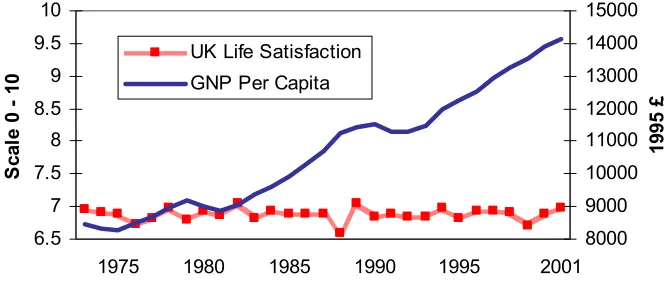
Critiques such as these have to some extent been supported by empirical evidence on well-being and life-satisfaction. In The Joyless Economy, Scitovsky could already cite the failure of reported levels of well-being to match the growth in GDP (Scitovsky 1976). In 1991, Erik Jacobs and Robert Worcester found that people were marginally less happy than they had been in 1981 in spite of increased personal income (Worcester 1998). A similar result was reported over a longer period by Myers and Diener (1996). Oswald (1997) found that reported levels of ‘satisfaction with life’ in the 1990s were only marginally higher than they had been in the mid-seventies. In some countries, including Britain, they were actually lower. As more recent time-series studies of life-satisfaction have shown (Figure 3), this divergence has continued unabated over the last decade or so (Donovan et al 2002, Lane 2000, Frey and Stutzer 2000, Veenhoven 2003).
Figure 3: Economic growth versus life-satisfaction in the UK: 1973- 2001
6.5 7 7.5 8 8.5 9 9.5 10
1975 1980 1985 1990 1995 2001
S
cal
e 0
- 10
8000 9000 10000 11000 12000 13000 14000 15000
199
5 £
This kind of evidence leaves us with the uncomfortable possibility that some at least some of our consumption may not be contributing positively to the satisfaction of any of our needs. More recent support for the same hypothesis has come from a wide variety of studies using psychometric tests to measure the relationship between materialist values, material lifestyles and subjective well-being.12 These studies draw attention in particular to the apparent failure of material commodities as effective satisfiers of psychological and social needs. Moreover they place much of the blame for the divergence of life-satisfaction from income on precisely this failure. Material acquisitiveness, according to these authors, correlates negatively with subjective well-being.
What the ecological critique of conventional development adds to this litany of discontent is the notion that, in addition to their psychological and social failings, highly materialistic lifestyles are also damaging and potentially disastrous in environmental terms. And here, precisely, lies the ‘pathology’ from which consumer society appears to be
suffering. If ecological damage were incurred as the inevitable result of a broadly successful attempt to increase human well-being, it might well be regarded as an unfortunate but
necessary consequent of human development. But that ecological damage should be the result of a series of consumption practices which clearly fail to increase well-being has all the characteristics of a social pathology. Our continued attempts to satisfy the seven social and psychological needs in the Max-Neef framework are not only potentially dangerous in environmental terms, according to this critique, they may not even be successful, in the long run, in meeting the underlying needs. Consumer society, argue these critics, for all its glitter and panache, may simply bequeath us a phenomenal ‘double whammy’: degraded ecosystems and impoverished lives.
The starkness of this conclusion is mitigated however, by the prospect for
‘A naïve and absurd moralism’? Against the rhetoric of needs
Given the role played by the language of needs in the long historical debates about human well-being and development, it is not at all surprising to find that needs-theoretical
approaches remain highly contentious. Nor is opposition confined to economists wanting to displace the concept of need with the language of wants, preferences and desires. There is also a good deal of scepticism about the whole needs-based project from within disciplines such as sociology, anthropology and cultural studies. Some of this scepticism about needs certainly draws strength from the historical dialectic on well-being. In particular, one strand of thinking is supportive of modern development, opposes the idea that consumer society is in the grip of a pathology, and points to the advances in technical competence and cultural richness that have characterised modern development (McCracken 1997 eg). Interestingly, however, there is also a strand of the argument against needs which is itself critical of modern society, argues that the ‘social logic’ of consumerism has left us in the grip of a ‘luxurious and spectacular penury’ (Baudrillard 1970 p.68), and yet still insists that ‘the desire to moderate consumption or establish a normalizing network of needs, is naïve and absurd moralism’ (Baudrillard 1968 p. 24-5).
Critics of needs theory tend to level a variety of charges against the needs-based discourse. Perhaps the most important of these are claims of naïvety, rhetoricism and moralism, and we shall look at these charges in more detail in a moment. First however, we outline one of the key intellectual premises on which most of these critiques rest, namely the insight that, in addition to their functional role, material goods play vital symbolic roles in our lives. Over the second half of the 20th Century, this insight has become an increasingly important defining feature of sociological debates about consumption (Dittmar 1992, Miller 1995). The hypothesis itself has arisen from the confluence of some rather diverse
intellectual influences including the semiotics of Charles Morris (1946), the structuralism of Roland Barthes (1973), the social philosophy of Baudrillard (1968, 1970), the social
anthropology of Marshall Sahlins (1976) and Mary Douglas (1976), the psychology of Mihalyi Csikszentmihalyi and Eugene Rochberg-Halton (1981) and the consumer and motivation research of Ernest Dichter (1964), Elizabeth Hirschman and Morris Holbrook (1980), Russell Belk (1988) and others.
our desires, about our successes and failings, about our hopes and our dreams. Material goods are not just artefacts. Nor do they offer purely functional benefits. They derive their
importance, in part at least, from their symbolic role in mediating and communicating personal, social, and cultural meaning not only to others but also to ourselves.
This hypothesis offers a vital clue to our understanding of the social and psychological dimensions of consumer behaviour. In particular, it suggests – contrary to the perspective from humanistic psychology – that material artefacts may after all be legitimate candidates in the search for human well-being, precisely because of their ability to embody symbolic meaning. What looked like irrational or pathological consumer behaviours, claim those sceptical of the humanistic position, become increasingly comprehensible once we view material objects as signs. ‘Forget the idea of consumer irrationality,’ urge Mary Douglas and Baron Isherwood in The World of Goods. ‘Forget that commodities are good for eating, clothing and shelter; forget their usefulness and try instead the idea that commodities are good for thinking; treat them as a nonverbal medium for the human creative faculty’ (Douglas and Isherwood 1979, p 40-1).
Douglas and Isherwood draw attention, in particular, to the importance of material goods in providing ‘marking services’ – social rituals that serve to embed the individual in their social group, cement social relations within the group and play an important role in maintaining information flows between members of the social group. These information flows, claim Douglas and Isherwood, serve a vital purpose in helping both the group and the individual to maintain and improve social resilience in the face of cultural shifts and social shocks. Thus, what is at stake, in asking consumers to forego material consumption is not just the presence or absence of empty, meaningless stuff, or even the invidious display of
‘conspicuous consumption’ that Veblen (1898) inveighed against. Rather, it is personal identity, social cohesion, cultural capital, and the symbolic resources required to create and maintain these.
of certain sociologists and social philosophers, this insight has become the basis for a quite specific view of consumer society. According to this view, the individual consumer is ‘locked’ into a continual process of constructing and reconstructing personal identity in the context of a continually renegotiated universe of social and cultural symbols.
There is clearly a sense in which this model of the perpetual reconstruction of social identity through material goods appears to reinforce the idea that consumer society is in the grip of some kind of social pathology, and indeed some of those critical of the needs perspective – Baudrillard, for instance – do not dispute this point. Baumann (1998, p.29) points to the convenient resonances between this process of perpetual reconstruction of identity, and the impermanent, transient nature of modern consumer goods. ‘Aggregate identities, loosely arranged of the purchasable, not-too-lasting, easily detachable and utterly replaceable tokens currently available in the shops,’ he writes, ‘seem to be exactly what one needs to meet the challenges of contemporary living.’ However, this is certainly not a pathology located within the remit or control of the individual consumer, and the idea that he or she could free themselves from the ‘iron cage’ of consumerism simply by paying a closer attention to a fixed set of individual needs is, for these authors, nothing more than absurd.
In the light of these criticisms, we are confronted with the question of what, if anything, is to be gained by referring to individual needs at all. For some, the answer to this question is clear. The discourse on needs is a rhetorical discourse. In the common usage of the term, to refer to a particular choice as a ‘need’, rather than simply a want or a preference, appears to offer some form of social justification for that choice, to underline the importance of making it and to claim some form of moral legitimation for it. Campbell (1998) takes this argument even further and identifies two distinct ‘rhetorics’ employed in the discourse of consumer choice: one is based on needs and the other on wants. Whereas the former is prosecuted through a vocabulary of ‘need’, ‘requirement’, ‘necessity’, and ‘deficiency’ with accompanying antonyms such as ‘satisfaction’, ‘comfort’ or ‘utility’, the latter employs a vocabulary of ‘desire’, ‘pleasure’, and ‘love’ with accompanying antonyms of ‘boredom’ or ‘indifference’. Campbell locates the origins of these separate discourses within two distinct philosophical traditions. The needs-based discourse, he argues, owes much to the Puritan-inspired utilitarian tradition, whereas the discourse of desire is inherent in the Romantic tradition (and its predecessor of philosophical hedonism) which elevates pleasure over comfort.13
pedigree of a desire-based discourse, but also its reality as a component of our psychological make-up. As numerous writers from Epicurus to Blake to modern consumer researchers have pointed out (Belk et al 2003), the dynamic of desire is a fundamental aspect of the human psyche, and Campbell’s argument is that this dynamic is not amenable to a neat needs-based characterisation. While deprivation and satisfaction may be paradigmatic of a needs-oriented dynamic, Campbell argues that the pursuit of pleasure is not motivated by deprivation and tends to be eroded by guaranteed satisfaction. Moreover, whilst only reality, in Campbell’s view, can provide for the satisfaction of needs, ‘both illusions and delusions can supply pleasure’ (Campbell 1987, p.61). The second point Campbell makes is that, given this dialectical tension in our make-up between needs and desires, we must regard the
employment of a needs-based discourse in practice as a purely rhetorical strategy either to imbue our decisions with moral legitimacy or else to condemn the decisions of others to moral illegitimacy. ‘I need this or that consumer good’, according to Campbell, affords my access to that good priority either over other people’s access to it, or over my access to any number of other consumer goods, that I simply desire or prefer.
This latter observation also provides perhaps the strongest charge against the needs-based discourse from its critics, that of moralism. As soon as we attempt to use the language of needs to claim preferentiality for specific consumer choices, we are drawn, either wittingly or unwittingly into a moral discourse. In fact, some at least of the needs-based critics have been quite explicit in their moral condemnation of ‘over-consumption’. But is this
condemnation valid? The needs-sceptics argue not. ‘We would like to know how they live, the style and life of these moralists..’ declare Douglas and Isherwood (1979, p.xv). ‘Over-consumption is more serious and more complicated than personal obesity and moral indignation is not enough for understanding it…The moralists who indignantly condemn overconsumption will eventually have to answer for whom they do not invite to their table, how they wish their daughters to marry, where their old friends are today with whom they started out in their youth.’ Though clearly couched in slightly moralistic language itself, this charge has two components to it. The first is that ‘moralistic’ attempts to regulate one’s own consumption may have unforeseen consequences not just for oneself but also for one’s dependents and friends. The second is that ‘moralistic’ attempts to regulate the consumption of others on the basis of some fixed idea about needs are in fact themselves ethically dubious. For the fact of the matter is, according to these critics, that no one person is in a position to identify with authority what the needs of any other person might be. Nearly all the
Campbell 1998, p. 241) because ‘all needs humans recognise as real should also be considered real.’
From Needs to Functionings
A careful reader might be forgiven for feeling slightly frustrated by the way in which the debate about needs somehow slides away from rational inquiry. The arguments about moralism are a case in point. For it seems as though the critiques of needs on grounds of moralism are missing or misinterpreting two critical aspects of modern needs theories. The first is just about noun usage. As we noted earlier there are several distinct usages of the word ‘need’ as a noun. Whereas needs theory is mainly employing the word in the context of underlying motivations or drives, its critics appear to be attacking another kind of usage, namely the one associated with the external environmental requirement for achieving an end. For needs theory, needs are the underlying physiological, psychological and social
functionings that contribute to human well-being. For its critics, needs are the things that humans employ to facilitate these functionings. To specify that humans generally have a number of distinct kinds of underlying drives is not in itself to circumscribe how these drives are to be satisfied. Secondly, modern needs theories do not attempt to prescribe or proscribe specific responses to these drives. From Maslow onwards, needs theories have attempted to offer a categorisation of underlying motivations – and not a prescriptive list of what is or is not a legitimate way of satisfying the underlying needs.14 Moreover, in practice, the Max- Neef framework, for example, is often not used prescriptively or proscriptively at all. Rather it is employed as a tool for reaching inter-subjective agreement on which kinds of satisfiers might best be employed to meet the range of underlying motivations (Max-Neef 1992, Stagl and O’Hara 2001, Jackson and Marks 1999).
Some attempts have been made to avoid this ambiguity in usage – and the
functionings are achievements or outcomes, capabilities are the freedom or opportunities to achieve (Robeyns, 2003).
Sen’s focus on capabilities rather than commodities is an attempt to retain a means-based focus (stopping short of the language of needs satisfaction) while noting that some people require a larger commodity endowment than others in order to achieve the same scope of ability to be fully functioning in society (e.g., handicapped persons' capability for mobility, or pregnant women’s capability for required nutrition). On the one hand, a capability-based approach to consumption differs fundamentally from the utilitarian approach, which considers exclusively whether people get pleasure from their consumption choices. Instead the
capabilities view changes the focus from the subjective feeling of pleasure or satisfactions to objective criteria like opportunities for health and participation. It revives the concern with poverty and deprivation, which had been lost in utility theory. On the other hand, its emphasis on opportunities rather than outcomes preserves some of the respect for individual choice, which is one of the key concerns for critics of the needs-based approaches.
The capability approach allows us to distinguish between people who starve and those who are hungry because they choose to fast, and about whom there is no need to worry as long as they have the capability of eating well. Similarly we can distinguish between someone who has to walk because they do not have any other means of mobility and those who choose to walk for environmental reasons. The capability approach directs us to investigate whether societies, and societal consumption patterns, would permit people to live healthy lives, in harmony with each other and with nature.
Nussbaum (2003) has also developed Sen’s idea, arguing that capabilities supply guidance superior to that available from consideration of the utility gained from resources. She takes the capability approach further by specifying a definite set of capabilities as the most important ones to protect. This requires to take a more definite stand on which
capabilities are important in our ethical judgements and our conceptions of justice. According to Nussbaum, without such a list, the capability approach cannot offer valuable normative guidance on justice. And Robeyns (2003) proposes a method for selecting the relevant capabilities, and applies this method to an analysis of gender inequality in affluent societies. In particular, she emphasises the importance of the process in specifying a list, such as taking account of the existing literature in the field and having a public discussion on it, to give the list academic and political legitimacy.
that material requirements for physiological functioning tend to be fairly similar in all societies. Crucially however, he claims that the material requirements associated with social and psychological capabilities can vary widely between different societies. Echoing a sentiment expressed much earlier by Adam Smith (1776), he argues that:
‘To lead a life without shame, to be able to visit and entertain one’s friends, to keep track of what is going on and what others are talking about, and so on, requires a more expensive bundle of goods and services in a society that is generally richer and in which most people have, say, means of transport, affluent clothing, radios or television sets, and so on... The same absolute level of capabilities may thus have a greater relative need for incomes (and commodities) (Sen 1998, 298).
The point being made here is in some sense similar to the one that Douglas and Isherwood (1979) made about ‘marking services’, although expressed in a rather different way. As it is presently organised, modern society has appropriated the symbolic property of commodities to play a vital role in articulating social identity, ensuring social capabilities, and maintaining social cohesion. Thus, Sen’s framework allows us to re-emphasise the fact that simplistic appeals to consumers to forego material consumption will be unsuccessful. Such appeals are tantamount to demanding that we give up certain key capabilities and freedoms as social beings. Far from being irrational to resist such demands, it would be irrational not to, in such a society.
At the same time, and for all his emphasis on well-being, Sen offers little insight into how it is to be pursued. Thus, he recognises that whole parts of societies may be trapped in ‘hedonic treadmills’: while consuming more and more in order to achieve higher well-being this very activity may endanger other dimensions of well-being like living in harmony with nature, and yet does not offer any insight into how this situation might be corrected. While he asserts that the 'central feature of well-being is to achieve valuable functionings', he provides little guidance in interpreting what 'valuable' means in this context (Dodds, 1997). The capabilities approach is merely a normative tool, which can help to frame discussions about lifestyle choices, but it does not allow us to derive goals and criteria directly.
Beyond Insatiability – towards an eco-social theory of wellbeing?
So where exactly does the needs-theoretic approach stand in the face of the criticisms outlined above? How much credit should be given to the charges levelled against it? Is the concept of needs still in any sense useful in attempting to prosecute the project of sustainable
development? And if it is not, should the Brundtland definition of sustainability be abandoned as unworkable?
There is of course a sense in which the debate about needs may turn out to be just too entrenched, too convoluted, and too laden with political ideology to be amenable at this late stage to useful elucidation. And yet, there is surely also a sense in which the needs-theoretic critique of consumer culture has something useful to say both about the nature of human motivations and about our cultural attempts to improve well-being. In particular, the idea that humans experience some kinds of underlying motivations or drives which are psychological or social in character, and that these kinds of motivations are not always best served by material consumption really does appear to expose a line of fault in conventional development. It also appears to offer something very attractive in terms of negotiating sustainable well-being, namely the possibility that we could significantly reduce material impact without compromising our well-being.
At the same time, critics of needs theory are surely right to point to the key symbolic role of material goods and to the complexity of the social logic within which these symbolic roles are negotiated. We cannot simply dismiss as pathological the importance attributed by consumers to material artefacts. Consumer goods must, in some sense, be regarded not only as functional artefacts, but also as symbolic resources in the fulfillment of vital social and psychological functionings. As such, any attempt to persuade consumers to give them up, without offering alternative resources for the fulfillment of such functionings, could rightly be regarded as naïve.
But would it be possible to provide alternative resources? Could we drive a wedge between the requirement for symbolic resources and the demand for material goods? Could we envisage a theory of well-being that accepted the limitations of material resources (both ecologically and psychologically) and offered some other way to facilitate social and
Notes
1 According to the Brundtland Commission, sustainable development is ‘development which meets the
needs of the present without compromising the ability of future generations to meet their own needs.'
2 This silence reflects a quite deliberate and sometimes explicit agenda – whose roots extend downwards
to the ethics of utilitarianism (Russell 2000) and whose branches extend outwards to the politics of neo-liberalism (Berry 1999) – to defend the sovereignty of individual preference over either the
interventions of the state or the moral edicts of the church.
3 We should perhaps mention here the attempt by Lancaster (1966) to develop a theory of consumer
choice that unravels the simple commodity value of economic goods in terms of the underlying properties or attributes of those goods. Even Lancaster, however, shies away from relating these attributes to specific functionings or motivations on the part of the consumer.
4 A seminal paper by Weitzmann (1976) established a formal equivalence between a non-declining
national income and the continued maintenance of (economic) well-being over time.
5 As we note in the later discussion, this second usage of the word ‘need’ is often substituted by the term
‘satisfier’ in modern needs theories.
6 A classic example of a ‘violator’ might be the case of nuclear armaments intended to provide for the
protection need.
7 A cornucopious and fat-laden diet may suggest satisfying one's need for subsistence, but endanger this
need in the long run due to health problems.
8 An example might be breast-feeding which simultaneously satisfies the infant’s need for subsistence,
protection, affection as well as some needs of the mother for participation, affection and so on.
9 A similar point relating to the duality and ambivalences between different kinds of needs is raised by
Røpke (1999)
10 This point has also been made in the context of a slightly different conceptual framework for well-being
developed by Amartya Sen and his collaborators, to which we return in a later section.
11 This distinction has also been articulated in terms of a distinction between hedonic and eudaimonic
well-being (Deci and Ryan 1985).
12 See Kasser (2002) for an overview of some of this literature and an exposition of the needs-theoretic
framework that underlies it.
13 This is in some sense an odd perspective against Fromm’s earlier distinction between hedonic
well-being – as employed within the conventional economic framework – and eudaimonic well-well-being as an alternative framework. Moreover, there are places in Campbell’s writing where he seems to backtrack on his antipathy for needs, arguing that the pursuit of hedonistic desires may in itself be the result of a ‘psychological need’ (Campbell 2003). This position is clearly closer to the modern needs theoretic conception than Campbell’s earlier writing suggests.
14 Though Campbell (1998) casts Maslow’s higher needs (such as self-actualisation) as ‘wants’ in another
References
Allen, William (1982), Midnight Economist: broadcast essays III, Los Angeles: International Institute for Economic Research.
Anderton, A. (2000), Economics (3rd edition), Ormskirk, UK: Causeway Press. Argyle, Michael (1987), The Psychology of Happiness, London: Methuen. Barthes, Roland (1973), Mythologies, London: Paladin.
Baudrillard, Jean (1968). ‘The System of Objects’, extracted (1988) in Selected Writings, Cambridge: Polity Press.
Baudrillard, Jean (1970), The Consumer Society- myths and structures(reprinted 1998), London: Sage Publications.
Bauman, Zygmunt (1998), Work, Consumerism and the New Poor, Buckingham: Open University Press.
Begg, David, S. Fischer and R. Dornbusch (2003), Economics(7th edition), Maidenhead: McGraw-Hill.
Belk, Russell (1988), ‘Possessions and the Extended Self’, Journal of Consumer Research, 15, 139-168.
Belk, Russell and G. Coon (1993), ‘Gift-giving as agapic love: an alternative to the exchange paradigm based on dating experiences’, Journal of Consumer Research, 20, 393-417. not found in text !
Belk, R., Güliz. Ger and S. Askegaard (2003). ‘The Fire of Desire: a multi-sited inquiry into consumer passion’, Journal of Consumer Research, forthcoming.
Berry, C. J. (1999), ‘Needs and Wants’, in The Elgar Companion to Consumer Behaviour and Economic Psychology, Cheltenham: Edward Elgar, 401-405.
Campbell, Colin (1987), The Romantic Ethic and the Spirit of Modern Consumerism, Oxford: Basil Blackwell.
Campbell, Colin (1998), ‘Consumption and the Rhetorics of Need and Want’, Journal of Design History 11(3), 235-246.
Campbell, Colin (2003), ‘I Shop Therefore I Know That I Am: The Metaphysical Basis of Modern Consumerism’, in Elusive Consumption: Tracking New Research
Perspectives, Karin Ekstrom and Helen Brembeck (eds.), Oxford: Berg. Carney, J. and J. Dickerson (2001), ‘A work in progress’, Time October 22.
Csikszentmihalyi, Mihaly and Eugene Rochberg-Halton (1981), The Meaning of Things – domestic symbols and the self, Cambridge and New York: Cambridge University Press.
Daly, Herman (1996), Beyond Growth – the economics of sustainable development, Boston: Beacon Press. Not found in text
Daly, Herman and John Cobb (1989), For the Common Good. Washington, DC: Island Press. not found in text
Deci, E.L. and Richard Ryan (1985), Intrinsic Motivation and Self Determination in Human Behaviour, New York: Plenum Press.
Dichter, Ernest (1964), The Handbook of Consumer Motivations: the psychology of consumption, New York: McGraw Hill.
Dittmar, Helga (1992), The Social Psychology of Material Possessions – to have is to be, New York: St Martin’s Press.
Dodds, Steve (1997). ‘Towards a 'science of sustainability': Improving the way ecological economics understands human well-being’, Ecological Economics, 23, 95-111. Donovan, Nic, David Halpern and R. Sargeant (2002), ‘Life Satisfaction: the state of
knowledge and implications for government’, London: Cabinet Office Strategy Unit. Douglas, Mary (1976), ‘Relative Poverty, Relative Communication’, in Halsey, A. (ed)