Development of Teaching Materials by Using Thinking
Map on Embryology Learning
https://doi.org/10.3991/ijoe.v16i05.13437
M. Haviz
Institute Agama Islam Negeri Batusangkar, Sumatera Barat, Indonesia [email protected]
Abstract—The purpose of this study is to develop learning materials by using thinking map in integrative learning model. The research method is educational design research which consist of three stages of preliminary, prototyping and as-sessment. The data obtained with the validation and test of learning result were analyzed by descriptive statistics. The study participants were 69 students and 3 experts. The result of preliminary research shows that there is diversity of student characteristic in Embryology learning. The teaching material prototype uses a thinking map designed and validated by 3 experts with a valid average result. The results of the implementation test show that the achievement of student learning outcomes on embryology learning with good average value. These results show that the designed prototype matches expectations with the results found. These results also show that the designed product has good internal relevance and con-sistency. So, it is concluded that the learning material is obtained using thinking map on the integrative learning model with good internal relevance and con-sistency.
Keywords—Embryology, thinking map, integrative learning
1
Introduction
Thinking map are the consistent visual pattern linked directly to eight specific through process and help students reach higher levels of critical and creative thinking. Because thinking map is the language of cognitive process pattern [1]. Each thinking map corresponds to a single thinking process such: Circle map—helps define words or things in context and presents points of view; Bubble map—describes emotional, sen-sory, and logical qualities; Double bubble map—compares and contrasts qualities; Tree map—shows the relationships between main ideas and supporting details; Flow map— shows events as a sequence; Multi-flow map—shows causes and effects and helps pre-dict outcomes; Brace map—shows physical structures and part-whole relationships; Bridge map—helps to transfer or form analogies and metaphors [2].
organizers [3], like brain-based learning and multiple intelligences have been the focus of many workshops [4]. In other study showed that thinking map was also effective to improve science process [5]. Because to adopting the use of the strategy of thinking maps in teaching from the teachers as one of the effective means to the learner and making work ships aim to show the importance of using thinking maps strategy in teaching.
Previously, concept map was the tools used in learning that the effective dialogue between teacher and student [6, 7]. Concept map was an activity with numerous uses in the biology classroom, and it value in planning, teaching, revision, and assessment, and the attitudes of students and teachers towards its use. The concept map was assessed as an instructional strategy for use by high school students in learning biology concepts [8]. Concept map was discussed as a tool for the visualization of knowledge structures that can be exploited within biological education [9]. The concept map can be used to help students to improve their learning achievement and interests [10]. Concept map, a meta‐learning tool, is appearing on the scene as a potential pathway for promoting the acquisition of problem‐solving skills [11]. Teachers' use of concept mapping as an al-ternative assessment strategy in advanced level biology classes and its effects on stu-dents' cognitive skills on selected biology concepts [12].
The use of concept maps in biological learning is known from several research re-sults. Concept map can be use on skeleton concept maps [13]. The content validity as well as application validity for the given concept map and argue for the practical rele-vance of the proposed validation frame-works [14]. The synergy that can be created when concept-mapping techniques are used in collaboration with the construction of power point presentations to increase the richness of the learning experience [15]. The use of five methods of representing cognitive structures - free word association, con-trolled word association, tree construction, concept map and flow map [11].
An integrative learning model has been designed [16, 17, 18]. In this learning model, teaching materials using thinking map is a part supporting system. There are five es-sential elements on learning model. The fifth component is syntax, the social system, the principles of reaction, supporting system and instructional and nurturing effect [19]. Integrative learning is a part of the modern instructional. Many integrative instructions identified to be part of the modern instructional design. Integrative instruction was as part of modern instructional design [20] that use in learning design [21] and to improved skill in biology learning [22]. The other articles are describing the integration of meth-ods, strategies and learning materials [23, 24, 25].
to describe the relevance and internal confidence of teaching materials using thinking maps in integrative learning models.
2
Method
This research is an educational design research consisting of phases: preliminary re-search, prototyping phase and assessment phase [26, 27]. In this study, learning material of embryology [28] used by 69 students who took the subject of embryology in the Department of Biology Education IAIN Batusangkar academic year 2017/2018. This study also involved 3 experts in the fields of embryology, learning technology and In-donesian language. The product assessment instrument validated by 3 experts and test result learning instruments measured its validity and reliability using Cronbach. The instruments used are validation sheets and learning outcomes test instruments. Validity validation test results are valid with a mean of 3.25. The results of the validity and reliability of the test results of learning outcomes in Cronbach are 81.52 and 75.54. Data on learning outcomes were analyzed by descriptive statistics [29].
The research procedure is at the preliminary, the researcher conducts an analysis of the characteristics of students. Student characteristics are based on cumulative achieve-ment index, origin and school majors, anatomy courses and aptitude test results. At the prototyping stage, researchers designed prototype embryology teaching materials using thinking map. This prototype is assessed by experts [30]. Revisions are made on the basis of expert judgment. At the assessment stage, valid products are tested in the class-room on embryology learning. The trial was conducted for 8 meetings. The learning process uses the syntax of integrative learning models. At the end of the meeting a written test is conducted for students using instruments that have been developed pre-viously. Product quality is determined from the aspect of relevance and internal con-sistency [31].
3
Result and Discussion
The results of the study show that it has fulfilled the internal relevance and con-sistency aspects. This aspect of relevance and concon-sistency is based on research findings on development characteristics, validity test and observation of learning process. The design and development process are based on findings on preliminary research. The results of the study at the preliminary stage showed that in the aspect of the cumulative achievement index, the highest average GPA of students was at 3.01-3.51 with a per-centage of 41%. In the aspect of student learning achievement in the course of anatomy is in the B-, value that is equal to 31.5%.
Table 1. The prototype matrix of teaching material development using the thinking map on the integrative learning model
No Educational design research [26] Characteristic [32]
Consistent Flexible Growing Integratif Reflective
1 Preliminary Research
Characteristics
of students ● ● ● ● ●
2 Prototype Phase
Design
prototype ● ● ● ● ●
Expert review ● ● ● ● ●
Revision ● ● ● ● ●
3 Assessment Phase Summative
evaluation ● ● ● ● ●
(●) indicates the component is in the matrix
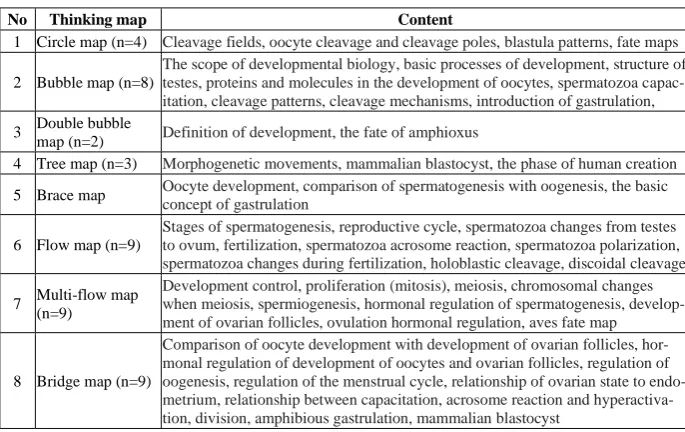
The prototype design is carried out based on the prototype matrix for the develop-ment of teaching materials using thought maps on integrative learning models. The de-sign results are listed in Table 2. In Table 2 it can be seen that there are 47 pieces of material visualized into eight types of thought maps. The results of this design were carried out by expert review with 3 experts. The results of the validity test are written in Table 3. The results of the validity test show that the prototype obtained a value with a valid average (Table 3), and the validator gives revised suggestions on the aspects of consistency in the use of terms in the thought map and the use of images in the product book. These results also show that there is internal relevance and consistency in the development of teaching materials using thought maps in integrative learning models.
Table 2. Teaching materials use thinking maps on integrative learning models
No Thinking map Content
1 Circle map (n=4) Cleavage fields, oocyte cleavage and cleavage poles, blastula patterns, fate maps 2 Bubble map (n=8)
The scope of developmental biology, basic processes of development, structure of testes, proteins and molecules in the development of oocytes, spermatozoa capac-itation, cleavage patterns, cleavage mechanisms, introduction of gastrulation,
3 Double bubble
map (n=2) Definition of development, the fate of amphioxus
4 Tree map (n=3) Morphogenetic movements, mammalian blastocyst, the phase of human creation 5 Brace map Oocyte development, comparison of spermatogenesis with oogenesis, the basic
concept of gastrulation
6 Flow map (n=9)
Stages of spermatogenesis, reproductive cycle, spermatozoa changes from testes to ovum, fertilization, spermatozoa acrosome reaction, spermatozoa polarization, spermatozoa changes during fertilization, holoblastic cleavage, discoidal cleavage
7 Multi-flow map (n=9)
Development control, proliferation (mitosis), meiosis, chromosomal changes when meiosis, spermiogenesis, hormonal regulation of spermatogenesis, develop-ment of ovarian follicles, ovulation hormonal regulation, aves fate map
8 Bridge map (n=9)
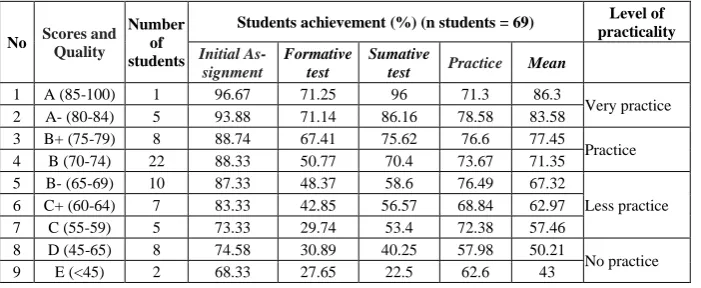
The next stage is a prototype of teaching material using an assessment mechanism (assessment phase) using summative evaluation techniques. This stage also describes the practicality of using prototypes. Summative evaluation is done by applying the use of prototypes in the learning process. Application of prototype use in learning process using integrative learning model syntax. The practicality of applying this prototype is determined by student learning outcomes. The findings of the study on the results of the application of teaching materials using thought maps on integrative learning models are listed in Table 4. The test results showed that there were 36 students as participants obtained grades A, A-, B + and B. These results also indicated that the level of practi-cality of the prototype was at level is very practical and practical. This result also shows that there is relevance and consistency in the development of teaching materials using thought maps on integrative learning models.
Table 3. The results of the validity of teaching materials using a thought map on integrative learning models
No Aspect Result of validity (n expert = 3)
χ SD Category
1 Consistent 2.72 0.71 Valid
2 Flexible 3.50 0.71 Very valid
3 Growth 3.00 1.41 Very valid
4 Integrative 3.50 0.71 Very valid
5 Reflective 2.82 0.71 Valid
Mean 3.26 0.85 Valid
Note: χ = Mean, SD= Standard Deviation. χ >3.20 is very valid; 2.40< χ ≤3.20 is valid; 1.60< χ ≤2.40 is less valid; 0.80< χ ≤1.60 is valid; χ ≤0.80 is no valid.
Table 4. Students' learning outcomes after the implementation of teaching materials using thinking maps on integrative learning models
No Scores and Quality
Number of students
Students achievement (%) (n students = 69) Level of practicality Initial
As-signment
Formative test
Sumative
test Practice Mean
1 A (85-100) 1 96.67 71.25 96 71.3 86.3
Very practice
2 A- (80-84) 5 93.88 71.14 86.16 78.58 83.58
3 B+ (75-79) 8 88.74 67.41 75.62 76.6 77.45
Practice
4 B (70-74) 22 88.33 50.77 70.4 73.67 71.35
5 B- (65-69) 10 87.33 48.37 58.6 76.49 67.32
Less practice
6 C+ (60-64) 7 83.33 42.85 56.57 68.84 62.97
7 C (55-59) 5 73.33 29.74 53.4 72.38 57.46
8 D (45-65) 8 74.58 30.89 40.25 57.98 50.21
No practice
9 E (<45) 2 68.33 27.65 22.5 62.6 43
products that have been designed. These aspects were fulfilled in this study. The expla-nation also shows the existence of internal relevance and consistency in the develop-ment of teaching materials using thought maps on integrative learning models.
At internal relevance and consistency in educational development research is also determined by how much expectation is matched (expectation) with those of research findings [34]. The expected expectation of the research results is evidenced by a series of tests such as expert review and small or large group tests. The results of the research on the development of teaching materials using thought maps in this integrative learn-ing model also show the existence of expert review and application tests (small large group tests). This finding also shows that internal relevance and consistency have been fulfilled in the development of teaching materials using thought maps in integrative learning models.
The results show that the developed subject meets five characteristics of the thinking map [1]. This result also shows that the developed teaching material can be visualized into the form of all types of thought maps. Because the research findings have helped to absorb the course material well. The results show that embryology learning materials can be visualized and support the lecturer's role in discovering and describing linear and nonlinear knowledge structures [32]. Embryological material has been visualized into eight forms of thought maps. The research findings also show that flow maps, plu-ral flow maps and bridge maps are the most visualized type of embryological material. These results are suspected because embryological learning materials that are charac-terized by theories, processes, facts and concepts [35] can be met with flow maps, mul-tiple plural maps and bridge maps [32]. Because the flow map visualizes the infor-mation settings in sequence. Plural flow maps visualize the analysis of physiological feedback systems and bridge maps visualizing the use of analogies and metaphors to understand concepts [32].
In terms of the use of learning methods, this study uses integrative learning model syntax supported by the theory of integrative learning approaches [36]. One of the most important aspects of an integrative model / approach is interdisciplinary, thought map and problem solving. The use of syntax of integrative learning model in learning pro-cess has direct impact [19] in the form of equalization of student learning outcomes on good quality. These findings also show that the fulfillment of the internal relevance and consistency aspects of the development of teaching materials uses the thinking map in the integrative learning model.
4
Conclusion
The use of thought maps on content with the characteristics of theories, concepts, facts and processes should be more widely used in integrative learning processes. Be-cause it will help students to achieve teh learning materials. The use of thought maps should also involve students / students in the design process. So that the process of mapping and changing information to form (meta-cognitive) knowledge is more bene-ficial for students.
5
Acknowledgement
This study fund by IAIN Batusangkar. I would like to thank for it.
6
References
[1]Hyerle, D. (2012). Peta Pemikiran (Thinking Maps) sebagai Suatu Bahasa Transformasional untuk Pembelajaran. Dalam N. D. Hyerle, & L. Alper, Peta Pemikiran (Thinking Maps), Penelitian Berbasis Sekolah, Hasil dan Model untuk Prestasi dengan Menggunakan Peralatan Visual (A. Cahayani, Penerj., 2nd ed.). Jakarta: PT. Indeks.https://doi.org/10.24 114/jpp.v18i3.4291
[2]Hyerle, D. (1995). Thinking maps: seeing is understanding. Educational Leadership, 53(4), 85-89. Retrived from: http://www.ascd.org/publications/educational-leadership/dec95/ vol53/num04/[email protected].
[3]Long, D., & Carlson, D. (2011). Mind the map: how thinking maps affect student achieve-ment. Networks, 13(2), 1-7. https://doi.org/10.4148/2470-6353.1083.
[4]McDonnell, J., & Zeni, J. (2003). Book Review: a field guide to using visual tools by David Hyerle. The Quarterly, 25(3). https://www.nwp.org/cs/public/print/resource/876.
[5]Salah, A. A.-n., & Abu-Owda, M. F. (2014). The effect of using thinking maps strategy to improve science processes in science course on female students of the ninth grade. Science Journal of Education, 2(2), 44-49. https://www.10.11648/j.sjedu.20140202.12.
[6]Kinchin, I. M. (2000). Concept mapping in biology. Journal of Biological Education, 34(2), 61-68. https://www.dx.doi.org/10.1080/00219266.2000.9655687.
[7]Kinchin, I. M. (2010). Effective teacher ↔ student dialogue: a model from biological edu-cationJournal of Biological Education 37(3): 110-113. https://doi.org/10.1080/00219266. 2003.9655864.
[8]Schmid, F. R., & Telaro, G. (1990). Concept Mapping as an Instructional Strategy for high school biology. The Journal of Educational Research, 84(2), 78-85. https://doi.org/10. 1080/00220671.1990.10885996.
[9]Kinchin, I. M. (2011). Visualising knowledge structures in biology: discipline, curriculum and student understanding. Journal of Biological Education, 45(4), 183-189. https://doi. org/10.1080/00219266.2011.598178.
[10]Chiou, C. C. (2008). The effect of concept mapping on students’ learning achievements and interests. Innovations in Education and Teaching International, 45(4), 375-387. https:// doi.org/10.1080/14703290802377240
[11]Tsai, C. C., & Huang, C. M. (2002). Exploring students' cognitive structures in learning science: a review of relevant methods. Journal of Biological Education, 36(4), 163-169.
[12]Lalor, S. B., & Rainford, M. (2014). The effects of using concept mapping for improving advanced level biology students' lower- and higher-order cognitive skills. International Jour-nal of Science Education, 36(5), 839-863. https://doi.org/10.1080/09500693.2013. 829255.
[13]Marée, T. J., Bruggen, J. M., & Joche, W. M. (2013). Effective self-regulated science learn-ing through multimedia-enriched skeleton concept maps. Research in Science & Technolog-ical Education, 31(1), 16-30. https://doi.org/10.1080/02635143.2013.782283.
[14]Steiner, S. M., Albert, D., & Wan, S. (2017). Validating domain ontologies: A methodology exemplified for concept maps. Cogent Education, 4(1). http://www.tandfonline.com/.
https://doi.org/10.1080/2331186x.2016.1263006
[15]Kinchin, I. M. (2006). Concept mapping, powerPoint, and a pedagogy of access. Journal of Biological Education, 40(2), 79-83. https://doi.org/10.1080/00219266.2006.9656018
[16]Haviz, M., Lufri, Fauzan, A., & Efendi, Z. M. (2012). Pengembangan model pembelajaran integratif pada biologi perkembangan hewan: analisi kebutuhan pengembangan. Ta'dib, 15(1), 1-14. http://ecampus.iainbatusangkar.ac.id/ojs/index.php/takdib/article/view/213.
https://doi.org/10.31958/jt.v15i1.213
[17]Haviz, M. (2013). Integrative Model of Learning Construction and Validation: an Embryol-ogy Case. Seminar on Educational Design Research (Pp. 210-220). Padang: Graduate Pro-gram Padang State University. Retrived from: https://scholar.google.com/cita- tions?user=uhto6cAAAAAJ#d=gs_md_cita-d&u=%2Fcitations%3Fview_op%3Dview_ci-tation%26hl%3Den%26user%3Duhto6cAAAAAJ%26citation_for_view%3Duhto6cAAA AAJ%3AhFOr9nPyWt4C%26tzom%3D-420
[18]Haviz, M. (2016). Designing and developing the integrated learning model on embryology. Transylvanian Review, 24-7. http://transylvanianreviewjournal.org/index.php/TR/article/ view/2998.
[19]Joyce, B. R., & Weil, M. (1992). Models of Teaching (4th ed.). Massachusetts: Allyn and Bacon Publisher.
[20]Haviz, M. (2015). Modern instructional design on educational research: how to use the adap-tive systems on instructional of biology in International conference on Mathematics, Sci-ence, Education and Technology (Icomset) Held on 22 october 2015, Padang, 2015. Retrivedfrom:https://www.researchgate.net/profile/Adri_Nofrianto/publication/3140948 62_Etnomathematics_Mathematical_Concepts_in_Minangkabau_Traditional_Game/links/ 58b534fa45851503bea17c05/Etnomathematics-Mathematical-Concepts-in-Minangkabau-Traditional-Game.pdf#page=307
[21]Agostinho, S., Bennett, S., & Lockyer, L. (2003). Integrating learning objects with Learning design. The 20th Annual Conference of the Australasian Society for Computers in Learning Tertiery Educatiaon (ASCILITE) (hal. 571-575). Australia: Australasian Society for Com-puters in Learning Tertiery Educatiaon (ASCILITE). Retrived from https://www.aca- demia.edu/22037009/Integrating_learning_objects_with_learning_designs?auto=down-load. https://doi.org/10.1109/icalt.2005.91
[22]Haviz, M., Karomah, H., Delfita, R., Umar, M. I. A. & Maris, I. M. (2018). Revisiting ge-neric science skills as 21st century skills on biology learning. Jurnal Pendidikan IPA Indo-nesia, 7(3): 355-363. https://journal.unnes.ac.id/nju/index.php/jpii/article/view/12438.
https://doi.org/10.15294/jpii.v7i3.12438
[23]Sadik, A. (2008). Digital storytelling: a meaningful technology-integrated approach for en-gaged student learning. Education Tech Research Dev, 487-506. https://doi.org/10.1007/ s11423-008-9091-8
springer.com/article/10.1007/s11423-009-9119-8. https://doi.org/10.1007/s11423-009-91 19-8
[25]Tezci, E. (2011). Turkish primary school teacher perceptions of school culture regarding ICT integration. Educational Technology Research and Development, 59, 429-443. https:// link.springer.com/article/10.1007/s11423-011-9205-6. https://doi.org/10.1007/s11423-011-9205-6
[26]Plomp, T. (2010). Educational Design Research: An Introduction. In T. Plomp, & N. Nieev-een (Penyunt.), An Introduction to Educational Design Research (Pp. 9-35). Netherlands. Retrived from: https://ris.utwente.nl/ws/portalfiles/portal/14472302/Introduction_ 20to_20education_20design_20research.pdf.
[27]Haviz, M. (2013b). Research and development; penelitian di bidang kependidikan yang ino-vatif, produktif dan bermakna. Ta'dib, 16(1), 28-42. http://ecampus.iainbatusangkar. ac.id/ojs/index.php/takdib/article/view/235.https://doi.org/10.31958/jt.v16i1.235
[28]Dudek, R. W. (2011). Embryology (5th ed.). Philadelphia: Lippincot Williams and Wilkins. [29]Gay, L. R., Mills, G. E., & Airasian, P. W. (2009). Educational research, competencies for
analysis and application (9th ed.). New Jersey: Pearson Education.
[30]Tessmer, M. (1993). Planning and conducting formative evalution. London: Kogan Page. [31]Nieveen, N. (2010). Formative evaluation in educational design research. In Plomp, T.
(2010). Educational Design Research: An Introduction. In T. Plomp, & N. Nieeveen (Penyunt.), An Introduction to Educational Design Research (Pp. 9-35). Netherlands. Retrived from: https://ris.utwente.nl/ws/portalfiles/portal/14472302/Introduction_20to_ 20education_20design_20research.pdf. https://doi.org/10.1080/13803610801896349
[32]Conroy, L. A., & Hyerle, D. (2012). Berpikir seperti ilmuwan. Dalam D. N. Hyerle, & L. Alper, Peta Pemikiran (Thinking Map), Penelitian Berbasis Sekolah, Hasil dan Model untuk Prestasi dengan Menggunakan Peralatan Visual (A. Cahayani, Penerj., 2nd ed.). Jakarta: PT Indeks.
[33]Richey, R. C., Klein, J. D., & Nelson, W. A. (2002). Developmental research: studies of instructional design and development. Retrived from: http://citeseerx.ist.psu.edu/viewdoc/
download? doi=10.1.1.551.8284&rep=rep1&type=pdf
[34]Haviz, M. (2018). Computer-assisted biology learning materials: Designing and developing an interactive CD on spermatogenesis IOP Conference Series: Materials Science and Engi-neering, Volume 335, conference 1. Retrived from https://iopscience.iop.org/arti-cle/10.1088/1757-899X/335/1/012081/meta. https://doi.org/10.1088/1757899x/335/1/ 012081
[35]Haviz, M. (2015). Cooperative learning model on developmental of biology. American Jour-nal of EducatioJour-nal Research, 3(10), 1298-1304. Retrived from: http://www.sciepub.com /EDUCATION/abstract/4992
7
Author
M. Haviz is PhD, Master of Science. Assistant Professor at Department Biology of Education IAIN Batusangkar. Jalan Sudirman No. 137 Kubu Rajo Lima Kaum Batusangkar, West Sumatra, Indoenesia. E-mail: [email protected].