International Doctorate School in Information and Communication Technologies
DISI - University of Trento
Optimization-based Strategy for
Polyomino Subarraying in Wideband
Phased Array Design
Roman Chirikov
Advisor:
Prof. Paolo Rocca
Universit`a degli Studi di Trento
Advisor:
Prof. Valeriy Bagmanov
Ufa State Aviation Technical University
First of all, I would like to thank Prof. Paolo Rocca and Prof. Andrea
Massa for inviting me to the Eledia group, teaching me and changing all
my life in the very best sense.
I thank Erasmus Mundus programme for financial support, in particular
Kerstin Kruse and Claudia Tarzariol.
I thank Silvano Gambadoro and Andrea Steccanella for the time we
worked together.
Special thanks go to Prof. Nafisa Yussupova for believing in me and
supporting me.
Many thanks to my teachers, colleagues and dear friends from USATU:
Prof. Albert Sultanov, Prof. Valeriy Bagmanov, Prof. Vladimir Vasiliev,
Prof. Vadim Kartak, Dr. Ivan Meshkov, Dr. Guzel Abdrakhmanova, Marat
Musakaev, Pavel Kucherbaev, Elizaveta Grakhova and others.
Thanks to my English teacher, Lidia Miniakhmetovna, for forcing me
to learn the language long before I ever needed it.
Finally, I thank my dearest Mama, Papa, Vova and Granddad for
Phased antenna arrays provide ultimate performance in areas where high directivity and electronic scanning are needed. That performance is achieved by involving large number of radiators as well as corresponding control units. As a result, such systems become bulky and heavy. In order to re-duce the number of control units, elements are grouped in subarrays with one of the control units, such as time delay, put at the subarray level. The drawback of this approach is that if elements are grouped into subarrays producing repetitive patterns in the array structure, radiation pattern of such array will be affected by undesired grating lobes. To eliminate that effect, subarrays of irregular shapes, such as polyominoes, are used. Still, those structures are an object for optimization. This work aims at apply-ing optimization techniques like genetic algorithm to the problem of findapply-ing optimal structures of phased antenna arrays composed of polyomino-shaped subarrays. For this purpose a new mathematical model, new algorithm and optimization methods are developed. Application of those techniques showed significant advances in radiation characteristics, in particular sidelobe level. Also new features were enabled, for example, multi-beam radiation pattern forming.
Keywords
1 Introduction and State-of-the-Art 1
1.1 Actuality of the problem of polyomino placement . . . 1
1.2 Analysis of existing methods and approaches to the
opti-mization of planar structures . . . 11
1.3 Goals and tasks of research . . . 18
1.4 Chapter 1 conclusions . . . 20
2 Development of mathematical model and optimization meth-ods for rectangular structures of polyominoes 21
2.1 Development of a mathematical model of antenna array
struc-tures built of polyomino-shaped subarrays . . . 21
2.2 Development of the optimization method based on the
struc-ture irregularity estimation . . . 29
2.2.1 Example values of irregularity by colour filtration
method . . . 35
2.2.2 Colour filtering method analysis . . . 38
2.3 Development of an optimization method based on
estima-tion of structure’s self-similarity . . . 41
2.3.1 Examples of self-similarity values by the
autocorre-lation method . . . 44
2.3.2 Autocorrelation method analysis . . . 47
2.4 Chapter 2 conclusions . . . 50
3 Development of an optimization algorithm based on the
genetic algorithm 53
3.1 Problem of the genetic algorithm application . . . 53
3.1.1 Circular placement principle . . . 56
3.1.2 Fitness function . . . 59
3.1.3 Calibration of GA parameters . . . 62
3.1.4 Examples of structures by the Gwee—Lim algorithm 68 3.2 Development of the “Snowball” algorithm for optimization of structures of polyominoes . . . 74
3.2.1 Mathematical formulation . . . 75
3.2.2 Decoding strategy . . . 76
3.2.3 Fitness function . . . 80
3.2.4 Calibration of GA parameters . . . 81
3.2.5 Examples of structures by the “Snowball” algorithm 85 3.3 Comparison of the Gwee—Lim and “Snowball” algorithms by the fullness of structures . . . 91
3.4 Tiling with two shapes of polyominoes simultaneously . . . 94
3.4.1 Examples of structures by GLA with two shapes of polyominoes . . . 97
3.4.2 Examples of structures by SA with two shapes of polyominoes . . . 102
3.5 Comparison of the Gwee—Lim and “Snowball” algorithms by the fullness of structures with two shapes of polyominoes 107 3.6 Chapter 3 conclusions . . . 109
4 Application of the optimization algorithms to antenna ar-ray design 113 4.1 Applying Gwee—Lim algorithm to phased antenna array optimization . . . 114
by the sidelobe level . . . 125
4.4 Analysis of steering capabilities . . . 131
4.5 Analysis of bandwidth capabilities . . . 138
4.6 Chapter 4 conclusions . . . 147
5 Multi-beam features of phased antenna arrays 149 5.1 Analysis of SLL for different angles between two beams . . 151
5.2 Application of the developed algorithm to two beams forming157 5.3 Chapter 5 conclusions . . . 171
6 Conclusions 173
Bibliography 175
1.1 Minimal estimation of number of different structures for
dif-ferent polyominoes . . . 10
2.1 Output data of the first example . . . 36
2.2 Output data of the second example . . . 37
2.3 Irregularity and SLL of structures of different sizes of
L-tromino . . . 38
2.4 Irregularity and SLL of structures of different sizes of
L-octomino . . . 39
2.5 Output data of the first example . . . 45
2.6 Output data of the second example . . . 46
2.7 Self-similarity and SLL of 32 × 32 structures of different
polyominoes . . . 48
2.8 Self-similarity and SLL of 64 × 64 structures of different
polyominoes . . . 48
2.9 Normalizing denominators ρ . . . 49
3.1 Average fitness function values at the first step of GLA
cal-ibration . . . 65
3.2 Average fitness function values of cubes at the first step of
GLA calibration . . . 66
3.3 Average values of the fitness function at the second step of
calibration of GLA . . . 68
3.4 Output data of the first example . . . 70
3.5 Output data of the second example . . . 71
3.6 Output data of the third example . . . 72
3.7 Output data of the fourth example . . . 73
3.8 Average fitness function values at the first step of SA cali-bration . . . 83
3.9 Average fitness function values of cubes at the first step of SA calibration . . . 84
3.10 Average values of the fitness function at the second step of calibration of SA . . . 86
3.11 Output data of the first example . . . 87
3.12 Output data of the second example . . . 88
3.13 Output data of the third example . . . 89
3.14 Output data of the fourth example . . . 90
3.15 Fullness of structures of different sizes by L-trominoes . . . 93
3.16 Fullness of structures of different sizes by L-octominoes . . 93
3.17 Fullness of a 32×32 structure with different polyominoes . 93 3.18 Output data of the first example . . . 98
3.19 Output data of the second example . . . 99
3.20 Output data of the third example . . . 100
3.21 Output data of the fourth example . . . 101
3.22 Output data of the first example . . . 103
3.23 Output data of the second example . . . 104
3.24 Output data of the third example . . . 105
3.25 Output data of the fourth example . . . 106
3.26 Fullness of structures of different sizes with different pairs of polyominoes . . . 109
3.27 Fullness of a 32×32 structure with different pairs of poly-ominoes . . . 109
4.4 Output data of the fourth example . . . 119
4.5 Output data of the first example . . . 121
4.6 Output data of the second example . . . 122
4.7 Output data of the third example . . . 123
4.8 Output data of the fourth example . . . 124
4.9 SLL of structures tiled with L-trominoes, ropt = 1.3 . . . . 126
4.10 SLL of structures tiled with L-trominoes, ropt = 1.818 . . . 127
4.11 SLL of structures tiled with L-octominoes, ropt = 1.3 . . . 128
4.12 SLL of structures tiled with L-octominoes, ropt = 1.818 . . 129
4.13 Output data of the first example . . . 132
4.14 Output data of the second example . . . 133
4.15 Output data of the third example . . . 134
4.16 Output data of the fourth example . . . 135
4.17 Output data of the fifth example . . . 136
4.18 Output data of the sixth example . . . 137
4.19 Output data of the first example . . . 139
4.20 Output data of the second example . . . 140
4.21 Output data of the third example . . . 141
4.22 Output data of the fourth example . . . 142
4.23 Output data of the fifth example . . . 143
4.24 Output data of the sixth example . . . 144
4.25 Output data of the sixth example . . . 145
4.26 Output data of the sixth example . . . 146
5.1 Output data of the first example . . . 152
5.2 Output data of the second example . . . 153
5.3 Output data of the third example . . . 154
5.4 Output data of the fourth example . . . 155
5.5 Output data of the fifth example . . . 156
5.6 Output data of the first example . . . 159
5.7 Output data of the second example . . . 160
5.8 Output data of the third example . . . 161
5.9 Output data of the fourth example . . . 162
5.10 Output data of the fifth example . . . 163
5.11 Output data of the sixth example . . . 164
5.12 Output data of the seventh example . . . 165
5.13 Output data of the eighth example . . . 166
5.14 Output data of the ninth example . . . 167
5.15 Output data of the tenth example . . . 168
5.16 Output data of the eleventh example . . . 169
5.17 Output data of the twelfth example . . . 170
1.1 Example of a solution of an optimal packing problem . . . 3
1.2 Example of a radiation pattern in polar coordinates . . . . 5
1.3 Large phased antenna array for radio location . . . 6
1.4 Phased antenna array (a) and architecture of an element (b) 7 1.5 Radiation pattern of PAA with no subarraying in the sine
space . . . 8
1.6 PAA tiled with rectangular subarrays (a) and architecture
of subarrays (b) . . . 9 1.7 Picture of a PAA tiled with rectangular subarrays: front
view (a) and feeding network behind (b) . . . 10 1.8 Radiation pattern of a PAA built with rectangular subarrays 11
1.9 Polyomino shapes: L-shaped tromino (a), L-shaped tetro-mino (b), S-shaped tetromino (c), T-shaped tetromino (d), C-shaped octomino (e), L-shaped octomino (f), PU-shaped
octomino (g) . . . 12 1.10 Phased antenna array tiled with L-shaped octominoes . . . 13
1.11 Radiation pattern of PAA tiled with L-shaped octomino
subarrays . . . 14
1.12 Rectangular subarray placement on an irregular grid . . . 16
1.13 The “Danzer” structure . . . 16
1.14 The “Penrose” structure . . . 17
1.15 The “Sunflower” structure . . . 17
2.1 Element location in the structure . . . 23
2.2 Phase shift forming . . . 27
2.3 RGB model: three basic and three secondary colours . . . 31
2.4 Example of a structure in which polyominoes are painted in colours according to orientations . . . 32
2.5 Views of the structure in red (a), green (b) and blue (c) channels . . . 33
2.6 Array structure in the first example . . . 36
2.7 Array structure in the second example . . . 37
2.8 Irregularity and sidelobe level of structures of different sizes, tiled with L-trominoes . . . 38
2.9 Irregularity and sidelobe level of structures of different sizes, tiled with L-octominoes . . . 39
2.10 Irregularity and sidelobe level of structures of same size tiled with L-tromino . . . 40
2.11 Irregularity and sidelobe level of structures of same size tiled with L-octomino . . . 41
2.12 Serial scanning . . . 42
2.13 First six steps of the Hilbert curve . . . 43
2.14 Structure of an array in the first example . . . 45
2.15 Structure of an array in the second example . . . 46
2.16 Self-similarity and sidelobe level of 32 × 32 structures of different polyominoes . . . 47
2.17 Self-similarity and sidelobe level of 64 × 64 structures of different polyominoes . . . 49
2.18 Self-similarity and sidelobe level of structures of same size tiled with L-trominoes . . . 50
2.19 Self-similarity and sidelobe level of structures of same size tiled with L-octominoes . . . 51
3.4 Clarification of border edges and common edges [38] . . . . 60
3.5 Calibration space . . . 63
3.6 The first step of GLA calibration . . . 64
3.7 Second step of the GLA calibration . . . 67
3.8 Fitness function in the first example . . . 69
3.9 Fitness function in the second example . . . 69
3.10 Structure of the array in the first example . . . 70
3.11 Structure of the array in the second example . . . 71
3.12 Structure of the array in the third example . . . 72
3.13 Structure of the array in the fourth example . . . 73
3.14 Flowchart of the “Snowball” algorithm . . . 77
3.15 Orientations of L-shaped octomino with corresponding num-bers . . . 78
3.16 Search order of suitable positions . . . 79
3.17 Chromosome (3.17) decoding result . . . 80
3.18 The first step of SA calibration . . . 82
3.19 Second step of the SA calibration . . . 85
3.20 Fitness function in the fourth example . . . 86
3.21 Structure of the array in the first example without (a) and with margins (b) . . . 87
3.22 Structure of the array in the second example without (a) and with margins (b) . . . 88
3.23 Structure of the array in the third example without (a) and with margins (b) . . . 89
3.24 Structure of the array in the fourth example without (a) and with margins (b) . . . 90
3.25 Fullness of structures of different sizes by L-trominoes . . . 92
3.26 Fullness of structures of different sizes by L-octominoes . . 94
3.27 Fullness of a 32×32 structure with different polyominoes . 95 3.28 A 32×32 structure, tiled by GLA with C-octominoes . . . 95
3.29 A 32×32 structure, tiled by SA with C-octominoes . . . . 96
3.30 Extended genes in a chromosome . . . 96
3.31 Fitness function in the second example . . . 97
3.32 Array structure in the first example . . . 98
3.33 Array structure in the second example . . . 99
3.34 Array structure in the third example . . . 100
3.35 Array structure in the fourth example . . . 101
3.36 Fitness function in the first example . . . 102
3.37 Array structure in the first example without (a) and with (b) margins . . . 103
3.38 Array structure in the second example without (a) and with (b) margins . . . 104
3.39 Array structure in the third example without (a) and with (b) margins . . . 105
3.40 Array structure in the fourth example without (a) and with (b) margins . . . 106
3.41 Fullness of structures of different sizes by L-trominoes and L-octominoes . . . 108
3.42 Fullness of structures of different sizes by L-tetrominoes and L-octominoes . . . 110
3.43 Fullness of a 32×32 structure with different pairs of poly-ominoes . . . 111
4.1 Structure of the software . . . 114
4.2 Fitness function in the second example . . . 115
4.6 Radiation pattern in the fourth example at r = 1.3 . . . . 119
4.7 Fitness function in the second example . . . 120
4.8 Radiation pattern in the first example at r = 1.3 . . . 121
4.9 Radiation pattern in the second example at r = 1.3 . . . . 122
4.10 Radiation pattern in the third example at r = 1.3 . . . 123
4.11 Radiation pattern in the fourth example at r = 1.3 . . . . 124
4.12 SLL of structures tiled with L-trominoes, ropt = 1.3 . . . . 126
4.13 SLL of structures tiled with L-trominoes, ropt = 1.818 . . . 127
4.14 SLL of structures tiled with L-octominoes, ropt = 1.3 . . . 128
4.15 SLL of structures tiled with L-octominoes, ropt = 1.818 . . 129
4.16 SLL comparison for structures of different sizes of L-octominoes,
obtained by GLA, SA and R. Mailloux [59] . . . 130
4.17 Fitness function in the first example . . . 131
4.18 Radiation pattern in the first example at r = 1.3 . . . 132
4.19 Radiation pattern in the second example at r = 1.3 . . . . 133
4.20 Radiation pattern in the third example at r = 1.3 . . . 134
4.21 Radiation pattern in the fourth example at r = 1.3 . . . . 135
4.22 Radiation pattern in the fifth example at r = 1.3 . . . 136
4.23 Radiation pattern in the sixth example at r = 1.3 . . . 137
4.24 SLL at different steering angles . . . 138
4.25 Radiation pattern in the first example at r = 1.333 . . . . 139
4.26 Radiation pattern in the second example at r = 1.500 . . . 140
4.27 Radiation pattern in the third example at r = 1.600 . . . . 141
4.28 Radiation pattern in the fourth example at r = 1.667 . . . 142
4.29 Radiation pattern in the fifth example at r = 1.750 . . . . 143
4.30 Radiation pattern in the sixth example at r = 1.818 . . . . 144
4.31 Radiation pattern in the sixth example at r = 1.875 . . . . 145
4.32 Radiation pattern in the sixth example at r = 1.905 . . . . 146
4.33 SLL at different bandwidths . . . 147
5.1 Structure of the array in the first example . . . 150
5.2 Radiation pattern for structure in figure 5.1 at r = 1.3 . . 150
5.3 Fitness function in the first example . . . 151
5.4 Radiation pattern in the first example at r = 1.300 . . . . 152
5.5 Radiation pattern in the second example at r = 1.300 . . . 153
5.6 Radiation pattern in the third example at r = 1.300 . . . . 154
5.7 Radiation pattern in the fourth example at r = 1.300 . . . 155
5.8 Radiation pattern in the fifth example at r = 1.300 . . . . 156
5.9 SLL and beam power difference for various angles . . . 157
5.10 Fitness function in the fourth example . . . 158
5.11 Radiation pattern in the first example at r = 1.3 . . . 159
5.12 Radiation pattern in the second example at r = 1.3 . . . . 160
5.13 Radiation pattern in the third example at r = 1.3 . . . 161
5.14 Radiation pattern in the fourth example at r = 1.3 . . . . 162
5.15 Radiation pattern in the fifth example at r = 1.818 . . . . 163
5.16 Radiation pattern in the sixth example at r = 1.818 . . . . 164
5.17 Radiation pattern in the seventh example at r = 1.3 . . . . 165
5.18 Radiation pattern in the eighth example at r = 1.3 . . . . 166
5.19 Radiation pattern in the ninth example at r = 1.3 . . . 167
5.20 Radiation pattern in the tenth example at r = 1.3 . . . 168
5.21 Radiation pattern in the eleventh example at r = 1.818 . . 169
5.22 Radiation pattern in the twelfth example at r = 1.818 . . . 170
The thesis consists of chapters as follows.
The first chapter contains analysis of the field of phased antenna arrays
together with the state-of-the-art. The actual problem is formulated. Also
the topic of optimization is discussed on examples of several common tasks
and various techniques are listed.
The second chapter describes development of the mathematical model
of planar phased antenna arrays built of polyomino-shaped subarrays. Two
optimization methods based on that model are also developed and
anal-ysed.
Chapter 3 describes the problem of application of the genetic algorithm
and shows in details the algorithm for polyomino placement by Gwee and
Lim. Then the “Snowball” algorithm is developed and compared to the
Gwee—Lim algorithm with examples.
Chapter 4 is dedicated to the analysis of antenna array structures
ob-tained by two algorithms. It shows advantages of the developed algorithm
in terms of sidelobe level suppression.
Chapter 5 includes several examples and analysis of multi-beam
radia-tion patterns obtained by structures with two shapes of subarrays. They
show further enhancements of the array technology.
Introduction and State-of-the-Art
1.1
Actuality of the problem of polyomino placement
The task of optimization of technological processes and solutions has always
been a part of a technical thinking. Optimization is a process of finding an
optimal solution. Optimal solution is the one that is more preferable than
other according to some criteria [86].
Optimization of technological processes can be divided into four general
groups.
• Time optimization means that the process should run as fast as pos-sible. For example, the slowest part of a conveyor may need to be
optimised to increase productivity of the whole assembly process.
• Raw materials optimization pursues the most effective usage of the needed raw materials. As an example one may consider optimization
of a shape of a plastic cover of some unit to decrease the consumption
of plastic [42].
• Cost optimization in opposite of raw materials optimization supposes minimization of all the costs including salary and equipment.
• Quality optimization has a goal of reaching the best quality in a
1.1. ACTUALITY OF THE PROBLEM OF POLYOMINO PLACEMENT
cess. The example is manual potato cleaning instead of automated.
The process becomes expensive and long but the quality increases.
In a similar way optimization of technological solutions is made in
ac-cordance with some set of criteria. The set may consist of one or more
criteria. Under a technological solution may be considered a solution of
some problem by applying an existing technology as well as some system in
a broad sense. Optimization of a system may be focused on choosing the
optimal components of the system, optimization of connections (including
spatial) between them or all together.
Optimal placement of a set of objects in a limited space represents a wide
class of optimization problems. Usually such space is a rectangular area
on a plane while objects are geometrical shapes, real objects or even
ab-stract objects represented in geometrical shapes.Further examples of such
problems are listed. All of them belong to NP-hard class of problems.
Optimal packing problem. This problem is classical in such areas as system analysis, combinatorics and linear algebra. This problem can be
formulated like: there is a container of a given shape in which the maximum
number of objects again of given shapes should be placed. The objects may
be of different shapes and sizes. Such a problem has been investigated in a
one-dimensional [35], two-dimensional [80, 12], three-dimensional [87] and
multidimensional variations. In figure 1.1 an example of a solution of such
problem is shown.
Optimal cutting problem. The difference of this problem is that there are several shapes into which a sheet of some material should be cut.
The point is to minimize the garbage from cutting, i.e. maximization of
the density of the shape placement. This problem is studied in several
well-known works [30, 29, 46].
The rucksack problem. This problem is different from the previous ones because it is multi-criterial by definition. The essence is in the
Figure 1.1: Example of a solution of an optimal packing problem
lowing: there is a rucksack of a limited volume. There is a set of objects
of given sizes and prices. It is needed to put in the rucksack such a set of
objects so that their total cost would be maximal. There is a variation of
this problem where instead of the limit of the volume there is a limitation
of its load capacity and the objects have weight instead of price.
But along with the listed above problems there is an important task of
optimization of the structures of phased antenna arrays built with irregular
subarrays in order to increase their energy efficiency, communication range
and electromagnetic interoperability. The topic of this work is in the area
of optimization of a system that consists of a fuzzy set of components
with particular properties and two types of connections — geometrical
and electrodynamic. Both connections will be studied during the process
of the mathematical model development.
First of all it is necessary to explain what is a phased antenna array
and what is it used for. An antenna is a device for radiating or receiving
electromagnetic waves. Antennas are the key elements in such well-known
areas as wireless communication, radio location and radio astronomy. In
recent years the research in wireless energy transfer has got an impulse.
Antennas can be of various types, shapes and sizes. But there are several
basic parameters applicable for all of them:
1.1. ACTUALITY OF THE PROBLEM OF POLYOMINO PLACEMENT
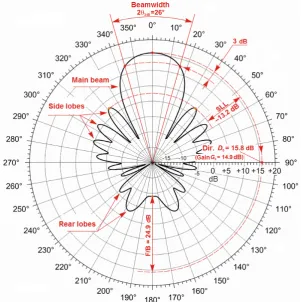
• radiation pattern (RP) — graphical representation of dependence of gain or directivity of the antenna on the direction in a given plane;
• gain — ratio of input power of the reference antenna to the input power of the given antenna given that both antennas produce the
same electric field intensity in one direction at the same distance or
same power flux density;
• directivity — ratio of squared electric field intensity produced by the antenna in a given direction to the average square of electric field
intensity in all directions;
• sidelobe level (SLL) — relative (normalized to the maximum of RP) level of antenna radiation in direction of side lobes;
• front-to-back ratio (F/B) — ratio of the front radiation level to the back radiation level;
• beamwidth — angle within which the radiation level is higher than half of the level of the main beam (or in other words, less than the
maximum for 3 dB or less).
In figure 1.2 a typical radiation pattern is shown in polar coordinates.
It has a main beam and side lobes including a backside lobe.
In some cases there are special requirements for the antenna parameters,
such as high gain or ability to change radiation pattern. In such cases
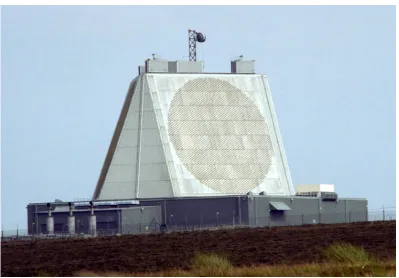
phased antenna arrays (PAA) are used (figure 1.3). Antenna arrays are
complex systems consisting of two or more equal antennas joined by one
feeding network and functioning in coherence. Radiators belong to passive
components. Phased arrays differ by having active components such as
amplifiers and phase shifters. PAAs have the ability to apply amplitude and
phase corrections at every radiator (array element) forming therefore the
Figure 1.2: Example of a radiation pattern in polar coordinates
needed radiation pattern. Sharp RP increases the quality of transmitting
and receiving signals in a given direction decreasing the noise level coming
from other directions. PAA may be linear, when all elements are aligned
in one line, and planar, when elements lie in a plane.
In order to increase the throughput of wireless communication systems
in recent years a shift towards wideband systems has been initiated [81, 43].
The feature of those systems is wide signal spectrum, i.e. a big set of
frequencies of electromagnetic waves is used for signal transmission [77].
As it was said, PAA can change its radiation pattern, i.e. steer its main
beam [71]. In case of wideband systems and/or large antenna array the
phase shifters cannot handle the task of beam forming [49]. In this case
time delay (TD) is required. Such arrays find their application in radio
1.1. ACTUALITY OF THE PROBLEM OF POLYOMINO PLACEMENT
Figure 1.3: Large phased antenna array for radio location
location, radio astronomy and communication systems [32].
A PAA of 8 × 8 elements is shown in figure 1.4a. Every element has the same architecture behind it shown in figure 1.4b. A typical radiation pattern is presented in figure 1.5. The RP is shown in three-dimensional
sine space (discussed in more details in chapter 3). The radiation level
is expressed in decibels relatively to the main beam. The simulation was
run with the beam steering to angle (45◦; 45◦) that corresponds to sine
space coordinates (0,5; 0,5). As it is seen from RP, there is one strongly
pronounced beam and two rows of weak side lobes in accordance with
Taylor current distribution [82].
The problem of time delay components is that they are significantly
more expensive, bigger and heavier than other components. If we don’t
consider the cost, their application is still limited in satellite
communica-tions due to its weight. To solve this problem by sacrificing the performance
Element (a)
Radiator
Amplifier
Phase shifter
τ
Time delay(b)
Figure 1.4: Phased antenna array (a) and architecture of an element (b)
it was proposed to split PAA into subarrays and put one time delay
com-ponent before subarray input, i.e. move time delays to the subarray level
[79, 78]. Therefore, the number of needed time delays decreases
propor-tionally to the number of elements grouped in one subarray. In figure 1.6
a 8×8 PAA is shown tiled with subarrays of 4×2 elements.
There is another problem with subarrays. The delay of a signal formed
by the time delay is true only for that point of an array that it was
cal-culated for. Let us consider that TD is placed under the central element
of a subarray and the value of the delay is calculated for that element. In
this case an error will be generated on all other elements of the subarray
represented by a time shift of the signal. To be exact, it should be
re-minded that this effect occurs only for wideband systems. Every element
receives its own error value and own time shift. That shift is the same
for corresponding elements of neighbour subarrays. Consequently, the
1.1. ACTUALITY OF THE PROBLEM OF POLYOMINO PLACEMENT -1 -0.5 0 0.5 1 -1 -0.5 0 0.5 1 -60 -50 -40 -30 -20 -10 0 Radiation, dB u v Radiation, dB -60 -50 -40 -30 -20 -10 0
Figure 1.5: Radiation pattern of PAA with no subarraying in the sine space
nal from those elements is coherently added and amplified. It turns out
to be an error accumulation. This error is represented in grating lobes
in the RP that happen to be side lobes [68]. Their existence is highly
undesired because they lead to decrease in power of the main beam and
affect the electromagnetic interoperability of a system. Note that the error
accumulation from the corresponding elements happens due to the regular
placement of subarrays in the array. The illustrative radiation pattern is
shown in figure 1.8. Besides the main beam it has five strong side lobes
with the highest level at −9,5 dB.
One of the ways to overcome the occurrence of strong side lobes is to
use the subarrays of irregular shape, namely polyomino-shaped (figure 1.9)
[56]. Character C defines the centre. Such shapes rotated by a multiple
of 90 degrees allow to eliminate the regularity in the subarray placement
and, therefore, prevent the error accumulation. Figure 1.10 shows the same
8×8 structure tiled this time with L-shaped octominoes. On the radiation
(a)
τ
τ
Radiator
Phase shifter Amplifier
Time delay
(b)
Figure 1.6: PAA tiled with rectangular subarrays (a) and architecture of subarrays (b)
pattern (figure 1.11) it can be seen that the side lobes are spread over the
whole space, decreasing therefore its maximum down to −20,3 dB.
PAA of the same size in one and the same frequency band but with
different structures, obviously, produce different level of side lobes. It is
easy to estimate the minimal number of possible structures of size M ×N
elements tiled with polyomino with q cells. Let us define the area of a
1.1. ACTUALITY OF THE PROBLEM OF POLYOMINO PLACEMENT
(a) (b)
Figure 1.7: Picture of a PAA tiled with rectangular subarrays: front view (a) and feeding network behind (b)
minimal rectangle completely tiled with such a polyomino as Smin. Inside
this rectangle Smin/q polyominoes are placed unambiguously. This rectangle
can be rotated by 90 degrees or flipped. In total there are four possible
minimal rectangles. Inside the structure there can be M ×N/S
min such
rect-angles. So, we can say that the minimal number of various structures with
full coverage is
NK =
2Smin
q
MS×N
min
. (1.1)
In table 1.1 this number has been calculated for some polyomino types.
As it is seen, even the minimal estimation of the structures number prevents
from using brute force search for the optimal structure larger than 8 ×8
according to some criteria. Therefore, an approximate method is needed.
Table 1.1: Minimal estimation of number of different structures for different polyominoes L-tromino L-tetromino L-octomino
8×8 2642246 6536 256 16×16 4.87·1025 1.84·1019 4.29·109
32×32 5.64·10102 1.16·1077 3.4·1038
In papers by Mailloux [59, 61] such structures were composed manually
-1
-0.5
0
0.5
1 -1
-0.5 0
0.5 1 -60
-50 -40 -30 -20 -10 0
Radiation,
dB
u
v
Radiation,
dB
-60 -50 -40 -30 -20
Figure 1.8: Radiation pattern of a PAA built with rectangular subarrays
without any optimization. The question of choosing particular structure
was not stated. So, there is an actual problem of optimization of phased
antenna arrays structures tiled with polyomino-shaped subarrays.
Therefore, the actuality of the problem was shown. Practical
applica-tion field was described in details, in which phased antenna arrays act as
complex spatially distributed objects. Problems were shown that occur in
design of large phased antenna arrays with polyomino-shaped subarraying.
1.2
Analysis of existing methods and approaches to
the optimization of planar structures
In the previous section the urgency of the research topic was described.
Now it is necessary to analyse the state of the art. Analysis of the
achieve-ments in the field will be performed from two sides. From one side, methods
and algorithms for optimization of two-dimensional structures, tiled with
1.2. ANALYSIS OF EXISTING METHODS AND APPROACHES TO THE OPTIMIZATION OF PLANAR STRUCTURES
C C C
C
C C C
a b c d
e f g
Figure 1.9: Polyomino shapes: L-shaped tromino (a), L-shaped tetromino (b), S-shaped tetromino (c), T-shaped tetromino (d), C-shaped octomino (e), L-shaped octomino (f), PU-shaped octomino (g)
objects of irregular shape, would be considered. That is geometric or
sys-tem component of the work will be analysed. From the other side, the
analysis of sidelobe level suppression methods in phased antenna arrays
will be performed.
There are analytical and empirical methods of packing objects in
struc-tures. For example, Chinn and Grimaldi in their work analytically pack
polyominoes into rectangular areas of the smallest size, which then cover
the structure [14].
Opting empirical methods was done for the following reasons:
1. Such evaluation criterion of a PAR structure as the sidelobe level is in
the complex implicit dependence on the structure itself and can only
be calculated by modelling the entire system. Thus, the optimization
problem is finding the global maximum in the large discrete space of
solutions [85].
2. number of structures that can be obtained by filling a large rectangular
Figure 1.10: Phased antenna array tiled with L-shaped octominoes
area with polyominoes is so big that it is not possible to sort out all
the options and model them.
Empirical methods include optimization, that implements search for
so-lutions in some complex multidimensional space. There are a number of
studies that have compared different optimization algorithms such as
parti-cle swarm optimization method with genetic algorithm [40, 31],
evolution-ary algorithms [4, 63] and ant colony optimization [73]. Some researchers
are interested in combining particle swarm optimization with such genetic
mechanisms as breeding and selection [55, 5, 65]. Many variations of the
original method of particle swarm optimization were suggested. For
ex-ample, parallel optimization of several smaller swarms [83, 75, 84], adding
negative entropy for mixing the particles [91], dissemination of findings
within a limited number of nearest neighbours [48, 50, 62, 47], variation of
searching objects in time [3], application of the particle swarm optimization
method for controlling mutation in the evolutionary methods [89],
disper-sal of clustered particles to increase diversity [54], application of fuzzy logic
1.2. ANALYSIS OF EXISTING METHODS AND APPROACHES TO THE OPTIMIZATION OF PLANAR STRUCTURES
-1 -0.5 0 0.5 1 -1 -0.5 0 0.5 1 -60 -50 -40 -30 -20 -10 0 Radiation, dB u v Radiation, dB -60 -50 -40 -30 -20 -10 0
Figure 1.11: Radiation pattern of PAA tiled with L-shaped octomino subarrays
for adjusting the parameters of the algorithm [74]. Daniel Boeringer and
Douglas Werner compared particle swarm optimization with the genetic
algorithm [8] and showed that the latter has a better ability to beam
form-ing. There are examples of the use of genetic algorithm in electromagnetics
and antenna design [90, 2].
Among the empirical methods we have chosen the genetic algorithm
(GA) for the following reasons:
1. Independence from the task type. In this work the task is a battery
of many parameters for which the optimal value has to be found.
2. Discreteness of the nature of the task. Since PAAs have regular grid
and polyominoes are placed in the nodes of that grid with strictly
defined possible orientations, the search space is discrete.
3. Continuous actual range of the cost function. In opposite to the search
space, the criteria that describe potential solutions are continuous
Now let us face the question of sidelobe level suppression. As it was
mentioned, grating lobes appear due to the accumulation of the phase shift
error among regularly placed subarrays. The subarrays and elements inside
them could be placed within a periodic and an aperiodic grid. In the first
case the array is called equidistant and in the second — non-equidistant.
The shape of the subarrays can be rectangular and irregular. Accordingly,
there are four domains of planar array subarraying.
The first domain represents the simplest case, when rectangular
subar-rays are put into a periodic grid. In other words, the array is being split
into equal rectangle areas of several radiating elements. Although in this
case the area of the array is simply and effectively filled (figure 1.6), the
corresponding radiation pattern is characterized by poor radiation
perfor-mance with grating lobes due to the periodicity of the structure (figure 1.8)
[60].
Other three domains aim at breaking this periodicity in different ways.
In the second domain the rectangular subarrays are arranged in an
ape-riodic grid, which results in small arbitrary relative displacements and/or
rotations (figure 1.12) [51]. This is the simplest solution for breaking
pe-riodicity. This solution is still simple from the point of view of production
process but the achieved sidelobe suppression is not high (around 11 dB)
[52].
The third domain is represented by irregular subarrays that
aperiodi-cally tile the aperture of the array [76, 88]. Here subarrays of more than
one irregular shape are used simultaneously and placed in an aperiodic
order, thus in nodes of an irregular grid.
One of the examples is the “Danzer” structure by Thomas Spence and
Douglas Werner [76]. Their structure consists of many various triangles
each being a subarray (figure 1.13). Such an array produces sidelobes of
1.2. ANALYSIS OF EXISTING METHODS AND APPROACHES TO THE OPTIMIZATION OF PLANAR STRUCTURES
Figure 1.12: Rectangular subarray placement on an irregular grid
−17.3 dB.
Figure 1.13: The “Danzer” structure
Pierro with colleagues published a structure called “Penrose” [66]
(fig-ure 1.14). It also contains a lot of subarrays and suppresses SLL down to −17 dB.
A very beautiful variant of an antenna array structure was shown by
Vigan´o [88]. It is called “Sunflower” (figure 1.15) and also keeps SLL at
level of −17 dB.
called “Pinwheel” [69]. In their article Morabito and others declare SLL
suppression to −21.5 dB.
Figure 1.14: The “Penrose” structure
Figure 1.15: The “Sunflower” structure
1.3. GOALS AND TASKS OF RESEARCH
The results achieved in this domain are significant due to high
irregular-ity of the array structures (also considering arbitrary placement of elements
within a subarray) [64, 66]. Although, the structures become very complex
and include a big number of elements, which leads to high costs of the
arrays and their size and weight.
Accordingly, the fourth domain — the use of subarrays of irregular
shapes placed onto a periodic grid — has been adopted to avoid the
pres-ence of grating lobes of the array factor [57]. This approach provides good
sidelobe level suppression still keeping the structure feasible in terms of
mass production (figure 1.11). Having one irregular shape of a subarray
it is possible to produce them first and then use them to build the whole
array, just rotating the shape. Circular polarization used in
communica-tion systems will not be ruined. The quescommunica-tion that arises is how to obtain
such a structure to meet particular requirements. In other words, the array
structure has to be optimized. The problem of large array tiling with
sub-arrays of irregular shape comes to finding subarray positions with minimal
number of holes (i.e. uncovered cells), that decrease the gain, and avoiding
periodicity in subarray placement in order to minimize the number and
level of the side lobes [6].
Therefore, existing methods and approaches to the problem of
opti-mization of planar structures were analysed. Separately the optiopti-mization
methods for phased antenna array structures were considered.
Disadvan-tages of those methods applied to antenna array design were indicated and
the way of research was chosen.
1.3
Goals and tasks of research
After substantiating actuality and analysing present methods and
appro-aches, the goal of the work was set to be an increase of operating efficiency
optimization of their structures composed of polyomino-shaped subarrays.
The choice of the genetic algorithm is grounded on the features of the
application field. Phased antenna array optimization is one of the ways
to fulfil the growing requirements for wireless communication speed and
electromagnetic interoperability. The following research tasks have been
formulated:
1. To develop a mathematical model of a phased antenna array structure
composed of polyomino-shaped subarrays. This model should join
geometric properties of the system, common for all planar structures,
and electrodynamic properties that are specific for antenna arrays.
The development of the model lies in the base of the whole research
and is a fundamental step for further activities.
2. To develop a optimization method for polyomino placement based on
a criterion of estimation of irregularity of structures. The sidelobe
level of an antenna array that is being optimized is connected with
subarray placement in the structure, more exactly with their
irreg-ularity. Therefore, by the irregularity estimation of a structure it is
possible to estimate the sidelobe level. This task plays an important
role in universalization of the algorithm to be developed.
3. To develop an algorithm of a structural-parametric synthesis of
struc-tures of polyominoes. This is the main theoretical task of the work.
The algorithm is meant to synthesize structures, optimized by given
criteria applying developed methods.
4. To develop a software based on the proposed algorithm for solving the
phased antenna array optimization problem. The task has both
theo-retical — parameters calibration — and practical sides — synthesis of
1.4. CHAPTER 1 CONCLUSIONS
antenna array structures. The software is needed for testing the
algo-rithm and running numerical simulations on the obtained structures.
5. To assess the efficiency of the proposed algorithm and obtained
struc-tures by the mathematical simulation. Using the software it is needed
to get output results of the algorithm and to analyse them, proving
that the goal is achieved.
1.4
Chapter 1 conclusions
1. The actuality of the problem was shown. Practical application field
was described in details, in which phased antenna arrays act as
com-plex spatially distributed objects. Problems were shown that occur in
design of large phased antenna arrays with polyomino-shaped
subar-raying.
2. Existing methods and approaches to the problem of optimization of
planar structures were analysed. Separately the optimization methods
for phased antenna array structures were considered. Disadvantages
of those methods applied to antenna array design were indicated and
the way of research was chosen.
3. The goal of the work was formulated according to analysis of the state
of the art in the field. The scientific tasks were stated that will lead
to the goal achievement by a consistent progress.
Development of mathematical model
and optimization methods for
rectangular structures of
polyominoes
2.1
Development of a mathematical model of antenna
array structures built of polyomino-shaped
sub-arrays
First of all in order to solve the optimization problem it is necessary to
formulate and describe it mathematically. Moreover, except for the static
characteristics of the whole system it is required to describe the relations
between the system components, as well as the characteristics of the
com-ponents. This is called the development of a model of the system. The
model reflects all the necessary properties of the system and its
compo-nents and its response to external stimuli. Only having a correct model of
the system one can develop methods and algorithms for optimization and
be sure they are adequate. Main results of the chapter are published by
the author in journals and conference proceedings [16, 18, 21, 70, 23].
2.1. DEVELOPMENT OF A MATHEMATICAL MODEL OF ANTENNA ARRAY STRUCTURES BUILT OF POLYOMINO-SHAPED SUBARRAYS
Thus, the model of the same system may be different for different
appli-cations. For example, for the calculation of the deformation forces of the
bridge, a model is needed that takes into account the type, size and
mate-rial of the structure. If we need a model for visualizing the same bridge, it
will contain information about the shape, size and colour of the bridge.
The theme of this work is to optimize rectangular structures on the
example of antenna arrays. Accordingly, it is necessary at first to consider
the characteristics of the antenna arrays and to decide which criteria will be
used in the optimization of the characteristics and which must be present
in the model. Thereafter, these features must be combined into a single
mathematical apparatus capable in terms of the laws of physics to reliably
describe the antenna array.
In the first chapter it was mentioned that the antenna array is a
sys-tem in which there are two types of inter-element relations: geometric and
electromagnetic. Also there was a list with definitions of the main
char-acteristics of antennas: radiation pattern, gain, directivity, sidelobe level,
front-to-back ratio, beamwidth.
The usage of subarrays of different polyomino shapes (figure 1.9) in the
design of the antenna array was originally aimed at the suppression of
side lobes in the radiation pattern. However, the maximum suppression
of SLL does not mean the maximum coverage of the array by subarrays.
If a portion of the array is not included into any subarray, this means
that in this area (which may consist of one or more elements) no radiating
elements are set. Such areas are called holes. Large number of holes in the
array reduces the antenna gain, which affects both the receiving and the
transmission of signal. Thus, the optimization criteria selected are sidelobe
level and geometric fullness of the array.
In this work planar rectangular equidistant antenna arrays are
consid-ered. They are rectangular planar structures consisting of equal-sized cells.
have M rows and N columns and lies in the x−y plane, where rows are
parallel to the axis x, and the columns to axis y (Figure 2.1).
dx
dy
x
y
1 2 3 N
1
2
3
M 0
Figure 2.1: Element location in the structure
As was already mentioned, the antenna arrays consist of identical
emit-ters. The distance between the centers of the elements in an equidistant
array are the same too within the axes. Note that the physical
dimen-sions of the radiators do not play an important role in the work and are
not counted. It is supposed that the dimensions of the emitters are small
enough to fit in a predetermined inter-element distance, which is set in the
wavelengths at the central frequency of the bandwidth. Accordingly, we
denote the inter-element distance along the axes x and y as dx and dy.
An empty structure is represented by a zero-filled matrix [45]:
A =
0 0 · · · 0
0 0 · · · 0 ... ... ... ... 0 0 · · · 0
(2.1)
As filling the structure with polyomino forms, matrix elements belonging
to those polyominoes are assigned sequence numbers, starting with one.
2.1. DEVELOPMENT OF A MATHEMATICAL MODEL OF ANTENNA ARRAY STRUCTURES BUILT OF POLYOMINO-SHAPED SUBARRAYS
Each shape of polyomino may be rotated inside the structure by an angle
that is a multiple of 90 degrees. In addition, the polyomino can be flipped
that adds four more orientations. In total there are eight orientations.
Each of the orientations may be provided by a separate matrix with two
columns and as many rows as the number of elements in polyomino without
one. Matrix elements are the coordinates defining the location of each
element relative to a pre-determined center of the polyomino. Each row of
this matrix determines the shift of each element polyomino (except center)
relative to the center. The first column specifies the offset for axis y,
and the second for axis x. For example, the L-shaped octomino comprises
eight elements. To describe its orientations we need to make eight matrices
of 7 × 2 elements. Following are the eight orientations of L-octomino in
accordance with figures 1.9 and 3.15:
T0 =
−2 −1 −1 −1 0 −1 0 1 1 −1 1 0 1 1
, T1 =
−1 −1 −1 0 −1 1 −1 2 0 −1 1 −1 1 0
, T2 =
−1 −1 −1 0 −1 1 0 −1 0 1 1 1 2 1 ,
T3 =
−1 0 −1 1 0 1 1 −2 1 −1 1 0 1 1
, T4 =
−2 1 −1 1 0 −1 0 1 1 −1 1 0 1 1
, T5 =
T6 = −1 −1 −1 0 −1 1 0 −1 0 1 1 −1 2 −1
, T7 =
−1 −2 −1 −1 −1 0 −1 1 0 1 1 0 1 1 .
These matrices are used by the program and stored in separate files.
Possessing a structure matrix and polyomino orientations matrix, we can
formulate the condition of possibility of polyominoes placement (in our
example, L-octomino) at position (x, y). It is understood that the center
of polyomino is located at coordinates (x, y) and the other elements —
according to their relative shifts identified by vectors in an orientation
matrix. Subarrays can not be superimposed on each other, respectively a
polyomino can not be put in the structure, if at least one element of it is in
already occupied place. It is easy to figure it out. It is enough to compute
the sum of elements of the structure matrix, found in the coordinates from
the orientation matrix. Here also a ban is included on crossing border
of the structure — all polyominoes must be located entirely within the
structure:
Yµ(x, y) =
Ax,y + q−1
P
i=1
Ax1,y1, 06 x1 < N ∧06 y1 < M;
1, x1 < 0∨x1 > N ∨y1 < 0∨y1 >M;
(2.3)
x1 = x+Ti,µ2, y1 = y +T
µ i,1,
whereµ— orientation of polyomino,q — number of elements in polyomino.
If Y = 0 then the placement of the polyomino at a given location is
2.1. DEVELOPMENT OF A MATHEMATICAL MODEL OF ANTENNA ARRAY STRUCTURES BUILT OF POLYOMINO-SHAPED SUBARRAYS
an example of placement of the first L-octomino with orientation number
zero (matrix T0) into an empty structure of size 8×8 at the center with
coordinates (4,4):
A =
0 0 0 0 0 0 0 0
0 0 1 0 0 0 0 0
0 0 1 0 0 0 0 0
0 0 1 1 1 0 0 0
0 0 1 1 1 0 0 0
0 0 0 0 0 0 0 0
0 0 0 0 0 0 0 0
0 0 0 0 0 0 0 0
(2.4)
Therefore, we have a model of a structure (array matrix), model of
poly-ominoes (orientation matrices) and conditions for polyomino placement.
This set lets us to describe and consider geometric relations between the
elements in a system.
As well as geometric, we need to consider electrodynamic relations to
compute the radiation pattern. It is well known that the far field of an
antenna array E(θ, φ) is derived from the field of a single element:
E(θ, φ) = E1(θ, φ)×AF(θ, φ), (2.5)
where θ and φ — spherical coordinates, E1 — single element field, AF —
array factor. For ease, instead of spherical coordinates they use sine space
coordinates [67]:
u = sinθcosφ,
v = sinθsinφ. (2.6)
The array factor characterizes the interference of radiation from single
The standard notation is the following:
AF(θ, φ) =
M
X
m=1
N
X
n=1
amne−jk[mdx(u−u0)+ndy(v−v0)], (2.7)
where amn — amplitude coefficient that sets amplitude distribution, k =
2π/λ — wave number, λ — wave length, u0 and v0 — steering angle of
the main beam. The exponent defines the phase shift from phase shifter.
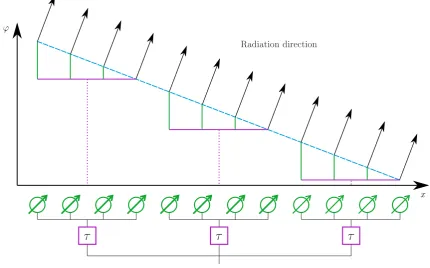
Figure 2.2 shows a simplified scheme of phase shift forming in a linear
antenna array composed of three subarrays with four elements in each. The
y axis measures the signal phase of each element. Linear phase distribution
through the array provides the forming of the main beam in the desired
direction.
x ϕ
τ τ τ
Radiation direction
Figure 2.2: Phase shift forming
Equation (2.7) supposes that beneath each element in the array there is
2.1. DEVELOPMENT OF A MATHEMATICAL MODEL OF ANTENNA ARRAY STRUCTURES BUILT OF POLYOMINO-SHAPED SUBARRAYS
Let the array of size M×N be completely filled with rectangular subarrays
of size M0 × N0 (figure 1.6a) with architecture according to figure 1.6b.
Subarray factor will be written as:
SAF(θ, φ) =
M0 X m=1 N0 X n=1
amne−jk[mdx(u−u0)+ndy(v−v0)]. (2.8)
Array factor will be expressed through subarrays as:
AF(θ, φ) = M/M
0
X
m0=1
N/N
0
X
n0=1
SAF(θ, φ)e−j2πf τm0n0, (2.9) where f — frequency, τ — time delay value from the time delay element,
that can be calculated for rectangular subarrays placed regularly:
τm0n0 =
1
c [cm + (m0 −1)M0dx] (u−u0) +
1
c [cn+ (n0 −1)N0dy] (v−v0),
(2.10)
where c — speed of light and cm and cn — subarray center coordinates
relatively to top left corner.
In case of polyomino-shaped subarrays the situation becomes more
com-plicated, because polyominoes and their centres are located not regularly.
Actually, for this they are used. However, they can also be described
math-ematically, meaning that we know all the orientations matrices and centre
coordinates for each of them. Subarray factor will be expressed as:
SAF(θ, φ) =
q−1
X
i=1
aie−jk[T
µ
i,2dx(u−u0)+Ti,µ1dy(v−v0)]. (2.11)
In the calculation of the factor of the entire array composed of
polyomino-shaped subarrays, it is also needed to know positions and orientations of
all the polyomino in the structure:
AF(θ, φ) =
N
X
i=1
where N — number of subarrays in the array. Delay τi can also be
calcu-lated from the subarray centre coordinates in the array [13]:
τi =
1
c [xidx] (u−u0) +
1
c [yidy] (v −v0), (2.13)
where xi and yi — coordinates of the centre of i-th subarray in the array.
Having all these equations one can compute the field of a phased antenna
array and measure the sidelobe level. At the same time there is no need to
put into equation (2.5) a field of a particular radiator: radiation pattern
of a radiating element itself is not optimized in this work, and so instead
of a real radiator we can use expression for the ideal isotropic radiator:
E1(r, θ, φ) =
e−jkr
4πr ~r(θ, φ), (2.14)
where r — distance to the measuring point, ~r — unit vector. In such
called far field r λ/2π, therefore (2.14) can be simplified significantly by
normalizing the amplitude to some value in the far field:
E1 = 1. (2.15)
So, a mathematical model of a structure of polyominoes, representing a
phased antenna array, was developed that describes and joins geometrical
and electrodynamic relations between the elements. The model takes into
account technical features of radiating structures. Radiation properties of
the structures are described by array factor.
2.2
Development of the optimization method based
on the structure irregularity estimation
In this work the optimization of phased antenna arrays acts as the
appli-cation area for the optimization methods and algorithms being developed.
2.2. DEVELOPMENT OF THE OPTIMIZATION METHOD BASED ON THE STRUCTURE IRREGULARITY ESTIMATION
focused on gain and sidelobe level. The gain is optimized by implication
by the increase of geometric fullness of the structure. But the sidelobe
level is not connected with evident dependence only to the geometric part
of the structure and requires experiments or numerical simulation for its
obtaining.
For obvious reasons it is impossible to run hardware experiments during
the optimization of an antenna array. There are software libraries for
numerical simulations of the sidelobe level. Depending on the sizes of the
array and accuracy the simulation may take from half a second up to several
minutes. This time multiplied by the number of iterations of the genetic
algorithm and population size grows to hours spent on one experiment.
In order to solve this problem a task was set to find another optimization
criterion that could replace the sidelobe level and be quicker to calculate.
In works of Mailloux [59, 61] it is stated that the sidelobe suppression
is proportional to the irregularity of the array structure tiled with
subar-rays. Therefore, we should search for a criterion that could estimate the
irregularity of a structure.
Two attempts were made to find such a criterion. The first one uses the
colour filtering method. This way did not show good results and so another
attemp was done based on calculation of the autocorrelation function of
the structure scanning. The second approach has shown good results and
was used in the examples provided in the fourth chapter. Further the two
methods are described in more details.
Irregularity of a structure tiled with polyominoes may mean that it does
not have patterns repeated with some spatial periodicity. At the same time
a pattern can be represented by a single polyomino as well as a group of
two, three or more. So, it is important to consider uniform distribution of
not only all eight orientations of the polyomino, but also groups of such
filtering. Its essense is in the following.
According to the RGB model, all the colours can be obtained by mixing
three basic colours: red, green and blue (figure 2.3). The basic colours are
orthogonal to each other: they cannot be obtained by mixing two other
colours.
Figure 2.3: RGB model: three basic and three secondary colours
If we mix each pair of basic colours in equal proportion we will get three
secondary colours:
red + green = yellow
red + blue = magenta
green + blue = cyan
In total we can use these six colours. We paint polyominoes in the
structure with these colours. Each colour is associated with one orientation.
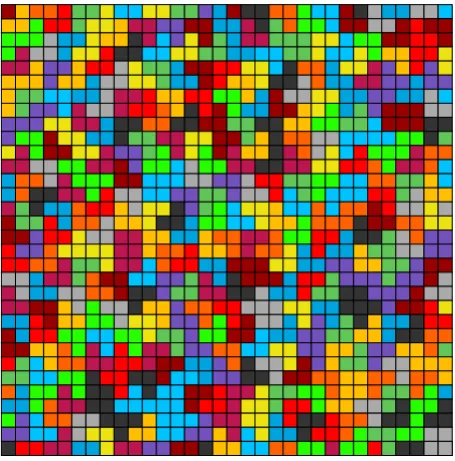
In figure 2.4 a structure is shown where all the polyominoes are painted in
their colours.
Now let us describe colour channels. Colour channels correspond to the
basic colours of the model. In RGB it is red, green and blue. They say a
colour is visible in a channel if the corresponding basic colour is used to
obtain it. Therefore, in the red channel among our six colours we will see
2.2. DEVELOPMENT OF THE OPTIMIZATION METHOD BASED ON THE STRUCTURE IRREGULARITY ESTIMATION
Figure 2.4: Example of a structure in which polyominoes are painted in colours according to orientations
while in blue channel — blue, cyan and magenta.
Now, if we “turn on” only one channel we will see only those
polyomi-noes in the structure that are painted in the corresponding visible colours.
Figure 2.5 shows the initial structure in each of three channels.
But we ought to remember that every polyomino in the structure has
eight orientations, while there are only six basic and secondary colours.
Black colour is used to designate invisible polyominoes and holes that are
invisible in any channel. White colour is useless because it is visible in all
channels.
It is impossible to find four orthogonal colours. But we can abstract our
mind from colours and transfer the same principle (mixing and elicitation)
to other objects. In this work the prime numbers have been chosen as such
objects. Four imaginary colours act as basic: C2, C3, C5 and C7. They
are orthogonal and they don’t divide by one another. Their multiplication
will represent mixing. Since the numbers are prime, every product will be
(a) (b)
(c)
Figure 2.5: Views of the structure in red (a), green (b) and blue (c) channels
are six secondary colours:
C2 +C3 = C6,
C2 +C5 = C10,
C2 +C7 = C14,
C3 +C5 = C15,
C3 +C7 = C21,
C5 +C7 = C35.
We will use only two basic colours (C2 and C3) and six secondary to
2.2. DEVELOPMENT OF THE OPTIMIZATION METHOD BASED ON THE STRUCTURE IRREGULARITY ESTIMATION
Then we need somehow to estimate the uniformity of visible elements
in the structure in each channel. For that we calculate the number of
visible elements in all the rows and columns and their standard deviation
(separately among rows and columns). The average value is set exactly to
the number of elements in a row/column per one channel. In channels C2
and C3 four colours are visible, while in channels C5 and C7 only three.
Therefore we divide the number of elements in a row/column by 3.5 to
obtain the average:
hU(C)i = N
3.5, (2.16)
hV(C)i = M
3.5, (2.17)
σp C = v u u t 1 M M X i=1
Vi(C)− hV(C)i2, (2.18)
σC− =
v u u t 1 N N X i=1
Ui(C)− hU(C)i2, (2.19)
where σp
C,σ
−
C — standard deviation of visible elements in a row and column
in channel C, Ui(C) and Vi(C) — number of visible elements in the i-th row or column in channel C, M and N — number of rows and columns in the
structure.
By this the information about the uniformity of the elements
distribu-tion for each colour channel is extracted. Then all the standard deviadistribu-tions
are summed up forming a numerical value of the irregularity of the
struc-ture R:
R = X
C σp Cσ − C . (2.20)
The optimization criterion in this case will be positive minimization
and columns in all the channels and, therefore, absence of repeated patterns
inside the structure.
Next we present several experiments to identify the dependence between
sidelobe level and calculated value of irregularity of structures.
2.2.1 Example values of irregularity by colour filtration method
Here two examples of structures of 32×32 elements are presented for which
irregularity values are calculated by the colour filtering method as well as
sidelobe levels. In the first example the structure is tiled with L-shaped
trominoes, in the second — L-shaped octominoes. These examples are
listed for understanding the range of values of irregularity. According to
the formulae, those values can be non-integer. In the first example it is
346.36 and in the second — 370.54. At the same time sidelobe level differ
2.2. DEVELOPMENT OF THE OPTIMIZATION METHOD BASED ON THE STRUCTURE IRREGULARITY ESTIMATION
Example 1: structure 32 × 32, L-tromino
Input parameters:
• structure size: M = N = 32;
• polyomino type: L-tromino.
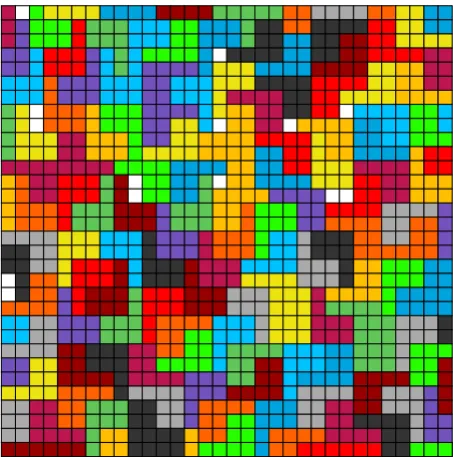
Figure 2.6 shows the structure, numerical results are given in table 2.1.
Figure 2.6: Array structure in the first example
Table 2.1: Output data of the first example
Parameter Value
Number of polyominoes 363
Fullness of the structure A, % 100
Irregularity R 346.36
Example 2: structure 32 × 32, L-octomino
Input parameters:
• structure size: M = N = 32;
• polyomino type: L-octomino.
Figure 2.7 shows the structure, numerical results are given in table 2.2.
Figure 2.7: Array structure in the second example
Table 2.2: Output data of the second example
Parameter Value
Number of polyominoes 144
Fullness of the structure A, % 98.63
Irregularity R 370.54
Sidelobe levelγ for r = 1.300, dB −19.97 Sidelobe levelγ for r = 1.818, dB −10.76
Below the analysis of the method is provided from the point of view of
2.2. DEVELOPMENT OF THE OPTIMIZATION METHOD BASED ON THE STRUCTURE IRREGULARITY ESTIMATION
2.2.2 Colour filtering method analysis
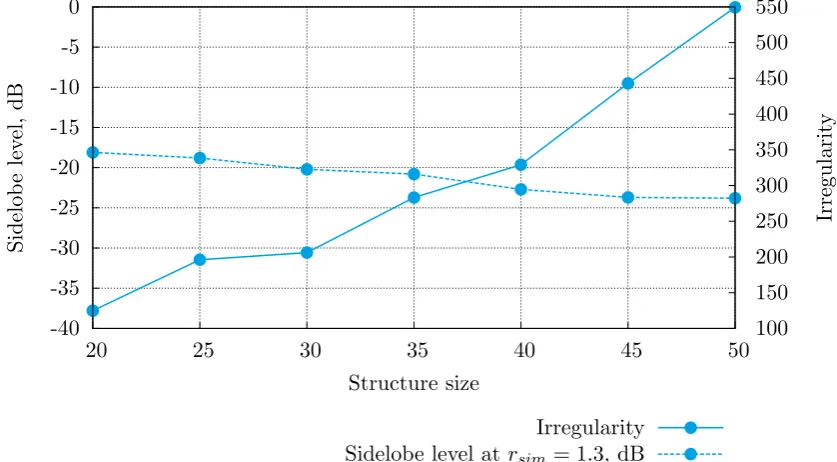
Figure 2.8 shows graphs of irregularity calculated by the colour filtering
method and sidelobe level obtained by simulation for bandwidthrsim = 1.3.
The experiments were run for structures of different sizes tiled with
L-tromino. Numerical data is presented in table 2.3.
-40 -35 -30 -25 -20 -15 -10 -5 0
20 25 30 35 40 45 50 100 150 200 250 300 350 400 450 500 550 Sidelob e lev el, dB Irregularit y Structure size Irregularity Sidelobe level at rsim = 1.3, dB
Figure 2.8: Irregularity and sidelobe level of st