www.ijaer.in Copyright © IJAER 2017, All right reserved Page 3113
EVALUATION AND SCREENING OF DURUM WHEAT GERMPLASM
TO STEM RUST RACES AT SEEDLING STAGE
Tesfaye Letta
Oromia agricultural research institute, Sinana agricultural research center, P. O. Box 208, Bale, Robe, Ethiopia
ABSTRACT
Wheat stem rust rapidly evolves a new virulence to resistance genes. Recently emerging races in East Africa, such as TTKSK (or Ug99), possess broad virulence to durum cultivars, and only a limited number of genes provide resistance. In attempts to identify and characterize stem rust resistance genes effective against four pgt races with broad virulence (TRTTF, TTTTF, TTKSK and JRCQC) at the seedling stage, a panel of durum wheat germplasm collected from major durum growing countries were evaluated.
In this study, 183 durum wheat germplasm were screened for seedling resistance to stem rust races under controlled condition with the aim of identifying source of resisnce to stem rust in the future breeding activity.The seedling stage infection types were scored based on standard scoring method. The germplasm showed diverse seedling resistance responses to the four races. Germplasm with high resistance to multiple races were identified. The current result of this study identified suitable parental lines for further improving stem rust resistance in durum wheat in Ethiopia where such races are prevalent.
Keywords: Durum wheat, stem rust, Ug99, races
INTRODUCTION
www.ijaer.in Copyright © IJAER 2017, All right reserved Page 3114
Durum wheat is a major staple food used for pasta, couscous, bread and more across the globe, especially in developing countries. It is especially important in developing countries where it often represents a large portion of total wheat planted as well as a major staple food. It is also attractive to farmers due to its adaptability to arid climate conditions, marginal soils and relatively low water requirements. Despite this broad adaptability, durum wheat production is often limited by various fungal diseases including rusts.
Durum production and kernel quality can be negatively affected by rust diseases (Singh et al., 2005). Historically, stem rust infections of Puccinia graminis Pers. f. sp. tritici, (Pgt) have caused severe losses to wheat production (McIntosh and Brown, 1997; Eversmeyer and Kramer, 2000; Singh et al., 2011). While >50 Sr loci have been identified in cultivated wheat and wild relatives, only a few of them remained effective against the newly emerged races in East Africa, including TTKSK = Ug99 (Pretorius et al., 2000) and its variants, and even fewer are effective against the durum-specific Ethiopian races (Admassu et al., 2009; Rouse et al., 2012). In Ethiopia, Ug99 was, in fact, added to previously existing races, several of them specifically virulent on durum wheat (Admassu and Fekadu, 2005; Haile et al., 2012). Two such races, typed as TRTTF and JRCQC, have a combined virulence on stem rust resistance genes Sr9e and Sr13
(Olivera et al., 2012). Virulence on Sr13 appears to be widespread in Ethiopia (Admassu et al., 2009). Very limited effective resistance (5.2%) to races TRTTF and JRCQC was found in a highly diverse collection of 996 tetraploid genotypes evaluated for field reaction at the Debre Zeit Research Center in Ethiopia (Olivera et al., 2012). Therefore, the combination of Ug99 with
Sr9e- and Sr13-virulent Ethiopian races represents a major threat to the viability of the Ethiopian durum wheat production. Achieving higher and more durable stem rust resistance requires the characterization of improved durum wheat germplasm or in exotic sources used for introgression in breeding. Only then can breeding programs develop strategies to preemptively counter the emerging new virulence types in the pathogen populations. Whereas field resistance is the ultimate goal sought in breeding programs, seedling tests are a good complement for resistance characterization, as they allow screening a large number of lines for reaction to multiple races, one race at a time, in relatively short periods and with modest space requirements. Seedling screening provides information for postulating the presence of designated loci based on the series of available races and/ or the presence of novel loci, avoiding the confounding effects of having several races acting at the same time, as is usually the case in field experiments.
www.ijaer.in Copyright © IJAER 2017, All right reserved Page 3115
The replacement of currently susceptible wheat varieties with more stem rust resistance varieties remains a high priority given the favorable climatic conditions in East African region for the infection and spread of stem rust. Urgent interventions in identifying good sources of resistance to stem rust will offer an indispensible relief. Hence, the objective of this study was to evaluate 183 durum wheat germplasms against four aggressive stem rust races of Pgt races TRTTF, TTTTF, TTKSK, and JRCQC at the seedling stage and to identify new sources of stem rust resistance for future durum wheat breeding program.
MATERIALS AND METHODS
Plant Materials
Host materials comprised of one-hundred-eighty-three cultivars from different durum wheat-growing regions of Mediterranean countries (Italy, Morocco, Spain, Syria, and Tunisia), the Southwestern United States, and Mexico (Appendix 1). A set of the standard North American stem rust differentials with known genes for resistance to stem rust was included in each inoculation with each isolate.
Pathogen Races and their virulence
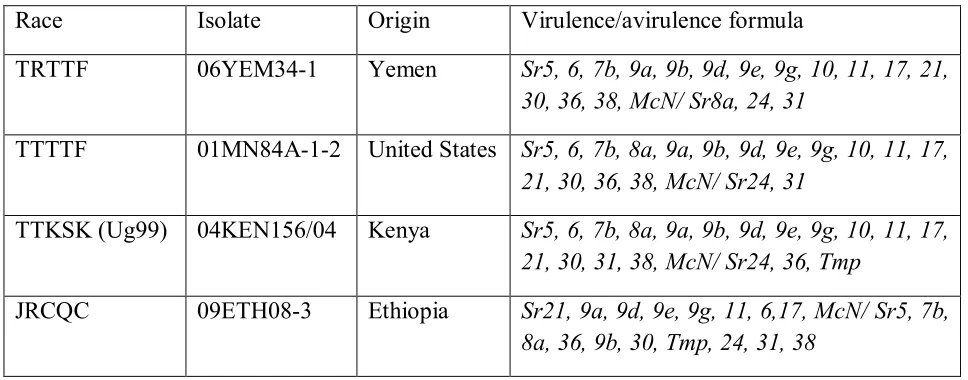
The durum wheat cultivars were tested against four Pgt races: TRTTF, TTTTF, TTKSK, and JRCQC with broad virulence and different geographic origin. The race designation is based on the letter code nomenclature system (Roelfs and Martens, 1988; Roelfs et al., 1993), modified to further delineate races in the TTKS lineage (Jin et al., 2008). These races were selected based on their differential virulence pattern and/or importance for durum wheat. Race TTKSK (Ug99) has a wide virulence spectrum and is rapidly evolving in East Africa. Race TTTTF is the most widely virulent race known in the United States, producing high infection types (ITs) on the majority of stem rust differential lines (Jin et al., 2007). Races TRTTF and JRCQC, both present in Ethiopia, possess a virulence combination that overcomes both the resistance genes Sr13 and
Sr9e, two genes present at high frequency in durum wheat (Klindworth et al., 2007). All isolates were derived from single pustules, increased in isolation, and stored at -80oC. Information about
www.ijaer.in Copyright © IJAER 2017, All right reserved Page 3116 Table 1. Origin and virulence properties of the Pucciniagraminisf.sp. tritici
races used to evaluate the durum varieties.
Race Isolate Origin Virulence/avirulence formula
TRTTF 06YEM34-1 Yemen Sr5, 6, 7b, 9a, 9b, 9d, 9e, 9g, 10, 11, 17, 21, 30, 36, 38, McN/ Sr8a, 24, 31
TTTTF 01MN84A-1-2 United States Sr5, 6, 7b, 8a, 9a, 9b, 9d, 9e, 9g, 10, 11, 17, 21, 30, 36, 38, McN/ Sr24, 31
TTKSK (Ug99) 04KEN156/04 Kenya Sr5, 6, 7b, 8a, 9a, 9b, 9d, 9e, 9g, 10, 11, 17, 21, 30, 31, 38, McN/ Sr24, 36, Tmp
JRCQC 09ETH08-3 Ethiopia Sr21, 9a, 9d, 9e, 9g, 11, 6,17, McN/ Sr5, 7b, 8a, 36, 9b, 30, Tmp, 24, 31, 38
Inoculation, Incubation, and Disease Assessment
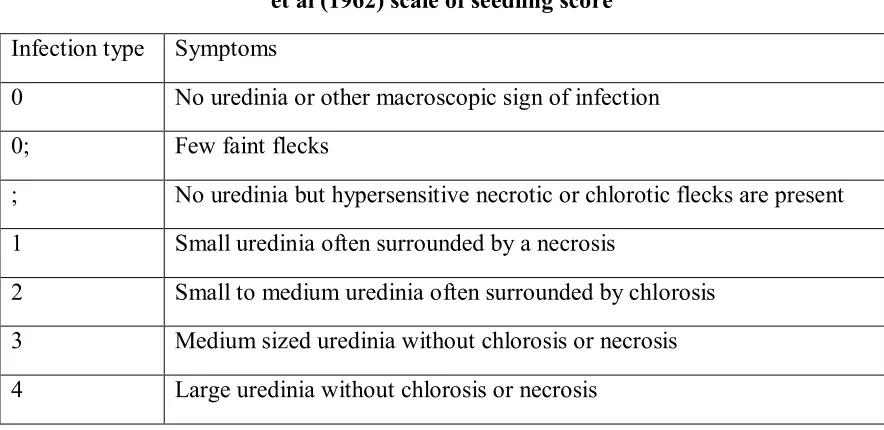
www.ijaer.in Copyright © IJAER 2017, All right reserved Page 3117 Table 2. Description of infection type and symptoms based on stakman
et al (1962) scale of seedling score
Infection type Symptoms
0 No uredinia or other macroscopic sign of infection
0; Few faint flecks
; No uredinia but hypersensitive necrotic or chlorotic flecks are present
1 Small uredinia often surrounded by a necrosis
2 Small to medium uredinia often surrounded by chlorosis
3 Medium sized uredinia without chlorosis or necrosis
4 Large uredinia without chlorosis or necrosis
RESULTS AND DISCUSSION
Seedling Evaluations
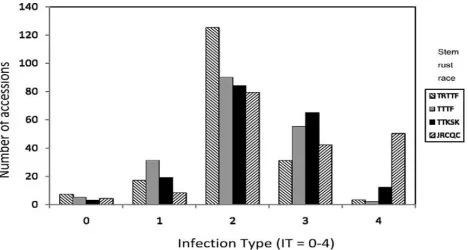
Seedling Infection Types (ITs) for each of the 183 durum germplasms is presented in Appendix 2. The result of seedling test indicates that there is successful inoculation as shown by the
susceptible infection types of the check cultivar ‘McNear with IT score of 33+. The 183 durum
www.ijaer.in Copyright © IJAER 2017, All right reserved Page 3118
× genotype interaction. The current results reveal that these durum wheat germplasm are rich source of stem rust resistance. Resistance to wheat stem rust at the seedling stage was reported in cultivated tetraploids by Olivera et al. (2011). Similar results was also reported by Beteselassie et al. (2007) in Ethiopian emmer wheat, as 18 of 41 accessions were resistant to a bulk of six local isolates of stem rust. Similarly, the predominance of infection types ranging from 2= to 2+ appears to be a common feature in cultivated tetraploid wheat and similar results were observed in wild emmer (Olivera et al 2012).
www.ijaer.in Copyright © IJAER 2017, All right reserved Page 3119 Table 3. Numbers and frequencies of infection types (IT) and resistant, susceptible and heterogeneousreactions of the 183 durum genotypes included in this study to four races of Puccinia graminis f. sp. tritici and the combined reaction to all races.
IT1 / Reaction TRTTF TTTTF TTKSK (Ug99) JRCQC All races
Lines % Lines % Lines % Lines % Lines %
“0” or “;” 10 5.5 3 1.6 2 1.1 4 2.2 0 0
“1” 1 0.5 10 5.5 1 0.5 5 2.7 0 0
“2” or “23” or “X” 138 75.4 104 56.8 103 56.3 78 42.6 66 36.1
Resistant Reaction 149 81.4 117 63.9 106 57.9 87 47.5 66 36.1
“3” 22 12.0 47 25.7 53 29.0 39 21.3 10 5.5
“4” 4 2.2 2 1.1 13 7.1 50 27.3 2 1.1
Susceptible Reaction 26 14.2 49 26.8 66 36.1 89 48.6 12 6.6
Heterogeneous2 8 4.4 17 9.3 11 6.0 7 3.8 1 0.5
1Infection types observed on seedlings at 14 days post-inoculation using a 0 to 4 scale according to Stakman et al. (1962), where
infection types of ; 1, 2, or X are considered as a low IT and ITs of 3 or higher are considered as a high IT
www.ijaer.in Copyright © IJAER 2017, All right reserved Page 3120 Breeding Perspectives and Conclusions
Identifying new sources of resistance to stem rust including Ug99 and other virulent races provides wheat breeders with an increased diversity of Sr genes to be combined in new cultivars. With proper planning and an accurate selection of Sr genes, long-term, broad-spectrum resistance can thus be attained. Attaining adult plant resistance is essential for the release of novel cultivars of durum wheat because stem rust susceptibility is not high until heading. Nonetheless, stem rust resistance at the seedling stage, while easy and fast to assay, may not be indicative of the reaction at the adult plant stage because some genes are effective only at specific growth stages. Combining the results of this study with those in adult plant resistance in the field at Debrezeit where races such as TTKSK, TRTTF and JRCQC are prevalent will provide valuable indications to select suitable parental lines for further improving stem rust resistance of durum wheat. Additionally, accessions carrying resistant genes against the four races should be tested against a collection of other different stem rust isolates in the greenhouse to determine whether they possess a broad-based resistance.
A better understanding of the genetic basis underlying the naturally occurring genetic diversity for stem rust response in durum wheat could help to accelerate the progress of enhancing stem rust resistance in this crop while shedding light on the evolution of the host–pathogen relationships. Along this line, the panel of durum wheat germplasm herein evaluated surveys the genetic variation present in elite germplasm pool commonly used by durum breeders, a feature that makes our results more readily transferable to breeding activities. The survey was performed based on a set of Pgt isolates belonging to four races chosen to represent the most virulent, diverse, and aggressive pathotypes challenging durum wheat worldwide, that is, the TTKSK (= Ug99) race now diffused throughout Central and Northeast Africa and Iran in Asia (Singh et al., 2006), The North American TTTTF race (Jin et al., 2008) and two recently described and highly virulent Ethiopian races (TRTTF and JRCQC) that overcame some of the few resistance genes effective against Ug99 (Olivera et al., 2012). These four races complement each other in terms of their virulence/avirulence formula, thus providing a nearly complete spectrum of virulence against known resistance loci (Pretorius et al., 2000; Rouse et al., 2012).
www.ijaer.in Copyright © IJAER 2017, All right reserved Page 3121
Stem rust is among the most destructive of wheat diseases and can cause heavy yield loss if uncontrolled. It is however possible to mitigate this yield loss through the use of fungicides, but this has a serious cost implication to a resource poor farmers. Consequently, the plant breeders have emphasized the use of genetic sources of resistance. Major gene resistance/seedling resistance can offer complete protection and significant economic benefits to farmers. Nevertheless, this kind of resistance is known to lack durability. Adult plant resistance (APR) is not complete and not limited to specific physiological races of the pathogen but unlike major gene resistance, it can be durable, hence a major concentration for wheat breeders and valuable to farmers. However, the APR genes can render the plant completely susceptible to the pathogen at seedling stage. Thus, if major genes/seedling resistances genes are identified and systematically employed through gene pyramiding (pyramiding 3-4 major genes using Marker assisted selection by the aid of diagnostic markers), they provide resistance to stem rust for adequate period of times.
In, this study provides novel information that can be exploited for pre-emptive breeding efforts to reduce the vulnerability of durum wheat to stem rust.
ACKNOWLEDGEMENTS
The financial contribution of the Beachell-Borlaug International Scholar Initiative to support Tesfaye L. Dugo is gratefully acknowledged.
REFERENCES
Admassu B, Fekadu E (2005) Physiologic races and virulence diversity of Puccinia graminis f. sp. tritici on wheat in Ethiopia. Phytopathol. Mediterr. 44: 313-318.
Admassu B, Lind V, Friedt W, Ordon F (2009) Virulence analysis of Puccinia graminis f. sp. tritici populations in Ethiopia with special consideration of Ug99. Plant Pathol. 58: 362-369.
Badebo A, Gelalcha S, Ammar K, Nachit M M, Abdalla O et al (2009) Durum wheat research in Ethiopia. In: Proceedings of the 2009 BGRI Technical Workshop, CIMMYT, Cd. Obregon, Sonora, Mexico, March 17-20, 2009. pp 28.
Beteselassie, N., C. Fininsa, and A. Badebo. 2007. Sources of resistance to stem rust (Puccinia graminis f. sp. tritici) in Ethiopian tetraploid wheat accessions. Genet. Resour. Crop Evol. 54:337–343. doi:10.1007/s10722-005-5561-6
www.ijaer.in Copyright © IJAER 2017, All right reserved Page 3122
Haile JK, Nachit MM, Hammer K, Badebo A, Roder MS et al (2012) QTL mapping of resistance to race Ug99 of Puccinia graminis f. sp. tritici in durum wheat (Triticum durum Desf.) Mol. Breed. 30: 1479-1493.
Jin Y, Singh RP, Ward RW, Wanyera R, Kinyua M, Njau P, Pretorius ZA et al (2007) Characterization of seedling infection types and adult plant infection responses of monogenic Sr gene lines to race TTKS of Puccinia graminis f. sp. tritici. Plant Dis. 91: 1096-1099.
Jin Y, Szabo LJ, Pretorius ZA, Singh RP, Ward R, Fetch T Jr et al (2008) Detection of virulence to resistance gene Sr24 within race TTKS of Puccinia graminis f. sp. tritici. Plant Dis. 92: 923-926.
Klindworth DL, Miller JD, Jin Y, Xu SS (2007) Chromosomal locations of genes for stem rust resistance in monogenic lines derived from tetraploid wheat accession ST464. Crop Sci. 47: 1441-1450.
McIntosh RA, Brown GN (1997) Anticipatory breeding for resistance to rust diseases in wheat. Annu. Rev. Phytol. 35: 311-326.
Olivera, P.D., Y. Jin, A. Badebo, S. Xu, and D. Klindworth. 2011. Resistance to race TTKSK of Puccinia graminis f. sp. tritici in tetraploid wheat. Phytopathology 101:S132.
Olivera PD, Jin Y, Rouse, Badebo A, Fetch T, Jr., Singh RP, and Yahyaoui AM et al (2012) Races of Puccinia graminis f. sp. tritici with combined virulence to Sr13 and Sr9e in a field stem rust screening nursery in Ethiopia. Plant Dis. 96: 623-628.
Pretorius ZA, Singh RP, Wagoire WW, Payne TS (2000) Detection of virulence to wheat stem rust resistance gene Sr31 in Puccinia graminis f. sp. tritici in Uganda. Plant Dis. 84: 203.
Roelfs AP, Martens JW (1988) An international system of nomenclature for Puccinia graminis f. sp. tritici. Phytopathol. 78: 526-533.
Roelf AP, Long DL, Robert JJ (1993) Races of Puccinia graminis in the United States during 1990. Plant Dis. 77: 125-128.
www.ijaer.in Copyright © IJAER 2017, All right reserved Page 3123
Singh RP, Huerta-Espino J, Fuentes G, Duveiller E, Gilchrist L, Henry M, Nicol MJ et al (2005) Resistance to diseases. In: Royo C, Nachit MM, Di Fonzo N, Araus JL, Pfeiffer WH, Slafer GA (eds) Durum wheat breeding: current approaches and future strategies. Food Product Press, Binghamton, pp 291-315.
Singh RP, Hodson DP, Jin Y, Huerta-Espino J, Kinyua MG, Wanyera R, Njau P, Ward RW et al (2006) Current status, likely migration and strategies to mitigate the threat to wheat production from race Ug99 (TTKS) of stem rust pathogen. In: CAB reviews: perspectives in agriculture, veterinary science, nutrition and natural resources. 1, No. 054.
Singh RP, Hadson DP, Huerta-Espino J, Jin Y, Bhavani S, Njau P, Herrera-Foessel S, Singh PK, Singh S, Govindan V et al (2011) The emergence of Ug99 races of the stem rust fungus is a threat to world wheat production. Ann. Rev. Phytopathol. 49: 465-481.
www.ijaer.in Copyright © IJAER 2017, All right reserved Page 3124 APPENDIXES
Appendix 1. Name and origin of durum wheat genotypes used in this study.
Genotype code Genotype name Origin
1. CANNIZZO ITALY
2. CLAUDIO ITALY
3. LESINA ITALY
4. MERIDIANO ITALY
5. MONGIBELLO ITALY
6. NORBA ITALY
7. PIETRAFITTA ITALY
8. TORREBIANCA ITALY
9. BISU_1/PATKA_3 CIMMYT
10. CMH82A.1062/3/GGOVZ394//SBA81/PLC/4/AAZ_1/CREX/5/HUI//CIT71/CII CIMMYT
11. DUKEM/3/RUFF/FGO//YAV79 CIMMYT
12. KULRENGI-BALIKCIL_8 CIMMYT
13. PLATA_16 CIMMYT
14. PORTO_5 CIMMYT
15. ROK/FGO//STIL/3/BISU_1 CIMMYT
16. ACUATICO/YAZI_1 CIMMYT
17. FOCHA_1/5*ALAS CIMMYT
18. BUSHEN_4/TARRO_2//BUSHEN_4 CIMMYT
19. GS/CRA//SBA81/3/HO/4/MEXI_1/5/MEMO/6/2*ALTAR 84 CIMMYT
20. RASCON_37/2*TARRO_2 CIMMYT
21. SRN_3/AJAIA_15//DUKEM_1/3/DION_2 CIMMYT
22. ALDEANO IRTA-SPAIN
23. ARIESOL IRTA-SPAIN
24. ARTENA IRTA-SPAIN
25. ASTIGI IRTA-SPAIN
26. BOABDIL IRTA-SPAIN
27. BOLENGA IRTA-SPAIN
28. BOLIDO IRTA-SPAIN
29. BOLO IRTA-SPAIN
30. BOMBASI IRTA-SPAIN
31. BORLI IRTA-SPAIN
32. CANYON IRTA-SPAIN
33. DURCAL IRTA-SPAIN
34. DUROI IRTA-SPAIN
35. GALLARETA IRTA-SPAIN
36. ILLORA IRTA-SPAIN
37. SENADUR IRTA-SPAIN
38. SULA IRTA-SPAIN
39. NASSIRA (MOROCCO_1805) INRA-MOROCCO
40. CHAOUI (MOROCCO_1807) INRA-MOROCCO
41. AMRIA (MOROCCO_1808) INRA-MOROCCO
42. MAROUANE (MOROCCO_1809) INRA-MOROCCO
43. JAWHAR INRA-MOROCCO
www.ijaer.in Copyright © IJAER 2017, All right reserved Page 3125
45. MARZAK INRA-MOROCCO
46. OURGH INRA-MOROCCO
47. TAREK INRA-MOROCCO
48. AWALBIT ICARDA
49. BCR/3/CHAM_1//GTA/STR ICARDA
50. CHHB88/DERAA ICARDA
51. CHACAN ICARDA
52. KARIM ICARDA
53. HML/CHHB88 ICARDA
54. KRS/HCN ICARDA
55. MURLAGOST-3 ICARDA
56. MOULSABIL_2 ICARDA
57. OMBAR ICARDA
58. MRB589_5 ICARDA
59. QUADALETE//ERP/MAL/3/UNKNOWN(VSGI,ODESSA) ICARDA
60. SEBAH ICARDA
61. STOJOCRI_3 ICARDA
62. ZEINA_1 ICARDA
63. ANTON ICARDA
64. APPIO ITALY
65. ARCANGELO ITALY
66. ARCOBALENO ITALY
67. BRAVADUR DESERT
68. BRONTE ITALY
69. CAPEITI 8 ITALY
70. CAPPELLI ITALY
71. CICCIO ITALY
72. COLORADO-DW DESERT
73. COLOSSEO ITALY
74. CORTEZ DESERT
75. CRESO ITALY
76. DON PEDRO ITALY
77. DUILIO ITALY
78. FLAMINIO ITALY
79. FORTORE ITALY
80. GARGANO ITALY
81. GRAZIA ITALY
82. IRIDE ITALY
83. ITALO ITALY
84. IXOS ITALY
85. KRONOS DESERT
86. MESSAPIA ITALY
87. MEXICALI 75 ITALY
88. MOHAWK ITALY
89. OFANTO ITALY
90. PLATANI ITALY
91. PLINIO ITALY
www.ijaer.in Copyright © IJAER 2017, All right reserved Page 3126
93. REVA ITALY
94. ROQUENO ITALY
95. SVEVO ITALY
96. TRINAKRIA ITALY
97. VALBELICE ITALY
98. VALNOVA ITALY
99. WESTBRED 881 DESERT
100. WESTBRED TURBO DESERT
101. AGHRASS_1 ICARDA
102. AINZEN_1 ICARDA
103. ANGRE ICARDA
104. AMEDAKUL-1 ICARDA
105. AMMAR-1 ICARDA
106. ARISLAHN-5 ICARDA
107. ATLAST-1 ICARDA
108. AUS1 ICARDA
109. AWALI_1 ICARDA
110. RADIOSO ITALY
111. AZEGHAR_2 ICARDA
112. BICRE ICARDA
113. BICREDERAA_1 ICARDA
114. BIGOST-1 ICARDA
115. BELIKH 2 ICARDA
116. BRACHOUA ICARDA
117. CHAHBA88 ICARDA
118. CHAM_1 ICARDA
119. DERAA ICARDA
120. GEROMTEL-1 ICARDA
121. GEZIRA-17 ICARDA
122. GIDARA_2 ICARDA
123. GUEROU_1 ICARDA
124. HAURANI ICARDA
125. HEIDER ICARDA
126. OSL_1/4/BUC/CHRC//PRL/3/PVN/5/HEL/3/YAV/CORM//SHWA ICARDA
127. SEBOU ICARDA
128. BLK2//134XS-69-186/368-1/3/MRB589_5/4/ALBT_3 ICARDA
129. ARIC31708.70/3/BO-DW//CDECH/BR-DW/4/CIT71/GTA ICARDA
130. JORDAN ICARDA
131. KABIR 1 ICARDA
132. KHABUR_1 ICARDA
133. KORIFLA ICARDA
134. LAGONIL-2 ICARDA
135. LAHN ICARDA
136. LOUKOS_1 ICARDA
137. MAAMOURI-1 ICARDA
138. MARSYR-1 ICARDA
139. MASSARA_1 ICARDA
www.ijaer.in Copyright © IJAER 2017, All right reserved Page 3127
141. MURLAGOST-1 ICARDA
142. NILE ICARDA
143. OMGENIL_3 ICARDA
144. OMLAHN-3 ICARDA
145. OMRUF-2 ICARDA
146. OMSNIMA-1 ICARDA
147. ORONTE 1 ICARDA
148. OTB-6 ICARDA
149. OUASERL_1 ICARDA
150. OUASLAHN-1 ICARDA
151. QUABRACH-1 ICARDA
152. QUADALETE ICARDA
153. RAZZAK INRAT
154. SAADA3/DDS//MTL-1 ICARDA
155. SAJUR ICARDA
156. SHABHA ICARDA
157. TELSET_5 ICARDA
158. TENSIFT_1 ICARDA
159. TERBOL 97_3 ICARDA
160. TUNSYR-1 ICARDA
161. WADALMEZ_1 ICARDA
162. YOUNES-1 ICARDA
163. YOUSEF_1 ICARDA
164. KOFA ITALY
165. 1A.1D 5+10-6/3*MOJO//RCOL CIMMYT
166. SOOTY_9/RASCON_37 CIMMYT
167. STOT//ALTAR 84/ALD CIMMYT
168. SOMAT_4/INTER_8 CIMMYT
169. CHEN_1/TEZ/3/GUIL//CIT71/CII/4/SORA/PLATA_12/5/STOT//ALTAR
84/ALD CIMMYT
170. MALMUK_1//LOTUS_5/F3LOCAL(SEL.ETHIO.135.85) CIMMYT
171. 1A.1D 5+10-6/2*WB881//1A.1D 5+10-6/3*MOJO/3/BISU_1/PATKA_3 CIMMYT
172. HESSIAN-F_2/3/STOT//ALTAR 84/ALD CIMMYT
173. AJAIA_12/F3LOCAL(SEL.ETHIO.135.85)//PLATA_13/3/SOMAT_3/4/SOOTY_
9/RASCON_37 CIMMYT
174. USDA595/3/D67.3/RABI//CRA/4/ALO/5/HUI/YAV_1/6/ARDENTE/7/HUI/YAV
79/8/POD_9 CIMMYT
175. CNDO/PRIMADUR//HAI-OU_17/3/SNITAN CIMMYT
176. GEDIZ/FGO//GTA/3/SRN_1/4/TOTUS/5/ENTE/MEXI_2//HUI/3/YAV_1/GEDIZ
/6/SOMBRA_20/7/STOT//ALTAR 84/ALD CIMMYT
177. VANRRIKSE_6.2//1A-1D 2+12-5/3*WB881 CIMMYT
178. RANCO//CIT71/CII/3/COMDK/4/TCHO//SHWA/MALD/3/CREX/5/SNITAN CIMMYT 179.
PLATA_10/6/MQUE/4/USDA573//QFN/AA_7/3/ALBA-D/5/AVO/HUI/7/PLATA_13/8/THKNEE_11/9/CHEN/ALTAR
84/3/HUI/POC//BUB/RUFO/4/FNFOOT CIMMYT
180. EUDO//CHEN_1/TEZ/3/TANTLO_1/4/PLATA_6/GREEN_17 CIMMYT
181. ROLA_5/3/AJAIA_12/F3LOCAL(SEL.ETHIO.135.85)//PLATA_13/4/MALMUK
_1/SERRATOR_1 CIMMYT
www.ijaer.in Copyright © IJAER 2017, All right reserved Page 3128
183. SOMAT_3/PHAX_1//TILO_1/LOTUS_4 CIMMYT
Appendix 2. Phenotypic response to four races (TRTTF, TTKSK, TTTTF and JRCQC) of the 183 durum germplasm included in the study.
Stem rust response
Genotype TRTTF TTKSK TTTTF JRCQC
1. 3- / 2- 2 / 3 2-; 1;
2. 22- 2 / 3 2- 2
3. 2 33+ 2-; / 33+ 1; / 3+
4. 2- 4 4 4
5. 3 2+/2+3- 2+ / 3- 2-
6. 2- ;2- 2- 3+ / 2-;
7. 33+ 3 2+ ;N
8. 33+ 33+ 3+ 4
9. 2- 2- 2- 2-
10. 2- 2 2- 4
11. 2 3+ 3+ 3+
12. 2- 2 2- 2-
13. 2-; 2 2-; 2
14. 2- 2 2- 2
15. 2- 2 2- 22+
16. 2- 2-; 2- 4
17. 2- 2 2- 2
18. 2- 22- 2- 2
19. 2-; 2 2- 2-
20. 2- 2- 2- 2-
21. ;N 2-; ;N 22+
22. 2- 2- 2- 0; / 3+
23. ; 2-; 2- 2-
24. 3+ 3 3+ / 2 4
25. 2- 3 33+ 4
26. 2- 4 3+ 0
27. ;N ; ;1- 2+
28. 2- 2- 2 2+
29. 2- 2 2-; 2-
30. 2- 2 2- 2-
31. 2- 2-; 2- 2-
32. 2- 2- 2- 3+1;N
33. 22- 3+ 3+ 3+
34. 2- 2- 22- 22+
35. 2- ;2- 2-; 2-
www.ijaer.in Copyright © IJAER 2017, All right reserved Page 3129
Stem rust response
Genotype TRTTF TTKSK TTTTF JRCQC
37. ;N 0; ;1 2+3-
38. 2- 2 / 2+ 2-; 2-
39. 2 3++ 3+ 4
40. 2 2- 22- 3
41. 2- ; 2- 2-
42. 33+ 3 3+ 3+
43. 2- / 22+ 2- 2- 2-
44. 2- 2- 2- 2-
45. 2+ 2- 2- 2
46. 2 2+3- / 3 3+ 3+
47. ;2-N 33+ 22- 3+
48. 2 3- 3 3+
49. 2- 3+ 2 / 3 3+
50. 2- 3 3 4
51. 22- 3- 2- 3+
52. 22- 3- 3+ 4
53. 2 / 3+ 2- / 3 2 / 3+ 2+ / 4
54. 2- 2- ;1- 2-
55. 0; / ;1 2+3- / 22- 2+3- 3+
56. 4 3 33+ 3+
57. 2 / 2-; 2- / 3+ ;2- / 3 2
58. 22+ 3+ 3 4
59. 2- 2- 2- 2-
60. 22- / ; 2- 2- 2+
61. 22- 2- 2 22+
62. 3 3 2- ;N
63. 3 3 2- 11+;
64. X 2+ 2+ 4
65. 3- 2+3- 3- 33+
66. 2- 22+ 2-; 2-
67. 2- 2-; 2- 3+
68. 2 3 33+ 4
69. 2+3 2+ 22+ 33+
70. 3- / 4 2+3 2+ 4
71. 33+ 3 33+ 4
www.ijaer.in Copyright © IJAER 2017, All right reserved Page 3132
Stem rust response
Genotype TRTTF TTKSK TTTTF JRCQC
144. 2- 4 33+ 4
145. 2- 2- 2-; 2-
146. 4 3+ 3+ 4
147. 2-; 2-; 2-; 2-
148. 2 / 3- 3+ 2- 2
149. 2- 2+ 3+ 3+
150. 2- 3 / 2 ;2- ;1 / 4
151. 2- 2- 2- 2
152. 3+3 X- 3 4
153. 22+ ;2- 2- 4
154. 2- / 3+ 2- 2- / 3 3+
155. 2- 2-; 2-; 2-
156. 3+3 3 3 3+
157. 2- 22+ 2- / 3 2-
158. 2- 2-; 2- 3+
159. 2- 2- 2- / 3- 2-
160. 2- 4 / 2- 2- 3+
161. 2- 2- 2- ;2-
162. 2- 33+ 3+ 4
163. 2- 3+ 3+ 4
164. 2- 2- ;2- 2-
165. ;N 33+ 3 3+
166. 2- 4 3 3+
167. 2- 2- 2-; 2
168. 2 4 3+ 4
169. 2- 2 2 2+
170. 2- 2- 2- 22+
171. 2- ;2= / 3 ;2- ;
172. 2- 2- 2-; 2-
173. 2- 2- 2- 4
174. 2- 2- 2 2
175. 2- 3 3+ 4
176. 2- 2- 2- 3
177. 2- 2 2- 2
178. 2- 3 3+ 4
179. 2- 2- 2-; 4
180. 2- 2- 2- 3+
181. 2-; 2 2- / 3 2
182. 2- 2 2+ 2+