Confirmatory Factor Analysis of the Competitive State Anxiety Inventory-2
Andrew M. Lane, David F. Sewell, Peter C. Terry, David Bartram, and Mark S. Nesti
REVISION
Revision Submitted: August 15th 1998
Abstract
The present study evaluated the factor structure of the Competitive State Anxiety Inventory-2 (CSAI-2: Martens, Vealey, Burton, Bump, and Smith, 1990) using confirmatory factor analysis. Volunteer participants (N = 1,213) completed the CSAI-2 approximately 1 hour before competition and data were analysed in two samples. The hypothesised model showed poor fit indices in both samples independently and simultaneously, suggesting that the factor structure proposed by Martens et al. is flawed. The present results question the use of the CSAI-2 as a valid measure of competitive state anxiety.
Anxiety is among the most frequently investigated variables in sport psychology (see Hardy, Jones, and Gould, 1996; Jones, 1995). It is usually conceptualised as a
multidimensional construct comprising cognitive and somatic components (Martens, Vealey, and Burton, 1990). Cognitive anxiety is typified by negative self-images and self-doubts, while somatic anxiety is typified by increased heart rate, tense muscles and clammy hands. The Competitive State Anxiety Inventory-2 (CSAI-2: Martens, Burton, Vealey, Bump, and Smith, 1990) has been the measure of choice for most researchers of competition anxiety during the past decade. The CSAI-2 also assesses self-confidence, which is characterised by positive expectations of success. The CSAI-2 has 27 items with nine items in each of three subscales: Cognitive Anxiety, Somatic Anxiety, and Self-confidence. Given the research interest in competitive state anxiety and self-confidence, and the extent to which tests of theory rely upon valid measurement, demonstration of the factorial validity of anxiety measures is an imperative. There are at least three arguments to suggest that it would be prudent to re-evaluate the factor structure of the CSAI-2.
scale (3:1 ratio). Moreover, exploratory factor analysis has been criticised for its inherently atheoretical nature (e.g., Thompson and Daniel, 1996) which tends to result in spurious factors especially when the participant to item ratio is low. Further methodological concerns include the re-analysis of responses from the same data set rather than cross-validating to new samples; the collection of anxiety data from some participants based on a hypothetical competition at Stages 1 and 2 (especially surprising given Martens et al.’s recommendation that one hour before competition is the optimum time to assess state anxiety); and the use of an exclusively undergraduate athletic sample, limiting the generalizability of the results to athletes from different educational backgrounds. Collectively, these methodological limitations suggest that cross-validation of the CSAI-2 to new samples is desirable.
A second reason for re-evaluating the factor structure of the CSAI-2 derives from the decision taken at Stage 5 of the original validation process to change the word “worried” to “concerned” in the Cognitive Anxiety scale to reduce the influence of social desirability. It appears possible that the semantic difference between these words may have threatened the conceptual integrity of the scale. Also at this stage, Martens et al. (1990) argued that low intercorrelations between the three anxiety subcomponents was sufficient evidence of factorial validity although no further factor analysis was conducted on the participant group of 266 athletes (see Martens et al., 1990, p. 139).
The third argument for re-evaluating the CSAI-2 is that recent developments of computer software to test the factor structures of psychological questionnaires have prompted researchers (see Bentler, 1992, 1995; Hendrick and Hendrick, 1985; Schutz and Gessaroli, 1993; Thompson and Daniel, 1996) to emphasise the benefits of structural equation
assessed using more stringent criteria. It would appear incumbent upon contemporary researchers involved in questionnaire development to use confirmatory procedures to
establish factorial validity. Therefore, the purpose of the present study was to re-examine the proposed 27-item, three-factor structure of the CSAI-2 using confirmatory factor analysis techniques.
Method Participants
A total of 1,213 volunteer participants (Age range = 15 to 39 yr., Male = 1,025, Female = 262) completed the CSAI-2. Participants were from a number of different sports including track and field, basketball, duathlon, hockey, jujitsu, karate, rugby, soccer,
swimming, 10 km running, tae-kwon-do, tennis, and triathlon. It is suggested that the uneven gender distribution of the participants is representative of the respective proportion of males and females competing in sport. Although previous research has demonstrated gender
differences in the intensity of anxiety responses (e.g., Martens et al., 1990), there has been no research to suggest that anxiety is conceptualized differently by males and females (Perry and Williams, 1998). Further, it is suggested that factorial validity is best demonstrated in large samples which represent the population to which findings are to be inferred (Tabachnick and Fidell, 1996).
Proposed Structure of the CSAI-2
standard (“I am concerned about performing poorly”, “I’m concerned I won’t be able to concentrate”, “I’m concerned about reaching my goal”, “I am concerned that I may not do as well as I could” and “I’m concerned about choking under pressure”), and one assesses general concerns about the competition (“I am concerned about this competition”). The remaining item assesses general doubts (“I have self-doubts”).
The nine items in the Somatic Anxiety scale include two that describe generalised somatic responses (“I feel nervous”, and “I feel jittery”), three that refer to muscular tension, (“My body feels tense”, “My body feels relaxed”, and “My body feels tight”), and four that describe somatic responses in specific parts of the body (“I feel tense in the stomach”, “My heart is racing”, “I feel my stomach sinking”, and “My hands are clammy”).
The nine items in the Self-confidence scale include five that describe positive expectations (“I feel self-confident”, “I am confident I can meet the challenge”, “I’m
confident about performing well”, “I’m confident because I mentally picture myself reaching my goal”, and “I’m confident about coming through under pressure”), and four that describe a generalised feeling of calmness (“I feel calm”, “I feel comfortable”, “I feel secure”, “I feel mentally relaxed”). All items are rated on a 4-point scale anchored by 1 (“Not at all”) and 4 (“Very much so”).
Procedure
The CSAI-2 was administered to participants approximately 1 hr. before competition. Prior to completing the questionnaires, the Martens et al. (1990) “antisocial desirability” statement was read aloud, using the response set “How are you feeling right now?” Data analyses
an hypothesised model is examined more rigorously by randomly dividing participants into two samples, conducting CFA on one sample and then cross-validating the results on the other sample (Bynner and Ronney, 1985). Hence, the sample was split randomly into two samples of equal size (Sample A, N = 606; Sample B, N = 607) through the EQS V5 package.
The model tested specified that items were related to their hypothesised factor, with the variance of the factor fixed at 1, and the three factors were correlated. As there was evidence of multivariate non-normality in the data, the model was tested using the Robust Maximum Likelihood method which has been found to effectively control for overestimation of X2, under-estimation of adjunct fit indexes, and under-identification of errors (see Hu and Bentler, 1995).
Following the recommendations of Hu and Bentler (1995), a number of fit indices were used to test the factor structure. First, the X2 statistic was considered. A good fitting model tends to produce a non-significant X2 value, although its value is inflated among large samples. Recent research has addressed the issue of how to interpret a significant X2 among large samples, with the ratio of X2 to degrees of freedom being proposed as a superior index. Byrne (1989) suggested that a ratio of two or lower indicates an acceptable fit.
(AGFI) which indicate the relative amount of the observed variances and covariances accounted for by the model. The criterion value associated with an acceptable model fit is .90 for all fit indices (Bentler, 1995).
Multisample CFA was used to test the strength of the factor solution across both samples simultaneously. In multisample analysis, it is assumed that data from more than one sample provide comparable information about the hypothesised model. This assumption is tested by analysing data from different samples simultaneously to verify whether the model reproduces the data of each sample to within sampling accuracy (see Bentler, 1992). As with one-sample CFA, X2 statistics and adjunct fit indexes represent the extent to which
variance/covariance matrices from different samples are identical. In multisample analysis, the Lagrange Multiplier (LM) test assesses the extent to which the fit of the model would be improved if equality constraints were removed. Cronbach (1951) alpha coefficients of internal consistency were also calculated for each factor. Tabachnick and Fidell (1996) suggested that Cronbach alpha coefficients for an internally consistent scale should be .70 or higher.
Results
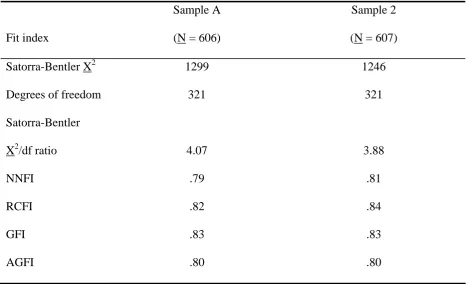
Results of the single-sample CFAs of the model proposed by Martens et al. (1990) are reported in Table 1. The ratio of X2 to degrees of freedom indicated a questionable fit
between the data and the model in both samples (Sample A = 4.07, Sample B = 3.88). More importantly, all fit indices were lower than the .90 criterion level (e.g., Sample A: RCFI = .82; Sample B: RCFI = .84) required of an acceptable fit (see Bentler, 1995).
and the parts of the model that were weak were consistent across both samples. The model tested the extent to which factor loadings were equal in both samples.
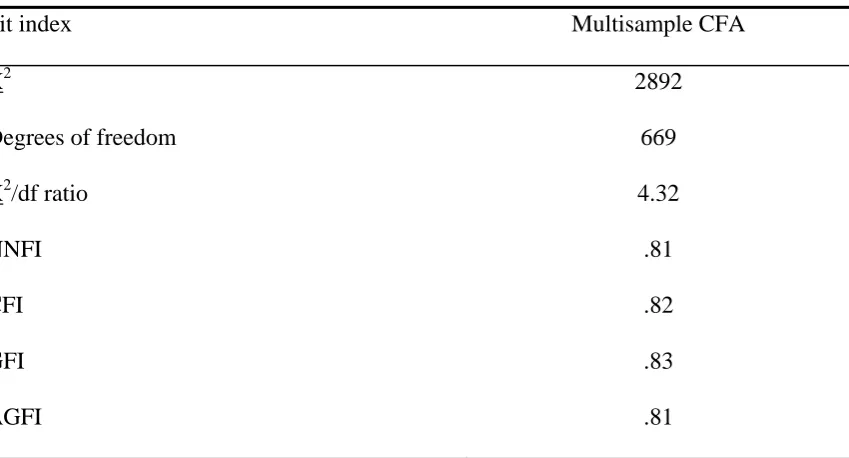
Multisample CFA results also indicated a poor overall fit (see Table 2). The
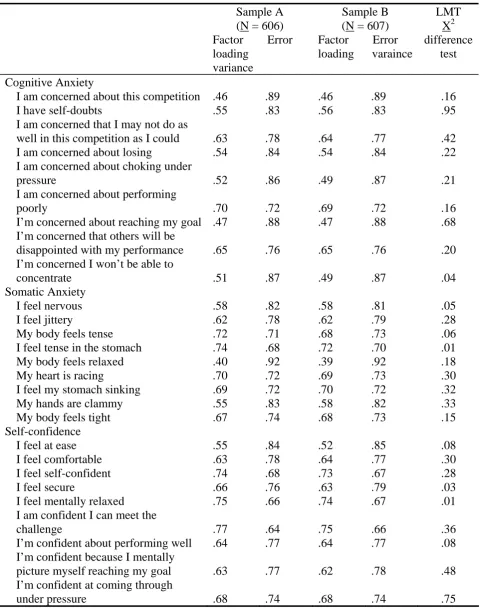
emphasis of multisample analysis is on the extent to which equality constraints placed on the factor loadings differ significantly between samples. Standardised correlation coefficients, error variances, and X2 difference test from the multisample LM test are contained in Table 3. Standardised factor coefficients indicated poor relationships between four items and their hypothesised factor (“I am concerned about this competition” and “My body feels relaxed”). These items demonstrated low factor loadings and high error variances in one or both
samples. The multisample LM test results indicated that none of the factor loadings differed significantly between the samples. Further, the multivariate multisample LM test indicated that differences in item-factor relationships were not significant. This casts substantial doubt upon the inclusion of these four items in the CSAI-2 as they do not contribute to their hypothesised factor.
Table 4 contains the intercorrelations among factors. The variance shared between Cognitive Anxiety and Somatic Anxiety scores was 43% for Sample A and 38% for Sample B. Self-confidence and Cognitive Anxiety shared 19% (Sample A) and 22% (Sample B) common variance; Self-confidence and Somatic Anxiety shared 26% (Sample A) 22% (Sample B) common variance. The strength and direction of these correlations are consistent with those reported by Martens et al. (1990).
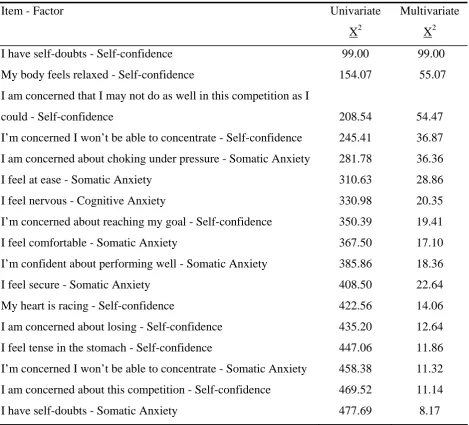
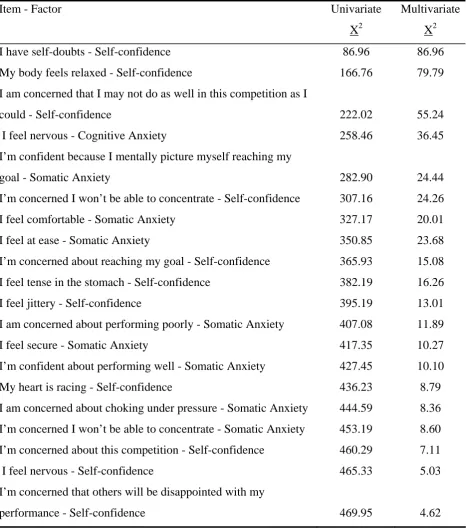
Sample B (see Table 6: X2 improvement = 469.95). Most notably, results indicated that three items (“I have self-doubts”: Sample A: X2 = 99.00, p < .001 and Sample B: X2 = 86.98, p < .001; “My body feels relaxed” - Sample A: X2 = 55.07, p < .001 and Sample B: X2 = 79.79, p < .001; and “I am concerned that I may not do as well in this competition as I could” -
Sample A: X2 = 54.67, p < .001 and Sample B: X2 = 55.24, p < .001) should cross-load into the Self-confidence scale.
Internal consistency coefficients for the three subscales were: Cognitive Anxiety, alpha = .80; Somatic Anxiety, alpha = .85; and Self-confidence, alpha = .88, all above the .70 criterion value. Although this provides support for the hypothesised model, the analysis was re-run including all 27-items producing an alpha coefficient of .70. This result could be construed as evidence to show that including all items in a single anxiety dimension produces an internally consistent factor. It also reinforces the LM test results which suggest that several items should load onto more than one factor to increase the fit of the model.
When examined collectively, the results provide strong evidence that the model proposed by Martens et al. produced an unacceptable level of fit to satisfactorily explain the observed variance within the data.
Discussion
Given the nature of cognitive anxiety, it is hypothesised that an item such as “I have self-doubts” should have shown the strongest relationship with the Cognitive Anxiety scale rather than the weakest. Therefore, at a theoretical level, it could be argued that the item “I have self-doubts” genuine assesses cognitive anxiety, while the other eight items in the scale which refer to feeling “concerned” assess a slightly different construct. Logically, an athlete who is about to compete in an important competition is likely to report feeling concerned about performance, and thereby produce a high score for cognitive anxiety, even though they may remain confident in their ability to meet the demands of the task. Being concerned about an impending performance does not necessarily mean that an athlete is experiencing negative thoughts, but that the athlete is acknowledging the importance and difficulty of the challenge and is attempting to mobilise resources in order to cope.
cognitive anxiety scale should be reworded to reflect the extent to which individual are “worried” about performance, as the notion of worry better captures the negative self-images proposed to be central to the cognitive anxiety construct. It is proposed that such a change reflects more than a semantic nuance and indeed lies at the heart of conceptual integrity.
Martens et al. (1990) originally used the word “worried” in some items in the Cognitive Anxiety scale but replaced it to “concern” in the final stage of the factorial
validation process to reduce social desirability. It is not unreasonable to assume that athletes would more readily acknowledge concern about a competition than worry, and perhaps report this as likely to facilitate good performance. However, the more “honest” responses may simply reflect the importance attached to the event by the individual rather than negative expectations. Therefore, the price of reduced social desirability bias may have been the conceptual integrity of the cognitive anxiety construct. Evidently, there is a need for further examination of this issue.
The place of a self-confidence scale in an anxiety inventory needs a strong theoretical rationale. Martens et al. (1990) found that the Self-confidence scale emerged out of
exploratory factor analysis techniques. The items in the scale had originally been included in the item pool to assess cognitive anxiety through positively-worded items. Recent research has questioned the reproducibility of the structure of the original self-confidence factor. Prapavessis, Cox, and Brookes (1996) replicated the techniques used by Martens et al. on a sample of 199 athletes from a variety of different sports1. Results indicated that Self-confidence divided into two factors; one comprising five items that describe positive
1
performance expectations (e.g., I am confident I can meet the challenge” and “I’m confident about performing well”), the other comprising four items that describe an absence of
cognitive anxiety (e.g., “I feel comfortable” and “I feel at ease”) and therefore seem to assess what could be described as a sense of calmness.
The doubts expressed about the psychometric integrity of the CSAI-2 are founded on analyses which were not available at the time of the development and validation of the measure. Confirmatory factor analysis is proposed to be a rigorous test of theory as data are tested against a hypothesised model. The CSAI-2 was developed using exploratory factor analysis which, it has been argued (Thompson and Daniel, 1996) lack a theoretical basis by virtue of its exploratory nature. Factors derived from exploratory techniques will a product of the items entered into the analysis and may be anomolous to the participants under investigation rather than generalizable constructs. Further, Mulaik (1987) argued that data can inform judgements, but the development of psychological measurements should be grounded in theory not data.
References
Bentler, P. M. (1992). EQS Structural equation program manual. Los Angeles; CA: BMDP Statistical software.
Bentler, P. M. (1995). EQS structural equation program manual. Los Angeles, CA: BMDP Statistical Software.
Bentler, P. M., & Wu, E. J. C. (1993). EQS/Windows user’s guide. Los Angeles, CA: BMDP Statistical Software.
Bynner, J. M., & Romney, D. M. (1985). LISREL for beginners. Canadian Psychology, 26, 43-49.
Byrne, B. M. (1989). A primer of Lisrel: Basic applications programming for Confirmatory Factor Analytic models. New York: Springer-Verlag.
Cronbach, L. J. (1951). Coefficient alpha and internal structure of tests. Psychometrika, 16, 297-334.
Hardy, L., Jones, J. G., Gould, D. (1996). Understanding psychological preparation for sport: Theory and practice of elite performers. Chichester: Wiley.
Hendrick, C., & Hendrick, S. (1986). A theory and method of love. Journal of Personality and Social Psychology, 50, 392-402.
Hu, L., & Bentler, P. M. (1995). Evaluating model fit. In Hoyle, R. H. (Ed.). Structural Equation Modelling: Concepts, issues, and applications. (Pp. 76-99). London: Sage. Jones, J. G. (1995). More than just a game: Research developments and issues in
competitive anxiety in sport. British Journal of Psychology, 85, 449-478.
Martens, R., Vealey, R. S., & Burton, D. (1990). Competitive anxiety in sport. Champaign, IL: Human Kinetics.
Vealey, & D. Burton (Eds.), Competitive anxiety in sport. (Pp. 117-178). Champaign, IL: Human Kinetics.
Mulaik, S. A. (1987). A brief history of the philosophical foundations of exploratory factor analysis. Multivariate Behavioural Research, 22, 267-305.
Perry, J. D., & Williams, J. M. (1998). Relationship of intensity and direction of competitive trait anxiety to skill level and gender in tennis. The Sport Psychologist, 12, 169-179. Prapavessis, H., Cox, H., & Brookes, L. (1996). A test of Martens, Vealey, and Burton’s
theory of competitive anxiety. Australian Journal of Science and Medicine in Sport, 28, 24-29.
Schutz, R. W., & Gessaroli, M. E. (1993). Use, misuse, and disuse of statistics in
psychology research. In R. N. Singer, M. Murphy, & L. K. Tennant (Eds), Handbook of Research in Sport Psychology. (pp. 901-921). McMillan, NY.
Tabachnick, B. G., & Fidell, L. S. (1996). Using multivariate statistics. New York: Harper & Row.
Thompson, B., & Daniel, L. G. (1996). Factor analytic evidence for the construct validity of scores: A historical overview and some guidelines. Educational and Psychological Measurement, 56, 197-208.
Tucker, L. R., & Lewis, C. (1973). A reliability coefficient for maximum likelihood factor analysis. Psychometrika, 38, 1-10.
Author Note
Andrew M. Lane and Peter C. Terry, Department of Sport Sciences, Brunel
Correspondence concerning this article should be addressed to Dr. A. M. Lane, Dept. of Sport Sciences, Brunel University, Osterley Campus, Borough Road, Isleworth,
Table 1
Confirmatory Factor Analysis of the Competitive State Anxiety Inventory-2
Fit index
Sample A (N = 606)
Sample 2 (N = 607) Satorra-Bentler X2
Degrees of freedom
1299 321
1246 321 Satorra-Bentler
X2/df ratio 4.07 3.88
NNFI .79 .81 RCFI .82 .84 GFI .83 .83 AGFI .80 .80
Table 2
Multisample Factor Analysis of the Competitive State Anxiety Inventory-2
Fit index Multisample CFA
X2
Degrees of freedom
2892 669
X2/df ratio 4.32
NNFI .81 CFI .82 GFI .83 AGFI .81
Table 3
Standardised Factor Loadings and Error Variances of Items Sample A
(N = 606) Factor Error loading variance
Sample B (N = 607) Factor Error loading varaince
LMT X2 difference
test
Cognitive Anxiety
I am concerned about this competition .46 .89 .46 .89 .16
I have self-doubts .55 .83 .56 .83 .95
I am concerned that I may not do as
well in this competition as I could .63 .78 .64 .77 .42
I am concerned about losing .54 .84 .54 .84 .22
I am concerned about choking under
pressure .52 .86 .49 .87 .21
I am concerned about performing
poorly .70 .72 .69 .72 .16
I’m concerned about reaching my goal .47 .88 .47 .88 .68 I’m concerned that others will be
disappointed with my performance .65 .76 .65 .76 .20 I’m concerned I won’t be able to
concentrate .51 .87 .49 .87 .04
Somatic Anxiety
I feel nervous .58 .82 .58 .81 .05
I feel jittery .62 .78 .62 .79 .28
My body feels tense .72 .71 .68 .73 .06
I feel tense in the stomach .74 .68 .72 .70 .01
My body feels relaxed .40 .92 .39 .92 .18
My heart is racing .70 .72 .69 .73 .30
I feel my stomach sinking .69 .72 .70 .72 .32
My hands are clammy .55 .83 .58 .82 .33
My body feels tight .67 .74 .68 .73 .15
Self-confidence
I feel at ease .55 .84 .52 .85 .08
I feel comfortable .63 .78 .64 .77 .30
I feel self-confident .74 .68 .73 .67 .28
I feel secure .66 .76 .63 .79 .03
I feel mentally relaxed .75 .66 .74 .67 .01
I am confident I can meet the
challenge .77 .64 .75 .66 .36
I’m confident about performing well .64 .77 .64 .77 .08 I’m confident because I mentally
picture myself reaching my goal .63 .77 .62 .78 .48
I’m confident at coming through
under pressure .68 .74 .68 .74 .75
Correlation Coefficients Among Competitive State Anxiety Inventory-2 Subscales
Somatic Anxiety Self-confidence
Cognitive Anxiety
Sample A .65* -.44*
Sample B .62* -.46*
Somatic Anxiety
Sample A -.51*
Sample B -.47*
Table 5
Lagrange Multiplier Test Scores for Adding Parameters in Sample A: Significant Predictors Only (P < .01)
Item - Factor Univariate
X2
Multivariate X2
I have self-doubts - Self-confidence 99.00 99.00
My body feels relaxed - Self-confidence 154.07 55.07
I am concerned that I may not do as well in this competition as I
could - Self-confidence 208.54 54.47
I’m concerned I won’t be able to concentrate - Self-confidence 245.41 36.87 I am concerned about choking under pressure - Somatic Anxiety 281.78 36.36
I feel at ease - Somatic Anxiety 310.63 28.86
I feel nervous - Cognitive Anxiety 330.98 20.35
I’m concerned about reaching my goal - Self-confidence 350.39 19.41
I feel comfortable - Somatic Anxiety 367.50 17.10
I’m confident about performing well - Somatic Anxiety 385.86 18.36
I feel secure - Somatic Anxiety 408.50 22.64
My heart is racing - Self-confidence 422.56 14.06
I am concerned about losing - Self-confidence 435.20 12.64 I feel tense in the stomach - Self-confidence 447.06 11.86 I’m concerned I won’t be able to concentrate - Somatic Anxiety 458.38 11.32 I am concerned about this competition - Self-confidence 469.52 11.14
Table 6
Lagrange Multiplier Test Scores for Adding Parameters in Sample B: Significant Predictors Only
Item - Factor Univariate
X2
Multivariate X2
I have self-doubts - Self-confidence 86.96 86.96
My body feels relaxed - Self-confidence 166.76 79.79
I am concerned that I may not do as well in this competition as I
could - Self-confidence 222.02 55.24
I feel nervous - Cognitive Anxiety 258.46 36.45
I’m confident because I mentally picture myself reaching my
goal - Somatic Anxiety 282.90 24.44
I’m concerned I won’t be able to concentrate - Self-confidence 307.16 24.26
I feel comfortable - Somatic Anxiety 327.17 20.01
I feel at ease - Somatic Anxiety 350.85 23.68
I’m concerned about reaching my goal - Self-confidence 365.93 15.08 I feel tense in the stomach - Self-confidence 382.19 16.26
I feel jittery - Self-confidence 395.19 13.01
I am concerned about performing poorly - Somatic Anxiety 407.08 11.89
I feel secure - Somatic Anxiety 417.35 10.27
I’m confident about performing well - Somatic Anxiety 427.45 10.10
My heart is racing - Self-confidence 436.23 8.79
I am concerned about choking under pressure - Somatic Anxiety 444.59 8.36 I’m concerned I won’t be able to concentrate - Somatic Anxiety 453.19 8.60 I’m concerned about this competition - Self-confidence 460.29 7.11
I feel nervous - Self-confidence 465.33 5.03
I’m concerned that others will be disappointed with my