Vol. 10, No.1, 2015, 123-128
ISSN: 2279-087X (P), 2279-0888(online) Published on 29 July 2015
www.researchmathsci.org
123
Annals of
The Total Dominating Graph
V.R.KulliDepartment of Mathematics, Gulbarga University, Gulbarga 585 106, India e-mail: [email protected]
Received 14 July 2015; accepted 28 July 2015
Abstract. Let G = (V, E) be a graph. Let S be the set of all minimal total dominating sets of G. The total dominating graph Dt(G) of G is the graph with the vertex set V∪S in which two vertices u and v are adjacent if u ∈ V and v is a minimal total dominating set of G containing u. In this paper, some properties of this new graph are obtained. Also characterizations are given for graphs (i) whose total dominating graphs are complete bipartite, (ii) whose total dominating graphs are Eulerian.
Keywords: dominating graph, minimal total dominating set, total dominating graph, Eulerian, Hamiltonian
AMS Mathematics Subject Classification (2010): 05C72
1. Introduction
All graphs considered here are finite, undirected without loops and multiple edges. Any undefined term in this paper may be found in [1, 2].
Let G = (V, E) be a graph. A set D of vertices in a graph G is called a dominating set of G if every vertex in V – D is adjacent to some vertex in D. The domination number γ(G) of G is the minimum cardinality of a dominating set in G. Recently several domination parameters are given in the books by Kulli in [2, 3, 4].
A set D of vertices in G is a total dominating set of G if every vertex of G is adjacent to some vertex in D. The total domination number γt(G) of G is the minimum cardinality of a total dominating set of G. A total dominating set D of G is minimal if for any vertex v ∈ D, D –{v} is not a total dominating set of G.
We note that any graph G without isolated vertices has a total dominating set. Thus we consider only graphs without isolated vertices.
The total minimal dominating graph Mt(G) of a graph G is the intersection graph defined on the family of all minimal total dominating sets of vertices of G. This concept was introduced by Kulli and Iyer in [5].
The common minimal total dominating graph CDt(G) of a graph G is the graph with same vertex set as G with two vertices in CDt(G) adjacent if there exists a minimal total dominating set in G containing them. This concept was introduced by Kulli in [6].
124
introduced by Kulli et al in [7]. Many other graph valued functions in domination theory were studied, for example, in [ 8, 9, 10, 11, 12, 13, 14, 15, 16, 17, 18, 19, 20, 21] and also graph valued functions in graph theory were studied, for example, in [22, 23, 24, 25, 26, 27, 28, 29, 30, 31, 32, 33, 34, 35, 36].
The following will be useful in the proof of our result.
Theorem A. [ 1, p.66] A nontrivial graph is bipartite if and only if all its cycles are even.
In section 2, we obtain some properties of total dominating graphs.
Traversability of some graph valued functions was studied, for example, in [37, 38, 39, 40]. In section 3, we study traversability of total dominating graphs.
The subdivision of an edge uv is obtained by removing an edge uv, adding a new vertex w and adding edges uw and wv. The subdivision graph S(G) of a graph G is the graph obtained from G by subdividing each edge of G.
2. Total dominating graphs
The definition of dominating graph of a graph inspired us to define the following graph valued function in domination theory.
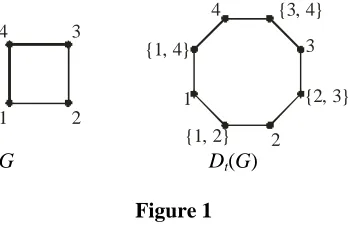
Definition 1. Let G = (V, E) be a graph. Let S be the set of all minimal total dominating
sets of G. The total dominating graph Dt(G) of G is the graph with the vertex set V ∪ S in which two vertices u and v are adjacent if u ∈ V and v is a minimal total dominating set of G containing u.
Example 2. In Figure 1, a graph G and its total dominating graph Dt(G) are shown.
4 3
1 2
4
3
1
2 {3, 4}
{2, 3} {1, 2}
{1, 4}
G Dt(G)
Figure 1
Proposition 3. If G has a vertex which does not lie in any minimal total dominating set,
then Dt(G) is disconnected.
Proof: Let u be a vertex of a graph G. If u does not lie in any minimal total dominating
set, then u is an isolated vertex in Dt(G). Hence Dt(G) is disconnected.
125
Proof: By definition, no two vertices corresponding to vertices of G in Dt(G) are adjacent and also no two vertices corresponding to minimal total dominating sets of G in Dt(G) are adjacent. Thus Dt(G) has no odd cycles. By Theorem A, Dt(G) is bipartite.
We characterize graphs whose total dominating graphs are complete bipartite.
Theorem 5. The total dominating graph Dt(G) of G is complete bipartite if and only if G = mK2, m ≥ 1.
Proof: Suppose Dt(G) is complete bipartite. Clearly V(Dt(G)) = V1 ∪ V2, where V1 is the
set of all vertices of G and V2 is the set of all minimal total dominating sets of G. We now prove that G = mK2, m ≥ 1. On the contrary, assume G ≠ mK2. Then there exists a component G1 in G which is not K2. Let v be a vertex of G1. Then v ∈ G. We consider the following two cases:
Case 1. Suppose v ∉ D, where D is any minimal total dominating set in G. Then the
corresponding vertex of v is an isolated vertex in Dt(G). It implies that the corresponding vertices of D and v are not adjacent in Dt(G). Thus Dt(G) is not complete bipartite, which is a contradiction.
Case 2. Suppose there exist two minimal total dominating sets D1 and D2 such that v ∈ D1 and v ∉ D2. Thus the corresponding vertices of v and D2 are not adjacent in Dt(G). Hence Dt(G) is not complete bipartite, which is a contradiction.
From Case 1 and Case 2, we conclude that every component of G is K2. Thus G = mK2, m ≥ 1.
Conversely, suppose G = mK2, m ≥ 1. Then there exists exactly one minimal total dominating set containing all vertices of G. Then |V(Dt(G) | = 2m +1. Thus by definition Dt(G) = K1, 2m and hence Dt(G) is complete bipartite.
We also prove the following result.
Theorem 6. Dt(G)= K1,2m if and only if G = mK2, m ≥ 1.
Proof: Suppose Dt(G) = K1, 2m, m ≥ 1. Then Dt(G) is complete bipartite. By Theorem 5, G
= mK2, m ≥ 1.
Conversely, suppose G = mK2, m ≥ 1. Then there exists exactly one minimal total dominating set containing all vertices of G. Thus by definition, Dt(G) = K1, 2m.
The double star Sm, n is the graph obtained from joining the centers of two stars K1, m and K1,n with an edge. The centers of K1,m and K1, n are called central vertices of Sm, n. Thus Sm, n has m+n+2 vertices.
Theorem 7. If Sm, n, 1 ≤ m ≤ n, is a double star, then
Dt(Sm,n) = (m+n) K1 ∪ K1,2.
Proof: Let Sm, n be a double star, 1≤m≤n and u and v be central vertices of Sm, n. Then Sm, n
has exactly one minimal total dominating set D containing the central vertices u and v of Sm, n. Then D = {u, v}. Thus the vertex set of Dt(Sm, n) in V∪D, where V is a vertex set of Sm, n, and hence Dt(Sm,n) has m+n+2+1 vertices. The corresponding vertices of D and u are adjacent and also the corresponding vertices of D and v are adjacent in Dt(Sm, n) and all other vertices of Dt(Sm, n) are isolated vertices. Thus Dt(Sm, n) is disconnected and
126
Theorem 8. Let G be a nontrivial connected graph. Let S(G) be the subdivision graph of
G. The graphs Dt(G) and S(G) are isomorphic if and only if every pair of vertices forms a minimal total dominating set of G.
Proof: Let G be a nontrivial connected graph. Suppose Dt(G) = S(G). Since G is connected, S(G) is connected. For each edge ei=uivi of G, wi is a new vertex such that uiwi and wivi are edges of S(G). Since Dt(G)= S(G), it implies that every pair of vertices ui,vi forms a minimal total dominating set of G.
Conversely, suppose every pair of vertices of G forms a minimal total dominating set of G. Then they are adjacent in G. Clearly for each minimal total dominating set D of G, the corresponding vertex of D in Dt(G) is adjacent with exactly two vertices and hence we see that Dt(G) = S(G).
Corollary 9. If G=Kp, p≥2 or Km, n, 1≤m≤n, then Dt(G) = S(G).
3. Traversabiltiy
We need the following result.
Theorem B. A connected graph G is Eulerian if and only if every vertex of G has even
degree.
We characterize total dominating graphs which are Eularian.
Theorem 10. Let G be a nontrivial connected graph. The total dominating graph Dt(G) of G is Eularian if and only if the following conditions hold:
i) every minimal total dominating set contains even number of vertices, ii) every vertex of G is in even number of minimal total dominating sets of G.
Proof: Suppose Dt(G) is Eulerian. On the contrary, if condition (i) is not satisfied, then there exists a minimal total dominating set containing odd number of vertices and hence Dt(G) has a vertex of odd degree. By Theorem B, Dt(G) is not Eulerian, a contradiction. Similarly we can prove (ii).
Conversely, suppose the given conditions are satisfied. Then the degree of each vertex in Dt(G) is even. Hence by Theorem B, Dt(G) is Eulerian.
Theorem 11. Let Γt(G) =2. If every vertex is in exactly two minimal total dominating
sets of G, then Dt(G) is Hamiltonian.
Proof: Clearly γt(G) = Γt(G) and Dt(G) is connected. Let v ∈ V and D be a minimal total
dominating set of G. Then degD(G) v = deg(D(G) D = 2. Hence Dt(G) is connected 2 - regular.
Thus Dt(G) is Hamiltonian.
REFERENCES
127
2. V.R.Kulli, Theory of Domination in Graphs, Vishwa International Publications, Gulbarga, India (2010).
3. V.R.Kulli, Advances in Domination Theory I, Vishwa International Publications, Gulbarga, India (2012).
4. V.R.Kulli, Advances in Domination Theory II, Vishwa International Publications, Gulbarga, India (2013).
5. V.R.Kulli and R.R.Iyer, The total minimal dominating graph. In Advances in Domination Theory I, V.R.Kulli., ed., Vishwa International Publications, Gulbarga, India, (2012) 121-126.
6. V.R.Kulli, The common minimal total dominating graph, Journal of Discrete Mathematical Sciences and Cryptography, 17(1) (2014) 49-54.
7. V.R.Kulli, B Janakiram and K.M. Niranjan, The dominating graph, Graph Theory Notes of New York, New York Academy of Sciences, 46 (2004) 5-8.
8. V.R.Kulli, The semientire dominating graph. In Advances in Domination Theory I, V.R.Kulli., ed., Vishwa International Publications, Gulbarga, India, (2012) 63-70. 10. V.R.Kulli, The entire dominating graph. In Advances in Domination Theory I,
V.R.Kulli., ed., Vishwa International Publications, Gulbarga, India, (2012) 71-78. 11. V.R.Kulli, The middle edge dominating graph, J Computer and Mathematical
Sciences, 4(5) (2013) 372-375.
12. V.R.Kulli, The semientire edge dominating graph, Ultra Scientist, 25(3)A (2013) 431-434.
13. V.R.Kulli, Entire edge dominating transformation graphs, International Journal of Advanced Research in Computer Science and Technology, 3(2) (2015) 104-106. 14. V.R.Kulli, Entire total dominating transformation graphs, International Research
Journal of Pure Algebra, 5(5) (2015) 50-53.
15. V.R.Kulli, On entire dominating transformation graphs and fuzzy transformation graphs, International Journal of Fuzzy Mathematical Achieve, 8(1) (2015).
16. V.R.Kulli and B Janakiram, The minimal dominating graph, Graph Theory Notes of New York, New York Academy of Sciences, 28 (1995) 12-15.
17. V.R.Kulli and B Janakiram, The common minimal dominating graph, Indian J.Pure Appl. Math, 27(2) (1996) 193-196.
18. V.R.Kulli, B Janakiram and K.M. Niranjan, The vertex minimal dominating graph, Acta Ciencia Indica, 28 (2002) 435-440.
19. B. Basavanagoud, V.R. Kulli and V.V.Teli, Equitable total minimal dominating graph, International Research Journal of Pure Algebra, 3(10) (2013) 307-310. 20. B.Basavanagoud, V.R.Kulli and V.V. Teli, Semientire equitable dominating graphs,
International Journal of Mathematical Combinatorics, Vol.3 (2014) 49-54.
21. B.Basavanagoud, V.R.Kulli and V.V.Teli, Equitable dominating graph, International J. of Math. Sci. and Engineering Applications, 9(2) (2015)109-114. 22. V.R.Kulli, On line block graphs, International Research Journal of Pure Algebra,
5(4) (2015) 40-44.
23. V.R.Kulli, The block-line forest of a graph, Journal of Computer and Mathematical Sciences, 6(4) (2015) 200-205.
128
25. V.R.Kulli, On full graphs, Journal of Computer and Mathematical Sciences, 6(5) (2015) 261-267.
26. V.R.Kulli, The semifull graph of a graph, Annals of Pure and Applied Mathematics, 10(1) (2015)99-104.
27. V.R.Kulli, On qlick transformation graphs, International Journal of Fuzzy Mathematical Archive, 8(1) (2015) 29-35.
28. V.R.Kulli, On semifull line graphs and semifull block graphs, Journal of Computer and Mathemetical Sciences, 6(7) (2015).
29. V.R.Kulli and M.S.Biradar, The middle blict graph of graph, submittted.
30. V.R. Kulli and N.S.Annigeri, The ctree and total ctree of a graph, Vijnana Ganga, 2 (1981) 10-24.
31. V.R.Kulli and B.Basavanagoud, On the quasivertex total graph of a graph, J. Karnatak University Sci., 42 (1998) 1-7.
32. V.R.Kulli and M.S. Biradar, The point block graph of a graph, Journal of Computer and Mathematical Sciences, 5(5) (2014) 476-481.
33. V.R.Kulli and M.S. Biradar, The line splitting graph of a graph, Acta Ciencia Indica, 28 (2001) 57-64.
34. V.R. Kulli and M.H. Muddebihal, Lict and litact graph of a graph, J. Analysis and Computation, 2 (2006) 33-43.
35. V.R.Kulli and M.H.Niranjan, The semi-splitting block graph of a graph, Journal of Scientific Research, 2(3) (2010) 485-488.
36. V.R.Kulli and N.S. Warad, On the total closed neighbourhood graph of a graph, J. Discrete Mathematical Sciences and Cryptography, 4 (2001)109-114.
37. V.R.Kulli and D.G.Akka, Traversability and planarity of total block graphs, J Mathematical and Physical Sciences, 11 (1977) 365-375.
38. V.R.Kulli and D.G.Akka, Traversability and planarity of semitotal block graphs, J Math. and Phy. Sci., 12 (1978) 177-178.
39. B.Basavanagoud and V.R.Kulli, Traversability and planarity of quasi-total graphs, Bull. Cal. Math. Soc., 94(1) (2002) 1-6.